Hill End community not satisfied with MP John Cobb’s attitude to nuclear waste dump proposal
MP’s apology fails to pacify residents, Western Advocate By LOUISE EDDY Dec. 11, 2015 When members of the Hill End community gathered in the Royal Hall on Wednesday morning they wanted only one thing – for Member for Calare John Cobb to ask what he could do to help.
This was the third meeting the community has held to discuss Sallys Flat being short-listed for a national nuclear waste dump, and the first the federal member has been able to attend.
Community spokesperson Robyn Rayner said around 100 people attended the meeting, many of them new faces. Mr Cobb had earlier drawn the community’s anger when he dismissed their concerns about the safety of the proposed facility.

Ms Rayner said Mr Cobb apologised to the meeting for the way the matter had been handled, and for not being in contact with the community prior to Wednesday’s meeting.
“We appreciate the fact that he did turn up, but he treated us with utter contempt,” she said. “At no time did he say ‘What can I do to help you’,” she said…….
Yesterday Mr Cobb said he would help by conveying to the minister the fact that the community don’t want the waste dump.
However, despite assurances Sallys Flat won’t be further shortlisted if the community opposes the nuclear waste dump, Mr Cobb said the matter cannot end here and now. “They do want to finish this now, but the minister has set that consultation period because those who do want to consult privately with the minister should have that right,” Mr Cobb said. He said it was a good meeting.
“But I think people had made their minds up they didn’t want it,” he said.
“There are some communities in Australia who will think – here’s an opportunity. You are not often offered the chance to get $10 million. But it’s their choice. I don’t live there,” he said. Mr Cobb said he would be visiting the Lucas Heights reactor shortly to take a look.“It’s 14 years since I’ve been there. I’m sure there is no danger but I want to go back and reassure myself,” he said.
Ms Rayner said there were concerns Mr Cobb was not taking the matter seriously enough. http://www.westernadvocate.com.au/story/3552229/mps-apology-fails-to-pacify-residents/?cs=115#disqus_thread
Wangan and Jagalingou traditional owners continue to fight $16.5 billion Carmichael coal mine
 Vow to fight mine ‘Wangan and Jagalingou (W&J) traditional owners were blindsided last week..’
http://www.cpa.org.au/guardian/2015/1714/05-vow-to-fight.html 9 Dec 15:
“Wangan and Jagalingou (W&J) traditional owners were blindsided last week by revelations that Queensland Coordinator-General Barry Broe was proposing to extinguish native title on parts of their traditional lands in the Galilee Basin in order to enable Indian company Adani to develop infrastructure for its $16.5 billion Carmichael coal mine. …
“It is beyond comprehension that the government would consider such a shameful and absurd proposal in an era when our rights are sanctioned under international law and when we are already in the Federal Court contesting the state government and Adani’s attempts to override our rights,”
[Adrian] Burragubba said. “I assure the Premier she will be bringing on one of the biggest human rights battles we’ve seen in Queensland in a long time. … ” … “
Julie Bishop signs Paris Declaration for clear rules for carbon trading
What a tortuous track Julie Bishop, Greg Hunt and co. have to navigate, as they weave about within the Turnbull government’s climate policies – which are exactly the same as Tony Abbott’s !
 How long before the Turnbull government trips itself up in its own convoluted
rhetoric?
How long before Australia’s voters wake up to them?
Australia signs up for clear carbon trading rules, hinting at policy change, Guardian, Lenore Taylor in Paris, 10 Dec 15
Signing declaration at the Paris climate talks ‘recognises the role a carbon market might play after 2020’, foreign minister Julie Bishop says. Australia has signed a Paris declaration calling for new clear rules for international carbon trading in a signal the Coalition’s six-year carbon pricing policy veto could be softening as it prepares to review its climate policy in 2017.
Foreign minister Julie Bishop, who signed the declaration in Paris, said it was in Australia’s interests to recognise the role an international carbon market might play in reducing emissions after 2020.
“It’s just a declaration, it’s not legally binding,” she said after a speech to an event organised by Australia’s Carbon Market Institute. Continue reading
Australia not welcomed into “high ambition coalition” climate action group
 Aust missing from climate change group, Herald Sun, 12 Dec 15 Australia has not yet been welcomed into a new “high ambition coalition” of 100 nations at major climate talks in Paris, despite claiming it had joined through the European Union.
Marshall Islands Foreign Minister Tony de Brum revealed the alliance of around 100 countries, including the United States, this week at the United Nations summit.
Australia was not among them and Foreign Minister Julie Bishop seemed unaware of the group when it was revealed on Wednesday.
Mr de Brum, who spearheaded the alliance, issued an open invitation to countries in Paris.
A spokeswoman for Ms Bishop on Friday confirmed Australia had been formally invited by the European Union and had accepted the invitation. However, it appears Australia hasn’t yet been welcomed into the group, the Marshall Islands hinting the country would have to prove its worth.
“We are delighted to learn of Australia’s interest and look forward to hearing what more they may be able to do to join our coalition of high ambition here in Paris,” a spokesman for Mr de Brum said.
Earlier on Friday Mr de Brum read out a list of countries that had accepted his open invitation, with Australia notably absent.
WHAT THEY WANT *Reference to limiting global warming to 1.5C (is in the text)
*Clear path towards a low-carbon future (emissions neutrality by second half of century in text)
*Five yearly updates (is in the text)
*Strong package of financial support for developing nations ($100 billion per year plus scale up after 2020 is an option in the text – could be removed) http://www.heraldsun.com.au/news/breaking-news/aust-not-yet-welcome-in-climate-alliance/news-story/f7812eb6755851c7cc8ecd71ae9ca55f
How much is the #NuclearCommissionSAust farce costing the taxpayer?
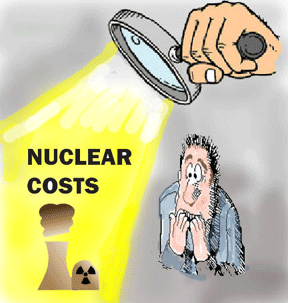 How much has the South Australian tax-payer already spent on the Nuclear Fuel Chain Royal Commission? The public should be informed – how much are they paying Kevin Scarce and his overwhelmingly pro nuclear merry men for all their ‘hearings’ and ‘information sessions’ and junkets to rural Australa, and to Japan, France, Canada, South Korea etc?
Blind Freddy could tell that the purpose is now, and always has been , to set up an international nuclear waste importing business – aimed at enriching a very few South Australians – and bugger the costs to the State’s children their children their chilred and beyond.
A whole heap of blah has gone on about nuclear power stations – which, everybody knows, is not an option, due to their astronomic expense. Then Kevin Scarce presumably will look good when he rules that one out, and just goes for the waste dump.
Anyway, it’s about time we all knew how much this whole sorry farce is costing.
ABC News reported thuis week that an extra $3 million will be pumped into the Nuclear Fuel Chain Royal Commission
Film “Containment” timely, as #NuclearCommissionSAust blocks environmental and Aboriginal voices

It would certainly be beyond their comprehension that any community, any government, would actually volunteer to take other countries’ nuclear waste, which remains radioactive for thousands of years. Yet in Australia, this is what nuclear proponents, the SA premier, and now the prime minister are backing.
South Australia’s Royal Commission has refused Australian environmental movement experts ACF and Friends of the Earth permission to appear. On 8 December Rose Lester, a second-generation Yankunyjatjara nuclear survivor, found her own plea blocked by Commissioner Scarce.
Fears and fictions in SA’s nuclear waste tussle, Eureka Street, Michele Madigan | 10 December 2015 The long anticipated arrival of reprocessed nuclear fuel rods in the first week of December has thrown the spotlight again on Australia’s nuclear industry. Greenpeace’s highlighting of the deficiencies of transport gives little hope that government plans will fit with the usual assurances of ‘world’s best practice’ in this, the world’s most dangerous industry…….
At a screening last month of his film Containment, Harvard Professor Robb Moss agreed with me regarding the ‘providence’ of its timely showing to Australian audiences. Five years in the making, Containment shows, among other sequences, how the US is attempting to tackle the massive problem of dealing with their own high level radioactive waste.
It includes interviews with government officials and regulator personnel amid their attempts to contain the radioactivity for the expected 10,000 years — a time frame that will embrace ‘people who will not share our language, our nation and even our civilisation’. It’s unsurprising that the oft repeated phrase from those from the nuclear industry was that ‘the hardest thing is to get the community onside’. Continue reading
#NuclearCommissionSA moves on to phase about overturning Australia’s federal law on waste dumping
 Scarce to meet pro-nuke chief scientist as conclusions emerge. IN
  Daily, Tom Richardson 10 Dec 15 “…….Nuclear royal commissioner Kevin Scarce has indicated that some of his inquiry’s terms of reference may not be viable, as the commission prepares to wrap up its major phase of evidence-gathering.
Scarce will next week meet Australia’s new chief scientist Dr Alan Finkel, a nuclear power advocate.
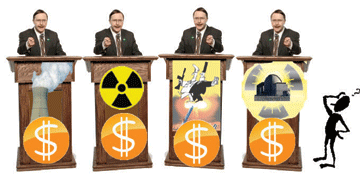
“He’s got considerable experience in the industry, (so) we’re going across to talk with him about nuclear issues from a national perspective,” Scarce said.
“I think it’s important that we’re starting to see a national debate of the issue … because there’s federal legislation that needs to be changed as well as state legislation, were we to proceed.”
South Australia Nuclear Fuel Chain Royal Commission quietly spinning to rural SA
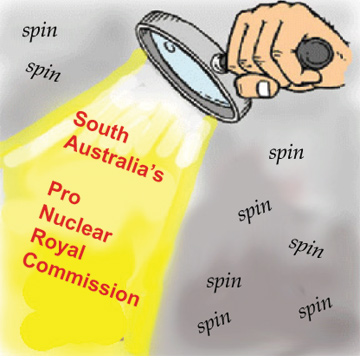 It’s hard to keep up with developments in the South Australian Nuclear Fuel Chain Royal Commission.
On the one hand, as Kevin Scarce has recently revealed, the first move for the nuclear lobby is to get rid of Australia’s national legislation against setting up a nuclear waste dump. (There is special legislation allowing only the Lucas Height reprocessed nuclear wastes to be deposited)
On the other hand, the Royal Commission is keeping a very low profile, nationally.
Do they think that rural South Australia is stupid? Quietly quietly, the Royal Commission is doing its propaganda bit in rural centres – at Port Pirie Yacht club (3/12), at Port Lincoln and Whyalla this week.
Former Santos CEO warns on the diseconomics of nuclear operations in Australia
 x-Santos CEO says megaprojects tough in Aust and nuclear needs upfront revenue December 10, 2015, SMH, Simon Evans An Australian nuclear industry would have to overcome very high construction costs and would only be built if there is certainty beforehand that it can generate secure revenue over a long period, former Santos chief executive David Knox said.
Mr Knox said that assuming the construction costs of overseas megaprojects can be directly translated to be similar in Australia is fraught with danger. That’s because the logistics, large distances, higher labour costs and finding the right skilled workers makes it more challenging.
“This can be a trap, of course,” Mr Knox told South Australia’s royal commission into the nuclear industry on Thursday.
“The whole logistics exercise of doing a megaproject in Australia does make it more challenging.”
He said the large geographic distances from specialist manufacturers of equipment offshore, the need to import certain levels of specialist expertise and skills, and the higher costs of labour are influencing factors. He gave the example of an Australian worker costing an overall $100 an hour, compared with $50 an hour for a Gulf of Mexico project in the northern hemisphere.
He emphasised that Santos had no wish to enter the nuclear industry, but he was giving evidence on the broad issue of building large infrastructure projects and the potential pitfalls……
A nuclear project would need to demonstrate at the start that it could generate revenue for a long time, similar to the LNG contracts that Santos had signed, which lasted for 20 years……..
The head of the nuclear royal commission, Kevin Scarce, is due to hand down preliminary findings in February, ahead of a final report in May 2016, on whether South Australia should expand into nuclear waste storage, enrichment and power generation……. http://www.smh.com.au/business/exsantos-ceo-says-megaprojects-tough-in-aust-and-nuclear-needs-upfront-revenue-20151209-gljwl0.html#ixzz3twyrGFxv
‘High ambition coalition” on climate change – but Australia won’t be joining
 Australia unlikely to join climate coalition, Sky News, 11 December 2015 Canada has joined a new coalition of 100 countries calling for an ambitious agreement at major climate talks in Sky News alia is unlikely to add its name to the list.
Some predict the new ‘high ambition coalition’ could be a significant force in the negotiations, with a majority of nations – from the richest to the poorest – involved.
Australia, while supporting its intention, hasn’t joined.
The 100 countries, including the United States, are demanding a reference to limiting global warming to 1.5C, five-yearly reviews and a pathway to low carbon.
It also wants adequate financing for poor countries.
Marshall Islands Foreign Minister Tony de Brum urged more countries to join while revealing the coalition on Wednesday night.
Canada’s environment and climate change minister Catherine McKenna took up that offer the following day, despite not initially being on the list.
Australia is understood to agree with the group’s goals but wants to focus its energy elsewhere…….http://www.skynews.com.au/news/top-stories/2015/12/11/-difficulties–in-climate-talks–hollande.html
Deliberate downplaying of the seriousness of Oman Ama nuclear waste proposal
 Oman Ama nuclear waste proposal being ‘downplayed’, Warwick Daily News, Annette Clement, Oman Ama | 8th Dec 2015 The role of the proposed waste facility was played down at the first information meeting in Inglewood.
We are not children to be lulled into compliance by a ‘glossy’ film and soothing narrative.
The facts are that this facility, as well as containing the medical waste mostly mentioned, is being built to house all nuclear waste including intermediate level waste produced by Australia in the past and for the next 100 years (not just ANSTO’s medical waste), the containers of processed spent fuel rods and other waste (en route from France and United Kingdom) will be ‘temporarily’ stored in a secure shed for an indeterminate period.
This waste should be buried 400-1000 metres deep.
It appears that the significance of this is being deliberately downplayed and my trust has been shaken in the intentions to be completely open with the plans for, the facts about and the future use of the proposed facility, Mr Wilson said during question time ‘the eventual use of the facility is as yet unknown’.
Some points for you to consider.
Tourists …
Land devaluation … this area is known for its lack of harmful or potentially harmful industry that’s why a lot of people live and work or farm here. It’s their life.
Income loss … this area is rich in production from the land, some producers would be adversely affected by lowered consumer confidence in their products, possible devaluation of their land which could mean their banks will be less likely to back them when they most need it….
Security hazard ... regardless of the ‘little reward for a lot of effort’ reassurance we get concerning the waste facility ever becoming a target the possibility should not be brushed aside, our once relatively isolated and trouble free country has seen incidents recently which clearly demonstrate we are not immune to radical behaviour.
Ecologic concerns … although I am satisfied that the waste facility will endeavour to keep all nuclear waste in proper containment the risks for this area are still too great.
We are subject to major flooding, and large fluctuations in the water table.
In the great scheme of all things our lives are just a fleeting moment, therefore it’s not so much what we do now but what we leave for all future generations. That is our true legacy. http://www.warwickdailynews.com.au/news/nuclear-being-downplayed/2865565/
Western Australia systematically eroding Aboriginal heritage rights
 Separate but unequal: the sad fate of Aboriginal heritage in Western
  Australia The Conversation, Tod Jones Senior Lecturer, Human Geography, Curtin University December 7, 2015 There is systemic discrimination against Aboriginal heritage in Western Australia. This does not come from a racist administrator somewhere who hates Aboriginal heritage, but from the evolution of the institutions, rules and conventions that make up cultural heritage management.
Let me explain why.
Western Australia manages the heritage sites of Aboriginal and non-Aboriginal sites through different institutional channels, under different laws. This system is now providing much higher levels of protection for non-Aboriginal heritage.
There are several obvious imbalances. Should the Aboriginal Heritage Amendment bill that’s currently before parliament be passed, the maximum penalty for an individual illegally disturbing a non-Aboriginal heritage site will be A$1 million and two-years imprisonment, but for an Aboriginal site it will be A$100,000 and 12 months imprisonment, doubled on a second offence (it is currently A$20,000 and imprisonment for nine months, increasing to A$40,000 and two years for a second offense).
Less obviously, since Colin Barnett’s government took office in 2008 it has gradually reduced protection by reinterpreting definitions within theAboriginal Heritage Act 1972 to severely curtail the number of new sites. To date, some 1,262 sites have been blocked from gaining protection.
In 2012 the definition of “sacred” was reinterpreted to only include sites “devoted to a religious use rather than a place subject to mythological story, song or belief” – leading to the deregistration of 35 sites. This was found earlier this year to be a “misconstruction” by Justice John Chaney in the Supreme Court of Western Australia. Dreamtime stories have long been and continue to be considered sacred to Aboriginal people.
Furthermore, a recent report by UWA archaeologists indicates that more than 3,000 Aboriginal heritage sites have lost registration status as part of sweeping changes in classifications in the Aboriginal Heritage Register.
At no stage have Aboriginal custodians been notified about the changing status of their heritage……….
Proposed amendments to the Aboriginal Heritage Act
Sydney’s Lord Mayor Clover Moor in Paris: upbeat about city’s climate change action
Paris UN climate conference 2015: Clover Moore tells government to get out of the way http://www.canberratimes.com.au/environment/un-climate-conference/paris-un-climate-conference–clover-moore-says-government-hindering-her-carbon-neutral-efforts-20151203-glf653.html December 8, 2015 Peter Hannam Environment Editor, The Sydney Morning Herald In Paris, the local city government is presenting a grim view of the possible impacts of global warming. It is offering visitors to the climate conference apocalyptic visions of a Venice or New York largely under water, and Stonehenge surrounded by an English desert.
Sydney lord mayor Clover Moore adopts a more optimistic view. In the French capital for a number of events held on alongside the climate summit, she has a positive story to tell, noting her city’s operations are already carbon neutral and deep emissions cuts are under way as business and green groups get on with it.
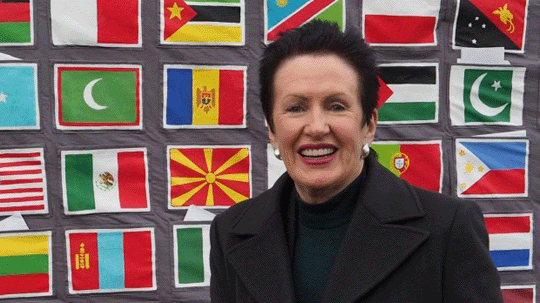
The city’s top commercial landlords have cut 45 per cent of their carbon dioxide emissions since 2006, saving $30 million a year, she said on the sidelines of the Paris . A surge in developments – almost $4 billion in 2014 rising to $7 billion this year – means a focus on efficiency in new buildings will also avoid future costs for energy, water and waste.
“The actions cities are taking across the world are making an incredible difference,” Cr Moore told Fairfax Media, noting 75 per cent of Australians and more than half the world’s people live in cities.
The performance and potential of the world’s major cities has been a theme of the Paris climate summit through a series of urban events – Ms Moore attended or spoke at five – highlighting the contribution that cities can make to meeting the conference’s wider goal of keeping global warming to less than 2 degrees of pre-industrial levels.
A report released at the conference found that cities – already home to more than 50 per cent of the world’s population – alone had the potential to cut global greenhouse gases by about 6 per cent by 2030 – or 3.7 gigatonnes of carbon dioxide – and more than double that by 2050.
For Sydney, the goal is to cut emissions 70 per cent on 2006 levels by 2030. Although well on the way to that goal, the city’s progress is being hampered by Canberra on the planning front, Cr Moore said. Continue reading
Upper Hunter Aboriginal Cultural Heritage Trust under scrutiny over funds to mining industry
 Mining funds reserved for Indigenous groups allegedly funnelled back to industry, ABC News 7 Dec 15 By state political reporter Brigid Glanville
A New South Wales Government body is under scrutiny amid claims it failed to distribute trust money to local Indigenous projects in the Upper Hunter and instead gave it to a mining industry body.
Key points:
- Trust set up so that mining companies pay $50k for each new development
- Funds to go to Aboriginal groups with connection to Upper Hunter
- $300k given to ARG, a company endorsed by chief mining lobby group
- Aboriginal Land Council chief says ARG has little affiliation with Indigenous communities Continue reading
Aboriginal landowners in King’s Canyon area want protection against mining
“The CLC and traditional owners of the park will accept nothing less than a [government] decision to protect the park for future generations by prohibiting exploration or mining within its boundaries.”
Kings Canyon landowners want protection from mining: ‘What happens if the water gets messed up?’ Guardian, Helen Davidson , 8 Dec 15 Watarrka national park’s Indigenous owners will petition environment minister over an existing fracking exploration licence and future mining ‘of all kinds’
Traditional owners of the land encompassing Kings Canyon in Australia’s central desert are petitioning the federal environment minister, Greg Hunt, to guarantee their protection against mining operations.
Under Northern Territory legislation, the Watarrka national park has no real protection from oil and gas exploration or mining operations, according to David Morris, the principal lawyer of the NT Environmental Defenders Office (EDO). Continue reading
1 This month
17 October, Free Public Talk on Nuclear Issues in South Australia
David Noonan will speak on public interest concerns over the new Roxby Downs Indenture Act 2026 on BHP copper-uranium mining and ore processing in SA, and on how AUKUS may face SA with a High-Level nuclear waste agenda.
Dr Jim Green will discuss international developments in the field of nuclear power including ‘small modular reactors’ and Generation 4 ‘advanced’ nuclear reactor concepts.


Help Aunty Sue Protect Her Land and Sacred Sites From Destructive Rocket Testing.
.

Australians deserve the truth
about
AUKUS – https://aukuspublicinquiry.com/

PETITION – To: Prime Minister Anthony Albanese and the Australian Labor Government

of the week – Australians for War Powers Reform (AWPR)
To see nuclear-related stories in greater depth and intensity

