Increasing popularity of community solar energy projects in Australia
 Small is beautiful: the community solar projects taking on big energy, Guardian, Annie Kane, 8 Dec 15 A brewery, a bowling club and a library join forces with a new type of energy supplier to save money and become more sustainable
What do Sydney’s Young Henrys brewery, Shoalhaven Heads’ Bowling and Recreation Club, and Bendigo library have in common? They’re all hosts to some of Australia’s first solar power projects funded and run by local people in community energy groups.
Projects like these are becoming increasingly popular in Australia. The Coalition for Community Energy (C4CE) 2015 national community energy strategy states that there were 19 community energy groups operating in early 2015, with a further 59 projects in development. Continue reading
South Australia headed for 100% renewable energy, and away from nuclear
It is also supporting its capital city, Adelaide, in its push to become the first large carbon neutral city in the world – a target it hopes to achieve within a decade. Both the state government and the city council have pushed new incentives to encourage battery storage in homes and businesses. Weatherill has also called for tenders to ensure that his government’s own electricity demand is met entirely by renewable energy.
South Australia is also hosting a royal commission into the nuclear fuel cycle, but since the release of a new report late last month predicting that nuclear technology will cost more than twice as much as wind and solar in the next decades, the chance of nuclear power being built in South Australia, or even Australia, appears negligible.
 South Australia to set path towards 100% renewable energy, REneweconomy By Giles Parkinson on 8 December 2015 South Australia is expected to pass its 50 per cent renewable energy target next year – nearly a decade ahead of schedule – and the Labor government will now aim to get the state as close to 100 per cent renewable energy as possible.
Premier Jay Weatherill said in Paris on Monday that the state was leading the world in the incorporation of variable renewable energy sources such as wind and solar, and hoped the knowledge gained would create a massive economic opportunity for a state struggling with the decline of long-term industries such as car manufacturing.
“We are running a big international experiment right now,” Weatherill said at the launch in Paris of the Compact of States and Regions, an initiative that will see 44 states and regions reduce their emissions by 12.4 tonnes by 2030.
“We have got a long, skinny transmission system and we will soon have 50 per cent renewable energy, including a lot of wind and some solar.
“We need technology breakthroughs for large-scale storage, such as pumped hydro or batteries, but these are massive technological challenges that are exciting opportunities for the state.”
South Australia does find itself at the cutting edge of the transition from a fossil-fuel based economy to an energy system dominated by technologies such as wind, solar and storage. Its last coal fired power generator is due to close in March next year.
The 50 per cent renewable energy target was formally announced last year, but was always going to be met well ahead of time – the addition of the Snowton 2 wind farm, the construction of the Hornsdale wind farm, and the growth in rooftop solar PV will take the state over that threshold in 2016.
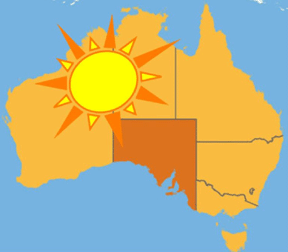
Indeed, the Australian Energy Market Operator has forecast that all of the state’s daytime demand may on occasions be met by rooftop solar alone within the next decade. Continue reading
Don’t undervalue the contribution of Australia’s indigenous people at Paris Climate Summit
West Australian Indigenous association, the Kimberley Land Council has sent a group of representatives to the conference.
The Council’s CEO, Nolan Hunter, warns that Indigenous communities shouldn’t be undervalued.
 What do the Indigenous voices say on climate change? SBS, 8 Dec 15 Climate change continues to dominate the agenda, with Prime Minister Malcolm Turnbull holding firm to his target of a 26 to 28 per cent reduction on 2005 levels of carbon emissions at the Paris talks, but some are wondering where the Indigenous voices are in the debate?
It’s a truly international topic of discussion: what can and should the world do about climate change?Like many nations, Australia faces hotter summers, more droughts, rising tides and a significant impact on its ecology.
Larissa Baldwin, national coordinator of youth climate group Seed, says the country’s Indigenous communities will bear the brunt.
And she believes their voices aren’t being given enough attention.
“I don’t think we have been given enough of a say, when you look at Indigenous communities around the world we’re already being impacted by climate change right now. We’re also on the forefront of fossil fuel extraction in Australia, and I think for a lot of us – we’ve had to send people over to Paris to actually get in front of our world leaders and say ‘hey you need to listen to us’.” Continue reading
Western Australian Greens appalled at plan for funding out-of-state renewable energy projects
 WA considers funding out-of-state renewable energy projects, The Fifth Estate Annie Kane | 8 December 2015 Electricity generator and retailer Synergy, owned by the Government of Western Australia, is considering paying for renewable energy projects in other states in order to meet renewable energy targets.
According to The West Australian, the company is looking at paying for wind farms and solar plants in eastern states to help meet the Renewable Energy Target, which requires electricity providers to get 20 per cent of their power supplies from large-scale renewable sources by 2020…..
Move is a “bastardisation of the Renewable Energy Target”
The move, however, has been criticised by WA Greens energy spokesperson Robin Chapple, who said: “The idea of our tax dollars going towards renewable projects interstate is a bastardisation of the Renewable Energy Target.
“Why would we pay for clean energy projects that we won’t ever receive electricity from? “The fact that this has even been floated just shows how short-term this government is in its thinking.
“Here is an industry that could create new jobs, lower the price of electricity and greatly improve our environment. “The excuse that our system is over capacity is ridiculous.”
He said that by retiring the state’s fossil-fuel generators could help bring in new renewable capacity and therefore work towards the 2020 target.
Mr Chapple added: “As a state we should, and could, be doing a lot more around renewables. Frankly, the costs of this technology are dropping so fast, and our natural resources are so good, that it is only a matter of time for WA.
“I am dumbfounded by Mr Rowe’s comments, and I sincerely hope that these ideas are not borne out.” http://www.thefifthestate.com.au/innovation/energy/wa-considers-funding-out-of-state-renewable-energy-projects/79284
Govt talks big on renewables ‘innovation’, but will close Australian Renewable Energy Agency
JOHN CONNOR: Well, we’ve got a big belting boom gate that’s our old, clunking coal-fired power stations, and so until we get those out of the system and replaced with cleaner technologies, then we’re going to be stuck.
Innovation is fine, but we’ll have no way to implement it.
MICHAEL EDWARDS: The environmental sector also wants the Government to provide certainty about the future of the Australian Renewable Energy Agency, the body charged with developing new technologies and increasing the supply of renewable energy in Australia.
Hopes innovation money will drive investment in renewable energy http://www.abc.net.au/am/content/2015/s4367751.htm Michael Edwards reported this story on Tuesday, December 8, 2015 MICHAEL BRISSENDEN: There are hopes that renewable energy products will be one of the areas that will see a boost in investment form the Government’s billion-dollar innovation package.
The Prime Minister Malcolm Turnbull says he wants to start an ‘ideas boom’ to transform Australia’s economy away from mining.
The investment sector has welcomed the package, saying it provides a policy framework needed for people to invest in the clean energy sector.
But some say the Government needs to change its positions on renewable energy and climate change for the industry to truly thrive. Continue reading
Australian Renewable Energy Agency (ARENA) funds CSIRO’s solar energy initiative
 ARENA supports new, cheaper solar technology to reduce cost of renewable energy in Australia http://www.ibtimes.com.au/arena-supports-new-cheaper-solar-technology-reduce-cost-renewable-energy-australia-1490089 By Darwin Malicdem on December 07 2015 The Australian Renewable Energy Agency (ARENA) is aiming to reduce the cost of renewable energy in the country by providing a funding boost to an innovative solar cell technology. The new perovskite solar cells could significantly be cheaper than and as efficient as existing solar cells.
ARENA will be providing about $892,000 to CSIRO for the development and application of guidelines for assessing the performance of the perovskite solar photovoltaic (PV) cells. The materials of perovskite can be used in solar cells with a less cost and labour intensive process compared to silicon.
ARENA aims to accelerate the development of perovskite solar PV cells in the country. “If perovskite solar cell technology matures to commercialisation, it has the potential to provide cheaper power from the sun,” said ARENA CEO Ivor Frischknecht.
CSIRO is planning for new methods and guidelines applicable to perovskite solar cells, as international standards to measure solar PV cell performance are only applicable for silicon wafer cells. The new guidelines would be applied at the ARENA-supported PV Performance Laboratory in Newcastle, Frischknecht said. The lab would help Australian researchers test perovskite samples in the country instead of conducting tests overseas, which will boost research and reduce the risk and costs of the project.
The $2.4-million project for perovskite solar cells is expected for completion in November 2018. ARENA has already received letters of support and offers of cell samples from members of the Australian Centre for Advanced Photovoltaics and international research agencies.
The test results will be validated by internationally accredited laboratories, and CSIRO will work with overseas counterparts for the development of best practice methods suitable for different research laboratory environments, Frischknecht said.
Australia ranked way down the bottom for climate change action

“Experts criticise that Australia’s attitude appeared to be to try to avoid making any substantive commitments, and to do the absolute minimum that it has to. There appeared to be no recognition of Australia’s national interest in minimising climate change; rather, the focus seems to be on protecting domestic energy and resource exporters (coal and gas industry),”
Australia ranked third-last in climate change performance of 58 countries, Guardian, Lenore Taylor 9 Dec 15 2016 Climate Change Performance Index released at Paris climate summit, day after Julie Bishop said Australia was meeting and beating its climate targets. Australia has come third last in an annual assessment of 58 nations’ climate policies, with only Saudi Arabia and Kazakhstan ranking worse.
The assessment by Germanwatch and Climate Action Network Europe was released at the Paris climate summit, just one day after foreign minister Julie Bishop told the assembled ministers Australia was meeting and beating its climate targets and transforming its energy production. Continue reading
Nuclear Royal Commission blocks lessons learned from Maralinga
 The carefully engineered terms of reference for the Royal
  Commission into the Nuclear Fuel Cycle in South Australia are being used to block a thorough investigation of the ongoing effects of radiation from the fallout of the Maralinga bomb test on Indigenous communities across South Australia. This is the latest example of Kevin Scarce and the Royal Commission ignoring and disrespecting Aboriginal people. He can expect fierce resistance from Aboriginal people in the firing line from plans to dump high-level nuclear waste in South Australia and other plans to expand the state’s role in the nuclear industry.
Ms Rosemary Lester, a second generation survivor of the Maralinga atomic tests, met with Commissioner Scarce today, and asked him whether he would be making comment on the effects of radiation on Indigenous communities from the Maralinga bomb tests. The Commissioner said, ‘I’ll be reporting only on the effects on the entire community from the nuclear fuel cycle’. He stated that the history and effects of the Maralinga tests were outside the scope of the Commission’s terms of reference saying; ‘Issues of Maralinga are not linked to the terms of reference that I have’.
However, it is argued by Ms Lester, that a closer examination of the terms of reference require that the Commission enquires into the risks and opportunities associated with processing, management, storage and disposal of waste and that it includes an inquiry into the full impact of these on the South Australian community (incorporating regional, remote and Aboriginal communities) including potential impacts on health and safety. Moreover, the terms of reference clearly state that “consideration should be given, as appropriate, to their future impact…” Ms Lester argues that the Inquiry must investigate and consider Maralinga as a major incident of radiation exposure in South Australia that affected all Australians, especially remote Indigenous communities living across the Maralinga Tjarutja region, and that irreversible contamination continues to degrade the environment.
Leaving aside semantic interpretations of the terms of reference, there is unfinished business from Maralinga. It is a disgrace that Commissioner Scarce refuses to investigate these issues and it is a disgrace that the SA Government wants to increase radiological risks – risks that impact disproportionately on Aboriginal communities – when the health and environmental issues from Maralinga remain unresolved.
When pressed about the effects on Indigenous communities of the Ranger Uranium Mine in Northern Territory as a result of leaks and mismanagement of the waste storage, his response was that “The situation in Ranger is very different to other sites in South Australia”. Ms Lester says, “Irrespective of where these catastrophic incidents occurred, it is critically important that the universal lessons from such incidents are recognised and should form a central focus of the Commission’s work. It is clear that the dangers inherent in uranium and its use are well within this Commission’s terms of reference. It seems curious that the Commissioner has gone to great lengths to travel and inquire into nuclear sites across the world, including Fukushima and Scandinavia, and yet will not acknowledge the critical relevance of the Ranger experience.”
Rose Lester continues:
“The very narrow and selective interpretations of the Commission’s terms of reference are at best disingenuous and at worst another example of nuclear racism. This interpretation ignores the critical issues of the mismanagement and inability to safely dispose of radioactive waste. By adopting a legalistic approach to the terms of reference the Commissioner ignores the spirit that underpins the Inquiry. It is critical, and within the Commission’s scope, to focus on the risks associated with the management, storage and disposal of nuclear waste.”
Government must come clean about radioactivity and treatment of nuclear of waste
There is a public meeting being held in Alice Springs tonight to discuss the national nuclear waste dump proposal and shortlisting of the site near Alice Springs. http://www.ntnews.com.au/news/centralian-advocate/alice-group-to-oppose-date-farm-as-nuke-dump-site-at-public-meeting/story-fnk4wgm8-1227633870645
 The closest neighbours of one of the shortlisted sites for a nuclear waste repository want the federal government to explain the classification and treatment of nuclear waste returning to Australia for storage.
 “Under Oak Valley we have two major aquifers (the Mereenie and Pacoota) that are part of the vast Amadeus Basin, so if any contamination gets into one of those, what’s it going to affect, how many lives?”
Bill Gates on the nuclear bandwagon, Australia’s Gareth Evans on board, too.
The nuclear industry is trying to hijack the Paris Climate Summit , Independent Australia, 6 December 2015 The new Breakthrough Energy Coalition, backed by billionaires such as Bill Gates and supported by the global nuclear lobby is hijacking climate talks at COP21, writesNoel Wauchope.
At the Paris Climate Summit (COP21), the global nuclear lobby is in overdrive.

The centrepiece of today’s global nuclear lobbying is the Breakthrough Energy Coalition, led by Bill Gates, made public at the start of the conference.
Bill Gates announced the Breakthrough Energy Coalition, uniting the efforts of two dozen other billionaire philanthropists such asRichard Branson, Mark Zuckerberg and Jeff Bezos, to sponsor research into energy that doesn’t produce carbon.
Gates was present in Paris together with U.S. President Barack Obama — the White House is reported to be supportive of the initiative. Article after article in the U.S. and other media outline the purpose of this group, stressing renewable initiatives, or rather, “clean” energy initiatives. Nuclear power is not mentioned but is tacitly included in that weasel word, “clean”. …..
Eventually, I came upon Tina Casey‘s article, in Clean Technica: the very first one to notice the Breakthrough Energy Coalition’s focus on the nuclear industry and to question the inclusion of nuclear energy as “clean energy”.
She also notes the group’s co-operation with Mission Innovation, which brings tax-payer funding into the “clean” energy research programs. And Casey reminds us that Bill Gates is co-founder and chair of the innovative nuclear energy company TerraPower.
Only one university has joined the group, the University of California, which runs the Lawrence Berkeley National Laboratory — known for its nuclear energy research facilities.
Meanwhile, back in Australia, nuclear enthusiasts are on the bandwagon, too. The latest – and one of my favourites – is Gareth Evans. Evans has long been a voice for the nuclear industry, while simultaneously being Australia’s voice for nuclear disarmament. He sees no connection between nuclear reactors and nuclear weapons.
The Australian, ever a promoter of the nuclear industry, quotes Evans under the headline, ‘Nuclear waste dump a no-brainer‘.
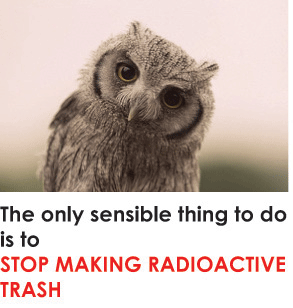
At the South Australian Nuclear Fuel Chain Royal Commission on 3 December 2015, Evans isquoted as being almost ecstatic at the thought of Australia importing the world’s radioactive trash:
“Australia would stand very tall in the international community by repatriating waste made from exported uranium as well as storing waste for other countries. It was disconcerting that European countries had been spooked by the 2011 Fukushima nuclear power plant accident.”
 And Professor Evans used that notorious nuclear lobby argument to counter critics of nuclear power. He said:
“To me seems a triumph of emotion over reason.’……
Bill Gates himself may be something of a dreamer, with high aims and ideals, along with the commercial motive. His Breakthrough Energy Coalition sounds suspiciously like the Breakthrough Institute, which has a long history of advocating inaction on fossil fuel emissions, with the distracting promise of almost magical, new nuclear reactors that still exist only as blueprints. https://independentaustralia.net/politics/politics-display/the-nuclear-industry-is-trying-to-hijack-the-paris-climate-summit,8458
Nuclear waste arrival from France drives concerns about NSW dump site
 At the weekend twenty five tonnes of nuclear waste arrived at Port Kembla from France on a ship blacklisted by US authorities. Greens NSW Senator Lee Rhiannon says the delivery is worrying news, particularly for residents at Hill End, near Bathurst, an area shortlisted by the federal government as a dumping site for nuclear waste.
‘Yesterday twenty five tonnes of nuclear waste, classified as ‘high-level’ by French authorities, arrived on our shores at Port Kembla,’ Senator Rhiannon said.
‘To add insult to injury, the government has chosen a rust bucket flag of convenience ship blacklisted by US authorities to deliver the waste, adding a whole host of threats to our environment, economy and local jobs.
‘The BBC Shanghai has been blacklisted by US authorities after failing to pass inspections, so why was it judged good enough to transport nuclear waste from France to Australia?
‘The transport of this dangerous waste increases the likelihood of an accident. Hundreds of police were involved in in transporting the waste to Lucas Heights, a southern Sydney suburb, in the dead of the night.
‘This delivery will elevate concerns of the Hill End community that any nuclear dump in Australia will not just be for ‘low level’ waste.
‘The Greens accept that storing this waste at Lucas Heights is the ‘least worst’ option.
‘Nuclear waste is a threat to surrounding communities and the environment for thousands of years.
‘This is further reminder that the Lucas Heights reactor should be closed.
“The pharmaceuticals developed from medical isotopes can be produced with particle accelerators. When total costs are considered it is not as expensive as a nuclear reactor and much, much safer,’ Senator Rhiannon said.
Elaborate secret operation transports deadly nuclear wastes through Sydney
 Nuclear convoy: 25 tonnes of deadly waste closes Sydney roads December 7, 2015
Ian Walker The Daily Telegraph POLICE outnumbered Greenpeace activists 100 to one as tonnes of nuclear waste returned from France was driven in a kilometre-long convoy to the Lucas Heights Reactor early yesterday morning.
A forged steel container strong enough to withstand the impact of a jet strike carried the 25 tonnes of radioactive waste on the back of a semi-trailer to the reactor in south Sydney about 2am.
The waste was sent to France in the 1990s for reprocessing to be made safe for long-term storage in Australia, something that is not able to be done here……..Every conceivable threat to the precious cargo’s slow journey from Port Kembla to Sydney was covered in an elaborate operation throughout the night. http://www.dailytelegraph.com.au/news/nsw/nuclear-convoy-25-tonnes-of-deadly-waste-closes-sydney-roads/story-fni0cx12-1227635720100
Right wing Senators Madigan and Bill Heffernan angry about unsafety of nuclear waste ship

Independent Senator John Madigan said on Sunday he found it unacceptable that a ship carrying radioactive waste could sail into an Australian harbour when little was known about its ownership or crew, and its previous voyages had been to ports in Angola, Egypt, Russia and China, where he said the level of security could not be guaranteed.
‘National security for sale’: senators’ outrage over ship’s cargo of nuclear waste, SMH, December 6, 2015 Tony Wright A cargo of nuclear waste that arrived in Australia at the weekend was aboard a ship owned and operated by a web of German companies, registered in the tiny Caribbean islands of Antigua and Barbuda and crewed by a mix of Russian and Ukrainian seafarers.
It brought accusations from an independent Australian Senator that Australia was “tendering out its national security to the lowest common denominator”, and followed expressions of disbelief from major party parliamentarians that the bureaucracy did not check the ownership of foreign vessels operating in Australian waters…... Continue reading
72% of Australians oppose this nation becoming the world’s radioactive trash dump
Nuclear waste returned to Australia, raising concerns about future dump site, Guardian, 5 Dec 15 “………Environmentalists have raised concerns about the safety of the ship, which left the northern French port of Cherbourg in October. One French lawmaker described it as a “dustbin ship”.“This is not the kind of ship you would want to see transporting nuclear waste,” said Greenpeace campaigner Emma Gibson, who was on board a boat following the BBC Shanghai on Saturday……
The waste will initially be housed at the Lucas Heights reactor in southern Sydney until a nuclear waste dump site is selected and built. It is expected to be trucked to the reactor from Port Kembla overnight.
The government has said the nuclear waste dump site would only be used to store Australia’s radioactive waste but Greenpeace has warned that creating a new waste facility is an invitation to other countries to use Australia as a dumping ground.
The group said a poll of 3,144 people last month that it had commissioned from ReachTel suggested that most Australians opposed plans to store nuclear waste for other countries.
Asked about Australia accepting nuclear waste from overseas, 18.3% supported it, 72.1% opposed it and 9.6% were undecided…….
Most Australians rightly don’t want their country to become a nuclear waste dump for the rest of the world,” Gibson said.
“Nobody has yet worked out a safe way to manage long-term nuclear waste, which can remain dangerous for hundreds of thousands of years.”…..http://www.theguardian.com/environment/2015/dec/05/nuclear-waste-returned-to-australia-raising-concerns-about-future-dump-site
Lucas Height’s nuclear reactor’s returning wastes arrive by ship at Port Kembla
 Controversial nuclear waste shipment arrives in Port Kembla http://www.smh.com.au/nsw/controversial-nuclear-waste-shipment-arrives-in-port-kembla-20151205-glged7.html Twenty five tonnes of nuclear waste will be transported to Sydney’s Lucas Heights after it arrived in NSW on Saturday.
The bulk carrier BBC Shanghai was greeted at Port Kembla, near Wollongong, by a heavy police presence including the riot squad, mounted officers and divers.
Police boats and jet skis accompanied it into the harbour as Greenpeace protesters followed behind. On shore about a dozen protesters unfurled a banner that read “don’t waste Australia”. “We are very concerned our place, our region, is being used to do other people’s dirty work,” South Coast Labour Council secretary Arthur Rorris said.
Arriving from France, the ship entered the harbour just before 1pm. The waste was expected to take around eight hours to unload before it was to be transported in in a six-metre-long and three-metre-wide steel cell along the Princes Highway under police guard to Lucas Heights in Sydney’s south.
Police in Port Kembla worked with the Australian Nuclear Science and Technology Organisation (ANTSO) to coordinate the arrival. ANTSO in a statement said the waste would be held in Sydney while the Federal government searches for a permanent site to dump nuclear waste.
A shortlist of six sites was released in November, including Sallys Flat near Bathurst in New South Wales and three sites in South Australia.
The waste is what remains of shipments sent to France for reprocessing in the 1990s when eight shipments in total were sent there, as well as to the United Kingdom and the United States.
The waste sent to the US will remain there, but shipments sent to the UK will return within five years. In its statement ANTSO said the nuclear waste had “enabled generations of potentially life-saving nuclear medicine production”.
1 This month
17 October, Free Public Talk on Nuclear Issues in South Australia
David Noonan will speak on public interest concerns over the new Roxby Downs Indenture Act 2026 on BHP copper-uranium mining and ore processing in SA, and on how AUKUS may face SA with a High-Level nuclear waste agenda.
Dr Jim Green will discuss international developments in the field of nuclear power including ‘small modular reactors’ and Generation 4 ‘advanced’ nuclear reactor concepts.


Help Aunty Sue Protect Her Land and Sacred Sites From Destructive Rocket Testing.
.

Australians deserve the truth
about
AUKUS – https://aukuspublicinquiry.com/

PETITION – To: Prime Minister Anthony Albanese and the Australian Labor Government

of the week – Australians for War Powers Reform (AWPR)
To see nuclear-related stories in greater depth and intensity

