Australia should start a “post-disaster humanitarian visa” for Pacific islanders displaced by climate change
Australia needs US-style green card deal for climate-threatened Pacific islanders, Guardian, Ben Doherty, 2 Dec 15
And to boost historically low rates of migration from the Pacific, Australia should consider instituting a green card-style lottery for Pacific islanders to live and work in Australia, and boost seasonal worker numbers to industries such as horticulture.
Migration from Pacific countries to Australia has been consistently low for decades – representing less than 0.5% of all visas granted to Australia – but the Migration Council, an independent migration policy body, argues that the movement of people from the Pacific could benefit source countries and Australia.
Pacific countries, geographically disparate, sparsely populated and, in many cases, economically fragile, are forecast to be at the forefront of the impacts of climate change, with low-lying atoll nations particularly vulnerable to rising sea levels and worsening natural disasters.
Research suggests that by 2050, between 665,000 and 1.7 million people will be displaced by climate change across the Pacific. Continue reading
Across Australia, rallies for climate change action
 Australians join global rallies for climate change action ahead of Paris talks ABC News 29 Nov 15 Thousands of Australians have joined a worldwide wave of marches on the eve of United Nations climate change negotiations in Paris, calling for stronger measures to combat global warming.
Events were held today in Sydney, Canberra, Perth and Hobart, as well as regional and rural towns around Australia, joining about 600 other cities in more than 120 countries around the world. Continue reading
Australian govt’s contribution to UN Climate Summit – pro coal video “Coal is Amazing”!
 Australian Delegation To Present ‘Coal Is Amazing’ Video At Climate Conference http://www.theshovel.com.au/2015/11/30/australian-delegation-to-present-coal-is-amazing-video-at-climate-conference/ Australia’s contribution to the Paris climate change talks will be a short animated video explaining the benefits of coal.
Environment Minister Greg Hunt said he was looking forward to sharing the ‘little gem of a video’ on the conference’s main stage. “The broader global community has a bit of catching up to do when it comes to understanding coal’s amazing qualities. This video will be the talk of the conference I feel,” he said before leaving for Paris.
A Rational Fear – This Little Black Rock is gonna F you Up!
[Oh dear, I think I might have put up the wrong video – what a shame!]
Mr Hunt said the little black rock provided endless possibilities. “It can provide light. And jobs,” he said, holding up a piece of coal for reporters to see.
Following Australia’s presentation, delegates will receive a take-home bag containing a genuine piece of Australian coal. “It’s a little memento to remember the Aussies by,” Mr Hunt said.
Minerals Council of Australia’s deceptive video promoting coal industry
 The campaign claims that low-emission coal-fired power plants and carbon capture and storage (CCS) technology is “now a reality” and are slashing emissions.
However, there is only one CCS-enabled plant operational in the world, in Canada. In Australia, there is just one CCS project aimed at coal emissions in the pipeline, which may arrive at some point in the 2020s.
Coal is a dangerous little black rock. Every climate scientist and almost every politician in the world knows that coal is very polluting and very dangerous. The only people who don’t get that are the Minerals Council and our government.
Green groups criticise ‘ludicrous’ Minerals Council of Australia ad which claims coal creates ‘light and jobs’ and ‘can now reduce its emissions by up to 40%’
Australia’s mining industry has launched a new ode to coal in the form of a major advertising campaign that hails the mineral’s ability to “create light and jobs”, as well as claiming that new technology will drastically slash its emissions. The campaign, called Little Black Rock , has been launched by the Minerals Council of Australia. An eye-catching TV ad shows an extreme closeup of the contours of a lump of coal, as if it were the surface of a rugged, distant planet.
A voiceover explains the “endless possibilities” of coal, Continue reading
Sydney: huge climate rally shows support for Pacific islanders
Huge crowds march in Sydney climate rally, Herald Sun, November 29, 2015The giant costumed figures of Malcolm Turnbull and Tony Abbott greeted scientists, activists, families, elderly and youth that gathered at the Domain on Sunday to urge leaders to shift more rapidly to renewable energy and cut carbon emissions worldwide.
People have waved placards to the sound of drums while others have broken into dance and worn costumes of marine life that would be affected by increasing global temperatures.
“Minds change or climate change” read one placard, while another said “there is no Planet B”.
Climate Council’s Professor Tim Flannery addressed the crowd before they marched, saying a successful outcome at the UN summit was vital. “Do your utmost to see success at Paris, we won’t accept anything less,” he said to the cheers of the crowd, which he described as “the biggest climate march” in Australia’s history.
The rally observed a minute’s silence to acknowledge those most affected by climate change, especially Australia’s neighbours in the Pacific.
Earlier, deputy federal Opposition Leader Tanya Plibersek said the government had to take action now before the cost of reducing emissions increased.”The sooner we start making cuts to our carbon pollution, the cheaper it’ll be to get there,” she told reporters in Sydney just before the rally.
Sydney march organiser Reece Proudfoot said those taking part in the Australian marches walked in solidarity with millions of people across the world as part of a global campaign. Mr Proudfoot welcomed Labor’s pledge on Friday to cut carbon emissions by 45 per cent on 2005 levels by 2030, which is well above the coalition pledge of between 26 and 28 per cent.
More than 40,000 people marched in Melbourne’s central business district on Friday to kick off the weekend of climate marches, with dozens of events also taking place in regional towns across the country. http://www.heraldsun.com.au/news/breaking-news/huge-crowds-march-in-sydney-climate-rally/news-story/6317c3f8464c27b851c07fac5677cd3f
Canberra residents in their thousands march for climate action
Thousands gather in ACT for climate march http://www.heraldsun.com.au/news/breaking-news/thousands-gather-in-act-for-climate-march/news-story/600de104ef2c1c83651cc582a56d75fe November 29, 2015 Thousands of Canberrans have joined a worldwide protest by marching to support action on climate change.
They gathered on the front lawn of parliament house, a broad cross-section of people from Labor and the Greens to the fireman’s union, bee keepers, the Grim Reaper and Tibetan cows – pantomime-style cows that is.
Federal Labor ACT MP Gai Brotmann said people were sending a strong message to the Turnbull government. “Action is required on climate, credible action and direction action is not that,” Ms Brotmann told AAP.
Royal Commission hears that nuclear is a poor solution to Climate Change
SA NUCLEAR FUEL CYCLE ROYAL COMMISSION PROFESSOR  HENRY SOKOLSKI, The Nonproliferation Policy Education Centre TRANSCRIPT OF PROCEEDINGS ADELAIDE, 25 NOVEMBER 2015 DAY 27
excerpt:
COMMISSIONER: We had it put to us that nuclear power generation might be the saviour in terms of climate change. Would you add that to your economic analysis of light-water reactors in terms of accepting their development?
PROFESSOR SOKOLSKI: I think I would not, and I’ll tell you why. This is a topic which has been debated very extensively here in the States and as a result, the folks promoting nuclear power and the folks who are against nuclear power have gotten focused on very, very detailed analytical models. The best, or I should say the one used the most, is put out by an auditing firm called McKenzie. This model has been used by Greenpeace analysts and the largest 25 merchant utility utilising nuclear power, Epsilon, and they both use this model and they both agree that it’s a good model, and this model tells you that you should do about ten other things first if you’re serious about reducing carbon before you buy a new power reactor. That strikes me as very, very interesting and as positive.
More recently, I think you can read an article that was put out by Chris Buckley in the New York Times, and he makes the case that others do, that China must go with nuclear to reduce its carbon footprint. But he repeats the claim by the government of China that at most by 2030 if every one of the 35 reactors they built was built on time, which will be a remarkable achievement, they will only have 10 per cent of their electricity generation supplied by nuclear. The rest will likely be fossil fuels. I think this tells you how far you can go with nuclear. First, not very and second, there are quicker ways to reduce carbon that are cheaper.
Mostly it has to do with management of consumption which is a fancy word or phrase for turning the lights off more regularly and the second thing is doing natural gas substitutions for coal. Those are your quickest, cheapest ways to most dramatically reduce carbon and that is the project probably of the next 45 three decades. That is where you will make your advances. Also grid……to me http://nuclearrc.sa.gov.au/app/uploads/mp/files/videos/files/151125-topic-16-day-3-transcript.v1.pdf
Yet another delay in radioactive cleanup of Sydney’s Hunter’s Hill
 Residents appalled as radioactive clean-up of Sydney street delayed another four years http://www.smh.com.au/nsw/residents-appalled-as-radioactive-cleanup-of-sydney-street-delayed-another-four-years-20151128-glaf1b.html Kirsty Needham State Politics Editor, The Sun-Herald
|
The clean-up of radioactive waste from a residential street in Hunters Hill has been delayed for another four years, as the cost has almost doubled. |
The Baird government was ordered by the Environment Protection Authority last November to submit a plan to remove toxic waste from six properties on Nelson Parade after a decade of delay and political paralysis.
The clean-up was to begin within 90 days of the plan being approved.
But Government Property NSW’s annual report has revealed the remediation work won’t be undertaken until 2016-17, and won’t be complete until 2018-19.
Remediation costs have blown out from $12.4 million to $22.5 million “mainly as a result of changes in the final waste disposal location”.
Philippa Clarke, of the Nelson Parade Action Group, said a delay until 2018 was “appalling”. Continue reading
Bathurst – oldest inland city – No to ‘newest nuclear waste dump’ !
 Bathurst business group concerned about nuclear dump proposal http://www.abc.net.au/news/2015-11-27/bathurst-business-group-concerned-about-nuclear-dump-proposal/6978472 By Gavin Coote A Bathurst business group says it is unconvinced of the economic benefits being touted for a shortlisted nuclear waste site in the district.
Dozens of people packed a hall in Hill End yesterday to hear about the Federal Government’s proposal to store the material at nearby Sallys Flat.
The Bathurst Business Chamber says the $10 million sweetener on offer to the selected community would not offset the potential economic losses.
The president Stacey Whittaker said there could be ramifications for the local tourism and agriculture sectors if the proposal went ahead. “I don’t think it’s bringing anything positive to the region,” Ms Whittaker said. “We’ve got a lot of small businesses by way of farming out in the that area which I think are certainly more important and have put more back into the community and the area than a nuclear waste dump will ever do.”
Sallys Flat is one of six sites shortlisted for the facility, and government officials have told the forum it would not pose a safety threat.
Ms Whittaker said the stigma surrounding nuclear waste could draw unnecessary negativity to the area. “Certainly from the local business side of things in town itself of Bathurst, people are a bit concerned.
“You know Bathurst, oldest inland city in Australia and first nuclear waste dump. “That’s not a real good title, is it?”
United Nations call on Australia to produce a consistent climate policy, not ‘mixed messages’

 UN calls for consistent climate policy from Australia http://www.sbs.com.au/news/article/2015/11/28/un-calls-consistent-climate-policy-australia Australia needs to be more consistent on climate change after mixed messages under recent governments, a senior UN official says. Australia must be more consistent on climate change after a series of erratic policy changes, a senior United Nations environment program official says.
Kaveh Zahedi, the UN’s Environment Program (UNEP) Asia Pacific representative, says Australia’s climate policies have failed to reflect wider community concerns over climate change.
“It seems we are getting mixed messages (on climate change policy),” Zahedi told AAP.
Zahedi’s comments come ahead of next week’s Paris summit on climate change, which is aimed at forging an agreement to cut greenhouse emissions, and limiting global warming to 2C.
Policy measures to deal with climate change have included a carbon tax introduced by the former Labor government, which was later repealed by the coalition under Tony Abbott.
Zahedi said Australia needed to bring policy certainty to the Paris negotiating table next week.
He hoped the underlying message from the Paris summit would be clear and “override some of the mixed messages that might or might not exist at the national level”.
Queensland govt plans to extinguish Native Title for Adani’s coal mine
 Wangan & Jagalingou People:
Qld Government Plans to Extinguish Native Title for Adani’s Coal Mine A New Low in Violating Traditional Owners Rights http://wanganjagalingou.com.au/qld-government-plans-to-extinguish-native-title-for-adanis-coal-mine-a-new-low-in-violating-traditional-owners-rights/
http://wanganjagalingou.com.au/author/wj/
http://wanganjagalingou.com.au/news/
27 Nov 15:
“‘Not here, not now, not this time’ say Traditional Owners
Adrian Burragubba, senior spokesperson of the
Wangan and Jagalingou (W&J) Traditional Owners’ Council, has strongly condemned plans by Queensland’s Coordinator General Barry Broe, under the imprimatur of Minister for Mines Anthony Lynham, to extinguish native title on parts of the W&J’s traditional lands in the Galilee Basin in order to enable Indian giant Adani to develop infrastructure for its $16.5bn Carmichael coal mine, the biggest in Australian history.
The plans were revealed in documents obtained by the ABC. Mr Burragubba said, “It is beyond comprehension that the Government would consider such a shameful and absurd proposal in an era when our rights are sanctioned under international law; and when we are already in the Federal
Court contesting the State Government and Adani’s attempts to override our rights.”
“Premier Palaszczuk needs to rule out this outrageous proposal immediately”, Mr Burragubba said. “I assure the Premier she will be bringing on one of the biggest human rights battles we’ve seen in Queensland in a long time. If destroying our rights and handing our lands to a foreign
mining company is on her agenda, she better think again.” … “
Huge Melbourne rally kicks off Australia’s marches for climate action
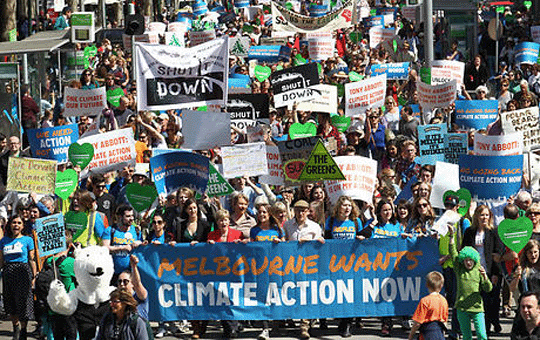
Thousands gather at Melbourne CBD rally ahead of Paris climate summit, The Age, [excellent photos and video] November 27, 2015 -Chloe Booker, Timna Jacks, With Tom Cowie and AAP
- 10 things you need to know about the summit
- Activists plan to defy ban on Paris protests
- Business singing a new song on climate
Tens of thousands of people have gathered in Melbourne’s CBD to demand world leaders take strong action to protect the planet at the Paris climate change conference.
The so-called People’s Climate March was one of hundreds of rallies being held around the world in the lead up to the crucial meeting. Members of The Cat Empire performed for the crowd, which included Opposition Leader Bill Shorten and Greens Senator Richard Di Natale.
A sea of placards stretched down Bourke Street from Spring Street to Swanston Street and along Swanston Street from Bourke Street to La Trobe Street. There was a stand-off between banked-up traffic and protesters at Exhibition Street as frustrated drivers honked their horns and the crowd erupted in cheers and shouts.
Stunned diners observed the march from outside Bourke Street cafes, and some heckled the demonstrators. Sections of the crowd were more like a party, with some dancing and clapping to a marching band dressed in green-glittered uniforms, while others swayed to the strumming of a guitar. ……..
Andy Parsons, an Environment Victoria volunteer who attended both rallies, said environmentalists supported the right of Aboriginal people to live independently.”The Aboriginal people lived sustainably for thousands of years. Us white people could learn a lot from them,” he said.
Aboriginal man Robbie Thorpe said he saw a parallel between the “genocide” of his people and what he called the “ecocide” of Australia’s natural environment. “We are the custodians of the land and the language. Only we know how to talk to our land. Without the Aboriginal people the land can’t survive and without the land, we can’t survive.” http://www.theage.com.au/victoria/thousands-expected-at-melbourne-cbd-rally-ahead-of-paris-climate-summit-20151127-gl9lz8.html
Australia’s sorry history of deception about action on climate change
Australia is not the only country to have tried to use international rules to its domestic advantage. But Australia’s history of special deals now raises some big domestic policy questions.
the accounting rules may not come to our rescue another time. It is not clear whether we will be able to “carry over” again, although Hunt has indicated we would like to. But the task is now also bigger than any “carry over” could massage.
After decades of fighting and fudging, Australia will have to really do something about its greenhouse emissions this time
 Welcome to the wonderful world of climate talks, where less means more,
  Guardian
Lenore Taylor, 27 Nov
The maths doesn’t add up – Australia’s emissions are trending up and yet we are meeting pledges to cut them. But it all makes sense in the complicated and chaotic world of climate negotiations The numbers look clear. In 1990, Australia emitted 564m tonnes of carbon dioxide. In 2005 that rose to 611m. By 2014-15 that had fallen a bit to 565m. But in 2029-30, the latest published projections say we will emit 724m tonnes.
They have gone up and down and they might not be rising by as much as if we’d never heard the words “climate change”, but in absolute terms our greenhouse emissions are trending up, not down.
And yet over those same decades we will have solemnly given three different national pledges to reduce our emissions and, as the environment minister, Greg Hunt, keeps enthusiastically reminding us, in every case we will “meet and beat” our pledges.
How can it be possible for national emissions to rise over 30 years while a country “meets and beats” successive promises to reduce them? The answer takes us first deep into the complicated and chaotic world of international climate negotiations and then to the dizzying heights of political spin. Continue reading
#NuclearCommissionSAust on HIGH LEVEL WASTE STORAGE AND DISPOSAL
HIGH LEVEL WASTE STORAGE AND DISPOSAL
SA NUCLEAR FUEL CYCLE ROYAL COMMISSION SPEAKERS: DR MARK NUTT Argonne National Laborator WEDNESDAY, 25 NOVEMBER 2015 DAY 27 – excerpts from transcript
“……COMMISSIONER: can you tell us where the current US plans are for a high-level waste facility?
DR NUTT: As of right now, I would say they’re a little bit uncertain……So right now it’s really doing groundwork activity, open storage and disposal, to essentially be ready for when a decision is made to proceed with national policy towards disposal and storage. [ed: USA doesn’t know what to do with the wastes]
….DR NUTT: In terms of low-level waste generation it is probably – it is the biggest contributor. We have 100 – roughly 100 operating reactors that – the maintenance of the reactors, the clean up of the cooling systems all generate low-level waste that has to be disposed of. There are smaller contributions 45 from medical, industrial applications of radioactive materials that then become .SA Nuclear 25.11.15 P-1460 Spark and Cannon low-level waste. So by far in terms of volume it’s the nuclear industry that dominates the low-level waste disposal….. [ed: mdical wastes are not the problem, as ANSTO pretends]
…….it’s this inter-generational equity that people of today are gathering the benefits from nuclear electricity or nuclear energy and should deal with the problems of today and not pass the problems down…..[nuclear industry pretend to care about future generations, but no thought of stopping producing radioactive trash]
…there is a general consensus that it’s indeed temporary, that the ultimate 35 solution should be disposition of it in a geologic repository. There may be – there is countries that are considering fuel cycles where you might reprocess and recycle materials back to the reactor but either way you are going to generate high-level waste that would need to be disposed of. [ed: so new reactors that supposedly ‘eat wastes’ still produce wastes]
….We’ve gone towards interim dry storage at the reactor sites because all of the spent fuel pools for the US fleet are essentially full….[ waste pools full BUT THEY STILL KEEP MAKING THE STUFF!]
COMMISSIONER: Can I just pick up on the dry storage Dr Nutt? What sort of studies have been conducted in the US to look at the longevity of these dry storage casks and is there a view about – conservative view about how long they will last? S
R NUTT: I don’t – no one has done a study to put a – what I’ll call a line in the sand for how long they can last. Our regulatory framework allows storage up to 60 years, dry storage. We have studies underway within the Department of Energy’s programme, the Electric Power Research Institute which is our utilities research arm. It’s also investigating various aspects associated with 15 extended storage. The Electric Power Research Institute runs a group called the Extend Storage Collaboration Project which is involved in – a number of countries are involved with it that are dealing with the same issues that we are. So there is a lot of work going on looking at extended storage and what it entails. There has been several gap analyses done to identify what the key 20 issues are and the R&D’s under way to try to resolve those, so that there is confidence in extended storage. (there seems no reason for this confidence: sound like blind faith]
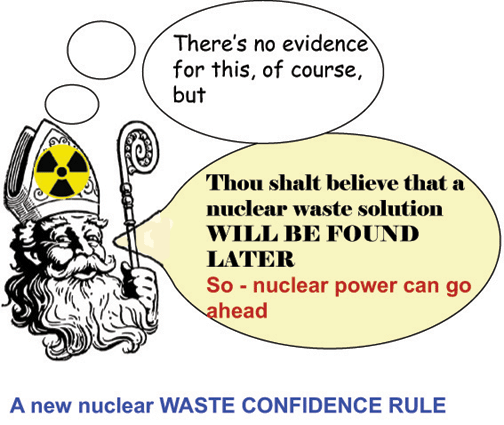
… When you get in to disposals, where I believe things get a little bit different because you are 20 dealing with long timeframes, you’re dealing with geologic systems, you are a large – sometimes large areas or footprints for the disposal facility and it leads to a little different type of safety case that one needs to consider to help build confidence in the safety of – the long term safety of the facility……[means they’ve got to convince the public somehow?]
DR NUTT: I’ll say it’s not possible to validate the long-term disposal models in the traditional sense. In that you can’t do an experiment and then run the 30 model and validate the experiment for the repository itself. You can do a variety of techniques to again demonstrate your confidence in the models and their ability to reasonably predict or estimate exposures out in the future…[ that doesn’t make ME feel confident]
New report rules out nuclear power for Australia, on economic grounds
 Nuclear priced out of Australia’s future energy
  equation in new report By Sophie Vorrath & Giles Parkinson on 26 November 2015 http://reneweconomy.com.au/2015/67465
Australia’s official economic forecaster has finally admitted that the cost of nuclear energy is more than double other clean energy alternatives, suggesting it would likely play no role in a decarbonised grid based around lowest costs.
The Australian Power Generation Technology Report – a 362-page collaborative effort from more than 40 organisations, including the CSIRO, ARENA, the federal government’s Department of Industry and Science and the Office of the Chief Economist – clearly shows that solar and wind will be the cheapest low carbon technologies in Australia.
It comes at a critical time, with the nuclear lobby, supported by existing coal generators, pushing nuclear generation heavily, on the basis of previous technology cost assessments that had unrealistically optimistic views of its costs.
But the APGT report has essentially ruled out nuclear power for the whole of Australia, revealing that the technology is becoming more and more prohibitively expensive, at around double the capital cost estimated three years ago – and double the cost of competing technologies. Continue reading
1 This month
17 October, Free Public Talk on Nuclear Issues in South Australia
David Noonan will speak on public interest concerns over the new Roxby Downs Indenture Act 2026 on BHP copper-uranium mining and ore processing in SA, and on how AUKUS may face SA with a High-Level nuclear waste agenda.
Dr Jim Green will discuss international developments in the field of nuclear power including ‘small modular reactors’ and Generation 4 ‘advanced’ nuclear reactor concepts.


Help Aunty Sue Protect Her Land and Sacred Sites From Destructive Rocket Testing.
.

Australians deserve the truth
about
AUKUS – https://aukuspublicinquiry.com/

PETITION – To: Prime Minister Anthony Albanese and the Australian Labor Government

of the week – Australians for War Powers Reform (AWPR)
To see nuclear-related stories in greater depth and intensity

