Firefighters will march for climate action: global warming increases their dangers
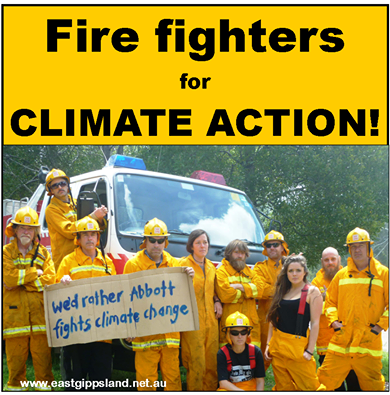 Ideology aside, firefighters find themselves at the front line of climate impacts, and we are well aware that something is going on and conditions are gradually worsening. Of course climate change is not the only factor making firefighters’ work more and more challenging, but there’s no question that increasing temperatures and increasing drought conditions are a big part of the problem.
the United Firefighters Union will join with tens of thousands of Australians this weekend at the People’s Climate Marches taking place all over Australia.
More dangerous bushfires in our future if we don’t take action on climate change http://www.smh.com.au/comment/more-dangerous-bushfires-in-our-future-if-we-dont-take-action-on-climate-change-20151119-gl2rq5.html November 26, 2015 Peter Marshall and Victoria McKenzie-McHarg There are no climate change sceptics at the end of a fire hose.
Australia’s firefighters know from first-hand experience that climate change has led to more frequent and more intense fires. It has also made our fire seasons longer.
Every day, firefighters go into situations as others flee in the opposite direction. Firefighters’ jobs are already dangerous. But we are increasingly concerned that changing climate conditions are increasing this danger.
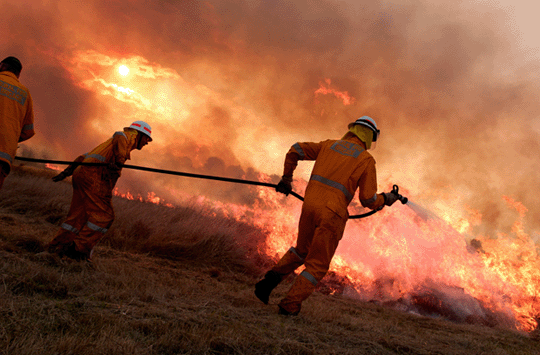
This summer is on track to be one of the worst on record for fires. The US National Oceanic and Atmospheric Administration rates it as a 97 per cent chance that 2015 will be the hottest year on record – and it looks like it will be the hottest by quite a wide margin. Continue reading
Low Carbon Economy Expert Panel report – boost renewables, No to nuclear
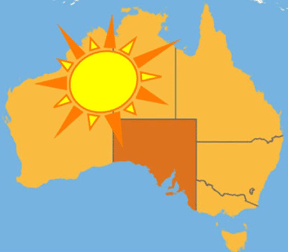 Low Carbon Economy Expert Panel report recommends South Australia move quickly to 100 per cent green energy production, Sheradyn Holderhead Political Reporter The Advertiser November 25, 2015 SOUTH Australia should produce 100 per cent green energy “relatively quickly” using a mix of solar, wind and other sources but not a nuclear power station, a report recommends.
On releasing the Low Carbon Economy Expert Panel report today, Premier Jay Weatherill said the State Government would adopt a target of zero net carbon emissions by 2050.
But Mr Weatherill is yet to map out exactly how the state will reach that target, as the Government is still to respond to more detailed recommendations in the report.
They include:
SET a goal of 100 per cent renewable electricity within, a timeframe to be decided, that could be done relatively quickly, capitalising on the abundance of solar, wind, oceanic, geothermal and bioenergy resources.
EXPAND the state’s renewable energy generation to the point where a significant amount is exported interstate.
DEVELOP and manufacture cost-effective energy storage technology, which is critical for a stable renewable electricity supply and could also become a new industry for the state.
SIGN the Under 2 memorandum of understanding, making SA a part of the growing group of sub-national governments making a commitment to contribute to limiting global warming to 2°C.
CONSIDER implementing a state-based emissions trading scheme linked to California’s ETS, which could be politically and economically attractive to California and provide significant benefits for SA.
INTEGRATE curriculum in schools, universities and TAFE colleges about carbon pollution, green energy and related technologies.
The report also noted that nuclear power stations generally need to be of a certain size to be cost effective and should not be considered for use in smaller states such as SA.
Former Federal Liberal leader John Hewson headed the panel, which also included Anna Skarbek of ClimateWorks and Australian National University’s Frank Jotzo……http://www.adelaidenow.com.au/news/south-australia/low-carbon-economy-expert-panel-report-recommends-south-australia-move-quickly-to-100-per-cent-green-energy-production/story-fni6uo1m-1227622467473
Residents near proposed Northern Territory nuclear dump site will oppose it
questions about what kind of intermediate-level waste would be stored 15 kilometres from their house and garden have not been answered.
“Originally it was just low-level and then they brought in intermediate and when we queried what intermediate was we couldn’t get an answer,” Mr Rossignol said.
“Then halfway through a conversation they said intermediate and low level,” he said.
Neighbours of proposed NT nuclear waste dump upset at ‘lack of consultation‘ http://www.abc.net.au/news/2015-11-25/neighbours-of-proposed-nuclear-dump-upset-lack-of-consultation/6972048 By Rosa Ellen Neighbours to a proposed nuclear waste site south of Alice Springs are upset they were not consulted by the property’s owner and say they will oppose it.
The Aridgold date farm in Hale, 75 kilometres from Alice Springs, is one of six sites shortlisted to house the country’s low-to-intermediate level radioactive waste.
Bordering the date farm is a land trust made up of three homesteads, the closest of which is the Oak Valley Outstation owned by Mary Le Rossignol and her husband Robert, who are also traditional owners.
Ms Le Rossignol said she first heard Tim Micklem, their neighbour of 30 years, had nominated his property as the country’s next nuclear waste dump on ABC Local Radio.
“I was angry because we live right next door to him,” Ms Le Rossignol said. “It just hit me hard, because I honestly expected people to go around and talk to your neighbours and let them know what was going on.
“But that didn’t happen here.” Continue reading
The hypocrisy of Malcolm Turnbull and Greg Hunt at Paris climate summit
 Paris 2015: Hunt says climate change action at Paris talks a ‘deeply personal
 goal’
goal’
Clinching a global deal in Paris to keep global warming below two degrees is a “deeply personal goal” and climate change inaction is “not an option”, Environment Minister Greg Hunt is expected to say on Wednesday. – Sydney Morning Herald, 25/11/15
Don’t be a climate coward PM – Greens
The Greens have warned Malcolm Turnbull not to be a “climate coward” at global talks in Paris.
The prime minister had one last chance to prove he was not a weathervane on climate change like his predecessor Tony Abbott, Greens MP Adam Bandt told reporters in Canberra on Tuesday.
“He’s going to Paris with a big black rock around his neck,” he said, citing the government’s approval of the southern hemisphere’s biggest coal mine Adani Carmichael.http://www.sbs.com.au/news/article/2015/11/24/dont-be-climate-coward-pm-greens
Michael Brull: Before Adopting Them As PM, Malcolm Turnbull Called Bullsh*t On The Coalition’s Climate Change Plans
In 2010 Turnbull helped launched a report calling for a zero emissions future. He understands the threat climate change poses, he just doesn’t seem to care anymore
https://newmatilda.com/2015/11/24/before-adopting-them-as-pm-malcolm-turnbull-called-bullshit-on-the-coalitions-climate-change-plans/
‘Captain’s call’ plea as more CSIRO job cuts loom on eve of PM’s address to Paris climate summit Some of Australia’s leading climate research programs are under threat even as Prime Minister Malcolm Turnbull prepares to address world leaders at next week’s global climate summit in Paris.
http://www.theage.com.au/environment/climate-change/captains-call-plea-as-more-csiro-job-cuts-loom-on-eve-of-paris-climate-summit-20151124-gl6jsy.html
Economics stack up well for the Greens’ renewable energy plans
 The Greens’ plan for 90% renewables by 2030 sounds hard, but it stacks up, The Conversation, Andrew Blakers Director of the Centre for Sustainable Energy Systems (CSES) , Australian National University, November 24, 2015 The Australian Greens this weekend announced a target of 90% renewable electricity by 2030 – pledging to go further than Labor, which has already backed a target of 50%. How hard is it to reach these targets?
The Abbott government made plain its dislike of renewable energy by reducing the renewable electricity target (RET) for 2020 to 33 terawatt hours (TWh) of new renewable electricity.
Under this target, about 24% of electricity will come from renewable sources in 2020, comprising existing renewables (mostly hydro-electricity with some biomass) and new renewables (mostly wind energy and photovoltaic (PV) solar energy). It’s straightforward to calculate the annual additions (gigawatts, GW) of wind and PV required to hit a 50% or 90% RET in 2030……..
The corresponding figures for Labor’s target of 50% by 2030 are 1.2 GW of PV and 0.8 GW of wind per year.
An achievable prospect
Labor’s target is a straightforward prospect. In years gone by, Australia has installed this much PV and wind in a year, and can readily do so again. It is not much more than the installation rate needed to meet the 2020 RET.
The Greens’ target, meanwhile, is about 2.5 times more challenging than Labor’s, but still readily achievable. The Australian Capital Territory and South Australia have shown the way by adding new renewable electricity capacity equivalent to 90% and 40% respectively of their annual electricity consumption – mostly over a period of about 5 years. There are no practical constraints in terms of land because of Australia’s vast solar and wind resources.
Australia’s electricity system is becoming increasingly renewable. Continue reading
South Australian govt has already ruled out nuclear power
 from “Adelaide Arclight”, 25 Nov 15 , There is barely a mention of nuclear power in the 53 page Panel’s final report from the South Australia Low Carbon Economy Experts Panel. You have to hunt to find:
on page 22:
“In the high-level analysis for South Australia undertaken for the Panel, the CCS and nuclear scenarios were not considered, and all data was derived from the 100% renewable scenario.”
“Given South Australia’s abundance of wind and high solar rating (DNI), South Australia has the capacity to move to 100% renewable energy more quickly than other States and has already made significant progress in decarbonising its electricity supply utilising these advantages.”
On page 24 it states:
“The modelling for the Panel did not include consideration of whether the nuclear and carbon capture and storage scenarios modelled at the national level are a cost-effective means to move to low carbon electricity for South Australia. The Deep Decarbonisation Pathways modelling found that nuclear power stations generally need to be of a certain size to be cost effective and thus precluded their consideration for use in smaller States such as South Australia.”
Can we take it from this that the nuclear scenario is already off the table entirely? The Premier’s and Minister Hunter’s joint press release is vague talking about “zero net emissions” and “low carbon economy”, but in context their endorsement of the report would seem to undercut any push for nuclear energy, leaving the Nuclear Fuel Cycle Royal Commission with just an expansion of uranium mining and nuclear waste dumps to consider.
Given that the Nuclear Fuel Cycle Royal Commission is in progress and that one of the report’s authors gave evidence at a public hearing, it can hardly be an oversight that nuclear was not considered.
Renewable energy is the star – throughout the report:
“…….South Australia can greatly expand its renewable energy generation, to the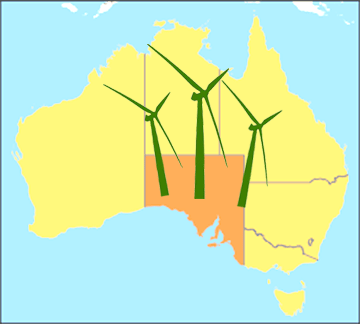 point where on balance over the year all of the State’s electricity comes from renewables and a significant amount is exported interstate. According to the Panel’s preliminary analysis, this could occur relatively quickly. South Australia can therefore set an indicative goal of 100% renewable electricity with the timeframe to be decided. The timeframe will depend on expansion of interconnectors, costs of renewables and extent of support for renewable energy federally. The share of renewables in South Australia is expected to be double that in the National Electricity Market at any point in time up to 100%. Action….”
SOUTH AUSTRALIA’S LOW CARBON ECONOMY EXPERTS PANEL Findings and recommendations
2015 http://www.environment.sa.gov.au/Science/Science_research/climate-change/climate-change-initiatives-in-south-australia/sa-low-carbon-economy-experts-panel November 2015 With an economy in transition, changes in the national and international policy environment, and key strengths in renewable energy, South Australia has the opportunity to transition to a low carbon economy.
To maximise this opportunity, the South Australian Government appointed a panel of experts to provide independent advice about climate change targets and objectives for the State to 2050. The Panel was also asked to recommend key strategies to meet these objectives and ensure that the SA economy is best placed to adjust to a carbon constrained future. The Panel members were Dr John Hewson, Anna Skarbek and Frank Jotzo.
The Panel’s final report was released on 25 November 2015. The Panel found that it is feasible for South Australia to achieve a target of net zero emissions by 2050 and that a commitment to this target will position South Australia well in a low carbon world.
South Australia to aim for zero emissions by 2050
 Premier Jay Weatherill Minister Ian Hunter Minister for Climate Change , 24 November, 2015
South Australia will adopt a target of zero net emissions by 2050, as recommended in a report by the Low Carbon Economy Expert Panel released today. The Panel consisting of John Hewson, Anna Skarbek of ClimateWorks and Frank Jotzo of the Australian National University recommends that South Australia:
SIGNALS the transition to a zero net emissions economy by 2050
SUPPORTS the community and industry to transition to a zero net emissions economy
IMPLEMENTS the transition by taking action now
PremierJay Weatherill said being the first to signal this intention to Australian and overseas investors will give South Australia a competitive advantage. “As we head towards the Paris Climate Change Conference, South Australia has an opportunity to place itself at the forefront as a leader in transitioning to a low carbon economy,” Mr Weatherill said. “The Expert Panel’s report is a roadmap for our State to reduce emissions in a way that supports job growth in new and emerging green technologies. “
One example is the potential for South Australia to be a low carbon electricity powerhouse and a net exporter of renewable energy. “The state’s abundant renewable electricity combined with its rich resource base and existing manufacturing expertise mean that the state could be a natural base for energy intensive mining and manufacturing industries in a low carbon world.”
Minister for Climate Change Ian Hunter said the Expert Panel also identified the state’s strengths in education and the potential for these to be applied to developing the skills and workforce for a carbon constrained future. “This means providing assistance for workers moving from industries in decline into new opportunities is critical as is support for communities affected by rapid change,” Mr Hunter said.
“There are also significant innovative market opportunities for energy storage solutions from the state’s high penetration of solar PV, with the potential to attract and develop technology suppliers and expertise in the state.” Minister Hunter said the Government would not seek to implement a State based emissions trading scheme – favouring a national scheme
“Consensus for global action on climate change should be a trigger for the Federal Government to revisit the important issue of a nationwide ETS,” Mr Hunter said. “We believe this is the most practical approach to this question and will not seek to implement an ETS at the State level.” Further details of South Australia’s efforts to tackle climate change, including responses to the other recommendations, will be detailed in the soon to be released new Climate Change Strategy for the State. The South Australian Low Carbon Experts Panel report is available at www.environment.sa.gov.au
Senator Scott Ludlam in Parliament, on the sale of uranium to India
“……One of the most striking differences between the uranium market and those other commodity markets which Australians might be more familiar with and the one which the industry is most determined to deny is the link with weapons of mass destruction. In September this year this parliament’s Joint Standing Committee on Treaties handed down a unanimous report on the proposed nuclear cooperation agreement with India…..
The unanimous recommendations, in essence, say that there should not be uranium sales to India by Australia at this time under the terms of the current agreement. They made those recommendations on the advice of, among others, very senior former Australian officials from within the nonproliferation world who cautioned that the nuclear cooperation agreement:
… has a number of loopholes which mean that under the terms of the NCA India could use our uranium in the production of material that could end up in bombs……..
India is engaged in an active nuclear weapons arms race with its neighbour Pakistan, and just under one and half billion people live in these two countries.
Australia seems determined to circumvent and undermine the only disarmament and nonproliferation framework that the world has, just in order to open up another market for the desperate uranium sector…… Far away, on the other side of the world, in United Nations meetings in Geneva and New York, which our government assumes will never filter back to Australia, we are quietly sabotaging the first hopeful signs in a long while of global resolve in this area. The UN General Assembly’s First Committee recently voted overwhelmingly in favour of an Austrian sponsored resolution to fill the legal gap for the staged prohibition and elimination of nuclear weapons. This resolution was based on the careful study of the unthinkable humanitarian consequences of the use of these weapons. As a result, early in 2016, serious negotiations will get underway in Geneva to scope the elements of a global treaty banning these weapons. Why did Australia vote against this initiative? How many people in this country are even aware that that is what Australia’s diplomats were instructed to do by the Turnbull government?……
The third issue that the miners would probably prefer that we did not point out is that their industry, even at the primary end, at the mining end, is in very deep trouble not just because of the catastrophe that overwhelmed Japan’s Pacific coast on 3/11 but because peak nuclear was in the year 2002. Europe is on its way out. Japan is out. France is trying to work out how to drawn down and not have to replace the nuclear reactors it built in such a rush in the 1970s and 1980s. Germany is getting out. Italy has already got out. These are the things the uranium miners would probably prefer we did not talk about. The Beverley uranium mine is over. The Honeymoon mine in South Australia is over as well. The Roxby Downs expansion is cancelled. The Ranger 3 Deeps proposed expansion in Kakadu National Park in the Northern Territory, which I had the good fortune to visit about this time last week, is cancelled. The Jabiluka deposit will never be mined. The Koongarra deposit has been reincorporated into Kakadu National Park. Colleagues, are you seeing a pattern here because I am? This is an industry that is on its last legs and it is just as well.
Hosting nuclear waste – a liability in the long run, and a dangerous one
Wasting Australia’s future, Green Left , November 20, 2015 By Jim Green“………Profits from nuclear waste?
It is no secret that the driving force behind the South Australian Nuclear Fuel Cycle Royal Commission is the idea that the state could make billions from storing or disposing of high-level nuclear waste from power reactors around the world.
Accepting nuclear waste might be profitable. Or it might not. Most likely, it would be profitable in the short-term and a liability in the long-term.
Proponents are talking up the billions that might be made by making Australia the world’s nuclear waste dump, but they have said little about costs. Since the volume of waste would presumably be large, the cost of a deep underground repository for high-level nuclear waste would likely be in the tens of billions of dollars. Plans for a high-level waste repository in Japan may be comparable: the estimated cost is ¥3500 billion (A$40.8 billion).
The US wasted $10 billion on the plan for a deep geological repository for nuclear waste at Yucca Mountain in Nevada before abandoning the project. In 2008 the US Department of Energy estimated that the cost of construction and operation of Yucca Mountain over a 150 year period would be US$96 billion (A$135 billion).
The waste would need to be monitored and problems addressed for millennia: it takes about 300,000 years for the radioactivity of spent nuclear fuel to fall to that of the original uranium ore. The annual cost of monitoring waste might be modest; the costs over millennia would be anything but.
Explosion in deep underground repository
The idea that nuclear waste can be safely disposed of in a deep underground repository has been shot to pieces by an explosion in the world’s only deep underground repository for nuclear waste: the Waste Isolation Pilot Plant (WIPP) in the US state of New Mexico. Continue reading
Civil Contractors Federation SA want to save town Leigh Creek by hosting nuclear dump
Call to store nuclear waste at Leigh Creek http://www.9news.com.au/national/2015/11/24/10/29/call-to-store-nuclear-waste-at-leigh-creek A nuclear waste dump should be built at Leigh Creek in the South Australian outback before it becomes a ghost town, the state’s peak civil construction body says.The federal government has short-listed six sites – two on the Eyre Peninsula and another in SA’s mid-north – for Australia’s first permanent nuclear waste dump for low-level and intermediate domestic waste.
The Civil Contractors Federation SA says putting a nuclear waste dump near Leigh Creek would be a “no brainer” and guarantee its survival after Alinta Energy last week shut down the town’s coal mine, shedding about 200 workers.
Chief executive Phil Sutherland says the facility could also be used to store and convert other industrial waste into energy and fuel.
The proposal bypasses the commonwealth in favour of the state government, which is holding a Nuclear Fuel Cycle Royal Commission.
“All the SA government needs to do is simply show some mettle and bite the bullet to give Leigh Creek a purpose before the township transitions into a ghost town,” Mr Sutherland said.
Vested interests stop universities from divesting in fossil fuels
This places them behind faith organisations, not for profits, local councils, banks, superannuation funds and a host of others moving capital away from fossil fuels.
Why is this?
Strong links to the mining sector have put universities in a difficult position.
They are conflicted between climate concerns and the income they derive from vested interests with big mining companies.
While many Australian universities engage in the climate change debate, their commitment to divestment has, at best, been minimal. Continue reading
Indigenous Australians Western Australian group at Paris UN climate talks
Rising sea levels and global temperatures could impact on Kimberley Aboriginal groups, who potentially face hotter and more frequent bushfires, affecting traditionally significant animal and plant life.
WA group represents Indigenous Australia at UN climate change conference http://www.abc.net.au/news/2015-11-24/wa-groups-heads-to-climate-change-conference/6971072 By Natalie Jones A group of leaders from Northern WA is heading to the United Nations Conference on Climate Change (COP21) in Paris to be the voice of Indigenous Australia.
The Kimberley Land Council (KLC) group of five will be led by KLC chairman Anthony Watson, who is also the Australian delegate to the Indigenous People’s Forum on Climate Change.
“I’ll be with the Pacific Islanders. They have a lot of concerns about their islands going underwater and they’ll be raising their concerns and I’ll be supporting them in whatever way I can,” Mr Watson said. Continue reading
Dr Edwin Lyman: Direct nuclear waste disposal is best: pyroreprocessing has dangers
 In the second part of his evidence to South Australia’s Nuclear Royal
  Commission, Dr Lyman explains that direct disposal is the safest and the most prudent approach for nuclear power. In recycling, as in pyroreprocessing, the risks outweigh the benefits.
Dr Lyman has studied pyroreprocessing in great detail. The fact that its products are highly radioactive does not act to deter thieves, especially those aiming to use these products for weapons proliferation.
Also, “the IEA is still struggling to provide even technical approaches for how you would get weapons grade accountancy in pyroprocessing, and that’s a great concern”……”Many minor actinides that would be in the pyroprocessing product are also weapons useable “… “It’s also easy, if that combination were to be stolen, to separate out plutonium from the minor actinides”.
Lyman describes the pyroreprocessing process as an “unmanageable enterprise”. The United States decided not to pursue re-processing and fast reactors in the 1970s, for these very same risks of terrorism and weapons proliferation.
SA NUCLEAR FUEL CYCLE ROYAL COMMISSION DR EDWIN LYMAN, Union of Concerned Scientists TRANSCRIPT OF PROCEEDINGS ADELAIDE 7.30 AM, TUESDAY, 17 NOVEMBER 2015 DAY 23
The Commission’s first witness today, Dr Edwin Lyman, is a senior scientist in the global security program at the Union of Concerned Scientists in the United States. His areas of interests include nuclear proliferation, terrorism and nuclear power safety and security, and he’s published articles in a number of 5 journals and magazines on these topics. Dr Lyman is a member of the Institute of Nuclear Materials Management and has given evidence before the US Congress and Nuclear Regulatory Commission, the NRC, on multiple occasions. 10 Prior to joining the Union of Concerned Scientists, Dr Lyman was president of the Nuclear Control Institute, the CI, in Washington, an organisation concerned with nuclear proliferation. The Commission calls Dr Edwin Lyman……..
The transcript of Dr Lyman’s interview can be read at http://nuclearrc.sa.gov.au/app/uploads/mp/files/videos/files/151117-topic-14-day-1-transcript-full.v5.pdf
Dr Edwin Lyman at Nuclear Royal Commission, speaks on waste transport problems.
Dr Lyman’s evidence can be pretty heavy going for the non technical reader. First, he explained safety problems in standards for transportation casks for land or sea shipment of spent fuel, high-level radioactive waste and specially with materials like plutonium or plutonium oxide. These standards have not been updated over many decades, and the USA Nuclear Regulatory Commission (NRC) has not yet carried out tests intended to address this problem.
If a transport package of radioactive material is lost in the ocean, it could lead to significant long term contamination, if the package is not retrieved.
With increased transport, and speed of transport, of radioactive wastes, the risk of such accidents is increased, and the NRC would have confidence in the current standard for transporting wastes.
Apart from accidents, the other big danger is terrorism.
SA NUCLEAR FUEL CYCLE ROYAL COMMISSION DR EDWIN LYMAN, Union of Concerned Scientists TRANSCRIPT OF PROCEEDINGS ADELAIDE 7.30 AM, TUESDAY, 17 NOVEMBER 2015 DAY 23
The Commission’s first witness today, Dr Edwin Lyman, is a senior scientist in the global security program at the Union of Concerned Scientists in the United States. His areas of interests include nuclear proliferation, terrorism and nuclear power safety and security, and he’s published articles in a number of 5 journals and magazines on these topics. Dr Lyman is a member of the Institute of Nuclear Materials Management and has given evidence before the US Congress and Nuclear Regulatory Commission, the NRC, on multiple occasions. 10 Prior to joining the Union of Concerned Scientists, Dr Lyman was president of the Nuclear Control Institute, the CI, in Washington, an organisation concerned with nuclear proliferation. The Commission calls Dr Edwin Lyman……..
The transcript of Dr Lyman’s interview can be read at http://nuclearrc.sa.gov.au/app/uploads/mp/files/videos/files/151117-topic-14-day-1-transcript-full.v5.pdf
1 This month
17 October, Free Public Talk on Nuclear Issues in South Australia
David Noonan will speak on public interest concerns over the new Roxby Downs Indenture Act 2026 on BHP copper-uranium mining and ore processing in SA, and on how AUKUS may face SA with a High-Level nuclear waste agenda.
Dr Jim Green will discuss international developments in the field of nuclear power including ‘small modular reactors’ and Generation 4 ‘advanced’ nuclear reactor concepts.


Help Aunty Sue Protect Her Land and Sacred Sites From Destructive Rocket Testing.
.

Australians deserve the truth
about
AUKUS – https://aukuspublicinquiry.com/

PETITION – To: Prime Minister Anthony Albanese and the Australian Labor Government

of the week – Australians for War Powers Reform (AWPR)
To see nuclear-related stories in greater depth and intensity

