We might need a Senate inquiry into ultrasound from trees etc
If the committee is sincere in its concerns about the health effects of infrasound, will we soon learn of a new inquiry about the pernicious and unappreciated dangers of living near the sea or trees, having air conditioners, stereos, ceiling fans, or travelling in motor vehicles?
What’s next, a Senate inquiry into infrasound from trees, waves or air conditioners?, The Conversation, Simon Chapman Professor of Public Health, University of Sydney November 18, 2015 At the centre of claims about wind farms allegedly causing health problems is the infrasound that wind turbines generate as they turn in the wind.
Infrasound is sound below 20Hz, which is generally inaudible. Wind turbines are just one source of artificial man-made infrasound. Others include power stations, industry generally, motor vehicle engines, compressors, aircraft, ventilation and air conditioning units, and loudspeaker systems. Everyone living in an urban environment is bathed in infrasound for most of their lives.
As I sit at my inner Sydney desk writing this I’m copping infrasound from the planes that pass some 200-300 metres over my house sometimes many times an hour, the sound of passing road traffic on a quite busy road 100 metres from our house, and the stereo system I listen to as I write. Don’t tell anyone, but I feel fine and I’ve lived here 25 years.
But infrasound is generated by natural phenomena too. These include rare occurrences such as volcanoes and earthquakes, but also sources like ocean waves and air turbulence (wind) that countless millions, if not billions, are exposed to on most days. Anyone living close to the sea is surrounded by constant infrasound from waves.
The inclusion of wind as a source of infrasound is of particular significance to claims made that wind turbine-generated infrasound is noxious. In a Polish research paper published in 2014, the authors set out to measure infrasound from wind turbines and to compare that with naturally occurring infrasound from wind in trees near houses and from the sound of the sea in and around a house near the seaside…….
Wind is, of course, a prerequisite for wind turbines to turn and generate their mechanical infrasound. Here, the Polish authors noted that:
natural noise sources … always accompany the work of wind turbines and in such cases they constitute an acoustic background, impossible to eliminate during noise measurement of wind turbines.
This is a fundamentally important insight: wherever there are wind turbines generating infrasound, there is also wind itself generating infrasound. And it is impossible to disentangle the two. Indeed, every time I’ve been near wind turbines, easily the most dominant sound has been that of the wind buffeting my ears. Continue reading
Moree solar farm operational by end of 2015
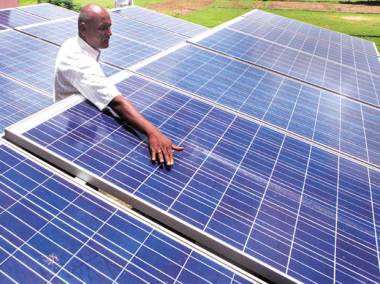 Energy generation expected at Moree Solar Farm by year’s end, ABC News, 17 Nov 15
Work is nearly complete on the Moree Solar Farm with an expectation energy will be generated at the site by the end of the year. A spokesman for the company behind the project, Fotowatio Renewable Ventures, said there’s just a few tasks left to do on site.
“The Moree Solar Farm is entering the final stages of construction,” Technical manager Tom Best said.
“We’ve finalised the installation of the PV modules and the tracking system and we’re currently undertaking commissioning of the PV plant with a view to start generating energy by the end of the year.”
The project is led by FRV and has been funded with assistance of a $102 million grant from Australian Renewable Energy Agency and $47 million in debt financing from the Clean Energy Finance Corporation…….
The solar farm is expected to supply 15,000 homes. http://www.abc.net.au/news/2015-11-17/production-expected-at-moree-solar-farm-by-year27s-end/6946716
Canberra researchers seek information from solar home-owners
Solar panels installed on homes across ACT needed by researchers for local power study 666 ABC Canberra By Hannah Walmsley with Philip Clark, 19 Nov 15 Researchers at the Australian National University (ANU) are calling for volunteers across the ACT who have solar panels on their house to take part in a new study. This project will allow us to predict what will be fed into the grid at a particular time. Dr Christfried Webers
ANU researchers are collaborating with Data61’s Machine Learning Research Group — formerly National ICT Australia (NICTA) — to develop methods of forecasting power output from rooftop solar energy systems.
Dr Christfried Webers from the ANU’s College of Engineering and Computer Science said that while total energy output could be measured over long periods, little was known about changing energy output across the day. “What we need is to be able to predict how much energy will be produced over five minutes to 60 minutes,” he said.
“That’s necessary information for the energy market operator — they need information on what’s coming from hour to hour. “It’s also important for the local utility providers because they have a spinning reserve running and if they can anticipate an energy drop, they can ramp that up when they need to.”
Close to 13 per cent of households in the ACT have solar panels generating power. “If that reaches 30 per cent, it will become vital to predict what energy will be produced to ensure the stability of the grid,” Dr Webers said. How the weather can impact
Dr Webers said he hoped the project would allow his team to develop software to forecast the solar output from each suburb using low-cost data-logging devices installed on individual homes…….Canberra residents interested in participating in the project can register their interest with NICTA. http://www.abc.net.au/news/2015-11-17/volunteers-wanted-for-canberra-solar-panel-study/6946904
Australia’s really big radioactive waste dump is at Roxby Downs
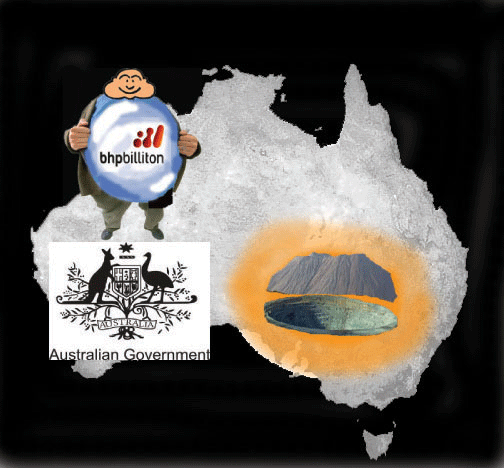
Dennis Matthews, 19 Nov 15, In the 1980’s we were repeatedly told not to worry about uranium mining at Roxby, that Roxby was a copper mine and that uranium was incidental. Now we are being told that Roxby has the world’s largest deposit of uranium.
Despite strong public opposition, mining at Roxby got the nod from politicians. Soon radioactive water started leaking through the un-sealed base of the tailings dam, and now BHP is building an ever-expanding man-made stockpile of radioactive waste.
Paul Starick (The Advertiser, 13/11/15) downplays the fact that we have a nuclear reactor, stating that Australia has no nuclear power reactor, a distinction that has little to do with the issue. Using the “nuclear medicine” mantra, Starick downplays the main role of a nuclear waste dump, namely to deal with highly radioactive waste from Australia’s nuclear reactor, which will open the door to international waste.
The small amounts of relatively benign low-level waste being safely stored in institutions around Australia is trivial compared to BHP’s massive stockpiles of waste at Roxby and Australia’s nuclear reactor waste.
What are the radioactive risk of nuclear waste dump to a farming community?
Jim Green Friends of the Earth, 18 Nov 15 Responding to these questions: “So what are irradiation cans, ion exchange resins and aluminium ends of fuel rods and what dangers do they present to those living in a farming community? Is anyone able to inform me or direct me to where I can find such information please?”
They are harmless metals (irradiation cans + aluminium ends of fuel rods) and resins/polymers … but hazardous because of contamination with radioactive substances. For the contaminated metals they are likely contaminated with long-lived alpha-emitting radionuclides and would likely be classified as long-lived intermediate-level waste (LLILW) and would therefore be sitting in an above-ground shed at Kimba for an ‘interim’ period likely to last for many decades since absolutely no effort is being made to find a disposal site for LLILW (it is destined for deep underground disposal).
The risks …. pretty much anything you can imagine has happened at one or another radioactive waste repository around the world: fires, leaks, water infiltration and corrosion of waste drums, a chemical explosion, etc.
Fire would be a particular concern at Kimba, all the more so since the most hazardous waste (LLILW) would be stored above ground. Articles about recent fires at U.S. repositories are posted at: http://www.foe.org.au/fire
Water infiltration and corrosion is a difficult dilemma. Continue reading
South Australia’s radioactive threat: it’s not “medical” waste – it’s nuclear waste from used fuel rods
Freydenberg said the facility would ‘only’ house low and intermediate level waste. Perhaps he is unaware of the toxicity of this LLILW. Dr Green again: ‘When the spent fuel is removed from the reactor, it is high-level nuclear waste. After some months it cools down and falls below the heat criterion so is reclassified as LLILW.’
The farmer opponents of the Kimba sites are right to be concerned. The spent fuel reprocessing waste will be hazardous for thousands of years.
 South Australia’s nuclear threat continues http://www.eurekastreet.com.au/article.aspx?aeid=45708#.VkuCE9IrLGh Michele Madigan | 17 November 2015
Last Friday 13 November, the federal government released the shortlisted sites of the proposed national radioactive waste facility. No surprise that three are in South Australia, the ‘expendable state‘: Cortlinye and Pinkawillinie near Kimba on Eyre Peninsula, and Barndioota near Hawker, north of Port Augusta.
I wonder if South Australians aren’t beginning to feel like nuclear particles themselves, bombarded on all sides by the nuclear industry. This announcement from the federal government about its nuclear repository plans comes as the state government continues to consider, through its Royal Commission, whether, when and where South Australia will offer to host the world’s high-level nuclear waste.
The six names on the federal government shortlist (the remaining three being Sallys Flat in NSW, Hale in the Northern Territory and Oman Ama in Queensland) are taken from an original list of 28 properties that were offered by their landowners. It’s disturbing to find that the owner of the Cortilinye site, at least, has been misinformed,believing ‘It’s basically only a medical waste facility.’
In reality, only 10–20 per cent of the radioactive waste is medical in origin. And nuclear medicine is in no way affected by the lack of a national repository.
Resources and energy minister Josh Freydenberg’s Friday announcement included a masterly sentence of understatement: ‘Low level waste is those gloves or those goggles or the paper or the plastic that comes into contact with nuclear medicine, and intermediate waste could be, for example, those steel rods that are used in the reactor to actually create these particular products.’
It’s interesting to notice what’s different and what stays the same from the 1998–2004 ‘dump’ campaign in SA. Continue reading
Indigenous Australians fight Liberal bigwig Grant Chapman’s plan for radioactive trash dump
 Indigenous groups to fight plan for Flinders Ranges nuclear dump THE AUSTRALIAN NOVEMBER 18, 2015 Michael Owen Aborigines in the northern Flinders Ranges of South Australia are vowing to fight any move to make a site owned by a former senator the home of a national nuclear waste dump.
A group representing the Adnyamathanha people yesterday said it was fiercely opposed to any expansion of the nuclear industry. The group was shocked that Barndioota, along the Leigh Creek railway to Port Augusta, was one of six sites, including three in South Australia, being considered by the federal government to store low and intermediate-level nuclear waste.
Former senator and state Liberal Party president Grant Chapman jointly owns the long-term lease to
Wallerberdina, a station near Barndioota in the Flinders Ranges. If the site were chosen, it would house a storage facility over about 100ha in the northern section of the 25,000ha property.
Adnyamathanha Camp Law Mob spokeswoman Jillian Marsh yesterday said there was no support for the “imposition of a radioactive waste dump on Adnyamathanha country”.
“We are shocked that one of the three nominated sites in South Australia … is 377 Wallerberdina Road, Barndioota,” Ms Marsh said. “We understand that ex-Liberal senator Grant Chapman is the current owner of the nominated site that is a perpetual lease property and therefore no native title claim can be lodged.”
Public meeting in Oman Ama vents opposition to nuclear waste site proposal
 Southern Queensland community Oman Ama vents fears over potential nuclear waste site, ABC News, 18 Nov 15 Residents of a Queensland southern border community earmarked for a nuclear waste dump have gathered for a public meeting to voice concerns about the proposal.
Oman Ama, near Inglewood, is one of six sites shortlisted to host the country’s first permanent nuclear waste dump.
It comes with a $10 million sweetener but that is not enough to convince many local residents of the small rural community……The Federal Government wants one site in Australia and is due to make a decision by the end of 2016, with the site operating by 2018, or 2020 at the latest.
Government experts are trying to allay their fears with claims the dump will not be built anywhere if there is an environmental risk.
Oman Ama locals mainly asked about the risk if the waste escapes, how long it took to break down, what happens in a flood and how can they be sure it is safe.
Some yelled out their opposition, which drew claps from the audience.
Gavan Lahey said he was concerned the local catchment would be polluted……..http://www.abc.net.au/news/2015-11-18/oman-ama-vents-fears-over-potential-nuclear-waste-site/6952492
Despite warnings, Malcolm Turnbull, in Turkey, announces uranium deal with India
 Australia – India Civil Nuclear Deal Finalised Amidst Warnings, Australia Network News, 17 Nov 15 In 2014, India and Australia signed the civilian nuclear cooperation agreement during then Australian PM Tony Abbott’s visit to New Delhi. Now, his successor, Australian PM Malcolm Turnbull, told PM Narendra Modi on Sunday that procedure for the deal had been completed and could now be implemented…….The significant part of the civil nuclear cooperation agreement was that Australia agreed to become “a long-term reliable supplier of uranium to India.”…..
However, a Huffington Post piece suggests it was only around two months ago that the Joint Standing Committee on Treaties delivered a well-considered report into Australia’s controversial plan to sell uranium to India. The government-controlled Committee identified a number of practical steps & recommendations needed to address safety, security and legal uncertainty around the deal.
According to Dave Sweeney, earlier this week, the government chose to ignore these recommendations — emphatically stating that “the Government does not accept the Committee’s recommendation that exports of uranium to India should be deferred.” http://www.australianetworknews.com/australia-india-civil-nuclear-deal-finalised-amidst-warnings/
Investors urged to dump Toro Energy at company AGM
 Conservation Council of Western Australia, 18 Nov 15, Traditional Owners and environment groups will ask shareholders to withdraw support for Toro Energy highlighting community opposition to the company’s uranium mine plans and a flat lining uranium market at the Toro’s AGM today.
Vicki Abdullah, Traditional Owner of the Lake Maitland area where the company plans to mine uranium will be attending the AGM today.
Ms Abdullah said, “I’ve told Toro Energy time and time again that they are not allowed to mine at Lake Maitland, they have no right to destroy our homelands, our sacred places and the burial sites of our old people. You wouldn’t let them do that your home or your ancestors. Well I won’t let them do it to mine.”
CCWA Director Piers Verstegen, said “After ongoing weak performance we expect Toro Energy will be asking shareholders to ‘hang in there and be patient’, however the reality is that community opposition and weak market are serious impediments that are not going to go away.
“Uranium is unnecessary, unsafe and unwanted and we will be asking Toro shareholders to place their investments in more lucrative and responsible industries like renewable energy.
“Toro must also face reality and cease pressuring local communities and Traditional Owners causing anxiety and conflict over a mine that will never make economic sense” concluded Mr Verstegen.
Bega climate activist Philippa Rowland to speak at UN summit in Paris
 Community projects lead to world stage: Bega climate change activist to speak at UN summit in Paris ABC South East NSW Ian Campbell, 17 Nov 15 Philippa Rowland, one of the founding members of a regionally-based climate action group, is Paris-bound, keen to play a role in shaping a safer climate future for the world.
The United Nations Conference on Climate Changeruns from November 30 to December 11, and Ms Rowland will be there as a voice from rural Australia.
Motivated by her connection with Clean Energy for Eternity (CEFE), based in the Bega Valley of New South Wales, Ms Rowland said she would bear witness at a pivotal time in the world’s response to a warming atmosphere.
“If we turn the corner now we still have time,” she said.
Since 2006 CEFE has championed a range of renewable energy projects that have resulted in solar panels being installed on community buildings, and culminating in the Tathra Solar Farm coming online earlier this year……..http://www.abc.net.au/news/2015-11-17/bega-activist-to-address-un-climate-change-paris/6947248
Bathurst residents rally to protect Sallys Flat from nuclear waste
 Residents rally to protect Sallys Flat from nuclear waste http://www.abc.net.au/news/2015-11-18/sallys-meeting/6950152 Residents in a Bathurst district village are rallying to fight Federal Government plans to store nuclear waste on a local property. Dozens of people have attended a public meeting at Hill End yesterday to discuss the proposal to house the material at nearby Sallys Flat.
Local resident Ross Brown says more than two-thirds of the community attended and all were opposed to the waste being dumped in the area. He said they were getting advice from environmental groups and federal MPs on how to stop Sallys Flat being selected by the government.
“It’s not a place where we want it to be, at Hill End or Sallys Flat,” Mr Brown said.”We want to know how best to object to it being at Sallys Flat or Hill End.
“Most people see that if the facility is here it will devalue their land. “They’re not really happy with the process of how it was selected.”
A committee is being set up as part of the community’s efforts to stop Sallys Flat being chosen.Mr Brown said locals would do everything they could to protect the area. “They’ve all offered methods in counteracting this proposal and show that the local community are (sic) entirely against it.”
Toowoomba shop owner Peter Campbell sees nuclear waste dump as a joke
Comic book seller says nuclear waste dump for southern Queensland has great potential ABC Southern Qld ,By Peter Gunders , 17 Nov 15 Peter Campbell does not claim to be a nuclear energy expert, scientist, or waste disposal expert.
But he knows his chosen industry — pop culture — and in that capacity, he cautiously welcomes the idea of a nuclear waste dump in his backyard of southern Queensland.

Late last week Inglewood, a small town west of Toowoomba, was name-checked as one of six locations shortlisted by the Federal Government as a possible site to store low-to-intermediate level nuclear waste.
“If there’s one thing comics have taught us, it’s that we could all gain superpowers,” Mr Campbell laughed. The co-owner of Brutal Deluxe, a Toowoomba store specialising in comics and video games, said nuclear themes pervaded pop culture.
“Bruce Banner was a normal guy until he was exposed to high levels of gamma radiation, and now he’s the Incredible Hulk,” Mr Campbell said. “Right throughout pop culture, people are always being exposed to radiation.” And if any problems arose at the nuclear dump?
“Well, there is not a gamer on this planet that isn’t playing Fallout 4 at the moment,” he said.
“And that shows that so much fun can be had in a post-apocalyptic nuclear wasteland.”……..http://www.abc.net.au/news/2015-11-16/pop-culture-store-owner-says-nuclear-waste-facility-could-be-fun/6945128
The Kakadu Charter led to stopping of uranium mining
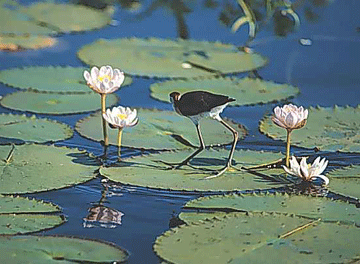 The 15th anniversary of the Kakadu Charter is a good time for Aboriginal and environmental advocates to re-confirm our shared concern, action and effectiveness for the long awaited total rehabilitation and completion of Kakadu National Park.
The Kakadu Charter Which Helped Stop A Uranium Mine Marks 15 Years Of Shared Values https://newmatilda.com/2015/11/16/the-kakadu-charter-which-helped-stop-a-uranium-mine-marks-15-years-of-shared-values/ Tomorrow marks a significant anniversary in a landmark battle to protect a people, and a place. Justin O’Brien and Dave Sweeney explain.
Continue reading
Cancer Council’s warning on sunburn
 The Cancer Council and the Australasian College of Dermatologists are joining forces this week during the National Skin Cancer Action Week http://www.cancer.org.au/preventing-cancer/sun-protection/campaigns-and-events/national-skin-cancer-action-week.html to remind Australians that damage from UV radiation adds up whether by accident or attempts to have a tan and increases the risk of skin damage and cancer
Australians’ risk for cancer-causing sunburn higher at home than the beach, study finds, IBT, By Karla Tecson on November 16 2015 Half of weekend sunburns occur while Australians are going about their day-to-day activities at home, a new study suggests.
According to Cancer Council’s National Survey, one in two adult sunburn cases occurs during daily activities such as gardening and chores around the house, along with passive recreation activities such as reading, enjoying a picnic in the park or having a barbecue. Continue reading
1 This month
17 October, Free Public Talk on Nuclear Issues in South Australia
David Noonan will speak on public interest concerns over the new Roxby Downs Indenture Act 2026 on BHP copper-uranium mining and ore processing in SA, and on how AUKUS may face SA with a High-Level nuclear waste agenda.
Dr Jim Green will discuss international developments in the field of nuclear power including ‘small modular reactors’ and Generation 4 ‘advanced’ nuclear reactor concepts.


Help Aunty Sue Protect Her Land and Sacred Sites From Destructive Rocket Testing.
.

Australians deserve the truth
about
AUKUS – https://aukuspublicinquiry.com/

PETITION – To: Prime Minister Anthony Albanese and the Australian Labor Government

of the week – Australians for War Powers Reform (AWPR)
To see nuclear-related stories in greater depth and intensity

