King Islands’s world first renewable energy success
Renewable energy a power coup for island http://www.theadvocate.com.au/story/3489296/renewable-energy-a-power-coup-for-island/ THE use of renewable energy to power King Island’s electricity supply for 33 successive hours has been hailed as a significant milestone. The latest achievement of the Hydro Tasmania’s King Island Renewable Integration project was an unprecedented milestone, project director Simon Gamble said.
“What makes this significant is that we’ve used renewable energy to support the needs of an entire community, which includes residential and industrial loads, for a full day,” Mr Gamble said.
“Our system has successfully managed the peaks in energy consumption that occur over the course of a full day, including early evening when demand is at its highest and there’s no solar contribution.
“It’s the first time anywhere that this has been achieved at a megawatt scale for such an extended period of time.”

King Island mayor Duncan McFie said the progression of the project helped to support the image of the island, and Tasmania, as clean and green.
“That King Island is leading the way on this is a highly significant achievement,” he said. Australian Renewable Energy Agency chief executive officer Ivor Frischknecht said the project was an example of how renewable energy and enabling technologies could work together to provide stable, reliable power.
“Hydro Tasmania is using a unique combination of technologies to reduce King Island’s reliance on expensive shipped-in diesel and provide residents with a more secure and reliable energy source,” he said. “This innovative energy solution could benefit off-grid communities on islands and in regional mainland Australia. “I look forward to seeing Hydro Tasmania continue to refine and commercialise its approach in other locations
Total Environment Centre’s legal challenge to South Australia solar tariff proposal
Solar penalty tariff proposal for SA households subject of Federal Court challenge, ABC News By Candice Marcus, 16 Nov 15, An environment group wants the Federal Court to uphold the energy regulator’s decision to reject a penalty tariff on South Australian households with solar power.
The Total Environment Centre has intervened in a court case in which SA Power Networks is challenging the Australian Energy Regulator.
The regulator rejected a pricing proposal for households to face a solar tariff and a social tariff, which SA Power Networks said would have been directed toward helping low-income earners facing hardship in paying their bills.
It was estimated the solar tariff could cost the average solar-powered household about $100 annually.
The Total Environment Centre lodged submissions with the Federal Court urging it uphold the regulator’s rejection of the penalty pricing proposal.
Extra tariffs would be solar ‘disincentive’
Mark Byrne from the environment group said imposing additional tariffs would be a disincentive for people to install and use solar power.
“We’ve got half a million people living under solar roofs in South Australia already though and it’s going to negatively impact on them as well as making it less advantageous for new customers to install solar,” he said.
“Obviously in the long run we want to see more solar because it helps reduce greenhouse emissions as well as household electricity bills.”
He said SA Power Networks had a flawed argument.
“Their argument effectively is that solar customers should be paying more because they use less energy and the network is entitled to a fixed amount of revenue,” he said.
“The unfortunate thing about that is it discriminates against solar customers and will result in them paying about another $100 a year.
“What the network should be doing is introducing a tariff that affects everyone equally and recovers more of their revenue during those peaks, when they’re worried about the impact on prices because they have to build more to meet peak demand.”……..http://www.abc.net.au/news/2015-11-16/court-hears-challenge-on-sa-solar-penalty-tariff-proposal/6944870
Indigenous Adnyamathanha Camp Law Mob shocked at selection of South Australian site for radioactive trash dump
Response from the Adnyamathanha Camp Law Mob regarding the Federal Resources Minister’s announcement of 3 sites nominated for a nuclear waste dump in South Australia.
The Adnyamathanha Camp Law Mob are a group of Adnyamathna people who meet regularly to discuss issues relating to our land and culture.
The Camp Law mob share this message on behalf of all Adnyamathanha people and other South Australians who are opposed to any further expansion of the nuclear industry. We have taken part in the SA Nuclear Fuel Cycle Royal Commission, and our views along with many others are clearly stated in our submission that we do not support any expansion of a nuclear industry this includes the imposition of a radioactive waste dump on Adnyamathana country at Barndioota.
We are shocked to hear on Friday 13th November 2015 that one of the 3 nominated sites in South Australia for a national nuclear waste dump is 377 Wallerberdina Road, Barndioota. We understand that ex-Liberal Senator Grant Chapman is the current owner of the nominated site that is a Perpetual Lease property and therefore no native title claim can be lodged over this area. It must still be governed according to the requirements of the Aboriginal Heritage legislation.
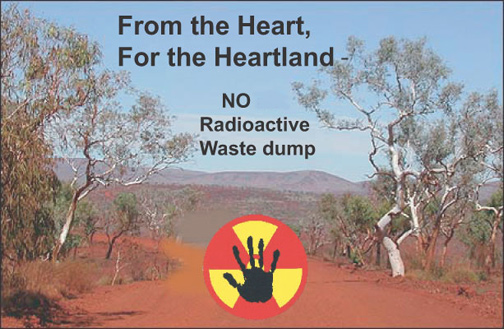
We demand that the Federal Resources Minister Josh Frydenberg publicly declare who he has consulted regarding these nomination, and who has the authority to nominate these sites.
We want to know who are the experts with local knowledge that took part in the advisory panel prior to these sites being nominated as waste sites? Who are the Traditional Owners that took part in this process? What Traditional knowledge from thousands of years of occupation has been incorporated into the decision-making?
Our involvement is this industry is nothing new. We were concerned by the government agreeing to uranium mining activities that have now permanently contaminated our land and our groundwater. We want no further expansion of the nuclear industry and we will continue to fight for our rights as Traditional Owners in respect of the wisdom of our old people that came before us.
That’s what Traditional Owners do. We care for our country. We only wish governments and industries would do the same. Stop playing with our future and care for our country.
Former Liberal Party presidnt and Senator Grant Chapman offers Grant Chapman land for high level nuclear waste dump
 Proposed Flinders Ranges nuclear site identified as pastoral property belonging to former Liberal senator Grant Chapman, ABC News, By Daniel Keane, 16 Nov 15 A former South Australian senator and Liberal Party president who jointly owns one of several proposed sites for a nuclear dump in the state said he would be willing to allow high-level waste to be stored on the property in the future.
Grant Chapman owns the long-term lease to Wallerberdina, a station near Barndioota in the Flinders Ranges about 40 kilometres north-west of Hawker, which is currently used to graze cattle.
It is one of six sites across the nation, including three in SA, being considered by the Federal Government to store low- and intermediate-level nuclear waste.
News of its potential future use has alarmed some neighbours, who are opposed to a nuclear dump and said they had not been consulted.
Mr Chapman said if approved, a proposed nuclear storage facility would eventually occupy 100 hectares in the northern section of the 25,000-hectare property.
He said he nominated the site several months ago…….Mr Chapman was a strong supporter of storing nuclear waste in Australia during his time as a senator, chairing a Senate committee into the subject.
“If it was shown to be safe for that high level waste to be eventually transformed into a form that was safe to store in that situation then certainly the property would be a potential site for that,” he said…..
Neighbour angered and concerned by location
Artist Regina McKenzie, who lives on neighbouring Yappala Station, which shares a boundary with Wallerberdina, said she and her family were angry and frustrated they had not been consulted.
Ms McKenzie said she had heard rumours Wallerberdina was being considered but was shocked when that was confirmed by the Federal Government.
She said Aboriginal people have suffered greatly as a result of the Maralinga nuclear tests and she feared history would repeat itself.
“The water here that we use, the aquifers that are under the earth, what if they get contaminated by some leakages or something?” she said.
“I don’t care how safe they say it is. If it’s so safe, why don’t they take it back and put it in their own back yards. If it’s so safe, have it in Canberra there where all the pollies sit.”
Ms McKenzie said the area was culturally significant to the Adnyamathanha people.
We don’t want [waste] in the area. We didn’t want them to take it out of the ground in the first place, it’s against our culture, and now they’re sending it back to the country,” she said.
“It’s not right. If they take it, they should keep it. It’s poison. We don’t want the poison back.
“I’m a little bit scared about it. My grandchildren are going to come back here and visit as well.
“I just don’t want anything coming back on our communities.”………http://www.abc.net.au/news/2015-11-16/proposed-nuclear-site-identified-as-wallerberdina-station/6944636?section=sa
Nuclear Medicine – the Fig Leaf on the Nuclear industry
 Medical radioactive wastes — the nuclear industry fig leaf, Independent Australia, 17 Nov 15 With modern developments in the non-nuclear production of medical isotopes, perhaps it’s also time to shut down the Lucas Heights nuclear reactor and stop producing dangerous radioactive trash, writes Noel Wauchope.
Watching the Australian media last week, you would be sure that the government’s hunt for a nuclear waste disposal site was solely to do with medical wastes. Rarely do they mention the real impetus for this hasty search, which is Australia’s current obligation to take back processed nuclear wastes from France. Later, we will have to receive similar wastes returning from UK. …..
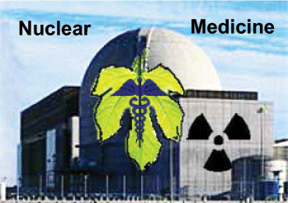
the vast majority of medical radioisotopes have very short half-lives, so there’s no need for them to be moved beyond the site of use…. The real problem is the returning intermediate level wastes from Australia’s used nuclear fuel rods reprocessed overseas….
it must be acknowledged that the medical radioisotopes produced at Lucas Heights do have their valuable uses in diagnostics and in the treatment of cancers.
However, it also must be recognised that all these radioisotopes can be produced without use of a nuclear reactor. This is happening increasingly and, rather like the distributed renewable energy boom, the world could be on the brink of a distributed medical radioisotope boom. Continue reading
Malcolm Turnbull assures India they can now buy uranium from Australia
India, Australia nuclear deal to come into force, Indian Express, by Shubhajit Roy | Antalya November 16, 2015 A year after India and Australia signed the civilian nuclear cooperation agreement during then Australian PM Tony Abbott’s visit to New Delhi, his successor, Australian PM Malcolm Turnbull told PM Narendra Modi Sunday that procedure for the pact has been completed and can now be implemented…..

“The PM thanked the Australian PM and said the nuclear agreement is a milestone and a source of trust and confidence. With the completion of procedures, including administrative arrangements, the Civil Nuclear Agreement will now enter into force,” he said.
This was Modi’s first meeting with Turnbull after he took over. Sources described the meeting to be “very constructive” and pointed out to the result-oriented conversation in their first-ever bilateral meeting.
It may be recalled that former Australian PM Julia Gillard paid a state visit to India in October 2012. The decision of Australian government to supply uranium to India was taken during her time and on September 5, 2014, India and Australia signed a MoU for “Cooperation in the Peaceful Uses of Nuclear Energy” during Abbott’s visit.
The significant part of the civil nuclear cooperation agreement was that Australia agreed to become ‘a long-term reliable supplier of uranium to India’……..http://indianexpress.com/article/india/india-news-india/india-australia-nuclear-deal-to-come-into-force/
Ipswich’s Councillor Paul Tully urges residents to fight nuclear waste dump plan
 Tully speaks out against planned nuclear waste dump http://www.qt.com.au/news/tully-speaks-out-against-planned-nuclear-waste-dum/2841387/, 16 Nov 15 CR PAUL Tully has urged Ipswich residents and the community as a whole to prevent a nuclear waste storage facility less than three hours drive from the city from going ahead.
He said Ipswich had a proud history of preventing similar dumps going ahead within its city borders in the past. He drew the community’s attention to the issue on his Facebook page.
“The Federal Government has picked a potential site – one of six – near Inglewood 250km southwest of Brisbane to store nuclear waste from Lucas Heights in Sydney’s west and from other states of Australia,” he posted.
“This would mean hundreds of truckloads of hazardous waste coming through Brisbane, Ipswich and  Toowoomba via cities and towns in NSW every year.
“Say no to Queensland becoming a nuclear waste dumping ground for the rest of Australia.
The Ipswich community stopped a similar dump at Redbank in 1988 proposed by the state government at the time, which was finally scrapped by the new Goss government in 1989.”
Adelaide branch of University College London (UCL) to close (and good riddance)
 With UK import Tim Stone, and Prof Stefaan Simons leading the charge, this UCL branch has been a useful propaganda piece for the global nuclear lobby. South Australia has enough nuclear shills without UCL. It will be good to see it gone.
UCL Australia ‘to wind down by 2017’ https://www.timeshighereducation.com/news/ucl-australia-to-wind-down-by- 2017/2018581.article#comment-5146
Future of branch campus in Adelaide under review as funds dry up and London focuses on partnerships
February 19, 2015University College London is set to close its Australia branch within two years as part of a wider review of its overseas campuses.
UCL’s Adelaide campus is likely to be wound up in 2017 on the completion of research deals with energy and mining companies Santos and BHP Billiton worth about A$20 million (£10 million).
Support from South Australia’s regional government is also due to expire that year, which led the university to carry out a review of UCL Australia’s long-term sustainability.
It is now undertaking a consultation process with its staff about a “move away from a stand-alone presence in Adelaide”, although it says this is “not a fait accompli”. Continue reading
Central West New South Wales wants consultation on nuclear waste dump plans
Calls for central west to consulted over nuclear waste plans http://www.abc.net.au/news/2015-11-16/sallys-reax/6943130?section=nsw A Bathurst environment group says a number of central west communities could be put at risk from plans to store nuclear waste in a local village.
The Federal Government has shortlisted six sites including Sallys Flat near Hill End, to house the material that is used in medical procedures and is currently stored at Lucas Heights in Sydney and in hospitals.
The Bathurst Climate Action Network says the impact of the local community and capacity of the road network need to be carefully considered before any decision is made.The president Tracey Carpenter said there were several questions that needed to be answered.
“Apart from the residents, Hill End being a national park, and the thriving community and a tourism attraction and the stigma that would come from being a nuclear waste dump, it needs to transported along our roads, through our centres,” Ms Carpenter said.
“That’s putting all our communities at risk.”
Bev Smiles from the Mudgee District Environment Group said it was not just people around Sallys Flat and the Bathurst district who would be concerned.
“Road accidents with nuclear waste are a highly relevant concern for people and the idea of having nuclear waste buried in your backyard, is something that I think people in a large area of the central west would not be comfortable with,” Ms Smiles said.
Ms Carpenter said it remained to be seen whether the local state MP Paul Toole supported his federal counterparts.“Politically it’s a really interesting issue because the local member Paul Toole opposed wind farms in our region on the grounds that it was divisive to the community,” she said.
“This would certainly be the ultimate division for a community.”
The ABC has contacted Mr Toole for a response.
Nov 16 Royal Commission public hearing with Maralinga Tjarutja & Yalata Community Incorporated
 In all the drama about nuclear waste returning from France, we need to be mindful that this has nothing to do with the Royal Commission proposal to import the world’s radioactive trash to Australia.
On 16 November the RC’s public hearing topic will be COMMUNITY ENGAGEMENT & NUCLEAR FACILITIES – ENGAGEMENT WITH ABORIGINAL COMMUNITIES. TThe speakers will include two representing the Maralinga Tjarutja & Yalata Community Incorporated – a group whose Submission to the RC was not negative.
Strong objections to nuclear waste dump sites
 Why is it that THE AUSTRALIAN and most media go on about medical wastes, but don’t mention the REAL problem – Lucas Heights nuclear reactor wastes returning from France?
Nuclear waste dump goes against the grain, THE AUSTRALIAN, REBECCA PUDDY ANDREW BURRELL, 14 Nov 15, Grain farmer Cameron Scott is no green activist, but he promises to fight any move to build the nation’s first nuclear waste dump on his doorstep in South Australia’s wheatbelt.
Mr Scott is a key member of a coalition of neighbours in the town of Kimba, almost 500km northwest of Adelaide, who are strongly opposed to the region hosting a facility to store the nation’s low-level and mediumlevel radioactive waste.
“The first thing that hit me was safety — we’ve got kids, we’ve been here for three generations and we want to look after their future,” Mr Scott said yesterday, as he acknowledged deep tensions in his local community over the issue.
“What will this do for our price of land, who wants to buy land next to a radioactive waste dump and what will happen to the price of our grain?”
Kimba is ground zero in the deeply personal battle over the location of the dump, with two of the six shortlisted sites across Australia — all of which were voluntarily nominated by landholders — located in the district……… Continue reading
Australian govt to pay 4 times land value for nuclear dump site, plus #10 million to local community

Sallys Flat should be removed from nuclear waste shortlist, residents say, ABC News 13 Nov 15 By Joanna Woodburn, “……The Government says it needs to build a facility to store the low and intermediate nuclear waste that’s been accumulating in at hospitals, universities and at the Lucas Heights nuclear reactor in Sydney.
Landowners were asked to volunteer their land, with the government offering to buy it at four times the market value. Local communities are being offered $10 million for local projects.”… http://www.abc.net.au/news/2015-11-13/take-sallys-flat-off-nuclear-waste-shortlist-residents-say/6937442
Danger in transporting radioactive trash to Queensland
Goondiwindi mayor raises issues over transport of nuclear waste to Queensland, ABC News 13 Nov 15 The Mayor of a southern Queensland region shortlisted to store nuclear waste is concerned about how it will be transported, but is keeping an open mind to the proposal.
Oman Ama, 250 kilometres southwest of Brisbane,is one of six sites earmarked by the Federal Government, including three in South Australia, one in New South Wales and one in the Northern Territory. Goondiwindi Mayor Graeme Scheu said he did not want to jump to conclusions.
“The main question around it would be transportation, where it goes, so, so many questions that we don’t even have an answer for and the facts,” he said……..
The Federal Government is offering sweeteners to the community that agrees to house nuclear waste…..
Transporting waste to Queensland ‘total lunacy’
National secretary of the Australian local government nuclear free zones secretariat, Ipswich councillor Paul Tully, said “total lunacy” had overtaken the Federal Government.
Mr Tully said the federal Energy Minister Josh Frydenberg will put major cities across southeast Queensland under threat with hundreds of trucks a year carrying nuclear waste across the region.”They will be transporting nuclear waste from the Lucas Heights reactor west of Sydney and other parts of Australia to Queensland,” he said.
“We don’t want Queensland to become the dumping ground for dangerous waste from NSW.”
He said similar plans in 1989 for a radioactive waste dump at Redbank in Ipswich had been thwarted after major environmental concerns were raised.
Kirsten Macey from the Queensland Conservation Council said regional communities should not be used as the scapegoat for a “dirty” nuclear industry. She wants the waste left in Sydney.
“We believe that where the regulator is – where they have the capacity to store it and monitor it, that’s where the nuclear waste should be stored,” she said. “That’s at Lucas Heights where the nuclear waste is being generated.”http://www.abc.net.au/news/2015-11-13/mayor-goondiwindi-transport-nuclear-waste-queensland/6937570
Australian Conservation Foundation wants wide-ranging public review into Australia’s nuclear materials
 Nuclear waste: Review needed before permanent disposal site, say environmentalists, SMH Jane Lee, Legal affairs, health and science reporter November 13, 2015
“……Environmentalists fear that a permanent site would pave the way for the nuclear waste of other countries to be stored in Australia, with Prime Minister Malcolm Turnbull last month remarking that Australia could expand its nuclear industry, including leasing local uranium overseas.
Dave Sweeney, the Australian Conservation Foundation’s national nuclear campaigner, said on Friday: “There is no public health or radiological imperative to rush the movement of material.”
He said there should be a wide-ranging public review into how, where, and why we produce nuclear material, with clear policies “best worked through when you’re not searching for a postcode”.
Mr Sweeney, a member of the government’s independent advisory panel on nuclear waste, insisted this was “not a stalling tactic”. Environmental groups were prepared to approach a review in good faith, he said: “We genuinely believe that getting a lasting, scientifically responsible solution that enjoys a high level of community consent is through an open review process, with a full range of management options.”
Australian Nuclear Science and Technology Organisation’s (ANSTO) existing facility in Lucas Heights in Sydney, was the “least worst” option for storing waste until a national independent review was completed, he said, with federal police and people with nuclear expertise already based there.
The site held most of Australia’s more-radioactive waste, and now included a national facility for extended interim storage, he said. It would also hold nuclear waste which is due to return to Australia next month, after being sent to France between 1996 and 2009. Continue reading
Darling Downs, Queensland, residents shocked at proposal to site nuclear waste there
 Darling Downs locals opposed to potential Oman Ama nuclear storage site, 9 News, 13 Nov 15, A property near the Darling Downs town of Oman Ama has been shortlisted by the Federal Government as a potential storage site for low-to-intermediate nuclear waste, but locals have told 9NEWS they are seriously concerned by the plan.
“Initally, horror, shock, how could they?” Liff Parr said. “I would hate to find something like that happening in our area,” Jo Clark said.
Locals had not received any notice of the plans, Andrew Clark-Dickson said. “Up until seven o’clock this morning I knew nothing about it,” he said. “It’s got to be put somewhere, but I really don’t think it should be on top of the Murray-Darling Basin.”
Organic olive farmer Gesine Owen echoed his concerns. My biggest fear is the water contamination,” she said. Ms Owen said she had spent many years investing in infrastructure to attract tourists to the town.“We just don’t see why we should be picked,” she said.
The residents realise one landowner has volunteered to sell their property for the purpose of establishing a nuclear waste site, with the government offering to pay four times market value for the selected site………
The Australian Nuclear Free Alliance said Australian Aboriginal communities “are reeling from this announcement”.
“We are concerned about the lack of consultation with Aboriginal communities, which are already under attack due to unconventional gas mining, coal proposals and the roll-back of Aboriginal heritage protections,” Alliance co-chair Adam Sharah said in a statement. http://www.9news.com.au/national/2015/11/13/19/51/darling-downs-locals-opposed-to-potential-oman-ama-nuclear-storage-site#fg1Io11Df1AmGg61.9
1 This month
17 October, Free Public Talk on Nuclear Issues in South Australia
David Noonan will speak on public interest concerns over the new Roxby Downs Indenture Act 2026 on BHP copper-uranium mining and ore processing in SA, and on how AUKUS may face SA with a High-Level nuclear waste agenda.
Dr Jim Green will discuss international developments in the field of nuclear power including ‘small modular reactors’ and Generation 4 ‘advanced’ nuclear reactor concepts.


Help Aunty Sue Protect Her Land and Sacred Sites From Destructive Rocket Testing.
.

Australians deserve the truth
about
AUKUS – https://aukuspublicinquiry.com/

PETITION – To: Prime Minister Anthony Albanese and the Australian Labor Government

of the week – Australians for War Powers Reform (AWPR)
To see nuclear-related stories in greater depth and intensity

