Malcolm Turnbull is keen on renewable energy. Would he save the Renewable Energy Target?
originally published in February 2015
Renewables is a different matter. Turnbull is known to be a supporter – as are most Nationals. Turnbull understands that the world is on the cusp of an energy revolution, and that new technologies will not send the economy back to the dark ages. Judging by his response to his Tesla test drive – he thinks it could be rather fun, and exciting.
Supporting a robust renewable energy target, either unchanged from its current level of 41,000GWh, or with minor changes, or delays, as recommended by the Climate Change Authority, would help Turnbull recapture the centre of the policy debate
 Would Malcolm Turnbull save the renewable energy target? REneweconomy, By Giles Parkinson on 6 February 2015 As the Coalition government’s energy and environment ministers and their Labor counterparts sit down to resume discussions over the renewable energy target, one question that should overhang the negotiations is this: “What would Malcolm do?”
Tony Abbott’s position is clear: He established a panel of climate deniers and fossil fuel supporters to argue that the RET should be removed completely or slashed by more than half. The latter remains its negotiating position.
But talk of a leadership spill offers the real possibility that Malcolm Turnbull could be the new prime minister as early as next week. As veteran Canberra political writer Michelle Grattan writes, Abbott will either go now, or soon. His leadership is terminal.
What we can assume is that when this happens Turnbull would sweep away the cabal of climate deniers that have installed themselves in and around the PM’s office and dominated the government’s policy making.
 This would include Abbott’s main business advisor, Maurice Newman, who was at it again on Friday, writing in The Australian that 2014 was NOT the hottest year on record, and that NASA, NOAA, the World Meteorological Organisation, the Australian Bureau of Meteorology, Japan’s Meteorological Agency, and the UK Met Office were all wrong for thinking so. Why? Because he had read as much on an obscure though notorious climate denier website favoured by the Mad Right.
So, one suspects we can count on Turnbull to sweep a broom through the likes of Newman, Dick Warburton, Tony Shepherd and David Murray – all climate deniers in charge of advising the government on key policy areas.
What Turnbull won’t do is reverse Abbott’s dumping of the carbon price. The Guardian’s Lenore Taylor gives a good explanation of why here. While Turnbull has been a fierce critic of Direct Action, he also believes it can be adapted into a baseline and credit scheme of the type he has long favoured. In effect, it will be a trading scheme without the word tax. Continue reading
#NuclearCommissionSAust – a preliminary analysis of submissions
 Companies and individuals who sent in submissions (as published so far at http://nuclearrc.sa.gov.au/submissions/?search=Submissions)
- they bundle people’s submissions together under whatever heading (i.e Issues Paper number) they feel like.
- If separate submissions were sent in, as I did – sending 4 separate, they don’t necessarily all appear, or if they do appear, not under the heading they were intended for.
- While companeis and agencies like ANSTO are listed alphabetically, individuals are listed under their first name, not surname – alphabetically. (makes it hard to find e.g if you looked for Dr Diesendorf)
- It is difficult to work out how many individuals and organisations actually sent in submissions, as many people have put in several. My list below is just of those who sent in submissions, whether they sent in just one submission or several, I have counted each only once.
- Anti -nuclear total 75
- Pro nuclear total 66
- Pro nuclear – something to gain – business, career,and
- Anti nuclear – for the public good
Nuke power too expensive, too inflexible: energy expert
14 Sept 15 Leading energy expert Dr Mark Diesendorf will be in Adelaide today to give evidence before the Nuclear Fuel Cycle Royal Commission.
“Nuclear power is simply not a practical option for South Australia. It’s hugely expensive compared to the alternatives and its inflexibility, like coal, makes it a poor partner for your state’s high proportion of renewable energy,” said Dr Diesendorf.
“My research shows that South Australia has a real opportunity to get to 100% renewable energy generation before any nuclear power plant could ever be built here,” he said.
The Conservation Council of SA commissioned Dr Diesendorf from the University of NSW to research whether SA could reach 100% renewable energy generation by 20301. His team found that it was feasible and affordable.
“Australia’s National Electricity Market could be operated reliably on 100% commercially available renewable energy technologies”, Dr Diesendorf said. “Such an ecologically sustainable, renewable energy system would be affordable and could create thousands of new jobs in manufacturing and installation.”
Distinguished economist Professor Ross Garnaut told the Royal Commission last week that nuclear power is unlikely to become economically viable in South Australia as the state’s “exceptional” renewable energy sources become cheaper.
Conservation SA chief Craig Wilkins said “As each day passes, the gap between the cost of renewables and the cost of nuclear power grows. Renewables are getting cheaper, while the cost of nuclear power – already massive – rises ever higher.
“Just last week, French nuclear giant Areva conceded that the cost estimate for a new reactor at Flamanville has reached a staggering $16.8 billion – three times the initial estimate.”2
“When we’re already a world leader in renewable power. nuclear power simply doesn’t make sense for our state,” he said.
1www.conservationsa.org.au/images/100_Renewables_for_SA_Report_-_Dr_Mark_Diesendorf_-_web_version.pdf
2 www.world-nuclear-news.org/NN-Flamanville-EPR-timetable-and-costs-revised-0309154.html
Media Contacts: Dr Mark Diesendorf, University of NSW: 0402 940 892 Craig Wilkins, Conservation SA: 0417 879 439
Joint Standing Committee on Treaties (JSCOT) shows big hurdles in selling uranium to India
 Miles to go: exporting uranium to India http://www.onlineopinion.com.au/view.asp?article=17665, By M V Ramana – 11 September 2015 Plans to export uranium from Australia to India may have hit their most significant hurdle so far in the form of Report 151 of the federal Parliament’s influential Joint Standing Committee on Treaties (JSCOT). After much deliberation and expert testimony, the Committee has put forward a number of recommendations that India has to abide by before Australian uranium is sold to India. The history of India’s nuclear programme and the country’s stand in various diplomatic fora suggest that there is little chance of India agreeing to these conditions.
The first three recommendations laid out in the JSCOT report are particularly important. The first and second recommendations pertain to India acceding to the Comprehensive Test Ban Treaty (CTBT) and negotiating a fissile material cut-off treaty as well as a nuclear arms limitation treaty for the Indian subcontinent region. The third recommendation is focused on the safety and efficacy of the safeguards and standards of nuclear facilities in India arguing that a series of key checks and balances must be put into practice and proven to work before any uranium sales. If taken seriously, these recommendations will make it all but impossible for the Australian government to sell any uranium to India. Continue reading
Tony Abbott un-moved by Pacific islands plight with rising seas
Tony Abbott faces down Pacific island nations’ calls for tougher action on climate change
ABC Radio AM By Eric Tlozek in Port Moresby, 11 Sept 15 Prime Minister Tony Abbott has held his Government’s line on climate change despite pleas from low-lying Pacific island nations for a stronger stance on emissions and temperature rises.
Both Mr Abbott and New Zealand prime minister John Key refused to go further than their existing commitments on global warming at the Pacific Islands Forum in Port Moresby.
Some Pacific island leaders say they are disappointed in the leaders for putting economic growth ahead of the survival of communities in small Pacific nations.
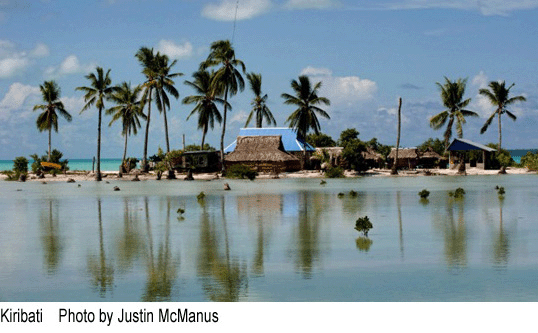
“Australia and New Zealand have made no additional commitments when it comes to climate change,” Mr Abbott told reporters after the meeting last night……….
Where now for Australia’s Climate Change Authority?
 Ignored by the government, shrunk by resignations – where now for Australia’s Climate Change Authority?, https://theconversation.com/ignored-by-the-government-shrunk-by-resignations-where-now-for-australias-climate-change-authority-47366 The Conversation, Clive Hamilton
Professor of Public Ethics, Centre For Applied Philosophy & Public Ethics (CAPPE) at Charles Sturt University September 11, 2015 Bernie Fraser’s resignation as chairman of Australia’s Climate Change Authority has left many wondering what is left of it and what its future might be.
Established three years ago as part of the climate change package negotiated by the previous parliament’s Multi-Party Climate Change Committee, the Authority was formed to serve as the principal source of climate policy advice to the federal government, particularly on the issue of emissions targets. Championed by the then Greens deputy leader Christine Milne, it was modelled closely on Britain’s Committee on Climate Change.
The Authority is legislated to have nine part-time members, including the Chief Scientist ex officio. When the Abbott government was elected two years ago it expressed its intention to abolish the Authority along with the rest of the Labor government’s climate policy architecture. Continue reading
A Submission to #NuclearCommissionSAust raises objections to its whole modus operandi
 Submission to the SA Nuclear Fuel Cycle Royal Commission Ally Fricker & Bob Lamb for ENuFF (Everyone for a Nuclear Free Future)
A few introductory objections about the RC:
* The 4 Issues Papers provided by the RC became available throughout the early part of May 2015, and the RC was still holding information meetings until the 3rd week of May, thereby, limiting the time available in which people could, reasonably, be expected to respond to the complexities of the nuclear fuel cycle
* The highly structured format required in which to respond including the unnecessary requirement for a statutory declaration
* The bias in the “objective” information provided followed by “questions to be answered”; indeed, the questions are so loaded that frequently they, in themselves, determine the answer – or hope to. We noted information only from industry and/or government sources. No authors critical of the industry were cited
* The timing of the federal government’s adverts calling for tenders for long-term disposal for Lucas Height’s waste concurrent to the commencement of the RC
* The likelihood that the mining lobby and other pro-nuclear interests had prior notice – a couple of high-profile conferences were held in Adelaide at the time of the announcement of the RC which gave first Tim Stone (March 12) and shortly after Barry Brook timely and extensive media opportunities to spruik their pro-nuclear arguments and
* The timing of Premier Jay Wetherill’s enthusiastic comments about opportunities for SA which could come from an expansion of the nuclear industry in SA in stark contrast to previous concerns expressed by him and former Premier Mike Rann.
For these and other reasons we consider that there is little likelihood that the RC will come to any conclusion that is not in the interests of the military/civilian nuclear industry in collaboration with SA and federal governments.
The history of this industry leads us to have zero trust in its statements, its modus operandi and its motivation in South Australia, at this time…… http://nuclearrc.sa.gov.au/app/uploads/2015/09/ENUFF-30-07-2015.pdf
Ross Garnaut not up to date about uranium enrichment
Philip White 11 Sept 15, So Ross Garnaut says nukes are too expensive for Australia. We didn’t need a Royal Commission to tell us that. Just look at the fiasco of the way over budget, way behind schedule new nuclear plants being built in France, Finland, and the US, not to mention the exorbitant subsidies being offered for the planned new plant in the UK.Ross Garnaut tells Royal Commission of ever cheaper solar photovoltaic electricity
Nuclear power Royal Commission told renewables are main game for future energy needs. ABC Radio The world Today Nick Grimm reported this story on Wednesday, September 9, 2015 DAVID MARK: South Australia’s Nuclear Fuel Cycle Royal Commission has heard that uranium enrichment and nuclear energy could become an increasingly important part of Australia’s effort to reduce its carbon emission in response to climate change.
That’s the view of one of Australia’s leading authorities on the impact of climate change, the economist Professor Ross Garnaut. He was speaking on day one of the commission’s first public hearings.
But the Australian Conservation Foundation says the royal commission is focussing on the wrong area.
It’s arguing that rapid advances in renewable energy technologies is the main game when it comes to finding a sustainable solution to the world’s energy needs.
Nick Grimm reports..…….
The question of whether nuclear energy should be regarded as friend or fiend is the focus of a royal commission set up by the South Australian Government.
KEVIN SCARCE: Today’s the commission’s public sessions commence.
NICK GRIMM: It began its first public session today in Adelaide, led by royal commissioner Rear Admiral Kevin Scarce, the former South Australian governor.
KEVIN SCARCE: Subsequent sessions will explore a range of other issues, including the threat posed by radiation to humans and the environment.
As he acknowledges he’s no climate scientist, but he was tasked by the former Labor federal government to write the 2008 Garnaut climate change review and its 2011 follow-up review, entitled ‘Australia and the Global Response to Climate Change’.As he told the royal commission, the need for Australia to reduce carbon emissions is an urgent one……..
NICK GRIMM: On the upside, Professor Garnaut says the cost of fossil fuel alternatives has fallen faster than he’d ever anticipated, boosting hopes that the world can be weaned off its reliance on coal, oil and gas.
ROSS GARNAUT: This is most spectacularly so in the case of photovoltaic solar; the last time I looked, the capital costs of photovoltaic panels had fallen 80 per cent.
NICK GRIMM: And Ross Garnaut says as wind and hydro-electric turbines become more efficient, he expects renewable will become ever-increasingly a more important part of the solution.
But he doesn’t dismiss a role for nuclear energy as part of the mix.
ROSS GARNAUT: You may actually see a larger role for Australia in other parts of the nuclear cycle, particularly uranium enrichment.
NICK GRIMM: For others though, nuclear is not the way to go……..
NICK GRIMM: And as far as the ACF is concerned, the nuclear fuel cycle royal commission is merely a costly exercise by the South Australian Government to justify the establishment of a nuclear waste dump inside the state, something past Labor governments there have firmly opposed.
DAVE SWEENEY: There’s four terms of reference, one’s on uranium, one’s on enrichment and reprocessing and one’s on nuclear power and one’s on radioactive waste.
Increasingly we’re seeing the commission and the discussion scoping down to hosting radioactive waste, because the other ones do not stack up economically and make no sense in the South Australian or Australian context. http://www.abc.net.au/worldtoday/content/2015/s4308966.htm
Tony Abbott has ‘a very good story to tell’ Pacific Islanders, about climate change
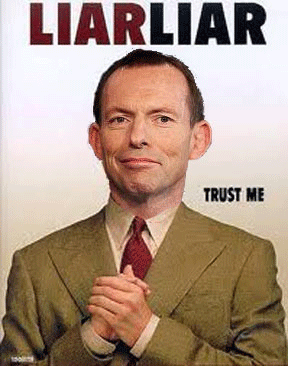 ‘I’ve got a very good story to tell’: Tony Abbott confident of placating island leaders on climate change September 10, 2015 Michael Gordon Political editor, The Age Tony Abbott has entered a retreat with leaders from Pacific island nations confident he can reassure those who say their survival is threatened without a stronger commitment to reduce carbon emissions.
“I think I have got a very good story to tell on climate change to tell the Pacific Islands Forum,” the Prime Minister said before entering a day-long meeting with 15 Pacific island leaders.
Led by the president of Kiribati, Anote Tong, several of the leaders have warned that anything short of a commitment to limit the average global temperature rise to 1.5 per cent would represent a betrayal of their people.
…..Both Mr Abbott and New Zealand Prime Minister John Key will resist the push led by the smaller island states to go beyond a commitment to the goal of limiting the global rise to 2 degrees.
Fairfax Media has seen successive drafts of the leader’s declaration where a reference to a 1.5 degree commitment is removed. The final draft will be released after the leaders’ retreat. http://www.theage.com.au/federal-politics/political-news/ive-got-a-very-good-story-to-tell-tony-abbott-confident-of-placating-island-leaders-on-climate-change-20150910-gjj93v.html#ixzz3lOo0rT8H
Abbott’s attempt to stop legal action by green activists is likely to fail in the Senate
BUT with Labor and the Greens adamantly opposed, Environment Minister Greg Hunt faces a tough lobbying job to get it through the Senate.
The measure follows a Federal Court order, sought by a local environmental group, setting aside Mr Hunt’s approval of the proposed Carmichael coal mine in Queensland’s Galilee Basin.Mr Hunt on Thursday told parliament the change would prevent people with no connection to a project except a political agenda from using the courts to disrupt and delay.However the rights of farmers and other impacted landowners to go to court would not be affected………http://www.heraldsun.com.au/news/breaking-news/greens-court-options-being-limited/story-fni0xqi4-1227521109153
Questionable Integrity of #NuclearCommissionSAust scrutinised in 22 questions – Submission by Yurij Poetzl
 Submission To The Nuclear Fuel Cycle Royal
  Commission Regarding Issues Papers 1 and 4 by Yurij Poetzl http://nuclearrc.sa.gov.au/app/uploads/2015/09/Yuri-Poetzl-24-07-2015.pdf
 I’m a private citizen and have no vested interest in the nuclear industry; however the nuclear industry does direct ly impact me, my family and my friends As a member of the public I wish to give evidence and express my concerns in regard to the issues being examined by the Royal Commission.
It is valid to examine economics and risks relating to the nuclear industry; however is the Royal Commission a fair and objective examination of the Nuclear Cycle? It has been disclosed that Kevin Scarce Is a shareholder in the Rio Tinto Group,who own and operate uranium mines in Australia and internationally. ls this a conflict of interest for the Royal Commissioner? It is of great concern that the Royal Commissioner has selected predominantly pro-nuclear experts for the R.C’s Advisory Committee (the single exception being Professor lan Lowe). See Appendix 1.
It also seems remiss that there isn’t any health or medical professionals engaged in the R.C’s Expert Advisory Committee or Key Commission staff. It’s well documented that by-products of the nuclear industry can have adverse effects on the health of the global community for many future generations. The omission of health experts makes me question whether the R.C is truly considering what is in my and the general public’s best interest.
The Public Health Association of Australia have made their position clear in regard to the R.C and the Nuclear Industry, see http :1 /www .phaa. net. au/ documents/item/51 0 or http://www .phaa.net.au/documents/item/264 The Royal Commission could prove to be pivotal in South Australia’s future having significant and far reaching consequences, affecting many future generations; however, was the process leading toward the establishment the Royal Commission flawed?
The S.A. public (and wider global communit y) deserve a balanced and unbiased assessment of the issues raised Appendix 2. Contains questions regarding issues papers 1 and 4 Yours sincerely Yurij Poetzl
Appendix. 1 4 of the 5 Royal Commissions Expert Advisory Committee appear to be pro nuclear. They are Professor Barry Brook, Dr Timothy Stone, John Carlson AM and Dr Leanna Read. Below is a brief summary oftheir involvement in the nuclear industry Professor Barry Brook is an active advocate of the Nuclear Industry. The self described”Promethean Environmentalist” is openly critical of people who have concerns regarding the Industry. Professor Brook is the author of, or contributor to several pro nuclear publications such as; Key role for nuclear energy in global biodiversity conservation, Australia’s nuclear options and, An Open Letter to Environmentalists on Nuclear Energy. To name a few.
Dr Timothy Stone is an advocate for nuclear power generation and nuclear industrial expansion in Australia. In the UK Dr Stone has held the position of Expert Chair ofthe Office for Nuclear Development and he is currently on the board of Horizon Nuclear Power as non-executive Director John Carlson AM has been Director General of the Australian Safeguards and Non-Proliferation Office. In part 6 of the introduction to Mr Carlson’s paper “Nuclear power for Australia”- an outline of the key issues he claims “Nuclear has a major advantage over other energy sources”. Later in the same document Mr Carlson states “Currently both major parties say that nuclear power is “offlimits”. While this is disappointing, at least it ensures neither side is making statements tlhat will later be embarrassing to retract” It is clear that Mr Carlson is pro nuclear providing the appropriate safeguards are met
Dr Leanna Read has publicly stated that she “has an open mind” regarding the Nuclear Industry. Dr Read is a Fellow of the Australian Academy ofTechnological Sciences and Engineering, which advocated for nuclear power in Australia in August 2014. This seems to contradict Dr Read’s claims of impartiality toward the nuclear industry Given the information in Appendix 1, can the Royal Commission be considered truly independent?
Appendix 2 Continue reading
Kevin Scarce sees “a long journey” ahead to get the nuclear fuel chain happening in South Australia
 Our nuclear future needs national support: Scarce http://indaily.com.au/news/2015/09/07/our-nuclear-future-needs-national-support-scarce/ ADELAIDE | South Australia will not be able to increase its role in the nuclear fuel cycle without bipartisan support both locally and federally, according to the former governor overseeing a royal commission into the industry’s prospects.
Kevin Scarce’s inquiry will this week begin a series of public forums, with electricity network operators and the Australian Energy Regulator’s market analyst set to front the commission in coming days.
Senior executives from Electranet and the Australian Energy Market Operator will give evidence next week, along with Craig Oakeshott, the national regulator’s Wholesale Markets Director, as Scarce tries to paint a picture of the state’s future power needs and likely costs.
But he insists: “Really nothing can happen until we have bipartisan support both at state and federal level.”
“Because these projects have such long gestation periods, if there’s not certainty there’s very little likelihood of us moving forward,” Scarce told InDaily ahead of the first hearing, to be held on Wednesday at the Science Exchange in the Royal Institution of Australia building in Adelaide.
And he says even with political consensus, it would be at least 10 years before any construction work began. “The overseas experience says a decade, and that’s probably optimistic,” he said.
“Should we decide to go ahead, and should the (Weatherill) Government accept our recommendations, the first part is to engage the community in specific terms about what’s proposed to happen. That takes some time; it’s not going to happen overnight.”
Federal Labor has already baulked at the Weatherill Government’s nuclear inquiry, with Bill Shorten’s office re-stating the party’s “longstanding position (against) nuclear power based on the best available expert advice”.
The royal commission has awarded tenders to four firms – Ernst & Young, WSP Parsons Brinckerhoff, Jacobs Australia and Hatch – to model the business case for each of the inquiries terms of reference, which take in nuclear power generation, enrichment and waste management. “We need to model the costs of developing the infrastructure, because we do have a great disparity of views (in submissions) from roughly the same technical evidence,” Scarce said.
“What we’re doing with the public sessions is using the information we’ve got in the submissions, using our own examination both overseas and here in Australia and drawing out the major issues of contention to help us write our final report.”
The electricity market analysts will be asked to detail both current needs and capabilities, as well as forecasting future trends.
“We’ve asked them a series of questions about the market: what will the market look like? What assets in the market will continue to operate, and what will need to be replaced?” Scarce said.
“We need to understand from them where demand is going in future and what’s happening with supply… We’ve got ageing coal power plants – when do they need to be replaced? What’s going to happen in the world when they get together in December in Paris (for the United Nations Climate Change Conference)? All of those issues are long-term issues that fit into questions of whether nuclear power is an option for us in future.”
Scarce says however he adjudicates, his inquiry is at most the first step in a long journey.“I think a lot of people think this is the only engagement that’s going to happen – it’s not,” he said.“It’s the start of the process.”
Will Tony Abbott ignore the cautionary message of committee on uranium sales to India?
 India uranium red-light a test for Tony Abbott, SBS News, 8 Sept 15, While Prime Minister Abbott and Foreign Minister Bishop have been strong supporters of selling Australian uranium to India, many others, including key Australian diplomats and insiders, remain far more circumspect. By Dave Sweeney
The JSCOT report followed a detailed examination and expert testimony and states that while the federal government can ratify the deal it must not advance uranium sales or supply to India before key checks and balances are put into practice and proven to work.
In short, the committee charged with advising the government on Indian uranium sales has reached the unambiguous conclusion that the government can sign but not sell.
The question now is whether the Abbott government will follow due parliamentary process and act in the public interest or will it ignore these concerns and JSCOT’s advice and seek to fast-track the agenda of the under-performing uranium sector?
When Prime Minister Tony Abbott signed a uranium deal with Indian Prime Minister Narendra Modi in New Delhi in September 2014, he praised India’s “absolutely impeccable non-proliferation record”. Yet India’s record on nuclear proliferation tells another story. India acquired its nuclear arsenal by breaking a promise not to use a Canadian reactor for military purposes. It remains outside the globe’s key non-proliferation frameworks and the region remains on nuclear high alert amid tensions with nuclear rival Pakistan.
Instead of addressing real questions about India’s nuclear weapons program and inadequate nuclear safety standards Mr Abbott resorted to cricketing clichés, declaring that Australia and India trust each other on issues like uranium safeguards because of “the fundamentally ethical principle that every cricketer is supposed to assimilate – play by the rules and accept the umpire’s decision”.
The JSCOT process received strongly critical submissions from a who’s who of nuclear arms control diplomats and experts including John Carlson (former long serving Director-General of the Australian Safeguards and Non-Proliferation Office from 1989 to 2010), Ron Walker (former Chair of the International Atomic Energy Agency, Prof. Lawrence Scheinman (former Assistant Director of the US Arms Control and Disarmament Agency). These are veteran players in global nuclear diplomatic and regulatory regimes, not anti-nuclear activists.
Nuclear arms control expert Crispin Rovere noted that “this treaty appears less like the deepening of a bilateral partnership and more like one of a client state being dictated to in an expanded Indian empire. It is a major display of weakness on the part of the Australian Government, and a failure to stand up for Australia’s national interests in this area”.
One thing we can all agree on is that Australia has a key role to play in supporting India’s legitimate energy aspirations, but this cannot be advanced by a retreat from responsibility on nuclear safeguards and security. The government must read and heed the JSCOT report and Australia’s uranium must remain away from India’s nuclear reactors and weapons – to do otherwise would be profoundly irresponsible.
JSCOT has just clean bowled this dangerous and deeply deficient sales plan. Mr Abbott must now heed his own words, “accept the umpire’s decision” and start the long walk back to pavilion for a serious re-think. http://www.sbs.com.au/news/article/2015/09/08/comment-india-uranium-red-light-test-tony-abbott
Public hearings with #NuclearCommissionSAust
Nuclear commission in public hearings http://www.9news.com.au/national/2015/09/09/03/36/nuclear-commission-in-public-hearings Economist Ross Garnaut will be the first witness to appear at public hearings for South Australia’s royal commission into the nuclear fuel cycle.
Mr Garnaut will appear in Adelaide on Wednesday with his evidence to centre on climate change predictions and the opportunities that presents for future energy policy.
He will be followed by Anna Skarbek, from climate change research group Climate Works Australia, and University of Queensland economics professor John Quiggin, a member of the Climate Change Authority.
The royal commission is examining every aspect of the nuclear fuel cycle from the mining of uranium to the use of nuclear power and the disposal of nuclear waste.
Commissioner Kevin Scarce will continue his public hearings until mid-December and then present his report to the state government next year.
1 This month
17 October, Free Public Talk on Nuclear Issues in South Australia
David Noonan will speak on public interest concerns over the new Roxby Downs Indenture Act 2026 on BHP copper-uranium mining and ore processing in SA, and on how AUKUS may face SA with a High-Level nuclear waste agenda.
Dr Jim Green will discuss international developments in the field of nuclear power including ‘small modular reactors’ and Generation 4 ‘advanced’ nuclear reactor concepts.


Help Aunty Sue Protect Her Land and Sacred Sites From Destructive Rocket Testing.
.

Australians deserve the truth
about
AUKUS – https://aukuspublicinquiry.com/

PETITION – To: Prime Minister Anthony Albanese and the Australian Labor Government

of the week – Australians for War Powers Reform (AWPR)
To see nuclear-related stories in greater depth and intensity

