Malcolm Turnbull – two-faced on climate change
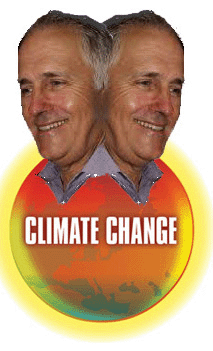 Is new Australian prime minister Malcolm Turnbull already a climate change turncoat?
Malcolm Turnbull once endorsed common sense positions on climate change. Then he became prime minister, Guardian, Graham Readfearn , 18 Sept 15 During the first few days of being prime minister, Malcolm Turnbull seems to be doing his best to argue about climate change with a former version of himself.
I know I might have already given the game away here, but who do you think said this only five years ago?
We are as humans conducting a massive science experiment with this planet. It’s the only planet we’ve got…. We know that the consequences of unchecked global warming would be catastrophic. We know that extreme weather events are occurring with greater and greater frequency and while it is never possible to point to one drought or one storm or one flood and say that particular incident is caused by global warming, we know that these trends are entirely consistent with the climate change forecasts with the climate models that the scientists are relying on…. We as a human species have a deep and abiding obligation to this planet and to the generations that will come after us.
Stirring stuff eh?
That was Turnbull in August 2010, speaking at the launch of a report demonstrating the technical feasibility of moving Australia to a 100 per cent renewable energy nation.
During his first Question Time as PM earlier this week, Turnbull was asked if he would join Labor in its aspiration (and that’s about the extent of Labor’s policy on this right now) that Australia should be generating 50 per cent of its electricity from renewables by 2030.
Turnbull’s response?
[Opposition leader Bill Shorten] is highlighting one of the most reckless proposals the Labor party has made. Fancy proposing, without any idea of the cost of the abatement, the cost of proposing that 50 per cent of energy had to come from renewables! What if that reduction in emissions you needed could come more cost-effectively from carbon storage, by planting trees, by soil carbon, by using gas, by using clean coal, by energy efficiency?
What did the Turnbull of 2010 make of a plan to move away from fossil fuels that was twice as ambitious as Labor’s, that actually explained how it could be done and that proposed doing it faster?
But now it seems, Turnbull wants to ridicule an idea that he enthusiastically supported five years earlier. Turnbull once described the government’s Direct Action climate change policy as “fiscal recklessness on a grand scale” but now thinks the policy is a “resounding success”.
During his Question Time response, Turnbull also listed “clean coal” and “carbon capture” as viable responses to the problem……..
now, Turnbull is defending his government’s weak targets on climate change that, if they were replicated by other countries around the world, analysts saywould likely see the planet warm by 3C or more.
Not only is Turnbull abandoning the science, he is abandoning his previous common sense position on climate for what a former Turnbull described as a policy that was no more than fig leaf…… http://www.theguardian.com/environment/planet-oz/2015/sep/18/is-new-australian-prime-minister-malcolm-turnbull-already-a-climate-change-turncoat
Climate hypocrites – survey findings on Rio Tinto, Business Council of Australia
 Rio Tinto, Business Council of Australia among ‘climate hypocrites’, survey says SMH, September 16, 2015 Peter Hannam Environment Editor, The Sydney Morning Herald BHP Billiton, Rio Tinto and the Business Council of Australia are among the world’s largest companies and industry groups holding back action on climate change, according to a new survey.
The research, based on methodology developed by the US-based Union of Concerned Scientists and applied by UK-based non-profit group InfluenceMap, found 45 per cent of the 100 biggest industrial companies were “climate hypocrites” that obstruct action on global warming. Some 95 per cent of the delaying firms were also members of trade associations that demonstrated “the same obstructionist behaviour”.
BHP Billiton was rated a “D”, keeping it just outside the lower 45 per cent of companies that were ranked as “hypocrites”.
“More and more, we’re seeing companies rely on their trade groups to do their dirty work of lobbying against comprehensive climate policies,” Gretchen Goldman, lead analyst at the Union of Concerned Scientists, said. “It is unacceptable that companies can obstruct climate action in this way without any accountability.”
Google topped the list of best performers, along with Unilever and Cisco Systems, each of which received a “B” rating for their relatively positive involvement on tackling greenhouse gas emissions and backing laws that supported such action.
Unilever, which has consumer brands including Dove and Flora, gained kudos for “strongly” supporting the introduction of a carbon tax in Australia in 2012.
The Abbott government scrapped the policy two years later and newly installed Prime Minister Malcolm Turnbull indicated in his first speech after toppling Tony Abbott that he would stick to the replacement direct action policy to pay polluters to curb emissions.
BHP Billiton, which has coal and oil interests, received its “D” for having a “low level but negative engagement on climate regulation”, including supporting the repeal of the carbon price. “The company appears to be supportive of [greenhouse gas] intensive energy sources, supporting continued use of coal,” the survey said.
BHP also lost marks for its membership of the International Association of Oil and Gas Producers and the Business Council of Australia (BCA), “both of which appear to be opposing climate policy”, the report argued. http://www.smh.com.au/environment/climate-change/rio-tinto-business-council-of-australia-among-climate-hypocrites-survey-says-20150915-gjn3rz.html#ixzz3m2HDgRjw
Malcolm Turnbull – not really going to act on climate chnage
I don’t think Labor has a hope of defeating Malcolm Turnbull as things currently stand—unless we change our politics.
Our only hope of defeating Malcolm Turnbull is also our only hope of seriously tackling climate change. We have to come together across divides to articulate a different way of doing things, to mount a cohesive, comprehensive, and strategic campaign for a better, fairer, greener world.
Malcolm Turnbull’s elevation to the Prime Ministership will change very little on its own. But it could be the stimulus we need to work with the new recruits brought to us by Tony Abbott to change everything.
 The Fall of Tony Abbott Changes…Not What You Think It Might http://theleap.thischangeseverything.org/the-fall-of-tony-abbott-changes-not-what-you-think-it-might/
September 15, 2015 by Tim Hollo Australia’s climate vandal Prime Minister is no more.
Tony Abbott, elected under two years ago after a lie-filled, Murdoch-fuelled anti-climate campaign, has been deposed by his own party.
Abbott, who famously declared that “coal is good for humanity,” led the first government in the world to reverse a price on carbon or slash a renewable energy target. He rejected funding for mass transit and increased it for roads; he attacked wind farms as ugly and pandered to the junk science of “wind turbine syndrome.” He took Australia’s treatment of refugees to new depths of depravity, even banning doctors from reporting on abuses in the detention camps; begged Barack Obama to let Australia join the bombing of Syria; slashed funding for universities, research and the arts; and escalated the “war on terror” rhetoric.
Tony Abbott’s political demise is cause for celebration.
But what can we expect of his replacement, Malcolm Turnbull, a man seen by some as Australia’s climate saviour? My expectation is: far too little to make a difference, but just enough to threaten to defuse the growing radicalization that Abbott’s clumsy approach was fomenting. We may have just replaced our movement’s most unlikely recruitment tool with someone more dangerous. Continue reading
Victorian Environment Protection Authority wants ILuka Resources to explain radioactive trash dump plan
 Iluka Resources asked for more proof that waste won’t pollute river, KATE DOWLER THE WEEKLY TIMES SEPTEMBER 16, 2015 THE Environment Protection Authority Victoria has asked miner Iluka Resources to provide more proof that its plans to continue dumping radioactive waste south of Horsham will not pollute the Glenelg River.
The EPA has formally asked Iuka to provide more information by Friday on the company’s works approval application to continue dumping interstate mining waste at its former Douglas mine site.
Among the EPA requests, Iluka has been asked to install new groundwater bores to prove potentially contaminated water from the dump site is not moving from the dumping pit into the Glenelg River or local lakes, and raw groundwater data from before and after dumping at the site began.
Many residents in the Douglas and Kanagulk regions, and in the surrounding regions that are linked to the Glenelg River catchment — Balmoral, Rocklands, Harrow, Casterton, Cavendish, Hamilton, Digby, Dartmoor and Nelson — are concerned the radioactive waste could leach into waterways and threaten human health and the environment.
The Horsham Rural City Council, with EPA support, must decide if Iluka Resources can continue using the pit to dump mine waste — low-level radioactive byproducts and concrete and steel that has been in contact with radioactive material — from both old Victorian mines and active sites interstate……….http://www.weeklytimesnow.com.au/news/national/iluka-resources-asked-for-more-proof-that-waste-wont-pollute-river/story-fnkfnspy-1227530458473
Crisis of confidence in the process of #NuclearCommissionSAust
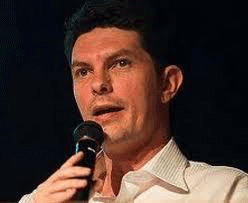 Submission to the South Australian Nuclear Fuel Chain Royal Commission, by Senator Scott Ludlam
Extract The Australian Greens have cautiously welcomed the idea of a Royal Commission to settle the issue of the nuclear industry in Australia once and for all.
For decades there have been the protagonists for and against the industry. There have been reports and case studies, public debates, political debates but nuclear power always comes up as unfeasible and hugely unpopular.
It is disappointing that this opportunity to examine the industry has been designed to exclude so many important issues and many voices on those issues. The process, independence and good fa ith of the Royal Commission has been damaged by narrow terms of reference, an unbalanced expert panel and consultation failures in remote and regional communities.
The terms of reference have been designed to exclude any review of the existing problems with uranium mining and waste management, the ongoing costs and liabilities from closed mines and processing facilities- costs that are left to the tax-payer.
The panel is in no way independent or balanced; it has been dominated by the nuclear industry and their advocates. We note complaints from Aboriginal communities in South Australia about the first round of ·engagement. Many people did not know about hearings or had limited warning about hearings. Others have not been given access to documents and or do not have access to the Internet, or do not speak English. We have had reports that hearings have been held in pubs at 11am – completely inappropriate for working people, and those who wouldn’t set foot in a pub.
There have been significant barriers put up for people in remote and regional communities. Inaccessible meetings and information, language barriers and the added constraint of getting submissions approved by a justice of the Peace all serve to exclude participation in the process. People in remote areas of SA have been most affected by South Australia’s involvement in the nuclear industry, and they are also the ones who are most likely to be affected by any future industrial nuclear activities. We are at a point where is a crisis of confidence in the process…..”
Australia, formerly a leader on nuclear disarmament, now a leper in the regional disarmament movement
 Australia’s earlier leadership on nuclear disarmament had diminished over the past four years.
“We know what Australia is saying ‘no’ to. It is saying ‘no’ to the humanitarian consequences pledge. Well, what is it saying ‘yes’ to?”
Australia resists new global push for nuclear disarmament, Guardian, Ben Doherty, 16 Sept 15 Diplomatic cables reveal prospects for nuclear disarmament are ‘bleak’ as Australia becomes increasingly lonely in opposing 116-nation push for ban
Prospects for nuclear disarmament are “bleak” under the current non-proliferation treaty, Australian diplomats have conceded in cables back to Canberra, but the country will resist growing global support for a new treaty banning nuclear weapons because of a dependence on the nuclear deterrent capability of the US.
A tranche of internal government emails from within the Department of Foreign Affairs and Trade reveals Australia’s opposition to a 116-nation push to ban nuclear weapons is leaving it increasingly isolated globally, and especially among anti-nuclear neighbours. The emails, released under freedom of information, reveal Australia is increasingly worried about an Austrian-led push for a treaty to ban all nuclear weapons. Continue reading
Giles Parkinson gives Malcolm Turnbull 5 pieces of good advice
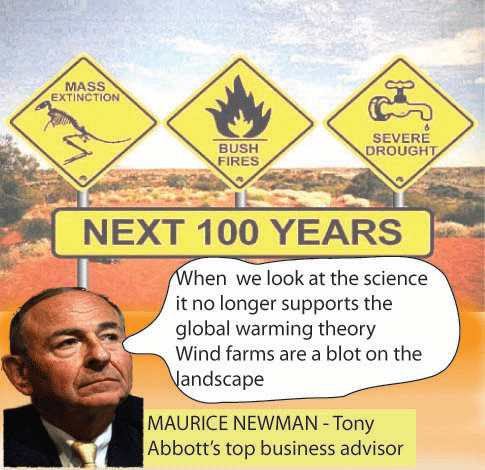 Sweep out the dead wood:………… This includes the likes of climate deniers such as Maurice Newman, Dick Warburton, David Murray and Tony Shepherd, and shake the Cabinet from the grim grasp of the Institute of Public Affairs and its policy wish-list.
Remove the threat to dismantle CEFC, ARENA and the CCA:…..
Find a new environment minister, or tell Greg  Hunt to stop saying silly things: Greg Hunt likes to tell people how hard it was to push a progressive line in an Abbott government. Many people wondered how hard he tried. Hunt came up with some of the Abbott government’s worst whoppers on climate change, coal, and renewable energy. Turnbull cannot afford to have such rhetoric repeated under his leadership
 Eight things Malcolm Turnbull should do on climate, renewables, REneweconomy By Giles Parkinson on 15 September 2015 Malcolm Turnbull’s dramatic replacement of Tony Abbott as prime minister of Australia has raised hopes of a change in direction for the Coalition government, particularly on climate change and renewable energy, and thereby the shape of its economic future……..
Paul Gilding, author and corporate advisor, describes a collective sigh of relief for those arguing for progressive climate and renewable energy policies.
“For climate advocates PM Turnbull is a “Nixon to China” moment,” Gilding said today. “We will never get on track as a country on this issue without genuine bipartisan support – and because of the way Rudd and Abbott made this a Left/Right issue, only the Liberal Party shifting can deliver the change we need.
“That’s why Turnbull’s arrival as PM is a game changer for Australia’s approach, but the impact will be medium to long term rather than sudden policy shifts. While Abbott had to say he supported action on climate policy, everyone knew he was faking it because the politics demanded he do so.
“Turnbull actually supports climate action and has long understood the economic implications of the transition required. And rather than being fearful of those implications he embraces them – seeing the inherent opportunity in a transition away from coal and towards a technology driven transformation of the energy system……..
What will Turnbull do? Over the next few days, weeks, months, we will find out. But here are eight things he could do right now: Continue reading
Uranium deal with India is bad for Australian business
 Australia-India nuclear deal http://www.lowyinterpreter.org/post/2015/09/14/Reader-riposte-Australia-India-nuclear-deal.aspx
Besides its collateral damage to Australia’s security, commercial and diplomatic interests, the soon-to-be ratifiedAustralia-India nuclear cooperation agreement notably fails to meet its objectives.
The aim was to give a green light to Australian uranium exports to India. Two objectives were to be served, one commercial, the other diplomatic. A vast new market was to be opened for Australian uranium exporters and India was to be convinced Australia was a reliable partner, worthy of a closer relationship.
Instead, as has been exposed in the Joint Parliamentary Committee, the Australian side gave away so much in the course of the negotiations on safeguards against nuclear proliferation and left open such loopholes for Australian uranium to end up in bombs or otherwise help their manufacture, that this proposed treaty does not do what Australia’s 23 existing nuclear safeguards treaties do.
Unlike them, it does not give Australian exporters legally watertight guarantees that the trade will be subject to effective controls against misuse of the uranium in ways Australian companies neither want nor could afford. So many deficiencies in the proposed treaty have been exposed it amounts at best, not to a greenlight but to a blinking yellow one. Not ‘all is guaranteed safe’ but ‘proceed carefully at your own peril’. And JSCOT’s main recommendation is a red light: no uranium exports to be permitted for the foreseeable future.
How Australian companies will respond and what risks they will be prepared to take remains to be seen, but no responsible government would have placed them in this situation.
The Indian Government has every reason to feel it too has been dudded. Instead of a reliable supply, there is a big element of precariousness. As for a demonstration of the Australian Government’s trustworthiness as a close partner, the contrary impression is conveyed of a bumbling inability to manage our own end of the deal.
Australia’s history of trying to get nuclear weapons
 In 1969, the government announced plans to construct a 500-megawatt nuclear reactor at Jervis Bay in New South Wales. The intention was clear — this reactor was to support a nuclear weapons program.
in 1972, the conservative Gorton government was swept from power and replaced. Gough Whitlam, a longtime advocate of arms control, wasted no time ratifying the NPT and abandoning the Jervis Bay reactor. In a heartbeat, the 40-year quest for Australian nuclear capability was over.
 Australia’s Failed Bid for the Bomb, War Is Boring, Chris Walsh, 15 Sept 15 Canberra was captivated by atomic weapons in the 1950s — then ruined its chances of ever getting them
At 9:00 in the morning on Oct. 3, 1952, a 25-kiloton nuclear explosion vaporized the retired British frigate HMS Plym off Australia’s remote western coast. The Operation Hurricane detonation in the Monte Bello Islands was a seminal moment for Britain and marked its return to the club of great powers.
But for Australia, these tests and others served a murkier purpose – as important and deliberate steps toward Australia’s own acquisition of nuclear weapons.
AUDIO: Aboriginal Freedom Summit 2 pushes for Treaty
 AUDIO Freedom Summit 2 pushes for Treaty http://caama.com.au/freedom-summit-2-pushes-for-treaty 14/09/2015 Organisers of the three day Freedom Summit held in Alice Springs say they will continue to push Government towards how treaties can be made with Aboriginal and Islander communities across the country.
Grass root Aboriginal leaders including South Australian Narungga Elder Tauto Sansbury came together in Central Australia to discuss and address a range of issues and government policies that continue impact on his people.
Don’t forget the damage from UV radiation, even on cool days
 The damages of UV radiation are a daily risk even when you can’t feel the heat of the sun, News Local, Sydney September 12, 2015 IT seems logical to assume that the red hot sunburn we get comes from standing under the hot sun we feel, but it is not quite correct.. Sun damage is a reality that Australians face every day of the year, regardless of how hot the temperature is or how cloudy the sky…….
associate Professor Pablo Fernández-Peñas, who sees the detrimental effects of too much sun exposure.
“We can’t feel UV light and the heat sensation is not related to the amount of UV light,” he said.
“In winter, as days are cooler, people tend to stay longer outdoors.” A 2014 Australian study, “The influence of age and gender in knowledge, behaviours and attitudes towards sun protection”, found the use of sunscreen dropped to between 24 and 49 per cent outside summer.
“When you are just walking from your house to the car or dropping the kids to school, that sun exposure accumulates in the future,” Prof Fernández-Peñas said.
“Australia has the highest mortality of skin cancer in the world.”……..HEALTH EFFECTS OF UV RADIATION
■ Sunburn: can cause permanent and irreversible skin damage that can lay the groundwork for skin cancer
■ Eye damage: photoconjunctivitis, also known as snow blindness or welders flash, and skin cancer of the conjunctiva and skin surrounding the eye
■ Premature ageing: such as skin wrinkling, sagging, blotchiness and roughness …….http://www.dailytelegraph.com.au/newslocal/city-east/why-sunscreen-should-be-a-daily-habit/story-fngr8h22-1227522871234
Global investment bank UBS approves Labor’s proposed 50 per cent renewable energy target
 Australia’s Energiewende: UBS on why 50% renewable target is good, REneweconomy, By Giles Parkinson on 14 September 2015 Global investment bank UBS has conducted the first in-depth analysis of Labor’s proposed 50 per cent renewable energy target for Australia by 2030, concluding that it will require around $80 billion in investment, but much of this would need to be spent anyway.
In various scenarios outlined in the report, UBS says that up to 20GW of wind energy will need to be built by 2030, and 26GW of solar (both rooftop and large-scale), along with around $10 billion in grid costs. Around $4.8 billion is expected to be spent on battery storage by networks, and nearly $3 billion by households.
But it says this much of this will come from private investment, mostly from listed companies. And much of it needs to be factored in because it would be spent anyway to replace ageing coal and gas plants. And, UBS notes, all polls point to the popularity of renewable energy.
“A big part of the above cost will be incurred in one way or another as most of the thermal fleet in Australia is old and will need replacing.”
The intervention of UBS comes at a critical time, with the Canning by-election ……….
UBS says that the current target aims for around 7GW of wind and 6GW of solar, but it is not working anyway, because the policy certainty is not there – an issue we explore in this story, If wind energy is this cheap, why aren’t wind farms being built?………
Indeed, UBS suggests that a reverse auction process might be the best way to meet a Labor 50 per cent target – the same system adopted with great success in the ACT, and now by Germany and Texas and elsewhere (South Africa, UAE and Brazil also come to mind).
“Renewable energy suppliers and financiers want revenue certainty,” UBS analyst David Leitch writes.
“Thermal suppliers want to be able to plan their future with confidence. We think capacity auctions meet both of these goals.”
How would this work?
Leitch says legislation could set a quantity of renewable capacity to be added to each year. For instance, a 50 per cent by 2030 target requires around 70TWh of new renewables to be delivered over the 13 years from 2018 to 2030. That’s around 5TWh per year…………http://reneweconomy.com.au/2015/australias-energiewende-ubs-on-why-50-renewable-target-is-good-76557
Australia’s Turnbull Liberal government – new style, same content
 Eight years ago, I started this website because I felt it necessary, in order to help get rid of Australia’s worst Prime Minster ever – John Howard. Little did I know that before long, Howard would be followed by an even worse Prime Minister than he, in Tony Abbott..
John Howard wanted to take Australia back to the complacent, comfortable, unimaginative 1950s. Still, John Howard brought in gun reform law, that prevented Australia going down the crazy American path of gun terrors. Howard must have saved many lives, in bringing about that law, and he deserves credit.
Tony Abbott aimed to reject every modern trend. For the purposes of this website, Abbott’s denial of climate change, and his support for nuclear power, were reason enough to want to get rid of him as PM.
But in addition to that, PM Abbott was like a punch drunk boxer, wanting to keep on fighting, not just personally, but in promoting militarism -ever ready to take Australia into any war, even ahead of USA asking us to tag along. Abbott – clever, cunning? But not really intelligent.
Thank goodness, new Prime Minister Malcolm Turnbull is intelligent, does understand climate change, does want to take Australia into the 21st Century, not back to the 18th. In a way – I wish him well.
BUT – Turnbull is still leading a Liberal-National Coalition government. Let’s not forget who’s backing them, and where they get their funding.
Graph below show the history of mining donations to Liberal and Labor parties:

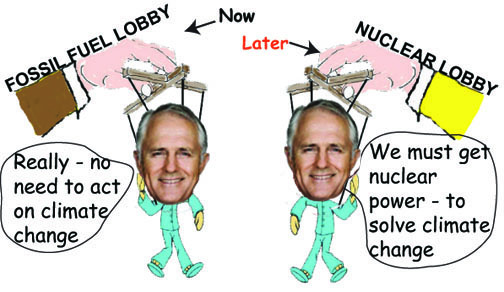
Malcolm Turnbull would be no better than Abbott on Climate Change

originally published 9 Feb 2015
Coalition needs a heart transplant, not a facelift, The Age, Waleed Aly. 6 Feb 15 The public has been focused on policy and that’s precisely why the Coalition’s in trouble. “…..the government’s in trouble precisely because we have been focussing on policy.
That was true for Labor, whose collapse in public support occurred the moment Kevin Rudd decided he no longer thought climate change mattered that much, and it is perhaps even truer for Abbott…..”http://www.smh.com.au/comment/coalition-needs-a-heart-transplant-not-a-facelift-20150205-136hjx.html
Here’s how Mark Kenny & James Massola saw it, writing in The Age 5 February 15 – “Amid feverish speculation over the leadership, unconfirmed reports also claimed Mr Turnbull had moved to assuage fears in the conservative wing of the party that his return to the leadership would see a reprise of the carbon tax or an emissions trading scheme.
It was claimed Mr Turnbull had promised, in a secret deal, that there would be no such reprise if elected”
Turnbull in climate change shift, West Australian, Andrew Probyn Federal Political Editor February 5, 2015, Malcolm Turnbull would make no change to the Government’s climate change policy in a major concession designed to extinguish lingering doubts about a return to him as Liberal leader….. https://au.news.yahoo.com/thewest/a/26199682/turnbull-in-climate-change-shift/
Malcolm Turnbull’s pro nuclear, pro coal, anti renewables policies
Malcolm Turnbull may have a better public profile than Tony Abbott but he is no hero and certainly doesn’t deserve support from outside the Liberal Party…….He fought the price on carbon and towed the party line beyond belief!# He supports coal seam gas mining, uranium mining, coal mining and doesn’t give a rats about Abbott Point or Mega factory ships in our waters or the pollution of our waters in so very 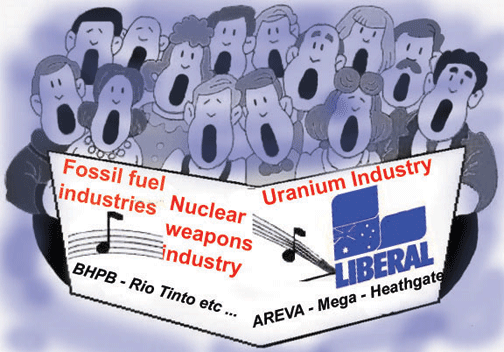 many ways!
# He doesn’t support renewable energy or renewable industry!…….Just because once upon a time he supported an emissions trading scheme (dumped that idea when Labor actually introduced one thanks to the Greens)
and just because he’s for equal marriage rights and wears a leather jacket does not mean he deserves our support!
Where did the Malcolm Turnbull propaganda come from? He’s very marginally better than Abbott because he presents well but then again, so does the big bad wolf in Little red Riding Hood! http://lisa-green-owen.blogspot.com.au/
1 This month
17 October, Free Public Talk on Nuclear Issues in South Australia
David Noonan will speak on public interest concerns over the new Roxby Downs Indenture Act 2026 on BHP copper-uranium mining and ore processing in SA, and on how AUKUS may face SA with a High-Level nuclear waste agenda.
Dr Jim Green will discuss international developments in the field of nuclear power including ‘small modular reactors’ and Generation 4 ‘advanced’ nuclear reactor concepts.


Help Aunty Sue Protect Her Land and Sacred Sites From Destructive Rocket Testing.
.

Australians deserve the truth
about
AUKUS – https://aukuspublicinquiry.com/

PETITION – To: Prime Minister Anthony Albanese and the Australian Labor Government

of the week – Australians for War Powers Reform (AWPR)
To see nuclear-related stories in greater depth and intensity

