Tony Abbott’s pointless accusations against environmental groups
Tony Abbott’s defence of the Carmichael coalmine is passionate but baseless, Guardian, Lenore Taylor, 7 Aug 15
 Prime minister, ‘sabotage’ is something undertaken by enemy agents, not citizens testing the laws of the land.In yet another passionate defence of coal (in an interview with the Australiannewspaper), Tony Abbott has made so many inaccurate and questionable claims it’s hard to know where to start. Here are some of his statements, juxtaposed with facts.
If a vital national project can be endlessly delayed, if the courts can be turned into a means of sabotaging projects which are striving to meet the highest environmental standards, then we have a real problem in this nation … we have to remain a nation that gives people a fair go if they play by the rules.”
The prime minister seems to be suggesting those taking court action are doing something unpatriotic and wrong. In fact, the environmentalists trying to stop the Carmichael mine are playing by the rules – the laws made by parliaments and interpreted by courts.
“Sabotage” is usually something undertaken by enemy agents, not citizens testing the laws of the land. The Environmental Defenders Office is an organisation representing the views of many loyal Australians. A recent Essential poll found that 50% of Australians believe governments should prioritise support for renewables over the coal industry, including 39% of Liberal voters. Only 6% thought governments should prioritise support for coal. The federal court interprets the law.
In any event, the biggest danger to the Adani mine is its own business case, not environmental legal cases, as my colleague Joshua Robertson explained after the recent court decision. Continue reading
Abbott govt to remove right of environmental groups to legally challenge developments
Coalition to restrict green groups’ right to challenge after Carmichael setback, Guardian, Lenore Taylor, 18 Aug 15 [below – mining donations to Coalition]

Decision to place restrictions on environment groups that can bring legal action comes after federal court overturned approval for the Queensland coalmine The government will remove the right of most environmental organisations to challenge developments under federal laws unless they can show they are “directly affected” – a direct response to the federal court decision this month on Adani’s Carmichael coalmine.
Attorney general George Brandis took the plan to cabinet “under the line” on Monday and it was approved by the Coalition party room on Tuesday, where Tony Abbott said he wanted to use the issue to prove Labor was “torn between workers and greens”, whereas the Coalition was always on the side of the “hard-working and decent” workers.
Brandis said the government would seek to repeal section 487 (2) of the Environmental Protection and Biodiversity Act and “return to the common law”. The government says “vigilante” green groups have been “sabotaging” development, jobs and growth by “lawfare” – unfair and improper use of the courts………
Abbott repeated the claim that the Adani mine would bring 10,000 jobs to Queensland even though the company’s own financial officer told a court this was not true and only 1,464 jobs would be created.
He told his party room “green activists” were “sabotaging” projects that could be bringing growth and jobs to Australia. The approval of the $16bn Carmichael mine, to be located in Queensland’s Galilee Basin region, was set aside earlier this month following a legal challenge by the Mackay Conservation Group. Continue reading
Australia’s Photovoltaic Institute ahead of Google with software tool for estimating solar savings
 Google allows households to calculate solar system savings, but Australia beats them to it, Business Spectator TRISTAN EDIS , 18 Aug 15, Google has unveiled a software tool that assists home owners to estimate how much they could save on their energy bill from placing solar panels on their available roof space. Yet Australia’s Photovoltaic Institute had already developed a similar tool some time ago.
The Google tool, known as Project Sunroof, uses high resolution aerial maps to estimate the suitable roof space of a building that could host solar panels, and then calculates the amount of energy these panels would produce and associated power bill savings. It does this taking into account the amount of solar radiation for that geographic location and then adjusts for factors such as roof orientation and shade from nearby buildings and trees. At present the tool is only available for the US locations of the San Francisco Bay Area, Fresno in central California and the North-east coast city of Boston.
However the Australian Photovoltaic Institute has designed almost precisely the same tool, releasing it several months ago. Called the Live Solar Potential Tool, it is a free to use tool that operates in a similar manner to Google Earth, allowing anyone to zoom in on a specific household and then estimate how much energy a given area of the rooftop would be likely to generate with solar panels……..http://www.businessspectator.com.au/news/2015/8/18/solar-energy/google-allows-households-calculate-solar-system-savings-australia-beats
Jeff McMullen on Aboriginal custodianship of Australia
You may see the Prime Ministerʼs litany of stupidity as merely a series of gaffes but I believe that his words point to a more troubling insensitivity, a failure to comprehend the strengths of Aboriginal culture and the resilience displayed throughout the longer timelines of history. I am thinking again of Bill Gammageʼs appraisal of Aboriginal “farming without fences”, the custodianship that created the sweet grasses that so delighted the English pastoralists. The mosaic of fire-stick farming and management of resources over many millennia is worthy of our admiration, not mere acknowledgement
 Custodianship in the 21st Century Green Left, Saturday, August 15, 2015 By Jeff McMullen, Darwin Vincent Lingiari’s fight for land rights shows it is possible to win.
The great power of Vincent Lingiariʼs story is that it teaches us how this land sings to us all, how it holds us and nurtures us. This is the common ground that we share.
When the Gurindji leader and his people walked off Wave Hill Station, camping by the Victoria River and then eventually by Wattie Creek at Dagaragu almost half a century ago, they understood that the land was their birthright and their destiny.
The Old Man also knew in his wisdom that a sharing of the living environment, a responsible Custodianship of the land, was the key to the common good for all Australians. With patience, humility and extraordinary dignity, Vincent Lingiariʼs fight for genuine Land Rights shows us how it is possible to unite and inspire enough Australians to move the country towards a legal settlement that is fair in the eyes of most reasonable people.
This is a priceless lesson as Australians once more contemplate many different views on recognition of the rights and rightful place of the First Peoples. Continue reading
A top Submission on Nuclear Waste Importing for South Australia
The Commission’s whole aim is to further the drive to make South Australia the World’s nuclear toilet. So, the Submissions on this topic of importing nuclear wastes are especially important.
NGOPPON TOGETHER INC sent in a top Submissions on all 4 Issues papers
Excerpts from NGOPPON TOGETHER INC – Submission on Issues Paper 4 – Management, Storage and Disposal of Wastes.
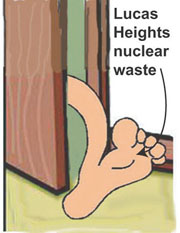 “…..Ngoppon Together’s answer [to Australia’s Lucas Heights wastes] – leave it where it is, where the expertise is, in Lucas Heights where it won’t be out of sight, out of mind; so that we avoid the hope of the pro-nuclear lobby and the consequent burgeoning of high and intermediate level waste in having finally established a repository, nuclear power will be far more possible (and the pressure to establish a nuclear power reactor thus increase.)
Measured by radioactivity, spent nuclear fuel reprocessing waste from Lucas Heights reactors accounts for over 90% of the waste the Government wants to dump … Although the volume of this waste is relatively small – some tens of cubic metres – it is by far the most radioactive material “ANSTO is capable of handling and storing wastes for long periods of time. There is no difficulty with that.” Dr Ron Cameron, ANSTO.(Lucas Heights (quoted in ‘Nuclear Freeways ‘)…….
 and waters, its people, its children? In such a vast country to discount the potential high level dangers of transport? Do we have no responsibility towards the future generations of South Australian and indeed Australian children?
 Ngoppon Together strongly refutes the muddled, quite fallacious so-called ‘ethics’ argument – We export and so are ethically bound to receive waste. This argument fails, as the people do not choose to export uranium but Governments and companies do. Aboriginal people oppose digging up uranium on their land in the first place and then to compound the burden, in the past at least are faced with the waste being imposed on them and their lands, waste that is up to one million times more reactive after enrichment. Our members point out the obvious realityif any government imports uranium then they import the responsibility for dealing with the implications of the purchase. Fewer than 1 in 6 South Australians are inclined towards reactors or waste dumps in S.A. We remind the Commission of their duties – to inform clearly and fully the SA Community of the facts and implications , rather than to persuade and cajole………
Radioactive trash storage would ruin South Australia’s vital fishing, agricultural and tourist industries

Huge solar panel array for Canberra Hospital’s roof
Canberra Hospital to get one of the nation’s largest solar rooftop arrays August 15, 2015 Matthew Raggatt Reporter at The Canberra Times The ACT government will spend up to $3.3 million, and install one of the nation’s largest rooftop solar arrays, to make Canberra Hospital more energy efficient.
The moves to add a 500-kilowatt solar system and install LED lights throughout all hospital buildings were aimed at slashing energy use at the site, which accounts for a quarter of the government’s electricity bill.
Overlapping two of his portfolios, Deputy Chief Minister Simon Corbell said the loan to ACT Health from the Carbon Neutral ACT Government Fund – by far the largest in the fund’s short history – would reap financial rewards.
“The Canberra Hospital delivers a critical 24-hour service to our community and is the ACT government’s largest user of energy,” he said.
“The announcement will see the hospital save a massive $490,000 a year in energy bills by 2017-18 and improve the government’s overall carbon footprint.”
The Sunday Canberra Times understands the hospital would become home to one of the top 10 largest roof-mounted arrays in Australia. A 500kW rooftop array [see below] at Toyota’s manufacturing plant in Melbourne, using 2000 panels, was Victoria’s largest when installed last year………http://www.canberratimes.com.au/act-news/canberra-hospital-to-get-one-of-the-nations-largest-solar-rooftop-arrays-20150814-giz7fh.html

France’s nuclear authorities anxious about the safety of China’s nuclear power programme
 “the state of conservation” of large components like pumps and steam generators at Taishan “was not at an adequate level” and was “far” from the standards of the two other EPR plants, one in Finland and the other in Flamanville, France
in a rare public comment about safety concerns, China’s own State Council Research Office three years ago warned that the development of the country’s power plants may be accelerating too quickly.
Critics of China’s nuclear safety regime, including Albert Lai, chairman of The Professional Commons, a Hong Kong think tank, says that lack of information risks eroding confidence in safety controls in what’s set to be a 14-fold increase of atomic capacity by 2030.
“The workings of China’s atomic safety authority are a ‘‘total black box,’’ said Lai. ‘‘China has no transparency whatsoever.’’
 China Regulators ‘Overwhelmed’ as Reactors Built at Pace, Bloomberg Tara Patel, Benjamin Haas , June 20, 2014June 19 (Bloomberg) — China is moving quickly to become the first country to operate the world’s most powerful atomic reactor even as France’s nuclear regulator says communication and cooperation on safety measures with its Chinese counterparts are lacking.
In the coastal city of Taishan, 100 miles (160 kilometers) from the financial hub of Hong Kong, Chinese builders are entering the final construction stages for two state-of-the-art European Pressurized Reactors. Each will produce about twice as much electricity as the average reactor worldwide.
France has a lot riding on a smooth roll out of China’s EPRs. The country is home to Areva SA, which developed the next-generation reactor, and utility Electricite de France SA, which oversees the project. The two companies, controlled by the French state, need a safe, trouble-free debut in China to ensure a future for their biggest new product in a generation. And French authorities have not hidden their concerns. Continue reading
Churchill and USA planned a massive nuclear strike on USSR
 Unthinkable as it may seem, Churchill’s plan literally won the hearts and minds of US policy makers and military officials.
These “first-strike” plans developed by the Pentagon were aimed at destroying the USSR without any damage to the United States.
The 1949 Dropshot plan envisaged that the US would attack Soviet Russia and drop at least 300 nuclear bombs and 20,000 tons of conventional bombs on 200 targets in 100 urban areas, including Moscow and Leningrad (St. Petersburg)
the Kennedy administration introduced significant changes to the plan, insisting that the US military should avoid targeting Soviet cities and had to focus on the rival’s nuclear forces alone.
Post WW2 World Order: US Planned to Wipe USSR Out by Massive Nuclear Strike, Sputnik News. Ekaterina Blinova. 15 Aug 15, Was the US deterrence military doctrine aimed against the Soviet Union during the Cold War era really “defensive” and who actually started the nuclear arms race paranoia?
Interestingly enough, then British Prime Minister Winston Churchill had ordered the British Armed Forces’ Joint Planning Staff to develop a strategy targeting the USSR months before the end of the Second World War. The first edition of the plan was prepared on May 22, 1945. In accordance with the plan the invasion of Russia-held Europe by the Allied forces was scheduled on July 1, 1945.
Winston Churchill’s Operation Unthinkable The plan, dubbed Operation Unthinkable, stated that its primary goal was “to impose upon Russia the will of the United States and the British Empire. Even though ‘the will’ of these two countries may be defined as no more than a square deal for Poland, that does not necessarily limit the military commitment.” Continue reading
Mururoa Nuclear Test Veterans seek answers to health problems
Mururoa nuclear testing witness spent years in pain, group seeks answers, Mururoa Veterans, SIMON EDWARDS, August 17 2015 There’s no doubt in Christine Hapuku’s mind that her late brother’s health problems stemmed from his exposure to fallout from the French nuclear testing at Mururoa Atoll.
At the weekend Christine and Alec Gage’s wider family unveiled his headstone at Wainuiomata’s Memorial Garden, a year ago almost to the day since his death.
……..Gage was a sailor on HMNZS Otago, which with the frigate Canterbury sailed to Mururoa in 1973 to protest the nuclear testing by France. He and his brother Bob, who was also on board, would talk about standing on the ship’s deck wearing metal discs around their necks that were to measure how much radiation they absorbed. The pair said the atmospheric testing fall-out was like fine rain, Hapuku said.
“Even the French acknowledged the bombs were a lot stronger than they were meant to be.
“Those discs were collected and never seen again.”
…….Christine Hapuku said medical researchers used to talk to Alec when he was in hospital but they never heard anything more. She is hoping further research being pursued by the Mururoa veterans’ group might give the family some closure.
The Mururoa Nuclear Veterans Group is searching for all those who sailed to Mururoa Atoll in 1973 aboard HMNZS Canterbury and HMNZS Otago. The group, formed in 2013 and registered as a Legal Society, monitors the medical conditions that have affected not only the personnel aboard the two frigates but also their children and grandchildren.
The group’s president, Wayne O’Donnell, said because there was no full list of the veterans who served at Mururoa they need the public’s help.
“Unfortunately over the years contact has been lost with the widows and children of those who have ‘crossed the bar’ and we need to make contact with these people so they can be informed of any findings.”
The group established a trust fund to enable the medical testing of the veterans’ children and grandchildren. “It is hoped the results will establish the truth of the genetic transfer of illnesses related to the nuclear exposure encountered by the crews,” O’Donnell says.
……Anyone with information should emailadmin@mururoavets.org.nz
Claire Catt’s fine Submission to #NuclearCommissionSAust
 CLAIRE CATT: SUBMISSION TO THE NUCLEAR FUEL CYCLE ROYAL COMMISSION
To the Commissioners, This submission pertains to Issue Paper No 4 Management, Storage and Disposal ofNuclear and Radioactive Waste
The following views and comments are sole my own as a citizen of the State of South Australia. My interest in nuclear issues is longstanding and my concerns are shared by many of my family and friends, here in Australia and overseas.
Issue Paper Question No. 4./ Clean and sufficient water resources are becoming a serious and difficult issue for countries all over the world. Australia is a very dry continent with limited and dwindling water resources. South Australia is its driest state. The nuclear industry requires huge and ongoing water resources which Australia cannot spare, let alone South Australia.
Issue Paper Question No. 4.6 Maintaining security at nuclear installations, both reactors and storage facilities, is becoming increasingly difficult due to geo-political developments. Security and defence issues are causing major concerns in the US and Europe. This heightened threat is relatively new and rising. Costs associated with maintaining security may become prohibitive, especially for a small community like South Australia. Provision of security by profit driven corporations poses its own inherent risks.
Issue Paper Question No. 4.8 Despite many years of research and experimentation, disposal/storage methods remain unsatisfactory, expensive and in terms of safety largely speculative, certainly in the (very) long term.
Issue Paper No. 4.10 It is important for each nation to responsibly address the problems caused by their own nuclear industries. The transportation and shipping of these dangerous material around the world exposes people and environments to unacceptable risks which are greatly reduced when local solutions are in place. Auslralia also needs 10 dispose of its own relatively small amount of medical nuclear waste as safely as possible in the most suitable location, away from large population centres. For this purpose we do require a small storage facility. The solution of this problem wilhin Australia is inthe interest of all Austral ans.
In conclusion I would like to voice my long held view that Australia has been very lucky and wise to avoid the significant problems posed by the nuclear industry all over the world. It would be an extraordinary decision to embark au this high risk venture at a time when much of the population here and overseas is focussing on clean renewable energy solutions which will benefit all including future generations.
South Australian government warned on using public money to encourage nuclear industry
“…..Greens MLC Mark Parnell has questioned why the Attorney-General’s Department is in charge of three tenders seeking on behalf of the Royal Commission business cases for the establishment of a nuclear power plant, a dump and an enrichment facility.
 “The Government must tread a very fine line between engaging in genuine open inquiry and actively promoting an expansion of the nuclear industry,’’ he said.
“It is illegal to spend any public money to “encourage” a nuclear waste facility in this State. The tender contract is in the name of the Attorney-General’s Department, so they will need to be very careful about any instructions they provide to tenderers about what to say or what not to say.” – Adelaide Now, August 14, 2015
Very worrying questions about that massive explosion in China
Tianjin explosions ignite barrage of questions, The Age, Philip Wen China correspondent for Fairfax Media, August 14, 2015 Tianjin: As fatalities continue to mount, so too have questions around the cause, response and potential health effects of the terrifying explosions at a toxic chemicals warehouse that tore through the port city of Tianjin, China, on Wednesday night.
Chinese authorities have dispatched more than 200 military nuclear and biochemical materials specialists to the site of the blast, as well as a team from the International Atomic Energy Agency’s Beijing environmental emergency response centre.
But some 36 hours after the explosions, municipal and environmental officials said they were still unable to determine the specific substances held in the warehouse which likely triggered the blast which killed dozens, injured hundreds, and ignited a fireball so large it was captured by orbiting satellites.
The owner of the warehouse, Ruihai International Logistics, is a firm which specialises in handling hazardous cargo, state news agency Xinhua said. It is licensed to handle dangerous and toxic chemicals including sodium cyanide, compressed natural gas, phosphoric acid, potassium nitrate and butanone – an explosive industrial solvent.
“So far, we are not able to provide the detail of type and amount of these dangerous items,” Gao Huaiyou, the deputy director of Tianjin’s work safety administration bureau, said on Thursday. “There is quite a big inconsistency with information provided by the company’s management and their customs declaration.”
Though a pungent smell and visible smog hung in the vicinity of the blast, officials said 17 emergency air monitoring stations indicated air quality in the city remained within a normal range, aided by easterly winds which blew toxic plumes from the fires out to sea.
Readings of cyanide and chemical oxygen demand – a measure of water quality – some three to eight times normal levels were detected near two underground discharge pipes, though officials said the pipes had been sealed off and posed no danger to health or the environment of the surrounding area.
Xinhua said 1000 firefighters and more than 140 fire trucks were struggling to contain the blaze in a warehouse which stored “dangerous goods”.
“The volatility of the goods means the fire is especially unpredictable and dangerous to approach,” it said….http://www.theage.com.au/world/tianjin-explosions-ignite-barrage-of-questions-20150814-gizjw9.html#ixzz3ir0wfaMy
Judge defending the NSW Land and Environment Court
‘If you have a degraded environment, you’re impoverished’: Justice Brian Preston, Peter Hannam ENVIRONMENT EDITOR, THE SYDNEY MORNING HERALD August 14, 2015 – Brian Preston, chief judge of NSW Land and Environment Court, joins Peter Hannam for a chat over lunch……. The Land and Environment Court was the first so-named court in the world when it was established in 1979, according to Ben Boer, Emeritus Professor at Sydney Law School and Preston’s first lecturer on environmental law, and a long-time friend and collaborator. There are now about 700 such courts globally.
But long before he got the top job at the court, he helped found another key organ of environmental law: the Environmental Defender’s Office of NSW.
It was the EDO that last week won a ruling in the Federal Court that found Environment Minister Greg Hunt had not properly considered advice on two threatened species, the Yakka skink and the ornamental snake, when approving Adani’s huge $16 billion Carmichael coal mine in Queensland.
The verdict prompted Prime Minister Tony Abbott to declare that courts were being used to “sabotage” mining projects, adding that Australia “must, in principle, favour projects like this”. The NSW Bar rejected the comments..
While our lunch preceded Mr Abbott’s outburst, Preston defended the importance of judicial independence, and later remarked that miners too often view environment checks as merely red tape.
Preston makes time for our lunch between his court duties, ongoing research for a book on environmentally sustainable development, and his work for a global effort to find ways the law can be used to curb climate change. He also teaches biodiversity law at Sydney University, and has helped develop environmental law in China and Thailand – two nations particularly in need of regulatory control –……..
He says that having a specialist court with judges well-read in environmental issues does not imply – as some miners argue – that developers won’t get a fair hearing.
“You should be environmentally literate,” he said. “All courts strive to make the right decision and you’re more likely to make that if you’ve got more knowledge.”……..http://www.smh.com.au/environment/lunch-with-justice-brian-preston-20150812-gixcdb.html
Guidelines for growing renewable energy in Victoria
 Four easy ways to grow renewable energy in Victoria, REneweconomy, By Leigh Ewbank on 12 August 2015 With the Abbott government sabotaging Australia’s clean energy future, states such as Victoria must step up and lead on renewable energy.
The uncertainty unleashed by the Abbott government has cost Australia’s renewable energy sector dearly. On the Prime Minister’s watch, investment has collapsed by 90 per cent and over 2,500 people working in the sector have lost their job.
Not content with its savage 20% cut to the national Renewable Energy Target, the Abbott government has dictated to the Clean Energy Finance Corporation that it can no longer invest in wind farms and rooftop solar power.
This is the context in which the Daniel Andrews government is developing its Renewable Energy Action Plan to grow the sector and jobs in Victoria.
The Andrews government has been sending all the right signals when it comes to renewable energy. It was elected with a commitment to repeal the Baillieu-era restrictions on wind farms. And it delivered on the commitment just months after taking office.
To date, the Andrews government has provided financial support for the Newstead community in it pursuit to be 100 per cent renewable by 2017, as well as a 30-KW community solar project in Woodend. It has also established a $20 million New Energy Fund to encourage investment in renewable energy and cleantech projects.
The Andrews government’s Renewable Energy Action Plan is due for release later in 2015 and will build on these positive first steps.
“We will do whatever we need to do to increase the total percentage of energy generated from clean sources but also do whatever we can to create more jobs,” Premier Andrews said while visiting the Ararat wind farm.
There are some straightforward ways the Victorian government can increase renewables before it announces its comprehensive plan. Continue reading
1 This month
17 October, Free Public Talk on Nuclear Issues in South Australia
David Noonan will speak on public interest concerns over the new Roxby Downs Indenture Act 2026 on BHP copper-uranium mining and ore processing in SA, and on how AUKUS may face SA with a High-Level nuclear waste agenda.
Dr Jim Green will discuss international developments in the field of nuclear power including ‘small modular reactors’ and Generation 4 ‘advanced’ nuclear reactor concepts.


Help Aunty Sue Protect Her Land and Sacred Sites From Destructive Rocket Testing.
.

Australians deserve the truth
about
AUKUS – https://aukuspublicinquiry.com/

PETITION – To: Prime Minister Anthony Albanese and the Australian Labor Government

of the week – Australians for War Powers Reform (AWPR)
To see nuclear-related stories in greater depth and intensity