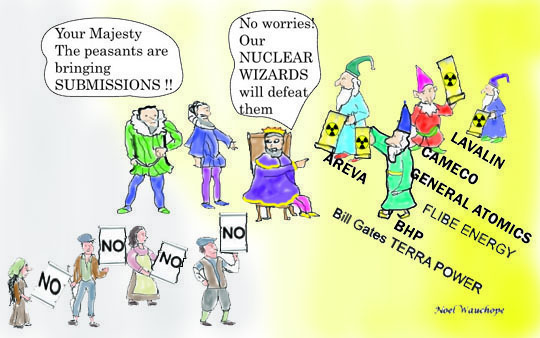
Yes, people understand that the outcome of commission is a foregone conclusion meant to placate those who are given the impression of having a say.
The only thing that would stop it now is incompetence or the simple fact that in the end the dollars may not add up. Or both.
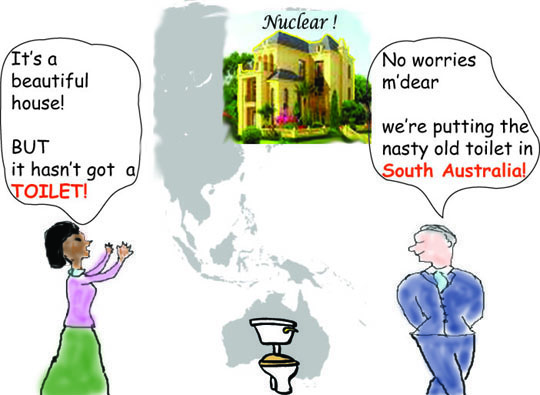
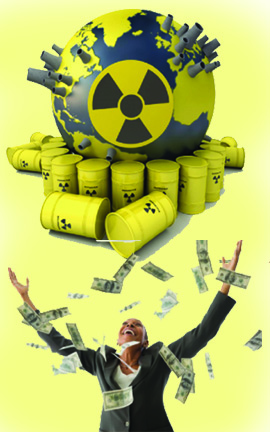
Particularly the idea of a dump is making certain personality-types swoon the kind of greed which indicates that they’ve already counted the profits and discounted the risks.
Future generations don’t get a say. I’m sure that that far down the track, the countries who’ve dumped their waste on us won’t be paying us to babysit it anymore. The overall trend as all resources decline is continued economic contraction. The only sane growth is degrowth. One way or another we’ll be forced to embrace it. And that’s what people and particularly politicians don’t want to talk about. http://m.indaily.com.au/opinion/2015/08/03/sas-nuclear-debate-lost-in-translation/
A couple of weeks ago, the Nuclear Royal Commission held a forum at the Marion Cultural Centre as one of a series aimed at engaging the South Australian people in the commission’s work.
The problem is, not one person came. Nobody.
Whether this raises alarm bells for the commission and the Weatherill Government depends on whether they genuinely want to create a community debate, or if they are just going through the motions.
What if an expensive, high profile inquiry held a public meeting and no-one turned up?
In early February this year, while most of us were slowly emerging out of South Australia’s long, lazy summer break, Premier Weatherill made a surprise announcement. South Australia would hold a first for Australia: a royal commission into the future role our state should play in the nuclear industry.
This came as a bolt from the blue, especially from a Government that had campaigned successfully a decade ago to stop a similar federal push to establish a nuclear waste dump in Woomera. Then Premier Mike Rann was so determined to stop a nuclear dump he enshrined it in state law.
And the timing was strange, with our state strongly embracing renewable energy, and the nuclear industry languishing in a post Fukushima downturn.
So while a typical royal commission is created by a government under pressure to respond to a major issue dominating talkback and dinner table discussions, the task given to ex-Governor Kevin Scarce was both challenging and unusual.
Not only would Scarce have to explore the huge technical and economic challenges of an expensive, divisive energy source with big waste and security issues, he would need to get the South Australian community interested enough to pay attention in the first place.
A couple of weeks ago, the Nuclear Royal Commission held a forum at the Marion Cultural Centre as one of a series aimed at engaging the South Australian people in the commission’s work.
The problem is, not one person came. Nobody.
Whether this raises alarm bells for the commission and the Weatherill Government depends on whether they genuinely want to create a community debate, or if they are just going through the motions.
As a fierce advocate for public involvement in decision-making, I believe the problem lies in the way the commission is going about its task.
The Issues Papers released to stimulate public submissions are an eye-watering challenge – dry, technical and full of assumptions. They appear aimed at industry players, not the general public. They have not been translated into other languages, despite non-English speaking Aboriginal communities being ground zero for any debate over a toxic dump.
Until far too late in the process, no-one with any expertise in engaging with Aboriginal communities was employed to work in the north of the state.
To put in a submission is an exercise in acrobatic hoop jumping including the requirement to appear in person before a Justice of the Peace – a huge challenge for anybody in rural or remote SA, and a totally unnecessary step not required for other similar inquiries.The ‘Community Forums’ that have been held so far have missed the mark, focusing on imparting information on the process, rather than an opportunity to debate issues in detail.
Also, Scarce in all his public statements has strongly emphasised that he is seeking “evidence” and “facts”, leaving little room for traditional cultural knowledge, or the perspective of a grandmother who doesn’t want to leave a toxic legacy for her grandchildren. Continue reading →
Mr Kenyon, now a backbench MP, refused to comment on the report.
The Sunday Mail understands it was not presented to Cabinet but became instrumental in prompting the current Royal Commission into the potential for the nuclear fuel cycle to revive the SA economy.
The report found there needed to be a good public relations campaign to convince people of the safety of the plan, and that money raised should be spent on infrastructure like the SA leg of a high speed rail to Melbourne.
It also proposed a model in which SA generate more money by leasing yellowcake mined here and taking it back as waste, and as a trade off people be guaranteed there will be no nuclear power plants in SA.
A BRIEFING paper delivered to the State Government recommended the state accept Taiwan’s nuclear waste, access that nation’s $10 billion disposal fund and establish an Outback nuclear waste dump to revive the economy.
As the Nuclear Fuel Cycle Royal Commission explores the option to help solve SA’s jobs crisis, the Sunday Mail has obtained a copy of a report prepared for former Employment and Science Minister Tom Kenyon which argues the case for a waste dump near Woomera.Continue reading →
SA Nuclear royal commission: Waste dump best economic option for state, Business SA says ABC News 3 Aug 15 Establishing an outback nuclear waste dump would be the best economic move for South Australia if the State Government decides to expand its role in the nuclear industry, Business SA says.
It has been revealed Premier Jay Weatherill last year received a report commissioned by former Employment and Science Minister Tom Kenyon, which found setting up a waste dump near Woomera could reap billions for the local economy.
A royal commission headed by Kevin Scarce is in the process of examining the potential for an expansion of the state’s role in the nuclear industry, including whether a nuclear power station or nuclear waste dump should be built.
Business SA’s chief executive Nigel McBride (above, at left) said countries such as Japan and South Korea would pay handsomely to dump their nuclear waste in the state’s outback.
We know that there are huge potential financial benefits from being able to provide that service, and it’s logical that they’ve identified somewhere in the Woomera region as a potential site because of course it’s very remote,” Mr McBride said.
“There is a huge market out of countries like South Korea who has got a lot of nuclear waste they need to deal with, Japan and other Asian countries and of course countries around the world.”………..
Mr McBride said South Australia was the ideal location for a waste dump, and could store the nuclear fuel safely.
He said the biggest concern would be transportation options……
More than a decade ago, South Australia’s Labor Government fought and won a vigorous battle against the Howard government to stop a low-level nuclear waste dump being located in far north South Australia.
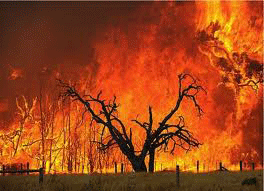
Dangers of Bushfires-Wildfires & Nuclear Business miningawareness, 3 August 15 “……… According to the South Australia Country Fire Service, nearly 1/2 of people living in bushfire prone areas don’t understand the threat. This is apparently true of those proposing adding nuclear anything in Australia.
For, in such a context, the risks of nuclear anything are clearly even higher than average. And, the solar potential in Australia is higher than average. The choice should be clear……..
In January of this year (2015) over 700 South Australian Country Fire Service volunteers fought the Sampson Flat bushfire series, helped by teams from New South Wales Rural Fire Service and Victoria Fire Authority, over the course of a week. On “Black Sunday” 1955 in South Australia, 1,000 Emergency Fire Service volunteers fought fires, but were overwhelmed and 2,500 citizens volunteered to help. For the 1983 Ash Wednesday Bushfires (II), 130,000 firefighters, defence force personnel, relief workers and support crews worked to fight the bushfires.Clearly this is serious business and dangerous in the best of
circumstances.
Adding nuclear to firestorms is even more dangerous than the Fukushima earthquake-tsunami disaster…………
The role of water in Australia’s uncertain future, The Conversation Amgad Elmahdi Manager Water Resources Assessment Section at Australian Bureau of Meteorology Matthew Hardy Manager, Urban Water at Australian Bureau of Meteorology August 3, 2015 “…….Water security is threatened by a number of factors. These include climate change, rainfall variability, population growth, economic development, and drought.
Rainfall declines are amplified in reduced streamflow and in turn the water in storages. Southwestern Australia has seen streamflow declines of 50% since 1970, while streamflow during the Millennium Drought (1996-2010) in southeastern Australia was half of the long-term average………
Australia also has naturally highly variable rainfall influenced by events such as El Niño and La Niña. An El Niño was declared in May 2015.
The El Niño’s likely impact will be drier and warmer conditions across inland eastern Australia. Importantly the strength of an El Niño does not always indicate how severely Australia may be affected.
These dryer conditions, should they arise, will place increased pressure on the water supply of effected regions. In particular, increased water demands and reduced stream flows will see declining surface water storage volumes. This could mean we need to develop and use more climate resilient sources………https://theconversation.com/the-role-of-water-in-australias-uncertain-future-45366
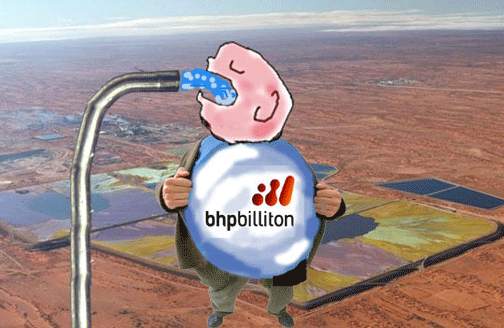
Olympic Dam Mine: Largest User of Energy in S. Australia; Largest User of Australia’s Precious Water Resource – The Great Artesian Basin31 Friday Jul 2015 by miningawareness The largest single user of electricity in South Australia is the Olympic Dam uranium, copper, gold, silver mine. Almost 60% of the energy in South Australia comes from renewables! Why would they need nuclear? Why a “Royal Commission”? They clearly want nuclear power so that they can sell their uranium to make energy to mine more uranium. Furthermore, the wise shun uranium, so to keep mining it in Australia, they need to dump it on Australia in the form of depleted uranium from enrichment, nuclear power, and the too often forgotten nuclear waste, to go with the radioactive tailings which they already have.
The largest user of underground water in the Southern Hemisphere is the Olympic Dam! Australia has a generally dry climate, and is highly dependent upon the same groundwater, underground aquifer, which is pumped for mining and most assuredly polluted by mining. Wikipedia says the Olympic Dam mine is the largest industrial user of underground water in the Southern Hemisphere. But, no single individual would use so much, so it much be the largest single user. Thus, it is also the largest single user of Australia’s precious Great Artesian Basin water.
We’ve all seen footage of out-of-control bushfires sweeping the Australian landscape, burning out hectares of native forest in their wake. But you might not have heard of a fire tornado, let alone seen one.
For many years now researchers have theorised that fire tornadoes could be possible. Now, in studying the 2003 Canberra bushfires, our colleagues and us have shown fire tornadoes do indeed exist.
So what are fire tornadoes? Where do they come from? And what sort of damage can they cause?
Fire thunderstorms
To answer these questions, we first need to understand a separate – but related – phenomenon: fire thunderstorms, also known as pyro-cumulonimbus clouds……….
Tracing the tornado
We showed that the weather conditions the fires were burning in were also suitable for tornado formation. We mapped the damage path, from the air and on the ground and could track the tornado in weather radar data………..
The 2003 Canberra fire tornado
Unlike the fire whirls observed by firefighters, the 2003 Canberra fire tornado was linked to the base of a thunderstorm, lifted off the ground, and then touched down again, three times.
What made this fire different to other fires was the wide range of observations being made as the edge of Australia’s capital was threatened.
ERA’s loss widens to $255m, Yahoo 7 Finance, 1 Aug 15 Uranium miner Energy Resources of Australia has slumped to a $255 million half year loss after shelving a major mine expansion in challenging conditions.
The Rio Tinto-controlled miner will not pay a half year dividend and said the uranium market remained challenging as an oversupply kept prices week……Half of the company’s board quit last month after ERA decided its proposed new underground mine at Ranger the Northern Territory would not proceed to a final feasibility study due to a sluggish uranium market.
Controlling shareholder Rio Tinto then pulled its support for any expansion of the mine, despite ERA saying it would seek to extend its authority to operate Ranger in order to re-visit the expansion at some stage.
The Senate inquiry is led crossbenchers David Leyonhjelm, John Madigan and Bob Day
.Senate inquiry into wind power a ‘stitch-up’ http://thenewdaily.com.au/news/2015/07/31/senate-inquiry-wind-power-stitch/Jul 31, 2015 Renewable energy sector claims industry would be destroyed if recommendations are followed. The Clean Energy Council (CEC) has accused a Senate inquiry of a “biased political stitch-up” against the renewable energy industry. Continue reading →
The Abbott government is being urged to strip billions more from subsidies to wind farms in the final report of a Senate committee that has already pushed renewable energy investment to favour solar.
In its recommendations, the committee says renewable energy subsidies for new wind farms should be limited to five years from more than 20.
It also wants the issue of renewable energy certificates restricted to projects in states that adopt federal regulations on infrasound and low frequency noise.
Why not adopt regulations on unicorns and bunyips?
The technology trap Could new types of nuclear power station solve the problem? “Fast breeder reactors” produce more nuclear fuel than they use and so would theoretically have much lower life-cycle CO2 emissions than existing “burner” reactors. But in practice breeders are even more complex, dangerous and expensive than burners. As a result they have been stuck at the demonstration stage for decades and even some nuclear proponents admit that breeders are unlikely to be commercialized for at least another two decades, if ever.
The government’s issues paper mentions the possibility of nuclear reactors based on the thorium fuel cycle, but these are also more complex than uranium-based nuclear energy and there are no commercial systems operating as yet.
To sum up, based on existing commercial technology, nuclear energy is not a solution to the global climate crisis, because it will soon become too emissions-intensive. It is also not a short-term solution, because it is a very slow technology to plan and construct. It is dangerous and very expensive.
Sure, let’s debate nuclear power – just don’t call it “low-emission”,
miningawareness Mark Diesendorf, UNSW Australia, 31 July 15 Nuclear power is back on Australia’s radar. In its recent issues paper released as a preface to September’s Energy White Paper, the Abbott government reopened the debate thus:
With environmental considerations constraining the further development of hydro-electric sources, nuclear technologies continue to present an option for future reliable energy that can be readily dispatched into the market.
This sentence appears in a passage dealing with the “move to low-emissions energy”, and although nuclear is not explicitly described as a low-emission option, it certainly looks as if the government is prepared to consider embracing nuclear power as part of an alleged move away from fossil fuels.
Is nuclear energy really low-emission?
Unfortunately, the notion that nuclear energy is a low-emission technology doesn’t really stack up when the whole nuclear fuel life cycle is considered.
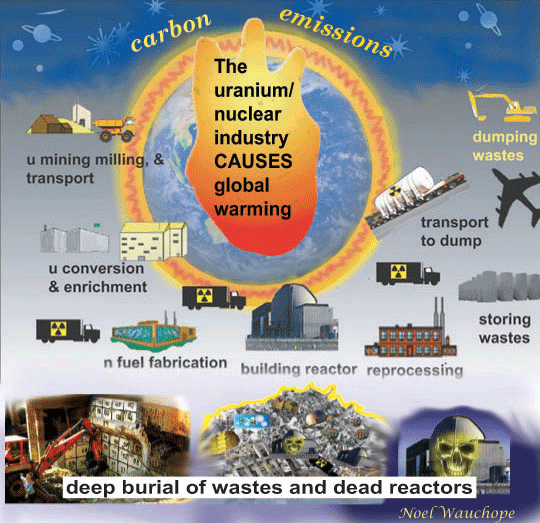
In reality, the only CO2-free link in the chain is the reactor’s operation. All of the other steps – mining, milling, fuel fabrication, enrichment, reactor construction, decommissioning and waste management – use fossil fuels and hence emit carbon dioxide.
Several analyses by researchers who are independent of the nuclear industry have found that total CO2 emissions depend sensitively on the grade of uranium ore mined and milled. The lower the grade, the more fossil fuels are used, and so the higher the resulting emissions. Continue reading →
Labor’s energy policy an Australian first in supporting workers TONY MAHER THE AUSTRALIAN JULY 30, 2015 There was an important Australian first in the electricity and climate change policy passed by Labor’s national conference on the weekend, and it had nothing to do with the renewable energy target or emissions trading schemes. Frankly, it had nothing to do with climate change.
It was the first time an Australian political party has got serious about designing a plan to support electricity workers and their communities with the transition from a coal-fired electricity system to a future where renewables play an increasing role in powering our homes and workplaces……….
So Labor’s plan for the electricity sector is an Australian first. It establishes a dedicated agency to manage any transition and oversee redeployment, retraining and income support. This has budget implications but it is the only way forward.
We need a clear industry adjustment package and workforce plan. The approach to retraining and redeployment requires a serious analysis of growth industries where energy and mining workers’ skills are transferable, combined with government intervention and financial support to help individual workers make a transition.
With thermal electricity plants closing one by one, we need a clear focus on redeploying workers to jobs in the energy and mining sector, including to remaining plants with continuous vacancies due to their age profile………
Labor’s electricity modernisation strategy announced on Saturday charts the way forward. It is designed to manage necessary industry restructure and support workers and their communities, while reducing emissions. It deserves broad support but, make no mistake, if Labor in government doesn’t deliver for workers, we will wage a concerted campaign to get what has been promised.
Pricing carbon: the simpler, the better..….. If we are to reduce carbon-emitting activities, the prices of those activities must be increased. Appropriate prices are the key here, and one way to make people happier about paying them is to make them as simple and transparent as possible. That’s what a carbon tax does
Politics aside, a simple carbon tax makes more sense than a convoluted emissions trading scheme, The Conversation, David Hodgkinson Associate Professor at University of Western Australia Rebecca Johnston Adjunct Lecturer, Law School at University of Notre Dame Australia July 31, 2015 Writing recently on The Conversation, Clive Hamilton correctly pointed out that an emissions trading scheme (ETS) can in no sense be called a tax – the two are fundamentally different. Under an ETS, the amount of emissions is fixed by the government and the market then sets the price; under a carbon tax, the price of emissions is fixed and polluters decide how much to emit.
In this sense, Hamilton is right to opine that “emissions trading is the opposite of a carbon tax”. But during Australia’s fractious debate about climate policy in recent years, the two have often been conflated together, and we have generally been starved of sober analysis of the contrasting merits of different policy instruments.
To put it more succinctly, what are the actual merits of a carbon tax, specifically as opposed to an ETS?
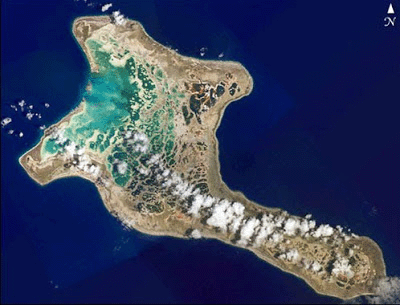
Vanishing Paradise Kiribati – A Case of Ecomigration : Dr Abe V Rotor http://avrotor2.blogspot.com.au/ 31 July 15 Kiribati main island is formerly Atoll Christmas, named by Captain Cook when he arrived on Christmas Eve in 1777. The island, like most islands in the region, faces irreversible submergence and sea water intrusion as a result of rising sea level brought about by global warming. The island was used as nuclear testing ground by the United States in the fifties and sixties.
Aerial view of the Kiribati group of islands. Rising sea level is forcing inhabitants to leave permanently their home islands, a classical example of modern day exodus – ecomigration. Displaced inhabitants are being settled mainly in Australia, New Zealand and Papua New Guinea.
Kiribati (pronounced /ˈkɪrɨbæs/ ( listen) KIRR-i-bas;[4] Gilbertese: [ˈkiɾibas]), composed of 32 atolls and one raised coral island, dispersed over 3.5 million square kilometres, (1,351,000 square miles) straddling the equator, and bordering the International Date Line at its easternmost point. Kiribati is the only country in the world located on both hemispheres and lying on both sides of the 180th meridian.
The groups of islands are:
* Banaba: an isolated island between Nauru and the Gilbert Islands
* Gilbert Islands: 16 atolls located some 930 miles (1,500 km) north of Fiji
* Phoenix Islands: 8 atolls and coral islands located some 1,100 miles (1,800 km) southeast of the Gilberts
* Line Islands: 8 atolls and one reef, located about 2,050 miles (3,300 km) east of the Gilberts.
Caroline Atoll channel between west side of Long Island and Nake Island.
Used for nuclear testing in the 1950s and 1960s, the island is now valued for its marine and wildlife resources. It is particularly important as a seabird nesting site—with an estimated 6 million birds using or breeding on the island, including several million Sooty Terns.
According to the South Pacific Regional Environment Program, two small uninhabited Kiribati islets, Tebua Tarawa and Abanuea, disappeared underwater in 1999. The islet of Tepuka Savilivili no longer has any coconut trees due to salination. The UN Intergovernmental Panel on Climate Change predicts that sea levels will rise by about half a metre (20 in) by 2100 due to global warming and a further rise would be inevitable. It is thus likely that within a century the nation’s arable land will become subject to increased soil salination and will be largely submerged.
Rising level level is also being felt in many countries, particularly island-countries like the Philippines.
David Noonan will speak on public interest concerns over the new Roxby Downs Indenture Act 2026 on BHP copper-uranium mining and ore processing in SA, and on how AUKUS may face SA with a High-Level nuclear waste agenda.
Dr Jim Green will discuss international developments in the field of nuclear power including ‘small modular reactors’ and Generation 4 ‘advanced’ nuclear reactor concepts.