New website advises on protection from UV rays
 Slip, Slop, Slap 2.0: New website tells Australians how much sun protection they need http://www.9news.com.au/health/2015/07/30/15/33/new-website-gives-australians-a-guideline-to-sun-protection A new index measuring ultraviolet rays will give sun-lovers Australia-wide a new way to figure out how much protection they need outside.
Exposure to sunlight is a balancing act, with too much UV radiation raising the risk of melanoma and premature ageing. However, sunlight also boosts vitamin D production, which is vital for the health of bones, boosting the immune system, and balancing mood.
The UV index is not dependent on temperature, reaching 1.8 by 10am in Sydney today, peaking at three at noon, before dipping to 1.8 at 2pm.
In Australia’s southern states, the midday sun is mild enough to usually render protection unnecessary. However, in summer, a few minutes of exposure to mid-morning or late afternoon sun should produce enough vitamin D. It is also recommended to expose larger areas of skin in short bursts to avoid vitamin D saturation.http://www.9news.com.au/health/2015/07/30/15/33/new-website-gives-australians-a-guideline-to-sun-protection#Tewiv3ZCge26lEX9.99
Australian uranium company Paladin desperate to stay alive – cuts salaries
 Paladin Energy cuts management salaries in break-even bid, THE AUSTRALIAN,BUSINESS SPECTATOR JULY 30, 2015 Michael RodMichael Roddan Troubled Australian uranium miner Paladin Energy has slashed the pay of its chief executive by 20 per cent as part of a string of cost cutting measures across the business designed to get the firm to a cash flow break-even point by the end of the year.
Paladin (PDN) said today it had materially lowered its break-even level for the 2016 financial year, on a cashflow basis, off the back of capital expenditure reductions, and cutting of corporate and debt costs….
Previous to this, the salary of the managing director had been reduced by 35 per cent and board fees cut by 10 per cent.
…Mr Borshoff also gave himself a 20 per cent pay cut as part of the restructure, along with a 10 per cent salary cut for management and staff and further 20 per cent reduction in fees payable to Paladin’s chairman and non-executive directors……..
Uranium is currently being traded at $US36 a pound, The market has been soft for some time, with the uranium spot price hovering around or under $US40 for the last two years, well below its peak of $US130 a pound in 2007.
Paladin shares have also taken a pounding since the commodity’s peak, falling from $10.44 in 2007 to their current level at 22.5c……..
Port Augusta coal-fired power stations to close early
Alinta Energy to close Port Augusta power stations and Leigh Creek coal mine early, ABC News 30 July 15 Alinta Energy has brought forward its deadline to close its power stations in Port Augusta and coal mine at Leigh Creek.
The company announced last month it would close the power stations and mine at some point between next March and March 2018…….http://www.abc.net.au/news/2015-07-30/alinta-energy-brings-forward-closure-power-station/6661082
Australian Youth Climate Coalition calls for NO Bjorn Lomborg Climate Centre at Flinders University
 Open Letter to Flinders Uni – Keep Us Bjorn-Free http://www.aycc.org.au/bjorn_free
To Flinders University Vice Chancellor Colin Stirling and Deputy Vice Chancellor (Research) Robert Saint,
We, the below signatories, object to controversial Danish academic Bjorn Lomborg being offered $4 million to set the Australian Consensus Centre at Flinders University. We are students, teachers, academics, alumni, and the general public. We are concerned that Flinders would consider such a reputationally risky and academically damaging appointment.
Lomborg’s “Consensus Centre” has already been kicked out of Denmark for its dangerous opinions that don’t align with scientific consensus . Flinders should learn from the decision of the University of Western Australia, where Lomborg was ousted because of his outdated views on climate change and record of poor academic integrity.
In a time when young people are attending university to equip themselves with the skills they need to make a positive impact on the world, there is no place for Lomborg’s backwards views at Flinders University.
This funding allocation sits outside of the competitive research grant process – an insult to students and researchers who are facing hefty cuts and job losses, doing important scientific research.
Lomborg’s views are dangerous. He trumpets the same ideology as the fossil fuel lobby – that we can solve energy poverty with coal, that Pacific Islanders don’t care about climate change, and that climate action should not be a priority for governments.
Bjorn Lomborg’s views on climate change, fossil fuels and economics are outdated and have been repeatedly discredited.
We will not stand by while ideologically motivated fossil-fuel industry mouthpieces are invited onto university campuses for political gain.
In the name of science, academic integrity and a safe future, we are calling on the Vice Chancellor to reject the appointment of Bjørn Lomborg.
Institute of public affairs works hard for the coal lobby
 IPA: Coal lobbyist and climate skeptic factory, Independent Australia, Graham Readfearn 30 July 2015 The fossil-fuel funded Institute of Public Affairs has just a released a report promoting the potential of the Galilee Basin, which just happens to be a project by one of its funders — right-wing, mining billionaire Gina Rinehart. Graham Readfearn from DeSmogBlog reports.
The Institute of Pubic Affairs holds the unofficial and dubious title of being Australia’s leading climate science denial organisation.
The so-called “think tank”, based in Melbourne, promotes fringe views on climate science from non-experts while attacking renewable energy………
The IPA has worked with Rinehart’s lobby group, Australians for Northern Development and Economic Vision, to push for a lowering of taxes and regulations in the country’s north to promote mining projects. IPA executive director, John Roskam, confirmed to Fairfax media in 2013 that Rinehart had provided funding to the IPA.
The IPA also gave Rinehart a “Free Enterprise Leader Award” in 2013 during its 70th anniversary dinner, attended by a who’s who of Australian conservative politics including Abbott and Rupert Murdoch.
But has the IPA’s decision to go all out in support of Galilee Basin coal come too late? ………https://independentaustralia.net/environment/environment-display/ipa-coal-lobbyist-and-climate-skeptic-factory,7999
Tobacco corporation Philip Morris sues Australia over cigarette plain packaging
ISDS provisions have been criticised by the High Court Chief Justice Robert French and the Productivity Commission which warned they gave foreigners greater legal rights than Australian companies, exposed local business to potentially large liabilities and were red tape-heavy.
There are concerns similar provisions in the yet-to-be-concluded 12-nation Trans-Pacific Partnership agreement, it would constrain the listing and pricing of medicines under the Pharmaceutical Benefits Scheme
 Tobacco giant sues Australia, The West Australian, Andrew Probyn July 28, 2015, More than $50 million of taxpayer money is expected to go up in smoke defending cigarette plain packaging in a secretive international tribunal in Singapore.
But costs will pile much higher if Australia loses on its first defence that Philip Morris indulged in cynical “venue shopping” by shifting its headquarters to Hong Kong to sue Australia.
The West Australian can reveal the Attorney-General’s Department, which is running the case in defence of plain packaging, called former Labor treasurer Wayne Swan as a witness before a special tribunal sitting in Singapore back in February. Continue reading
Labor Senator Wong fights TPP’s Investor State Dispute Settlement (ISDS) clauses
 ISDS clauses give foreign investors the right to sue governments if the company’s business interests are adversely affected by national policy. The Asian arm of the tobacco multinational Philip Morris is challenging the Australian government over plain packaging laws, despite the company already losing a case in the Australian courts.
Penny Wong backs fight against free-trade clauses that let companies sue Australia http://www.theguardian.com/australia-news/2015/jul/24/penny-wong-expected-to-fight-free-trade-clauses-that-let-companies-sue-australia Gabrielle Chan
Labor’s trade spokeswoman supports motion to remove investor state dispute settlement clauses from existing trade agreements Labor has committed to remove investor state dispute settlement (ISDS) clauses from existing trade agreements, including the Chinese and Korean free trade agreements (FTA) recently signed by the Abbott government.
The motion was supported by the opposition trade spokeswoman, Penny Wong.
The motion, moved by New South Wales MP Pat Conroy, would also mean a Labor government would work to reform ISDS tribunals to remove “perceived conflicts of interest” of judges determining disputes.
Conroy said: “When the Productivity Commission, the chief justice of the high court and a range of academics say ISDS must be reformed, it is time to fix this system that undermines our sovereignty.” Continue reading
Australian mining companies’ shameful record in Africa
Australia sells itself as a nation that can teach the world about responsible mining – Afghanistan is one willing student – but the record suggests our corporations have a callous disregard for the rights of civilians.
Why is it left to US NGOs to expose Australian mining’s wrongdoing in Africa? Antony Loewenstein, Guardian , 27 july 15
There are hundreds of Australian mining companies working in Africa, but just one full-time Australian journalist. What does that mean for accountability? Australian miners are making a killing overseas. With little regulation or oversight, billions of dollars are being made in some of the most remote places on Earth.
The necessity of partnering with autocratic regimes has proved no impediment to investment. Human rights have been breached. Victims are largely invisible.
None of this should be surprising. If Australian companies operating internationally are mentioned in the media, it appears in the business pages and discusses the strengths of a CEO or share price. Rio Tinto, for example, receives largely uncritical coverage despite in the 1980s the corporation facing serious allegations of human rights abuses around the world, including in Papua New Guinea.
Two American non-profit media organisations, the Centre for Public Integrity and the International Consortium of Investigative Journalists, recently bucked the trend and released a stunning report, Fatal Extraction, on Australian mining companies working in Africa (in which no allegations were made against Rio Tinto). How revealing that this research was led from America and not Australia itself.
The findings of the report, produced in collaboration with African journalists on the ground, were shocking.
From the Democratic Republic of the Congo to Malawi, grim details of death, maiming and police and army brutality were revealed. Continue reading
Increasing anxiety over secret Trans Pacific Partnership
 Secrecy Around TPP Fuels Suspicions, Worries, http://www.industryweek.com/trade/secrecy-around-tpp-fuels-suspicions-worries, 27 July 15, After chapters of the Trans-Pacific Partnership are leaked to Wikileaks, critics and backers of the controversial proposal are out in full force. With a Maui meeting looming, how will it affect the country and its industry? WASHINGTON, D.C. — Higher costs for needed generic drugs. Longer copyright protections than the global standard. Foreign investors empowered to overrule governments. A more tightly-regulated Internet.
Those are some of the potential pitfalls from any deal that could emerge from the Trans-Pacific Partnership, the 12-country free-trade and investment pact shrouded in secrecy as negotiations head into the final stage in Hawaii next week.
A handful of draft chapters of the TPP, leaked via Wikileaks, have highlighted the proposed treaty’s heavy emphasis on expanding protections for corporate rights and assets like intellectual property — patents, copyrights and databases — that are far more valuable to advanced economy corporations than traditional cargo trade. Continue reading
Answer points to #NuclearCommissionSAust Issues Paper 3 – Electricity Generation – this week’s theme
Submissions on this Issue are due by August 3rd. Check tips on submitting.
3.2 Are there commercial reactor technologies (or emerging technologies which may be commercially available in the next two decades) that can be installed and connected to the NEM?
There are commercial technologies available, such as the General Electric Mark 1 Boiling Water Reactor, that would be available in the next two decades. However, this is the same type of reactor as the ones at Fukushima Daiichi, and has been known to have safety flaws. (1) Then there is the Generation 3+ EPR reactor, currently being built at Olkiluoto, Finland, and at Flamanville, France. However, this might not be available within two decades. The history of its development is one of delays and over-running costs.(2) Recently, cracks in its pressure vessel have caused problems, that shed doubt on its safety. (3)
There are no “emerging” technologies that are at all likely to be available within the next two decades. The Generation IV reactors include : the Gas-cooled Fast Reactor (GFR), the Leadcooled Fast Reactor (LFR), the Molten Salt Reactor (MSR), the Supercritical Water-cooled Reactor (SCWR), the Sodium-cooled Fast Reactor (SFR) and the Very High Temperature Reactor (VHTR). (4)
The French Radiological Protection Agency (IRSN) has carried out a review of these systems from the point of view of safety and radiation protection. On the basis of its examination, IRSN considers the SFR system to be the only one of the six to have reached a degree of maturity compatible with the construction of a Generation IV reactor prototype during the first half of the 21st century.
Even then this will depend on further studies. DECC estimate in their 2013 Nuclear Energy Research and Development Roadmap that the first commercial Generation IV reactors should be operating by 2040. (4)
3.3. Are there commercial reactor technologies (or emerging technologies which may be commercially available in the next two decades) that can be installed and connected in an off-grid setting?
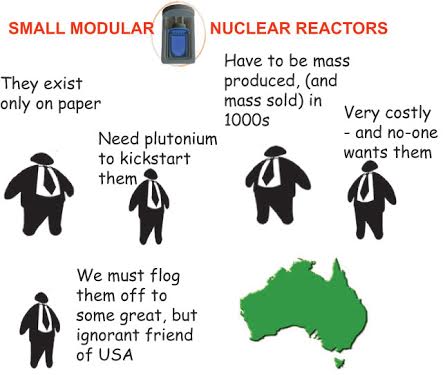
The suggested Small Modular Reactors , including the PRISM reactor have serious disadvantages, especially economiic ones . SMRs are likely to have higher costs per unit of output than conventional reactors. (5) Even if SMRs could eventually be more cost-effective than larger reactors due to mass production, this advantage would only come into play if large numbers of SMRs were ordered. But utilities are unlikely to order an SMR until they are seen to produce competitively priced electricity. This Catch-22 suggests the technology will require significant government financial help to get off the ground.
Even industry executives and regulators believe the SMR technology will have costs that are substantially higher than the failed “nuclear renaissance” technology on a per unit of output. The higher costs result from
- lost economies of scale in containment structures, dedicated systems for control,
management and emergency response, and the cost of licensing and security,
- operating costs between one-fifth and one-quarter higher, and
- decommissioning costs between two and three times as high.(6)
As to these “off-grid” technologies being available within the next two decades, I have been unable to find any credible reference that states that this is the case. I conclude that, even if design and testing of these small reactors were to be completed, it would be many decades before they would be commercially available. For reasons of regulatory processes, but more importantly, of uncertainty over economic viability, commercial availability is decades away, if ever to be achieved. (7)
3.4. What factors affect the assessment of viability for installing any facility to generate electricity in the NEM?
The major factor in assessing the viability of installing nuclear power for electricity generation in South Australia is the increasing practical and economic success of the alternative – truly modern power – renewable energy. (8) Combine that progress with the revolutionary developments in battery storage, and nuclear reactors of any size look like unnecessary and uneconomic dinosaurs in the electricity providing sector.(9)
3.7. What place is there in the generation market, if any, for electricity generated from nuclear fuels to play in the medium or long term?
Referring to my answers to previous questions, I would have to say – No place.
3.8 What issues should be considered in a comparative analysis of the advantages and disadvantages of the generation of electricity from nuclear fuels as opposed to other sources? What are the most important issues?
The most important issues are health, safety and environmental protection. Nuclear power of whatever design loses out on all those counts.(10)
However, that hardly matters in a world where economics is king. Fortunately as nuclear power is widely recognised now to be getting more and more expensive, while renewable energy and energy efficient technologies are getting cheaper, it is indeed economics that provide the killer disadvantage for nuclear power (9)
3.11. How might a comparison of the emission of greenhouse gases from generating electricity in South Australia from nuclear fuels as opposed to other sources be quantified, assessed or modelled?
For one thing, Greenhouse gases are emitted at all stages of the nuclear fuel chain. (10) However, in practical terms, nuclear power as a solution to climate change, is irrelevant – action on climate change is needed now , not in 20 -30 years.(11) Furthermore, climate change itself makes nuclear power an impractical and increasingly dangerous solution. – water shortage, water over-heating, (12) sea level rise (13) Storm surges (14)
3.12 and 313 . What are the wastes (other than greenhouse gases) produced in generating electricity from nuclear and other fuels and technologies?
What risks for health and safety?
Nuclear reactors produce dangerously toxic radioactive isotopes, come previous unknown on the planet, – plutonium – decaying to three types of radiation – alpha, beta, and gamma, caesium 137, iodine 131 , strontium 90 (15) No other technologies produce these toxic, carcinogenic wastes.
(3) http://yle.fi/uutiset/nuclear_watchdog_seeks_re-check_of_olkiluoto_3_reactor/7937448
(4) Generation IV International Forum https://www.gen-4.org/gif/jcms/c_40465/generation-iv-systems 2. IRSN 27th April 2015http://www.irsn.fr/EN/newsroom/News/Pages/20150427_Generation-IVnuclear-energy-systems-safety-potential-overview.aspx.
Nuclear Energy Research and Development Roadmap: Future Pathways, Dec 2013 https://www.gov.uk/government/uploads/system/uploads/attachment_data/file/168043/bis-13-632-nuclearenergy-research-and-development-roadmap-future-pathway.pdf.
Nuclear Engineering International 2013 http://www.neimagazine.com/opinion/opinionwhy-theenvironmental-movement-is-important-for-nuclear-power-4559455
(5) http://www.nuclearpolicy.info/docs/news/NFLA_Small_Nuclear_Reactor_report.pdf
(7) https://www.nirs.org/reactorwatch/newreactors/cooper-smrsaretheproblemnotthesolution.pdf
(8) http://qz.com/456931/half-the-world-already-gets-more-power-from-renewables-than-from-nuclear/(9)https://www.newscientist.com/article/mg22730312-100-the-battery-revolution-that-will-let-us-all-be-power-brokers/
(9) http://reneweconomy.com.au/2015/solar-and-wind-substantially-cheaper-than-nuclear-even-in-uk-10393
(10) http://www.psr.org/resources/nuclear-power-factsheet.html?referrer=https://www.google.com.au/
(11) http://www.counterpunch.org/2015/02/05/why-nuclear-power-is-not-low-carbon/
(12) http://www.nirs.org/factsheets/nukesclimatefact614.pdf
(13) http://www.climatecentral.org/news/sea-level-rise-brings-added-risks-to-coastal-nuclear-plants
(14) http://www.desmogblog.com/2014/01/21/push-nuclear-power-climate-change-concerns-overlooked
(15) https://en.wikipedia.org/wiki/Plutonium#Toxicity
http://www.geigercounter.org/radioactivity/isotopes.htm
#NuclearCommissionSAust’s Issues Paper 3 – designed to please the nuclear corporations!
 I am currently struggling with my Submission to the Commission on the questions in Issues Paper 3 – “Electricity Generation From Nuclear Fuels”. it’s a doozy. They’ve excelled themselves this time – with questions designed to elicit lovely answers from nuclear companies Transatomic, Bill Gates’ Terra Power , SNC Lavalin, NuScale, – anyone but you and me.
Given that the nuclear lobby’s plan is for Australia to be the guinea pigs for new untested (not yet existent) gee whiz reactors, Those companies are gonna love questions like this:
3.2 Are there commercial reactor technologies (or emerging technologies which may be commercially available in the next two decades) that can be installed and connected to the NEM?
3.3. Are there commercial reactor technologies (or emerging technologies which may be commercially available in the next two decades) that can be installed and connected in an off-grid setting?
3.6. What are the specific models and case studies that demonstrate the best practice for the establishment and operation of new facilities for the generation of electricity from nuclear fuels?
Pro Nuclear Royal Commission Pushes on With Determination
|
||||


| AGD 027826 Computational General Equilibrium Modelling Assessments for the Nuclear Fuel Cycle Royal Commission |
24 July 2015 | 10 August 2015 | Link to Tender |
| AGD 027828 Quantitative Analyses and Initial Business Case for establishing a Nuclear Power Plant and Systems in South Australia |
Climate change brings bushfires – a terrible risk to nuclear facilities
If the radiation leak lasts more than a few hours, there is no viable safe plan. If the radiation plume passes, the ground will probably still be contaminated
Wildfires also threaten Nuclear Waste and Nuclear Waste Shipments
 Wildfires and Nuclear Don’t Mix: Lessons from San Onofre and Chernobyl to Australia https://wordpress.com/read/post/feed/4410547/762849951 [good
  photos] miningawareness 27 July 15 As the deadline looms (3 Aug.) for comments regarding the risks of the nuclear fuel chain for South Australia – whether uranium mining, which is already occurring, or any proposed additions (uranium enrichment, nuclear energy, nuclear waste), foremost in everyone’s minds should be the risk of Bushfires (Wildfires), as well as endangerment to the Great Artesian Basin (GAB) aquifer, upon which so much of Australia is dependent for water, and which is being depleted, and most assuredly contaminated, by uranium and other mining:https://miningawareness.wordpress.com/2015/07/25/nuclearcommissionsaust-have-your-say-for-the-future-of-south-australia-submissions-close-soon-july-theme/ (Australia’s uranium mining “generates less than 0.2 per cent of national export revenue and accounts for less than 0.02 per cent of jobs in Australia.”http://www.conservationsa.org.au/images/Nuclear_Royal_Commission_issues.pdfMeanwhile it is laying waste to the land and provided nuclear fuel for Fukushima)
“The Australian climate is generally hot, dry and prone to drought. At any time of the year, some parts of Australia are prone to bushfires with the widely varied fire seasons reflected in the continent’s different weather patterns. For most of southern Australia, the danger period is summer and autumn.” http://www.ga.gov.au/scientific-topics/hazards/bushfire/basics/where
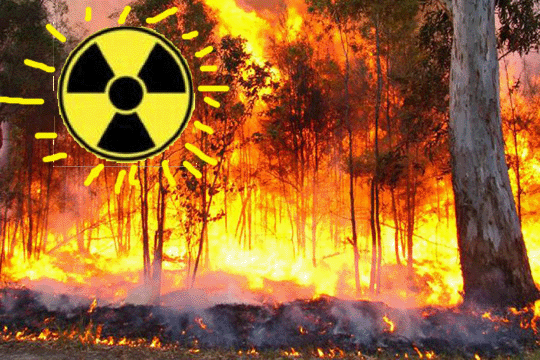
2015 Wildfires Near Chernobyl http://www.mns.gov.ua/news/40286.html
In April of this year, and again from the end of June into mid July, hundreds of firefighters in the Ukraine bravely battled fires in the area of the Chernobyl nuclear power station. Smoldering peat fires were the hardest to put out.
http://www.mns.gov.ua/news/40286.html
While this represents a serious danger to Europe, it received shockingly little media coverage. Continue reading
Australian Labor Party delegates vote for 50 per cent renewable energy plan
 Labor supports higher renewables target Delegates at the ALP national conference have passed a motion to aspire to a 50 per cent renewable energy target by 2030. SBS News 25 JUL 2015 AUSTRALIA SHOULD BE ASPIRING TO A TARGET OF 50 PER CENT RENEWABLE ENERGY BY 2030, LABOR SAYS.
Climate action groups rallied in support as a motion to increase the target was passed by delegates at the ALP national conference in Melbourne on Saturday.
“Labor will take a 50 per cent goal for renewable energy by 2030 to the election … because we know renewable energy will be a central part, not just of Australia’s energy system, but of our industrial and jobs base as well,” opposition climate change spokesman Mark Butler said……… Continue reading
Al Gore’s visit and Victoria’s Climate Charter proposal
Al Gore is visiting Australia to promote action on climate change. Still, we have to watch out that he is not on the “nuclear for climate” bandwagon.
A good sign is that Gore has recently been criticised by the pro nuclear front group Breakthrough Institute for being “sceptical” about nuclear power’s future. http://thebreakthrough.org/index.php/programs/energy-and-climate/al-gores-nuclear-hypocrisy
On Monday, Environmental Justice Australia will release a proposal for a Victorian Climate Charter, which it says is modelled on the state’s existing Human Rights Charter.
 Al Gore flies into Australia to push momentum towards Paris climate summit July 27, 2015 Tom Arup Environment editor, The Age Former United States vice-president Al Gore has flown into Australia for a whistlestop tour that includes meetings with state government ministers and senior business figures as part of efforts to build global momentum towards the Paris climate change summit later this year.
Mr Gore arrived in Melbourne on Sunday afternoon, heading to a speaking engagement and then dinner with Victorian ministers and senior executives from major companies, including BHP, National Australia Bank and Qantas, to discuss climate change and the importance of the Paris meeting, at which it is hoped a new international agreement to curb global warming will be signed……..
Ministers from Labor-led Victoria, Queensland and South Australia will attend Monday’s meeting with Mr Gore. Conservative-led NSW will send a senior public servant, as will Labor-led ACT. Tasmania, Northern Territory and Western Australia will not be represented. Continue reading
1 This month
17 October, Free Public Talk on Nuclear Issues in South Australia
David Noonan will speak on public interest concerns over the new Roxby Downs Indenture Act 2026 on BHP copper-uranium mining and ore processing in SA, and on how AUKUS may face SA with a High-Level nuclear waste agenda.
Dr Jim Green will discuss international developments in the field of nuclear power including ‘small modular reactors’ and Generation 4 ‘advanced’ nuclear reactor concepts.


Help Aunty Sue Protect Her Land and Sacred Sites From Destructive Rocket Testing.
.

Australians deserve the truth
about
AUKUS – https://aukuspublicinquiry.com/

PETITION – To: Prime Minister Anthony Albanese and the Australian Labor Government

of the week – Australians for War Powers Reform (AWPR)
To see nuclear-related stories in greater depth and intensity

