Government’s attack on Clean Energy Finance Corporation threatens commercial solar projects in ACT
Federal directive on solar threatens commercial rooftop projects in the ACT, says Simon Corbell July 13, 2015 Kirsten Lawson Chief Assembly reporter for The Canberra Times. The Abbott government’s directive against investment in small and medium-scale solar threatens commercial rooftop projects in Canberra, ACT Environment Minister Simon Corbell said on Monday.
Mr Corbell attacked Prime Minister Tony Abbott as “public enemy No 1” on renewable energy.
“He’s putting jobs at risk, he’s putting investment at risk and he’s putting the industry at risk, an industry that will need to grow considerably over the next decade if Australia is to meet its international greenhouse gas reduction commitments,” Mr Corbell said.
He was responding to news of a draft directive from the Abbott government to the Clean Energy Finance Corporation not to invest in small and medium-scale solar projects. The corporation was also ordered not to invest in new wind projects.
He was responding to news of a draft directive from the Abbott government to the Clean Energy Finance Corporation not to invest in small and medium-scale solar projects. The corporation was also ordered not to invest in new wind projects.
Mr Corbell said the ACT’s large-scale projects were not threatened by the decision, with the ACT government’s funding providing the certainty that companies and financiers needed.
Queensland, South Australia and Victoria were already looking at the ACT’s model, he said. http://www.canberratimes.com.au/act-news/federal-directive-on-solar-threatens-commercial-rooftop-projects-in-the-act-says-simon-corbell-20150713-gib2e8.html#ixzz3ful17Caa
Tony Abbott, Joe Hockey, Matthias Cormann placing bizarre restrictions on renewable energy development
By potentially restricting the CEFC’s mandate to “big solar” – particularly parabolic troughs and molten salt storage – and as yet undeveloped technologies such as wave and tidal energy, as suggested by environment minister Greg Hunt, the government is not just confusing the CEFC’s role with that of the Australian Renewable Energy Agency, but also making its task of achieving double the government bond rate return impossible.
It is asking it to take on the riskiest technologies and put all its eggs in just a few baskets.
 The Coalition’s push against renewables is bizarre, contradictory, risky nonsense, Guardian Giles Parkinson, 13 July 15 With its directive to the Clean Energy Finance Corporation, the Abbott government is also telling the banks to avoid financing renewables here Not content with putting the renewable energy industry on hold through an interminable review, and then cutting the large scale component by more than one third, and then declaring wind energy to be offensive,ugly and unwelcome, the Coalition government has now decided to try to nobble the Clean Energy Finance Corporation (CEFC).
Clean energy bank ‘seeks legal advice’ after Coalition pulls plug on wind and solar projects
Not for the first time, but the attempts by treasurer Joe Hockey and finance minister Matthias Cormann to impose bizarre, contradictory and mystifying restrictions on the $10bn institution are designed to prolong the drought in large scale renewable energy investment and extend it to small scale renewables as well.
Much of the uproar has focused on the apparent targeting of wind technology and household solar – the two most successful renewable energy sectors in Australia to date. Continue reading
BHP under fire for artificial tax avoidance
McGeoch slams BHP over tax Glenda Korporaal – The Australian, 15 July 15 Sydney company director Rod McGeoch has hit out at BHP Billiton for using a Singapore company to structure its tax arrangements and called for major Australian companies to drop artificial tax avoidance structures.
In an interview with The Australian, Mr McGeoch, who is a director of Ramsay Health Care and led the Sydney bid for the 2000 Olympics, said directors on the boards of major companies should hold themselves to higher standards than just maximising profits for shareholders………
He said company directors who felt their main duty was just “wealth maximisation” for shareholders were “heading for trouble”.
Mining companies, including BHP Billiton, have recently come under focus for the use of so-called offshore marketing hubs.
“When you are taking minerals out of the ground and putting them on a ship and sending them to China, to suggest that there is a transaction going through Singapore, that is not artificial.
“I am sure they (BHP) do have an office in Singapore but the truth of the matter is that the ore is going from Australia to China. We can all create a series of transactions that Singapore buys the ore (from Australia) and Singapore sells it (to China), but, really, does any person in China really think this stuff comes from Singapore?” Mr McGeoch said……..
Mr McGeoch’s comments come in the wake of recent appearances by BHP and other mining executives before the Senate inquiry into corporate tax minimisation. During the inquiry, BHP confirmed it was in a dispute worth more than $500 million with the Australian Taxation Office relating to its Singapore marketing operations………http://www.businessspectator.com.au/news/2015/7/15/resources-and-energy/mcgeoch-slams-bhp-over-tax
The hypocrisy of Abbott and Shorten in the constitutional “recognition” for Aborigines
On July 1, just days before the Kirribilli gathering, the Abbott government cut off funding for the Aboriginal Medical Service at Mount Druitt in western Sydney, cutting adrift its 11,000 active patients and 96 doctors, nurses and other staff.
Since the 2014 federal budget, the Abbott government has stripped $600 million in funding from indigenous community organisations, including health, legal and language support services. It has also driven, via funding cuts, moves to shut down hundreds of remote settlements in Western Australia and elsewhere, forcing their residents off traditional lands.
Despite the hype, no concrete proposals emerged from Monday’s gathering
Australia: The political fraud of constitutional “recognition” for Aborigines, World Socialist Website By Mike Head 8 July 2015 A hand-picked group of 40 indigenous officials and academics joined Prime Minister Tony Abbott and opposition Labor Party leader Bill Shorten in Sydney on Monday for what was billed by the establishment media as an “historic summit” to discuss a proposed referendum to “recognise” indigenous people in the Australian Constitution.
The contrived event, staged at Kirribilli on Sydney Harbour, one of the city’s most affluent neighbourhoods, exposed the widening social and economic gulf between these privileged layers and the vast majority of Aboriginal and Torres Strait Islander people, who live in poverty-stricken working class suburbs, rural towns and remote settlements……. Continue reading
Tony Abbott sabotages thousands of Australian jobs by ending wind and solar investment
 Renewable energy investment: Government ‘sabotages’ thousands of jobs as it ends wind, solar power investment, Australian Solar Council warns, ABC News By Katri Uibu 13 July 15 Thousands of Australians could lose their jobs because of the Federal Government’s latest “ideology-driven” decision not to invest in wind and small solar power projects, the head of the Australian Solar Council (ASC) says.
The Federal Government has ordered the Clean Energy Finance Corporation (CEFC) to stop financing wind and household solar energy and instead invest in “new and emerging technologies”.
But ASC chief executive John Grimes said small business owners would be most affected by the change, saying the “tragic” decision would compromise thousands of jobs.
“There are about 18,000 people in Australia directly employed in the solar industry,” he said.
“These are the jobs of rural and regional Australia and these are the jobs that we want to create. So, the Government is sabotaging the whole industry because of its ideology that we should burn more coal and we need to shut down the renewable sector.”
Mr Grimes said the Government was “completely out of touch with the people of Australia” on the issue and vowed to “campaign hard” for policy change.
Small-scale solar energy installers labelled the Government’s policy a “stupid” decision that was causing them to “move out of the solar industry”.
Installing solar panels has been Richard de Bruin’s livelihood for five years.
Because of the Government’s decision, Mr de Bruin — the owner of R&R Solar Installations — is facing an even “bigger drop” in his revenue. It is a predicament that has forced him to explore alternative business ideas and axe the job of his own son.
“The uncertainty that we’ve had for the last six to 12 months has just really hurt the business to the effect that now we’re moving to a new site, trying to find some more work,” he said……….
Policy change ‘stupidest thing’ Government could have done
Craig Balmanno, owner of Free Solar & Solar Farmers, said while his business was not exposed to solar energy funding cuts, the decision was destructive for the industry.
“Up till now the CEFC hasn’t provided any funding to our business,” he said.
“CEFC has funded larger organisations and now, before the CEFC has a chance to fund the smaller ones, the Government’s going to cut them off.
“It is a bad cut for the renewable energy industry as a whole, but for one particular company, in our circumstances, it’s not going to affect us in a huge way.”
He found the Government’s policy to stop investing in a system “that is making money” incomprehensible and named it “the stupidest thing they could have ever done”.
“They are worried about renewables removing revenue from the fossil fuel industry and tax receipts from the fossil fuel industry,” he said.
“As far as a finance corporation, it’s [the CEFC] an organisation that’s actually making money for them.
“Why would they want to cut back on how it’s investing and try and limit its investments only to emerging technologies?” http://www.abc.net.au/news/2015-07-13/government-sabotages-thousands-of-solar-energy-sector-jobs/6615778
SCARCELY ACCURATE: NUCLEAR FUEL CYCLE ROYAL COMMISSION ‘ISSUES PAPER’ INACCURATE
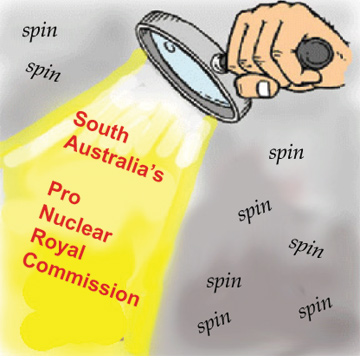 Nectaria Calan, 13 July 15, Friends of the Earth have informed Royal Commissioner Kevin Scarce and the Nuclear Fuel Cycle Royal Commission of a significant inaccuracy in Issues Paper 1, regarding the current and future legal framework for the nuclear industry in South Australia. According to the Royal Commission, the Issues Papers are intended to provide factual information and background to assist the public in making submissions.
Issues Paper 1, which deals with the exploration, extraction and milling of uranium, states that Aboriginal sites of significance are protected by the Aboriginal Heritage Act 1988.
“This is not the case for BHP Billiton, South Australia’s biggest miner,” explained Nectaria Calan of Friends of the Earth Adelaide. “Under the Indenture Act, which applies solely to BHP Billiton, the company’s Olympic Dam mine and some 15, 000 square kilometres of the surrounding Stuart Shelf, are exempt from the Aboriginal Heritage Act 1988. This exemption would also apply to any future expansion of uranium mining by BHP Billiton at Olympic Dam or in the surrounding area.”
“This inaccuracy is significant as it misrepresents existing regulatory and legal arrangements and potential arrangements in the future, issues on which the Issue Paper invites public comment,” said Ms Calan. “The largest of the two operating uranium mines in the state is exempt from the Aboriginal Heritage Act 1988, alongside a further 15, 000 square kilometres of South Australia. BHP Billiton is also the most likely candidate for the expansion of uranium mining, also the subject of Issues Paper 1. It is negligent to omit that this company is subject to a different legal framework than other companies operating in the state.”
“We have requested that the Royal Commission address this mistake, adequately publicise the required corrections, and extend the upcoming deadline for submissions to allow people to consider the new information that the Royal Commission should provide. The public cannot make submissions based on inaccurate information.”
N.B. Legal details are provided as an appendix.
For comment contact: Nectaria Calan 0432 388 665 Friends of the Earth Adelaide
Appendix
Legal details: Continue reading
Mirrar people call on Abbott government to secure Kakadu National Park from further uranium mining
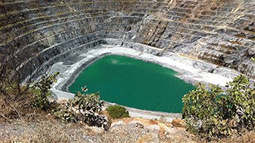 Traditional owners ask Abbott government to fix stand-off over Ranger uranium mine, SMH. July 12, 2015 – Peter Ker Resources reporter The traditional owners of the land on which the Ranger uranium mine is built have challenged the federal government to guarantee that no future mining will occur on the Ranger and Jabiluka mineral leases, and to begin preparations for the sites’ inclusion in Kakadu National Park.
In rare comments that do not bode well for the operator of the mine, Energy Resources of Australia (ERA), the Mirarr traditional owners indicated they would not agree to an expansion of the Ranger mine in the future, despite ERA seeking to keep that option open.
More than a month after ERA’s major shareholder, Rio Tinto, declared it did not support the Ranger expansion project, the uranium miner continued to push that barrow, and confirmed on Friday it had asked the federal and Northern Territory governments for an extension of its lease beyond 2021 so that it might reconsider the mine expansion if commodity prices improved.
Mirarr spokesman Justin O’Brien said the comments continued the “intense uncertainty” that had surrounded ERA’s future.
He called for certainty from the Abbott government. Continue reading
Tony Abbott now attacking rooftop solar power industry

“By knocking off wind and solar, the only thing that you leave there is the high-risk stuff,” he said. “They’re trying to make it as difficult as possible for the CEFC.”
Abbott government extends renewable energy investment ban to solar power, Guardian, Shalailah Medhora 12 July 15 Clean Energy Finance Corporation banned from investing in small-scale solar projects in move industry claims is ‘revenge politics’ that will strangle the sector A directive banning the Clean Energy Finance Corporation (CEFC) from investing in existing wind technology will also apply to small-scale solar projects, a move that will effectively throttle the industry, the Australian Solar Council said.
The federal government on Sunday confirmed that the $10bn CEFC will no longer invest in wind power, instead focussing on “emerging technologies”.
“It is our policy to abolish the Clean Energy Finance Corporation because we think that if the projects stack up economically, there’s no reason why they can’t be supported in the usual way,” Abbott told reporters in Darwin. “But while the CEFC exists, what we believe it should be doing is investing in new and emerging technologies – certainly not existing windfarms…..
it has emerged the government’s investment directive also applies to small-scale solar technology like rooftop panels that generate up to 100 kilowatts of power. Continue reading
Australia’s Prime Minister revs up his attack on the wind farm industry
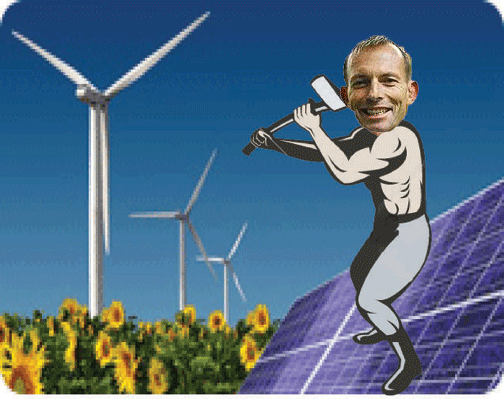 Abbott escalates war on wind, The Age, 11 July 115 Adam Gartrell EXCLUSIVE: Tony Abbott has been warned he is putting international investment at risk after ordering the $10 billion Clean Energy Finance Corporation not to finance new wind power projects. Tony Abbott has dramatically escalated his war on wind power, creating a new cabinet split and provoking a warning he is putting international investment at risk.
Fairfax Media can reveal the government has ordered the $10 billion Clean Energy Finance Corporation not to make any new investments in wind power projects. Treasurer Joe Hockey and Finance Minister Mathias Cormann have issued the so-called green bank with a directive to change its investment mandate, prohibiting new wind funding. It’s understood the directive was issued without the approval or knowledge of Environment Minister Greg Hunt, angering the minister. The decision is another blow for the multibillion-dollar wind industry, which has just started to recover from the uncertainty created by the government’s Renewable Energy Target review. Analysts say $8.7 billion is expected to be invested in wind power in the next five years, while the corporation has invested about $300 million in wind projects to date.
And international investors are warning the government’s move sends a bad message about how safe it is to do business in Australia.
The directive is just the latest salvo in the government’s attacks on the wind industry.
Brotherhood of St Laurence exposes Victoria’s unfair electricity charges
A critique of the Victorian retail electricity market http://apo.org.au/research/critique-victorian-retail-electricity-market Brotherhood of St Laurence 7 July 2015
The Brotherhood of St Laurence commissioned Bruce Mountain from Carbon and Energy Markets (CME) to investigate the Victorian retail electricity market.
Electricity costs have been rising across Australia’s National Electricity Market since 2007. In most Australian states rising network costs – the poles and wires – have been the primary cause of these price increases.
However, the Victorian case is different. Network costs are lower than in other states, and haven’t risen as much. High retail charges appear to be the cause.
The report and accompanying summary, released 7 July 2015, investigate the dynamics of the retail energy market and how that impacts on householders bills……..
Submission Points to Issues Paper 4 – Nuclear Royal Commission
Submissions Issues Paper 4 (Storage and Disposal of Waste) are due by 24 July, 2015
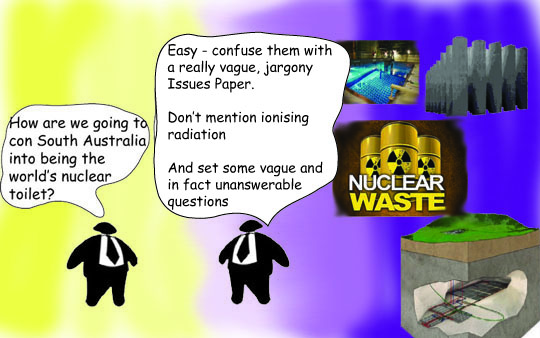
4.1 Are the physical conditions in South Australia, including its geology, suitable for the establishment and operation of facilities to store or dispose of intermediate or high level waste either temporarily or permanently?
Earthquake hazard: For either temporary or permanent storage of radioactive wastes, South Australia poses great risks. While the whole State has a small earthquake hazard zone, there are large sections which have an increased earthquake hazard. Particularly in the South of the State (1)
Risk to precious artesian water. While the South of the State has earthquake risks, almost the entire of the rest of the State covers the Great Artesian Basin. (2)
Effectively, this means there is almost no part of South Australia that could safely store radioactive trash for decades, let alone for thousands of years.
- 3 What would the (overseas) holders of radioactive wastes be willing to pay for disposal and storage of radioactive wastes in South Australia?
This question really has no answer. At present every country with nuclear facilities is struggling with the unanswered question of what do do with their radioactive trash. Even Finland, which has built a 500 metre deep burial place, will not have enough space for their accumulating radioactive trash. So far, there is no room for Fennovoima’s waste in the Onkalo repository in Olkiluoto. (3)
At this stage there are no proposals for exporting nuclear waste. Royal Commissioner Kevin Scarce, in his recent report on the Commission’s overseas visit, said “We haven’t done the financial study”. When anyone does do the financial study, they will need to factor in the financial costs of insurance, of security for hundreds, thousands, of years, as well as of environmental degradation.
Another factor would be the comparison of the commercial value of renewable energy not pursued, tourist and agricultural opportunities lost as government money went into fostering nuclear schemes rather than South Australia’s more positive activities.
4.4 What sorts of mechanisms would need to be established to fund the costs associated with the future storage or disposal of either Australian or international nuclear or radioactive wastes?
A mechanism has been put forward by Oscar Archer. (4) In Archer’s words “it goes like this. Australia establishes the world’s first multinational repository for used fuel – what’s often called nuclear waste” he wants the funding to be provided by “our international partners”, on condition that “This is established on the ironclad commitment [my emphasis] to develop a fleet of integral fast reactors to demonstrate the recycling of the used nuclear fuel” This would be a highly unsatisfactory arrangement. As the nuclear industry now struggles to fund these as yet not developed Generation IV reactors – South Australia would find itself locked in – in a sort of blackmail position, to buying a technology that very likely has no future.
4.5 What are the specific models and case studies that demonstrate the best practice for the establishment, operation and regulation of facilities for the storage or disposal of nuclear or radioactive waste?
The massively expensive 500 metre deep bunker being developed in Finland is so far the only facility that has appears to have relative safety, but that can accomodate only some of Finland’s radioactive trash . Meanwhile in USA, the Waste Isolation Pilot Plant has been as disaster. (5)
4.6 What are the security implications created by the storage or disposal of intermediate or high level waste at a purpose-built facility?
In the short term (i.e a period of decades) the above ground concrete containers are vulnerable to terrorist attack. In the long term , i.e. thousands of years, deep waste reposiitories run risk of climate and seismic events, as well as possible terrorism. They need to to be guarded virtually forever, or else, as they are forgotten, pose risks to future generations.
4.9 Bearing in mind the measures that would need to be taken in design and siting, what environmental risks would the establishment of such facilities present?
Climate change continues to increase risks of extreme weather events, and it is possible that seismic activity, already a risk, would increase.
4.10 What are the risks associated with transportation of nuclear or radioactive wastes for storage or disposal in South Australia?
Extreme weather, transport accidents that would spread ionising radiation , terrorist attack.
4.12 Would the establishment and operation of such facilities give rise to impacts on other sectors of the economy?
In the past, countries like France accepted the risks of nuclear power, and their other industries thrived. Now, even in France, there is concern about polluting industries. For some time after the Chernobyl nuclear catastrophe, the French wine industry was severely depressed., because the wine growing regions were squarely in the path of the ionising radiation fallout. (6) There is concern in Washington State about the impact of Hanford nuclear waste facility on the wine industry. (7)
(1) https://www.sa.gov.au/__data/assets/pdf_file/0005/17168/Earthquake_hazard_zones_SA.pdf
(2) http://www.environment.gov.au/water/environment/great-artesian-basin
(3) http://yle.fi/uutiset/battle_for_nuclear_waste_disposal_site/5097360
(4) http://www.abc.net.au/radio/programitem/pgJrGaLDL7.
(5) 1 6 June 2014, ‘Fire and leaks at the world’s only deep geological waste repository’, Nuclear Monitor #787,www.wiseinternational.org/node/4245 222 27 Nov 2014, ‘New Mexico nuclear waste accident a ‘horrific comedy of errors’ that exposes deeper problems’, The Ecologist,
(6) http://wineeconomist.com/2008/01/26/the-science-of-unintended-consequences/
(7) http://www.thedailybeast.com/articles/2015/03/28/hanford-nuclear-site-could-be-threatening-washington-state-s-best-vineyards.html
radophilia = the irrational love of radioactive poisons that harm children.
 Brett Stokes, 10 July 15 Kevin Scarce is challenged over the “fuel cycle” deceptive language and Scarce responds with a straight face, academy award stuff – I could not help coughing, something caught in my throat.
Scarce was challenged by an audience member at Flinders Uni in May 2015, regarding the diagram showing reprocessing as though that part of “the nuclear fuel cycle” was fully happening
Scarce’s response was a bold denial of the obvious, saying “we’re not trying to make it sound better than it is. We’re not trying to gild the lily” at 1:15:40 to 1:15:46 in https://www.youtube.com/watch?v=R2rexEyELig&feature=youtu.be
South Australia’s Just About Impossible Submission Process For Nuclear Royal Commission
 Submission Impossible: SA Royal Commission into nuclear fuel cycle, Independent Australia, 10 July 2015, The SA Royal Commission into the nuclear fuel cycle is calling for submissions but the mechanics involved have made it Submission Impossible, writes Noel Wauchope.
THE SOUTH AUSTRALIAN Labor government has ordered a Royal Commission, to inquire into the Nuclear Fuel Cycle: ‘Investigating opportunities and risks for South Australia’. This fast moving Royal Commission will receive submissions on this topic
All sounds good, doesn’t it? And who is supposed to send these submissions in? Well, any person or organisation in South Australia. As the Royal Commission (RC) has received little or no publicity outside South Australia, then it is likely that submissions will not be appreciated nor forthcoming from the other States.
However, the RC has invited nuclear technology companies from overseas, to put in submissions.
The RC has published four Issues Papers, with points for discussion. I could digress here, into the wording of these points, which are very much geared to receive input from nuclear companies. But my interest here is not so much in the content of submissions, but rather in the mechanics of actually writing, and sending in a submission. Submissions are due by 24 the July (for two Issues Paper topics) and by 3rd August (for the other two)
This is what is required:
- First, go to the RC’s website, Click on ISSUES PAPERS, and read the papers for each Issue………
Well, I’m thinking that the mechanics of this exercise pretty well trumps the content.
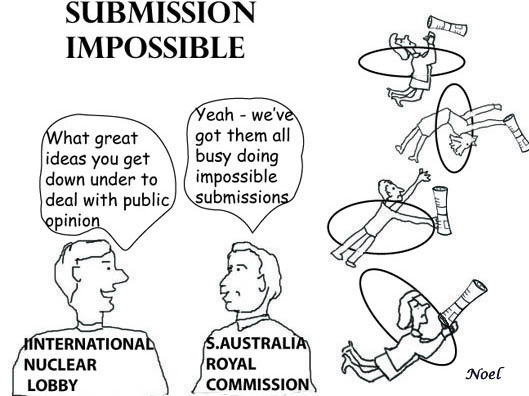
Imagine the scene … scenario 1:
You’re an executive of the French nuclear company AREVA, or of the Canadian nuclear company,SNC-Lavalin. (AREVA is in desperate financial straits and SNC-Lavalin in strife for corrupt practices). See report in the Financial Times 4 June 2015 ‘AREVA loses its reactor heart to EDF under French state plan’. Both companies are absolutely dependent on selling their nuclear technology overseas.
You have access to highly paid top lawyers, nuclear lobbyists and strategists, and access to top electronic equipment and computer skills. Indeed, this sort of thing is their job, and the company is well pleased to give them time to do this submission very thoroughly.
Submissions from a nuclear company do not need to be published. The Royal Commission deems that they can be kept private.
Imagine the scene … scenario 2:
You’re an ordinary citizen of South Australia, perhaps living in a rural area. Do you have access to the Internet, for a start? Well, you could make the effort, using a town library’s facilities. Then there’s the printing off of the ISSUES PAPERS, with those required question points. Then there’s the typing and printing of your Submission …. the JP …. the scanning … the PDF …. and so on. Your Submission will be published on the Internet, with your name.
What if you’re an Aboriginal, and your command of English is not great? No problem. The RC will send an officer to guide you. Mmmm … is there a problem in this?
I haven’t even touched on the content. I wonder … do I really need to?
Most of the questions appear to me to be squarely aimed at the nuclear companies…….. Some people have criticised the plentiful graphs and diagrams in the Issues Papers as sometimes inappropriate. I don’t know. It hardly matters. Many ordinary people, who are worried about the prospect of the entire nuclear fuel chain being established in South Australia will be sufficiently intimidated by the whole process anyway — never mind the graphs, or even the written content.
Perhaps that was the Royal Commission’s intention? https://independentaustralia.net/environment/environment-display/submission-impossible-sa-royal-commission-into-nuclear-fuel-cycle,7917
Australian uranium miners’ toxic track record in Africa
[Paladin’s] Langer Heinrich Uranium mine[Namibia] …
Craton Mining and Exploration [copper] is a subsidiary of Australian-based International Base Metals…..
Rio Tinto owns Rössing Uranium Mine…
[Australian] Deep Yellow Limited (DYL) the Aussinanis uranium project.
Aussies in toxic trail By Shinovene Immanuel, Ndanki Kahiurika 10 July 15 http://www.namibian.com.na/indexx.php?id=28936&page_type=story_detail&category_id=1#sthash.TJSxEgQV.P3bN2nwk.uxfs&st_refDomain=blogs.icerocket.com&st_refQuery=/search?tab=buzz&fr=h&q=uranium+Australia NAMIBIA, a mining frontier for decades, continues to struggle with mining companies which subject workers to dangerous working conditions.
That mining in Africa provokes controversy, even violence, is not new. Chinese companies receive regular criticism. Canada, too, has been forced to confront allegations of violence and even slavery linked to its mining companies.
The ICIJ investigation looked at Australia’s increasing role in exploring and developing mining projects on the African continent because it has been less examined.
TROUBLING
What ICIJ uncovered and pieced together suggests a troubling track record on the part of Australian companies in the rush for Africa’s minerals, including practices that would be impermissible, even unthinkable, in Australia and other parts of the developed world. Continue reading
World’s poorest country, Malawi, ripped off by Paladin in tax avoidance?
 Australian miner accused of dodging tax in world’s poorest country, The Age, July 11, 2015 –Heath Aston Political reporter
Tax avoidance tactics of multinational companies have angered Australians, but an Australian mining firm used such methods in Malawi. Tax avoidance tactics of multinational companies have angered the public and placed pressure on the Abbott government to prevent profits being exported offshore.
But an Australian uranium miner is defending the use of identical methods to reduce its tax bill in the world’s poorest country, Malawi.
Between 2009 and 2014, Paladin Energy moved $US183 million out of Malawi to a holding company in the Netherlands and then on to Australia.
A 15-page report by London-based ActionAid has found the Dutch transfers and a special royalties deal – in which Malawi’s mining minister agreed to drop the initial tax rate applied to the uranium mine from 5 per cent to 1.5 per cent – have cost the Malawi public $US43 million.
In Africa’s poorest nation, where per capita GDP is just $US226 a year and life expectancy 55, that money could provide the equivalent of 39,000 new teachers or 17,000 nurses, according to the aid group……..
Paladin’s tax-free transfers to the Netherlands were a combination of management fees and interest payments on loans initiated in Australia. The company loaded its African subsidiary up with huge debts, leaving the Kayelekera uranium mine in northern Malawi with an 80:20 debt to equity ratio – a financing structure known as “thin capitalisation”.
The Dutch structure allowed Paladin to avoid paying a 15 per cent withholding tax to the Malawi government due to a tax treaty between Malawi and the Netherlands which expired in 2014, saving the company $US7.3 million. Paladin closed the mine in February 2014, citing a “sustained low uranium price”.
ActionAid has accused the company of “treaty shopping” and shortchanging the Malawi people. The country’s nursing ranks have the equivalent of four nurses to every 100 in Australia, despite 10 per cent of Malawi’s population being infected with HIV/AIDS……..http://www.theage.com.au/federal-politics/political-news/australian-miner-accused-of-dodging-tax-in-worlds-poorest-country-20150710-gi6uzv.html
1 This month
17 October, Free Public Talk on Nuclear Issues in South Australia
David Noonan will speak on public interest concerns over the new Roxby Downs Indenture Act 2026 on BHP copper-uranium mining and ore processing in SA, and on how AUKUS may face SA with a High-Level nuclear waste agenda.
Dr Jim Green will discuss international developments in the field of nuclear power including ‘small modular reactors’ and Generation 4 ‘advanced’ nuclear reactor concepts.


Help Aunty Sue Protect Her Land and Sacred Sites From Destructive Rocket Testing.
.

Australians deserve the truth
about
AUKUS – https://aukuspublicinquiry.com/

PETITION – To: Prime Minister Anthony Albanese and the Australian Labor Government

of the week – Australians for War Powers Reform (AWPR)
To see nuclear-related stories in greater depth and intensity

