Litigation in Malawi against Australian uranium miner Paladin
“There is a very strong perception that when Australian mining companies come here they take every advantage of regulatory and compliance monitoring weaknesses, and of the huge disparity in power between themselves and affected communities, and aim to get away with things they wouldn’t even think of trying in Australia,”
Australian miners linked to hundreds of deaths, injuries in Africa, SMH, July 11, 2015 -Will Fitzgibbon Australian mining companies are linked to hundreds of deaths and injuries in Africa, which can go unreported at home. Some of the Australian Securities Exchange-listed companies include state governments as shareholders. One company recorded 38 worker deaths over an eleven-year period.
 In Malawi, litigation continues against Paladin Africa Limited, a subsidiary of Perth-based Paladin Energy, and its subcontractor after an explosion disfigured one worker with such heat that his skin shattered when touched by rescuers. Two others died in the same incident.
Other allegations include employees in South Africa hacking a woman with a machete and Malian police killing two protesters after a mine worker reportedly asked authorities to dislodge a barricade on the road to the mine.
An investigation by the International Consortium of Investigative Journalists, in collaboration with 13 African reporters, uncovered locally-filed lawsuits, violent protests and community petitions criticising some Australian companies. Continue reading
Victoria’s new wind farms going ahead
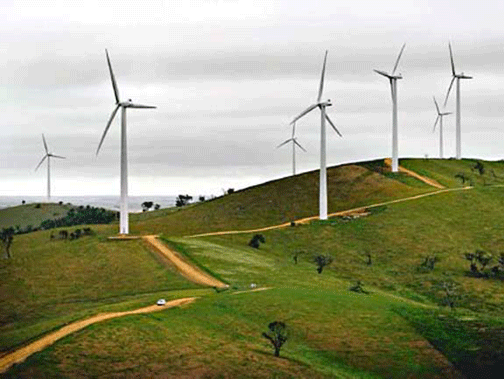 New wind farms for Victoria by Mark Eggleton, AFR, Jul 8 2015 This content is produced by The Australian Financial Review in commercial partnership with GE With the first new wind farm development beginning construction in Victoria since the election of the Coalition government recently, Australia could be on the brink of a new burst of activity in the renewable energy sector.
It follows the recent announcement of the $450 million Ararat project to build Australia’s third-largest wind farm in south-western Victoria with financing provided by developer Renewable Energy Systems (RES), turbine-maker General Electric and two other backers.
Yet while the new facility at Coonooer Bridge owes nothing to the recent agreement on the renewable energy target, the Ararat announcement came within days of the RET deal being passed in Parliament. Both projects come at a time when Australian business is starting to feel mildly confident about Australia’s energy future with the RET deal delivering much-needed certainty to the sector. Moreover, both wind developments play to the country’s natural resource strengths.
WIND SPEEDS
GE’s sales and finance managing director for Australia and New Zealand, Jason Willoughby, says Australia is blessed with great renewable energy resources – both from a wind perspective and from a solar perspective.
“I speak to colleagues in the US and in Europe and we compare what the wind speeds in Australia are, and they’re amazed that they’re so good and well located to where the load is.”
Importantly for Australia, Willoughby said the renewable energy target will unlock upwards of $10 billion of investment. http://www.afr.com/news/special-reports/australia-energy-future/new-wind-farms-for-victoria-20150708-gi6ulf
North Queensland’s Collinsville solar energy project going ahead
 Collinsville solar power plant to go ahead thanks to Renewable Energy Target decision says Ratch http://www.abc.net.au/news/2015-07-06/collinsville-solar-power-plant-a-goer/6597400 By Jonathan Hair
The company behind a proposed solar power project in north Queensland says it hopes to start construction next year. Ratch Australia is planning to build a $100 million solar plant in Collinsville. It will create up to 80 jobs in the construction phase and two to three once operational.
Ratch general manager of business management, Anil Nangia, said the recent Federal Government deadlock on the Renewable Energy Target put the project on hold. However, he said the recent agreement on a new target meant the project would go ahead.
“The other good thing about renewable energy is it produces jobs and investment in regional Australia,” he said.”The key aspect of this resolution is it was bipartisan support, with no additional reviews until 2020. “We believe there’s real certainty in this target and it will stay in place and we think it will be there for the long run, if not increased.”
He said it was disheartening when politicians expressed a lack of faith in renewables. It’s terrible when they talk like that, renewables are the way of the future,” he said. “They basically are going to produce the low cost power in the long-term and they produce power with no emissions, no side effects, it’s really sad when they talk … down the potential of renewable energy in Australia.”
GDF SUEZ Australian Energy, coal mine owner, investing big into solar energy
“Solar is becoming totally competitive,” “Solar is an energy of the future. It is the energy with the biggest potential for development. It’s no longer a subsidized niche.”
the shift by Engie from centralised fossil fuel and nuclear capacity to one based around decentralised renewable energy generation is typical of the transformation going on around the world – with Europe’s E.ON, RWE and Vattenfall, and in the US, with generators such as NRG, and network operators in California, New York and elsewhere.
 Hazelwood owner makes big push into solar energy, REneweconomy, By Giles Parkinson on 10 July 2015 The owner of the Hazelwood coal-fired power station, the dirtiest generator in Australia, has announced a major push into renewable energy, snapping up the international solar farm developer SolaireDirect for about $A300 million.
GDF Suez, now known as Engie under a massive re-branding campaign that signals its shift from fossil 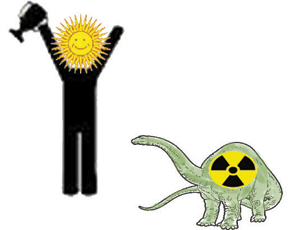 fuels and nuclear to renewable energy, will become the largest solar and wind developer in France after the purchase.
But its big focus is on the international scene. Gerard Mestrallet, the CEO of Engie, one of the biggest operators of nuclear plants in Europe, says new solar now beats new nuclear on price, with new solar parks costing between $US60 and $US90/MWh. Continue reading
Radio shock jock Alan Jones caught out in climate falsehood
Alan Jones gets slapped down for climate lies MYRIAM ROBIN | JUL 10, 2015 The Daily Mail got its maths wrong in a climate story, and even The Australian admitted it. But undeterred, Alan Jones repeated the falsehood after the Oz apologised. The fallout from an erroneous Daily Mail story that mucked up its maths on global warming continues, with shock jock Alan Jones the latest to be slapped down by the appropriate watchdog for relying on the dodgy figures.
On September 16, 2013, The Australian published a story based on reporting in the British tabloid, which claimed a leaked… [subscription only] http://www.crikey.com.au/2015/07/10/alan-jones-gets-slapped-down-for-climate-lies/
Community renewable energy will get a boost from Frontier Energy’s financing toolkit
 Financing toolkit in works for community renewables project http://www.businessspectator.com.au/news/2015/7/10/renewable-energy/financing-toolkit-works-community-renewables-project JOHN CONROY 10 JUL 15
 Frontier Energy is creating a toolkit that is set to make community energy projects easier to develop, supported by $296,000 funding from the Australian Renewable Energy Agency (ARENA).
The $493,000 project aims to break down some of the barriers facing new community energy projects by increasing project developers’ understanding of how to secure finance.
“While the community renewable energy sector in Australia is growing, there remains a large gap in information on financing,” ARENA CEO Ivor Frischknecht said.
“The new financial toolkit will provide easily accessible information on financier requirements, financial models, checklists and case studies through a central website, along with a list of key contacts.
“Spending less money on external advice, particularly in the early stages of development, will make projects cheaper overall. Continue reading
Is #NuclearCommissionSAust ignorant, or conflict of interest, as it goes to America?
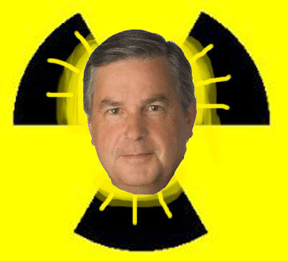 Kevin Scarce sometimes scarce on nuclear reality, Online opinion, Noel Wauchope, 7 July 15 “……..The Royal Commission next goes to USA and Canada for 8 days, from July 9th. They’re particularly interested in the Small Modular Reactor idea. I hope that they’re aware that Westinghouse abandoned their Small Modular Reactor project, and that Babcock and Wilcox pulled back from this – unable to get any contracts or investors.
What I’m worried about, is that the Commission will end up recommending the plan explained recently by Oscar Archer, on ABC Radio National – that South Australia make an “ironclad commitment [my emphasis] to develop a fleet of integral fast reactors to demonstrate the recycling of the used nuclear fuel”
As for the Commission visiting Canada, Kevin Scarce enthused about the similarity between Canada and Australia. Really? What about the difference in climate, in the amount of sunshine, that surely makes Australia ideal for solar power?
Worst of all, as Scarce enthused about Canada’s “very productive nuclear industry” I wondered if the Commission is aware that the World Bank has Canada at the very top of its Corrupt Companies Blacklist, and that this dubious honour is due entirely to its nuclear industry. In particular SNC Lavalin is the culprit – the very company that is trying to sell thorium reactors overseas.
I would like to think that South Australia’s Nuclear Fuel Chain Commission is both well informed and impartial. I really would. But, listening to Kevin Scarce, I am not reassured. Nor is it reassuring to read the background nuclear industry links of Scarce and his research team. Kevin Scarce is a shareholder in Rio Tinto Group – the owner and operator of Ranger and Rossing uranium mines in Australia and Namibia. His prominent team leader is Greg Ward – Ward is also the director of two companies:Prism Defence (for which he is also CEO) and Protegic. The latter is a project management service provider with clients including the Rio Tinto Group, BHP Billiton and Endeavour Energy. Four of the five members of the research team named on the NFCRC website have known prior or current associations with nuclear industrial entities. http://www.onlineopinion.com.au/view.asp?article=17489
Aboriginal elder Kevin Buzzacott speaks at strong anti nuclear protest in Adelaide
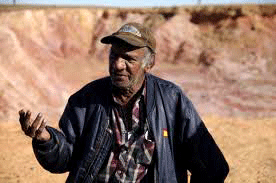 Nuclear dump would destroy our land: elder http://www.9news.com.au/national/2015/07/09/15/23/elders-students-protest-sa-nuclear-dump Aboriginal elders from across the country have joined scores of university students camping out in a stand against the storing of nuclear waste in Australia.
Protesters from far and wide have set up a tent community at Flinders University in Adelaide in protest against plans for a nuclear waste dump, in South Australia or anywhere else.
 “To the South Australian government, to the federal government, to the mining giants – don’t worry about trying to put the waste dump here,” Arabunna elder Kevin Buzzacott said on Thursday.
 It also coincides with South Australia’s royal commission into nuclear power, which is looking at whether the state should expand its involvement in the nuclear industry.
At least one SA Liberal senator says it should, with Sean Edwards recently urging the state to cash in by becoming a global player in the spent nuclear fuel recycling industry.
But Mr Buzzacott said a storage facility would destroy the sacred land of the country’s traditional owners. “We’ve lost a lot of sacred sites as it is,” he said. “We don’t want to lose any more. “We’ve been here 40,000 years. We’ve never touched the land – we love the land.”
BHP’s hypocrisy about climate change.
 As a proud non-subscriber to THE AUSTRALIAN, I haven’t been able to read this article. But on past performance of BHP, I reckon that I can have a pretty good guess on what BHP’s enthusiasm for climate action really means.
Last month, all the nuclear big-wigs met somewhere in Europe to plan a campaign about the Paris Climate Summit in December . The idea is to have nuclear power established as a solution to climate change.
BHP would love that – otherwise they couldn’t give a damn about climate change.
BHP embraces climate debate, THE AUSTRALIAN, ? 8 July 15
The private sector needs to play a part in this year’s Paris climate talks, says BHP Billiton’s Dean Dalla Valle…. (subscribers only)
The Nuclear Royal Commission’s whole aim – to build a case for importing global radioactive trash ?
If it did take more than 25 years to build a nuclear power plant then the technology could be made obsolete by renewables.
Last October, South Australia managed for the first time to get more than 100 per cent of its electricity needs for a working day between 9.30am to 6pm, from a combination of wind and solar energy. Overall it gets more than 30 per cent of its power from renewables, and has a target of 50 per cent to be achieved within 10 years.
Prof Diesendorf said it would only take 15 to 20 years to go to 100 per cent renewables in the state.
“The global enrichment market is oversaturated, and no-one credibly believes nuclear power is a realistic proposition for the sparse South Australian grid,” Greens senator Scott Ludlam argued in a column for New Matilda.
 “That leaves only the probability that this whole exercise is designed to build the case for a national or international radioactive waste dump.”
Is building a nuclear waste dump in Australia really the best idea? THE ADVERTISER, CHARIS CHANG JULY 09, 2 “………….at least one expert believes the [Nuclear expansion] scenario is too good to be true, and would do little to help the state’s economy in the short to medium term. The technology Senator Edwards has suggested is still in development and will not be feasible for more than 20 years.
Retired researcher Richard Leaver, formerly of Flinders University, told news.com.au that no Generation IV reactors had yet been built. These reactors are not generally expected to be available for commercial construction before 2030-40.
“And sodium cooling has, so far, a four-decade history of failure and serious accident,” Mr Leaver said.He said the state government should wait until someone managed to get the reactor working on an industrial scale before accepting anyone’s spent nuclear fuel.
Even if researchers could develop a Generation IV generator as a working technology, this would likely reduce the potential economic benefits. Continue reading
We need to change the Native Title Act and get Real Land Rights for Aboriginal poeple
“we have no rights to say no to mining under native title.”
The court has never once found in favour of holders of native title.
the constitution is not silent. It is actively discriminatory, explicitly enabling authorities to enact race-specific laws. This must end.
Native title yes, but still no land rights, The Age July 8, 2015 Elizabeth Farrelly Sydney Morning Herald columnist, author, architecture critic and essayist
Sacred land must not be dug up and our constitution and laws should assure that. So it’s NAIDOC Week. “We all stand on sacred ground,” protests the starry-eyed tagline. “Learn, respect, celebrate.”
Going by the flood of earnest Indigenous heritage displays, trucked-in smoking ceremonies and family-friendly clips of smiling Koori kids you’d think we meant it. Eighty-five per cent of us, apparently, support removing anti-Aboriginal racism from the constitution. God knows it’s little enough, late enough – but is it also hypocritical?
The most memorable part of that June 22 Q&A program wasn’t Zaky Mallah. It was the nine-minute segment on native title and mining rights. Yet the Mallah story was beaten up nationwide like a thousand-egg free-range souffle, while the land-rights conversation once again sank without trace. Continue reading
#NuclearCommissionSAust – Even Kevin Scarce has big doubts about thorium reactors
Kevin Scarce sometimes scarce on nuclear reality, Online opinion, Noel Wauchope, 7 July 15 On June 29 Kevin Scarce, chief of South Australia’s Nuclear Royal Commission, was interviewed by Ian Henschke on ABC Radio 891 Adelaide. Scarce had just returned from a Royal Commission whirlwind tour of Taiwan, Japan, Europe and the UK. The interview can be heard here.
I was pretty amazed, not only at the speed at which the Commission examined the nuclear industry, at so many places, from 26 May 12 June 2015, and at the complicated facilities that they examined, but also at how much information was left out of Scarce’s report, and at the apparent inadequacy of their grasp of current developments in the nuclear industry.
First and most obvious were two questions, both which Kevin Scarce had emphasised at his pre-tour community forums in South Australia. Scarce had stressed that the Commission would be consulting people on both sides of the nuclear debate – those for the nuclear industry, and those against it. In the whole interview, in all the places and organisations that Scarce described – not one word about meeting anyone remotely anti-nuclear.
Secondly, at the pre-tour meetings, Scarce had repeatedly said that the Commission would be studying renewable energy as well as nuclear. In his talk with Ian Henschke, it was clear that the Commission had not visited any renewable energy organisations or facilities. Indeed, when the interviewer brought up the subject of renewable energy, Scarce glossed over it very quickly – pointing out that Germany was “a way away’ from their renewables goal, and saying “We are certainly looking at renewables”.
Their first visit was to Taiwan, as Scarce said “to talk to the Taiwanese about their spent reactor fuel and about how they were going to manage it.” Well, it’s not surprising that Scarce did not go on to explain how the Taiwanese are going to manage their spent nuclear fuel, because the Taiwanese themselves do not know what to do with it. They are probablyretiring one reactor early, due to its accumulating wastes, and are also trying to work out a plan to export their nuclear wastes, but facing opposition in their legislature to this plan.
Then on to Japan…….
Reporting on France, Scarce was fairly reticent, considering that they spent so much time talking to AREVA, the State owned nuclear company. But that’s understandable. The South Australian Nuclear Royal Commission arrived at AREVA on 4th June. On 3rd June, the French government announced the break-up of AREVA, due to its disastrous financial record, to prevent it from bankruptcy……..
Questioned about new Generation IV nuclear reactors, Scarce emphasised their safety features, and, to be fair to him, he did point out the “enormous uncertainty” about when they would be commercially available – “not much before 2040″. He was asked about thorium reactors, and again, admitted to not knowing much about them, and that “2040 might be optimistic for thorium reactors“. Scarce said that with these reactors, thorium, not uranium, is the source of power. That’s not actually correct, as uranium 233 is the power source in thorium reactors. They need plutonium or enriched uranium to trigger the transformation of the inert thorium, to the fissile uranium.
To give credit to Kevin Scarce, he did mention the fact that this process is not so clean, meaning that plutonium or enriched uranium are a radioactive problem issue. He said “so some of your benefit in terms of a clean fuel source isn’t there”. Also, to be fair to Kevin Scarce, he did point out that thorium reactors have been tried in the past, in America, and closed down, and that he was doubtful about their future.
Henschke asked Scarce if he saw “state of the art” nuclear reactors. Yes, the Commission had been to both Olkiluoto and to Flamanville in France, and had seen the pressurised water reactors – the very ones that are now described as afinancial and safety fiasco. No wonder that Scarce did not elaborate on these visits……. http://www.onlineopinion.com.au/view.asp?article=17489

Submission Points to Royal Commission Issues Paper 1 EXPLORATION, EXTRACTION AND MILLING
Submissions to this Paper are due by July 24 POINTS TO CONSIDER
They want you to direct your answers to the points they have set out in http://nuclearrc.sa.gov.au/our-reports/exploration-extraction-and-milling/ SO: here are a few ideas:
1.1 and 1.2. (economics of uranium industry) Australia’s uranium production of 5,000 tonnes in 2014 was the lowest for 16 years. The industry generates less than 0.2 per cent of national export revenue and accounts for less than 0.02 per cent of jobs in Australia. (1)
Nowhere in this Issues Paper is information given on Government funding of the nuclear industry either directly in the form of grants and through government supplied services.
1.12 (Uranium enrichment) and 1.7 (Future of uranium market) The 2006 Switkowski Review concluded that “there may be little real opportunity for Australian companies to extend profitably” into enrichment. (2) Conditions are no more conducive to the establishment of an enrichment industry now than they were in 2006. Former World Nuclear Association executive Steve Kidd noted in July 2014 that “the world enrichment market is heavily over-supplied”.(3)
1.8. (health effects) There is a well established link between uranium mining and lung cancer. (4) Exposure to even low-level radiation is a health hazard. That is the position of all relevant expert bodies such as the United Nations Scientific Committee on the Effects of Atomic Radiation. As the the US National Academy of Sciences’ Committee on the Biological Effects of Ionising Radiation states, “the risk of cancer proceeds in a linear fashion at lower doses without a threshold and … the smallest dose has the potential to cause a small increase in risk to humans.”
1.10 (risks) Enrichment plants can produce both low-enriched uranium for reactors and highly-enriched uranium for weapons.
1.13 (effects on other industries). South Australia’s remarkable success in renewable energy, and its reputation for clean agricultural produce would clearly be threatened by further development in the uranium/nuclear industry
(1) http://www.conservationsa.org.au/images/Nuclear_Royal_Commission_issues_summary.pdf
(2) http://www.ansto.gov.au/__data/assets/pdf_file/0005/38975/Umpner_report_2006.pdf
(3) Nuclear Engineering International Magazine, May 2014
(4) http://www.mapw.org.au/files/downloads/Nuclear-power-uranium-mining-&-public-health_MAPW-Factsheet.pdf
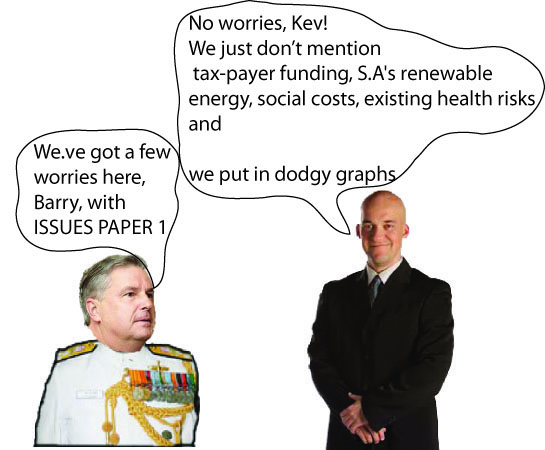
Answer Points to Nuclear Royal Commission on Importing Nuclear Waste
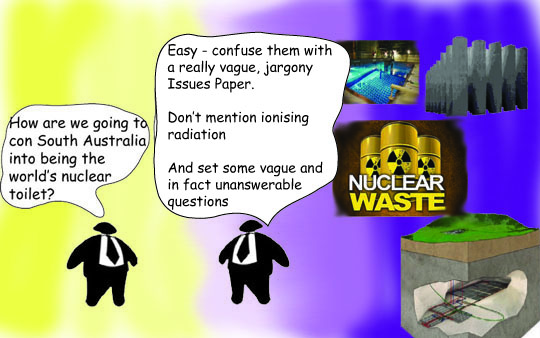
The nuclear-lobby-stacked Royal Commission faces stiff opposition in South Australia
 Renewables now! Nuclear not an option, Green Left, July 4, 2015 What about the new South Australian royal commission into the nuclear industry?
“……..South Australia has a nuclear industry the government wants to expand. There is uranium enrichment, but that is an economic non-starter, and then there is nuclear power, which is theoretically possible but very expensive and controversial.
The nuclear lobby is driving the idea that if you import other countries’ high-level waste, those countries would pay billions of dollars to get it off their hands. So there is all sorts of nonsense flying around South Australia, especially in the Murdoch press, that these billions of dollars would cover the entire cost of building nuclear reactors and would also allow the abolition of all state taxes.
But even with that sort of propaganda being circulated in the Adelaide Advertiser — a Murdoch tabloid — they found that fewer than one in six South Australians want a high-level nuclear waste dump.
It is a massive challenge, as the royal commission is stacked by pro-nuclear lobbyists. So it will issue a pro-nuclear report and we are doing the best we can to dull their enthusiasm.
We are building a separate campaign against the expansion. Traditional owners held a meeting in Port Augusta in April and this is the starting point to building an ongoing campaign.
A lot of these traditional owners have already experienced a track record of the industries of pollution and lies and they don’t want to be a part of it. They have seen the outrageous divide and rule tactics used by Heathgate against Adnyamathanha traditional owners. Then there is the long history of Olympic Dam uranium mine, and attempts to dump nuclear waste on Aboriginal land despite their ferocious opposition. Or go back to the Maralinga bomb tests in South Australia — there is a lot of history with people still suffering the varied impacts of that.
There is a lot of campaign strength in South Australia. Certainly we are putting in submissions to the royal commission but we don’t want to get sucked into their campaign too much because it is a fraud and the more important thing for us is to build campaigns and support Aboriginal people who want to build campaigns…..” https: //www.greenleft.org.au/node/59400
1 This month
17 October, Free Public Talk on Nuclear Issues in South Australia
David Noonan will speak on public interest concerns over the new Roxby Downs Indenture Act 2026 on BHP copper-uranium mining and ore processing in SA, and on how AUKUS may face SA with a High-Level nuclear waste agenda.
Dr Jim Green will discuss international developments in the field of nuclear power including ‘small modular reactors’ and Generation 4 ‘advanced’ nuclear reactor concepts.


Help Aunty Sue Protect Her Land and Sacred Sites From Destructive Rocket Testing.
.

Australians deserve the truth
about
AUKUS – https://aukuspublicinquiry.com/

PETITION – To: Prime Minister Anthony Albanese and the Australian Labor Government

of the week – Australians for War Powers Reform (AWPR)
To see nuclear-related stories in greater depth and intensity

