South Australia’s pro nuclear lobby upset about the State’s embrace of rooftop solar
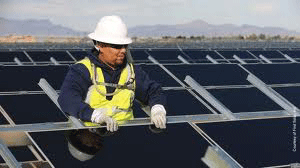 Dennis Matthews, 26 June 15, There is little doubt that South Australians have embraced rooftop solar electricity, with gusto. This is undoubtedly a worry to the pro-nuclear lobby ( a long time opponent of renewable energy) and to companies who stand to lose income from such independent electricity producers.
Thanks to the breakup and privatisation of the former publicly owned ETSA, what one part of the electricity industry gives, another part can just as easily take away. Or as the monopoly electricity network company SAPN has so coyly put (The Advertiser, 25/6/15) “it was ultimately up to the energy retailers as to how much of the reduction in SAPN charges were passed on to householders.”
Given that SAPN and the retailers do not compete for the electricity dollar, what’s the bet that prices will continue to go up, maybe not this year but almost certainly by the end of 2016, and that each segment of the privatised electricity industry will blame the other.
South Australia’s Renewable Energy Future
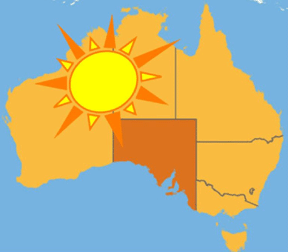 Renewable energy future for South Australia http://indaily.com.au/opinion/2015/06/25/renewable-energy-future-for-south-australia/ MARK DIESENDORF | 25 JUNE 2015 The closure of Alinta Energy’s Leigh Creek Coal mine and two Port Augusta power stations will cost 438 jobs in South Australia, but over several years this could be transformed into an opportunity to create many new jobs in renewable energy.
South Australia’s wind and solar resources are huge, and SA is already the leading Australian state in non-hydro renewable energy utilisation, with about 40 per cent of its annual electricity consumption coming from wind and sunshine.
State electricity supply has operated reliably and stably for hours when the contribution of variable renewable energy reached two-thirds of demand, and wind power and gas coped admirably recently when the coal-fired Northern power station went unexpectedly offline.
The SA electricity system could be operated entirely on scaled-up, commercially available, renewable energy sources. This is the conclusion of the studies underlying my report to the Conservation Council of South Australia, now available online.
Our hourly simulation modelling at University of New South Wales shows the South Australian system could be supplied by a combination of variable renewable energy sources (wind and solar PV), and flexible, dispatchable sources (biofuelled gas turbines and concentrated solar thermal power with thermal storage).
It is the combination of variable and flexible sources that is the basis for reliability. Continue reading
Australian Liberal Party is urged, by farmers, to defeat climate denialism
 Farmers call on Liberals to snuff out internal push by climate sceptic conservatives, SMH, June 25, 2015 Heath Aston Political reporter Farmers are circulating an open letter calling on the Liberal Party to kill off an internal push to derail Australia making meaningful commitments at the upcoming Paris climate talks.
The letter, which describes farmers as being “on the front line of rising temperatures and more extreme weather”, urges the Liberals to resoundingly defeat a climate sceptic motion to be debated at its federal council meeting on Saturday……http://www.smh.com.au/federal-politics/political-news/farmers-call-on-liberals-to-snuff-out-internal-push-by-climate-sceptic-conservatives-20150625-ghxp5s.html
Dr Timothy Stone should not be a Royal Commissioner: has financial interest in a nuclear company
 Dr Timothy Stone should be in the same position as any other business or ordinary individual: free to put his opinions to the Royal Commission through the submissions process, but not be a member of the Commission in any form.
Dr Timothy Stone Visiting Professor, International Energy Policy Institute, University College London Adelaide
Current potentially relevant activities:
- Non-executive Director, Horizon Nuclear Power Ltd (UK)
- Visiting Professorship, International Energy Policy Institute, University College London (Adelaide)
- Chairman, Advisory Board of DBD Ltd (UK, nuclear engineering)
The game is up for uranium miners ERA and Paladin
After 10 years of no profit, and millions in shareholder value destroyed, very few have profited from Paladin’s ongoing existence. ERA, on the other hand, was profitable up until 2010, but has gone backwards since. Neither trend is unlikely to change in the future.
 What’s next for Australia’s uranium miners? Motley Fool, 24 June 15 Energy Resources of Australia Limited (ASX: ERA) and Paladin Energy Limited (ASX: PDN)are two of Australia’s largest independent uranium producers, but have they lived out their useful half-lives?
Some might suggest yes, following the recent news stories surrounding ERA, which is majority owned (68%) by Rio Tinto Limited (ASX: RIO).
You may have already seen some of the news surrounding one of Australia’s largest uranium miners, ERA, when its shares plunged 47% in early trading two weeks ago. That reaction was due to the company’s decision to cancel its Ranger 3 Deeps project thanks to continued low uranium prices, and ongoing uncertainty over the uranium market’s direction in the immediate future.
ERA owned and operated the Ranger mine, which is surrounded by the Kakadu National Park in Australia’s Northern Territory. But the decision to not proceed with the Ranger 3 Deeps project means the mine holds very little value for ERA, Rio or anyone else wanting to mine uranium. Without Ranger 3 Deeps, ERA is processing stockpiled ore. What the company will do when that runs out is anybody’s guess. Continue reading
The end of big uranium mining projects in Australia
 Mining exploration slump makes a new Olympic Dam unlikely, The Age, June 24, 2015 Tess Ingram Reporter One of the key geologists involved in the discovery of BHP Billiton’s highly-regarded Olympic Dam mine says the industry’s search for another deposit of a similar scale has all but ceased as major miners reject greenfield exploration and juniors struggle to secure financing.
Douglas Haynes was one of a small fleet of young geologists working in the 1970s for Western Mining Corporation, whose innovative approach to copper exploration aided in the discovery of one of the world’s largest economic mineral deposits.
Mr Haynes told The Australian Financial Review on the sidelines of the Association of Mining and Exploration Companies Convention the sustained lull in exploration activity suggested “there is no more exploration for Olympic Dams in Australia”.
“There are two things happening,” he said. “The idea of finding an ore body at 300 metres depth puts a lot of small companies off because of the starvation of capital for entrepreneurial types doing this kind of thing.” He added major miners such as BHP Billiton and Rio Tinto were unlikely to “indulge” in large exploration programs……….http://www.theage.com.au/business/mining-and-resources/mining-exploration-slump-makes-a-new-olympic-dam-unlikely-20150624-ghvjmh
Energy Resources of Australia – half of uranium company’s Board quits
Half of Australian uranium miner’s board quits after Rio shelves project http://www.reuters.com/article/2015/06/22/energy-rsc-aust-moves-idUSL3N0Z81YX20150622 SYDNEY, JUNE 22 Half of the board at uranium miner Energy Resources of Australia resigned on Monday, saying majority owner Rio Tinto’s decision to abandon work on a major mine expansion made it difficult for the company to pursue its goals.
ERA’s stock has plunged more than 70 percent since it said on June 12 that it would not proceed with the final development study for its Ranger 3 Deeps uranium project in northern Australia due to low uranium prices.
Uranium prices have tumbled since the March 2011 meltdown at Japan’s Fukushima nuclear plant. Japan has idled its entire industry in response, exacerbating a worldwide supply glut.
Three ERA directors, including Chairman Peter McMahon, resigned, leaving the board with just three members, the company said in statement. ERA, a separately listed division in which Rio Tinto holds a 68.4 percent stake, said a search for replacement directors had been approved.
Rio has said it may have to book a $300 million charge relating to its stake in ERA after the Ranger 3 project was shelved. (Reporting by James Regan; Editing by Edwina Gibbs)
Wind farm research: Tony Abbott’s strategy to delay development by creating uncertainty
You don’t need to remove a policy to kill investment. You only need to make things uncertain
 More research is good, but not if wind experts are told what to find, The Conversation, Will J Grant, 24 June 15 “………..Research on this topic doesn’t exist in a political or economic vacuum. It is well established that renewable energy broadly, and wind turbines in particular, are matters of significant political debate.
Prime Minister Tony Abbott last week asserted that his intention when renegotiating the Renewable Energy Target was to “reduce the number of these things (wind turbines) that we are going to get in the future”, while his government is also considering appointing a “wind commissioner” to address complaints about the industry.
Meanwhile, key members of the Senate Committee – including John Madigan, David Leyonhjelm, Bob Day, Chris Back, and Matthew Canavan – have used their positions to speak stridently against wind energy. Against this backdrop, is it really possible to pause the world to undertake entirely neutral research?
Telling researchers how to research
There are allegations that suggest the Senate Committee is less interested in truly independent, high-quality research than its members might claim, and is instead recommending to the NHMRC the researchers whose work they would like to see included in future assessments……..
we’ve had inquiry after inquiry into this topic – with no rigorous scientific process finding any evidence of a human health impact – Continue reading
Australia’s Senate passes law to water down the Renewable Energy Target (RET)
Revised Renewable Energy Target Legislation Passes http://www.energymatters.com.au/renewable-news/ret-legislation-passes-em4886/ June 24, 2015 Legislation for a watered-down Renewable Energy Target (RET) was passed last night, ending nearly one and a half years of uncertainty for the Australian renewables sector.
The RET has now been officially slashed from 41,000 GWh to 33,000 GWh by 2020.
However, Australia’s Clean Energy Council says major renewable projects would now pick up pace; leading to $40 billion of investment and the creation of 15,200 jobs over the life of the RET, while helping to protect 20,000 current positions.
“While this has been a challenging process, and we are disappointed by the level of reduction of the target for large-scale renewable energy, the passage of this legislation provides the platform for a doubling of renewables over the next five years,” said Clean Energy Council Chief Executive Kane Thornton.
“The legislation also removes the two-yearly reviews of the scheme and ensures no changes to the Small-scale Renewable Energy Scheme, which is great news for thousands of people working in the rooftop solar and solar hot water sectors.” Continue reading
Tony Abbott – dangerously wrong about energy policy
The BNEF report – see details on it here – predicts that households and business will account for more than half of Australia’s demand by 2040, and is the latest, and most comprehensive, of a series of reports that highlight the rapidly shifting sands of the global energy market, and the move from centralised generation to a decentralised future.
This has been canvassed by the likes of the CSIRO, the International Energy Agency, the biggest utilites, and global investment banks.UBS last month came up with a report stating that a scenario where 50 per cent of all electricity generation was provided by solar by 2050 could not be ruled out. Much of this would be behind the meter, on the rooftops of homes and businesses.
Morgan Stanley has predicted 2.4 million homes in Australia will have battery storage.
 Tony Abbott in denial about Australia’s energy
  future http://reneweconomy.com.au/2015/tony-abbott-in-denial-about-australias-energy-future-36757 By Giles Parkinson on 23 June 2015 There was a brief exchange on the ABC TV’s Q&A program on Monday night that neatly summed up all that is wrong with Australia’s energy policy.
Grahame Morris – a former chief of staff to Coalition prime minister John Howard, and a corporate lobbyist who is influential in the government of Tony Abbott – had, in the words of host Tony Jones, steam coming out of his ears at the idea that wind and solar could offer a future energy solution. Flapping his arms about and pointing his finger, Morris exclaimed: “Look, not everyone wants a bloody big windmill in their backyard … nuclear power is clean … one of the problems with the third world with poverty is that they don’t have electricity. We have coal and we have uranium that can provide energy sources for those people. You are talking about poverty … that is the answer.”
Morris also scoffed at the idea of climate change and, with that, pretty much summed up the policy position of the Abbott government, its principal advisors, and the conservative think tanks that influence and applaud it.
It is a discourse – the belief in the primacy of centralised generation, be it coal or nuclear – that is guiding the Abbott government’s climate, energy and industrial policy. Disconcertingly, it is a view that spreads to the Labor Party, too, judging by the response of Labor’s Joel Fitzgibbon, from the Hunter Valley.
It’s also parroting the key marketing point of Big Coal: one that ridicules or downplays climate science, talks down the need to act, and places its faith in ageing technologies. The push against wind farms is a symptom of the view that nothing can or should change, and green policy can’t be allowed to be right about anything.
But it is plain wrong, and dangerously so. Continue reading
Fight back against government plans to shut down remote Aboriginal communities
The racist and neo-liberal mindset that drives the present and previous governments’ policies on land rights and remote, self managed communities does not recognise any culture or society that may be based on community or collective principles, or practises ecological land management, developed for this environment over tens of thousands years.
The UN State of the Indigenous Peoples Report (2009) observed that free-market economies have devastated Indigenous peoples worldwide……What is going on with the forced closure of Indigenous communities and the driving of Aboriginal people from their traditional lands has all the hallmarks of a land grab – rolling back the hard won recognition of land rights and native title in Australia.
Australia’s First Nations peoples and their supporters are coming together in unprecedented numbers to fight back against community closures and policies that foster cultural genocide and disempowerment.
Racist land grab Stand against forced closures of Aboriginal communities! The Guardian Len Waster, 24 June 15 The Abbott Liberal-National government wants to shut down 150 Indigenous communities in remote Australia. Its actions threaten to leave some of Australia’s most vulnerable people without water, electricity or basic services. The remote or homeland communities that are under threat allow Aboriginal people to live on their traditional country, where they can sustain their language, their spiritual connection to land and their culture.
They are among the more than 1,200 small, discrete Indigenous communities in regional and remote Australia, which present policies place under threat of eventual closure and forced eviction.
As long as there are adequate services people experience better health and wellbeing in their homeland communities than when living in larger townships, where social dysfunction and disadvantage are often prevalent. Continue reading
Wind farm set to be developed on Tasmanian cattle farm
Granville wind farm project awaits Senate vote http://www.perthnow.com.au/news/national/granville-wind-farm-project-awaits-senate-vote/story-fnjj6012-1227411859560, 23 June 15 HELEN KEMPTON Mercury THE 1900 cattle grazing on Tasmania’s most isolated farm will soon share the land with up to 33 wind turbines if Australia’s Renewable Energy Target is passed in the Senate tomorrow.
West Coast Wind plans to start construction of its wind farm on Royce Smith’s 1255ha beef property at Granville Harbour, outside Zeehan, at the end of the year. Already, a wind monitoring station is recording bankable energy data as investors in the $200 million project are secured. At 80m tall, the wind monitoring tower is as high as the turbines will be.
Renewable energy will dominate Australia’s electricity in 25 years
Australia’s electricity ‘to be dominated by renewables’ in 25 years, Rt.com : June 23, 2015 Renewable energy in Australia will outrun conventional means such as fossil fuels by 2040, accounting for 59 percent of electricity generation, according to energy analysts.
Rooftop solar systems are expected to squeeze out retiring coal and gas plants, the Guardian reports, referring to New Energy Outlook 2015, published by Bloomberg New Energy Finance.
However, analysts say that Australia’s carbon emissions from electricity are unlikely to fall significantly for at least two decades and will reduce only 9 percent by 2030 compared with 2014. Pollution will remain “stubbornly high” if the government doesn’t accelerate the closure of coal and gas plants.
It will be cheaper to replace retired electricity plants with wind or solar farms rather than with modernized coal plants even without the government’s participation, Kobad Bhavnagri, the head of Australia’s Bloomberg New Energy Finance, told the Guardian.
The Australian coal industry is currently focused on export and it has been “quite some time” since a new coal power station was built in Australia, he said………
If Australia places restrictions on fossil-fuels, it would be able to achieve 100 percent of renewable energy usage by 2040, Andrew Blakers, the director of the center for sustainable energy systems (CSES) at the Australian National University told the Guardian.
Moreover, the country would be able to achieve greenhouse neutrality a decade later if it switched to electric transport, including cars, trams and trains, he added.
“And it would be in everybody’s medium- and long-term interests to do so,” he said. http://rt.com/business/269227-australia-renewable-energy-sources/
Barry Brook should be removed from the South Australian Nuclear Royal Commission
 So that’s the game plan − making absurd claims about Generation IV reactors, pretending that they are near-term prospects, and being less than “abundantly clear” about the truth. Time for these people to be held to account and for Brook to be removed from the South Australian Nuclear Fuel Cycle Royal Commission’s ‘expert panel’.
Royal Commissioner Kevin Scarce was forewarned about Brook’s track record of peddling misinformation but still chose to include Brook in his ‘expert panel’.
On the troubled worldwide history with fast reactors, see the report by the International Panel on Fissile Materials.
Barry Brook being less than “abundantly clear” about Generation IV reactors Jim Green, June 2015, www.foe.org.au/anti-nuclear/issues/oz/barry-brook-bravenewclimate An 18 June 2015 guest post on Barry Brook’s website claims that Generation IV fast neutron reactors will be mass produced and “dominating the market by about 2030.”
Compare that Big Fat Lie with the following:
- The Generation IV International Forum states: “Depending on their respective degree of technical maturity, the FIRST Generation IV systems are expected to be deployed commercially around 2030-2040.” (emphasis added)
- The International Atomic Energy Agency states: “Experts expect that the FIRST Generation IV fast reactor DEMONSTRATION PLANTS AND PROTOTYPES will be in operation by 2030 to 2040.” (emphases added)
- A 2015 report by the French government’s Institute for Radiological Protection and Nuclear Safety (IRSN) states: “There is still much R&D to be done to develop the Generation IV nuclear reactors, as well as for the fuel cycle and the associated waste management which depends on the system chosen.”
IRSN is also sceptical about safety claims: “At the present stage of development, IRSN does not notice evidence that leads to conclude that the systems under review are likely to offer a significantly improved level of safety compared with Generation III reactors, except perhaps for the VHTR …” Moreover the VHTR (very high temperature reactor) system could bring about significant safety improvements “but only by significantly limiting unit power”.
- The World Nuclear Association noted in 2009 that “progress is seen as slow, and several potential [Generation IV] designs have been undergoing evaluation on paper for many years.”
All year round vegetable production from huge solar glasshouse in New South Wales
 Massive solar-powered glasshouse in NSW Hunter Valley to employ refugees, migrants , ABC News, By Jackson Vernon 21 June 15 Construction is underway on Australia’s biggest glasshouse, in the New South Wales Hunter Valley, which is solar powered and already providing employment opportunities for new migrants and refugees.
Excavators have started the groundwork on the vegetable growing facility at Fullerton Cove, about 40 minutes outside of Newcastle. At more than 16 hectares, it will cover the size of 20 rugby fields.Dutch investor Cor Disselkoen has developed glasshouses throughout the Netherlands and has brought in materials and labour for construction here.
 Once operating, the facility will produce 15,000 tonnes of tomatoes, cucumbers and capsicums every year. “We are producing 14 times more per square metre so we have a huge production compared to open field growing,” Mr Disselkoen said.
“It’s year-round, reliable, independent from whatever climactic circumstances so we can guarantee year around delivery to our clients.” Continue reading
1 This month
17 October, Free Public Talk on Nuclear Issues in South Australia
David Noonan will speak on public interest concerns over the new Roxby Downs Indenture Act 2026 on BHP copper-uranium mining and ore processing in SA, and on how AUKUS may face SA with a High-Level nuclear waste agenda.
Dr Jim Green will discuss international developments in the field of nuclear power including ‘small modular reactors’ and Generation 4 ‘advanced’ nuclear reactor concepts.


Help Aunty Sue Protect Her Land and Sacred Sites From Destructive Rocket Testing.
.

Australians deserve the truth
about
AUKUS – https://aukuspublicinquiry.com/

PETITION – To: Prime Minister Anthony Albanese and the Australian Labor Government

of the week – Australians for War Powers Reform (AWPR)
To see nuclear-related stories in greater depth and intensity

