Surge in solar power in Eastern Australia threatening sale price of power assets
Solar boom raises doubts on power asset sale THE AUSTRALIAN< ROSS KELLY
THE WALL STREET JOURNAL JUNE 30, 2015 When bidders crunch the numbers on a looming $26 billion auction of Australian power assets in one of the world’s biggest privatisation of this year, they would do well to cast their eyes upward, to the tops of apartment blocks and factories.
Business for fitters of rooftop solar panels in eastern Australia is flourishing as more households and companies choose to generate their own power rather than relying entirely on electricity from the grid.While solar remains a small part of the nation’s energy mix, accounting for about 2 per cent of electricity output, the industry’s growth in recent years is casting a shadow over the impending auction of power assets in New South Wales.
Demand for solar power began stirring around eight years ago, when expensive upgrades to the grid jacked up electricity bills while rooftop-panel prices were falling. The market has continued to grow despite easing in late 2010, when the state government started slashing generous subsidies for people who sold solar power back into the grid.
Now, many expect a strong pick-up with the launch of new batteries from Tesla Motors and others capable of storing substantially higher amounts of solar energy for use after sundown — and at prices that are expected to fall more within the reach of ordinary households. Batteries with weaker storage capabilities have been around for some time, but stronger ones have tended to be prohibitively expensive.
“Whether it takes 12 months, two years or five years, I believe battery storage will become viable,” said Matt Vella, managing director of MPV Solar, which turns over $5 million a year installing panels in sun-soaked Sydney suburbs. “When it does, it’ll be as big for the energy market as the shift from the fixed-line telephone to mobile phones.”
New South Wales last week invited first-round bids for a long-term lease of 49 per cent of the government’s power-transmission network…….
The problem for bidders is this: How do you value the poles and wires that crisscross the state if demand for solar panels and storage batteries surges? A recent survey commissioned by Morgan Stanley found 2.4 million households in New South Wales, Victoria, Queensland and South Australia states were willing to spend up to $10,000 each on a solar-panel installation, including the batteries. There were 7.8 million households in Australia in 2006, a total projected to rise to at least 11.4 million by 2031, according to the most recent count by the Australian Bureau of Statistics.
The worry for grid owners is that cheaper storage devices will take more people off their networks more often, forcing a ramp-up in prices to cover costs. And the higher rates go, the more appealing solar panels and other energy-saving gizmos, such as low-voltage lights, look.
“That’s when people start talking about the death spiral,” said Clinton Wood, director of Lighthouse Infrastructure, a Melbourne-based fund manager with investments in solar power.
To be sure, the rooftop solar market has been unstable and influenced by government regulation, even on a continent with the highest amount of solar radiation per square meter. It is also unclear how soon companies such as Tesla can drive the cost of batteries low enough to appeal to a mass market. Tesla’s “power-wall” batteries, which were launched in May and will be available later this year, will sell for as much as $4,500 and need to be integrated with solar panels and other devices. The cost of buying and installing the full package may be $26,000 or more.
The case for solar power is more clear-cut for businesses that use energy during the daytime. Sun Connect, which turns over tens of millions of dollars a year, decided three years ago to focus exclusively on the commercial market. Since then, the company says, revenue has tripled……..http://www.theaustralian.com.au/business/wall-street-journal/solar-boom-raises-doubts-on-power-asset-sale/story-fnay3ubk-1227421384047
Lynas Rare Earths shares at all-time low
A tiny paragraph on page 25 of the business section of The Age (print version 29/6/15) tells that Lynas shares have plunged. Meanwhile Alkane resources, near Dubbu, NSW, is launching mining of rare earths.
What The Age didn’t tell us, in this tiny paragraph – is what is happening about the reprocessing of these rare earths, and disposal of the highly radioactive wastes. . I’m pretty sure that in the case of Alkane – thi is to be done in China. China, having learned very much the hard way, has now become a lot more careful about these wastes.
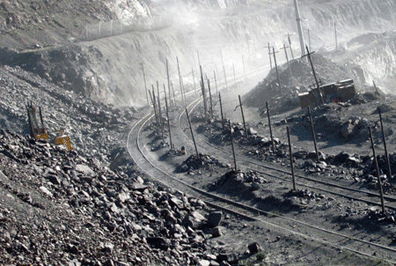
In the case of Lynas, they plan to process the rare earths in Malaysia. Lynas has been vague on what they planned to do with the radioactive wastes. No wonder the Malaysians objected – as they too have in the past, suffered a rare earth’s wastes radioactive disaster. No wonder Lynas is struggling now.
Pro Nuclear Expert John Carlson warns on selling uranium to India
 Expert warns SA that uranium supply deal with India could end up in its nuclear weapons, Perth Now June 28, 2015 TORY SHEPHERD Sunday Mail (SA) SOUTH Australians should be concerned that uranium from their backyard could end up in Indian nuclear weapons, one of Australia’s top experts says.
John Carlson was director general of the Australian Safeguards and Non-Proliferation Office, in the Department of Foreign Affairs, until 2010 and has held other posts on safeguarding radioactive elements.
Mr Carlson, who is pro-nuclear, told the Sunday Mail that the treaty being worked out for Australia to sell uranium to India was flimsy, and said South Australia’s people and companies should be concerned about where the state’s uranium ended up. ndia has huge demand for cheap energy, which Australian uranium can provide, but it is not a signatory to the Nuclear Non-Proliferation Treaty and is developing weapons.
Mr Carlson said India had a history of disregarding commitments it had made, had refused to meet safety standards and “is actually increasing its nuclear arsenal”.
“This agreement is very different to all our other agreements. There’s much less detail in it. Only India, Pakistan and North Korea are producing weapons … you’d have to think this would be a watertight agreement (but) it’s very weak.
“I think there’s a reputational issue for the industry. There’s a problem for South Australian citizens.”…….http://www.perthnow.com.au/news/national/expert-warns-sa-that-uranium-supply-deal-with-india-could-end-up-in-its-nuclear-weapons/story-fnii5yv8-1227418016005
Australia’s New Climate Roundtable

 Australian Climate Roundtable: Business, union, environmental, investor and welfare groups form unusual coalition on climate policy ABC News AM By AM business editor Peter Ryan 28 June 15 An unprecedented alliance of business, union, environmental, investor and welfare groups has been formed to forge what it sees as urgent common ground on climate policy.
The highly unusual coalition — to be branded the Australian Climate Roundtable — comes as developed nations gear up for the Paris Climate Conference in December, where leaders will be under pressure to update their strategies for dealing with climate change.
While Australia’s main political parties support the international goal of limiting climate change to less than 2 degrees Celsius above pre-industrial levels, the alliance warns the objective will require “deep global reductions”.
The high-profile members cover some influential employer and industry lobby groups, such as the Australian Industry (Ai) Group, the Business Council of Australia (BCA), the Australian Aluminium Council, the Energy Supply Association and the Investor Group on Climate Change.
They will be joined by groups at the opposite end of the political and economic spectrum — the Australian Conservation Foundation (ACF), WWF Australia, the Australian Council of Social Service, the Australian Council of Trade Unions (ACTU) and the Climate Institute.
In a statement, the Roundtable warned emissions reductions on the necessary scale would require “substantial change “and present “significant challenges” in Australia and other developed nations……..
Outlining its goals, the group said the “ideal” climate policy taken to the Paris conference should:
- be capable of achieving deep reductions in Australia’s net emissions;
- provide confidence that targeted emissions reductions actually occur;
- be based on the full range of climate risks;
- be well designed, stable and internationally linked;
- operate at least cost to the domestic economy; and
- remain efficient as circumstances change and Australia’s emissions reduction goals evolve.
Highlighting the social risks of climate policy and climate change, the Roundtable said climate policy must also:…… http://www.abc.net.au/news/2015-06-29/australian-climate-roundtable-business-unions-policy-alliance/6579106
Trans Pacific Partnership – putting Australia’s democracy in a noose

Critics of the TPP recognise it is not so much aimed at promoting free trade but more at limiting government rights to deal with present and emerging problems, especially those associated with climate change and the environment. The TPP and the bilateral FTAs are seen as a sham, designed to facilitate the growth of the corporate state at the expense of the welfare state.
The vehicle for this rollback is the section dealing with Investor-State Dispute Settlement. The ISDS rules, administered by secret, ad hoc tribunals – whose members may alternate between judging disputes and advocating on behalf of corporations seeking compensation for future losses resulting from legislative change or court decisions – trump local democracy and law, according to the Chief Justice of the High Court…..
The Trans-Pacific Partnership is bad for Australia. SMH June 29, 2015 Kenneth Davidson Senior columnist at The Age The Productivity Commission appears to have tried to convince the government not to put Australia’s head into a noose via the TPP.
President Barack Obama now has the authority to negotiate the Trans-Pacific Partnership agreement without Congressional interference. The Abbott government is reluctant to challenge even the most odious provisions of the agreement, which pretends to be a regional trade pact involving the US and 11 other countries. It is in fact a push for US regional dominance with particular relevance to its rivalry with China. Continue reading
Legal win for Australia’s nuclear veterans
 Radiation in court: landmark success for Australia’s nuclear veterans, Ecologist Chris Busby 24th June 2015
A legal judgment in Australia has fatally damaged the ‘official’ ICRP model of health damage by nuclear radiation, writes Chris Busby – reflecting the fact that cancer originates through the mutation of individual cells, not whole organs or organisms. The ruling is good news for Britain’s bomb test veterans whose day in court is coming up; and for all who suffer radiation induced cancers.
At the end of last month the Veterans Appeals Tribunal Decision on the CaseJean Mahoney vs. Australian Repatriation Commission was published.
The result was a win for the appellant, setting aside of the earlier Australian government decision not to grant a pension to the widow of a veteran who worked among the ruins of Hiroshima and later died from metastatic colon cancer.
I was the expert witness in this case and persuaded the Australian Tribunal (in an expert report and with oral cross examination by telephone, Brisbane to Riga) that the radiation risk model of the International Commission on Radiological Protection (ICRP) was not applicable to the kind of internal exposure to radioactive particles which her late husband, George Mahoney will have received. Continue reading
World is watching Australia’s pathetic performance on Climate Change
 Paris 2015: Australia in the climate change spotlight, SMH, June 26, 2015 Tom Arup and Adam Morton
Back home, the Abbott government was furiously arguing that there was nothing unusual about this – that the probe was a standard part of the laborious theatre of international climate negotiations.
“I think he’s right. We got some 36 questions on notice, so there is substantial interest in Australia’s climate change policies,” Peter Woolcott, Australia’s environment ambassador, later told the meeting.
“Particularly since the change of government, and the change in our approach to the Direct Action scheme to address climate change challenges in Australia.”
While some in Australia make the case that the country is largely irrelevant as a tiny contributor to global emissions – about 1 per cent of the total – the meeting in Bonn, Germany earlier this month suggested the international community thinks otherwise.
To many observers it was clear that other countries are closely watching Australia’s climate change debate as work continues on a global treaty due to be signed in Paris late this year. Continue reading
As the world moves to renewable energy, Tony Abbott has tried to wreck development in Australia
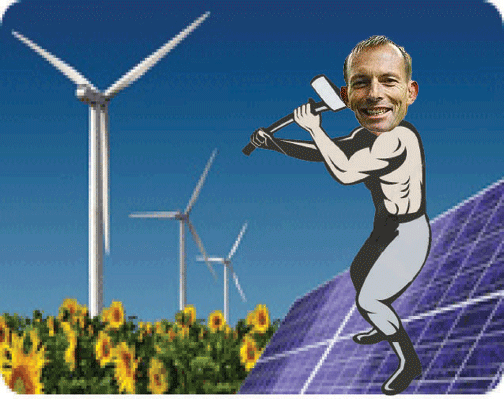 Abbott lets Australia slip behind as renewable energy advances, Canberra Times June 20, 2015 Allen Hicks
While the vocal attack on wind farms and the renewable energy target generally were rounded on as being out of touch, few people seem to realise exactly how dangerous that thinking is, not only for the environment, but for our nation’s future economic prosperity.
Far from being at the crossroads on renewable energy, most of the world has moved on, embracing a range of technologies that provide sustainable, renewable, affordable power.
Wind power, which Abbott decried as awful and noisy, is not only a mature and proven technology, it is a major growth sector, with global installed capacity leaping 44 per cent in 2014 alone…….. Continue reading
Aboriginal People Need A Treaty First- Forget constitutional recognition

A fair go cannot be achieved without a Treaty.
A Treaty would be the basis upon which the sovereign Indigenous people of Australia and the Government could negotiate the terms of rights to land, minerals and resources and the self-governing of communities. It would be a binding agreement that would have sanctions that would deter breaches of the terms of the treaty.
Forget constitutional recognition. It’s not the best option. Let’s do Treaty and let’s do it  right. http://misseaglesnetwork.blogspot.com.au/2015/06/forget-constitutional-recognition-its.html Let’s out Australia’s racist past, its attempts at ethnic cleansing, its whitewashing of who did what. The post below comes from Yinarr Yarning: Life, Love, Laughing, Politics and People – the blog of Natalie Cromb. It is re-posted here with Natalie’s kind permission.
Constitutional Recognition? Treaty First!
Between the Recognise campaign and Noel Pearson’s latest support for a conservative campaign for Declaration of Recognition, one thing is certain, constitutional recognition is on the agenda. Despite noted Indigenous support, these campaigns are looked upon with suspicion mainly because of the fact that the question remains over whether it would affect the sovereignty of Indigenous people, especially with respect to land rights.
In order to effect the changes suggested by the constitutional recognition campaigns, we would need to have a referendum. This would not be our first referendum. Continue reading
Big economic benefits to regional communities, from new wind and solar farms
 Regional areas to reap economic benefits of new wind and solar farms after new RET passes Federal Parliament ABC Rural By Catherine McAloon 26 June 15 Up to 50 new wind and solar farms are expected to be built in regional Australia, after a bill on a new Renewable Energy Target passed Federal Parliament this week.
An international consortium has announced plans to build a $450 million wind farm near Ararat, in western Victoria, and the Clean Energy Council expects it will be the first of many new projects.
“The Ararat wind farm really represents the first green shoots for an industry that’s been doing in extremely tough for the last 18 months,” the council’s Mark Bretherton said.
“We’re very confident that, with the bipartisan support that’s been restored to the Renewable Energy Target, we’ll see a lot more activity in this sector over the next few years.”
Mr Bretherton said between 30 to 50 major wind and solar projects, worth an estimated $10 billion, were expected to be built over the next five years, with most of those in rural areas.
“Most of the opportunity that we are going to see over the next five years will probably be in the wind and solar farm sector, so what that means is basically where there is the strongest wind and an opportunity to connect to the grid you’ll see wind farms, where there is the best sun, you’ll probably see some solar farms, particularly where there is enough land to build those kind of projects.” He predicted regional areas would see the greatest economic benefits of new renewable energy projects.
“That’s really good news, particularly for people who live in those areas. What it means is extra income being paid to farmers, direct jobs and it means money being paid for community projects as well.
“But apart from local jobs, it also means money is being spent at local restaurants, corner stores, equipment suppliers, motels, pie-sellers and much, much more.”………………http://www.abc.net.au/news/2015-06-26/regional-australia-to-benefit-from-new-renewable-energy-projects/6575566
General Electric prepared to spend $billions on renewable energy in Australia
GE ready to spend billions on renewable energy THE AUSTRALIAN, Damon Kitney, 26 June 15
The local chief executive of global conglomerate GE says its head office has given the green light for the company to pursue potentially billions of dollars of new investments in renewable energy in Australia after bankrolling the nation’s third-biggest wind farm in southwest Victoria.
GE, in partnership with local firms Renewable Energy Systems and Downer, has secured a major contract for the supply of 75 wind turbines to the 240MW Ararat Wind Farm, a $450 million project financed by shareholders RES, GE, Switzerland-based investment manager Partners Group and Canadian pension group OPTrust.
The project was secured by the passage through parliament on Tuesday of a new renewable energy target of 33,000 gigawatt hours of electricity from large-scale renewable energy projects by 2020.
“We are putting $125m of equity into the deal and we would not have done that without the policy certainty we now have,” said Geoff Culbert, president and CEO, GE Australia, New Zealand and PNG.
He said GE wanted to be involved in projects that produced as much of the 33,000 gigawatt hours as possible, noting they would be worth “billions” of dollars.
“We see GE playing an active role in that build-out. We are very heavily focused on trying to build a pipeline of wind deals in Australia and that is recognised right back to head office,” he said.
“We have a pipeline of deals that we have been looking at but we haven’t been able to progress. Now we have certainty we have a pipeline we are going to aggressively pursue. Australia is a really attractive place to invest for GE and we have the support from headquarters to invest more here.”
Two years ago, GE was part of a consortium that received a contract to supply wind turbines for the 55MW Mumbida wind farm in Western Australia, the first use of GE wind turbines in Australia. But political uncertainty about the RET target put further investment by the group under a cloud.
OPTrust managing director Stan Kolenc said the breaking of the political deadlock over the renewable energy target this week would open the floodgates to international investors in the Australian renewables industry………
Mr Culbert declined to comment on Mr Abbott’s views, instead noting that he was optimistic about the future. There are now more than 60 wind projects across the nation.
“There is trillions of dollars sitting on the sidelines globally looking for a place to invest. When you create a market with policy certainty, you unlock that investment,” Mr Culbert said.
The Ararat project is also being supported by a power purchase agreement with the ACT government which guarantees the purchase of about 40 per cent of the energy produced at the site http://www.theaustralian.com.au/business/ge-ready-to-spend-billions-on-renewable-energy/story-e6frg8zx-1227415347623
Transcript of Nuclear Royal Commission’s second meeting at Coober Pedy
 Jon Bok representing the Royal Commission. Small attendance (5 people)
This is not a perfect transcript, but is largely accurate. Where you see 1. that means a question from the attendees.
Bok: I’m here to help with providing information for the community, and particularly the Aboriginal community, as the Commissioner looks at risks and opportunities for expanding the nuclear industry in South Australia.
- Is there some reason why we are being targeted? We’ve had two Royal Commission community forums, and Roxby Downs hasn’t had one.
Bok: I’m out an about in the region. I’m going back to Port Augusta in the coming weeks.
- You’re not looking at the underground tunnels, are you? – I don’t mean you personally; I mean the government in general.
Bok: It’s a much broader process. It is my opportunity to meet people who are interested.
- AREVA is sending back a shipload of nuclear waste to Australia. What are we going to do with that, when it gets here?
Bok: I simply don’t know. The Commissioner is looking broadly at South Australia. One question is – should we take nuclear waste in, to South Australia?
I’m not aware if Australia has the obligation to take that waste back. The question is: is it viable to take back nuclear waste?. The Terms of Reference ask about the feasibility and viability of the four questions . Continue reading
#NuclearCommissionSAust Have your say for the future of South Australia – submissions close soon – July theme
Submissions for the Royal Commission into the Nuclear Fuel Cycle are closing soon.
This Commission could change our State forever.
Make sure you have a say in it. The Conservation SA team 26 June 15
This is too big an issue not to have your voice heard. Currently, our State government is weighing up a future that could see nuclear power, uranium enrichment and nuclear waste dumping here in South Australia. The window for the public to make comment on these issues closes in a month.
We encourage you to make a submission and draw on our resources to assist you.
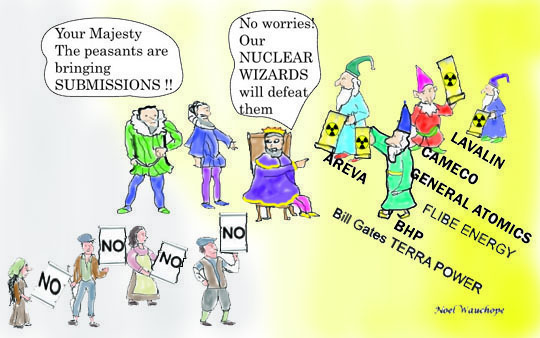
In May nuclear expert Dr Jim Green produced some information resources about each of the issues the Royal Commission into the Nuclear Fuel Cycle is investigating. Please see a summary and full report here.
Only last week renewables expert Dr Mark Diesendorf from the University of NSW finished an exciting report showing that South Australia could be run on 100% renewable energy is just 15 years. You can view and download the summary version and Dr Mark Diesendorf’s full report online here.
The issue papers generated by the Royal Commission are available here and submissions are due:
- Issues Paper 1 (Extraction) and/or Issues Paper 4 (Storage and Disposal of Waste) is 24 July, 2015
- Issues Paper 2 (Further Processing) and/or Issues Paper 3 (Electricity Generation) is 3 August, 2015.
If you wish to provide a consolidated written submission addressing all Issues Papers you have until Monday August 3, 2015.
If you wish to make an oral submission call the Royal Commission on 08 8207 1480 to make arrangements.
It’s critical that your voice is heard. This commission could change our State for generations to come.
Now is the time to act.
Kevin Scarce, Nuclear Royal Commission chief, shows up in his true pro nuclear colours
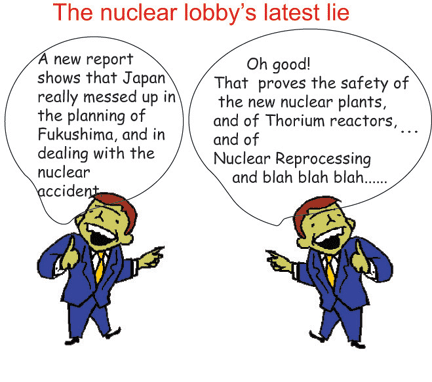
 Dennis Matthews, 26 June 15 It does no credit to the Advertiser, or Kevin Scarce, or the SA inquiry into the nuclear industry when Scarce cites misleading statements like no one was killed by exposure to ionising radiation from the Fukushima disaster (The Advertiser, 25/6/15).
This sort of ignorance was promulgated generations ago by the asbestos industry. Gullible, greedy politicians and newspaper editors became part of the problem and it took many decades before action was taken.
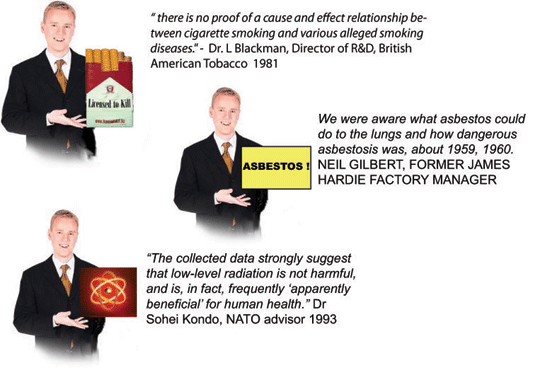
Sure, nobody was killed outright by asbestos, and lots of jobs and wealth were produced, but do we really want to lumber the next generation of South Australians with another expensive medical disaster?
It’s time that editors, politicians, and ex-Governors learnt from the past. Learnt that some medical disasters don’t happen overnight and can take decades to be diagnosed.
As with asbestos, the nuclear industry and its supporters will undoubtedly be condemned by history. It’s a pity that the Scarce’s and Koutsantonis’s of this world won’t be around to try to defend themselves.
Nuclear Royal Commission chief Scarce says “Don’t worry about Fukushima”
Fukushima scarcely a worry Adelaide Advertiser, Adelaide, Paul Starick 25 Jun 2015 FORMER governor Kevin Scarce says the Fukushima disaster doesn’t pose a major barrier to the nuclear industry’s development in SA.
The Nuclear Fuel Cycle Royal Commissioner, who toured the Fukushima exclusion zone during a global study tour, says the 2011 nuclear power plant meltdown was a result of poor design and management. In an exclusive interview with The Advertiser, Rear Admiral (retired) Scarce said the six-country study tour had demonstrated SA was technically capable, with help, of developing a nuclear industry, from the enrichment to spent fuel rod reprocessing, if this was financially viable.
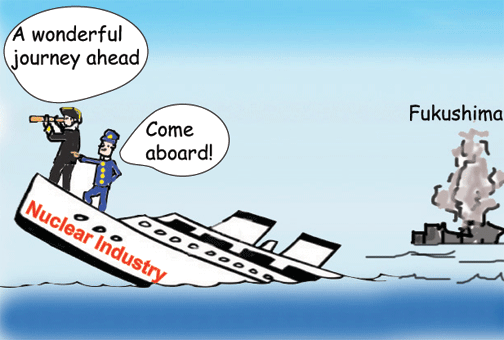
……. Rear Admiral Scarce said the disaster had prompted safety rethinks at other sites the three-person delegation visited during the Asian and European tour, completed this month…..it doesn’t indicate to me that we shouldn’t be looking at this technology. “It means we’ve got to be very careful. We’ve got to be aware of what the consequences are.
“As devastating as Fukushima was, the subsequent improvements made since then enable us to go and look at this technology for our future.”….
1 This month
17 October, Free Public Talk on Nuclear Issues in South Australia
David Noonan will speak on public interest concerns over the new Roxby Downs Indenture Act 2026 on BHP copper-uranium mining and ore processing in SA, and on how AUKUS may face SA with a High-Level nuclear waste agenda.
Dr Jim Green will discuss international developments in the field of nuclear power including ‘small modular reactors’ and Generation 4 ‘advanced’ nuclear reactor concepts.


Help Aunty Sue Protect Her Land and Sacred Sites From Destructive Rocket Testing.
.

Australians deserve the truth
about
AUKUS – https://aukuspublicinquiry.com/

PETITION – To: Prime Minister Anthony Albanese and the Australian Labor Government

of the week – Australians for War Powers Reform (AWPR)
To see nuclear-related stories in greater depth and intensity

