Dutton at odds with Queensland LNP over nuclear plans

Federal Liberal leader joined the state’s election campaign on Friday as David Crisafulli reiterated his objection to nuclear sites at Tarong and Callide
Andrew Messenger, Fri 4 Oct 2024, https://www.theguardian.com/australia-news/2024/oct/04/queensland-election-liberal-national-party-nuclear-plan-peter-dutton?fbclid=IwY2xjawFsifVleHRuA2FlbQIxMQABHatRzSolvCpDyme9yMGAFlBbI6wl6H_xHENLi2ILNvm4yPKbJbAux77dWQ_aem_EASDYfMnhAhutdbQArg8oA
The federal opposition leader, Peter Dutton, has dismissed the Queensland LNP’s rejection of his nuclear power plan as just a “difference of opinion” between friends as he joined the state’s election campaign on Friday.
At their first joint press conference since the controversial plan was announced, Queensland LNP leader David Crisafulli reiterated his defiance of Dutton’s plan for two nuclear plants in Queensland. Crisafulli said he would oppose them if elected at the 26 October poll.
It was their first joint appearance since June, when the federal leader announced plans for seven nuclear sites across Australia.
“Friends can have differences of opinion, that’s healthy,” Crisafulli said. Dutton agreed.
Dutton said he would have a “respectful” conversation with Crisafulli if he was elected.
“We can have that conversation,” Dutton said.
“The first step is to get David elected as premier. When the prime minister stops running scared, he’ll hold an election, and I intend to be prime minister after the next election, and we can have that conversation.
“In the end, we want the same thing, and that is cheaper electricity for Queenslanders.”
Crisafulli said he would not change his mind.
He has repeatedly ruled out repealing the state’s nuclear ban under any circumstances.
Dutton has previously suggested overriding state legislation.
“Commonwealth laws override state laws even to the level of the inconsistency. So support or opposition at a state level won’t stop us rolling out our new energy system,” he said in June.
Labor has repeatedly accused Crisafulli of secretly supporting the nuclear plan.
“He’ll have to roll over when it comes to nuclear power, because his entire state party, all of those state LNP MPs in the federal party, all of those state LNP senators in the federal Senate and all of his grassroots members, they want nuclear power, and he’ll have to roll over,” the deputy premier, Cameron Dick, said.
The LNP is widely tipped to win the election.
The prime minister, Anthony Albanese, is yet to appear alongside the premier, Steven Miles, on the campaign trail.
The associate director of research at the ANU’s initiative on zero carbon energy for the Asia Pacific Institute, Emma Aisbett, said having major policy differences between federal and state governments raised investment risk.
“It means that investors in energy will face higher policy uncertainty, which is also known as political risk,” she said. “It has a particularly strong depressing effect on investment for long-lived assets, which have high upfront costs, and both nuclear and renewables, either PV or wind, really fit into that category.”
She said having a dispute between governments could bring back the “energy wars”.
“What that does is slow and delay the net zero transition, and we do not have decades more to waste, slowing and delaying the transition away from fossil based energy.”
after newsletter promotion
“He’ll have to roll over when it comes to nuclear power, because his entire state party, all of those state LNP MPs in the federal party, all of those state LNP senators in the federal Senate and all of his grassroots members, they want nuclear power, and he’ll have to roll over,” the deputy premier, Cameron Dick, said.
The LNP is widely tipped to win the election.
The prime minister, Anthony Albanese, is yet to appear alongside the premier, Steven Miles, on the campaign trail.
The associate director of research at the ANU’s initiative on zero carbon energy for the Asia Pacific Institute, Emma Aisbett, said having major policy differences between federal and state governments raised investment risk.
“It means that investors in energy will face higher policy uncertainty, which is also known as political risk,” she said.
“It has a particularly strong depressing effect on investment for long-lived assets, which have high upfront costs, and both nuclear and renewables, either PV or wind, really fit into that category.”
She said having a dispute between governments could bring back the “energy wars”.
“What that does is slow and delay the net zero transition, and we do not have decades more to waste, slowing and delaying the transition away from fossil based energy.”
Big Super is still investing in nuclear weapons: report

| Quit Nukes / The Australia Institute, 1 October 24 https://theaimn.com/big-super-is-still-investing-in-nuclear-weapons-report/ |
A new report has found that despite claiming not to invest in ‘controversial weapons’ 13 of the top 14 Australian super funds are still investing in nuclear weapons companies, in some cases even in an option described as ‘responsible’.
One of the 14, Hostplus, has excluded nuclear weapons companies across its portfolio since December 2021.
At least $3.4 billion of Australian retirement savings are invested by these funds in companies involved in making nuclear weapons, according to the new research conducted by Quit Nukes in collaboration with The Australia Institute.
The report analyses financial returns and finds that the exclusion of nuclear weapon companies from portfolios has an immaterial impact on returns.
Rosemary Kelly, Director, Quit Nukes:
“It’s frankly unconscionable to sell super fund members a responsible investment option and then use their money to invest in nuclear proliferation.
“The thing that makes this baffling is that investing in nuclear weapon companies is just completely unnecessary in the broader scheme of things..
“Superannuation funds should divest immediately from weapons manufacturers who produce nuclear weapons. If you’re a member of 13 of these 14 leading funds you can request that your fund divest or threaten to take your savings elsewhere.
“Super funds are being sneaky by boasting of policies to exclude “controversial weapons” but not counting nuclear weapons as “controversial.” That’s pretty hard to swallow when you consider that most ESG advisers now consider nuclear weapons as controversial weapons, given the UN Treaty on the Prohibition of Nuclear Weapons that came into force in 2021.
Alice Grundy, Research Manager, The Australia Institute
“The most frustrating thing about the lack of process in this area is that excluding nuclear weapon companies from super portfolios is so easy. Divesting has an immaterial impact on investment returns.
“Your super fund could divest your money from nuclear weapon companies without materially impacting your returns.
“So long as nuclear weapons exist, nuclear war is an ever-present risk. Its impacts would be catastrophic. Even a limited nuclear war, involving say 250 of the over 12,000 nuclear weapons in the world, would kill 120 million people outright and cause nuclear famine, putting 2 billion lives at risk. There would be massive impacts on global supply chains and manufacturing.
“The long-term financial implications should be factored into decisions about where to invest Australian super.”
The full report Media contacts: Anil Lambert 0416 426 722
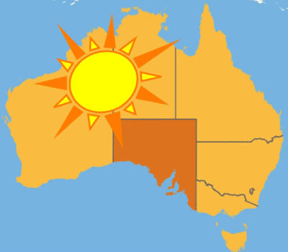
South Australia sets spectacular new records for wind, solar and negative demand
Giles Parkinson, Sep 30, 2024, https://reneweconomy.com.au/south-australia-sets-spectacular-new-records-for-wind-solar-and-negative-demand/
Records continue to tumble across Australia’s main grids as the spring weather boosts the output of wind and solar and mild weather moderates demand, but none are as spectacular as those being set in South Australia.
The state’s unique end-of-the-line grid already leads the country, and arguably the globe, in the integration of variable wind and solar, with an average of more than 70 per cent of its demand over the last year and a world-first target of 100 per cent net renewables by 2027.
On Sunday, at 9.35 am, the state set a new milestone, setting a new record share of wind and solar (as a percentage of state electricity demand) of 150.7 per cent, beating a record set on Christmas Day last year, when – for obvious reasons – there was little electricity demand.
As Geoff Eldridge, from GPE NEMLog, notes, this means that the rooftop PV, along with large scale wind and solar farms, were generating 50.7 per cent more power than the state’s total electricity demand at the time.
The scale of excess output was further crystallised later in the day with a new minimum record for instantaneous residual demand, which hit minus 927 megawatts at 12.35pm.
Eldridge says residual demand is what’s left for other generators to supply after wind and solar have met a share of the demand. A negative residual demand means wind and solar were producing more electricity than SA needed, resulting in excess renewable generation which can be managed by exporting and battery charging. The remainder is curtailed.
Of the surplus 927 MW, the state was exporting 685 MW to Victoria, while another 163 MW was being soaked up by the state’s growing fleet of battery storage projects, and 730 MW of output was curtailed. Prices at the time were minus $47/MWh, a good opportunity for batteries to charge.
A further 84 MW was being produced by a couple of gas generators – not because their power output was needed, but because the state, at least for the moment, relies on them for essential grid services such as system strength and fault current.
That will be reduced considerably when the new link to NSW is completed in a few years, and it will allow the state to both export more, and import more when needs be.
“Balancing the system with such high renewable penetration is challenging but necessary as the energy transition progresses,” Eldridge says. “Managing excess generation through exports, storage, and curtailment is critical to keeping the grid stable and efficient.”
It wasn’t the only record to fall over the weekend. In Queensland, the country’s most coal dependent state in terms of annual share of demand and generation, large scale solar hit a record share of 34 per cent, and coal output – in megawatt terms – hit a record low of 2,882 MW.
The Queensland coal fleet capacity is more than 8,000 MW, so that is about as low as it can run until more units are closed down.
In Victoria on Saturday, just before the AFL grand final, rooftop solar also hit a new record output of 3,164 MW – although it did not push operational demand down low enough for the market operator to enact Minimum System Load protocols and possibly switch off some rooftop solar panels to maintain grid stability.
It had flagged a potential MSL event on Friday but cancelled it in the morning. Those events will likely occur at other times in spring and over the summer holidays, although the market operator is now working on new rules for big batteries to avoid a potentially unpopular and unwieldy solar switch off.
AustralianSuper ESG option invested in nuclear weapons: report.

Hannah Wootton, 1 Oct 24 https://www.afr.com/wealth/superannuation/australiansuper-esg-option-invested-in-nuclear-weapons-report-20240926-p5kdpp .
Australia’s 14 biggest superannuation funds are investing about $3.4 billion of workers’ retirement savings in nuclear weapons despite many promising to avoid controversial arms, new research shows.
Industry fund gorilla AustralianSuper alone had $1.5 billion in nuclear weapons companies, while UniSuper, Aware Super and HESTA invested more than $200 million each.
Hostplus was the only major fund on the Australian market to exclude nuclear weapons, according to the study by Quit Nukes and the Australia Institute.
It comes as members ramp up engagement with super funds over concerns about unethical or environmental investments and regulators crack down on companies making false promises to consumers about their social good.
It also follows Treasurer Jim Chalmers saying there was an opportunity for super funds to “think more strategically” about how institutional capital flows into the defence industry as part of his push last year to tap $3.9 trillion for nation building investments, which funds and experts pushed back on.
Looking at funds’ default MySuper options, which account for the bulk of their members and funds under management, the report found Aware Super was the most exposed to nuclear weapons.
About 0.91 per cent of its total funds in the option were in nuclear weapons, outstripping AustralianSuper with 0.7 per cent and UniSuper and HESTA with just under 0.5 per cent.
Nuclear weapons ‘excluded’
Quit Nukes director and report co-author Rosemary Kelly said if funds wanted to keep pace with international law, global investment norms and members’ expectations and make the best risk-adjusted financial decisions, they would exclude atomic weapons.
“Super funds are being sneaky by boasting of policies to exclude ‘controversial weapons’ but not counting nuclear weapons as ‘controversial’,” she said.
“That’s pretty hard to swallow when you consider that the United Nations now considers nuclear weapons as controversial weapons.”
The report was based on portfolio holdings at December 31, 2023, and termed nuclear weapons companies as those which have a meaningful stake in the manufacture, maintenance, detonation or development of nuclear warheads and missiles or components exclusively used in them.
AustralianSuper and Spirit Super’s ESG options invested in them to the tune of $20.1 million and $400,000 respectively, despite targeting ethical investors and promising to exclude controversial (but not nuclear) weapons.
“That was a big surprise and it’s unacceptable. People read the headlines of funds’ websites and don’t have the tools to drill down into what’s actually happening – so if a fund says it excludes controversial weapons, a normal punter would think that includes nuclear,” Dr Kelly said.
Only Hostplus excluded nuclear weapons from its MySuper offering, while nine more funds ruled out controversial weapons but not atomic ones. AustralianSuper, Brighter Super, UniSuper and Care Super did not exclude any arms.
Financial sting
Dr Kelly, who is a former Aware Super director and headed its investment committee, said super funds needed to take the long-term economic implications of nuclear war seriously given their legal obligation to always act in the best financial interests of members.
“Any nuclear war, started intentionally or by accident, will be disastrous for global financial markets. This is clearly not in anyone’s best financial interest,” she said.
Even a “limited nuclear war”, which some conflict strategists view as a tactical alternative to full nuclear war should deterrence ever be deemed necessary, involving just 250 of the 12,000-plus atomic weapons in the world would kill 120 million people outright.
It would then risk a further 2 billion lives through a nuclear famine and have significant consequences for global supply chains and manufacturing.
Modelling included in the report showed there was no meaningful change in super fund returns when nuclear weapon companies were excluded from portfolios compared to when they were included.
An Aware Super spokeswoman said the fund’s investments in nuclear were only in companies where the weapons component was “a very small part of their overall business”, and its controversial weapons policy more broadly was under review.
A HESTA spokesman said only a small portion, 0.15 per cent, of the fund’s total assets were in nuclear weapons and that Quit Nukes’ data was outdated.
But the report acknowledged the fund had reduced its holdings since the data collection and sold out of four of the five companies it had previously held in breach of its own commitment to exclude companies earning more than 5 per cent of revenue from nuclear weapons.
An AustralianSuper spokesman said the fund’s members had “diverse values, preferences and attitudes when it comes to investing”, with any exclusions and screens communicated to them on its website.
Spirit Super planned to review its ESG and nuclear weapons positions after its current merger with Care Super completed.
Marles, with all pretension, flogging a dead seahorse

By Paul Keating, Sep 28, 2024, https://johnmenadue.com/marles-with-all-pretention-flogging-a-dead-seahorse/
Richard Marles and his mate, the US defence secretary, are beginning to wilt under the weight of sustained comment in Australia critical of the AUKUS arrangement.
Marles, unable to sustain a cogent argument himself, has his US friend propping him up in London to throw a 10,000-mile punch at me – and as usual, failing to materially respond to legitimate and particular criticisms made of the AUKUS arrangement.
The US Defence Secretary, Lloyd Austin, claims AUKUS would not compromise Australia’s ability to decide its own sovereign defence issues, a claim made earlier by Richard Marles and the prime minister.
But this would only be true until the prime minister and Marles got their phone call from the president, seeking to mobilise Australian military assets – wherein, both would click their heels in alacrity and agreement. The rest of us would read about it in some self-serving media statement afterwards. As my colleague, Gareth Evans, recently put it, “it defies credibility that Washington will ever go ahead with the sale of Virginias to us in the absence of an understanding that they will join the US in any fight in which it chooses to engage anywhere in our region, particularly over Taiwan”.
In London, Marles claimed that the logic behind AUKUS matched my policy as prime minister, in committing to the Collins class submarine program. This is completely untrue.
The Collins class submarine, at 3,400 tonnes, was designed specifically for the defence of Australia – in the shallow waters off the Australian continental shelf.
The US Virginia class boats at 10,000 tonnes, are attack submarines designed to stay and stand on far away station, in this case, principally to wait and sink Chinese nuclear weapon submarines as they exit the Chinese coast.
At 10,000 tonnes, the Virginias are too large for the shallow waters of the Australian coast – their facility is not in the defence of Australia, rather, it is to use their distance and stand-off capability to sink Chinese submarines. They are attack-class boats.
When Marles wilfully says “AUKUS matches the Collins class logic” during the Keating government years, he knows that statement to be utterly untrue. Factually untrue. The Collins is and was a “defensive” submarine – designed to keep an enemy off the Australian coast. It was never designed to operate as far away as China or to sit and lie in wait for submarine conquests.
And as Evans also recently made clear, eight Virginia class boats delivered in the 2040s-50s would only ever see two submarines at sea at any one time. Yet Marles argues that just two boats of this kind in the vast oceans surrounding us, materially alters our defensive capability and the military judgment of an enemy. This is argument unbecoming of any defence minister.
As I said at the National Press Club two years ago, two submarines aimed at China would be akin to throwing toothpicks at a mountain. That remains the position.
The fact is, the Albanese Government, through this program and the ambitious basing of American military forces on Australian soil, is doing nothing other than abrogating Australia’s sovereign right to command its own continent and its military forces.
Marles says “there has been demonstrable support for AUKUS within the Labor Party”. This may be true at some factionally, highly-managed national conference — like the last one — but it is utterly untrue of the Labor Party’s membership at large – which he knows.
The membership abhors AUKUS and everything that smacks of national sublimation. It does not expect these policies from a Labor Government.
South Australia joins Denmark in elite club of two, “pushing the boundaries” of renewable energy integration
Sophie Vorrath, Sep 20, 2024, https://reneweconomy.com.au/south-australia-joins-denmark-in-elite-club-of-two-pushing-the-boundaries-of-renewable-energy-integration/
[excellent tables and graphs]
South Australia has joined an elite global club, after being listed alongside Denmark as the only other energy system in the world to be successfully managing significant volumes of surplus variable renewable energy across the year – albeit with a lot of hard work ahead.
In its latest global stocktake of variable renewable energy (VRE) integration across 50 power systems, the International Energy Agency says South Australia has joined the ranks of grids with the highest share of solar and wind in the world.
On the IEA’s scale, this puts South Australia in Phase 5 of the integration of renewables (Phase 6 is the top ranking), managing a share of solar and wind that averages out to be higher than fossil fuels over most of the year and at times surpasses 100% of local demand.
And while this is an achievement to be extremely proud of – of the 50 systems analysed by the IEA, 25 are in Phases 1 or 2, representing around 60% of global electricity generation – it also puts South Australia at the pointy end of renewable energy integration, where big changes need to happen fast, to keep the transition on track.
“A growing number of power systems are pushing the boundaries of VRE integration, successfully managing very high shares of variable renewables,” the report says.
But these “frontrunner systems” face complex challenges related to stability and flexibility, which the IEA says call for a transformation of how power systems are operated, planned and financed.
Certainly, South Australia is facing numerous challenges to get its grid from where it is now, to net 100 per cent renewables. And, as the report notes, some of these challenges are uniquely complex.
“In contrast to the case of Denmark, South Australia has limited interconnections with its neighbours, and the impact of solar PV on the net load is more visible,” it says.
“High VRE periods resulting in surplus generation are managed by a combination of measures including energy exports via interconnection to the
neighbouring state, storage with battery energy storage systems (BESS), demand response and curtailment.
“High ramps at sunrise and sunset hours resulting from solar PV generation are managed predominantly by fast-acting gas turbines and the BESS, as well as accessible resources in the rest of the NEM through the interconnector.”
To this end, Project EnergyConnect – a “nation critical” new transmission project that will join up key renewable energy zones in South Australia,
New South Wales and Victoria – is expected to help.
Meanwhile, other parts of Australia are not far behind – the IEA says Australia, as a nation, should be well into Phase 4 by 2030, where it will face “key operational challenges” to the way the power system responds to maintain stability immediately following disruptions in supply or demand.
Just this week in New South Wales, the state’s “potential output” of renewables – that is, the amount available for use or storage in ideal circumstances – was clocked at 99.8 per cent of native demand just before 11am on Sunday, with a combination of sunny weather and strong winds across most of the state.
But, as Renew Economy editor Giles Parkinson notes here, that level of variable renewables currently can’t be accommodated on the NSW system, for a combination of technical and economic reasons. And it is precisely this problem that the IEA report is hoping to address.
“By 2028 the main case of our renewables forecast shows that a range of countries …reach unprecedented annual shares of generation originating from wind and solar power plants – some above 65%,” the report says.
“This development calls for a better understanding of how this could affect electricity systems even further, and what measures can be taken on several fronts to ensure that those higher levels of VRE are integrated in an affordable and secure manner.”
And it warns that a failure to solve these challenges could derail the global climate effort.
“Should integration measures fail to be implemented in line with a scenario aligned with national climate targets, up to 2,000 terawatt-hours (TWh) of global VRE generation would be at risk by 2030, endangering achieving national energy and climate pledges,” the report says.
“This potential loss – equivalent to the combined VRE output of China and the United States in 2023 – stems from possible increases in technical and economic curtailment, as well as potential project connection delays.
“Consequently, the share of solar PV and wind in the global electricity mix in 2030 would reach 30%, lower than the 35% in the case where integration measures are implemented on time. If this decrease is compensated by increased reliance on fossil fuels, it could lead to up to a 20% smaller reduction of carbon dioxide (CO 2) emissions in the power sector.”
It is comforting to note, however, that Australia is not alone in the challenges it faces – even if it is at the leading edge of some of them.
The IEA says successfully integrating higher levels of solar and wind energy into the grid will increasingly rely on measures taken to meet two “critical
requirements:” electricity grids, and procuring flexibility from a broad range of assets.
Grid congestion is a worldwide issue, the IEA notes, considering that global investment in renewables almost doubled between 2010 and 2023, while from 2015 grid investment has stagnated at $US300 billion a year until 2024, when it rose to $US400 billion.
“As a result of insufficient grid investment, at least 1,500 GW of solar and wind projects at an advanced stage were waiting for grid connection as
of mid-2023,” the report says.
“Further, many countries are facing grid congestion issues, which are expensive to address due to the high cost of dispatching power plants to overcome
immediate issues and because of the large amount of investment necessary to overcome congestion in the future.
“It is crucial for countries to accelerate grid expansion and upgrades, as it enables benefits beyond solely integrating VRE, such as improved electricity access and supporting overall demand growth.”
But, as Australia is experiencing, grid development takes a long time to materialise, the report adds, which means any and all complementary solutions with shorter lead times must be tapped to improve the integration of solar and wind.
On power system flexibility, the IEA says most of these needs will be met by solutions that are already in use, such as batteries, demand response and, to a smaller extent, curtailment.
Flexibility also extends beyond conventional generators, the report adds, encompassing storage, new electricity-based end uses, and grid infrastructure, all of which vary regionally.
“This report calls for strategic government action, enhanced infrastructure, and regulatory reforms to ensure the successful large-scale integration of solar PV and wind in order to meet global energy transition targets,” the IEA says.
“Robust data, stakeholder collaboration and government prioritisation of integration measures are essential for overcoming these challenges and achieving a sustainable energy future.”
Sophie Vorrath Sophie is editor of One Step Off The Grid and deputy editor of its sister site, Renew Economy. She is the co-host of the Solar Insiders Podcast. Sophie has been writing about clean energy for more than a decade.
The fake charity AMDA Foundation is exposed by Michael West Media’s Michelle Fahy.

Landforces’ brothers in arms: how a weapons peddler qualified for charitable status . https://www.michaelwest.com.au/landforces-brothers-in-arms-how-a-weapons-peddler-qualified-for-charitable-status/

by Michelle Fahy | Jun 4, 2021 The Coalition is cracking down on charitable organisations. However, the Australian charity promoting arms deals on behalf of weapons makers that profit from humanitarian catastrophes is unlikely to be in the government’s sights. With the weapons expo LandForces wrapping up in Brisbane this week, Michelle Fahy delves into the charity behind LandForces.
The Morrison government has charitable organisations in its sights. It proposes to amend the legislation covering charities so that minor legal misdemeanours by staff or supporters of a charity could be used as a prompt by the regulator for a review of a charity’s privileged status.
St Vincent de Paul told The Saturday Paper that if an activist wearing a Vinnies T-shirt refused to move along when asked by police, Vinnies could risk having its charitable status removed.
Hands Off Our Charities, an alliance of Australian charities, said in a submission to government: “The proposal is a major overreach and the need for further regulation has not been (and in our view cannot be) properly explained.”
Yet consider the activities of a not-for-profit organisation that many Australians will be astounded to discover has gained privileged charitable status – AMDA Foundation Limited (AMDA).
AMDA is the organiser of Land Forces, a biennial military and weapons exhibition running in Brisbane this week showcasing organisations “operating across the full spectrum of land warfare”.
The 600 exhibitors at Land Forces include local and multinational weapons manufacturers and other suppliers to military forces. Event sponsors include global arms corporations such as Boeing, BAE Systems, Lockheed Martin, Rheinmetall, General Dynamics, Saab and Hanwha, along with local companies Electro Optic Systems (EOS), CEA, and NIOA. Representatives from foreign governments and militaries are among the attendees.
Several of AMDA’s arms-maker sponsors have supplied their weaponry to the two countries leading the coalition fighting the war in Yemen – Saudi Arabia and the United Arab Emirates. The UN has been pleading for years for countries to cease supplying weaponry to these countries.
In late 2018, the New York Times published distressing photographs of emaciated children in Yemen dying as a result of aid blockades during the war. The mass starvation continues. UNICEF has said more than 400,000 Yemeni children under five could die preventable deaths this year.
Promoting arms deals on behalf of corporations that have profited from this unspeakable humanitarian catastrophe is the antithesis of what an Australian registered charity should be doing.
But the political posturing evident in the government’s proposed changes is unlikely to result in any repercussions for the AMDA Foundation. Instead, it is ‘activist’ environmental charities that are being targeted by the changes. Which is precisely the problem with such sweeping broad powers. They can be implemented selectively to silence voices the government does not want heard.
“It is the principle that underpins the change that is wrong, regardless of who it is used to target,” said Matt Rose, Economy & Democracy Program Manager at the Australian Conservation Foundation.
Arms trade promotion a “charitable activity”?
AMDA runs numerous major military and weapons-related trade exhibitions around Australia. Its roster of events includes Avalon, a biennial aerospace military and weapons expo in Victoria, next slated for early December 2021. The Indo Pacific Expo, a maritime warfare exhibition, is scheduled for May 2022 in Sydney.
These and other industry trade shows bring together sellers and buyers of weaponry and other military and security-related equipment. “Doing business is easy at Land Forces,” says its website, noting that Land Forces serves as a “powerful promotional and industry engagement forum”.
AMDA says it exists to help the “general community in Australia”. But the general community is not permitted to attend Land Forces nor AMDA’s other arms exhibitions. (The public can attend the Avalon Air Show, a separate public event run at the same time as the Avalon arms expo.)
AMDA is part of a group of companies registered with ACNC which operates around the country. It had 24 full-time-equivalent employees and a gross income in 2020 of $11.7 million – 32% of which came from government grants and 61% from operating revenue. Its income in 2019 was $26.2 million, mostly from operating revenue.
Revolving doors and conflicted interests
The AMDA board is an all-male affair. Its chair is former chief of the Royal Australian Navy, Christopher Ritchie, who joined the board in May 2017 while concurrently sitting on the boards of Lockheed Martin Australia (until 2020) and German naval shipbuilder Luerssen Australia, both multibillion dollar contractors to the Defence Department.
Former chief of army Kenneth Gillespie sits on the AMDA board while also sitting on the board of Naval Group, the French multinational building Australia’s controversial new submarines. Gillespie is also chair of the Australian Strategic Policy Institute (ASPI) Council, the highly influential and supposedly “independent” think tank tasked with providing strategic advice to the government.
ASPI is sponsored by Naval Group as well as other global arms manufacturers including Lockheed Martin, Thales, Saab and Northrop Grumman. ASPI has been vocal in its anti-China ‘war drums’ rhetoric, stoking regional tensions, along with the Asia Pacific arms race.
Protecting the Merchants of Death: The Police Effort for Land Forces 2024
September 12, 2024, by: Dr Binoy Kampmark, https://theaimn.com/protecting-the-merchants-of-death-the-police-effort-for-land-forces-2024/—
September 11. Melbourne. The scene: the area between Spencer Street Bridge and the Batman Park–Spencer Street tram stop. Heavily armed police, with glinting face coverings and shields, had seized and blocked the bridge over the course of the morning, preventing all traffic from transiting through it. Behind them stood second tier personnel, lightly armed. Then, barricades, followed by horse mounted police. Holding up the rear: two fire trucks.
In the skies, unmanned drones hovered like black, stationary ravens of menace. But these were not deemed sufficient by Victoria Police. Helicopters kept them company. Surveillance cameras also stood prominently to the north end of the bridge.
Before this assortment of marshalled force was an eclectic gathering of individuals from keffiyeh-swaddled pro-Palestinian activists to drummers kitted out in the Palestinian colours, and any number of theatrical types dressed in the shades and costumery of death. At one point, a chilling Joker figure made an appearance, his outfit and suitcase covered in mock blood. The share stock of chants was readily deployed: “No justice, no peace, no racist police”; “We, the people, will not be silenced. Stop the bombing now, now, now.” Innumerable placards condemning the arms industry and Israel’s war on Gaza also make their appearance.
The purpose of this vast, costly exercise proved elementary and brutal: to defend Land Forces 2024, one of the largest arms fairs in the southern hemisphere, from Disrupt Land Forces, a collective demonised by the Victorian state government as the great unwashed, polluted rebel rousers and anarchists. Much had been made of the potential size of the gathering, with uncritical journalists consuming gobbets of information from police sources keen to justify an operation deemed the largest since the 2000 World Economic Forum. Police officers from regional centres in the state had been called up, and while Chief Commissioner Shane Patton proved tight–lipped on the exact number, an estimate exceeding 1,000 was not refuted. The total cost of the effort: somewhere between A$10 to A$15 million.
It all began as a healthy gathering at the dawn of day, with protestors moving to the Melbourne Convention and Exhibition Centre to picket entry points for those attending Land Forces.
Over time, there was movement between the various entrances to prevent these modern merchants of death from spruiking their merchandise and touting for offers. As Green Left Online noted, “The Victorian Police barricaded the entrance of the Melbourne Convention Centre so protestors marched to the back entrance to disrupt Land Forces whilst attendees are going through security checks.”
In keeping with a variant of Anton Chekhov’s principle, if a loaded gun is placed upon the stage, it is bound to be used. Otherwise, leave it out of the script. A large police presence would hardly be worthwhile without a few cracked skulls, flesh wounds or arrests. Scuffles accordingly broke out with banal predictability. The mounted personnel were also brought out to add a snap of hostility and intimidation to the protestors as they sought to hamper access to the Convention. For all of this, it was the police who left complaining, worried about their safety.
Then came the broader push from the officers to create a zone of exclusion around the building, resulting in the closure of Clarendon Street to the south, up to Batman Park. Efforts were made to push the protests from the convention centre across the bridge towards the park. This was in keeping with the promise by the Chief Commissioner that the MCEC site and its surrounds would be deemed a designated area over the duration of the arms fair from September 11 to 13.
Such designated areas, enabled by the passage of a 2009 law, vests the police with powers to stop and search a person within the zone without a warrant. Anything perceived to be a weapon can be seized, with officers having powers to request that civilians reveal their identity.
Despite such exercisable powers, the relevant legislation imposes a time limit of 12 hours for such areas, something most conspicuously breached by the Commissioner. But as Melbourne Activist Legal Support (MALS) group remarks, the broader criteria outlined in the legislative regime are often not met and constitute a “method of protest control” that impairs “the rights to assembly, association, and political expression” protected by the Victorian Charter of Human Rights and Responsibilities.
The Victorian government had little time for the language of protest. In a stunningly grotesque twist, the Victorian Premier, Jacinta Allan, defended those at the Land Forces conference as legitimate representatives of business engaging in a peaceful enterprise. “Any industry deserves the right to have these sorts of events in a peaceful and respectful way.” If the manufacture, sale and distribution of weapons constitutes a “peaceful and respectful” pursuit, we have disappeared down the rabbit hole with Alice at great speed.
That theme continued with efforts by both Allan and the opposition leader, John Pesutto, to tarnish the efforts by fellow politicians to attend the protest. Both fumed indignantly at the efforts of Greens MP Gabrielle de Vietri to participate, with the premier calling the measure one designed for “divisive political purposes.” The Green MP had a pertinent response: “The community has spoken loud and clear, they don’t want weapons and war profiting to come to our doorstep, and the Victorian Labor government is sponsoring this.”
The absurd, morally inverted spectacle was duly affirmed: a taxpayer funded arms exposition, defended by the taxpayer funded police, used to repel the tax paying protestors keen to promote peace in the face of an industry that thrives on death, mutilation and misery.
South Australia is aiming for 100% renewable energy by 2027. It’s already internationally ‘remarkable’
Experts say the state’s approach could provide a template for what can be achieved elsewhere.
Eight years ago, South Australia’s renewable energy future was in doubt as an extraordinary statewide blackout saw recriminations flow.
On 28 September 2016, a catastrophic weather event sent the entire state into system black. Around 4pm, some 850,000 homes and businesses lost power as supercell thunderstorms and destructive winds – some travelling up to 260km/h – crumpled transmission towers, causing three major power lines to trip.
Almost immediately, and despite advice to the contrary, members of the federal government sought to blame the blackout on wind and solar, with the then prime minister, Malcolm Turnbull, saying several state governments had set “extremely aggressive, extremely unrealistic” renewable energy targets.
Instead of relenting,SA chose to persevere. It now leads the world in the integration of variable, or weather-dependent, renewables.
Wind and solar power in South Australia grew to 75% in 2023, with few other systems reaching comparable levels. For instance, frontrunner Denmark achieved 67% in the same year.
The International Energy Agency says demonstrating the ability to power a large grid with wind and solar is crucial in the context of climate change, and South Australia’s share is “remarkable”.
The state government is now attempting to legislate a target of 100% renewable energy by 2027. Experts say the state’s approach could provide a template for what can be achieved elsewhere.
Energy specialist Dr Gabrielle Kuiper says powering a jurisdiction of almost 2 million people with majority wind and solar is a globally significant achievement.
“One of the most impressive things about that feat, from a technical point of view, is there have also been periods, starting in September last year, where the entire state was powered by rooftop solar alone,” Kuiper says.
On New Year’s Eve 2023, rooftop solar met 101.7% of South Australia’s energy needs for 30 minutes. Australia’s energy operator says that’s a world record for a grid of that size. Its engineering roadmap seeks to enable similar milestones throughout the national grid.
Daniel Westerman, chief executive of the Australian Energy Market Operator, says the “world-leading” rooftop solar contribution is made possible by power system equipment providing security, smarter connections between rooftop solar and the grid, and policies which protect consumers from unwanted disruptions.
Dr Susan Close, South Australia’s deputy premier and climate change minister, was a government minister during the 2016 statewide blackout. She believes the then federal government’s reaction at the time, blaming the state’s renewable energy, was “unfair and unsubstantiated”.
But if anything, she says the unhelpful response from Canberra hardened the state’s resolve. “In South Australia, the vast majority of people were proud of what we were doing, and simply wanted us to make sure that it was as secure and stable as possible,” Close says.
Close says the state’s energy shift hasn’t happened by chance. World-leading climate laws, consistent policy and a supportive planning system attracted investment and helped the state gain an early advantage under federal renewable energy targets. High retail power prices combined with a generous feed-in tariff scheme (now finished) to drive early uptake in rooftop solar. Now every second home in the state has solar installed.
Johanna Bowyer, lead analyst at the Institute for Energy Economics and Financial Analysis, said while South Australia does have fantastic wind and solar resources, “that’s the case for a lot of Australia”. Crucially, coal power stations were allowed to close under market conditions, she said. “They didn’t subsidise it to stay open for longer, like what is happening in New South Wales with Eraring.”
As coal generation was phased out, renewable energy grew to fill the gap.
Proposed changes to South Australia’s Climate Change Act include a 100% net renewable energy target, formalising statements by the energy minister earlier in the year.
The “net” terminology recognises that interstate transmission lines – connecting South Australia to Victoria and eventually NSW – will continue to share electricity across state borders.
The amendments also include a 60% emissions reduction target by 2030 – compared to 43% federally, and 50% in Queensland, NSW and Victoria – and a framework for timely updates along the pathway to net zero by 2050.
Kirsty Bevan, chief executive of the Conservation Council of SA, says the state’s “trailblazing renewable energy transition” puts it in a unique position to adopt much stronger emissions targets than other state governments. The council supports the renewable energy and 2030 emissions targets, but is keen to see the net zero target date brought forward.
“We should be proud of our past renewable energy accomplishments, but also build upon and capitalise on those accomplishments – to the benefit of all South Australians, our nature, and our shared planet,” Bevan said.
The state government’s focus is on stability, flexibility and reliability, with more large-scale battery storage following in the footsteps of the Hornsdale battery (the world’s biggest when it was activated), and hydrogen part of the plan to soak up excess wind and sun.
Kuiper says the secure and reliable system is made possible thanks to investment in storage, smarter management and grid flexibility. But the key to SA’s success isn’t merely technical, she says, it’s also political.
“The bipartisan support for renewable energy in South Australia has been really significant. It’s given investors a sense of certainty,” Kuiper said.
“I think there are lessons at a federal level, particularly for the federal opposition, about what can be achieved if you provide consistent support to this vitally important industry – that’s important for the domestic economy and for Australia’s development of export industries into the future.”
The aim of 100% net renewables was initially set under the Marshall Liberal government, with the Malinauskas Labor government bringing the date forward.
Close acknowledges the opposition’s part in supporting the state’s decarbonisation, adding that the current bill protects to a degree from “a sudden shift in temperament from the other side of politics.”
She says there’s no reason the energy and cultural transition in South Australia couldn’t be replicated in other parts of the country.
“The sooner you start, the easier it is,” she said. “The real cost is in being the last ones to make the change. And so we wish our interstate colleagues well in making that shift.”
Basing US Nuclear Subs at Stirling on Garden Island makes Western Australia a nuclear target, while risking “catastrophic conditions” in a N-Sub reactor accident.

Briefer by David Noonan, Independent Environment Campaigner, 07 Sept 2024
What price should West Australian’s pay for AUKUS ? see “AUKUS: The worst defence and
foreign policy decision our country has made” by ex-FA Minister Gareth Evans (17 August 2024):
“… the price now being demanded by the US for giving us access to its nuclear
propulsion technology is, it is now becoming ever more clear, extraordinarily high.
Not only the now open-ended expansion of Tindal as a US B52 base; not only the
conversion of Stirling into a major base for a US Indian Ocean fleet, making Perth
now join Pine Gap and the North West Cape – and increasingly likely, Tindal – as a
nuclear target …”
No Emergency capability exists to respond to a nuclear weapons strike on Stirling off Freo
Nor can Federal and WA Labor claim to have a ‘social license’ for a US N-Sub Base at Stirling
while failing to inform affected community of the nuclear Health & Safety risks they could face.
Community has a basic ‘Right to Know’, a right to full disclosure of nuclear risks in advance of
decisions. A Labor Bill to declare Stirling a “Designated Nuclear Zone” is before Parliament
after a Senate Report. Now 3 yrs into AUKUS, it is long past time for Labor to inform community.
Federal & WA Labor Ministers Joint Ministerial Statement on Nuclear Reactors on Agricultural
Land (18 July 2024) have tackled Dutton over his crazy nuclear ‘power’ reactors at Muja, citing
accident impacts out to 80 km, but Labor fails to be transparent on nuclear risks they impose.
Federal and WA Labor have failed to make public required Health Impact Studies and
Nuclear Accident Scenario Modelling for US N-Sub visits and for a N-Sub Base at Stirling.
The WA State Hazard Plan “HAZMAT Annex A Radiation Escape from a Nuclear Powered
Warship” (update 20 Nov 2023) provides only scant over-view information to the public.
Federal Emergency provisions apply in event of a US N-Sub reactor accident at Stirling. The
federal civilian nuclear safety regulator ARPANSA sets out required Health Impact Studies,
Emergency response measures and Zones that are to be put in place (see “Guide for Radiation
Protection in Emergency Exposure Situations, Part 1 & 2, 2019).
A Defence Operations Manual “OPSMAN 1” (update 2023) is supposed to ‘operationalise’ the
Emergency measures for US N-Sub nuclear reactor accidents in Australian Ports and waters.
An “Urgent Protective Action Zone” of up to 2.8 km radius around the site of a US N-Sub
accident requires an Evacuation Plan for workers and affected residents. An “Extended
Planning Distance”, where “the surrounding population may be subject to hazards”, is set at
‘several kms’ around an accident site. This can extend to 5 km in UK N-Sub Emergency Zones.
ARPANSA and Defence also require studies of a local population out to 15 km from a US NSub mooring – as you can’t tell how far a radioactive pollution plume will spread by wind…
Children are at untenable Health risk in a nuclear strike OR in a US N-Sub reactor accident:
In a military nuclear reactor accident at Stirling the ARPANSA Guide Part 2 (p.18-19 & Table 3.1)
‘authorises’ ionising radiation health exposures to affected civilian workers AND to residents
and their children at a high dose of up to 50 mSv (milli-Sievert). Firty times more than Health
Authorities recommended maximum allowed dose of 1 mSv per year for members of the public.
Exposed residents and especially children need to be able to take stable iodine tablets ASAP to
try to reduce the radiological health risk of contracting thyroid cancer. Evacuees could have to
undergo ‘decontamination’ and need medical treatment, care which may have to be ongoing.
.
The Impact of Nuclear Weapons on Children (ICAN Report, August 2024) “shows in compelling
and often gut-wrenching detail, it is children who would suffer the most in the event of a nuclear
attack against a city today”. The Report is a dire warning that urgent action is needed to rid the
world of nuclear weapons. Australia must Sign & Ratify the Nuclear Weapons Ban Treaty.
WA Emergency workers could face “catastrophic conditions” at a N-Sub reactor accident:
In event of a severe US N-Sub reactor accident at Stirling the ARPANSA “Guide for Radiation
Protection in Emergency Exposure Situations (The Guide Part 2, p.18-19 & Table 3.1) authorises
“actions to prevent the development of catastrophic conditions” by designated WA workers.
‘Category 1 Emergency workers’ could “receive a dose of up to 500 mSv”, a dangerously high
ionising radiation dose exposure that is up to 500 times the public’s max allowed annual dose:
“Emergency workers may include workers employed by an operating organisation, as
well as personnel of response organisations, such as police officers, firefighters,
medical personnel, and drivers and crews of vehicles used for evacuation. …
- Category 1: Emergency workers undertaking mitigatory actions and urgent protective
actions on-site, including lifesaving actions, actions to prevent serious injury, actions
to prevent the development of catastrophic conditions that could significantly affect
people and the environment, and actions to prevent severe tissue reactions. … They
may also receive a dose of up to 500 mSv for life saving actions, to prevent the
development of catastrophic conditions and to prevent severe tissue reactions.”
The ARPANSA Guide Part 1 (Annex A, p.64 Table A.1, 2019) states in stark terms that Emergency
workers can be called upon to ‘volunteer’ for actions “to prevent the development of
catastrophic conditions” in event of a severe US N-Sub nuclear reactor accident:
“… under circumstances in which the expected benefits to others clearly outweigh
the emergency worker’s own health risks”.
As evidence of the extent of nuclear risks to the health of Emergency workers, the ARPANSA
Guide Part 1 (Annex A, p.63) requires female workers to be excluded from these roles:
“…female workers who might be pregnant need to be excluded from taking actions
that might result in an equivalent dose exceeding 50 mSv”
Note: the ‘safety’ of N-Subs in UK Ports has been found seriously wanting, see a Report (2009)
by Large and Associates Consulting Engineers on UK off-site Emergency Planning Measures.
The massive new projects propelling South Australia towards 100 per cent net renewables
The season of renewable records has begun early in Australia, sending
average coal power down below 50 per cent for the first time, establishing
new records for wind output, and sending grid demand to new lows across the
main grid.
The state at the forefront of the country’s energy transition
is, without a shadow of a doubt, South Australia. It kicked out coal in
2016, and is steadily reducing its dependence on gas. When a new
transmission link to NSW is completed in the next two years, the state
expects to run at 100 per cent net renewables – reducing gas to a support
role and becoming the first multi-gigawatt scale grid in the world to reach
such a milestone through wind and solar, rather than more conventional
renewable sources.
Big industry is lining up to build new factories and
production facilities to take advantage of cleaner power and lower
wholesale prices, and BHP is talking of doubling its mining production at
the giant Olympic Dam – and its smelting and refining capacity. The
latest data shows that wind and solar provided enough power to meet more
than 70 per cent of the state’s electricity demand in the last 12 months
– although the government says it is 75 per cent.
Over the past 30 days
it has been 86.4 per cent, and over the past week it has been more than 105
per cent. Rooftop solar now supplies the equivalent of all state demand on
occasions, presenting a complication for the market operator which prefers
to run the grid with assets it can control. It’s working on that solution
with new inverter standards and grid protocols, including solar
switch-offs. South Australia also led the country, and the world, in the
installation of the first big battery, the original “Tesla Big Battery”
now properly known as the Hornsdale Power Reserve.
Renew Economy 6th Sept 2024
Another Hunter Valley earthquake sounds alarms on Coalition’s nuclear scheme
Solutions for Climate Australia,
Elly Baxter, Senior Campaigner for Solutions for Climate Australia, 7 Sept 24 https://newshub.medianet.com.au/2024/09/another-hunter-valley-earthquake-sounds-alarms-on-coalitions-nuclear-scheme/65734/
The third earthquake in two weeks in NSW’s Hunter Valley today highlights the serious questions about the Liberal National Coalition’s plans for nuclear reactors they are still refusing to answer, says Solutions for Climate Australia.
The earthquake’s epicentre was again very close to the existing Liddell power station, where the Coalition aims to build at least one nuclear reactor. Solutions for Climate Australia Senior Campaigner Elly Baxter said the Coalition has not answered the many questions already raised about safety, emergency response, radioactive waste and water availability at the site.
“Five of the seven sites proposed by the Coalition as suitable for nuclear reactors experience earthquake activity,” Baxter said. “Their energy spokesman Ted O’Brien told ABC Radio Newcastle that a nuclear reactor at Liddell would not proceed if it was deemed unsafe, but what about the four other sites? If these sites are ruled out, where will the Coalition build their nuclear reactors? And will those communities be informed ahead of the federal election?
“Meanwhile, the safety issues we raised two weeks ago remain unanswered. Would local firefighting volunteers handle the nuclear material? What training would local firefighting volunteers receive in handling nuclear radiation? Who would train them? Would the army come in to help?
“How would iodine tablets be distributed to locals to try to reduce cancer risk? What would be the fallout zone and where would the local emergency staging area be? Where would nuclear refugees be accommodated?
“Would the Federal Government be responsible for the emergency management given under the Liberal National policy, the Federal Government would own the nuclear reactor?
“What would happen to the radioactive waste and who would be responsible for that? Where would the enormous volume of water come from to deal with the toxic, radioactive emergency?
“The safety issues highlighted by these earthquakes only compound our concerns that nuclear reactors will take far too long to build to protect Australians from the worst impacts of climate change.”
ENDS
Racist statements by mining magnate Lang Hancock, and claims that he had Aboriginal children
Lest we forget – the great mining magnates have not been so great on human rights.
This becomes an issue now, when their names can be attached to Australian sports teams. Surely an embarrassing whitewash of despicable public persons.
THE families of people claiming to be children born out of wedlock to Lang Hancock work in his mines, it was claimed yesterday. http://www.heraldsun.com.au/news/more-news/daughter-claims-lang-hancocks-descendants-work-in-mines/story-fn7x8me2-1226271180226 Gemma Jones From:Herald Sun February 15, 2012
Aboriginal elder Hilda Kickett, 68, who has been accepted as Mr Hancock’s love child by his widow, Rose Porteous, said some of the relatives of seven other suspected part-Aboriginal children of the late mining magnate were even paid royalties from mines opened on their traditional land.
Many of Mr Hancock’s suspected grandchildren have taken jobs in family mines and others in the vast northwest of Western Australia, which was opened up by the businessman……
Mr Hancock, who discovered iron ore in the Pilbara, once called for part-Aboriginals to be sterilised.
He also dismissed indigenous land claims, saying: “The question of Aboriginal land rights and things of this nature shouldn’t exist.”
He referred to part-Aboriginal people as “no-good half-castes” and said to deal with those who were unemployed he would “dope the water up so that they were sterile and would breed themselves out in the future”. ….. http://www.heraldsun.com.au/news/more-news/daughter-claims-lang-hancocks-descendants-work-in-mines/story-fn7x8me2-1226271180226
Dutton’s nuclear vision is distorted by ignorance (or worse)

The elephant in the room is the fantasy that we will somehow graduate to having a self-sustaining nuclear industry. Firstly, this would be in breach of the Nuclear Non-Proliferation Treaty, which, AUKUS notwithstanding, would bring down on our heads the disapproval of the civilised world. The difficulties I have described above, with the fuel rods presumably purchased from a weapons state, most likely the US, would be compounded by the need for the International Atomic Energy Agency to ensure that any processing of the fuel in Australia meets non-proliferation standards.
By Jim Coombs, Sep 2, 2024, https://johnmenadue.com/duttons-nuclear-vision-is-distorted-by-ignorance-or-worse/
Peter Dutton’s nuclear plan may well have minimal carbon emissions, but the distant time of arrival, and ignoring the well known drawbacks makes it a dud.
On the face of it, it is all whizzbang white heat of technology (albeit of 60 years ago) and no carbon emissions (never mind the other ones). The problem lies with the nature of the beast.
The energy produced is heat, resulting from nuclear fission (the splitting of atoms, from a critical mass of highly radioactive material, e.g., uranium 235). The process needs to be controlled or it goes off like Hiroshima, so it is a technical fear of some delicacy, given the cost of failure, as can be seen from Chernobyl and Fukushima.
The fuel is usually in the form of rods containing the fissile material, and, over time, it is transmuted into “waste” which contains residual fuel and what are quaintly called the “daughter products of fission”. The spent fuel is reprocessed to extract further and remaining fissionable material and the “daughters’, which are extremely radioactive and dangerous with radioactive half-lives of some thousands of years and which, up to now, have not been found a final resting place that can guarantee their safety for future generations for those thousands of years.
The most celebrated aggregation of these products is at Sellafield in the UK where they have sat awaiting adequate disposal for decades. Dutton blithely says the spent fuel rods will be stored on the power station site, which is mostly not the case elsewhere. For how long, how many and where they might be sent, once processed, for future generations to be safe, is ignored.
The nations he says happily depend on nuclear power, such as France or Japan, either fuel their stations with fissile material from their nuclear weapons programs, as in the case of France, (the cost is, thus, a defence secret), or they are trying to reduce their dependence, to reduce the cost of ensuring safe operation (Japan and Germany).
The cost overruns of nuclear power stations under construction in the UK and elsewhere are notorious. The light-bulb idea of small modular stations has yet to be demonstrated in practice, though the concept has been around for decades. They too have the problems of what to do with the waste as described above which remain unsolved .
The elephant in the room is the fantasy that we will somehow graduate to having a self-sustaining nuclear industry. Firstly, this would be in breach of the Nuclear Non-Proliferation Treaty, which, AUKUS notwithstanding, would bring down on our heads the disapproval of the civilised world. The difficulties I have described above, with the fuel rods presumably purchased from a weapons state, most likely the US, would be compounded by the need for the International Atomic Energy Agency to ensure that any processing of the fuel in Australia meets non-proliferation standards.
The idea that we could produce the fuel rods from our own supply of uranium would entail our establishing a uranium enrichment facility. All that we now know about the cost of doing this, in the face of international obloquy, is that it is a defence secret, which has never been undertaken commercially. Indeed President Richard Nixon famously offered GE and Westinghouse free access to the technology and they both declined to take it on as a business.
Consider then, what is involved in uranium enrichment. Uranium comes in two isotopes. U235 (the fissile one) and U238. To achieve fission, the concentration of U235 needs to be higher than is found in nature, so increasing the proportion of U235 is what needs to be done. That is, increasing the amount of the lighter isotope, and this can only be done by physical means, separating on the basis of three parts by weight out of 238. The only medium for achieving this separation is, in the case of uranium, uranium hexafluoride, an extremely corrosive gas, making the process entirely contained and corrosion resistant the only way to go ahead.
What is the mechanism working in this severely constrained process? A long series of gas centrifuges of the highest quality stainless steel requiring a constant supply of energy to keep the spinning process going. A task at the very edges of technical feasibility. Desperate stuff, or as Dr Johnson said of women preaching, surprising that it is done at all. Cost estimate? A deep dark secret.
Lastly, Dutton’s pro-AUKUS stance goes along with his wilful blindness to the nuclear safety issue. Way back, Billy McMahon denied entry of nuclear-powered submarines to all Australian harbours, because of the mere possibility of an escape of waste or other nuclear materials into populated environments. In the UK and US, berthing of nuclear powered vessels takes place largely at purpose-designed port facilities away from population centres. AUKUS plans to berth near Adelaide, and port cities in NSW. Imagine the effect of a minor “excursion” on real estate prices near Adelaide or even Port Kembla. “It’s clean, it’s green,” Peter cries, with no evidence whatsoever of the cost of keeping it all safe.
Barmy, or dishonest ?
Earthquake damages buildings near site of proposed nuclear plant
The Age, By Ben Cubby and Jessica McSweeney, August 23, 2024
A magnitude 4.7 earthquake struck near Muswellbrook just after midday on Friday, a few kilometres from the site where the Coalition has pledged to build a nuclear power plant, damaging some buildings in the town and sending tremors as far away as Sydney.
The State Emergency Services were called to help some people who suffered damage to their homes and businesses in Muswellbrook, but there were no reports of serious injuries.
Some buildings in Muswellbrook’s CBD had broken windows, fallen chimneys and stock spilling off shelves, locals said. At least two public schools were evacuated, and the local power grid was knocked until 2.30pm.
“It was quite alarming, we certainly felt it within the building,” said Muswellbrook Shire Council’s general manager Derek Finnigan. “It went for about 15 seconds I suppose, but it seemed longer of course.”
“We are assessing reports of minor damage to buildings in the community, some private structures in the CBD.”
Tremors were felt in a large radius around the quake’s epicentre at Denman, just south of Muswellbrook, from southern Sydney to Coffs Harbour on the Mid North Coast.
About 2400 people contacted Geoscience Australia to report that they had felt the quake which struck at 12.01pm, senior seismologist Hadi Ghasemi said.
“That is a very large number,” he said. “The earthquake itself was of a decent size and at a depth of 10 kilometres it was quite shallow, so it’s not surprising that it was widely felt.”
Ghasemi said fault lines run near the quake’s epicentre, and these had probably been triggered by stress building up as Australia’s continental plate nudges slowly north-east at a pace of about seven centimetres per year.
“There are existing cracks and weaknesses in the rock in this area, so it is a place where you might expect stress to build up,” he said.
The quake’s epicentre was a few kilometres west of Lake Liddell, where the federal Coalition plans to build a nuclear power plant if elected.
Nuclear facilities can be designed to withstand quakes of magnitude 4.8 and above, according to the World Nuclear Association and studies prepared by the Australian Nuclear Science and Technology Organisation for the Lucas Heights reactor in southern Sydney. However, hardening nuclear facilities against large quakes would add to the overall cost of building them…………………………………..https://www.theage.com.au/national/nsw/earthquake-damages-buildings-near-site-of-proposed-nuclear-plant-20240823-p5k4te.html
1 This month
17 October, Free Public Talk on Nuclear Issues in South Australia
David Noonan will speak on public interest concerns over the new Roxby Downs Indenture Act 2026 on BHP copper-uranium mining and ore processing in SA, and on how AUKUS may face SA with a High-Level nuclear waste agenda.
Dr Jim Green will discuss international developments in the field of nuclear power including ‘small modular reactors’ and Generation 4 ‘advanced’ nuclear reactor concepts.


Help Aunty Sue Protect Her Land and Sacred Sites From Destructive Rocket Testing.
.

Australians deserve the truth
about
AUKUS – https://aukuspublicinquiry.com/

PETITION – To: Prime Minister Anthony Albanese and the Australian Labor Government

of the week – Australians for War Powers Reform (AWPR)
To see nuclear-related stories in greater depth and intensity

