Labor Party firmly supporting price on carbon
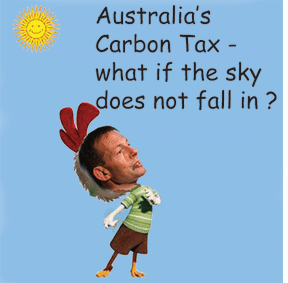 Chris Bowen puts carbon tax back in play for Labor, The Age May 20, 2015 Mark Kenny, Gareth Hutchens Shadow treasurer Chris Bowen has ruled out reviving Labor’s unsuccessful and politically corrosive mining tax under a future Shorten Labor government but has committed the ALP to putting a fully formed carbon pricing policy before voters at the next election….
a price on carbon remained central to the ALP’s platform.
“We continue to believe firstly that climate change is real,” he said.
“Secondly, that it’s caused by humankind and thirdly, the best way of dealing with it is a price on carbon. We continue to believe that, and that will be reflected in our detailed policy that we announce and seek a mandate to implement.”
The declaration means the political fight at the next election will in some senses be a carbon copy of the carbon-dominated 2013 race after Prime Minister Tony Abbott managed to abolish Labor’s fixed-price scheme last year……..http://www.theage.com.au/federal-politics/political-news/chris-bowen-puts-carbon-tax-back-in-play-for-labor-20150520-gh5sws.html
Here’s how the states can dodge Canberra’s renewable roadblock
Dylan McConnell & Anne Kallies: Here’s how the states can dodge Canberra’s renewable roadblock Labor and the Coalition government have now agreed to cut the federal renewable energy target (RET) from 41,000 gigawatt hours in 2020, to 33,000 GWh – a reduction of almost 20%. This agreement has been hailed as restoring stability to the industry, after a year plagued with uncertainty and featuring two reviews.
However, this is still a significant cut, particularly as the target is a significant part of Australia’s policy response to climate change.
Meanwhile, Victoria has committed to restoring its own renewable energy target, the VRET, following other states in developing renewable energy policy. However a clause the federal legislation prevents schemes similar to the federal RET.
How can the states get around this and support their industries? https://theconversation.com/heres-how-the-states-can-dodge-canberras-renewable-roadblock-42043
South Australia Nuclear Fuel Chain Royal Commission Community Consultation Coober Pedy 14 May 2015
 Transcript by Noel Wauchope, 20 May 2015 This transcript is a reliable account of the proceedings, but is not word for word accurate. As far as possible, I have used the exact words.
Uranium policy in the Draft ALP Conference Platform
Re: Uranium policy in the Draft ALP Platform for National Conference 2015 http://beyondnuclearinitiative.com/uranium-policy-in-the-draft-alp-conference-platform/
The 2015 Australian Labor Party (ALP) National Conference will be held from July 24/26 in Melbourne. Ahead of Conference the federal ALP has circulated draft policy documents for consultation and comment.
The full draft policy document can be found here with comments accepted from the general public as well as ALP members until Friday 29 May.
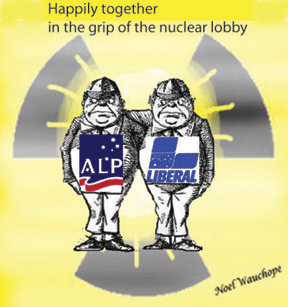 The draft uranium policy as presented poses both unreasonable reductions in transparency and unacceptable increases in risk.
The draft policy seeks to remove:
· health, safety and monitoring protections for workers
· public accountability and industry transparency mechanisms
· a long standing veto on the importation and storage of international nuclear waste
The draft policy proposes to facilitate:
· the importation, storage and disposal of international nuclear waste
· all aspects of the nuclear industry except domestic nuclear power (ie- uranium enrichment/fuel fabrication/reprocessing/waste conditioning)
Against the backdrop of the continuing Fukushima crisis, directly fuelled by Australian uranium, it is important that the ALP does not further erode an already deficient policy.
Key national and state environmental groups will be making submissions in response to the above points, but we encourage anyone concerned about this backwards policy step to also contribute via the online comment process.
A little effort from us now might help stop a big set back at the national conference in July.
Some suggested points to include in your submission are listed below- please feel free to adapt and expand on these.
If you would like further information or to discuss the draft policy and response please contact: Dave Sweeney, Australian Conservation Foundation, d.sweeney [at] acfonline.org.au or Natalie Wasley, Beyond Nuclear Initiative, beyondnuclearinitiative [at] gmail.com. Continue reading
Small Modular Nuclear Reactors touted to the South Australian Royal Commission
SA inquiry hears of new breed of small nuclear reactors, Financial Review, by Simon Evans, 19 May 15 “…………..The nuclear royal commission being headed by former South Australian governor Kevin Scarce will examine the suitability of small reactors in the Australian energy market and will also scrutinise emerging technologies known as fast neutron reactors. The commission started in mid-April and Mr Scarce has held several community forums across South Australia in the past few weeks and is holding open sessions at the state’s three universities, including Adelaide University, over the next three days starting on May 19.
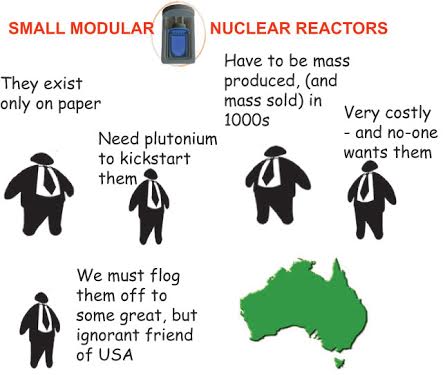
The issues paper says some of the new-generation reactors are “designed to use thorium as a fuel”. …………
Mr Scarce also points out that in Britain, which has a deregulated electricity market like the NEM, a new nuclear power generation project for Hinkley Point in Somerset had developed a regulated “contract for difference” model for the purchase of the electricity supplied by the facility to retailers. The £16 billion ($31.30 billion) project, which is being developed by French utility EDF, has started earthworks but there have been delays because of uncertainty around the final investment decision for what would be Britain’s first new nuclear power plant in two decades……..http://www.afr.com/business/sa-inquiry-hears-of-new-breed-of-small-nuclear-reactors-20150519-gh4p53
Federal parliament’s Joint Standing Committee on Treaties deliberating on uranium sales to India
To its credit, parliament’s treaties committee seems to be taking the problems with the India agreement seriously. If the committee recommends the deal be revised or rejected the onus will be on the government to take the problems seriously.
 No yellow cake for India http://www.onlineopinion.com.au/view.asp?article=17350 y Dave Sweeney – Monday, 18 May 2015 Despite widespread controversy around planned uranium sales to India, including from the government’s own former Director General of the Australian Safeguards and Non-Proliferation Office, the
moves to Melbourne this week taking evidence from groups concerned about security, safety and environmental impacts. Independent security analysts and representatives of the Uniting Church will join national environment groups Friends of the Earth and the Australian Conservation Foundation to highlight concerns over the contested sales plan. Continue reading
Labor, Coalition agree on new renewable energy target
Renewable energy sector welcomes bipartisan RET deal, debate rages over burning of wood waste, ABC Radio 19 May 15 By Peta Donald The renewable energy sector has welcomed a bipartisan deal over the Renewable Energy Target (RET), saying it clears the way for billions of dollars of investment in energy from sources like the wind and the Sun.
The Federal Government and Labor yesterday agreed to lower the RET from 41,000 gigawatt hours to 33,000, to fully exempt trade-exposed industries from the target and to scrap the two-yearly reviews which threatened to derail the deal.
Instead, the Clean Energy Regulator will provide an annual statement to Parliament and the government of the day on progress towards the target, what impact it is having on electricity prices, and whether the scheme is at risk of default.
The Government could bring legislation for the new target to the Parliament as early as next week, which means more than 23 per cent of Australia’s power would come from renewable sources in five years. Continue reading
$6 billion cut to investment as result of new renewable energy target will mean
New renewable energy target will mean $6 billion cut to investment: analysts, SMH, May 18, 2015 Lisa Cox National political reporter Six billion dollars in investment in wind and solar power will be lost as a result of a compromise deal on the renewable energy target, energy market analysts say.
Bloomberg New Energy Finance says investment in Australian projects will fall from an expected $20.6 billion by 2020 to $14.7 billion after the Abbott government and Labor reached a deal to reduce the target.
Monday’s agreement, which came after more than 12 months of political gridlock, will slash the original large-scale target of 41,000 gigawatt hours of annual renewable energy production by 2020 to 33,000 gigawatt hours.
Clean Energy Council chief executive Kane Thornton said the expected drop in projects is “what we’ve had to accept in order to resolve this situation”.
“The industry was entirely frozen. There was no new investment if the situation continued,” he said. Continue reading
Senators out to sabotage wind energy industry
Senators could demand wind power restrictions in RET scheme, The Age, May 19, 2015 Lisa Cox National political reporter Crossbenchers are set to demand the government shut wind power out of a portion of Australia’s renewable energy target, in exchange for backing the inclusion of native timber burning.
 Liberal Democratic senator David Leyonhjelm, Family First senator Bob Day and independent John Madigan will support the government’s proposal to bring wood waste into the scheme, but could seek conditions that would reserve part of the 33,000 gigawatt-hour target for solar and hydro power only.
The three senators are vocal opponents of wind turbines and sit on a parliamentary committee examining their health effects that held public hearings in Canberra on Tuesday……..
 He [David Leyonhjelm] said the senators were also talking about conditions they could seek for wind power to “prevent people from getting sick”.
Greens leader Richard Di Natale said he feared this could see the Senate debate being sidetracked by views that were anti-science.
“The first place to start is that there is not one medical scientific body anywhere in the world that accepts wind turbines cause physiological illness,” he said.
“What’s really most disappointing in this is that it’s the aggressive anti-wind stance adopted by politicians and some members of the community that spreads alarm … and is a potential cause for some of the symptoms people experience.”
Independent senator Nick Xenophon said he was concerned solar and hydro projects could be “crowded out” of the renewable energy scheme by wind power.http://www.theage.com.au/federal-politics/political-news/senators-could-demand-wind-power-restrictions-in-ret-scheme-20150519-gh574r.html
Aboriginal leaders meet in Broome
Leaders unite to finish the land rights battle THE AUSTRALIAN, Natasha Robinson
MAY 20, 2015 Aboriginal leaders from across the country have pledged to forge a new path to lift their people out of poverty and dependence, placing property rights at the centre of a national empowerment agenda that would shuck off the bureaucratic constraints threatening to reverse the gains of land rights and native title.
A historic meeting of more than 40 indigenous leaders in Broome yesterday heard that the enactment of land rights and native title legislation represented the “high point” of Aboriginal rights in recent decades, with those rights relentlessly undermined ever since by policies that had failed to afford indigenous people a true stake in policy and enterprise.
The roundtable was notable for its close co-operation between political warriors from the land rights era and conservative figures, with a remarkable level of agreement between the Left and the Right.
Reconciliation icon Patrick Dodson, hosting the event on Yawuru land, said the fight for true control over property and local economies was the “common backbone” of today’s Aboriginal rights movement.“Many of the gains that we thought we’d made … are now being undermined and dissipated,” Mr Dodson said. “We have a lot more in common than we have that divides us.
“None of us have got the silver bullet or the single answer, but we’re all searching for the best interests for the indigenous peoples, not just our own groups, but across Australia.”…….
The roundtable was attended by more than 40 indigenous leaders from across the country, including Cape York leader Noel Pearson, Northern Land Council chief executive Joe Morrison, chief executive of the Aboriginal charitable trust KRED Enterprises Wayne Bergmann, North Australian Land and Sea Management Alliance chief executive Melissa George, Carpentaria Land Council director Murrandoo Yanner, National Native Title Tribunal president Raelene Webb and North Australia Land and Sea Management Alliance chairman Peter Yu. Mr Pearson said the initiation of the roundtable by Mr Gooda and Mr Wilson had “brought a really fresh angle” to discussions of economic development that were often divided along ideological lines……..
In cases where native title was extinguished, compensation was next to impossible for communities to obtain, the meeting heard. http://www.theaustralian.com.au/national-affairs/indigenous/leaders-unite-to-finish-the-land-rights-battle/story-fn9hm1pm-1227360833594
Australian breakthrough solar technology built in Cyprus in five weeks
Australian scientists have designed and installed solar energy technology in Cyprus to help the island nation shift away from fossil fuels and also to tackle its chronic water shortages.
A team from the CSIRO, Australia’s national science agency, took five weeks to construct a ‘solar thermal field’ containing 50 heliostats – large mirrors that reflect the power of the sun. The solar thermal field lies in Pentakomo, on the southern coast of Cyprus and places the country at the frontier of solar energy research in Europe.
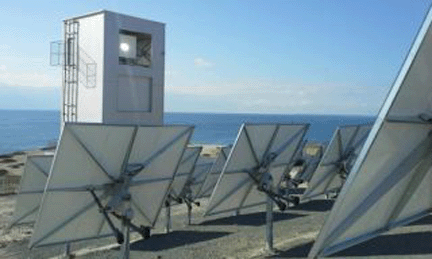
The CSIRO won an international tender to provide its technology to Cyprus for a trial that could lead to broad solar take-up in the country and elsewhere. It is understood that several other countries in Europe and the Middle East are interested in adopting CSIRO solar technology.
Cyprus hopes to take on the technology so it can reform its oil-dependent economy and meet a European Union target of 13 per cent of energy coming from renewable sources by 2020. The Mediterranean country is also plagued by water shortages and may use solar energy to power desalination plants.
The CSIRO technology uses mirrors to track the sun and reflect it towards a single receiving point on top of a tower. This heat then warms a fluid, in this case molten salt.
The molten salt, heated to 250°C, is stored in a hot tank and the steam produced powers a turbine for electricity. Crucially, this storage method allows for energy to be produced long after the sun has disappeared.
“The question about solar is always about storage at night-time,” said Wes Stein, solar research leader at CSIRO.
“This liquid is cheaper and more efficient than batteries, such as those made by Elon Musk. We can generate steam for electricity on a cloudy day. Continue reading
Australia leads the world in percentage of homes with solar power
 Australian households chase sun to lead world on solar adoption http://www.canberratimes.com.au/act-news/australian-households-chase-sun-to-lead-world-on-solar-adoption-20150516-gh2uh9.html May 16, 2015 Mark Sawa Northside Chronicle reporter Australian households are world leaders in solar power installation, according to new figures from Australia’s peak industry body representing the fossil fuel and renewable energy sector.
The Energy Supply Association of Australia, representing the fossil fuel and renewable energy sector, has sourced data from around the world revealing household solar photovoltaic (PV) penetration in Australia is way out in front of any other nation.
The report shows almost 15 per cent of Australian households have adopted the technology to power their homes.
This is more than triple that of Germans, who are second on the world stage and typically thought of as the most prolific solar adopters. Continue reading
Solar trams for Melbourne
Renewable energy group bids to turn Melbourne’s trams solar May 18, 2015 Tom Arup Environment editor, The Age

Melbourne’s entire tram network could be powered by solar if the state government gave a bold renewable energy proposal the green light.
While the pitch may conjure up images of trams with rooftop panels on them like the family home, the power would instead be generated at two new solar farms the project proponents plan to build near Swan Hill and Mildura.
The company behind the bid, the Australian Solar Group, have held quiet talks over four years with different arms of the government to try get the project off the ground, but has so far not got final backing.
The two solar farms would generate 80 gigawatt-hours of electricity a year, about the same amount used by Melbourne’s tram network, which is the world’s largest.
Under the proposal the government would back the project by signing Public Transport Victoria (PTV) up to a power purchase agreement with the solar farms, creating a reliable revenue source alongside the renewable energy target.
The proponents say the project has been designed to ensure the cost of tram tickets would not rise, nor would it add to PTV’s power bill. It would cut 100,000 tonnes of greenhouse gas emissions a year from running trams and give the city an obvious global selling point (see the mock-up tram design above), according to the pitch…….http://www.theage.com.au/victoria/renewable-energy-group-bids-to-turn-melbournes-trams-solar-20150518-gh3ime.html
Tasmania keen to fast track electric vehicles – and become 100% renewable energy powered
 Tasmania looks to EVs as next step to 100% renewable energy, REneweconomy, By Giles Parkinson on 19 May 2015 Tasmania looks to fast-track take-up of electric vehicles to boost its credentials as a green manufacturing hub to replace old industries, and export clean energy to the mainland. Tasmania could end up totally renewable – a Green Apple Isle – in both electricity and transport. Tasmania is looking closely at electric vehicles to take the next step towards 100 per cent renewable energy – both electricity and transport – and boost the state’s strategic advantage as a clean energy manufacturing hub. Continue reading
South Australia’s Pro Nuclear Royal Commission to visit Fukushima and elsewhere
 Nuclear Royal Commission to visit Fukushima disaster area, Adelaide Now PAUL STARICK CHIEF REPORTER THE ADVERTISER MAY 17, 2015 FORMER governor Kevin Scarce will inspect the Fukushima region, which was ravaged by a nuclear power plant accident, as part of the Royal Commission he is leading.
His three-person delegation next week will study the failed processes which resulted in a significant amount of radioactive waste being released into the atmosphere at the Daiichi Nuclear Plant in March, 2011.
They expect to go inside the 30km nuclear disaster exclusion zone, from which more than 150,000 people were ordered to evacuate as a result of the accident, caused by coolant loss following a tsunami.
“We’ll be looking at technologies in Japan and we’ll also be looking to talk to people who are against the nuclear fuel cycle,” Rear Admiral Scarce said.
The fact-finding mission is part of a global study tour of more than a fortnight, which also includes Taiwan, Finland, Austria, France and the United Kingdom……..
The delegation also will visit the Vienna-based International Atomic Energy Agency, the United Nations agency which promotes the safe, secure and peaceful use of nuclear technologies……..
he said SA needed to examine future economic opportunities as car and component manufacturing closes or declines……
Rear Admiral Scarce has completed community meetings across the state in venues including Mount Gambier, Port Augusta, Berri, Coober Pedy, Maralinga, Oak Valley and Umuwa on the Anangu Pitjantjatjara Yankunytjatjara lands.
The Royal Commission’s community meetings this week will be held at UniSA’s Mawson Lakes campus tomorrow, Flinders University’s Tonsley Park campus on Wednesday and Adelaide University’s Bonython Hall on Friday. See www.nuclearrc.sa.gov.au for details. http://www.adelaidenow.com.au/news/south-australia/nuclear-royal-commission-to-visit-fukushima-disaster-area/story-fnpp66pk-1227358258362
1 This month
17 October, Free Public Talk on Nuclear Issues in South Australia
David Noonan will speak on public interest concerns over the new Roxby Downs Indenture Act 2026 on BHP copper-uranium mining and ore processing in SA, and on how AUKUS may face SA with a High-Level nuclear waste agenda.
Dr Jim Green will discuss international developments in the field of nuclear power including ‘small modular reactors’ and Generation 4 ‘advanced’ nuclear reactor concepts.


Help Aunty Sue Protect Her Land and Sacred Sites From Destructive Rocket Testing.
.

Australians deserve the truth
about
AUKUS – https://aukuspublicinquiry.com/

PETITION – To: Prime Minister Anthony Albanese and the Australian Labor Government

of the week – Australians for War Powers Reform (AWPR)
To see nuclear-related stories in greater depth and intensity

