The Bjorn Lomborg recipe for inaction on Climate Change
Bringing Lomborg’s work to Australia seems to have been the personal project of Prime Minister Tony Abbott who found $4 million in a budget that cannot afford to support other scientific work on climate change. Abbott is, of course, famous for dismissing climate science as “crap” and choosing as his chief business adviser a man, Maurice Newman, who believes climate science is being used by the UN to impose authoritarian rule over the world.
The Lomborg Ruse, Clive Hamilton 23 MAY 2015 No one in Australia has more relentlessly attacked environmentalists, climate science, carbon taxes and the aspirations of the United Nations than Murdoch columnist Andrew Bolt.
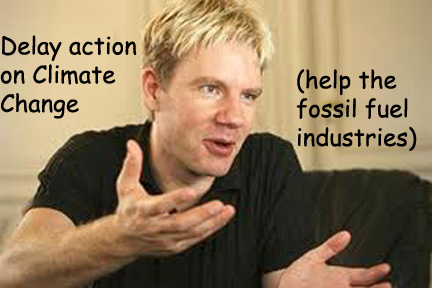
So what does it mean when Bolt sings the praises of a man who is a declared environmentalist, accepts the body of evidence for climate change, supports a carbon tax and is a strong supporter of the United Nations? Oh, and he’s also a gay vegetarian who’s never out of a trendy black T-shirt.
And what are we to make of it when Bolt, who has complained bitterly that the nation’s universities are stacked with leftists, is now up in arms because a man with admittedly left-leaning politics is sent packing from one of those universities.
I speak of course of Bjorn Lomborg and the University of Western Australia’s reversal of its decision to host his Consensus Centre and so reject the $4 million offered by the Federal Government.
Bolt is not Lomborg’s only unlikely defender. John Roskam of the Institute of Public Affairs writes that the opposition to Lomborg “demonstrates all that’s wrong with Australia’s universities”. The IPA, from the late 1990s the epicentre of the dissemination of climate science denial in Australia, now claims that the man who declares “I believe in global warming” has been “muzzled” and must be heard. (The IPA hosted a Lomborg visit to Australia in 2003, at the prompting of federal industry minister Ian Macfarlane.) Continue reading
Senator Leyonhjelm – Nuclear power is fine: wind power is the danger!
 Senator David Leyonhjelm wants government to monitor wind turbine noise, The Age, May 24, 2015 Adam Gartre It seems the only thing colourful crossbench senator David Leyonhjelm hates more than red tape is wind farming.
Despite typically being a fierce opponent of new government regulation, the Liberal Democrat is calling on the government to set up a new regulator to monitor noise levels near wind turbines.
He claims a Senate inquiry he set up has uncovered “credible evidence” that some people are suffering  health concerns caused by low frequency noise and vibrations known as infrasound.
Australia’s peak medical agency this year concluded there is no direct or consistent evidence that wind farms damage human health, after conducting a year-long study into so-called “wind turbine syndrome”.
Greedy businessmen just can’t wait for the Royal Commission’s final report
 Nuclear Royal Commission urged to fast-track storage talks DANIEL WILLS STATE POLITICAL EDITOR THE ADVERTISER MARCH 03, 2015 BUSINESS has urged South Australia’s nuclear Royal Commission to fast-track consideration of hosting the nation’s first major waste dump, amid fears the state could miss out on a lucrative opportunity to take a foothold in a future storage industry.
The Federal Government has announced a new tender process for a national radioactive waste management facility and is seeking site nominations until May 5. However, South Australia’s Royal Commission is not expected to conclude until late this year or early 2016.
“Maybe we need to fast track that. Maybe that’s the part of the Commission that needs to come out first. “We can’t just wait until the Commission is over. They’re calling for it now….
Federal Industry Minister Ian Macfarlane said an independent advisory panel has been established to assess nominations and advise on the suitability of applicant sites.
The Federal Government has promised “a package of benefits” for the tender winner……..
Australian Conservation Foundation nuclear free campaigner Dave Sweeney called for the tender to be delayed amid fears a rushed process could harm communities and the environment….
Nuclear business lobby geared up to make submissions to the South Australian Nuclear Fuel Chain Royal Commission
Mr Hundertmark said it was not simple to “overcome the anti-nuclear feeling” but that modern nuclear technology was far safer than older reactors, such as Fukushima in Japan
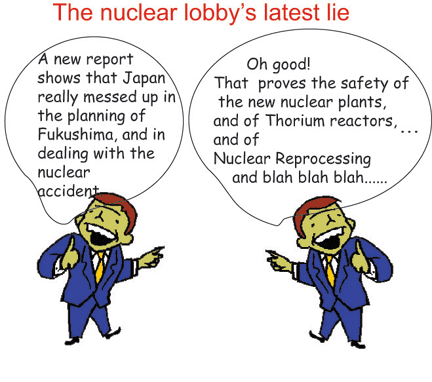
 Kevin Scarce, who is in favour of a debate on nuclear and is heading up the Royal Commission, has said he was sick of hearing politicians say they’re not opposed to nuclear power then doing nothing about it.
The $20bn blueprint to create a nuclear industry in SA TORY SHEPHERD POLITICAL EDITOR THE ADVERTISER FEBRUARY 22, 2015 A $20 BILLION blueprint to create a South Australian nuclear industry that turns around the state’s fortunes by employing tens of thousands of people has been developed by a panel of experts.
The draft plan says the project would make the state a “world centre” for nuclear energy by offering storage for radioactive waste, enriching our uranium and building nuclear reactors, creating a new industry.
SA Nuclear Energy Systems Pty Ltd, chaired by Bruce Hundertmark, comprises a range of nuclear experts and hopes to work with the US Department of Energy and other major international entities in  its quest to make the plan a reality.
The group, which has an office in Wayville, hopes to make a submission to the Royal Commission into a nuclear industry. Continue reading
Japan keen to make Australia’s new submarines
Japan Security Council Approves Bid to Build Australian Submarines DEFENSE STUDIES. FOCUS ON DEFENSE CAPABILITY DEVELOPMENT IN SOUTHEAST ASIA AND OCEANIA 22 Mei 2015 The Japanese proposal for the 4200-tonne Soryu would involve using contractors Kawasaki Heavy Industries and Mitsubishi Heavy Industries, with the bid competing against TKMS’s 4000-tonne Type 216 and a conventional version of DCNS’s 5000-tonne nuclear-powered Barracuda. (photo : Nosint)
Japan is to exploit the easing of its postwar ban on arms exports by entering the race to jointly develop and build a new generation of submarines for the Australian navy.
Members of Japan’s security council this week approved the country’s participation in the bidding process, months after the Australian prime minister, Tony Abbott, abandoned plans to buy Soryu-class submarines from Japan under pressure from ruling party and opposition politicians.
Instead, Japan will join non-nuclear submarine developers from Germany and France in Canberra’s “competitive evaluation process” to decide who builds the Australian navy’s next fleet of submarines.
South Australian government and defence industry representatives have gone to Europe to convince companies bidding to build Australia’s next fleet of submarines to do the work in Adelaide.
Yoshihide Suga, Japan’s chief cabinet secretary, confirmed that the security council had decided Japanese firms should join the process “in light of the importance of defence cooperation between Japan and Australia”.
Suga told reporters that the decision was in line with Japan’s revised rules on the transfer of arms and defence technology……….
Bjorn Lomborg’s USA operation seems to break many USA rules
It is unclear that Lomborg himself is a legitimate charity anywhere, but most of the money seems under his control. One might also wonder where income taxes are paid.
Perhaps with his new $4 million Australia Consensus Center (covered here, here, here) Bjorn Lomborg may pick a better site than a US shipping storefront, since he’ll receive much more taxpayer money, directly, courtesy of the Australian government. That does seem simpler
Bjorn Lomborg’s Copenhagen Consensus Center – Real Charity Or “Foreign Conduit”? DeSmogBlog By John Mashey • Sunday, April 26, 2015 Bjørn Lomborg is founder and president of the Copenhagen Consensus CenterUSA (CCC)), a tax-exempt 501(c)(3) “public charity” whose US physical presence is shown in the image: 262 Middlesex St, Lowell MA. Lomborg and the Copenhagen Consensus Center are known to DeSmog readers for efforts to downplay the importance of addressing climate change, a subset of climate science denialism that has infected the public debate across the English-speaking world.
Despite the name, it has not been based in Copenhagen since 2011. Continue reading
Bjorn Lomborg remains confident about his climate action delaying centre
 CCC’s Bjorn Lomborg appears unfazed by criticisms and setbacks, The Age May 23, 2015 – Paul McGeough, Amidst uncertainty over his planned expansion into Australia, sponsored and part-funded by Canberra, Danish climate contrarian Bjorn Lomborg is unapologetic over secret donor funding and his own, at times, large salary as head of the Copenhagen Consensus Centre (CCC).
Defending the donations, Lomborg doubled-back on a position he took late last year when he volunteered, in a Freakonomics talk in the US, “almost all” CCC donors wished to remain anonymous……
Asked if the combination of past trenchant scientific and environmentalist criticism of his “bang-for-your-buck” analysis, which underpinned the outrage at UWA, and of his willingness to accept some anonymous funding risked the credibility of his proposed Australian operation, Lomborg countered: “CCC has been recognised repeatedly as a top global think-tank – it has a strong reputation because of the excellent research that it produces with more than 100 leading economists and seven Nobel laureates.”
Yet Lomborg baulked, when asked about the intellectual hinge in his relationship with Canberra – did the Abbott government enlist him in the Australian discourse because he had always believed humans cause global warming, or because he now spent most of his waking hours articulating arguments against controversial proposals to cut carbon emissions?….
n the 2013 filings, Lomborg’s salary was reveal to be $200, 484, but in the previous year it was more than three times that amount – $US775, 000.That figure caused a rolling of eyes in some scientific and environmental corners. But unabashed, Lomborg told Fairfax Media: “My salary is assessed by a compensation committee. My position is as leader of a globally recognised, top-ranked think-tank and research funder, interacting with hundreds of the world’s top economists, opinion-makers and leaders.”
Hoping to ride out the storm over his appointment, Lomborg said in April: “We want to have this conversation in the developing world, but Imagine having it in Australia too. In a democracy we talk about what can be done in three-year election cycles, but let’s ask what could Australia do in the lifetime of the next generation.”……http://www.theage.com.au/national/cccs-bjorn-lomborg-appears-unfazed-by-criticisms-and-setbacks-20150522-gh6h2g
Environmental powers handed to the States – will mean falling standards
 Environmental standards face decline if all approval powers are handed to states, report finds, ABC News, By Jane Ryan, 21 May 15 Environmental standards would drop under a proposed state-based one-stop-shop environmental approval system, a new report has found.
The proposed legislation, which is before the Federal Senate, seeks to streamline environmental approval processes by giving power of approval to state governments and cutting out the Commonwealth.
But a report by the Environmental Defenders Office (EDO) warns against relegating environmental approval powers to state governments, saying the environment will suffer.
EDO principal lawyer Jess Feehely said there were several areas where state legislation did not meet the standards set by Commonwealth protections……..
Ms Feehely said Tasmania would not meet international obligations on environment protection under the proposed legislation change.”There’s a real risk that matters of national environmental significance will receive less protection,” she said. “Matters of national significance include threatened species, so habitat for the Tasmanian devil, and it includes world heritage areas and endangered ecological communities.”
She said there were four main areas where the Tasmanian law fell short of the protection afforded under the Commonwealth Environmental Protection and Biodiversity Conservation Act. “They don’t apply the precautionary principle, they don’t take account of our international obligations, and they don’t make it easy for people to find access to information about development decisions,” she said.
The report also commended the strong rights for public participation currently provided in many Tasmanian laws.http://www.abc.net.au/news/2015-05-22/one-stop-shop-system-would-reduce-environmental-standards-report/6489168
The solar revolution that is coming to Australia’s homes
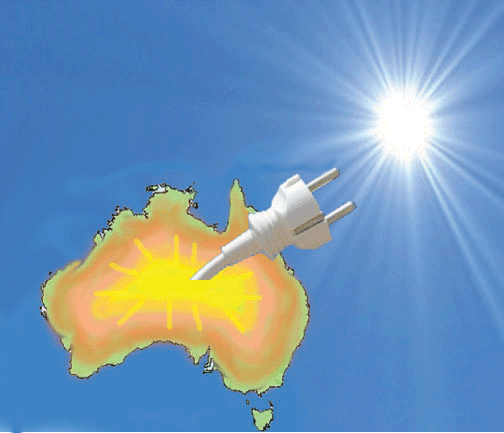 Could solar power be about to transform the electricity industry and drive prices down? http://www.abc.net.au/7.30/content/2015/s4240286.htm Australian Broadcasting Corporation Broadcast: 21/05/2015 Reporter: Matt Peacock A revolution driven by solar panels and cheaper batteries is transforming Australia’s electricity industry and promising to drive power prices down.
Transcript
LEIGH SALES, PRESENTER: Imagine life without that dreaded quarterly power bill. That could be around the corner for people with solar panels. Until now, solar energy couldn’t be stored efficiently and people who had it relied on the electricity grid for backup. Now, new battery technology means that could change. Matt Peacock reports. Continue reading
Funding method to help off-grid renewable energy take off in rural Australia
 CLOSING THE GAP
Renewable energy sources (in particular, solar and wind) have a significant relevance in the off-grid setting of Australia’s remote rural and indigenous communities.
At present these communities are serviced almost exclusively by off-grid diesel and gas. While these traditional fuels haven’t yet become prohibitively expensive, they are subject to price fluctuations and, in the case of diesel, affordable only as a result of government subsidies.
Fuel subsidies are also regularly under threat of repeal; and yet renewable energy has made enormous progress in providing an environmentally-friendly alternative which is competitive in terms of price and efficiency.
Taking diesel and solar powered energy as examples: while the cost of diesel generation has remained stable at around the $220-$300/MWh mark, the cost of solar energy is now about $200-$240/MWh; drastically down from $600/MWh in 2008 and likely to get cheaper with evolving technology and economies of scale.
Combine the comparative cost with the obvious environmental benefits of solar or wind and the case for their adoption looks compelling.
Renewable energy for remote Australia – can our rural and indigenous communities go off-grid?http://www.lexology.com/library/detail.aspx?g=1d65ab6f-6d9c-4499-abd7-de3a45c72191 Corrs Chambers Westgarth Australia May 21 2015
THE PRESENT DILEMMA
The renewable energy industry in Australia has taken more hits in recent years than a punch-drunk boxer. It may be uncharitable to say that Australia’s politicians were the only ones throwing the upper-cuts, but there’s little doubt they’ve played a significant role.
The current state of the renewable energy industry in Australia can be traced back to the repeal of the carbon price mechanism and has been further compounded by the prolonged political impasse surrounding the future of the Renewable Energy Target (RET).[1].
Running parallel to the renewable energy sector’s struggles, is the pressure on governments to reduce spending in the face of an undiminished social imperative to service the energy (and wider infrastructure) needs of remote rural and indigenous communities across the country.
In light of technological advances, off-grid renewable energy should be a key part of the solution to energy security.
In funding such a solution, debt-funded models could be a more practical way for industry to raise the capital it needs than waiting for government funding.
For government, private capital investment has long been an attractive funding solution for infrastructure projects as it allows for the deferral of upfront capital costs.
Equally, financiers benefit from the certainty that comes with government-sourced revenue streams – in this way circumventing the uncertainty that has so severely hamstrung renewable energy investment in recent years.
If a debt-funded model is to be pursued, the real question then becomes: how to structure that funding to make it attractive for all parties concerned? Continue reading
Energy retailers must take the lead, for solar and wind energy to spring back
A key element of the recent RET compromise is that the ruling Liberal coalition agreed to scrap the biennial reviews of the policy that had previously been in place.
“It removes the uncertainty factor that has been plaguing the RET for many years now,” Gemmell says.
Yet while the bipartisan compromise is a welcome development for the industry, the victory is still bittersweet.
“We’re both relieved and disappointed at the same time. We’re relieved in the sense that the pace of our PPA discussions and negotiations are picking up considerably. And we’ll have some clear visibility on building the first major stages of our projects,” he concludes, noting that Solar Choice may now be able to start construction at Bulli Creek at some point in 2016.
ANALYSIS: Energy retailers key after Australia RET deal http://www.rechargenews.com/solar/1400719/analysis-energy-retailers-key-after-australia-ret-deal Brian Publicover in Tokyo Friday, May 22 2015 The Australian legislature appears set to approve the nation’s revised Renewable Energy Target (RET) by as early as the end of June, but energy retailers will need to take the lead for solar and wind development to finally spring back to life after more than a year of uncertainty, according to industry analysts. Continue reading
USA ‘Missile Defense’ is Destabilizing the Region
 ‘Missile Defense’ is Destabilizing by Bruce K. Gagnon http://space4peace.blogspot.com.au/“….The Global Network will carry this with us to Kyoto, Japan from July 29-Aug 2 for our 23rd annual space organizing conference that is being hosted by peace activists from across the Kyoto Prefecture.
The US recently deployed a ‘missile defense’ radar in Kyoto Prefecture and the Ukawa village has been resisting the deployment for some time. During the conference we will take a side trip to join the villagers in a protest against the radar that is being aimed at China.
The US is now deploying “missile defense’ systems throughout the Asia-Pacific on land and on-board Navy Aegis destroyers. These interceptors play an important role in US first-strike attack planning.
They are now deployed in Taiwan, South Korea, Japan, Okinawa, Guam, Australia, and the Philippines. Taken together these interceptor systems serve as a loaded gun pointed at the head of China. Beijing has responded by building more nuclear weapons to ensure they have a “survivable retaliatory capability” and have moved many of their more vulnerable land-based nuclear weapons onto submarines so they are harder to hit in a possible Pentagon first-strike attack.
The US Space Command has been annually war gaming such a first-strike attack on China and Russia for many years. In the computer war game the US fires weapons from space and through space in order to take out the “enemy” nuclear forces. Then when China or Russia attempt to fire their remaining retaliatory forces the US ‘missile defense’ systems are used as a shield against them giving the Pentagon a theoretical successful first-strike.
Since the US withdrew from the ABM Treaty the US has been encircling both Russia and China with the destabilizing systems.
Aboriginal cultural heritage depends on remaining on homelands
 If Aboriginal people are forced off their land, who will pass down the stories?, Guardian, Kelly Briggs 22 May 15 Imagine what an unbroken link to the land, thousands of years old, feels like. IndigenousX host Kelly Briggs on keeping the light of culture burning bright “……………. People in this town work tirelessly to reinvigorate our languages, keep our stories strong and pass strength on through keeping the lights of pride in our culture burning bright.
Nuclear Royal Commission puts up barriers to community participation
Conservation Council of South Australia, 22 May 15 The SA Nuclear Royal Commission is putting huge barriers in the way of the community to formally participate in the current submission process, with Aboriginal people, people from remote, regional or rural areas, youth, and those with language difficulties particularly affected.
The Royal Commission is currently calling for public input in response to a series of Issues Papers. However, in the Submissions Guidelines they insist that submissions must be typed (not hand-written), and before lodging, a person has to swear in front of a Justice of the Peace (or equivalent) that it is their work.
“This requirement to find a JP will make it very difficult for many in remote areas, and especially for Aboriginal people of South Australia,” said Karina Lester, Yankunytjatjara Anangu Traditional Owner.
“How many JP’s live on the APY Lands or Maralinga Tjarutja Lands. How far does one have to travel to track down a JP?
“This is very unfair of the Commission to put these requirements in place as this will disengage the community and it will be all too hard to put in a submission.
“All South Australians need to contribute into this Royal Commission and feel that they have been consulted the right way.
“Anangu and the Aboriginal people of South Australia have been the ones directly impacted by the Nuclear Industry in the past. The Government of SA are not learning from the past and hearing and respecting the voices of those who have lost loved ones, lost their sight, skin infections, cancers, and the list goes on,” said Ms Lester.
A sworn oath in front of a Justice of the Peace to lodge a submission is:
– NOT required under the Royal Commissions Act 1917
– NOT required for equivalent Federal or State Parliamentary inquiries
“ Requiring a member of the public to travel to a JP and swear an oath in front of them before they can lodge a submission is a highly unusual, unnecessary and surprising restriction which will stop people getting involved,” said Conservation Council SA Chief Executive Craig Wilkins.
“If they are concerned about fake or spam submissions, all they need is for individuals to self declare and sign a coversheet. To be forced to swear an oath in front of a JP just to have your say is simply not necessary.
“Rather than creating a genuine community conversation as the Premier hoped, barriers like this will directly prevent a large number South Australians from participating and submitting their views.
“We urge the Commission to change their rules to allow as many South Australians as possible to participate, ” he said.
The last of 3 public information sessions about the Royal Commission will be held today at Adelaide University at 1pm. Media Contact: Meg Sobey, Communications Officer, 0411 028 930 meg.sobey@conservationsa.org.au
Southern Antarctic Peninsula ice sheet now collapsing?
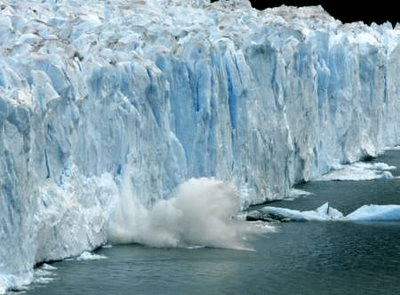 ‘Stable’ Antarctic ice sheet may have started collapsing, scientists say, Guardian, Karl Mathiesen, 22 May 15 Southern Antarctic Peninsula ice sheet losing ice 8,500 times the mass of the Great Pyramid of Giza every year, satellite data shows A vast slab of Antarctic ice that was previously stable may have started to collapse, according to new analysis of satellite data.
Research published in the journal Science on Thursday found the Southern Antarctic Peninsula (SAP) ice sheet is losing ice into the ocean at a rate of 56 gigatons each year – about 8,500 times the mass of the Great Pyramid of Giza. This adds around 0.16mm per year to the global sea level.
The sheet’s thickness has remained stable since satellite observations began in 1992. But Professor Jonathan Bamber of Bristol university, who co-authored the study, said that around 2009 it very suddenly began to thin by an average of 42cm each year. Some areas had fallen by up to 4m.
“It hasn’t been going up, it hasn’t been going down – until 2009. Then it just seemed to pass some kind of critical threshold and went over a cliff and it’s been losing mass at a pretty much constant, rather large, rate,” said Bamber……http://www.theguardian.com/environment/2015/may/21/stable-antarctic-ice-sheet-may-have-started-collapsing-scientists-say
1 This month
17 October, Free Public Talk on Nuclear Issues in South Australia
David Noonan will speak on public interest concerns over the new Roxby Downs Indenture Act 2026 on BHP copper-uranium mining and ore processing in SA, and on how AUKUS may face SA with a High-Level nuclear waste agenda.
Dr Jim Green will discuss international developments in the field of nuclear power including ‘small modular reactors’ and Generation 4 ‘advanced’ nuclear reactor concepts.


Help Aunty Sue Protect Her Land and Sacred Sites From Destructive Rocket Testing.
.

Australians deserve the truth
about
AUKUS – https://aukuspublicinquiry.com/

PETITION – To: Prime Minister Anthony Albanese and the Australian Labor Government

of the week – Australians for War Powers Reform (AWPR)
To see nuclear-related stories in greater depth and intensity

