Australia has the most affordable solar systems in the developed world.

But while this was happening a revolution was unfolding in the affordability of solar power systems. Rather fortunately for Australia, we are one of the best positioned nations to take advantage of this revolution. Continue reading
50% renewable energy by 2030 – Queensland government pledge
 Queensland government pledges to reach 50% renewable energy by 2030 Australian states are finally taking action, Science Alert MYLES GOUGH 15 MAY 2015 Queensland’s newly elected Labor government plans to generate 50 percent of the state’s electricity from renewable energy by 2030, and wants one million homes to have rooftop solar systems within five years.
The 50 percent renewable energy target was outlined in the party’s pre-election policy, and the new energy minister recently confirmed that the government is determined to make it happen, and will establish a productivity commission to come up with the right policy pathway to get them there. The government also has a plan to see the number of households with rooftop solar more than double by 2020, growing from 400,000 to one million.
“Renewable energy has long since stopped being a fringe issue, now is the time for Queensland to make this happen,” said energy minister Mark Bailey, before a speech at the Australian Solar Conference in Melbourne. As Giles Parkinson points out for RenewEconomy, there was some speculation that the ambitious target represented “the aspirations of a party that expected to remain in Opposition.”……..
the political tide has turned in Queensland, and with this commitment, all three Labor states – including Victoria and South Australia – are planning ambitious renewable energy targets. South Australia, which is already at 40 percent renewables, wants to make the jump to 50 percent by 2025. And Victoria is looking to sidestep recent legislation, which prevents it from having a state-based scheme, to try and install a similar target.
The federal government, by comparison, seems to be going in the wrong direction. It’s looking to cut the national target for large-scale renewables from a planned 41,000 GWh by 2020, to 33,000GWh. This has already caused the renewable energy industry a lot of grief, as investment in large-scale projects has virtually stalled over the uncertainty……
Still,several large-scale solar plants have been proposed in the state, along with a large wind farm in the north near Mount Emerald, Parkinson reports……http://www.sciencealert.com/queensland-government-pledges-to-reach-50-renewable-energy-by-2030
BY 2040 Australia could reach 100% renewables
Australia could reach 100% renewables by 2040 http://reneweconomy.com.au/2015/australia-could-reach-100-renewables-by-2040 By Sophie Vorrath on 14 May 2015Australia could reach 100 per cent renewables as early as 2040 by adding 1.9GW of solar PV and 1.9GW of wind power capacity a year, according to one of Australia’s top renewable energy experts. Continue reading
Institute of Public Affairs uses Australian tax breaks to push Climate Sceptic agenda
 IPA uses Australian tax breaks to help fund U.S. climate skeptic’s libel defence Independent Australia DeSmog Blog 16 May 2015 Environment charities like the ACF face having their Deductible Gift Recipient status stripped by the Abbott government, yet corporate mouthpiece, IPA, keep theirs to help fund U.S. climate skeptic Mark Steyn’s libel suit. Graham Readfearn fromDeSmogBlog reports.
WHEN THE facts on climate change become inconvenient or they start to rub your ideology or vested interest up the wrong way, then there are really only two options available.
Option one is to change your mind. Option two is to try and change, distort, misrepresent or just outright ignore the flood of scientific studies over decades showing the serious impacts of loading the biosphere with fossil fuel emissions.
Mark Steyn is a prominent conservative polemicist and writer in the United States and Canada who has chosen option two.
Australian “free market” think-tank The Institute of Public Affairs chose option two in the late 1980s and has stuck with it since.
Now a climate misinformation book produced by the IPA and paid for with the help of tax breaks in Australia is seemingly helping to finance Steyn in a high profile libel case.
So there are two stories to tell here – one about the libel case and the other about the book. The two meet up at the end……..
Changing Facts
The IPA keeps its funders a secret, although its supporters are known to include billionaire mining magnate Gina Rinehart and at least one major tobacco company.
Australian Prime Minister Tony Abbott, the country’s Treasurer Joe Hockey, News Corporation head Rupert Murdoch are all big fans.
The IPA holds Deductible Gift Recipient status with Australia’s tax office, which means that anyone giving money to the think tank for certain prescribed activities, such as research, can claim a tax break on their donation.
Last year, the IPA started fundraising to produce a book called “Climate Change: The Facts” which, when you glance at the list of contributors, should have its semi-colon shifted forward to better reflect the contents. It should really be Climate: Change The Facts.
The IPA decided it would use its DGR status to encourage people to donate cash towards producing the book, which the IPA said would cost about $175,000.
As I wrote on DeSmog last year, this meant Australia’s tax revenue would be a tiny bit reduced so a bunch of climate science deniers could spout their usual conspiratorial mush.
Mark Steyn, who has previously toured Australia thanks to the IPA, was one contributor. He has said the book will help “push back against the climate mullahs”………
On sale
The book has been produced and is now on sale internationally.
But according to retailers Amazon and Kobo, the book’s publisher is not the IPA but “Stockade Books” – a venture that’s actually owned by Mark Steyn. ……..https://independentaustralia.net/environment/environment-display/ipa-uses-australian-tax-breaks-to-help-fund-us-climate-skeptics-libel-defense,7715
Morawa Shire not happy about Gindalbie Metals nuclear dump proposal, and no right to veto
 Gindalbie Metals nuclear dump proposal surprises nearby WA shire, ABC News By Sarah Taillier 14 May 15, A shire in Western Australia’s Mid West says it has been caught completely off guard by a proposal to develop a national nuclear waste dump on land near its boundaries.
Iron ore miner Gindalbie Metals yesterday confirmed it had nominated Badja Station, south of Yalgoo as a potential site to hold low and intermediate level radioactive waste.The proposed site lies about 70 kilometres from the township of Morawa, where more than 600 people live.
Shire of Morawa president Karen Chappel said she was stunned to hear about the application from a resident yesterday. “It could have an absolute major impact on our shire and to just hear via the telephone that this is what’s happening [is unreasonable],” she said.”I seriously would have thought that the Shire of Morawa was owed the courtesy of being told that this was on the run.”
Ms Chappel said the shire was trying to source more information about the proposal. “When we’ve gained the information that we think is necessary, our council will be taking a formal position on where we sit with regard to this proposal,” she said.
Under the selection process, states and territories will not have the right to veto the Federal Government’s site selection.
“That may be legislation, that may be the principal of it, but underneath it all, every politician is put there by population and the people,” Ms Chappel said.
“They have an obligation and a responsibility to sit and listen to how their decision affects us and I would suggest they would need to sit and listen to this one.”
A shortlist of nominated sites is expected to be made public in July……..
Greens spokesperson Robin Chapple described the proposal to develop a nuclear waste dump as a “blatant cash grab from a struggling company”. http://www.abc.net.au/news/2015-05-14/gindalbie-metals-nuclear-dump-proposal-surprises-shire/6468176
Uranium mining companies are selectively buying off Indigenous people
Uranium Minefield: Middle Men Are Bleeding Aboriginal Land Dry, VICE May 11, 2015 by Jack Callil Buried in Australia’s soil is a third of Earth’s uranium, the largest reserve in the world. This means there’s big money in mining it. But standing on it are Indigenous Australians with native title rights to that land. The Martu people, only numbering only around 1,000, own around 136,000 square kilometers in Western Australia.

On the other side of the dispute is the world’s largest uranium company Cameco, which in collaboration with Mitsubishi, want to extend the Kintyre mine that was previously owned by Rio Tinto. It bears the name of an area cut out of the Karlamilyi National Park for mining in 1994.
Darren Farmer, a burly middle-aged Martu man, told VICE that “the Martu people do not want this uranium mine. Everybody has said no.” But that hasn’t stopped Environment Minister Greg Hunt, who last month gave Kintyre the green light.
This decision was made possible by the intricate mechanics of the Native Title Act. Indigenous Australians are forced to nominate a corporate body that represents them legally. In the case of the Martu people, theirs is the Western Deserts Land Aboriginal Corporation ( WDLAC). In 2012 WDLAC gave up Martu land for mining, and are nowworking with Newcrest Mining, Fortescue Metals Group, Reward Minerals—and Cameco.
WDLAC is currently under investigation for what VICE understands is the corrupt management of millions in mining profits. Continue reading
Australia IS obligated to take back wastes originating from Lucas Heights nuclear reactor
 Why does the Australian government persist in the lie that the nuclear waste contracted to return from UK and France originated from medical/scientific research? The medical radionuclides are but a tiny, tacked on part of the Lucas Heights reactor, and they are short-lived and not requiring export for reprocessing. The returning high level wastes originated from the reactor’s own process.
Federal budget 2015: Why Australia’s nuclear waste legacy will cost $27 million May 13, 2015 Lisa Cox National political reporter The Abbott government will spend nearly $27 million over four years to return radioactive waste that has been treated in the United Kingdom to Lucas Heights.
The funding is part of an agreement with the UK to return one of two batches of Australian waste, which the government said was largely generated from scientific research and nuclear medicine over a number of decades.
The second batch of nuclear material was sent to a facility in France for processing and its return has been funded in budgets since 2010.
Australian Conservation Foundation nuclear-free campaigner David Sweeney said of the federal money: “We believe the waste coming back to Lucas Heights is the least worst way to manage it.”
“That is – it’s still not a good thing,” he said.
“But because of the expertise, security and the presence of a purpose built facility at Lucas Heights it is the most appropriate option for the nation.”……….http://www.smh.com.au/business/federal-budget/federal-budget-2015-why-australias-nuclear-waste-legacy-will-cost-27-million-20150513-gh0i49.html
We need a proper judicial investigation of wind farm danger claims


a judge should investigate the following:
1. ‘Abandoned homes’
How many Australian families have really “abandoned” their homes near wind farms,………
2. Medical records
The judge should request the medical records of complainants from periods both before and after the operation of wind farms……
3. Has there ever been a wind disease diagnosis?
Next, public notices should be placed in the press and publicised in the attempt to find any medical practitioner who has ever diagnosed even a single case of “wind turbine syndrome” in Australia.
4. Experimental tests
Claims made by prominent opponents of wind farms that wind turbines can rock a stationary car at 1 km, cause lips to vibrate 10km away, “bring some men to their knees when out working in their paddock” near wind farms and be heard 100km away could be easily subjected to tests under blinded experimental conditions……..
5. Magical mystery tour
Similarly, Senator Madigan may like to cooperate in organising a fully supervised experiment where those claiming to be adversely affected by wind turbines at distances up to 10km could have this claim experimentally tested……..
Let’s appoint a judge to investigate bizarre wind farm health claims The Conversation, Simon Chapman Professor of Public Health at University of Sydney 14 May 2015, On April 30, 2015, South Australian Family First Senator Bob Day published an opinion piece on his website titled Wind turbines’ inconvenient truth. In gotcha-style exuberation, Senator Day noted that wind turbine motors incorporate rare earths, which are often sourced from heavily polluting mining in inner Mongolia.
Highlighting in bold an excerpt from a 2011 Daily Mail report, Day emphasised:
Whenever we purchase products that contain rare earth metals, we are unknowingly taking part in massive environmental degradation and the destruction of communities.
The subtext was plain: green wind energy supporters are indifferent to the environment and suffering and so are massive hypocrites.
A small problem with this accusation is that by far the main use of rare earths are not in wind turbine motors, but in a wide range of electronics that include billions of mobile phones, computers, DVDs and fluorescent lights, all of which Senator Day uses himself.
Senator Day, who has no training or experience in assessing medical evidence, also wrote to The Australian recently that he had heard “compelling” evidence about the adverse effects of wind turbines on humans and animals. Continue reading
Sea level rise a serious consideration for Mid North Coast councils
 http://www.abc.net.au/news/2015-05-13/mid-north-coast-councils-advised-to-take-sea-level-rise-serious/6465684 One of the authors of a new study into sea level rise is advising Mid North Coast councils not to cave-in to landholder concerns about property values.
The study has found sea levels are rising faster than previously thought, and appear to be accelerating.Coastal councils, coastal planners, do need to take account of sea level rise in the 21st century – Dr John Church, CSIRO
It found seas have risen faster since 1993, compared to previous decades, and its observations are in line with projections from the Intergovernmental Panel on Climate Change (IPCC).
CSIRO Fellow, John Church, was among the authors and said the findings have major implications for coastal planning. Continue reading
Australia’s budget trashes action on climate change
There is hardly any mention of climate change in the budget documents, apart from the Coalition’s continued determination to remove the phrase from the government’s lexicon, and to dismantle the remaining initiatives of Labor’s clean energy package, presumably when (and if) it wins the election in late 2016/17.
spending for the $10 billion Clean Energy Finance Corporation and the Climate Change Authority will be halted in fiscal 2016/17.
The Australian Renewable Energy Agency…— will also be absorbed back into the department and defunded.
 Budget losers: climate agencies up in smoke, Crikey GILES PARKINSON | MAY 13, 2015 Like true conservatives, the Coalition’s leadership team thinks the best environmental strategy is to defund every climate science body but boost spending for a bunch of people to pick up litter.
Just a few months ago, the newly constituted and Republican-dominated US Senate was asked to vote on a motion that “human activity significantly contributes to climate change”.
They voted against it. By a slim majority, 50-49, the senior conservative legislators in US Congress collectively declared that, well, climate science is crap.
In Australia’s ruling Coalition, that view is noisily shared by Prime Minister Tony Abbott’s closest advisers, such as Maurice “it’s all a UN plot” Newman and Dick “I’m not a climate sceptic, I just don’t accept the science”Warburton, and of course some rogue members of Parliament such as Barnaby“it’s cold down here” Joyce.
Abbott, the man who made the climate science “is absolute crap” phrase his own, doesn’t like to repeat it 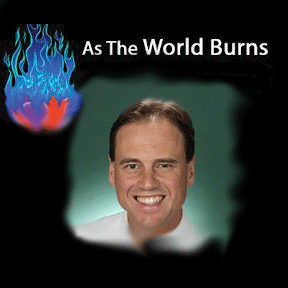 so much in public these days. Indeed, he has in environment minister Greg Hunt a man whose principal role seems to be Minister for Saying That The Coalition Really Takes Climate Change Seriously, despite its policies that suggest the opposite.
The budget handed down on Tuesday night by Treasurer Joe “I don’t like wind turbines” Hockey continues the recent trend of Coalition policy documents that sweeps the idea that Australia should be acting — urgently or otherwise — on climate action under the carpet.
As CSIRO and Bureau of Meteorology warn on extreme weather, Budget ignores climate change
 Budget 2015: An assault on Australia’s climate programs http://www.pressofatlanticcity.com/business/oyster-creek-nuclear-plant-offline-for-fifth-straight-day/article_bff63088-f7e9-11e4-98a9-1bde50cc13e9.html JOHN CONNOR LAST NIGHT’S BUDGET IGNORES THE GLOBAL REALITY THAT CLIMATE CHANGE IS HAPPENING AND OTHER COUNTRIES ARE MOVING TO ADDRESS IT. IT’S A LIABILITY FOR OUR FUTURE.
AS THE TREASURER was finalising his Budget speech yesterday, the World Bank released a report onDecarbonising Development: Three Steps to a Zero Carbon Future (pdf) and our announced that El Nino was back — a big problem for Australia as global warming puts our already extreme weather on steroids.
These are hardly ‘radical’ organisations. Yet the Treasurer’s speech made no mention of policies to modernise and decarbonise our economy. There was no mention of climate costs and the physical impacts of climate change that CSIRO has now repeatedly warned are happening now, and will only grow. The Treasurer did laud the truly awesome power of our fossil fuel exports — sufficient to power Mumbai, Tokyo and Singapore, apparently.
Last night’s budget highlights a number of problems with the government’s approach to climate and economic policy. Continue reading
Climate Council exposes Bjorn Lomborg’s climate fallacies
 The low down on Lomborg BY CLIMATE COUNCIL 13.05.2015 Last week’s announcement that the University of Western Australia would no longer house Bjorn Lomborg’s ‘Consensus Centre’ was a fantastic outcome for science. However, the fact that the Centre is still trying to establish itself in Australia is deeply troubling.
Misinformation is harmful. Just as false information about the ‘benefits’ of tobacco misled the public and damaged health, so false information about climate change and its impacts can mislead the public and decision-makers, delaying much needed action to stabilise the climate system. Here are the top four reasons why Lomborg’s arguments about climate change are flawed. Continue reading
Victoria wants its own renewable energy target, in light of Abbott govt’s anti climate policies
Victoria demands government let it establish its own renewable energy target, Guardian 14 May 15 State wants federal legislation changed to remove barriers to establishing schemes similar to the national RET Victoria has demanded the federal government allow it to establish its own system to drive uptake of renewable energy, following a year of national inertia in the clean energy industry.
The Victorian government wants federal legislation altered to remove barriers to states establishing schemes similar to the national renewable energy target (RET).
Victoria has criticised the federal government’s attempts to slash the RET, which requires that 41,000 gigawatt hours of Australia’s energy comes from renewable sources by 2020, for stymying jobs and investment.
Allowing a “top up” Victorian RET would allow projects in Ballarat, Ararat, Warrnambool and Port Fairy to go ahead, according to the state government. Victoria gave up its own renewables target in 2009 to join the national arrangement.
Victoria’s energy minister, Lily D’Ambrosio, said the government wanted a 2020 renewables target of “at least 20%”. Victoria currently derives 13% of its energy from clean sources.
“Tony Abbott has put a strong bipartisan position on the national RET into the dustbin,” D’Ambrosio told Guardian Australia. “We’ve said enough is enough, Tony Abbott needs to get out of the way and allow us to provide industry confidence and facilitate billions of dollars in investment.
“If the target was, for example, 20%, it would create 1,400 construction jobs in Victoria. There’s too much at stake here, too much at risk. We’ve already forgone too many dollars and jobs. We were elected to create jobs and this is one sure way, along with our other policies, to get action happening.”
D’Ambrosio said she’d be happy to talk to states such as New South Wales andSouth Australia that might be interested in their own schemes to overcome what she called the prime minister’s “stubbornness and ideological zeal” over renewables………
South Australia has a goal of a 50% renewables share by 2025, while the Australian Capital Territory wants 90% of electricity to come from clean sources by 2020. However, these are aspirational targets, whereas Victoria wants a binding system to ensure renewables uptake.
Under current laws, a corporation “need not comply with any law of a state” that is similar to the national RET. Victoria wants this stipulation scrapped………….http://www.theguardian.com/australia-news/2015/may/14/victoria-demands-government-let-it-establish-its-own-renewable-energy-target?utm_medium=twitter&utm_source=dlvr.it
Canadian nuclear manufacturer to make submission to #NuclearCommission SAust

The Australian pro nuclear Thorium lobby has asked the Canadian firm Terrestrial Energy to put in a Submission to the South Australian Nuclear Fuel Chain Royal Commission. This company is trying to market the Integral Molten Salt Reactor (IMSR).
Australians need to be aware of the agressive marketing methods of the purveyors of these new, untested highly expensive nuclear gimmicks.
One Western Australian speaks out against radioactive waste dumping
Ben 14 May 15 As a resident of the midwest and has lived and worked on and around the area of Badja Station, I am totally against this idea in our back yard.
I as a former employee, have contributed to the success of GML during the exploration stages of the Karrara mining operation.
Thanks to that I got to see and feel this country and now regret the destruction that has already occurred
So I as one individual totally reject GML nominating this area as a facility for radioactive waste storage which will inevitably lead to establishing a much larger facility to accommodate international nuclear waste for avery handsome $$ profit to those involved.
NO PANGEA HERE !!! Please.
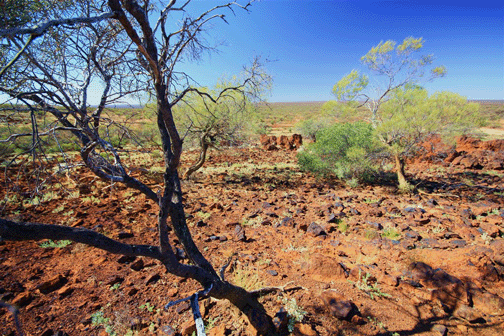
I hope and wish the Widi people are successful in their claim of native title of this area. It is beautiful country, surrounded by at least six vibrant, active towns / communities well within a 150km radius of the proposed radioactive waste dump as well as numerous exploration (because of the mineral wealth) and tourist activities in the area, not forgetting those living off and trying to protect this area
I object to, and will support anyone against, this proposal.
1 This month.
20 September –National Day of Action in Melbourne on the International Day of Peace


Help Aunty Sue Protect Her Land and Sacred Sites From Destructive Rocket Testing.
.

Australians deserve the truth
about
AUKUS – https://aukuspublicinquiry.com/
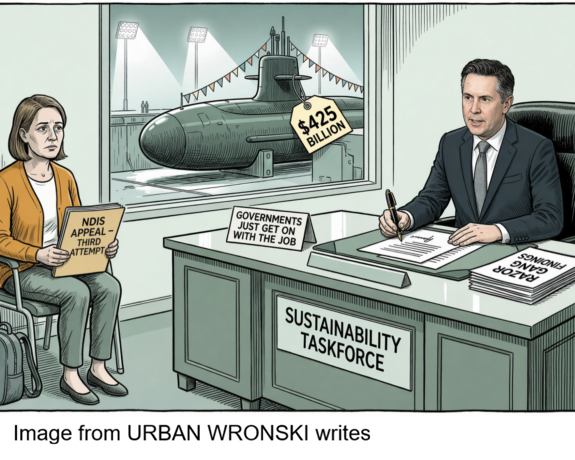

PETITION – To: Prime Minister Anthony Albanese and the Australian Labor Government

of the week – Australians for War Powers Reform (AWPR)
To see nuclear-related stories in greater depth and intensity
 Antinuclear