Crystal ball-gazing in South Australia’s Nuclear Commission ISSUES PAPER No. 3
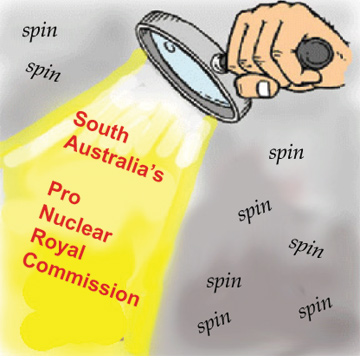 Dennis Matthews, 13 May 15 NUCLEAR FUEL CYCLE (sic) ROYAL COMMISSION ISSUES PAPER THREE
ELECTRICITY GENERATION FROM NUCLEAR FUELS
Once again we have an issues paper full of pro-nuclear conjecture and crystal ball-gazing with statements like “research has been undertaken”, “under development”, “are proposed”, “soon to demonstrate”, “could potentially”, “could, if commercialised”, “may be”,” might encourage” and “could have”. The history of the nuclear industry is a history of overstated optimism. Policy makers would do well to stick to the facts rather than optimistic forecasts from vested interests.
Ionising has been constantly dropped from “ionising radiation”, especially in the section on operational health and safety. At best this is sloppy science but given the history of the nuclear industry, it might well be considered mischievous.
The word “nuclear” is frequently dropped especially when talking about nuclear reactors. This demonstrates the sensitivity of the nuclear industry to its image. Ironically, the nuclear industry appears to be loathe to admit that it has anything to do with its own scientific and technical foundation. Continue reading
Issues Summary: SOUTH AUSTRALIA’S NUCLEAR FUEL CYCLE ROYAL COMMISSION
 SOUTH AUSTRALIA’S NUCLEAR FUEL CYCLE ROYAL COMMISSION ISSUES- SUMMARY -May 2015 Prepared on behalf of the Conservation Council SA by Dr Jim Green, Friends of the Earth, Melbourne. The Conservation Council of South Australia (Conservation SA) is the peak environment group in the state, representing around 50 non-profit environmental organisations.
Australian govt turns from Northern Territory in search for vulnerable communities to host nuclear wastes
Nuclear waste dump unlikely in NT after land councils, stations refuse to nominate site ABC News, 11 May 15, By Anthony Stewart The Northern Territory appears unlikely to house the Federal Government’s proposed radioactive waste dump after major land holders fail to nominate a site.
The Federal Government began a renewed searchfor a site to store Australia’s intermediate-level nuclear waste and dispose of low-level waste in March this year. A formal application process closed on the May 5.
The ABC confirmed the Northern Land Council, Central Land Council, and Northern Territory Government had not nominated any land. Gilnockie and Supplejack Downs Stations also decided against participating in the process.
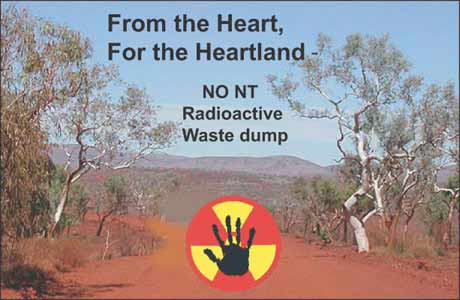
In a statement, the Federal Government refused to confirm whether any other organisation had nominated land.
“Details on nominations will be made public following the close of the nomination process and consideration by the Minister for Industry and Science. On current timeframes, this is expected in July 2015,” the statement read………
Anti-nuclear campaigner Lauren Mellor said it was the end of a long fight against nuclear waste in the Territory. “It’s very good news. We have spent the last decade with residents and traditional owners of the Northern Territory fighting a nuclear dump process,” she said. “The Federal Government has pulled out of the trenches in the Northern Territory.”
She said the fight had been pushed to other parts of Australia. “Unfortunately our concern is they will go and target another vulnerable community as they’ve done many times before to try and push them to house a national or even international dump,” Ms Mellor said.
Several organisations in both South Australia and the Western Australia have indicated they have nominated land under the process. http://www.abc.net.au/news/2015-05-11/nuclear-waste-dump-unlikely-in-nt/6461078
Iron ore miner in Western Australia applies to host low level nuclear waste facility
 Gindalbie applies to host nuclear waste facility in WA’s Mid West By Emily Piesse Iron ore miner Gindalbie Metals has confirmed it has nominated part of its land holding in WA’s Mid West as a potential site for a low level radioactive waste dump.
The site, on Badja Station in the Shire of Yalgoo, has been put forward by the company under a national tender process by the Federal Government. The nuclear waste facility, which would be a national repository for low level waste, would be the first of its kind in Australia.
Most low level waste is stored in hospitals, universities and other private facilities but this would act as a central storage centre.
The Shire of Leonora in WA’s Goldfields has also confirmed it has supported an application to have the nuclear waste dump on a pastoral station’s freehold land between Leonora and Malcolm.
A spokesperson for Gindalbie confirmed the miner had submitted Badja Station to be assessed, but said it was too early to comment as the Government was yet to finalise its shortlist of sites.
Badja Station is currently the subject of a native title claim by the Widi people.
Widi spokesperson Clayton Lewis said he had no prior knowledge of Gindalbie’s proposal.”It was a bolt out of the blue … [we’re] just amazed that it’s going to happen or potentially going to happen in our country,” he said.
“We think if we can get a decent body of support at this early stage we can certainly contest it.”
A spokesperson for federal Industry and Science Minister Ian Macfarlane would not confirm whether Badja Station was under consideration, but said initial site assessments had begun.
Under the selection process, states and territories will not have the right to veto the Government’s site selection.
A shortlist of nominated sites is expected to be made public in July.
World Bank warns Malawi not to re-open Paladin Australia’s uneconomic uranium mine
 Malawi warned against reopening uranium mine http://www.ventures-africa.com/archives/62631 May 12, 2015 – The World Bank has warned Malawi against reopening its only uranium mine, saying the project should be put on hold until global prices improve.
Australia mining company, Paladin Energy, is developing Malawi’s only uranium mine, the Kayelekera uranium mine, in Karonga, northern Malawi. The project was initial suspended in 2014 because of the then unfavourable price climate, but there are indications that the company plans to resume operations in the coming months. “Whether or not the mine at Kayelekera eventually resumes operations will depend primarily on future prospects for global uranium prices, for which the immediate outlook is uncertain,” the World Bank told Malawi in its latest report.Uranium from mining is used almost entirely as fuel for nuclear power plants.
In 2013, Malawi was ranked as the third largest producer of uranium in Africa and tenth in the world. It is behind Namibia and Niger in Africa.
Last year, uranium global prices crashed to $36, from $51 per pound. This posed a major setback to Paladin Energy Africa, having invested heavily on the premise that prices will climb to $70. The Kayelekera uranium deposit was discovered by UK’s CEGB firm and a feasibility study was subsequently undertaken in the 1980s. Paladin acquired the deposit in 1997, accepted a Bankable Feasibility Study early in 2007, and, following environmental approval, undertook a $220 million development. The mine was opened in April 2009.
Paladin Energy (Africa) Ltd holds Paladin’s 85 percent interest following the Development Agreement with the Government of Malawi in control of the remaining 15 percent. Kayelekera production commenced in mid-2009, and in 2012 production reached 1103 tU, followed by 1134 tU in 2013.
A “corrupt process” brought proposal for Bjørn Lomborg Consensus Centre
 Bjørn Lomborg centre earmarked for UWA in ‘corrupt process’, says Labor MP http://www.theguardian.com/australia-news/2015/may/12/bjrn-lomborg-centre-earmarked-for-uwa-in-corrupt-process-says-labor-mp
Alannah MacTiernan says proposal to fund centre at the University of Western Australia came ‘directly from the prime minister’s office’ A research centre linked to controversial Danish academic Bjørn Lomborg was earmarked for the University of Western Australia through a “corrupt” process initiated by the prime minister’s office, parliament has been told.
The university backed out of the proposal, which was to have been funded by the federal government, after protests by staff and students.The West Australian Labor MP Alannah MacTiernan said on Tuesday that science has been the big loser under the Abbott government.
She said it was curious that the government had found $4m for the Australian Consensus Centre, a think tank which had at its heart a commitment to cherry-pick the scientific evidence which argued against urgent action on climate change.
MacTiernan said the education minister Christopher Pyne says the decision to fund the centre at UWA followed a proposal put forward by the university and Lomborg, but vice-chancellor Paul Johnson said the proposal was not initiated by the university.
The proposal arose out of discussions between Lomborg and the government, MacTiernan said. “It seems the offer came directly from the prime minister’s office and came to UWA only after the Australian Catholic University had rejected it,” she said.
“Extraordinarily, this special research initiative didn’t come through the Australian Research Council or any peer review.” It was a “corrupt process”, she said.
Australian electricity utility Origin launches solar energy leasing programme
 Origin launches solar services program for homes, small business, REneweconomy, By Sophie Vorrath on 12 May 2015 Major Australian utility, Origin Energy, is set to launch a solar leasing program in three separate states, focusing on small-scale residential and commercial solar systems.
The move by Origin follows the launch, a week earlier, of the battery storage product from rival gentailer, AGL Energy – which was announced ahead of schedule, and to coincide with Tesla’s sensational energy storage reveal.
AGL’s first “proposition” – customers are being asked able to “register their interest” – will be a limited number of 6kWh batteries the size of a large suitcase, made to suit a family home with around 3-4.5kW of rooftop PV. And while this makes AGL Australia’s first energy retailer to stake a claim in the energy storage market, Origin says it will be the first to enter the roof-rental space, and says it hopes to expand its program into other cities.
The solar power purchase agreement market represents huge and largely untapped potential in Australia. Companies like SolarGen and SunEdison are already taking advantage – the soon to be launched 350kW PV system at Tyrrell’s Wines Hunter Valley vineyard, which we report on here, offers one of the nation’s first commercial examples.
Utilities, however, have been slower to get with the program………
Labor and business groups say No to reviews of Renewable Energy Target
Labor says no renewable energy deal if government keeps reviews SMH, May 12, 2015 Lisa Cox National political reporter The long-running saga of Australia’s renewable energy target has entered another round with Labor declaring there will be no deal if the government continues to review the scheme.
An eleventh hour government decision to retain two-yearly reviews has derailed a new bipartisan agreement that would have reduced the target from 41,000 gigawatt hours of renewable energy production by 2020 to 33,000.
 The move, believed to have been put forward by Industry Minister Ian Macfarlane, has prompted a furious reaction from the clean energy industry, which has demanded that the government stand by its promise to scrap two-yearly reviews.
The Clean Energy Council and a raft of energy companies have urged the government to scrap the reviews, while the Australian Chamber of Commerce has said there should be no further inquiries into the scheme until 2020.
The Labor caucus agreed early on Tuesday that a figure of 33,000 could form the basis of an agreement with the government but the opposition could not support a plan that included two-yearly reviews………http://www.smh.com.au/federal-politics/political-news/labor-says-no-renewable-energy-deal-if-government-keeps-reviews-20150512-ggzkns.html
Compelling case against the Trans-Pacific Partnership

 Sovereignty For International Investors (Trans-Pacific
  Partnership (TPP)) http://tm.durusau.net/ May 11th, 2015 Elizabeth Warren makes a compelling case against the Trans-Pacific Partnership in The Trans-Pacific Partnership clause everyone should oppose, where she says:…
ISDS [Investor-State Dispute Settlement] would allow foreign companies to challenge U.S. laws — and potentially to pick up huge payouts from taxpayers — without ever stepping foot in a U.S. court. Here’s how it would work. Imagine that the United States bans a toxic chemical that is often added to gasoline because of its health and environmental consequences. If a foreign company that makes the toxic chemical opposes the law, it would normally have to challenge it in a U.S. court. But with ISDS, the company could skip the U.S. courts and go before an international panel of arbitrators. If the company won, the ruling couldn’t be challenged in U.S. courts, and the arbitration panel could require American taxpayers to cough up millions — and even billions — of dollars in damages.
If that seems shocking, buckle your seat belt. ISDS could lead to gigantic fines, but it wouldn’t employ independent judges.Instead, highly paid corporate lawyers would go back and forth between representing corporations one day and sitting in judgment the next. Maybe that makes sense in an arbitration between two corporations, but not in cases between corporations and governments. If you’re a lawyer looking to maintain or attract high-paying corporate clients, how likely are you to rule against those corporations when it’s your turn in the judge’s seat? Continue reading
Electromagnetic radiation as a cause of brain cancer
Australian Researcher: Phone Radiation is a Hotline to Brain Cancer, Sputnik News, 12.05.2015 A highly respected Australian doctor, currently in remission from brain cancer, is speaking out on his belief that radiation from wifi, cell phones and their towers is a major factor in increasing brain cancer rates.

The Australian Mobile Telecommunications Association is denying any detrimental health effects from their radiation, but the World Health Organization has recently upgraded the radiation threat to category B2, meaning “possibly carcinogenic.”
“You can say you can’t prove it — in my mind it is proven looking at the studies that are unfunded by industry,” he said.
The largest study to take place so far was conducted among 5000 cancer patients. The study found that there was no increased risk of overall cancer, but cellphone use was linked to patients having a 40% increased likeliness of developing Glioma, a common type of brain cancer.
The Australian Mobile Telecommunications Association is denying any detrimental health effects from their radiation, but the World Health Organization has recently upgraded the radiation threat to category B2, meaning “possibly carcinogenic.”
“You can say you can’t prove it — in my mind it is proven looking at the studies that are unfunded by industry,” he said.
The largest study to take place so far was conducted among 5000 cancer patients. The study found that there was no increased risk of overall cancer, but cellphone use was linked to patients having a 40% increased likeliness of developing Glioma, a common type of brain cancer. http://sputniknews.com/science/20150512/1022019139.html#ixzz3ZxpkmsKt
Millions are being wasted on a commission dominated by pro-nuclear interests
Dennis Matthews 11 May 15 The energy and capital intensive, economically and environmentally disastrous, desalination plant fiasco (The Advertiser, 11/5/15) epitomises the mental bankruptcy of the South Australian Liberal-Labor duopoly.
Hard on the heels of the desalination disaster comes an equally desperate proposal by the Liberal-Labor duopoly – the expansion of the nuclear industry in South Australia. This capital intensive, environmentally and economically disastrous proposal comes at a time when South Australia could be capitalising on its natural advantage in renewable energy.
Millions are being wasted on a commission dominated by pro-nuclear interests whilst essential services such as regional hospitals are being closed thereby shifting health costs onto taxpayers in regional areas.
And amongst the ideas being discussed by the Scarce Commission is guess what – a nuclear powered desalination plant.
Talk about slow learners.
University of Western Australia praised for ditching Bjorn Lomborg Consensus Centre
 Students praise UWA for ditching controversial $4m Bjorn Lomborg Consensus Centre think tank ABC News 9 May 15 Students at the University of Western Australia (UWA) say the decision to can controversial Danish academic Bjorn Lomborg’s Australian Consensus Centre is a win for academic integrity and common sense.
The Australian Consensus Centre was going to be set up with the help of a $4 million Federal Government grant, but University Vice Chancellor Paul Johnson last night said the proposed centre was untenable and lacked academic support.
UWA student guild president Lizzy O’Shea said students were concerned about the impact the centre, inspired by self-proclaimed “sceptical environmentalist” Dr Lomborg, could have on the university’s reputation. “It’s a really good sign as far as community action goes that if enough people have mobilised against something, and don’t support it, that people will change their minds,” she said.
“The fact that we had international partners saying they wanted to pull out because of the association. So the reputational damage was probably the main complaint. Continue reading
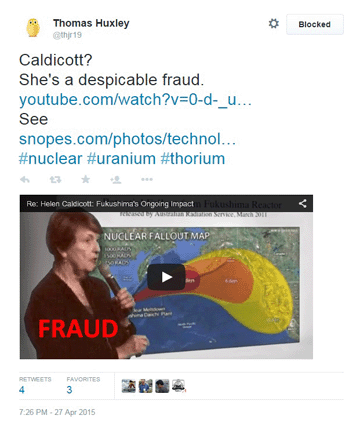
Social media used by activists AND by corporate nuclear shills
Govt secretive about 4 sites volunteered in South Australia for nuclear waste storage
 Remote sites in South Australia offered for nuclear dump , THE AUSTRALIAN, 9 May 15 Michael Owen Up to four sites in South Australia’s far north have been put forward as potential radioactive waste dumps.
The federal government, however, is officially remaining tight-lipped about the response to its call in March for voluntary site nominations for a national radioactive waste facility, which closed on Tuesday.Industry Minister Ian Macfarlane’s office refused yesterday to say how many nominations had been received or where they had originated.
“There won’t be details or a breakdown of nominated sites released at this early stage,” a spokeswoman said. “Information about shortlisted sites will be released after an initial assessment period and after consideration by the minister. That is expected to be completed around July.”
A preferred site is not expected to be identified until at least the middle of next year.
This week the government released a request for tender on Austender, seeking expressions of interest from “suitable companies to undertake the necessary site characterisation work”.
The request also seeks the successful tenderer to assist in the “development of a detailed business case which will inform the government’s decision as to whether to proceed with the project and its cost”.
Federal Liberal MP Rowan Ramsey said his vast electorate of Grey, in South Australia’s far north, was an ideal site for a radioactive waste dump as it was remote, sparsely populated and geologically stable. He said he had tried to nominate his own 2400ha farm, but was asked not to by Mr Macfarlane because of concerns of a potential conflict of interest.
“But as a consequence my understanding is there have been a number of other properties nominated in my community. I’ve encouraged people right across the board to nominate,” Mr Ramsey said. “I understand as many as four sites have been nominated in my electorate.”
The search for a site intensified last year after the federal government failed to convince a Northern Territory community to build a facility on its land.
This comes as South Australia’s royal commission into an expansion of the state’s role in the nuclear cycle picks up pace. Among other issues, the commission will examine whether to store international radioactive waste……..http://www.theaustralian.com.au/national-affairs/remote-sites-in-south-australia-offered-for-nuclear-dump/story-fn59niix-1227347545498
Abbott govt’s new Renewable Energy Target ensures uncertainty for renewables
 Government’s RET compromise guarantees uncertainty for renewables, Michelle Grattan, The Conversation 8 May 15 As the Abbott government prepares Australia’s post-2020 emissions targets for this year’s Paris conference, the chairman of the Prime Minister’s business advisory council has make an extraordinary intervention in the climate debate.
Maurice Newman, writing in the Australian, maintains it’s all a United Nations conspiracy – a power  grab of massive proportions.“This is not about facts or logic. It’s about a new world order under the control of the UN. It is opposed to capitalism and freedom and has made environmental catastrophism a household topic to achieve its objective.” Newman claims that 95% of the climate models that we’re told prove the link between human emissions and global warming “have been found … to be in error”.
In his article he targets Christiana Figueres, the executive secretary of the UN’s Framework on Climate Change, who has been visiting Australia. Newman writes that “there is a real chance Figueres and those who share her centralised power ambitions will succeed.
“As the UN’s December climate change conference in Paris approaches, Australia will be pressed to sign even more futile job-destroying climate change treaties.”………….. Continue reading
1 This month
17 October, Free Public Talk on Nuclear Issues in South Australia
David Noonan will speak on public interest concerns over the new Roxby Downs Indenture Act 2026 on BHP copper-uranium mining and ore processing in SA, and on how AUKUS may face SA with a High-Level nuclear waste agenda.
Dr Jim Green will discuss international developments in the field of nuclear power including ‘small modular reactors’ and Generation 4 ‘advanced’ nuclear reactor concepts.


Help Aunty Sue Protect Her Land and Sacred Sites From Destructive Rocket Testing.
.

Australians deserve the truth
about
AUKUS – https://aukuspublicinquiry.com/

PETITION – To: Prime Minister Anthony Albanese and the Australian Labor Government

of the week – Australians for War Powers Reform (AWPR)
To see nuclear-related stories in greater depth and intensity


