Groups join together to sign WA Nuclear Free Charter against uranium mining
Neil Watkinson & Stuart McKinnon, Kalgoorlie Miner, Thu, 11 August 2022
Nineteen groups representing thousands of West Australians have signed a joint statement against uranium mining in WA.
Their pledge comes as a $658 million merger of uranium mining companies Deep Yellow and Vimy Resources was confirmed this month, alongside plans to advance their $393m Mulga Rock project 290km east-north-east of Kalgoorlie-Boulder.
The groups — which include trade unions, faith groups and conservation organisations — have expressed their support for the WA Nuclear Free Charter which calls on the WA Government to remove any outstanding approvals for uranium mining at four sites across the State.
Three of the four sites — Kintyre, Yeelirrie and Wiluna — have missed development deadlines for approvals, but Mulga Rock remains active after Vimy achieved “substantial commencement” from the the State Government in December.
The price for uranium fell into the doldrums following the 2011 Fukushima nuclear accident in Japan, but the industry has been making much noise recently about a brighter future.
……………………….. Deep Yellow plans to revise and update a definitive feasibility study for Mulga Rock to include a base metals component, which was a condition of its original approval to develop the project.
The company also hopes to complete a definitive feasibility study for the company’s other project, Tumas in Namibia, by the end of the year.
Mulga Rock is expected to deliver 3.5 million pounds of uranium oxide per annum while Tumas is slated to produce 3Mlb a year.
But anti-uranium mining groups are marshalling themselves to continue fighting against the Mulga Rock project.
Signatories to the WA Nuclear Free Charter include UnionsWA and the WA branches of the Australian Manufacturers Workers Union, Electrical Trades Union, United Workers Union, State School Teachers Union, United Professional Firefighters Union and the Construction, Forestry, Mining and Energy Union, along with faith, health, and national and state environment organisations.
The charter describes uranium mining as “unwanted”, “uneconomic” and a “damaging and underperforming sector that unnecessarily risks our unique environment”.
Mia Pepper from the Conservation Council of WA — one of the many conservation groups to have endorsed the charter — urged the State Government to withdraw “expired and deficient” approvals for the four uranium mine proposals in WA.
“Consistently, the people of WA have said that they do not want uranium mining in their State,” she said.
“The current government, like many Labor governments before them, hold a strong clear position opposed to uranium mining because it puts workers, communities and the environment under threat.
“Now is the time to create lasting protections against uranium mining in WA by withdrawing outdated and deficient approvals.
“Uranium mining is different. It is radioactive, leaving behind long-lasting wastes which pose an ongoing threat to public health and the environment.
“No uranium mine in Australia has ever been successfully and completely rehabilitated.
“The Ranger uranium mine in the NT is undergoing a $2.2 billion clean-up, fortunately by a company with the money and resources to do so.
“In WA the one advancing uranium project — Mulga Rock — is being pushed by Deep Yellow . . . and we have no confidence they can do what bigger better resourced companies are failing to do.
“This government knows the risks, the costs and the legacy of this toxic trade which is why they have a strong anti-uranium policy.
“Along with unions, health, faith and environment groups we’re calling on the government to act now to put an end to uranium mining in WA.” https://www.kalminer.com.au/news/kalgoorlie-miner/groups-join-together-to-sign-wa-nuclear-free-charter-against-uranium-mining-c-7798925
The United States, in decline but still able to kill us all.
The march of folly in American strategic policy has enshrined the madness of control by a giant defence industry and defence budget now past $800 billion.
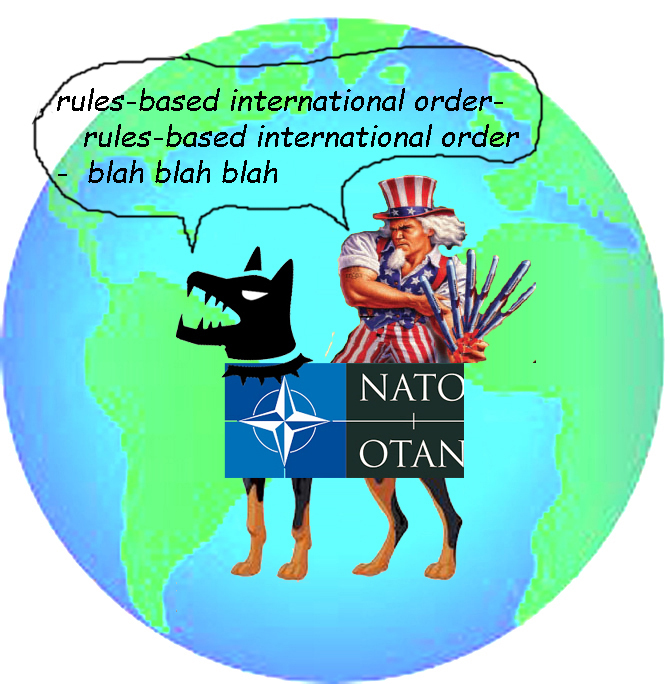
The fiercely presented wearisome trope of commitment to a Rules Based International Order is quite suddenly unmasked as an American Establishment desire to maintain a unipolar control of the world, with violence.
The fiercely presented wearisome trope of commitment to a Rules Based International Order is quite suddenly unmasked as an American Establishment desire to maintain a unipolar control of the world, with violence.
The global dominance of the United States, in so many fields, from space, to science, to entertainment, to sport, to novelty in the development of the English language, has been taken for granted, is part of our fabric of Australian existence.
Reinforced by the Covid Era of Isolation, Netflix, Facebook, and Computer Games and inability even to get to Bali or Thailand let alone China, we are now in a noisy metal barrel where even dissident voices seem projections from the dissident voices of the US, similarly muted and squeezed. At a time when the US and its roles in the world are suddenly dramatically changing.
The undoing of the United States, the collapse of the imperial centre, is happening with little awareness in Australia. Our generally oblivious mindframes affect the capacity of political leaders to reflect upon or point to core problems of our world. Richard Adams, the author of Watership Down, that great rabbit adventure full of meaning for human society, coined the rabbit language word ‘tharn’ for the mental state of rabbits caught in the headlights and stuck. We are a tharn nation, gabbling about entertainments and irritations, eyes glued to the seatback monitor, not wanting to know that the plane is crashing.
Heed these markers:
- The Americans were first to the moon, but NASA after the retirement of the space shuttle has depended on Russian rockets to get to their joint space station. The Russians are now planning to remove the propulsion units of the station which keep it from crashing, their property, for use on a bigger new venture. America is losing in space, though US private business has appallingly taken the lead in cluttering near space with junk.
- The fiercely presented wearisome trope of commitment to a Rules Based International Order is quite suddenly unmasked as an American Establishment desire to maintain a unipolar control of the world, with violence. This is being unmasked in much of the world if not NATO and AUKUS and the conservative acolytes in Japan and ROK. Ideological assertions of democracy versus autocracy, built by vilification and isolation of China and Russia, is rotting from the head as big democracies are in serious trouble.
- We are doing OK in Australia, our minds from age 12 filled with bubblegum flavoured vape and Tiktok, graduating to Facebook and the metaverse, and with a newer, kinder, kinda-tealish government we can all go to sleep, take off our masks and order American franchised fast food. Or real Aussie drinks. But while we have had a narrow focus on bad boys in the SAS we fail to review our complicity in the great crimes of the twenty first century, led by champions of democracy, smashing the lives of people in a number of countries far more violently than has the Ukraine war so far. Biden and his Secretary of State were advocates for invasions of Afghanistan and Iraq, so appallingly bringing down bad governments and making countries ungovernable. Creating Al Qaeda and ISIS in the process, directly through funding and arming extremists (in Afghanistan beginning before the Russians were invited into Afghanistan) and via embitterment of ordinary people. The world is destabilised, American control is widely undone.
- The march of folly in American strategic policy has enshrined the madness of control by a giant defence industry and defence budget now past $800 billion. Poverty of foreign policy has led to regimes of sanctions which have been substantially shaped by Richard Nephew whose book reveals that far from focusing on potentates and oligarchs, the targets of sanctions must be ordinary people and the purpose is to inflict pain and weaken resolve (his words). Consider sanctions related deaths in Iraq Venezuela Cuba, Afghanistan Pain but no loss of resolve, hatred not submission. The US official study of the effects of strategic bombing on Germany in World War II by J K Galbraith and others long ago suggested morale and resolve were increased by the bombing of cities and civilians. And yet we have the ongoing commitment to defend and achieve democracy by mass murder, with constant focus on disruption, regime change, and violence… not on peace.
- Jeffrey Sachs has recently returned to the themes of his 2013 book on the 50th anniversary of President John Kennedy’s Commencement Speech at American University in 1963. Speaking in the aftermath of the Cuban Missile Crisis, Kennedy spoke of peace not as an event or a state but a constant process of engagement. We now have no such thing, we are in an Age of Hostility, Meanness, Folly, and Decay.right wing is fervently in support. Stanley Kubrick made a movie about such madness, we are sleeping through it.
Australia recognises, as does the United States, that Taiwan is part of China. Though the media vague up the history, China kicked the Portuguese and Dutch out of Taiwan early in the 1600s, long before the greatest land grab in history, of Britain over the Australian continent, could even be imagined as the British didn’t know it was there then. The government in Taipei is the Government of the Republic of China. The large opposition party in the National Assembly is the Kuomintang, ruling party of the government of the Republic of China that lost the revolutionary war on the mainland in 1949 and retreated to Taiwan. The ROC held the China seat in the UN until 1971 with American backing. The majority of local governments in Taiwan are governed by the KMT because the party of the national government is on the nose both because of its independence-advocating foreign policy and corruption allegations. Pelosi’s visit risks great power war as not seen since 1945. The American right wing is fervently in support. Stanley Kubrick made a movie about such madness, we are sleeping through it.
The US economy is in serious trouble………………………………….
The US campaign for unipolar dominance has included partly fabricated propaganda against China and Russia. This no longer convinces or concerns a wide sweep of the world beyond NATO, the G7, the EU and AUKUS. Mix in enough lies and it all seems lies.
The summit meeting of BRICS in June seemed a more constructive meeting than the G7. The countries of Eurasia also have the Shanghai Cooperation Organisation SCO. The Iran,Russia, Turkey summit meeting in Tehran in July 2022 seems to have been more successful than President Biden’s visit to Saudi Arabia to meet also other Arab leaders, a visit described by the Wall Street Journal as worse than an embarrassment,…………………………..more https://johnmenadue.com/the-united-states-in-decline-but-still-able-to-kill-us-all/
Bob Carr puts Peter Dutton on the spot -calls for detail on Dutton’s plans for nuclear power in Australia
Bob Carr on the Opposition flagging nuclear, https://www.2gb.com/podcast/bob-carr-on-the-opposition-flagging-nuclear/ 9 August 22,
Michael speaks with Bob Carr, Former Premier of NSW & Former Australian Foreign Minister, who over the years has been a proponent of nuclear power, though becoming more circumspect with time.
Mr Carr writes, “Any opposition leader is under pressure to espouse fresh ideas and launch out in new directions. In this spirit Peter Dutton says the Coalition is open to nuclear power. He signalled an internal party review but took the opportunity to rehearse the somewhat dusty arguments about nuclear being cheap and reliable.”
“But Dutton in the next three months has the chance to prove this time Australian conservatives are serious. He can pitch it direct to 4.5 million voters in the November 26 Victorian elections. He can show this is more than a lazy “thought experiment” and invest it with hard-edge credibility.”
Taiwan not worth a mushroom cloud
Many talk about “national interest”; the need for security; and standing up for principles. But with Taiwan the choice may be more stark: allow the Chinese Communist Party to take it over or engage in a nuclear war.
Principles are meaningless amid nuclear devastation, and so is national interest and security.
http://www.crispinhull.com.au/2022/08/08/taiwan-not-worth-a-mushroom-cloud/?utm_source=mailpoet&utm_medium=email&utm_campaign=crispin-hull-column Crispin Hull 8 Aug 22,
The odd thing about the visit by the Speaker of the US House of Representatives to Taiwan was that it was done by a woman, Nancy Pelosi. Usually, women in government tend to be the negotiators and compromisers, not the aggressors and agitators.
Why not just leave well alone?
Why create for future schoolchildren (if there are any survivors) one of the “Ten Causes of the Third World War”: Pelosi’s visit to Taiwan. Just as we learned that the 10 causes of World War I and World War II included equally trivial misjudgments.
And, take note, as far as the Chinese leadership is concerned, Pelosi is not a legislator, separate from the executive government, making a visit off her own bat, because they could not conceive of such a thing. For them, she is part of the US Government. So, to them, the trip was a deliberate provocation.
The other puzzling thing about Taiwan is the way the US, on the one hand, talks the talk of defending democratic Taiwan against the bully China, but on the other hand officially accepts that Taiwan is part of China.
The US did that on January 1, 1979, when it recognised the People’s Republic of China and established diplomatic relations with it as “the sole legitimate government of China”. On the same day, the United States withdrew its recognition of, and terminated diplomatic relations with, the Republic of China (Taiwan) as the government of China.
In 1979, of course, Taiwan was not a democracy so it did not really matter in principle which of the two autocracies was the “sole legitimate government of China”. At the time, the US “national interest” suggested that the trade opportunities with mainland China were too good and democracy was not being undermined by the de-recognition of semi-autocratic Taiwan.
After Taiwan evolved into a democracy in 1996 with the first free, open, and fair election for the presidency, the US had a “whoops” moment, followed by nearly three decades of juggling three balls in the air: the principle of supporting democracy; supporting US national trade interests; and opposing ever-growing Chinese influence.
The three are hopelessly incompatible, even as the first and the third become ever more urgent. The solution for the US could have been dreamt up by the Chinese communists themselves: “deliberate ambiguity”.
The US should go back to that. More importantly, Australia should go back there, irrespective of what the US does. The west should play the long game with China and wait for it to go the way of the Soviet Union caused as the economic cost of not playing by the rules results in unsustainable pressure on the regime.
Already China is paying a penalty for its trade trashing of Australia. Australia has now found other markets. China has come back cap in hand for some of those goods and Australia has said, “No thanks, you are too unreliable because you do not follow the rules and legal principle.”
In any event, we should not, in the perspicacious words of defence expert Hugh White, “sleepwalk into war”.
If democratic Taiwan is so important to defend, why doesn’t the US officially recognise it as a nation? And if it does not recognise Taiwan as an independent democratic nation, why threaten military action if the central government of the nation that the US does recognise as exercising sovereignty over Taiwan sends in its army and police forces to physically exercise that sovereignty?
Not being a democracy is not a cause for war, nor is the overthrow of democracy in one part of a country a cause for war. If they were, the world would be in a constant state of war.
Pelosi’s visit coincided with the Rim of the Pacific naval exercise (RIMPAC), but to Chinese Communist Party chiefs it was not a coincidence.
Twenty-six nations, 38 surface ships, four submarines, nine national land forces, 170 aircraft and 25,000 military personnel took part.
From a Chinese perspective this is a tad threatening. To us it is benign. To Taiwan and Australia firing rockets over Taiwan and the seas around it is a tad threatening, To the Chinese it is a benign military exercise in its own back yard
Of course, China is jealous as well as threatened by RIMPAC. China has no friends, just nations it bribes or debt-burdens into military co-operation.
But the danger point comes when the US goes beyond seeking voluntary co-operation with allies and friends and aims for full military integration and interoperability.
The trouble here is that the US military exerts influence verging on control over the US Government. Its top military officer has a seat on the National Security Council (not just an advisory role). Both General Douglas MacArthur (Korea) and General Curtis Le May (Cuba) urged the use of nuclear weapons.
Mercifully, Presidents Truman and Kennedy stood up to them, but Biden is no Truman or Kennedy. Moreover, a change in Administration usually means little change in the military-industrial complex’s way of doing things.
In Australia, a change of Government has also meant very little change to the lock-step American Alliance – until now.
The new Defence Minister, Richard Marles, has ordered a Defence Forces Review. Maybe it will start questioning the pattern of blindly joining every major US military folly (Vietnam, Afghanistan and Iraq, for example), irrespective of whether it has anything to do with us.
Many talk about “national interest”; the need for security; and standing up for principles. But with Taiwan the choice may be more stark: allow the Chinese Communist Party to take it over or engage in a nuclear war.
Principles are meaningless amid nuclear devastation, and so is national interest and security.
It is unfortunate that 23 million people would go under the Chinese Communist jackboot, but that is better than going under a nuclear mushroom.
We allowed them to imprison, murder, and torture the Uyghurs and Tibetans and did nothing. What is the difference with Taiwan? Maybe it is just a good case to bolster a profitable arms race.
Regional security threat haunts nuclear power debate
we cannot ignore when weighing up these arguments that recent events at Zaporizhzhia help bolster the case against nuclear power. We would not want any future nuclear facilities to become hostage to the vagaries of war.
https://www.theage.com.au/national/regional-security-threat-haunts-nuclear-power-debate-20220808-p5b82t.html Editorial, August 8, 2022, The alarm sounded by the head of the International Atomic Energy Agency (IAEA), Rafael Mariano Grossi, that fighting between Russian invaders and Ukrainian forces near the Zaporizhzhia nuclear power plant carried “the very real risk of a nuclear disaster” is one with relevance far beyond the war raging within Ukraine’s borders.
The conflict has already served as a grim warning for powers such as Germany and the United States of the costs of relying on fossil fuel-producing nations with despotic leaders for energy supply. But Russia’s seizures of Zaporizhzhia and the defunct power plant at Chernobyl in the early days of the war – though Chernobyl later returned to Ukrainian control – have highlighted that a decision to increase reliance on nuclear power would carry risks even beyond the familiar ones.
As Industry and Science Minister Ed Husic pointed out during Grossi’s recent visit to this country, Australia has an exemplary record on nuclear safety. But one of the most important reasons for this is that we have a ban on using nuclear fission for power generation and have committed not to develop a nuclear arsenal under the Non-Proliferation Treaty (NPT).
In recent times both these bans have returned to the spotlight, as the Coalition in opposition has raised the possibility of domestic nuclear power plants to address our energy needs. This followed the Morrison government’s signing of the AUKUS deal with London and Washington last year. The deal envisions Royal Australian Navy submarines being fuelled with weapons-grade uranium.
Peter Hartcher reported for The Agethat the first question US President Joe Biden raised when the AUKUS proposal was put to him was whether it breached non-proliferation commitments. The key to addressing this question has been paragraph 14 of the IAEA’s safeguards agreement with Australia, which creates a loophole allowing weapons-grade material to be used without the usual safeguards in “non-proscribed military activity”. Concerns were raised earlier this month, at the latest meeting to review the treaty, that regardless of Australia’s good intentions, this would set a precedent for further transfers of highly enriched nuclear material to other nations.
Grossi has pointed out that Iran, which first informed the IAEA of its interest in naval nuclear propulsion in 2018, cited the AUKUS deal to argue for its own plans at meetings in 2021.
Some argue that this is a form of proliferation, and even our allies and neighbours, from New Zealand to Indonesia, have expressed strong reservations about the AUKUS arrangement. Australia has said that the nuclear material in its submarines will be handled only by existing nuclear states. Nevertheless, the deal could lead to a perception that nuclear “haves” will simply ignore “have-nots”.
The case for nuclear power more broadly – replacing coal and gas with another non-renewable resource in uranium – faces its own hurdles, from the cost, to the emissions involved in mining and waste management to the question of where highly radioactive waste might be stored.
As The Age has pointed out, nuclear power generation globally is declining. One major reason is the expense. A recent CSIRO report underlines that renewables are far cheaper, even after transmission and storage are taken into account.
All sides of politics agree that Australia faces an increasingly complex and challenging security environment, from talk of Chinese bases in Cambodia and Solomon Islands to cyberattacks by rogue international actors targeting key infrastructure, while general-turned-Coalition senator Jim Molan has outlined an even more apocalyptic scenario, a “second Pearl Harbour” aimed at establishing Chinese supremacy in the western Pacific.
The Age has agreed in the past that Australia should be prepared to have another look at the arguments for nuclear power. That remains our position. But we cannot ignore when weighing up these arguments that recent events at Zaporizhzhia help bolster the case against it. We would not want any future nuclear facilities to become hostage to the vagaries of war.
Hiroshima Day protests call on Albanese government to scrap AUKUS, nuclear subs
https://www.greenleft.org.au/content/photos-hiroshima-day-protests-call-albanese-government-scrap-aukus-nuclear-subs Kerry Smith, August 8, 2022,
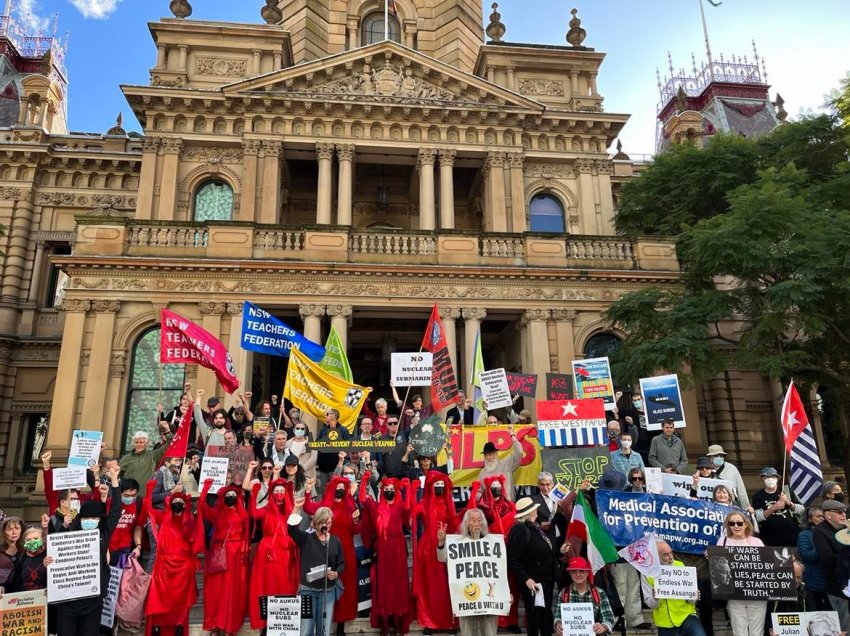
The 77th anniversary of the United States’ atomic bombing of Hiroshima and Nagasaki in Japan on August 6 was marked by gatherings around the country calling on the federal Labor government to sign the Treaty on the Prohibition of Nuclear Weapons, to scrap AUKUS and the nuclear submarines and to bring Julian Assange home.
The Sydney rally was organised by the Hiroshima Day Committee.
Several speakers said the enduring and horrific damage of nuclear weapons should be enough to prevent their proliferation. But the integration of nuclear arsenals into militaries has raised the threat of conventional conflicts turning nuclear.
Gem Romuld from International Campaign to Abolish Nuclear Weapons said the growing number of countries signing on to the Treaty on the Prohibition of Nuclear Weapons represented a “new benchmark”.
Greens Senator David Shoebridge said if Labor did not sign on by the end of the year, the Greens will move a motion that it does.
Nick Dean, representing the Sydney Anti-AUKUS Coalition, said the nuclear submarine deal must be axed and the billions reallocated to environment and social needs.
AUKUS is a threat to the Nuclear Non-Proliferation Treaty because for Australia to operate nuclear-powered submarines, it will have to become the first non-nuclear weapons state to exercise a loophole that would allow it to remove nuclear material from the inspection system of the International Atomic Energy Agency.
This will set a dangerous precedent allowing would-be proliferators to use naval reactor programs as cover for the development of nuclear weapons — with the expectation that, because of the Australia precedent, they would not face repercussions for doing so.
The Maritime Union of Australia, NSW Teachers Federation, the Red Rebels and campaigners for Julian Assange’s release lent their support.
Reverend Ray Minniecon acknowledged country, after several anti-war songs by singer-songwriters Patrick Harte, Margaret Walker, Jude, Chris Maltby and Antoinette.
At a gathering in Armidale protesters also called for freedom for Julian Assange who is being persecuted and tortured because he helped expose recent US war crimes. “What these acts of the US Empire have in common is that they were or are intended as a warning to others. It’s time to ban nuclear weapons, reject nuclear-powered submarines, jail the war criminals and free Julian Assange,” Bea Bleile said.
Australian Prime Minister Albanese refuses to meet with Assange’s family
The claim that Australia cannot intervene in the legal case is being advanced by Labor MPs across the board, including those who previously postured as defenders of the WikiLeaks founder.
https://www.wsws.org/en/articles/2022/08/06/rbnb-a06.html Oscar Grenfell@Oscar_Grenfell5 6August 2022 In a revealing development last Wednesday, Prime Minister Anthony Albanese refused to meet with the family of incarcerated WikiLeaks publisher Julian Assange when they visited the Australian federal parliament in Canberra.
Assange’s father John Shipton and his brother Gabriel Shipton met with Independent and Greens MPs, but were reportedly unable to secure meetings with Albanese, Foreign Minister Penny Wong or Attorney-General Mark Dreyfus.
The snub expresses, again, the real attitude of the Labor government to Assange, Australia’s most famous political prisoner. In line with its commitment to US-led militarism, including the confrontations with Russia and China, Labor is intensely hostile to Assange because of his exposure of US-led war crimes in Iraq and Afghanistan.
While making highly ambiguous statements about the Assange case having “dragged on too long,” the Labor administration has refused to use its diplomatic and legal powers to secure his freedom since it was installed after the May 21 election.
This amounts to a green light for Assange’s extradition from Britain to the US, where he faces Espionage Act charges and 175 years in prison for publishing true information about the illegal wars and global diplomatic conspiracies of American imperialism.
In comments to the Guardian after their visit, both Shiptons condemned the Labor government’s failure to defend Assange and demanded that it immediately intervene.
Gabriel Shipton recalled one of the few occasions on which Albanese explicitly referenced the WikiLeaks founder. Asked about the Assange case last December, Albanese purportedly told a shadow cabinet meeting, “enough is enough”—a refrain cited publicly by several Labor MPs.
But Shipton noted: “It is months ago now that he said this stuff and made the statement that enough is enough, but when is enough, enough? Julian’s still in prison. He’s been there for three years and he is not a convicted criminal.”
Shipton added: “They could pick up the phone and call Joe Biden and make it a non-negotiable. We are strategically vital to the US at the moment, they need our resources, if it was made a non-negotiable, Julian would be here tomorrow.”
The Labor government, however, is serving as the closest of partners with the Biden administration. Albanese and Wong have met repeatedly with the US president. The primary focus of their first months in office has been on foreign policy.
Labor has functioned as an attack dog for the Biden administration throughout the Asia-Pacific, with Wong continuously traveling the region to demand that its leaders sign up unequivocally to the US-led aggression against China.
Shipton pointed to the obvious hypocrisy at the heart of Labor’s refusal to defend a persecuted citizen and journalist. “We’re dealing with this prosecution or persecution that in any normal circumstance would be seen as totally illegal, and if it was Iran doing it to somebody, or China, or Vietnam, the government would be calling them out,” he said.
Shipton continued: “It is not just about Julian’s life and his wellbeing, it is a matter of principle, and if Australia wants to be the sort of country that calls out nations on their press freedom record, they could definitely be more vocal.”
John Shipton commented on a recent Declassified Australia article. It cited internal briefings to the Labor government, indicating that the sole focus of Labor’s “diplomacy” in the Assange case, was to consider a possible prison transfer from the US to Australia.
This would only be an option after Assange had been extradited and convicted on frame-up charges in a US court, a process that could take years or decades. It would, moreover, be entirely conditional on the agreement of the US government.
John Shipton said this scenario was “grotesque.” He pointed to the spate of extraordinary abuses carried out as part of the US pursuit of Assange. They have included the theft of Assange’s legal documents, unlawful spying on him and discussions within the Trump administration and the American Central Intelligence Agency in 2017 on kidnapping or assassinating him in London.
For Labor to refuse to intervene until after Assange’s extradition was “the most feasible way for them to continue to sit on their hands and do nothing.”
Such a course of action would also amount to a death sentence. Assange’s psychologists and doctors have testified, under oath, that he would take his life were he to face imminent dispatch to his US persecutors. In addition, the WikiLeaks publisher’s physical health is failing, expressed most sharply in a minor stroke last October.
On the same day the Shiptons visited parliament, Greens Senator David Shoebridge noted in question time that Labor MPs had claimed the government was engaged in “quiet diplomacy” on Assange’s behalf. “Quiet diplomacy can’t be no diplomacy,” Shoebridge stated, before asking: “What exactly is the government doing to secure the release of this Australian citizen, journalist and whistleblower?”
In reply, Trade Minister Don Farrell stated again that the case had “gone on for too long” and should be “brought to a close,” without giving any indication of how this would take place.
Farrell said Australia was not a party to the extradition case, which was between Britain and the US, and “respected” the legal processes of both parties. This line replicates that of the previous Liberal-National Coalition government. It amounts to a green light for the extradition and a declaration that Labor will do nothing.
Assange’s extradition hearings are not a routine “legal matter” but a monstrous frame-up. They involve the persecution of an Australian journalist for his publishing activities. This is a frontal assault on the most fundamental democratic norms, including press freedom.
In numbers of cases, Australian governments have actively used their diplomatic and legal powers to secure the freedom of citizens persecuted abroad, even when such attacks have taken a pseudo-legal form.
This was the case with Peter Greste, a journalist freed from an Egyptian prison in 2015, after being framed-up on “national security” charges. The same occurred with James Ricketson, a documentary filmmaker who had phony “espionage” charges leveled against him in Cambodia, and Kylie Moore-Gilbert, an academic who was accused by Iran of being a spy.
The claim that Australia cannot intervene in the legal case is being advanced by Labor MPs across the board, including those who previously postured as defenders of the WikiLeaks founder.
It was repeated in a recent Consortium News interview by Labor backbencher Julian Hill. He insisted there were “limits to what we can do because Australia and the Australian government are not parties to the case, that’s just a fact.” Hill also defended Albanese’s supposed “quiet diplomacy.”
Hill has changed his tune since Labor took office. In August 2020, for instance, he stated: “The UK claims to be a rule of law country guaranteeing a fair trial, open justice and due process. What a joke!… The persecution and treatment of Julian Assange are unconscionable. This is inherently political and our government is too cowardly to defend him, to even demand that he gets a fair trial.”
Hill could now say the same about Albanese, the Labor government and himself.
For their part, the Greens posture as defenders of Assange. But they have rejected calls for a party campaign fighting for his freedom and buried the WikiLeaks publisher’s plight during the election.
The Greens’ entire orientation is to deepen their collaboration with the Labor government, expressed last week in their backing for Albanese’s climate bill, which will do nothing to address global warming and is premised on defending the interests of the coal and gas barons.
As the Socialist Equality Party has insisted, the fight for Assange’s freedom requires a struggle against the entire political establishment, and its program of war and authoritarianism. This must be based on mobilising the Australian and international working class, the constituency for a genuine fight against capitalist reaction and in defence of democratic rights.
Australian War Memorial needs to own Australian frontier wars
Pearls and Irritations, By David Stephens Aug 7, 2022 Proper recognition and commemoration of the Australian Frontier Wars at the Australian War Memorial would be a practical expression of the Spirit of Uluru. As the Albanese government begins the lengthy process of enshrining the Voice in the Australian Constitution, having the Memorial commit to Australian Frontier Wars recognition and commemoration could happen soon – provided the will exists in both the Memorial and the government.
…………………………………… What is needed?
First, the Memorial should have an Australian Frontier Wars Gallery as part of the 2.5 hectares of additional space being built in the current extensions project. Professor Henry Reynolds has described the Frontier Wars as Australia’s most important war. The Frontier Wars deserve equal status at the Memorial with the First and Second World Wars, which each have designated galleries. The extensions should never have proceeded but, now that they seem inevitable, reserving space in them for an Australian Frontier Wars Gallery would reduce the area available for a military Disneyland full of Large Technology Objects and machines that go ‘bang!’
Secondly, the Memorial needs to add a prominent panel to its Roll of Honour to commemorate the dead of the Frontier Wars, both First Nations and non-First Nations. It will be impossible to include individual First Nations names, beyond perhaps those of leaders like Jandamarra, Pemulwuy, and Tongerlongeter – that White Australians do not know the names is poignantly significant – but the depth of the commitment of these First Nations warriors (and the suffering of their families, who often died with them) should be recorded in words like those used elsewhere in the Memorial. Lest We Forget.
Thirdly, the words ‘Australian Frontier Wars’ should be carved into the walls of the Memorial surrounding the Pool of Reflection. These words would stand alongside places like Gallipoli, Palestine, France, North Africa, Korea, Vietnam, and Afghanistan, but would go first, reflecting the fact that the Frontier Wars were our first wars, without which Australia would not be what it is today.
These forms of recognition and commemoration are much more decisive and less devious than what the Memorial has done previously: finding and publicising examples of Indigenous men and women who have worn the King’s/Queen’s uniform since 1901; buying and commissioning expensive paintings of massacres of First Nations people; a John Schumann ballad; a sculpture in the grounds; the special exhibition For Country, For Nation……………………………………….
Three options
How would these changes at the Memorial be made? There are three options, not mutually exclusive……………………………
Whichever option or options are used, we need, on the government side, courage to pull aside the ‘Anzac cloak’ that has for so long protected the Memorial from proper accountability and full responsiveness to modern Australia. On the Memorial side, we need willingness to make the place less a military mausoleum and trophy house – run mostly by white blokes with a military background and catering primarily for uniformed service people (particularly recent ones) – and more the possession of all Australians, First Nations and non-First Nations.
David Stephens is editor of the Honest History website (honesthistory.net.au) and joint editor with Alison Broinowski of The Honest History Book (2017). He has been convener of the Heritage Guardians group campaigning against the $548m extensions to the Australian War Memorial. https://johnmenadue.com/australian-war-memorial-needs-to-own-australian-frontier-wars/
US and Australia to launch second joint spy satellite from site in New Zealand
Some in space industry bewildered by Australia’s lack of fanfare about the launch of the satellites, which will be used to collect intelligence for allied nations
Guardian, Tory Shepherd, Tue 2 Aug 2022
A second spy satellite built by Australia and the United States is scheduled for liftoff on Tuesday from a launch site in New Zealand.
The first of the two satellites, which will be used to collect intelligence for the allied nations, launched two weeks ago.
The Australian Department of Defence did not announce the successful launch of the first satellite or the launch date of the second.
US spy agency, the National Reconnaissance Office, has been celebrating the “Antipodean Adventure”, which features a crocodile, a rocket and an eagle on its logo.
Some in the space industry are bewildered by the lack of information and fanfare on the Australian side.
Malcolm Davis, the Australian Strategic Policy Institute’s senior analyst and resident space expert, said there is a “very different culture” in the US military, which actively promotes its work, and the Australian military, which is “closed off”.
“It’s not just these particular satellites, it’s an attitude within Defence that they’re very closed off,” he said.
“The Americans are very forward. You only need to look at how they support movies like Top Gun: Maverick. It’s a very different culture, and it’s a frustrating one down here.”
…………………New Zealand’s Rocket Lab is providing the rockets to deliver the classified payloads into orbit from the launch site on the Māhia Peninsula.https://interactive.guim.co.uk/maps/embed/aug/2022-08-01T01:42:57.html
A Defence spokesperson said the department partnered with the NRO for “two space missions as part of a broad range of cooperative satellite activities”.
As defence minister, Peter Dutton announced Australia’s intention to work with the NRO to build a “more capable, integrated, and resilient space architecture designed to provide global coverage in support of a wide range of intelligence mission requirements”.
Earlier this year he announced a separate plan to develop a surveillance satellite with Queensland company Gilmour Space Technologies, due to launch next year.
The NRO projects are in the lead-up to Defence Project 799. The federal government has pledged $500m to DEF-799, to “improve Australia’s space-based intelligence, surveillance and reconnaissance capabilities to support Australian Defence Force operations around the world and at home”.
“The next goal is to build our own satellites,” Davis said. “So these are important steps … these are like interim tests that we’ve codeveloped with the Americans.”
The Defence spokesperson said details about the satellite payloads and missions were “protected”.
“Defence will continue to enhance Australia’s ability to generate military effects utilising the space domain,” they said.
“This will be achieved through efforts that include developing capabilities resilient in denied environments and assuring access to space.”
The NROL-199 launch was initially scheduled for 22 July but was delayed due to software issues. https://www.theguardian.com/science/2022/aug/02/us-hails-antipodean-adventure-and-australia-silent-as-second-spy-satellite-set-to-launch-from-new-zealand?CMP=share_btn_tw
Does Australia actually need nuclear submarines?
“It’s obvious the real policy is to subsidise the US Navy’s submarine budget. Some will be located in Australia, with Australian flags and personnel, but they’re essentially US boats operated in the US’s great power interests. We’re paying for them to set up part of their current and future fleet in Australia.”
fewer than two of Australia’s eight nuclear submarines would be operationally available, on average, each year. And the cost of the purchases is likely to be stunning, possibly as high as $171 billion……………….. No other country has bought this type.
“Australia could buy 20 high-quality, off-the-shelf, modern submarines for $30 billion.”
influential Australian intelligence and defence officials are ignoring the point that there is no need for Australian submarines to spend much time in China’s waters
Gilligan also warns that the shallow and warm waters around Australia’s north are unsuited to large nuclear submarines.
As experts question the diplomatic, strategic and economic rationale behind Australia’s purchase of nuclear-powered submarines, the gaps in the country’s defensive fleet could be filled by conventional subs. https://www.thesaturdaypaper.com.au/news/politics/2022/08/06/does-australia-actually-need-nuclear-submarines#mtr By Brian Toohey. 6 Aug 22,
In 1992, an Australian Oberon-class submarine entered the crowded waters of Shanghai’s port and became entangled in fishing nets. It had to surface for crew members to cut it free with axes. Chinese Navy sailors witnessed this, but nevertheless the submarine escaped. Had it not, the crew would’ve been imprisoned and Australia widely condemned and potentially convicted for an outrageous breach of international law.
Almost a decade earlier, the Australian Navy had seriously considered scrapping submarines, according to former senior Australian Defence official Mike Gilligan. A study in 1985 had concluded they offered “little marginal benefit to Australia’s defences yet inflict a large marginal cost”. The cost could’ve been much higher given the tremendous risks the government allowed the navy to take, snooping in Chinese and Russian waters on behalf of the Americans, who wouldn’t put their nuclear submarines in danger.
Australia now faces some tough and highly consequential decisions with respect to its fleet. Some experts in the defence field question not only the utility of nuclear-powered vessels but the diplomatic, strategic and economic commitment they entail.
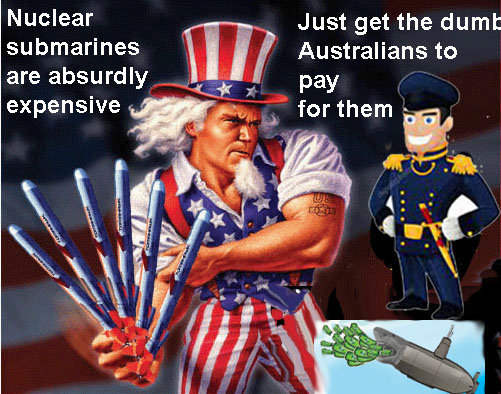
In Washington last month, Defence Minister Richard Marles said Australia, the United States and Britain were moving from “interoperability to interchangeability in defence hardware”. This would effectively mean Australia could not buy high-quality defence equipment from other countries if there was a higher-cost American or British version available. Professor Clinton Fernandes at the UNSW Canberra campus says, “It’s obvious the real policy is to subsidise the US Navy’s submarine budget. Some will be located in Australia, with Australian flags and personnel, but they’re essentially US boats operated in the US’s great power interests. We’re paying for them to set up part of their current and future fleet in Australia.”
Australia has a short and patchy record on submarine purchases. The government acquired many major weapons during World War II. None were submarines. That capability had to wait until the first of a total of six Oberon-class submarines was commissioned in 1967 from a Scottish shipyard. They operated satisfactorily but weren’t considered the nation’s most important military assets.
After Kim Beazley became Defence minister in the Hawke government, he gambled on the value of submarines by ordering six large, battery-powered versions to be built in Adelaide. No other country has bought this type.
The first was commissioned in 1966 and the last in 2003. Called the Collins class, it was based on a good Swedish design. But Beazley greatly increased its size and complexity, partly by adding American equipment that proved completely useless. Maintenance problems drove annual sustainment costs to $670 million. Often only two or three were available at a time, although availability later improved. And none attended the 2010 Rim of the Pacific event – known as Rimpac, the world’s largest international maritime warfare exercise, held biennially near Hawaii.
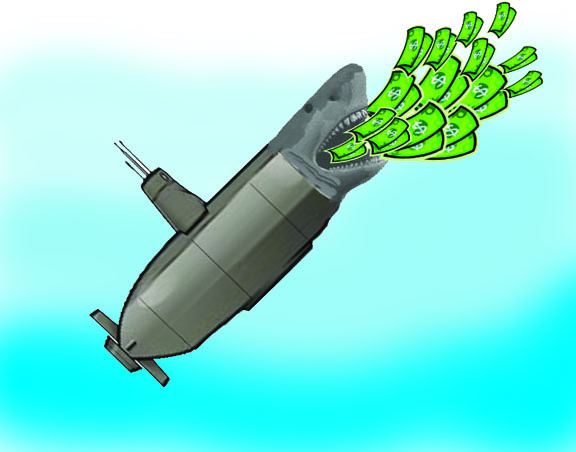
Former prime minister Scott Morrison and his successor, Anthony Albanese, have taken a much bigger gamble than Beazley did, with their commitment to buy at least eight nuclear attack submarines – almost certainly the American Virginia class. One of the US’s most highly regarded defence analysts, Winslow Wheeler, recently pointed out the Virginia-class subs have been available only 15 times in 33 years for their six-monthly deployments. This suggests fewer than two of Australia’s eight nuclear submarines would be operationally available, on average, each year. And the cost of the purchases is likely to be stunning, possibly as high as $171 billion when accounting for inflation, according to the Australian Strategic Policy Institute, and more recent estimates are above $200 billion. The costliest previous military acquisition, for the Australian Air Force, is the inflation-adjusted $16.6 billion program cost for 72 F-35 fighter jets.
Former submariner, naval consultant and South Australian senator Rex Patrick says, “Australia could buy 20 high-quality, off-the-shelf, modern submarines for $30 billion.”
Patrick also makes the point that nuclear submarines are often “defeated” in exercises by ultra-quiet conventional submarines.
Major new developments are making conventional submarines even more formidable than the nuclear versions. More powerful sensors mean submarines can be detected by the noise they make and by their passage through the Earth’s magnetic field. In addition, nuclear submarines can be detected by the wake they leave at high speeds, as well as the hot water they release from cooling their nuclear reactors, operating loud steam engines and other equipment. In future, submarines may also be detected by blue-green lasers that make the ocean more transparent.
A prize-winning essay published in the US Naval Institute’s magazine Proceedings in June 2018 said the US Navy would do well to consider acquiring “some quiet, inexpensive and highly capable diesel-electric submarines”. Until recently, conventionally powered submarines frequently had to rise close the surface to expose a mast and snorkel to obtain fresh air for their diesel engines to recharge the batteries. This process can be detected by radar.
Most conventionally powered submarines – except Australia’s – use what is called air independent propulsion (AIP), which allows them to remain silent for four to six weeks before snorkelling. That often entails using a hydrogen fuel cell to propel the submarine, but it takes up significant space on the vessel.
In a major change, Japan’s new Taigei-class submarines don’t need AIP because they’re equipped with particularly efficient lithium-nickel-cobalt-aluminium oxide batteries, rather than the lead-acid batteries that the Australian Navy prefers, due in part to the risks of lithium-ion batteries catching fire. Other navies are increasingly confident the new types of battery will prove safe. Hans Ohff, a submarine specialist and visiting fellow at Adelaide University, told The Saturday Paper, “Generally speaking, lithium-ion batteries have a 1.5-times range advantage over lead-acid at lower speeds and an incredible four-times range advantage at high speeds.”
Since the Collins class is due to start retiring in 2026, a replacement is urgently required to help fill the gap until the first nuclear submarine might arrive, near 2045, and the last in 2065. Senator Patrick says the time it takes to do this can be reduced by choosing one of the three available “off-the-shelf” submarines: Japan’s Taigei, which has passed numerous tests demonstrating the safety of its new batteries; Singapore’s Type 218SG, made by Germany’s thyssenkrupp Marine Systems; and the Spanish S-81. The latter two still use conventional lead-acid batteries, but Ohff says a French and German joint venture is under way to develop their own lithium-ion batteries.
These options have advantages and drawbacks. The new Taigei class – of which Japan is acquiring 22 – requires a costly crew of 70 per vessel. The Type 218SG’s German manufacturer is the biggest submarine exporter in the world, with an enviable reputation for low maintenance costs across its range. Extensive automation means it needs only 28 crew members, and the vessel has a longer range than the Taigei’s 12,500 kilometres. Spain’s S-81 has a crew of 32 but a less experienced manufacturer.
With China being the principal concern of Australian diplomatic and defence policymakers, Ohff says the navy will never accept off-the-shelf submarines unless it can “Australianise” them – meaning they must have the range to operate for long periods, many thousands of kilometres away, probably in Chinese waters or nearby. Ohff says the navy’s preferences would take a minimum of 10 years to deliver the first boat and additional two-year intervals for the following boats. He says delivery of a Swedish “Son of Collins” could take nine years.
Patrick says influential Australian intelligence and defence officials are ignoring the point that there is no need for Australian submarines to spend much time in China’s waters: Japan, South Korea, Singapore and Vietnam have high-quality submarines closer to China. The main attraction of nuclear submarines for these officials is they could fire subsonic cruise missiles at land targets in China from more than 1000 kilometres off its coast. However, cruise missiles can be shot down by fighter planes overhead. Once a nuclear submarine fired its missiles, it would be detected and swiftly targeted. Even if it survived, reloading would require the help of a tender – a large depot ship that supplies and supports submarines – probably from the distant base at Fremantle, which recently hosted a reloading for a US nuclear submarine. In any event, an attack on Chinese territory could provoke a heavy counterattack on Australia’s forces or its mainland.
Gilligan says most of the capability offered by submarines is better provided by Australia’s maritime and land-based aircraft. He says submarines, including nuclear ones, are slow compared to aircraft. Technically, a plane could sink a ship off Australia’s west coast in the morning, refuel, then sink another off the east coast in the afternoon. Gilligan also warns that the shallow and warm waters around Australia’s north are unsuited to large nuclear submarines.
Deploying nuclear submarines far from Australia marks a return to the previously discredited doctrine of “forward defence” in South-East Asia that concentrated on a big British naval base in Singapore, which was swiftly overrun by the Japanese in 1942. When this doctrine failed during the Vietnam War, the Coalition government in the late 1960s adopted a “defence of Australia” doctrine, which survived until its recent abandonment. Patrick and other proponents of this latter doctrine expect a revised doctrine would put more emphasis on having medium-sized conventional submarines to help deny hostile forces access to the approaches to Australia, unless they could detect and destroy all the submarines, drones, planes and land-based missiles blocking their way.
Finally, from a defence perspective, much of the planning around nuclear submarines assumes – implausibly – that Chinese and US policies will proceed in a predictable way until past 2060. A purely geopolitical analysis, however, could easily underplay the disruptive role of climate change.
In purely geopolitical terms, the region may become more peaceful or more dangerous. The only urgency for Australia is to forget about nuclear submarines and get some conventionally powered submarines to enhance deterrence.
The National Party’s false claim about nuclear power

Barnaby Joyce’s meltdown over nuclear energy claim , ABC, Jacob Shteyman August 5, 2022,
With Australia’s future energy needs dominating parliament, Nationals MP Barnaby Joyce has claimed we are the only OECD country that does not produce nuclear power.
The claim is false. Eighteen of the 38 OECD countries do not produce nuclear power.
Mr Joyce made the claim during a debate on Labor’s Climate Change Bill 2022 on August 3. In outlining his support for nuclear power, the shadow minister for veterans’ affairs asked: “Why is it that every OECD country produces nuclear power except us? Are we the wise ones and they’re all stupid?” (video mark 19:25).
Mr Joyce has been a supporter of nuclear power for a number of years while the coalition has looked into its implementation at several points in recent decades.
Opposition Leader Peter Dutton announced on August 2 that the coalition would begin an internal process to examine the potential for nuclear power in Australia.
AAP FactCheck contacted Mr Joyce on the source of his claim but received no reply at the time of publication.
The OECD, which is made up of 38 countries, was established in 1961 as a forum for governments to “seek solutions to common economic and social problems”.
The OECD Nuclear Energy Agency publishes an annual report showing nuclear energy generation by each member nation. The 2021 report (table 1.1, page 14) shows 18 of the 38 do not produce nuclear power.
They are Italy, Turkey, Poland, Ireland, Norway, Israel, Austria, Chile, Colombia, Denmark, Estonia, Greece, Iceland, Latvia, Luxembourg, Portugal, New Zealand and Australia.
ANU nuclear expert Tony Irwin confirmed to AAP FactCheck in an email that Australia is not the only OECD nation to generate nuclear power.
A similar claim was made by Liberal MP Stuart Robert in an interview on ABC’s Afternoon Briefing on August 2. While responding to a question about the affordability of nuclear energy, he said: “I think we’re one of only, in fact we’re the only non-top 20 OECD country that doesn’t use nuclear power as part of its power mix” (video mark 9min).
A spokesman for Mr Robert clarified to AAP FactCheck that he meant to say Australia is the only top 20 OECD country without nuclear power.
Either way his claim is false……………………………..
The most recent World Nuclear Industry Status Report, published last year, found global nuclear energy production is on the decline, despite a significant increase in China.
In 2019 AAP FactCheck debunked a similar claim by coalition MP Keith Pitt that Australia is the only OECD country not utilising nuclear energy.
A clarification about China and Taiwan
Norman Realname, 5 Aug 22,

I’m grateful to a reader for providing this explanation.
I still think that it’s a pretty bad idea for USA and Australia to start a probable World War 3 over Taiwan.
The Republic of China (ROC) and the People’s Republic of China (PRC) are NOT synonyms and should not be used as such. The ROC has NO control over Hong Kong; it’s a semi-autonomous territory ruled by the PRC under the “one country, two systems” arrangement, as per treaty. Thus, grumbling about democratic subversion aside, there was no question of the PRC’s sovereignty over it.
The ROC, however, DOES have control over Taiwan, and the PRC does NOT. As to why this is the case, the most oversimplified answer is that the Chinese Civil War never fully ended and both governments claim to rule the territory of the other, but since the PRC has the de facto control of almost all of it, it’s recognized as the “real” China. The more complicated answer is that since democratization the ROC government no longer wants to rule the mainland and sees itself as a separate Taiwanese nation but is forbidden to relinquish its territorial claims (under threat of invasion) by the PRC who view Taiwan as integral Chinese territory and would interpret any movement away from them as secession (even though the PRC has never actually ruled over Taiwan).
The US and China differ over their interpretation of the situation. The PRC’s One China PRINCIPLE states that there is only one China, and Taiwan is a part of China. The US’s One China POLICY states that they *acknowledge* the PRC’s position on the matter, without actually saying whether or not they agree that Taiwan is part of China. In other words: the US generally agrees there is only one China, but they’re not sure (read: deliberately ambiguous) whether Taiwan is part of it.
Fundamentally, while the PRC has been successful in preventing international recognition of the ROC (Taiwan), they do not control the territory and cannot control the territory without:
1. The ROC (Taiwanese) government agreeing to hand over power peacefully to the PRC.
2. A full-scale military invasion of Taiwan aimed at the surrender and/or destruction of the ROC (Taiwanese) government.
To compare the situation to Hong Kong, – the crucial difference is the People’s Republic of China did not need to roll in their military to fight some theoretical Hong Kong military in order to be able to tell Hong Kong what to do.
Hard-Wired for Corruption -The arms trade and Australia’s lax monitoring regimes
Chris Douglas concludes that from an anti-bribery/corruption risk perspective, Naval Group should not have been put on the shortlist for the Future Submarines program, let alone selected to partner with Australia to build the submarines. The ‘contract of the century’ was mired in unacceptable risk from the outset due to Defence’s poor risk-management processes and non-existent specific anti-bribery/corruption measures. A formal inquiry is needed both to examine how this deeply flawed decision was reached and to help prevent the situation recurring in future major defence procurement projects.
‘In the arms business, it’s always a time of war’, wrote Roeber. Without war, there is no revenue, no profit, no growth. Countries with established arms manufacturing industries therefore have a perpetual economic driver towards conflict and warfare.
To give just one example, there is no visibility around what or how much weaponry Australia has exported to Saudi Arabia or the United Arab Emirates during the years of the Yemen war.
https://undueinfluence.substack.com/p/hard-wired-for-corruption?utm_source=substack&utm_medium=email Michelle Fahy 1 Aug 22, The international arms trade, worth around US$200 billion a year, represents less than 1 per cent of world trade yet is said to account for about 40 per cent of its corruption. While estimates vary, there is little dispute amongst long-term arms industry researchers that it is the most corrupt industry on the planet. Indeed, it is said to be hard-wired for corruption.
The World Peace Foundation (WPF), housed at Tufts University in America, produces extensive research on the global arms trade, including a compendium of corrupt arms deals. It says that ‘Corruption within the industry is often treated in terms of isolated incidents, when it is, in fact, representative of the business model for the industry’.
This finding is supported by research for Transparency International’s (TI) Government Defence Integrity (GDI) index, which assesses the quality of controls for managing corruption risk in defence and security institutions. The GDI shows that 86 per cent of global arms exports between 2016 and 2020 originated from countries at moderate to very high risk of corruption in their defence sectors, while 49 per cent of global arms imports went to countries at high to critical risk of defence corruption. Australia is rated as a moderate corruption risk in the GDI, with two key areas of concern being the lack of transparency in defence procurement and weak anti-corruption safeguards on military operations.
The legal trade in arms has long been known for its susceptibility to corruption. This is due to the high value and complexity of arms deals, the close association between the arms industry and political power, and the secrecy claimed necessary for national security, all of which shield arms-related activities from scrutiny. As arms industry expert Joe Roeber pointed out, ‘Defence goods are complex and each contract contains a mix of special requirements. Comparison is remarkably difficult and effective monitoring by public watchdogs is all but impossible. An unknowable price can be manipulated to accommodate any amount of covert payments’. Further, there are very few major arms deals on offer globally each year—usually less than 10 in the range of tens of billions each meaning competition is intense—while only a small number of people make the decision on what to buy…
‘In the arms business, it’s always a time of war’, wrote Roeber. Without war, there is no revenue, no profit, no growth. Countries with established arms manufacturing industries therefore have a perpetual economic driver towards conflict and warfare.
For example, in the month leading up to Russia’s invasion of Ukraine, and just days after a horrific attack in Yemen by the Saudi-led coalition using a Raytheon missile that killed 90 people and injured 200, Raytheon’s CEO told investors that global tensions represented ‘opportunities for international sales’, and that he expected to ‘see some benefit’ from ‘the tensions in Eastern Europe [and] in the South China Sea’. Meanwhile, Just Security has noted that the ‘well-documented risks of corruption in the arms industry and the potential for profiteering from an arms race in the Ukraine war’ are risk factors embedded in the massive flow of lethal weaponry from the West into Ukraine…
Blanket secrecy
All countries justify secrecy around arms-related activity with claims of protecting ‘national security’. The Australian government, for example, imposes a high level of secrecy over its arms procurement, sustainment and export deals, with politicians and the Department of Defence resisting demands for greater transparency…
Australia also relies on ‘commercial-in-confidence’ justifications to protect arms industry interests. This, in combination with national security claims, has led to almost blanket secrecy around Australia’s arms exports. To give just one example, there is no visibility around what or how much weaponry Australia has exported to Saudi Arabia or the United Arab Emirates during the years of the Yemen war. The government has only released information about the number of export permits it has approved or declined (by March 2021 Australian approvals to these two nations topped 100). However, permit numbers are not useful, as not all permit approvals translate into actual exports, and permits can cover numerous types of equipment, small or large quantities, extend for varying time periods, and even cover multiple destinations.
This is significant because the decades-long UK Campaign Against the Arms Trade has amassed a ‘mountain of evidence of corruption in arms sales to Saudi’ showing that bribery is central to the Saudi government’s approach to arms deals. Andrew Feinstein, author of the exhaustively researched 600-page book The Shadow World: Inside the Global Arms Trade, told ABC radio in 2018 that he had never seen a Saudi arms deal that didn’t involve ‘massive amounts’ of corruption, and that the percentage of a Saudi contract paid in bribes could be up to ‘about 35 per cent of the contract price’. The United Arab Emirates is also known for its secrecy, corruption, and money laundering links.
Australia’s decreasing commitment to anti-corruption measures
Australia’s extraordinary current spending on military capability—$270 billion in a decade, on top of the usual defence budget—means the domestic arms industry is awash with cash. At the same time, the public’s limited ability to scrutinise this spending has been eroded further by a defence minister, Peter Dutton, who has restricted Defence’s engagement with the media. The combination of record sums of money and little scrutiny provides fertile ground for corruption.
Australia’s performance on anti-corruption measures has nose-dived in recent years:
- It recorded its worst ever score on a global anti-corruption index in 2022, dropping four points (from 77 to 73) and falling to 18th place. Australia has now dropped 12 points in a decade, from a high of 7th (85 points) in 2012.
- Its membership status at the Open Government Partnership risks being put under review because it has ‘acted contrary to the OGP process’ and failed to submit its latest national action plan.
- Its negligible attempts to investigate and prosecute cases of foreign bribery have been criticised by the Working Group for the OECD’s Anti-Bribery Convention (it expressed concern over ‘the continued low level of foreign bribery enforcement… given the size of Australia’s economy and the high-risk regions and sectors in which its companies operate’ and ‘its long-standing challenges in attributing wrongdoing to corporate entities’).
- It has been named an ‘international laggard’ in expanding anti-money-laundering laws in line with recommendations by the G7’s Financial Action Task Force, one of only three countries, alongside Haiti and Madagascar, to have failed to do so. Australia now risks being put on a grey list of countries that don’t meet international money-laundering standards. (Australia has been resisting anti-money-laundering regulation for fifteen years.)
- A dedicated federal anti-corruption body still has not been established…
Red flags
‘The biggest corruption risk in an arms deal is a company’s decision to pay bribes to secure the deal’, says Sam Perlo-Freeman, former Program Manager for Global Arms and Corruption, World Peace Foundation, Tufts University. Decisions to pay significant bribes are made at a company’s highest levels, and while no amount of technical anti-corruption measures will eliminate high-level corrupt behaviour, strong whistleblower protection mechanisms can increase the probability of exposure. Other anti-corruption measures are also important, particularly at lower levels where zealous company employees might be tempted to cut corners to advance their careers. However, such technical measures do not tackle the underlying political and economic drivers of high-level corruption in the arms industry, where winning large deals is necessary for corporate survival and price is not the primary concern. As Joe Roeber noted incisively, bribery in this context ‘is not just a simple add-on to the procurement process, but distorts the decisions. What would the equilibrium level of trade be without the stimulus of corruption?’ …
No evidence has emerged of…extensive corrupt practices in Australia, but there are regular red flags of possible arms industry corruption. Chris Douglas, a 31-year veteran of financial crime investigation for the Australian Federal Police, who now runs his own consultancy, is an Australian expert in anti-bribery and corruption measures. He says that such compliance programs are a necessary component of good corporate and public governance—essential for preventing corruption in the defence industry. Although he has lodged numerous Freedom of Information requests (FOIs) with the Defence Department about anti-bribery/corruption measures on major procurements, he says, ‘I have not detected an ABC [anti-bribery/corruption] program being used in any of the major defence projects I have examined’.
Douglas says that the Department of Defence ‘has not caught up with modern corporate management practices’ and has no understanding of how to use anti-bribery/corruption risk-based assessments to manage the significant risks posed by bribery and corruption in its projects, particularly major ones. As he puts it: ‘That any department would not undertake an ABC risk assessment when such large sums of money are involved, in an industry that is rated high for corrupt behaviour, speaks volumes about a poor culture within that department’.
Repeated cost blowouts and delays are just two of the red flags for corruption that are regularly found in Australian defence procurement and sustainment projects. The cost of these to the public is substantial.
While there are numerous examples of red flag projects, here are just three.
Naval Group—submarine contract
This contract was abandoned with the arrival of AUKUS, but the original deal with Naval Group requires a public inquiry to examine the full extent of the process by which the internationally lucrative ‘contract of the century’ was awarded. The need for an inquiry has been amplified given the shock shredding of Defence’s largest ever contract, a decision which made international news and may yet cost Australia billions.
Continue readingJenny Ware -A Liberal MP happily in the grip of the nuclear lobby

Some of the more inane comments promoting nuclear power for Australia have lately been voiced by Liberal MP Jenny Ware . She’s enthusiastically advocating nuclear to solve Australia’s electricity crunch prices. (a. Nuclear would not be operative for decades. b. Nuclear is the most costly source)
And she wants the Lucas Heights research reactor to provide electricity. Does she not know that there’s a bit of a difference between a research reactor and a commercial nuclear power plant? (There are a few other problems, too, but nuclear lobby mouthpieces don’t usually stretch to considering them.
from The Daily Telegraph – Nuclear the best medicine for power prices, says new MP Newly elected member for Hughes Jenny Ware has declared Australia has to start talking about adding nuclear into the mix, otherwise we won’t be able to keep the lights on.
James Morrow in The Chronicle writes Hughes MP Jenny Ware wants Lucas Heights nuclear reactor to help power Australia
Alarm on nuclear waste transport

Clare Peddie, Sunday Mail 31 July 2022, Rural 1st Edition p.22
A DECISION to exclude the risks of shipping and trucking intermediate-level radioactive waste from the environmental impact assessment of the planned Kimba nuclear waste dump has riled MPs, experts and Whyalla locals.
Independent environment campaigner and consultant David Noonan said Whyalla was the only port in the region with the infrastructure to take the 110-tonne casks the waste would be shipped in.
Mr Noonan wrote to the federal government in June demanding an explanation for excluding shipping and transport of ‘waste residues from reprocessing spent research reactor fuel’ from the EIS.
‘It is nonsensical and contrary to the public interest,’ he said. ‘It is just not credible to claim a later separate referral and assessment can somehow cover (it) … after the dump has been pushed through.’
Environment Department assistant secretary Kylie Calhoun said separating the transport issue would result in a ‘better-informed assessment of (it) at a future point in time.’
South Australian Greens senator Barbara Pocock said that was an ‘unacceptable’ position.
State Giles MP Eddie Hughes called for a ‘round-table dialogue about the responsible long-term disposal of our domestic long-lived intermediate waste, not moving it from one interim site to another’, given it ultimately required ‘deep geological disposal’.
Nuclear industry expert and author Ian Lowe, an adjunct professor at Flinders University, said the ‘serious’ transport risks deserved proper scrutiny and consultation.
Whyalla resident Andrew Williams has raised his concerns with the council.
Mr Williams said he firmly believed the transport routes should be publicly disclosed and subject to extensive consultation.
1 This month
7 April – WEBINAR – Australia and the Doomsday Clock – Preventing nuclear war through NoFirstUse and other policies
Online | Tuesday April 7, 4:00-5:30pm, Australian Eastern Time / 8:00-9:30am Central Europe Time
– Access the registration link
15 April – Zoom –Nuclear Power is Not the Solution
Apr 15, 2026 01:00 AM in Canberra, Melbourne, Sydney

Join the International Physicians for the Prevention of Nuclear War (IPPNW) on Tuesday, April 14th for a timely webinar exploring the risks associated with nuclear power and challenging the myth that it offers a simple, safe, carbon-free solution to the climate crisis

21 April Webinar: No Nuclear Weapons in Australia
Start: 2026-04-21 18:00:00 UTC Canberra, Melbourne, Sydney (GMT+10:00)
End: 2026-04-21 19:30:00 UTC Canberra, Melbourne, Sydney (GMT+10:00)
Event Type: Virtual
A virtual link will be communicated before the event.
Host Contact Info: australia@icanw.org

of the week – Australians for War Powers Reform (AWPR)
To see nuclear-related stories in greater depth and intensity
 Antinuclear