Government’s Intergenerational report is a junk document and should be rewritten
 Green groups slam report as inadequate ELISE SCOTT AAP MARCH 05, 2015 Daily Telegraph, “………despite the report being a snapshot of the next 40 years, it fails to detail any post-2020 emission reduction goals or the long-term costs of climate change.
Climate Institute chief John Connor believes the report shines a spotlight on the inadequacies of government policies and ignores economic challenges and opportunities.It refers to recent analysis that shows changes in the frequency of extreme weather but contains just one sentence about future impacts.”It’s almost breathtaking,” Mr Connor told AAP.”It’s woefully inadequate. It doesn’t even deal with this generation of policy, let alone the next.
 “The Australian Greens are demanding the report be rewritten.”This is a junk document and should be tossed away,” leader Christine Milne told reporters in Canberra.Senator Milne wanted to see “serious modelling” on the costs of global warming.The absence of long-term projections is a shared concern of the World Wildlife Foundation and the Australian Conservation Foundation.ACF spokesman Josh Meadows said climate change was the one area that could be planned for, yet the report ignored forward-thinking completely……..
Mr Connor welcomed the government’s acknowledgement the international community had committed to limiting global warming to 2C.The intergenerational report produced by Labor in 2010 found unmitigated climate change would leave Australian GDP in 2100 about eight per cent lower than the level it would be in the absence of climate change. http://www.dailytelegraph.com.au/news/breaking-news/green-groups-slam-report-as-inadequate/story-fni0xqi3-1227249614927
Marcia Langton doesn’t get it right on mining agreements
 Marcia Langton should go back to the drawing board on mining agreement praise Australian Conservation Foundation, March 6, 2015 Declaring mining agreements a success in Aboriginal communities after reviewing less than two percent of agreements seems a stretch, writes Dave Sweeney
Earlier this month mining executives mingled with politicians in federal Parliament’s Mural Hall as Indigenous Affairs Minister Nigel Scullion launched a new publication from the Minerals Council of Australia.
From Conflict to Cooperation, by Melbourne University’s Professor Marcia Langton, sets out to examine the “transformations and challenges in the engagement between the Australian minerals industry and Australian Indigenous peoples”.
Professor Langton’s main contention is that there has been an enormous improvement in relations and outcomes between miners and Aboriginal peoples over the past two to four decades. Aboriginal communities have experienced significant economic benefit and these now need to be consolidated through regulatory reform and a new economically driven Aboriginal financial trust and organisational structure.
Professor Langton has fulsome praise for the collaborative, indeed transformative, nature of the new era of Industry-Indigenous relationships and lauds mining companies and executives.
Two aspects of this paper are surprising.
One, Professor Langton sharply identifies the institutional bias and capacity constraints that work against Aboriginal communities and organisations in complex negotiations processes, yet she still claims the system delivers.
Two, her enthusiasm about the benefits of mining agreements is based on surprisingly scant information.
Late last decade the Native Title Working Group identified obstacles that frequently get in the way of successful agreements between Indigenous communities and mining companies. The working group noted that “there are only a limited number of good agreements to provide models… The reasons for the absence of more agreements containing substantial financial and other benefits for traditional owners after almost 15 years of the operation of the Native Title Act 1993 (NTA) is, in itself, deserving of inquiry”.
Indeed, it still is. This fact is highlighted by the confusing data on Aboriginal employment in the resources sector and the lack of detail on economic benefits.
The plentiful talk of jobs and dollars is not backed up with many hard facts.
Mining Agreements are rarely agreed and seldom seen. In the everyday world an agreement is a deal based on shared understanding, but in the world of the Native Title Amendment Act (1998) and the mining sector it means the right to negotiate, but not to say no……..https://www.acfonline.org.au/news-media/acf-opinion/marcia-langton-should-go-back-drawing-board-mining-agreement-praise
Terms of reference for South Australia’s Nuclear Royal Commission are inadequate
 Given that it will be navigating contested waters with significant and long lasting costs and consequences for this and all future generations of South Australians it is essential that the Premier heeds community concerns and revisits the terms of reference to ensure the Commission does not become a taxpayer funded nuclear industry promotional platform.
4 MAR 2015 THE CURRENT TERMS OF REFERENCE FOR THE ROYAL COMMISSION INTO SOUTH AUSTRALIA’S NUCLEAR INDUSTRY SADLY APPEAR TO PUT A HIGHER WEIGHTING ON INDUSTRY PROMOTION THAN PUBLIC INTEREST.
There is to be no review of SA’s atomic test legacy or flawed clean up attempts from earlier uranium mines. Disappointingly, the impacts and experience of current uranium mining is ignored lest it reflect poorly on industry expansion plans and key areas of very real public concern including health impacts, emergency capacity, implications for SA’s precious water resources and the potential for severe reputational and market damage to the important food, wine, fishing and tourism industries are missing.
Given that any credible assessment of the nuclear industry in South Australia also needs to fully explore the unique safety, security, legal, liability and transparency impacts and the full inter-generational economic, environmental and social costs and extent of direct or indirect public subsidies it appears that Premier Weatherill’s Royal Commission has failed to pass the most basic test of independence. Continue reading
Moving beyond Muckaty: next step in Australia’s radioactive waste story
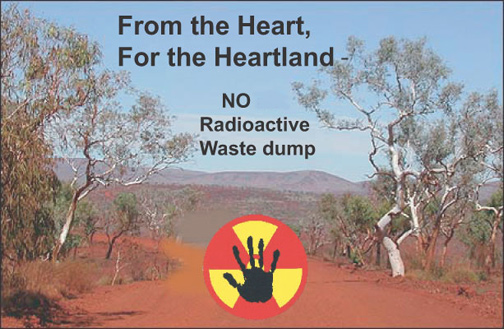 4 Mar 15 Environment groups have urged the federal government to deliver on its commitment not to impose radioactive waste storage on unwilling communities, as announced by Industry Minister Ian Macfarlane today.
The latest process to identify a site for a national nuclear waste facility follows more than 20 years of flawed and failed federal attempts to impose a dump on communities in South Australia and the Northern Territory, most recently at Muckaty, north of Tennant Creek.
“That this process is happening at all is a tribute to the tenacity of the Muckaty Traditional Owners who took sustained action to protect their country and culture,” said Beyond Nuclear Initiative convenor Natalie Wasley.
“It took more than eight years for the government to admit the Muckaty nomination was a ‘disaster’. This must not be allowed to happen to other communities.
“Environment and civil society groups will closely monitor – and engage where possible – with the revised site nomination and selection process,” she said.
The process outlined today includes federal commitments of increased transparency and a stated preparedness to consider a number of alternative siting models.
Environment, public health, Indigenous and trade union groups have called for an expert and independent Inquiry into the full range of waste management options, including decentralised nuclear waste storage instead of a centralised facility. This approach has not been adopted by Minister Macfarlane, who has opted for a limited, fast-tracked process.
“There are no compelling social or technical reasons to rush a decision on an issue that demands the highest quality decision making,” said ACF’s Dave Sweeney.
“We have time to get this issue right. The Minister’s revised process is significantly better than the previous one, but we are still a long way short of where we should be,” he said.
Most of Australia’s existing radioactive waste is securely stored at two dedicated federal sites. Reprocessed spent nuclear fuel set to return to Australia from Europe later this year will be sent to the Lucas Heights facility for interim storage. Context and comment: Dave Sweeney (ACF) 0408 317 812, Nat Wasley (BNI) 0429 900 774
Nigel McBride sees $billions in welcoming in the world’s radioactive trash
Nuclear Royal Commission urged to fast-track storage talks DANIEL WILLS STATE POLITICAL EDITOR THE ADVERTISER MARCH 03
BUSINESS has urged South Australia’s nuclear Royal Commission to fast-track consideration of hosting the nation’s first major waste dump, amid fears the state could miss out on a lucrative opportunity to take a foothold in a future storage industry.
The Federal Government has announced a new tender process for a national radioactive waste management facility and is seeking site nominations until May 5. However, South Australia’s Royal Commission is not expected to conclude until late this year or early 2016.
Australia has 4248 cubic metres of low level and 656 cubic metres of intermediate level waste in temporary storage, which the Federal Government is seeking to consolidate.
Most has been produced as the by-product of medical, research and industrial processes.
BusinessSA chief executive Nigel McBride said waste storage was a multibillion-dollar opportunity for the state and could become a major new revenue stream for government.
“The thing that really stands out as an opportunity is spent nuclear fuel storage,” he said.
“Maybe we need to fast track that. Maybe that’s the part of the Commission that needs to come out first. “We can’t just wait until the Commission is over. They’re calling for it now…….
Australian Conservation Foundation nuclear free campaigner Dave Sweeney called for the tender to be delayed amid fears a rushed process could harm communities and the environment.
“There are no compelling social or technical reasons to rush a decision on an issue that demands the highest quality decision making,” he said. “We have time to get this issue right.” http://www.adelaidenow.com.au/news/south-australia/nuclear-royal-commission-urged-to-fast-track-storage-talks/story-fni6uo1m-1227246749276
Federal government calls for nominations, by May 5, to host radioactive waste
 Nuclear waste dump search restarts http://www.theaustralian.com.au/business/latest/nuclear-waste-dump-search-restarts/story-e6frg90f-1227245757018 3 Mar 15 The federal government has called for voluntary nominations of sites for a national nuclear waste dump.
Industry Minister Ian Macfarlane says any landholder could nominate a site to store intermediate level radioactive waste and dispose of low-level waste.
Australia has 4248 cubic metres of low level and 656 cubic metres of intermediate level waste in temporary storage across more than 100 sites.The waste has been generated by medical, research and industrial processes.
An independent advisory body will assess the nominated sites against a number of criteria.
These include community well-being, stable environment, environmental protection, health, safety and security and economic viability. At the end of the assessment and public consultation the government will negotiate with the landholder of the selected site.
Site nominations close on May 5.
The South Australian government’s royal commission into the nuclear industry is looking at the prospects of nuclear waste facilities in that state.
Northern Territory chief minister Adam Giles has also shown an interest in putting forward a site.But last year he said it would not be done without “full information and dialogue with Territorians”.
In June 2014 the Northern Land Council withdrew its nomination for a section of Muckaty Station, north of Tennant Creek, as the site for Australia’s first nuclear waste dump amid a legal dispute.Further talks on alternative sites failed, triggering the new selection process.
Australian Conservation Foundation nuclear campaigner Dave Sweeney says the decision should not be rushed. “We have time to get this issue right,” he said.
“The minister’s revised process is significantly better than the previous one, but we are still a long way short of where we should be.”
The first concerted effort to build a dump occurred under the Labor government in 1992, identifying a site near Woomera in SA.
Federal Liberal MP Rowan Ramsey keen for nuclear waste dump in South Australia
ROWAN RAMSEY MP Federal Member for Grey 4 Mar 15 CALL FOR VOLUNTARY LAND NOMINATIONS FOR A NATIONAL RADIOACTIVE WASTE MANAGEMENT FACILITY
Federal Member for Grey Rowan Ramsey welcomes the Australian Government’s decision to open the process for voluntary site nominations for a national radioactive waste management facility. ……
Mr Ramsey said an Independent Advisory Panel had been established by the Department of Industry and Science to assist with assessing nominations and advising the Government on which sites may be suitable for a facility.
“It is interesting that this call for volunteers has occurred when Premier Jay Weatherill has just launched a Royal Commission into the possibility of South Australia raising its participation in the nuclear industry past the simple supply of yellowcake,” Mr Ramsey said…….
Australian Renewable Energy Agency (ARENA) helps Flinders hybrid system get going
 Hybrid system to take off-grid Flinders 60% renewable http://www.businessspectator.com.au/news/2015/3/4/renewable-energy/hybrid-system-take-grid-flinders-60-renewable JOHN CONROY The Australian Renewable Energy Agency (ARENA) today announced $5.5 million support for Hydro Tasmania to develop an “innovative” off-grid hybrid project on Flinders Island.
The $12.9m project will use a combination of solar, wind, diesel, storage and enabling technologies, together with a “sophisticated” control system, to displace more than 60% of the island’s diesel generated energy, ARENA said.
The project is scheduled for completion in November 2016.
“The Flinders Island project will build on the success of a similar project Hydro Tasmania developed on King Island with ARENA support, which is delivering 100% renewable energy to the island when conditions allow,” ARENA CEO Ivor Frischknecht said.
“One of the exciting aspects of the Flinders Island project is the development of a portable hybrid energy solution with the potential to further drive down costs and move a step closer to delivering a commercially competitive product.
“Hydro Tasmania will trial a series of modular units suitable to house and transport components for off-grid hybrid renewable energy projects.
“This low-cost, scalable approach has the potential to be a real game changer in remote areas – reducing the amount of construction and engineering work needed to be carried out on site would significantly reduce costs, risks and construction time.”
Mr Frischknecht said Hydro Tasmania’s hybrid project demonstrates how a flexible and integrated approach can provide improved penetration of renewable energy.
“Technologies like storage and dynamic resistors smooth out the power generated from solar and wind, while the automated control systems ensure generation and enabling equipment are coordinated and perform when required,” Mr Frischknecht said.
“Australia is a large country with many off-grid communities and industries facing similar energy supply challenges, whether they are on islands or in remote locations on the mainland.
“ARENA is committed to working with Hydro Tasmania to share the learning and expertise from the King Island and Flinders Island projects.
“This knowledge sharing will ensure we are best placed to advance competitive, reliable renewable energy options for off-grid Australia and help reduce its reliance on trucked and shipped in diesel.”
Coalition offer weakening Renewable Energy Target is rejected by Labor
- Labor rejects fresh renewable energy target offer, SMH March 2, 2015 Lisa Cox National political reporter Talks between the government and Labor toward a compromise on the renewable energy target appear to have again broken down, with the Opposition rejecting a new offer on Monday.
Government sources said a proposal to set the target at 31,000 gigawatt hours of baseline power by 2020 was put to Labor on Monday afternoon in a bid to break a deadlock that has existed for more than 12 months.
Labor is understood to have rejected the offer but could not be reached for comment.
The Opposition and the clean energy industry had been pushing for a figure in the mid- to high-thirties, but government sources said 31,000 was in line with demands from some quarters of the renewables sector.
Kane Thornton, chief executive of the Clean Energy Council, said on Monday that 31,000 gigawatt hours was too large a cut from the existing target of 41,000 gigawatt hours by 2020.
“We’ve been quite transparent about our position on this,” Mr Thornton said.
“There’s a strong consensus in the renewable energy sector on a desire to resolve this.
“But there’s also a strong consensus on what reduction in the target the industry is willing to accept.
“We’ve made this quite clear and explicit – 31,000 is quite clearly a number we’re not prepared to accept.”
The failed offer continues the uncertainty that has plagued the renewables sector since the government launched a review of the target more than 12 months ago……..
Oliver Yates, the chief executive of the Clean Energy Finance Corporation, told a Senate estimates hearing last week that uncertainty over the target had set the industry back 12 years.
Coalition government cripples renewable energy
Renewable energy industry’s uncertain future under Coalition government The Australian Financial Review JOANNA HEATH, 3 MAR 15
Whether a resolution of the uncertainty that has crippled the renewable energy industry of late is closer or further away than it was a month ago depends on who you ask.
On February 26, Industry Minister Ian Macfarlane made the surprising announcement through a media interview that he was prepared to drop the government’s plans to make changes to the original 2009, 41,000 gigawatt hour target altogether if the clean energy industry rejected the government’s latest compromise offer……..
On the face of it, it seems a victory –the renewable energy industry has always argued there is no need to change the status quo target which runs out in 2020.Not so fast. The Clean Energy Council says it in fact had not received any formal offer from the government for a new deal, and in any case would not accept the low-mid 30,000 gigawatt hour target the government was proposing.
But it is not happy with the government just dropping the whole thing and walking away either. It says given the damage that has been done in the last 12 months or so, some kind of bipartisan agreement on a continued, untouched target was needed to restore confidence………
Kane Thornton, chief executive of the Clean Energy Council, says more has to be done to fix the situation than for the government to “just walk away and leave it”.
“Investment in the clean energy industry is frozen due to the uncertainty generated by this review,” Mr Thornton said.
“The industry needs both sides of politics to reach a bipartisan agreement to provide long-term certainty, not to be left stranded. Without that bipartisanship the investment freeze will continue.”
The situation facing the renewable energy industry is indeed dire……..
Both parties pledged to relaunch talks in the new year. There has been one meeting so far with none further planned, and the situation appears to have once again reached stalemate. The most likely, and probably unfortunate, outcome is the target will be left alone by the government until 2020 but the issue is not resolved in the kind of definitive way required to bring confidence back to the market………….. http://www.afr.com/p/business/resources/renewable_energy_industry_uncertain_hV8xTeUOAwbl5MPKJCRCqK
South Australian government wanting to radioactively pollute Aboriginal land yet again?
“You know you feel gutted when they want to bring the nuke agenda back on,” she said. “The place has already been contaminated.
Maralinga could be flagged as nuclear dump site, opponent says in wake of SA royal commission, ABC News, 28 Feb 15 By Wendy Glamocak Less than four months after land used for nuclear testing in the 1950s was officially handed back to its traditional owners in full, nuclear is back on the agenda at Maralinga in South Australia.
Most of Maralinga’s 103,000 square kilometre lands were handed back to the Maralinga-Tjuarutja people in the 1980s, and in 2009, a 3,000 square kilometre site known as Section 400 that had been heavily contaminated by radiation and hazardous chemicals, was also handed back.
In November last year, the Defence Department officially gave the Maralinga-Tjarutja full control and unrestricted access to the lands.
Those connected to the land are worried that a newNuclear Fuel Cycle Royal Commission announced recently by Premier Jay Weatherill will see the land flagged as a potential site for a nuclear waste dump.
Karina Lester is the daughter of Yammi Lester, a man who said he was blinded by atomic tests on the site half a century ago. She said her grandmother was part of the Kupa Piti Kungka Tjuta, a council of senior Aboriginal women from northern SA who fought against the Howard Government’s plans in 1988 to build a national radioactive waste dump near Woomera.
After strong opposition from the local community, and from former SA premier Mike Rann, who won a High Court challenge against the proposal, the plan was abandoned in 2004.
Ms Lester said many custodians of the land were worried that the royal commission set up by Mr Weatherill meant they would soon have another fight on their hands.
“You know you feel gutted when they want to bring the nuke agenda back on,” she said. “The place has already been contaminated.
“Traditional owners are trying to move on from what happened back in the ’50s, but to perhaps propose that it’s a site for the waste, I think, is just another kick in the guts to the traditional owners up there at Maralinga-Tjaratja.
“Enough’s enough.”
Language difficulties could ‘stand in the way’
Ms Lester said many traditional owners will want to make a submission to the royal commission but she was worried language difficulties would stand in their way.
The Premier’s office did not respond to ABC questions on Ms Lester’s concerns……..http://www.abc.net.au/news/2015-02-28/maralinga-could-be-flagged-as-nuclear-dump-site-opponents-say/6270848
The Adelaide Advertiser starts publicity campaign for nuclear reprocessing?
 A pious article reminds South Australians that yes, there were health concerns about uranium mining, and yes nuclear waste is a serious problem.
But by the end of this article – we are told that South Australia “is an idea site for nuclear waste disposal, both national and international — with the potential for huge financial returns.”
and that “The international nuclear industry has made enormous advances in the past 30 years and many of the concerns raised by Mr Rann may have been addressed.”
and that these concerns “should be addressed, and hopefully dispelled, by the Royal Commission.”
 It sounds to me as though the Advertiser, scripted by the nuclear lobby, is softening readers up for the idea of a nuclear reprocessing industry, with the rationale of (supposedly) curing the world’s nuclear waste problem
Rex Jory: SA is an ideal site for nuclear waste disposal, Adelaide Advertiser, 1 Mar 15 “……..As an adviser to former Labor Premier, Don Dunstan, Mr Rann studied aspects of the nuclear industry in Europe and the United States and in the early 1980s wrote a 32 page soft-covered book outlining his concerns about SA’s potential involvement in the nuclear industry.
Mr Rann, now Australian Ambassador to Italy, may have revised some of his beliefs, yet his book raises serious issues which the community and the Labor Party cannot easily ignore. No matter what recent advances have been made in nuclear safety, what was true, or perceived to be true, in 1980 cannot now be rejected without questioning 35 years later. Continue reading
Queensland wind farm decision due this month, but anti-wind lobby is active
 Decision on controversial Tableland wind farm due mid-March http://www.cairnspost.com.au/news/cairns/decision-on-controversial-tableland-wind-farm-due-mid-march/story-fnjpusyw-1227242229621 DANIEL BATEMAN THE CAIRNS POST FEBRUARY 28, 2015
A CONTROVERSIAL wind farm planned for the Tableland could be approved within the next two weeks. The Palaszczuk Government is expected to make a decision about the Mt Emerald wind farm, four years after the project was first tabled.
A spokeswoman for Deputy Premier Jackie Trad said the Minister’s call-in of the development application was due in mid-March.
Developers for the $380 million project gave the Government until the end of February to approve the wind farm, which was awaiting a ministerial decision before the election was called. The development, to be built near Walkamin, between Atherton and Mareeba, is to include up to 63 turbines on towers about 80m-90m tall, with about 50m blades.
The farm, a joint venture between Ratch Australia and Port Bajool, has the potential to generate enough electricity to power at least 75,000 homes.
It is estimated 158 jobs could be created during the development’s two-year construction phase.
Ratch Australia spokesman Geoff Dutton said representatives from the company’s Brisbane office had recently met with the newly elected Government to brief it on the project.“I think Ratch would be delighted in getting an answer after four years of hard work,’’ he said.
“We’re very hopeful the wind farm will be approved. Continue reading
Pro nuclear spin hides the real motive behind South Australia’s Royal Commission – a nuclear waste import industry
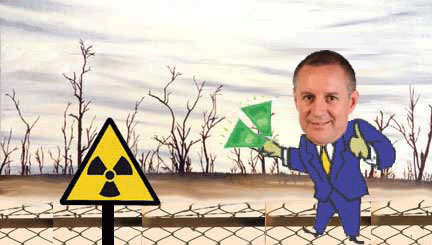
When announcing the commission last month, SA Premier Jay Weatherill said it would “explore the opportunities and risks of South Australia’s involvement in the mining, enrichment, energy and storage phases for the peaceful use of nuclear energy”.
The move caught many by surprise, not least federal opposition leader Bill Shorten, who – unlike his Labor colleague Weatherill – remains opposed to nuclear.
The announcement also generated huge amounts of free PR for the nuclear industry, as shown in the avalanche of media coverage that ensued – some deliberately balanced, some sceptical of the commission and its value, but much of it highly favourable, especially in the business press.
It is not hard to see why. As Naomi Klein contends, nuclear power is an industrial technology, organised in a corporate manner. And as psychiatrist Robert Jay Lifton points out, no technology does more to underline humanity’s dominion over nature than our ability to split the atom.
The positive spin Continue reading
Highly respected South Australian Aboriginal, Yami Lester, speaks out on nuclear waste dump plan
I’m hoping you will support us with this very important issue which has arisen from SA Goverenment regarding a Royal Commission into Nuclear Energy and proposal to store high-level nuclear waste at Maralinga, South Australia
Please read. With thanks, Yami Lester, Yankunytjatjara Walatinna Station, South Australia (08) 8670 5077
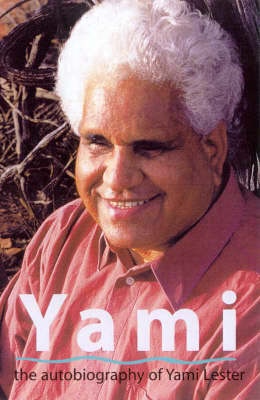 Statement on Royal Commission into Nuclear Energy and proposal to store high-level nuclear waste at Maralinga, South Australia:

In 1953 I was just ten years old when the bombs went off at Emu and Maralinga, I
didn’t know anything about nuclear issues back then, none of us knew what was happening. I got sick, and went blind from the fallout from those tests, and lot of our people got sick and died also.
Now I’m 73 years old and I know about nuclear issues, and I have some friends who know about nuclear waste, and they will fight the South Australian Government on their plans to put high-level nuclear waste at Maralinga and to develop nuclear energy in South Australia.
Why does the government keep bringing back nuclear issues when we know the problems last forever?
The Royal Commission into British Nuclear Tests in Australia (1984-85) revealed
what happened at Maralinga but it never told what happened to Aboriginal people; the findings were left open.Lawyers proved that there was radiation fallout over Walatinna, but because wenever had any doctors records to document what happened to us, (the closest clinic was Ernabella, 160km away as the crow flys and we didn’t have any transport to get there), we only had our stories and they were never written down.
A few years ago they cleaned up Maralinga from the waste that was leftover from the bomb tests; they spent $1 million, and now they’re going to put more waste back there?
That’s not fair because it’s Anangu land and they won’t be able to use that land.
Members from the APY, Maralinga-Tjarutja and Arabunna, Kokatha lands say we don’t want nuclear waste on our land.
The best thing the government can do is the leave the uranium in the ground, stop mining it.
We ask the South Australian Premier, Jay Weatherill, to talk to Aboriginal people on the lands, and to everyone who has been directly affected by the atomic tests and nuclear industry in Australia before he makes any decisions for South Australia.
1 This month
17 October, Free Public Talk on Nuclear Issues in South Australia
David Noonan will speak on public interest concerns over the new Roxby Downs Indenture Act 2026 on BHP copper-uranium mining and ore processing in SA, and on how AUKUS may face SA with a High-Level nuclear waste agenda.
Dr Jim Green will discuss international developments in the field of nuclear power including ‘small modular reactors’ and Generation 4 ‘advanced’ nuclear reactor concepts.


Help Aunty Sue Protect Her Land and Sacred Sites From Destructive Rocket Testing.
.

Australians deserve the truth
about
AUKUS – https://aukuspublicinquiry.com/

PETITION – To: Prime Minister Anthony Albanese and the Australian Labor Government

of the week – Australians for War Powers Reform (AWPR)
To see nuclear-related stories in greater depth and intensity


