South Australia’s proud history of the win against nuclear waste, a win led by Aboriginal women
One media narrative, as espoused in the AFR, is that this defeat was the result of a revolt by SA politicians. But this version of the story ignores the powerful campaign led by the Kupa Piti Kungka Tjuta, the senior aboriginal women’s council of Coober Pedy.
This story has been recorded by movement researchers Nina Brown and Sam Sowerwine and in a book, Talking Straight Out: Stories from the Irati Wanti Campaign.
Many members of the Kunga-Tjuta were survivors of the British government’s atomic testing in the 1950s and 60s, and so understood the devastating history of the nuclear industry. Upon hearing about the waste dump proposal, the group issued this statement:
We are the Aboriginal Women. Yankunytjatjara, Antikarinya and Kokatha. We know the country. The poison the Government is talking about will poison the land. We say, “No radioactive dump in our ngura – in our country. It’s strictly poison, we don’t want it.

The traditional residents of this supposedly “benign and sparsely populated geology” fought hard to protect their country using the tools they had available. They explained, demanded, marched and sang. They worked with green activists and wrote passionate letters. They urged politicians to “get your ears out of your pockets”. They won.
As South Australia faces another push from the nuclear industry, we would do well to remind ourselves of these stories. To paraphrase the late historian Howard Zinn, we need to emphasise what is possible by remembering those moments in our recent history when people demonstrated their capacity to resist, come together, and occasionally, to win.http://theconversation.com/south-australias-broad-brush-nuclear-review-is-meant-to-sideline-opponents-38110
Industry Minister Ian Macfarlane speaks with forked tongue on the Renewable Energy Target
What Macfarlane is essentially saying here is, ‘take my offer or I’ll leave you with scheme that we will make clear to investors does not have Coalition Party support.
And in the event that it looks like the target will not be met, we will use that as a mechanism to overcome Senate obstruction to cut the scheme back by even more than what is currently on the table’
 Macfarlane threatens: take my RET deal or else, Climate Spectator TRISTAN EDIS 27 FEB 15 , The confusing saga on the Renewable Energy Target continues with Environment Minister Greg Hunt sounding optimistic (as he seems to be about everything) that there will shortly be an agreement on the level of the target, and one that he said will “go significantly further” than 20% market share for renewable energy. Meanwhile Industry Minister Ian Macfarlane on the same day delivered a message of a rather more belligerent and less optimistic tone. Continue reading
Western Australia’s superb opportunities for $1billion in Renewable Energy
 $1 billion in untapped clean energy opportunities in WA http://ecogeneration.com.au/news/1_billion_in_untapped_clean_energy_opportunities_in_wa/091292/26 February 2015 Western Australia has an exciting opportunity to join the race for renewable energy and the investment and jobs it brings, according to the Clean Energy Council.
The CEC says that while Australia’s renewable energy industry has grown from a niche player to a multi-billion dollar industry, Western Australia hasn’t fully capitalised on the opportunities on offer.
“The Western Australian Government can step up to the plate and attract more renewable energy projects to the state with just a few simple policy measures,” Clean Energy Council CEO Kane Thornton said.
“I have written to Energy Minister Dr Mike Nahan to ask him to advocate for a bipartisan resolution to the Renewable Energy Target, which would see Western Australia attract more than $1 billion in new investment out to 2020.
The CEC has recommended 15 policy measures that would help Western Australia become a leading renewable energy state, while driving greater competition and consumer choice in the electricity sector.
The CEC launched its new Guide to improving electricity use in your business in Perth this week.
The guide aims to provide small and medium-sized businesses with more information on how they can reduce their operating costs through measures like installing solar and storage, or shifting their energy use.
The guide is part of the CEC’s Future-Proofing in Australia’s Electricity Distribution Industry project, which aims to enhance the flexibility and resilience of Australia’s electricity distribution systems for the future. The project is supported by $878,000 funding from the Australian Renewable Energy Agency.
To download the Guide to improving electricity use in your business, visitcleanenergycouncil.org.au/fpdi
For more information on the Clean Energy Council’s Western Australia Directorate, contact Dermot Costello atdcostello@cleanenergycouncil.org.au.
A clear economic case for the Australian government to support renewable energy
On reflection: Why Australia should not give up on renewables, Wind Power Monthly, 27 February 2015 by Alicia Webb ,
As the government battles to reduce the current renewables policy, the Australian wind industry is experiencing lost jobs and dwindling economic opportunities. Yet, there is a clear economic case for continuing renewables support.
Uncertainty and missed opportunity have been the recent themes for the Australian wind industry. While the country’s renewable energy target (RET) had enjoyed well over a decade of bipartisan support from the major political parties, the federal government plan to slash the level of the policy froze investment and resulted in many lost jobs and economic opportunities last year.
But the government does not have enough support to change legislation, and so the debate drags on. And, while the government looks for support from the opposition or a rag-tag alliance of senators from various smaller political parties, the RET’s uncertain future means the country is squandering billions of dollars in potential investment while interest in wind power and other renewables flourishes across the globe…….
The review undertook comprehensive modelling of prices. It found that any scenario in which the RET is cut would result in higher power prices for consumers from 2020, and that the scenarios that would deliver the most renewable energy were those that would also result in the lowest power prices over the life of the legislated policy. With the RET as it is, more than 18,000 jobs would be created and power bills would be lower in the long-term than they otherwise would be. Cut the RET to 27TWh by 2020, and 6,200 jobs will be lost and the average power bill will go up by A$42/year. Remove the RET altogether and by 2020, 11,800 jobs will be lost and the average power bill increases by A$56.
One of the reasons for this is that there is direct evidence of wind energy pushing wholesale electricity prices down. The Australian Energy Market Operator found in 2014 that in South Australia, the state with the highest wind penetration, wind farms have “low operating costs and tend to offer energy to the market at low prices”…….http://www.windpowermonthly.com/article/1335304/reflection-why-australia-not-give-renewables
Dangers of UV radiation from backyard solariums
Backyard solariums creating a dangerous market, The Saturday Paper, MAX OPRAY FEB 28, 2015
A recent ban on commercial solariums has seen many turning to backyard operations, ignoring the cancer risk. “……On January 1 commercial solariums were banned in New South Wales, Victoria, Queensland and South Australia, after a raft of studies confirmed indoor tanning was a particularly carcinogenic way to pass the time. According to the Australian Radiation Protection and Nuclear Safety Agency, sunbeds are responsible for an average of 43 melanoma-related deaths and 2572 new cases of squamous cell carcinoma every year in Australia.
Commercial use of these machines was banned, yet home use was left legal………
The Cancer Council strongly backs the ban, and in its position statement on solarium use cites a study published in the International Journal of Cancer in 2011 that, according to the council, found one in six melanomas in Australians aged 18-29 years “would be prevented if solariums were shut down”……. regular solarium users appeared six times more likely to be diagnosed with melanoma before the age of 30, and that 16 per cent of melanoma cases of those aged 18-29 would be prevented by avoiding sunbed exposure. …..http://www.thesaturdaypaper.com.au/news/health/2015/02/28/backyard-solariums-creating-dangerous-market/14250420001552#.VPDRw3yUcnk
Victoria’s Labor government to fund Macedon community solar energy program
 Andrews government shows renewed interest in renewables The Age, February 28, 2015 Michael Green
Renewable energy projects, including solar energy schemes i are staging a revival in Victoria under the new Andrews Labor government.
The Woodend local sustainability group is launching two green energy projects: a new solar energy scheme and the resurrection of a longstanding plan for three community-owned wind turbines.
Today, at the Sustainable Living Festival in Woodend, Energy and Resources Minister Lily D’Ambrosio will announce a $100,000 grant for a 30-kilowatt solar farm.
The panels will be installed at the old timber mill, where the tenants’ ongoing electricity bills will be reinvested in more solar panels. It will create a “perpetual fund” for community renewable energy, says Ralf Thesing, president of the Macedon Ranges Sustainability Group.
Last week, D’Ambrosio announced a $200,000 grant for the central Victorian town of Newstead to become fully powered by renewable energy.
She says the Labor government will “support and stand alongside” communities such as Newstead and Woodend, who are planning “to better control how their energy is made and where it comes from”.
“Everywhere I go, whether it’s metro Melbourne or regional and rural Victoria, people love renewable energy,” D’Ambrosio says. “That’s why we’re seeing many communities coming up with plans to make renewable energy part of their everyday life. They’re bottom-up approaches and they’re a terrific boon for local jobs.”
The Andrews government is preparing a “renewable energy action plan” and finalising the guidelines for its $20 million “new energy jobs fund”. It will also release a discussion paper on community-owned wind power.
For the clean energy advocates in Macedon Ranges shire, the election result was transformative. “It changes our situation completely – from being banned, we’re now unbanned,” says Barry Mann, who is helping co-ordinate the wind power project……….
The Victorian Liberal party appears to have had a change of heart under the leadership of Matthew Guy. For the first time, the state has a “shadow minister for renewables”, David Southwick. He says Victoria has the opportunity to be a leader in renewable energy. “We want an industry that can deliver more clean energy and clean energy jobs.”
Will South Australia’s Royal Commission be genuinely independent, or just excuse for importing radioactive trash?
If the Royal Commission brings a genuine spirit of independence and rigour, and is willing to take evidence on the nuclear sector’s performance in Australia and overseas, the report will provide a valuable contribution to domestic energy and industry policy.
An inquiry into how to get to zero emissions electricity as cheaply and rapidly as possible would have made a far more timely and valuable contribution to debates over energy policy and rebooting South Australia’s manufacturing sector than another rake through the slowly cooling ashes of the nuclear dream. Nonetheless, the lid has been lifted once again, and we can only hope that the Royal Commissioner is willing to take an unblinking look at the evidence, so that the failed hopes and broken promises of the atomic age can be set to rest once and for all
the probability that this whole exercise is designed to build the case for a national or international radioactive waste dump.
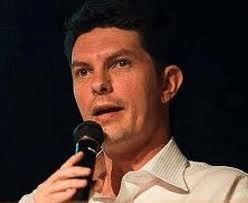 Nuclear Industry On Trial? Scott Ludlam Hopes So, New Matilda, 26 Feb 15 The debate about nuclear power in South Australia needs to be had, if only to put the issue to bed once and for all, writes Scott Ludlam.
At first glance, the decision to call a Royal Commission into nuclear technology in South Australia seems like a curious aberration from the ‘Yes Minister’ rule of inquiries: never call one unless you know in advance what it will tell you.
At the outset of this most polarising of debates, I’d like to propose a truce; particularly with those whose pro-nuclear views are motivated by the overwhelming imperative of climate change. If we respect that not all nuclear advocates intend to contaminate the gene pool and plunge us into nuclear winter, I’d ask in return that you consider the possibility that the anti-nuclear case is based on rational assessment of risks and performance, rather than pure emotion as is sometimes asserted.
For those whose motivation is a safe climate, this is a disagreement over means, not ends. Continue reading
Renewable energy leader Port Augusta does not need nuclear power – Mayor
Local mayor unhappy with city counterpart’s nuclear comments, The Transcontinental, 27 Feb 15 Port Augusta has been suggested as a “convenient” site for a nuclear reactor, just weeks after the state government announced it will establish a Royal Commission into nuclear power in SA.
Port Augusta mayor Sam Johnson is not happy, saying the suggestion treats those living in regional areas like Port Augusta as second-rate citizens……
Port Augusta mayor Sam Johnson said he’s open to an informed debate on nuclear power, but hit fiercely back at the Port Adelaide mayor’s comments, labelling the idea a “cop out”. (picture from The Transcontinental )
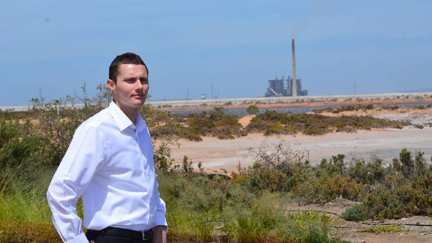
He said there’s no reason to consider putting nuclear power in Port Augusta, given the city is already leading the way in renewable energy.
“Why in the hell would we want nuclear power in Port Augusta when we’ve done so much work on renewable energy, in particular the solar thermal plant?” Mr Johnson questioned.
“We’ve had international experts actually say to us, why isn’t the government in Australia exploring renewable energy such as solar thermal given we have the best geographical climate in the world to do it?
“If the government wants to talk about nuclear, fine, happy to talk about it – but we’re already heading down a successful path…they can go and build the nuclear power plant in Unley or Norwood for all I care.”
Repower Port Augusta chairperson Gary Rowbottom suggested nuclear power is a higher risk option than renewable energy, and doesn’t see why it’s worth exploring when there’s a better option on the table for the city.
“Our current belief is that it is simply not required to take the risks and overcome all the implementation difficulties involved in ‘going nuclear’,” Mr Rowbottom said.
“We can substitute a suite of proven and developing renewable technologies in place of any need to go down the nuclear path…the commercial, health and environmental risks of nuclear are too high to justify it.
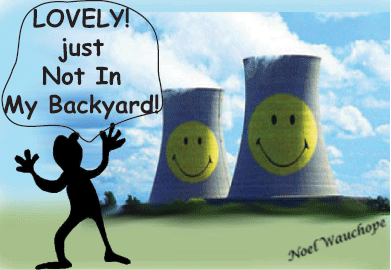 “It can be taken as somewhat offensive that the Port Adelaide/Enfield areas (Mr Johanson) are clearly saying that they are not prepared to have a nuclear reactor in their area but it is ideal and more convenient for Port Augusta to have one.”……
What do you think about having a nuclear reactor in Port Augusta?
Send your thoughts to the editor at ryan.smith@fairfaxmedia.com.au http://www.transcontinental.com.au/story/2903676/local-mayor-unhappy-with-city-counterparts-nuclear-comments/
Federal and State funding removed from top Northern Territory Environment Groups
End is nigh for NT environmental advocacy groups as funding runs out, ABC News 26 Feb 15 By Elliana Lawford Two environmental advocacy groups in the Northern Territory are set to close as government funding cuts announced last year start to bite.
The Environment Centre NT (ECNT) has told the ABC a number of staff were laid off last week and the centre has limited their operating hours from five to three days a week.
The organisation has led campaigns against uranium mining, pollution, gas exploration and water extraction licences. ECNT chair Tony Young said he was worried there would be no-one to fight for environmental issues in the Northern Territory if the centre closed.
“If there is no independent voice to point these things out then the problems continue and they are exacerbated,” he said. “The range and complexity of the environmental problems the Northern Territory faces really deserves a properly funded, independent, science-based voice … that’s what is in danger.”
The ECNT lost $185,000 in last year’s Territory budget.
The Environmental Defenders Office (EDO) is also struggling and has announced it will close on June 30, after it lost $450,000 in Federal Government funding. EDO chair Kirsty Howey said the office could not operate without financial help.
“With the cutting of federal funding at the EDO, we are looking at shutting the doors on June 30 this year,” she said.
“We just don’t have the money to survive any longer.”
NT Environment Minister Gary Higgins said he was unperturbed by the looming closures of the ECNT and the EDO……..
Labor spokeswoman Nicole Manison said both organisations were needed in the community.
“We need to have a full and independent voice for the government out there in the community,” she said.
“They bring up some pretty tough issues for governments and a good government would actually listen to them.”
Both organisations are still trying to secure independent funding that could delay their closures. http://www.abc.net.au/news/2015-02-26/environment-agencies-nt-for-the-chop/6262720
Senator Scott Ludlam on “new generation” nuclear reactors that “emit only unicorn dust”
Nuclear Industry On Trial? Scott Ludlam Hopes So, New Matilda, 26 Feb 15 “……The unthinkable consequences of a well-executed terrorist attack on an operating reactor or high-level waste store keep national security planners awake at night, with the potential for nuclear power plants to be used as pre-deployed radiological weapons by those with malevolent intent.
It seems likely that in the face of this evidence, the Royal Commission will see the industry play its last remaining card: an invitation to set aside the actual performance of existing reactors and imagine the potential of a new generation of nuclear technology: safe, clean, reliable, cheap, modular, proliferation-proof; reactors that consume only nuclear waste and emit only unicorn dust.
Forgive the scepticism: no-one has ever come remotely close to designing and building such a device, and commercial application of imaginary Generation IV reactors lies well over an indefinitely receding horizon; always just a few more years and decades away.
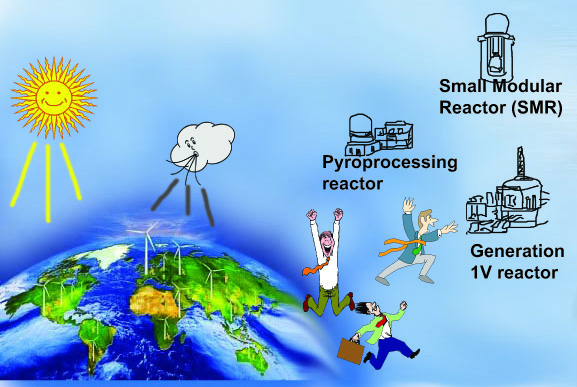
Perhaps more to the point, it may be that there are simpler ways to boil water or induce electrons to flow down a wire than the absurdity of plutonium-burning fission reactors cooled by liquid sodium.
Turning to face the timeless abundance of free solar energy presents a much simpler way forward. It is time that advocates of terrestrial nuclear power instead used their efforts to advocate for better use of the celestial nuclear reactor that sustains rather than threatens life on Earth.
The very qualities of scale, baseload delivery and centralisation that so appealed to energy planners of the 1950s make nuclear technology uniquely unsuited to the realities of the 21st century.
Emerging industrial economies like India, Africa and China’s rural hinterlands are vastly better served by decentralised renewable generators feeding local or regional-scale microgrids.
The plunging costs of solar, wind and micro-hydro generators are combining with cheap, decentralised energy storage technology – driven largely by developments in the IT and automotive industries – to drive the final nail into the fallen potential of nuclear power.
In March 2013 the cover and feature piece of the Economist magazine put the case succinctly: Nuclear Power – the dream that failed.
For the indefinite future, there will still be a need for reliable, dispatchable utility-scale power plants, but even here clean-technology has emerged to checkmate atomic energy: large-scale concentrating solar thermal plants have come online in Spain and the United States, paving the way for vastly more ambitious developments in South America and the Middle East combining cheap photovoltaics with heliostat fields heating overnight molten salt energy storage.https://newmatilda.com/2015/02/26/nuclear-industry-trial-scott-ludlam-hopes-so
Clean Energy Finance Corporation battles on, while Abbott governemnt determined to destroy renewable energy development
CEFC’s work was continuing, despite ongoing uncertainty over its own future.
 RET negotiations set industry back 12 years: Clean Energy Finance Corporation SMH, February 25, 2015 Lisa Cox National political reporter The Abbott government’s efforts to scale back the renewable energy target (RET) have set the industry back 12 years, a Senate estimates hearing has heard.
And the government has told senators it will still pursue the abolition of the Clean Energy Finance Corporation (CEFC), despite accepting advice from the agency on achieving emissions reductions through its direct action policy. Continue reading
AUDIO: EU wants USA, China, Australia to join global climate agreement

 AUDIO: EU pressures US and China to join global climate agreement ABC Radio, The World Today ,David Mark reported this story on Thursday, February 26, 2015 ELEANOR HALL: The European Union (EU) has ratcheted up pressure on the United States and China to join a global climate agreement.
Overnight the EU released its target for greenhouse gas reductions ahead of a meeting later this year in Paris.
It’s committing to reducing emissions by at least 40 per cent over 1990 levels by 2030 as David Mark reports.
DAVID MARK: The US and China made some commitments to greenhouse gas reduction targets at the APEC (Asia-Pacific Economic Cooperation) meeting in Brisbane last year.
Now the EU has announced specific targets – its member countries will reduce greenhouse gas emissions by 40 per cent by 2030 over 1990 levels.
Overnight the EU released its target for greenhouse gas reductions ahead of a meeting later this year in Paris. It’s committing to reducing emissions by at least 40 per cent over 1990 levels by 2030 as David Mark reports.
DAVID MARK: The US and China made some commitments to greenhouse gas reduction targets at the APEC (Asia-Pacific Economic Cooperation) meeting in Brisbane last year.
Now the EU has announced specific targets – its member countries will reduce greenhouse gas emissions by 40 per cent by 2030 over 1990 levels……
ERWIN JACKSON: Well, I think the momentum is towards having a core agreement in Paris which is legally binding, which does ensure that countries come forward and have national targets………
Significant omissions from the Terms of Reference for the SA Nuclear Royal Commission

Will anyone take this Royal Commission seriously?
 Some Significant omissions from the Terms of Reference for the SA Nuclear Royal Commission Margaret Beavis 25 Feb 15,
Focus on Mining expansion only
No mention of old mines and contaminated areas
No mention of water issues- huge supply required for reactor and risks of contamination of waterways and aquifers. SA is a dry state.
Opportunity cost of focussing on nuclear industry instead of becoming world leader in renewables
Ignores high cost of nuclear power compared to other sources
Large subsidies needed from government preventing spending on other important issues
Lack of financial/professional conflict of interest declarations being required from all witnesses and commission members
No mention of health impacts of radiation
No provision for how state would respond to Fukushima type scenario from accident/deliberate damage
No mention of possible impacts on SA tourism, food and wine exports (especially fisheries)
Vast majority of medical waste has a very short period of radioactivity and is not the main reason for a dump.
Conservation Council of South Australia : points on Terms of Reference for the Royal Commission.

 If the Royal Commission is to be a genuine inquiry, the draft terms of reference need significant revision. Otherwise it will lack credibility.
The Adelaide Advertiser misleads public on medical nuclear isotopes
The Editor
The Advertiser
Your correspondent Phil Day (The Advertiser, 24/2/15) is a victim of those nuclear industry spin doctors who try to use nuclear medicine to justify the use of nuclear reactors.
The nuclear waste that is being considered for dumping in South Australia does not come mainly from medical grade isotopes, it comes from nuclear power stations and from facilities for producing the fuel for nuclear power stations and nuclear weapons. The nuclear waste from medical grade isotopes is comparatively trivial.
I also hope I never need a CAT scan or X-ray because both use ionising radiation. However, neither CAT scans nor X-rays use radioactive isotopes or produce nuclear waste and hence their use to justify generating and importing nuclear waste is misleading.
Dennis Matthews

1 This month
17 October, Free Public Talk on Nuclear Issues in South Australia
David Noonan will speak on public interest concerns over the new Roxby Downs Indenture Act 2026 on BHP copper-uranium mining and ore processing in SA, and on how AUKUS may face SA with a High-Level nuclear waste agenda.
Dr Jim Green will discuss international developments in the field of nuclear power including ‘small modular reactors’ and Generation 4 ‘advanced’ nuclear reactor concepts.


Help Aunty Sue Protect Her Land and Sacred Sites From Destructive Rocket Testing.
.

Australians deserve the truth
about
AUKUS – https://aukuspublicinquiry.com/
PETITION – To: Prime Minister Anthony Albanese and the Australian Labor Government

of the week – Australians for War Powers Reform (AWPR)
To see nuclear-related stories in greater depth and intensity

