Nuclear waste generated at Lucas Heights is a very small amount – Ziggy Switkowski
 Nuclear waste dump needed, SA could fill gap, ABC Radio P.M February 23, 2015 Natalie Whiting reported this story
“……….NATALIE WHITING: Is the Federal Government going to need a sight for waste storage earlier than when we might see this royal commission wrap up?
NATALIE WHITING: Nuclear fuel rods from France are set to be returned to Australia before the end of the year
More nuclear waste, which is being reprocessed in the UK, will be sent back by 2020……”http://www.abc.net.au/pm/content/2015/s4185584.htm
South Australia’s Royal Commission should investigate the costs of uranium mining
The draft terms of the reference for the royal commission, released on Monday, are focused on nuclear power generation, uranium enrichment and waste storage. But the government has ruled out scaling back the state’s involvement in uranium mining, while also precluding the use of nuclear for military purposes.
Australian Conservation Foundation spokesman Dave Sweeney says the decision to exclude consideration of uranium mining is deeply disappointing. “The nuclear industry starts with uranium and so should any genuine assessment of the nuclear sector in South Australia,” he said.
Continuing process of removing Aboriginals from their land, making way for mining
 Aboriginal people driven from their land Green Left, Friday, February 20, 2015 By Emma Murphy “…………..It is now eight years since the Howard Coalition government launched its appalling intervention into NT Aboriginal Communities — the NT Emergency Response package. While the intervention may seem like old news, it continues to be raised as an example of the increasing neoliberal offensive against Aboriginal people’s right to their own land, identity, and self-determination.
History certainly did not stop in 2007 when the intervention started. Aspects of the intervention, such as income management and increased police presence, have continued and there have been many more attacks as well, not just in the NT, but across the country.
The intervention and policies banning bilingual education and undermining NT homelands, were really about launching an attack on Aboriginal identity and culture. They were about undermining a way of life that really isn’t compatible with capitalism; a way of life that involved collective property rights and aspirations other than home ownership and careers. It is a way of life that embraces multilingualism, sustainability and quite often strong opposition to the extractive resource industry.
Many of the policies in the NT were seen, in one way or another, as forcing Aboriginal people off their land, whether to free up resource-rich land for the extractive industries or to push remote Aboriginal people into larger, more “viable” service hubs.
Right now in Western Australia, Aboriginal people living in remote communities are facing a similar disastrous social experiment. The Barnett government has foreshadowed the closure of more than 100 remote communities. Continue reading
The Greens have a renewable energy vision for New South Wales


 Greens’ Clean, Renewable Energy Vision For NSW http://www.energymatters.com.au/renewable-news/greens-renewable-energy-em4699/ February 24, 2015
Coal and gas fired electricity generation in NSW generates 60 million tonnes of carbon emissions annually, making the state one of the most carbon-intensive economies in the world.
The Greens’ plan includes partnering with households to support the transition away from coal-fired electricity and gas to rooftop solar, energy efficient equipment and intelligent energy trading and management.
The plan would see the creation of public sector energy agencies to provide financial support and technical advice, investment in a “smart grid” and keeping the network in public hands.
“Transformation of the state’s energy industry is inevitable,” stated Greens NSW MP John Kaye, who said it was important this process begins as soon as possible. “Premier Mike Baird’s plans will to pass control of much of the electricity network to private hands would create political and financial barriers to the remaking of the network.”
The Greens say their energy vision would slash household power bills and break the stranglehold of big private-sector energy corporations. They envision an electricity sector where households and businesses would trade roof top solar electricity and other renewable sources across a publicly-owned network.
Pursuing a 100% renewable energy based New South Wales would also create a clean power jobs boom. While there are just 1,800 jobs in NSW’s coal-fired power stations and approximately 4,000 in mining the coal these facilities burn, more than 70,000 new jobs could be created in NSW in clean energy.
The Greens state much of the $17 billion investment in electricity transmission and distribution since 2009 in New South Wales has been in the wrong kind of technology, locking the state into a centralised and expensive supply based on coal and gas.
“A 100% renewable energy NSW is possible, affordable and essential. But it will not happen as long as the old parties remain committed to coal and gas and continue to frustrate and undermine wind and solar,” says the party.
Is classroom exposure to electromagnetic radiation a danger to kids?
Something in the air By: Elissa Lawrence Feb 15 Courier Mail
IT MAY be invisible but it’s everywhere — in our homes, parks, workplaces, shopping centres, hotels and schools.

Wi-fi has become a way of life — accepted, convenient and fundamental to how we live.
A type of electromagnetic radiation — the same as emitted from mobile phones — wi-fi, shorthand for “wireless fidelity”, is a means for computers, smart phones and other devices to wirelessly connect to the internet or communicate with each other. Data is transferred via radiofrequency electromagnetic fields (RF-EMF) instead of through wires. Wi-fi has the same frequency and wavelength as the microwaves used in ovens, but is not contained within a closed unit, routers are usually permanently switched on, and they have a range of 30 metres or more.
The technology, which took hold in the early 2000s, is now widely seen as integral to education. All Queensland state schools have wi-fi access and there is a widespread rollout across schools of Bring Your Own Device schemes, starting in many primary schools from grade four.
But a growing body of researchers, educators and parents is concerned about the future effects of exposing children to long hours of wi-fi. In 2011, RF-EMF were classified by the World Health Organisation’s International Agency for Research on Cancer as a 2B carcinogen, or “possibly carcinogenic to humans”, Continue reading
Australian governments’ political risks in promoting the really quite marginal uranium industry
Given that Australia’s uranium mining and export accounts for less than 1 percent of its hundred billion dollar mineral export business (iron ore, bauxite, coal, copper, nickel etc),36 however, these decisions by Australian leaders risked significant political capital over what has been a highly contentious issue in Australia’s recent political history
Undermining Nuclear Non-Proliferation: Energy and Security Politics in the Australia-India-Japan-U.S. Nuclear Nexus 核不拡散の土台崩し オーストラリア·インド·日本·米国間におけるエネルギーと安全保障政策 The Asia-Pacific Journal, Vol. 12, Issue 46, No. 2, November 1, 2014 Adam Broinowski “……Until 2014, along with China, Japan has also seen a boom in mostly solar and wind electricity generation. But this has been stalled by utilities who have refused to take an influx of renewable power into the grid or to reduce electricity prices.10 With fewer nuclear plants scheduled for construction around the world than for shutdown, however, the nuclear industry faces the likely prospect of contraction11 and replacement by rapidly advancing renewable energy options, including solar, wind, tidal, hydro and possibly geothermal power over the longer term.
Despite this gloomy prognosis for the uranium sector, confidence began to return to the uranium mining industry in Australia from late 2012. Continue reading
Australian Aboriginals’ widespread resistance to fracking
Australia Needs New Approaches to Fracking http://firstpeoples.org/wp/australia-needs-new-approaches-to-fracking/ Fracking in Australia continues to meet widespread resistance from Aboriginals. In Western Australia, Buru Energy’s negotiations with traditional landowners in the Canning Basin have been largely unsuccessful, and communities are organizing camp outs to stop the company. In Queensland, the weakening of environmental protections has prompted the Mithaka Peoples to go the UN Special Rapporteur on the Rights of Indigenous Peoples, claiming that “Australia has taken no action to ensure that we are consulted and involved in these decisions, or to protect our rights to our culture.” In the Northern Territory, communities have formed the Northern Territory Frack Free Alliance to oppose the drilling of boreholes and wells near aquifers.
The Australian government is attempting to circumvent these groups with legislative and regulatory changes. While this may accelerate the issuance of permits in the short term, Australia cannot expect to develop a sustainable oil economy without Aboriginal support, and will need to drastically shift its approaches to fracking on Aboriginal territories.
This post is excerpted from First Peoples Worldwide’s Corporate Monitor, a monthly report on key trends affecting companies interacting with Indigenous Peoples. To sign up for monthly e-mail updates, click here.
The next step in South Australia’s Nuclear Farce
OK – Now it has turned up on http://yoursay.sa.gov.au/blogs/draft-terms-of-reference
 The Premier’s media release says that you can find the Terms of Reference at www.yoursay.sa.gov.au.
I couldn’t find anything there about the subject. Perhaps later?
Symptomatic of the clumsy and inept rush that characterises this tacky Royal Commission idea.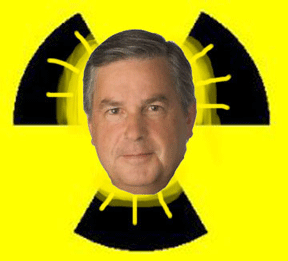
Also no mention of personnel – other than the pro nuclear former S.A Governore Kevin Scarse. (at right) Independent, my foot!
Anyway – here are the Draft Terms of Reference Continue reading
South Australia’s Premier Jay Weatherill announces the Terms of Reference for Royal Commission
Nuclear royal commission draft terms of reference announced by SA Premier Jay Weatherill http://www.abc.net.au/news/2015-02-23/nuclear-royal-commission-terms-of-reference-jay-weatherill/6224192 South Australia’s nuclear royal commission is to inquire into enrichment, storage of waste and power generation, but not uranium mining.
The State Government has r eleased draft terms of reference and announced there would be public consultation until March 13.
Premier Jay Weatherill said the inquiry would focus on three key areas, but the terms of reference had deliberately been kept general.
“These are the broadest possible terms of reference … they won’t be settled for a further week,” he said.
“The only caveats really are the non-military uses will be the only things explored and it’s not our intention to suggest any retreat from the current involvement in uranium mining.”
The Premier said it would be the broadest possible analysis of South Australia’s involvement and potential for future involvement in the nuclear fuel cycle.
“We think it’s important to go through what is a thorough process of debate and discussion in the community about this important issue,” he said.
When asked if the state were mindful of a looming federal deadline to deal with the issue of nuclear waste storage, he said: “We don’t think this is something that should be rushed.
“The Commonwealth’s been talking about nuclear waste storage for decades so I don’t think our timeline is going to threaten any key decisions.”
Before the year is out, nuclear fuel rods that are being reprocessed by the French are due to be returned to Australia and by 2020 more nuclear waste being reprocessed in the United Kingdom is due to be returned as well.
A Dangerous Farce – South Australia’s Nuclear Royal Commission
 SA nuclear royal commission a farce, Independent Australia 22 February 2015 The South Australian government’s royal commission into our nuclear future is a farce, and a dangerous farce, warns Noel Wauchope.
FIRST OF ALL, it is not the province of one State to determine by a State royal commission that a nuclear industry should be introduced in Australia. That is a protected issue as a ‘A Matter of National Environmental Significance’ under the National Environment Protection and Biodiversity Conservation Act 1999.
Secondly, this royal commission would be a mammoth waste of money for South Australia The cost would run into hundreds of $millions. The Royal Commission into Institutional Responses to Child Sexual Abuse was allocated over $434 million in 2013 for its first four years of operation. Given that nuclear issues are the province of national law, not South Australian, this is a totally unnecessary expense.
Thirdly, the ‘public involvement‘ in the terms of reference for this royal commission is a farce in itself. Just look at how this was dealt with by the South Australian government:
8 February:
The announcement was made. Despite the fact that this whole initiative is clearly of national importance, it has received minimal publicity outside Adelaide. The Adelaide Advertiser ran a poll. The Adelaide Advertiser is pretty much regarded as the nuclear lobby’s free propaganda vehicle. No surprise if their readership turns up the required positive result.
9 February:
Consultations began on the Terms of Reference for the royal commission. Premier Jay Weatherill touted nuclear power for climate change action, though he said it was not economically viable. The better options, he said, were importing and storing radioactive waste, and uranium enrichment.
Pro-nuclear former governor, Kevin Scarce, was appointed as “independent” head of the inquiry. No mention of what scientists, etc. might be on the panel.
16 February:
(closing day for comments on the Terms of Reference for the royal commission)
There is no need for a royal commission into the nuclear industry for Australia. Nuclear proponent, Ziggy Switkowski, concluded in the 2006 Switkowski Report that the industry is not economically viable here. Nuclear reactors often far exceed their construction budgets. The last nuclear power plant built in Canada cost AUD$15.1 billion.
Mr. Switkowski predicted the capital cost at $4-6 billion for our first 1000MWe reactor.
However, we already know that, despite some pious statements by Jay Weatherill about nuclear power’s ability to reduce greenhouse gas emissions, action on climate change is not the motivator for this new inquiry.
According to a report by The Australian on 10 February 2015:
‘He [Premier Jay Weatherill] said he was open to the prospect of remote parts of the state hosting a nuclear waste deposit but played down the prospect of a power plant being built.
“I think that’s the least likely outcome of the royal commission,” he told ABC radio on Monday.
“I think what’s most likely is that it will be regarded as not viable for either the state or the nation.” ‘
In the same interview on ABC’s The World Today, Weatherill’s enthusiasm for storing the world’s nuclear waste is clear: ……..https://independentaustralia.net/environment/environment-display/sa-nuclear-royal-commission-a-farce,7399
Dirty, Unsafe, Unsound, Uneconomic – yes – that’s the nuclear industry chain
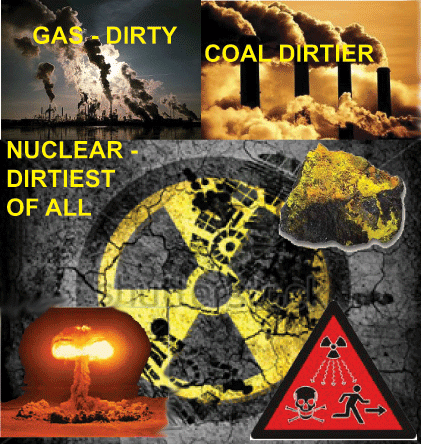
The case to expand the nuclear industry in South Australia and the world is weak. It stands neither on its life-cycle carbon dioxide emissions, nor increased safety, nor economy. New nuclear technologies under construction are far over budget and over time. Future nuclear technologies are not close to being commercially available.
These and other nuclear issues are discussed in more detail in Chapter 6 of my bookSustainable Energy Solutions for Climate Change.
Uncritical acceptance of the claims of nuclear proponents would set back safer, cleaner, faster and cheaper methods of mitigating climate change.
 Nuclear Energy Is Dirty, Unsafe And Uneconomic: Environmental Scientist https://newmatilda.com/2015/02/21/nuclear-energy-dirty-unsafe-and-uneconomic-environmental-scientist by Dr Dr Mark Diesendorf , Associate Professor and Deputy Director within the Institute of Environmental Studies at the University of NSW..At present there is no market for expanding South Australia’s uranium mining and exports. In 2012, BHP Billiton put on hold its expansion plan for the Olympic Dam uranium-copper mine and since then has shed hundreds of jobs. That there is an excess of uranium enrichment capacity in the world is even acknowledged by the World Nuclear Association.
And, as explained below, wind energy is already much less expensive than nuclear and, on current trends, large solar power stations based on photovoltaic modules will also be cheaper within the 15-year period that it would take to plan and build a nuclear power station in Australia.
We should add to the 15 years the indefinite time-period it would take to gain public acceptance.
Looking beyond South Australia to the world, there seem to be three shaky legs upon which proponents attempt to stand their campaign to expand nuclear energy:
1. Nuclear energy has allegedly no or low greenhouse gas emissions.
2. New nuclear reactor technologies are allegedly safer than the present generation of reactors.
3. New and existing reactors are allegedly cheaper than other low-carbon technologies, notably renewable energy.
Let’s examine these claims. Continue reading
Some solar panels are shoddy quality: vast majority are good quality

 Solar experts claim multi-billion dollar subsidies wasted on cheap and dodgy panels, The Age February 22, 2015 Heath Aston Political reporter More Australians are buying cheap rooftop solar panels that fail long before their promised lifespan, prompting claims a federal rebate scheme needs to be overhauled to prevent dodgy systems receiving public subsidies.
Solar industry experts say lax rules covering the scheme – which provides incentives of up to $4350 for a $5500 rooftop system – mean it is not always delivering the environmental benefits promised.
They blame an explosion of cheap, mainly Chinese-produced solar panels that have flooded the market over the past five years that are failing to provide the 15 years of clean power expected. Installers in four states told Fairfax Media that the worst systems stopped working within 12 months, with others “falling apart” within two or three years.
Clean Energy Council chief executive Kane Thornton played down the scale of failures and warned against blaming production faults on systems from one country.
He said the “Chinese success story” had led to prices for solar tumbling dramatically, allowing more households to invest in green energy.
“If someone is getting a subsidy there is an expectation that the benefit to the environment and society equals or outweighs that cost. There are cases of systems not running for 15 years and people have got rid of them, but from our point of view most will run for 25 years,” he said.
“There are cases that come up just like in any industry, but failure rates are low.”…….
Nigel Morris, a solar industry analyst and consultant to the Clean Energy Council, said he wasn’t aware of any statistics that showed a widespread problem.
“Is the industry perfect? Absolutely not. Do we occasionally have quality issues with product and installations? Yes, we do … There is evidence to say it is not endemic.” http://www.theage.com.au/environment/solar-experts-claim-multibillion-dollar-subsidies-wasted-on-cheap-and-dodgy-panels-20150221-13kqub.html
A recent Choice survey found, while more than 80 per cent of solar system owners were satisfied with what they had bought, 17% of owners of Chinese-made solar systems and 11 per cent of those with a German inverter had experienced problems of some kind.
South Australia faces choice of a Renewable or a Radioactive future
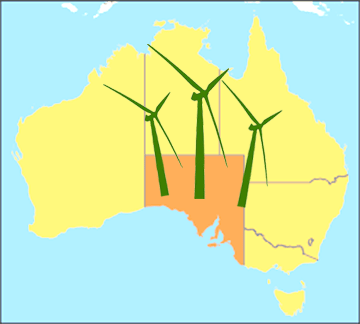
Rather than make SA a hub for renewable energy and other sustainable technologies (the state already derives 26 percent of its energy from wind power), the corporate board rooms are determined to press ahead with the most dangerous “alternative” available.
 The Murdoch press, which previously defended the state from the imposition of a nuclear waste dump, has changed its tune accordingly. Its pages, usually dominated by climate change denying pens-for-hire, now carry bogus “carbon-free” claims for the water-guzzling, weapons proliferating, tax-payer supported nuclear power industry.
The Australian Financial Review refers to opponents of the nuclear industry as the “loony, left-progressive class”. The same editorial says the locating a dump for the world’s nuclear waste in SA would be an “act of good global citizenship” given that we supply the uranium. The dishonesty of this position is plain. A good global citizen wouldn’t have supplied the uranium in the first place.
 A renewable or radioactive future http://www.cpa.org.au/guardian/2015/1673/02-editorial.html South Australian Premier Jay
  Weatherill’s announcement that there will be a Royal Commission into the extension of the nuclear industry into enrichment, waste storage and nuclear power has rocked the state and sent shock waves across the country.
The Labor Party reversed its anti-uranium mining stance in the 1980s with a promise to limit to three the number of mines extracting and exporting the radioactive material. Kevin Rudd later lifted the cap to five. Widespread security and safety concerns in the community meant that political leaders had to step carefully in advancing the interests of the uranium industry.
Long decades of pressure from the industry via lobbyists, servants in academia, the media and the bureaucracy appear to have changed all that. There have always been advocates of hosting the riskier parts of the nuclear cycle, including nuclear-powered vessels and even nuclear weapons, but their views were considered extreme and hawkish. The SA Premier’s choice of an open-ended Royal Commission to inquire into the matter appears to be an effort to make the impending policy shift appear “scientific”, “arm’s length” and “impartial”. Continue reading
Australia sleep-walking into a bad deal with the secretive Trans Pacific Partnership
An Australian National University study of the US-Australia Free Trade Agreement found there was very little in it for Australia. A recent US department of agriculture study found it would deliver a zero economic benefit to Australia and a zero economic benefit to the United States. For smaller nations the economic benefits are bigger which may explain why they are eager to join and why the US is driving a hard bargain on intellectual property and the rights of its pharmaceutical industry
 Trans Pacific Partnership. What’s the deal being negotiated in our name?, SMH, February 21, 2015 Peter Martin When The Lancet and the Australian Medical Journal editorialise against Australia’s next free trade agreement it’s a fair bet they are concerned about more than just trade.
The Trans Pacific Partnership is the biggest free trade agreement hardly anyone’s ever heard of. Bubbling along below the radar for half a decade, it’s about to become solid. It is set to deliver much more money and power to US pharmaceutical companies, to criminalise the use of technology in ways that presently don’t attract jail time and to set up outside tribunals to reconsider decisions already made by Australian courts. Continue reading
In Lismore a new political party starts off – to tackle climate change
Political party forms in Lismore to tackle climate change Darren Coyne, Echo Net Daily, 19 Feb 15, A new political party focused on tackling climate change is being formed by a group of north coast residents. The Renewable Energy Party plans to stand candidates in every state and territory at the next Federal election in 2016.
Following a meeting at the Lismore Worker’s Club this week, the political hopefuls announced they were in the process of signing up the 500 members required to form the party.
Campaign manager Jim Moylan said membership was not likely to be a problem. ‘Aussies are really passionate about climate change,’ Mr Moylan said.‘Our Facebook page has gone-off like a skyrocket. All we did was set up a news-feed to climate change news – and a big audience appeared.’
Mr Moylan told Echonetdaily that the micro-party would act as ‘better angels’ to The Greens and other left-leaning parties……..
Party founder Peter Breen, a former independent member of the New South Wales Parliament, and a former member of both Labor and the Liberal parties, will be national coordinator of the party. Mr Breen, a resident of Byron Bay, said the party had good prospects.‘Of course they will take us seriously. We are well funded, well organised and mainstream,’ Mr Breen said.
‘We have advertising people, political insiders, fund-raisers, social media specialists and other professionals.
‘The Renewable Energy Party wants science and the public interest to dictate the terms of the climate debate – not coal, gas and oil companies.’

Following the Lismore meeting, the fledging party released the following statement.
‘Renewable energy needs grass roots representation. More than a million households in Australia now use solar energy and we are getting a very bad deal from the major energy companies who all own coal mines.
‘Currently, Australians are paying as much as $1,000 per year for electricity and gas connections – before we even turn on our appliances. On top of that, the major energy companies pay 6 to 8 cents for solar power exported to the grid while charging four times that amount for customers to buy it back”
‘In the UK, politicians are talking seriously about phasing out fossil fuels, but Australian politicians are talking about phasing out renewable energy. The Renewable Energy Party hopes to bring a consumer’s perspective to the debate in Australia.’
‘The Renewable Energy Party will speak on behalf of the many Australians who believe that climate change is simply the most important issue we face. We support the 97 per cent of climate scientists who say man-made climate change is real and we need to do something serious about the predicted global temperature rise.
‘According to the International Monetary Fund, Australia’s implicit subsidies to oil, coal and gas companies are worth 1.8 per cent of GDP, or about $23 billion annually. Subsidies to the renewable energy industry are small beer by comparison.
‘The Renewable Energy Party has been formed to highlight the differences between the favourable treatment given to the fossil fuel industries by government and the difficulties faced by the emerging renewable energy industry.
‘It is also a fact that renewable energy creates more jobs per unit of energy delivered than fossil or nuclear fuels. Action on climate change is our best hope for better present and a more promising future,’ the statement concluded.http://www.echo.net.au/2015/02/political-party-forms-lismore-tackle-climate-change/
1 This month
17 October, Free Public Talk on Nuclear Issues in South Australia
David Noonan will speak on public interest concerns over the new Roxby Downs Indenture Act 2026 on BHP copper-uranium mining and ore processing in SA, and on how AUKUS may face SA with a High-Level nuclear waste agenda.
Dr Jim Green will discuss international developments in the field of nuclear power including ‘small modular reactors’ and Generation 4 ‘advanced’ nuclear reactor concepts.


Help Aunty Sue Protect Her Land and Sacred Sites From Destructive Rocket Testing.
.

Australians deserve the truth
about
AUKUS – https://aukuspublicinquiry.com/

PETITION – To: Prime Minister Anthony Albanese and the Australian Labor Government

of the week – Australians for War Powers Reform (AWPR)
To see nuclear-related stories in greater depth and intensity

