Cabinet papers 1988-89; Bob Hawke and the Aboriginal Treaty that never came
Cabinet papers 1988-89 SMH: Aboriginal Treaty SMH Damien Murphy 1 Jan 15 “……...The treaty that never came Bob Hawke attended the Barunga festival in the Northern Territory in June 1988 and promised an historic treaty with the Aboriginal people.
 The Hawke government had been promising to improve representation of Aboriginal interests and issues, but by 1985 attempts to frame a “national model” for land rights had stalled in compromise, amid farmer and miner opposition and distrust from Aboriginal groups. So Hawke’s treaty had more than a touch of the sun about it. Continue reading
PM Tony Abbott close to signing the secretive Trans Pacific Partnership
 Will Tony Abbott to stand up for Australia on the TPP? http://action.sumofus.org/a/australia-tpp/2/2/ Abbott’s government has confirmed they’re getting ready to crack down on internet freedom to comply with the TPP — including a “three strikes” provision that forces ISPs to monitor and police our activity online.
Tony Abbott’s trade minister is about to sign a secret, global pact to allow corporations to sue the Australian government for billions — just for passing laws to protect our health or the environment.
Tony Abbott wants us to believe the 12-country Trans-Pacific Partnership (TPP) is all about getting a better deal for ordinary Australians. But the truth is that it could end up being one of the biggest corporate power grabs in a generation.
Abbott and his cronies are refusing to make the deal public (although corporate lobbyists seem to be getting the inside track) — making it hard to know just what’s in the TPP. But leaks so far indicate this is bad news. That’s why Tony Abbott wants it to stay confidential — he’d prefer to quietly sign away our rights without a big fuss.
This deal is too important to leave to the politicians: it could affect the lives of Australians for generations to come. Continue reading
Australia’s high skin cancer rate: banning of tanning beds is welcome
Australia Launches Tanning-Bed Ban To Tackle High Cancer Rate http://www.ibtimes.com/australia-launches-tanning-bed-ban-tackle-high-cancer-rates-1770926 1 Jan 15 By Shuan Sim @ShuanSim s.sim@ibtimes.com on December 31 2014 Indoor tanning fans in Australia will soon have to go outdoors for a golden skin tone after their tanning beds are switched off because of a nationwide ban taking effect on Thursday. The ban, which the government has been planning since October 2013, is part of an ongoing effort to tackle the country’s skin cancer rate, one of the highest in the world.
The crackdown on tanning beds will take effect in five of Australia’s six states, and one of two territories – New South Wales, Victoria, South Australia, Tasmania, Queensland and the Australian Capital Territory. Western Australia said it will also ban tanning beds, but hasn’t announced a start date. The legislation does not affect the Northern Territory because there are no commercial tanning bed facilities in that part of the country.
Australia has one of the highest skin cancer rates in the world, affecting two out of three Australians by the age of 70. Continue reading
12 months of Nuclear Free Action in Australia
December sees action in the Top End with spirited protests over uranium and fracking concerns outside the MCA’s NT mining conference and 4000 formal public submissions opposing the R3D plan, ICAN holds a successful set of gatherings on the humanitarian impacts of nuclear war in Vienna – including a presentation from Sue Coleman Haseldine and an open letter from ENGO’s to Julie Bishop, Energy Metals Australia move to seek approval to mine Mulga Rocks – but Mia Pepper is in the way, the long waited for Olkala land handover in Cape York see’s further constraints put on Areva’s plans to dig, PM Abbott flags uranium sales to Ukraine – from the land that fuelled Fukushima to the country that is home to Chernobyl, Barry Brook leads a call for nuclear power to be accepted by ENGO’s, Minister Macfarlane accepts that the push through approach to dump siting has failed and announces modest public input into a new model.
 Nuclear Free snapshot 2014 Dave Sweeney, Australian Consevation Foundation, 31 Dec 14 January started with Top End storms washing out a section of the Ghan rail line and further highlighting transport risks with hazardous materials, concerns over the spectacular December 2013 uranium slurry spill at Ranger mine remained high and around 4000 people gathered in Redfern for the opening of John Pilger’s film Utopia
In February the Muckaty Federal Court case had detailed directions hearing in Melbourne, a delegation of MP’s from Greenland heard directly about the impacts of uranium mining on country and culture when they were briefed by ACF, FoE and Gundjeihmi while on a fact finding mission, mid-month saw activists from WA and beyond meet in Perth for an effective planning session aimed at keeping the West uranium free, the CCWA led a series of workshops to facilitate public engagement with the Kintyre mine approvals process and also drove a detailed response from national groups while Scott Ludlum took time off from electioneering to join a nuke free session at Melbourne’s Sustainable Living festival, Paladin put the Kayelekera mine in Malawi on care and maintenance, Uranium Free NSW activists lodged formal objections to the Dubbo Zirconia project and after making the Black Mist publication pozible and reminding Peter Costello and the Future Fund that there is no future in nuclear weapons ICAN reps took the nuclear weapons abolition message further with a successful conference in Nayarit (Mexico)
March saw the annual national nuke free strategy and planning gathering with crew from around the country Continue reading
Trade In Services Agreement another secretive deal like the Trans Pacific Partnership
 The Trade In Services Agreement Goodbye Privacy, Hello Censorship CounterPunch
Yet another tentacle in the octopus of multi-national corporations’ attempt to achieve dictatorial control, the Trade In Services Agreement (TISA) is intended to eliminate government regulations in the “professional services” such as accounting and engineering but goes well beyond that, proposing sweeping de-regulation of the Internet and the financial industry.
Another snippet of TISA’s text has been leaked, this time by the freedom-of-information organization Associated Whistleblowing Press. Continue reading
Liberal MP contradicts Abbott on coal (but doesn’t mention renewables)
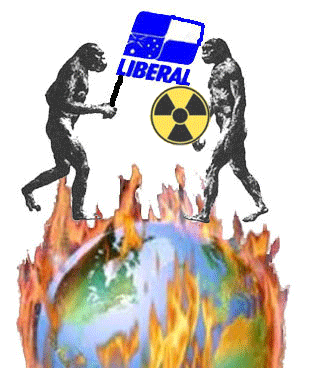 Liberal MP rebukes Abbott on coal and says gas is the future for developing nations SMH December 30, 2014 Latika Bourke One of the Liberal Party’s rising stars has rebuked Prime Minister Tony Abbott’s claim that coal is the key to providing developing countries with low-cost energy.
NSW Liberal MP Angus Taylor, who was elected the member for Hume in the 2013 election, says gas is the better way to reduce carbon emissions and supply countries such as China and India with the energy they need to continue their rise……….
Mr Taylor’s comments put him at odds with Mr Abbott, who has repeatedly insisted that coal is “good for humanity” and the “foundation of prosperity” for “now and the foreseeable future”, because it is cheaper.
Recently, Foreign Affairs Minister Julie Bishop said any honest conversation about reducing Australia’s domestic emissions had to include a debate about nuclear power, describing it as an“obvious direction” for a country blessed with uranium supplies. http://www.smh.com.au/federal-politics/political-news/liberal-mp-rebukes-abbott-on-coal-and-says-gas-is-the-future-for-developing-nations-20141230-12fg3k.html
Australian government’s budget cuts threaten remote Aboriginal communities
Aboriginal communities under threat Ft.com December 26, 2014 Jamie Smyth in Sydney Dickie Bedford was born in the 1960s at a time when thousands of aboriginal people were being evicted from pastoral cattle stations. Half a century later a new generation of indigenous Australians faces a similar fate as budget cuts threaten to close hundreds of remote communities.
“They will turn us into fringe-dwellers again if they go ahead with these closures,” says Mr Bedford, executive director of the Marra Worra Worra aboriginal corporation in Western Australia.
“Withdrawing municipal services from these remote communities will force people to move into overcrowded hub towns where they are much more likely to encounter drugs, alcohol and family dysfunction,” he says.
Western Australia has warned that 150 of its 270 remote indigenous communities may have to close as the state cannot afford to pay for road, power, water or waste services. A further 60 aboriginal communities in South Australia are under threat as the federal and state government argue over who should fund basic services.
About 16,000 indigenous people live in these remote communities, which have received federal government funding for more than 50 years. Tony Abbott, Australia’s prime minister, has decided to phase out federal funding and shift responsibility to state governments following final one-off payments of A$90m (US$73m) to Western Australia and A$10m to South Australia………
In May, the federal government unveiled the toughest budget in two decades, which included a A$500m cut in aboriginal funding programmes, to tackle a $48.5bn budget deficit. Western Australia, which is heavily dependent on taxes from mining companies, is selling state assets and considering spending cuts.
Advocacy groups say aboriginal people, already the most marginalised group in society, are bearing the brunt of the tougher economic climate. They say the threat to close hundreds of communities harks back to an earlier era when indigenous people were forced from their land by white settlers following a court ruling that they must be paid a basic wage.
“Forcing aboriginal people to move from their communities is a form of cultural genocide,” says Tammy Solonec of Amnesty International Australia………..
The National Congress of Australia’s First Peoples, an advocacy group, has written to Mr Abbott urging him to intervene.
A federal government spokeswoman said the issue was a matter for states to settle.
South Australia’s government is resisting the federal government’s decision to withdraw services, accusing it of using “gun-toting” tactics to force states to accept “insulting” final payments from Canberra. ………http://www.ft.com/cms/s/0/f12f376c-81ba-11e4-b9d0-00144feabdc0.html#axzz3N84itvYv
Grim reality of government moves to get Aborigines off their homelands
Aboriginal communities under threat Ft.com Jamie Smyth in Sydney December 26, 2014 Dickie Bedford was born in the 1960s at a time when thousands of aboriginal people were being evicted from pastoral cattle stations. Half a century later a new generation of indigenous Australians faces a similar fate as budget cuts threaten to close hundreds of remote communities.
“They will turn us into fringe-dwellers again if they go ahead with these closures,” says Mr Bedford, executive director of the Marra Worra Worra aboriginal corporation in Western Australia.
“Withdrawing municipal services from these remote communities will force people to move into overcrowded hub towns where they are much more likely to encounter drugs, alcohol and family dysfunction,” he says.
Western Australia has warned that 150 of its 270 remote indigenous communities may have to close as the state cannot afford to pay for road, power, water or waste services. A further 60 aboriginal communities in South Australia are under threat as the federal and state government argue over who should fund basic services.
About 16,000 indigenous people live in these remote communities, which have received federal government funding for more than 50 years. Tony Abbott, Australia’s prime minister, has decided to phase out federal funding and shift responsibility to state governments following final one-off payments of A$90m (US$73m) to Western Australia and A$10m to South Australia………
In May, the federal government unveiled the toughest budget in two decades, which included a A$500m cut in aboriginal funding programmes, to tackle a $48.5bn budget deficit. Western Australia, which is heavily dependent on taxes from mining companies, is selling state assets and considering spending cuts.
Advocacy groups say aboriginal people, already the most marginalised group in society, are bearing the brunt of the tougher economic climate. They say the threat to close hundreds of communities harks back to an earlier era when indigenous people were forced from their land by white settlers following a court ruling that they must be paid a basic wage.
“Forcing aboriginal people to move from their communities is a form of cultural genocide,” says Tammy Solonec of Amnesty International Australia………..
The National Congress of Australia’s First Peoples, an advocacy group, has written to Mr Abbott urging him to intervene.
A federal government spokeswoman said the issue was a matter for states to settle.
South Australia’s government is resisting the federal government’s decision to withdraw services, accusing it of using “gun-toting” tactics to force states to accept “insulting” final payments from Canberra. ………http://www.ft.com/cms/s/0/f12f376c-81ba-11e4-b9d0-00144feabdc0.html#axzz3N84itvYv
Pope Francis takes on the world’s polluting industries, and promotes renewable energy
 How Pope Francis could tip the balance against fossil fuels http://reneweconomy.com.au/2014/how-pope-francis-could-tip-the-balance-against-fossil-fuels-63601 By Giles Parkinson on 23 December 2014 Six years ago, Pope Benedict XVI installed more than 1,000 solar panels on the Vatican’s audience hall, helping him earn him the sobriquet of the “Green Pope.
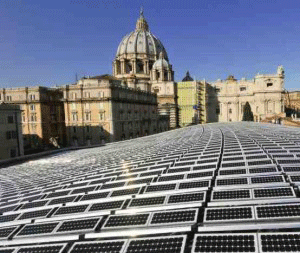 Some time in the next few months, his successor Pope Francis may just go one step further. His actions could tip the balance against fossil fuels, as the world’s wealthiest institution takes on the world’s most powerful industry.
The signs have been building. In November, the Pope sent a letter to Australian Prime Minister Tony Abbott urging him to address climate change and sustainability at the G20 summit – something Abbott had pointedly refused to do.
At Lima, the Pope sent another letter urging diplomats to agree on a strong deal to tackle climate change as UN negotiations drew to a close. In a message to Peru’s environment minister, Manuel Pulgar Vidal, who led the discussions in Lima, Francis warned that “the time to find global solutions is running out.”
A group of Catholic Bishops went one step further, calling for an end to fossil fuel use, citing climate change’s threat to the global poor as the lodestar of their concern. The document, signed by bishops from all continents, insisted on limiting global temperature rise to 1.5°C relative to pre-industrial levels — a considerably more ambitious goal than the 2°C ceiling that’s generally agreed on as the threshold beyond which climate change becomes truly dangerous.
They also called for the building of “new models of development and lifestyles that are both climate compatible” and can “bring people out of poverty.” Specifically, they said: “Central to this is to put an end to the fossil fuel era, phasing out fossil fuel emissions and phasing in 100 per cent renewables with sustainable energy access for all.”
There is growing speculation within church circles that this view is held at the highest level. Pope Francis wants the image of the Catholic Church to evolve beyond that of a huge multi-national corporation, to its origins as a social and humanitarian based organisation.
As he showed in his extraordinary speech this week to the priests, Pope Francis is very much his own man, not of the establishment.
Francis told the bishops and cardinals who run the Curia – the central administration of the Roman Catholic Church – that their careerism, scheming and greed had infected them with “spiritual Alzheimer’s”.
It was Benedict, though, who put the wheels in motion. The solar panels on the audience hall were enough to power the lighting, heating and cooling of a portion of the entire Vatican state. According to this National Geographic article, he authorised the Vatican’s bank to purchase carbon credits by funding a Hungarian forest, thus making the Catholic city the only fully carbon neutral nation-state.
Several years later, he unveiled a new hybrid Popemobile that would be partially electric. Francis went a step further, commissioning Osram to install 7,000 LED lights in the Sistine Chapel, cutting energy consumption by 90 per cent. It is now being extended to other Vatican museums.
But how much further could Pope Francis go? There is speculation that in his Encyclical, due in April, or even in a New Year’s speech, he could call for dramatic reform by the Catholic church. It would be similar, but bolder and more practical, than the Ecological Conversion address of Pope John Paul II in 2001.
This could include divestment. No one knows how much the Catholic Church has in its funds. It is likely to be hundreds of billions. The Uniting Church in Australia has voted to divest from fossil fuels. In July, the World Council of Churches, an umbrella group representing over half a billion Christians, announced its plans to fully divest from fossil fuels.
The SMH reports that in the same month, the Anglican Church of Australia passed a motion encouraging its diocese to divest. It noted then than a global campaign for the Vatican to divest had just been launched. Ironically, the Vatican’s finances are now controlled by Cardinal George Pell, the former archbishop of Sydney who is a noted climate science denier.
There is speculation that the Pope could emulate the bishops’ call for 100 per cent renewables. What he could do is repeat and enhance the efforts to install solar and lighting at the Vatican across the church’s global assets. In effect, he could follow in the footsteps of other corporate giants – such as Google, Apple and Ikea – and set a goal of 100 per cent renewables for his own church, or corporate entity.
The Catholic Church is not just the largest private employer in Australia (and other countries), with some 180,000 employees, it is also one of the biggest energy consumers – with a combined annual bill that runs into the billions of dollars from schools, aged care centres, churches, parish centres and hospitals.
A series of initiatives that encouraged energy efficiency, the installation of solar systems – schools would be perfect for this because usage matches solar output – and also battery storage would have a profound impact on the incumbent energy system, hastening the inevitable transition to decentralised energy grid.
Not only will this encourage and facilitate a much higher overall adoption of renewables, it will also likely result in cheaper energy for all consumers. Major network providers in Australia see this as inevitable, and are already installing – without subsidies – battery storage instead of upgrading grids,and talking of renewables-based micro-grids instead of relying on the old centralised model.
In the US, the combined energy consumption of Catholic organisations – schools, hospitals, aged care, churches, seminaries and the like, would run into the tens of billions. In Europe, the same again.
But if the Pope’s criticism of the Curia was greeted by stunned silence in the Vatican, it is unlikely that any move towards divestment or a massive uptake of renewables would be greeted in the same way.
The fossil fuel industry is certainly worried. Rio Tinto CEO Sam Walsh, who has repeatedly told everyone that the future is coal, took part in a “day of reflection” at the Vatican in September last year. It was ostensibly billed as a chance for mining companies to get “Christian ethical input” to their conversations about the future of their industry. Others saw it as a lobbying exercise.
More recently, the AFR reports, Walsh and other CEOs of major fossil fuel companies took part in an “Ecumenical Day of Reflection on Mining” at Lambeth Palace, the seat of the Church of England, another massive institution – both in terms of funds, and energy consumption.
Renewable Energy Target makes economic sense for Australia
 The economic case for renewable energy Brisbane Times,December 25, 2014 – Andrew Leigh “………Let’s start with electricity prices. This year, the Warburton review commissioned modelling by ACIL Allen showing that the RET delivers lower electricity prices for consumers. If the Abbott government cut the RET, the modelling showed, Australian consumers would pay more for their electricity. Puzzlingly, after presenting this evidence, the Warburton review recommended cutting the RET anyway.
How about employment? The RET creates jobs because it opens up new fields of activity: installing solar panels, building and maintaining wind farms, researching and developing new ways to capture wave and geothermal energy. More than 24,000 Australians were employed in the renewable energy sector in 2012. The Clean Energy Council estimates that a further 18,400 new jobs will be created by 2020 if the RET is retained in its current form.
Recent surveys put the jobless rate at about 6 percent, the highest rate since Tony Abbott was employment minister. Right now, more than 700,000 Australians are looking for work. In such a tight employment market, 18,000 more jobs should drive down the unemployment rate. If the government scales back the RET to what it calls a ‘true’ 20 per cent target (in reality, a 40 per cent cut), the Clean Energy Council’s modelling suggests 6200 less jobs will created over the next six years. Scrapping the RET altogether will see us lose the opportunity to create 11,800 new jobs.
Then there’s investment. Since the RET was introduced, more than $10 billion has already been invested in large-scale renewable energy projects like First Solar’s huge plants in the NSW towns of Nyngan and Broken Hill. First Solar says it has already invested about $142 million in its plants, creating more than 600 jobs in the process.
By contrast, scrapping the RET altogether will put at risk $11 billion of additional investment between now and 2020. Even scaling back the RET to the government’s preferred level has been modelled as leading to a $6 billion drop-off in investment. The renewable energy business is a good one to be in right now as countries and companies around the world look for ways to grow the supply of alternatives to coal and gas. It is perplexing that the Abbott government wants Australia to get out of this business just when there is the potential for a major international investment boom.
All this new investment and the jobs created as a result are clearly good for Australia’s economic growth. But the RET also has the potential to support growth in places where the decline of other industries would otherwise see them go backwards. In Geelong, IXL used to make components for the auto industry, but since Ford and other car companies announced their withdrawal from Australia, the company has switched to manufacturing steel mounting structures for solar farms. IXL is now a major supplier to First Solar’s two NSW plants, and has recently opened an Adelaide factory to keep up with the demand…….
By stimulating demand for this kind of manufacturing, the RET also has the potential to help communities such as Geelong and Elizabeth grow economically in the future.
For a government that once declared Australia ‘open for business’, it’s puzzling to see Mr Abbott putting a ‘closed’ sign on the renewable energy industry. Whether you want lower electricity prices, more jobs, or more investment, keeping the RET makes sense. Oh, and by the way, it’s good for the environment too.
Andrew Leigh is the shadow assistant treasurer and Member for Fraser. www.andrewleigh.com.
http://www.brisbanetimes.com.au/comment/the-economic-case-for-renewable-energy-20141225-12dcl5.html
Labor to talk with Abbott govt on Renewable Energy Target, armed with latest report from Climate Change Authority
A Climate Change Authority (CCA) review of the RET, released on Monday,concluded that the scheme should not be cut, although it should be deferred by “up to three years” in order to restore investor confidence.
Investment in clean energy has virtually ground to a halt due to uncertainty over the future of the RET, which requires that 41,000 gigawatt hours of Australia’s energy come from renewables such as solar and wind by 2020.
The government has sought a bipartisan deal to “reform” the RET but Labor walked away from negotiations earlier this month, claiming the Coalition’s plan for a “real 20%” renewable target would devastate jobs and investment in the sector.
When the target was initially set, 41,000 GWh represented 20% of Australia’s estimated 2020 energy production. But the country is now on course to produce 26% to 28% of its energy from clean courses by 2020, meaning a “real 20%” would be significantly less than 41,000 GWh.
The government and opposition have now signalled that talks will resume in January, but Labor said the Coalition needed to heed the CCA’s findings.
“We do need to see a change in position from the government, a change from the prime minister’s position either to abolish the target altogether or to severely cut it back,” Mark Butler, Labor’s environment spokesman, told the ABC.
“Both of those options the Climate Change Authority says in their report would be very, very unwise options.”……..
Th environment group WWF said its own polling from November showed that nearly nine in 10 Australians thought the RET should be retained as it is or increased.
“Cutting the Renewable Energy Target is poor policy, it will see Australia’s carbon pollution go up, sustainable energy jobs lost and investment shut out,” said Kellie Caught, WWF’s climate campaigner. http://www.theguardian.com/australia-news/2014/dec/23/labor-returns-renewable-energy-target
Australia’s carbon tax resulted in dramatic decline in greenhouse gas emissions
New data shows record fall in carbon emissions , The Age Gareth Hutchens December 23, 2014 – Environment Minister Greg Hunt has quietly published data, just two days before Christmas, showing the second year of operation of Australia’s carbon price was more successful at reducing emissions than the first.
New data from Australia’s National Greenhouse Gas Inventory show emissions declined across Australia by 1.4 per cent over the 12 months to June.
That compares to a decline in emissions of 0.8 per cent for the previous 12 months.
The carbon price was introduced by the Gillard government and began operation on July 1, 2012. It ended on July 1, this year after the Abbott government fulfilled an election pledge by abolishing it.
The new data, published on Tuesday, record emissions produced during the final year of operation of the carbon price, from June 2013 to June 2014.
They show the electricity (minus 4 per cent), agriculture (minus 2.6 per cent), industrial processes (minus 1.3 per cent) and transport sectors (minus 0.4 per cent) all experienced declines in emissions this year………….
Greens Leader Christine Milne has slammed the federal government for waiting until after the Lima Climate Change Conference to release the data, saying the figures show just how effective Australia’s carbon price was at bringing down pollution.
“This is the biggest ever drop recorded and the price made it happen,” Ms Milne told Fairfax Media.
“Why did the government withhold this report until after the Lima climate talks? These are embarrassing figures for the Abbott government because they demonstrate just how destructive they have been to the global effort to reduce pollution and tackle dangerous global warming,” she said…….http://www.theage.com.au/environment/climate-change/new-data-shows-record-fall-in-carbon-emissions-20141223-12d1z3.html
South Australia scaling back feed -in solar payments to householders
 Payments slashed for solar homes that feed into grid in SA
But if you installed the same sized system before October 2011 you would potentially be pulling in $4836 per year.
Those payments will continue until June 30, 2028.
The retailer feed-in tariff, which must be paid by your energy provider, was set at 7.6c/kWh last year but fell to 6c once the carbon price was removed.
The Essential Services Commission of South Australia has further reduced it to 5.3c/kWh because it “reflects the forecast wholesale market value of photovoltaic (solar) electricity in the coming year’’.
“The proposed value is lower than the 2014 retailer feed-in tariff of 6.0 cents/kWh, due to the lower forecast wholesale market price of electricity,’’ ESCOSA says.
Individual energy retailers can elect to pay householders more for their power.
The original 44c/kWh feed-in tariff was taken up by more than 100,000 householders before it was closed by the Government in September 2011, and reduced to 16c/kWh. Householders who receive these payments are also eligible for the 5.3c payment which is paid by energy retailers.
Those who signed up before the cut-off receive the higher tariff until the scheme expires in 2028, costing an estimated $1.425 billion — an amount recovered through fees charged to all electricity customers.
The initially generous scheme was designed to foster the growth of the solar industry.
Solar panel prices have plummeted since then, with larger systems much more affordable now.
Problem of rising sea levels causing waves of dissent in Queensland Liberal National Party
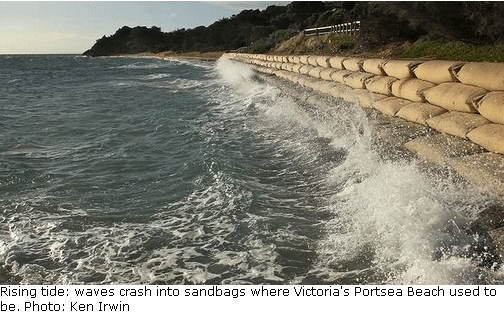 Will climate change denials sink the LNP? DES HOUGHTON THE COURIER-MAIL DECEMBER 20, 2014 IT’S a controversy that could not have come at a worse time for Campbell Newman. Cracks are appearing in LNP ranks over a State Government edict forcing Moreton Bay Regional Council to remove a theoretical climate change sea level rise of 0.8m when considering developments.
Inside the party there are waves of discontent. Continue reading
Tony Abbott shamed Australia at Lima climate summit, but will continue to sabotage climate action anyway
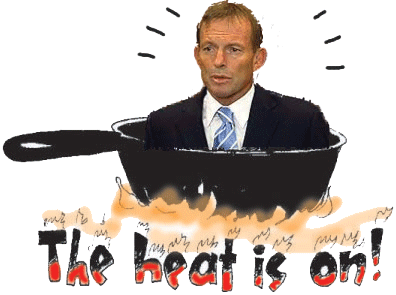 Abbott’s ‘mean and tricky’ Australia: Lima’s Colossal Fossil, Independent Australia 18 December 2014, The Abbott Government has managed to turn Australia into an international climate pariah and laughing stock in the course of just one year, writes deputy editor Sandi Keane. The Abbott Government’s abject failure to address climate change copped a deserved hammering at Lima. ‘Fossil of the Day’ awards from the international Climate Action Network rained down on Foreign Minister Julie Bishop — the only person there who didn’t see global warming as a threat to the Great Barrier Reef. It all culminated in the final humiliation for the nation, with the ‘Colossal Fossil’ award being bestowed on Australia as the worst performer on climate change action for the entire year.
Having failed to sabotage any new global agreement by demanding legally binding emissions, Julie Bishop is now trying a different tack: as the planet cooks, she wants to cook the books. This could see Australia’s emissions skyrocket to a massive 49-57% above its original 1990 Kyoto pledge.
This latest attempt to protect vested mining interests – the Coalition’s major paymasters – hedges around the success of Bishop’s threat to scuttle any agreement on the second stage of the Kyoto Protocol unless she can use the same favourable rules around land clearing agreed to in Kyoto in 1997. Continue reading
1 This month
17 October, Free Public Talk on Nuclear Issues in South Australia
David Noonan will speak on public interest concerns over the new Roxby Downs Indenture Act 2026 on BHP copper-uranium mining and ore processing in SA, and on how AUKUS may face SA with a High-Level nuclear waste agenda.
Dr Jim Green will discuss international developments in the field of nuclear power including ‘small modular reactors’ and Generation 4 ‘advanced’ nuclear reactor concepts.


Help Aunty Sue Protect Her Land and Sacred Sites From Destructive Rocket Testing.
.

Australians deserve the truth
about
AUKUS – https://aukuspublicinquiry.com/

PETITION – To: Prime Minister Anthony Albanese and the Australian Labor Government

of the week – Australians for War Powers Reform (AWPR)
To see nuclear-related stories in greater depth and intensity

