Rear Admiral Scarce joins the South Australian pro nuclear clique
Let’s talk nuclear, says ex-governor Kevin Scarce THE AUSTRALIAN Verity Edwards DECEMBER 13, 2014 AFTER seven years of political silence in his role as governor of South

Is it a good idea to sell uranium to conflict zone Ukraine, with its ongoing Chernobyl pollution?
PM talks uranium sales to Ukraine THE AUSTRALIAN AAP DECEMBER 11, 2014 AUSTRALIA is considering selling uranium to Ukraine, home to the world’s worst nuclear disaster.

UKRAINIAN President Petro Poroshenko raised his country’s energy security needs with Prime Minister Tony Abbott when the pair met in Melbourne on Thursday for talks focused on the MH17 disaster.
- “There is the possibility for Ukraine to buy Australian uranium for our nuclear power stations,” he told reporters.Energy security is a vital issue for Ukraine, which relies heavily on its hostile neighbour Russia for gas and has difficult shoring up supplies of uranium and coal.Mr Abbott said Australia was an energy superpower and wanted to help Ukraine address its vulnerabilities…….
Any uranium sales to Ukraine will prove controversial given the legacy of the 1986 explosion at the Chernobyl nuclear power plant, about 100km from the capital Kiev.It remains the worst nuclear accident in terms of lives and cost in history………http://www.theaustralian.com.au/news/latest-news/ukraine-australia-hold-nuclear-talks/story-fn3dxiwe-1227152259883
Uranium industry will NOT go ahead in Cape York land, as Aboriginals win land rights
 Olkola reclaim traditional Cape York land after three-decade struggle, Guardian, Joshua Robertson, 10 Dec 14 More than 6,300 square kilometres of former cattle grazing land in Queensland is formally handed back to Indigenous owners, spelling the end of uranium exploration in the area and the start of a quest to develop tourism opportunities One of the largest returns of land to traditional owners in Queensland’s history has killed off the prospect of uranium mining in a key part of Cape York.
The Olkola, who reclaimed more than 6,300 square kilometres of former cattle grazing land in a formal ceremony on Wednesday, are instead seeking business opportunities in adventure tourism.
Just over 1000 sq km of Olkola land is licensed for uranium exploration by French corporation Areva, which has spoken of north Queensland’s potential to match Kazakhstan as a source for nuclear fuel.
But the deal negotiated by the Olkola has forced Areva to give up its exploration licences in areas given over to a national park, and the clan has no intention of allowing mining elsewhere.
The traditional owners are instead in talks with a global adventure travel agency about a possible joint venture.
It comes just months after the Newman government began to accept uranium mining applications across the state with a view to ending a 25-year ban.
The Australian Conservation Foundation has praised the Olkola people’s move, along with their decision to give over almost a third of their land to a protected national park.
For Mike Ross, the chairman of the Olkola Aboriginal Corporation, the joy of reclaiming country after nearly 30 years of negotiations was tempered by the need to find viable ways for his people to make a living………http://www.theguardian.com/australia-news/2014/dec/10/olkola-reclaim-traditional-cape-york-land-after-three-decade-struggle
Perth council wants renewable energy to be a requirement in home building plans
 Perth council to seek mandate on renewable energy for new homes, ABC News, 10 Dec 14 720 ABC Perth By Emma Wynne A Perth council is hoping to radically alter its planning scheme to require new homes to have their own energy supply.
Nedlands council, which covers some of Perth’s wealthiest suburbs, will apply to the WA Planning Commission to alter their planning scheme to require installation of onsite power generations, such as solar panels or wind power, in all new home building…….http://www.abc.net.au/news/2014-12-10/perth-council-hopes-to-mandate-renewable-energy/5954842
Audio: Push to develop Northern Australia linked to push to dismantle Aboriginal land rights
 Top End traditional owners fear land rights will be dismantled in push to develop the north (AUDIO) ABC Radio PM Sara Everingham reported this story on Thursday, December 11, 2014 MARK COLVIN: The Northern Land Council says it’s deeply concerned that the push to develop Northern Australia could dismantle hard-fought Aboriginal land rights in the Northern Territory.
A COAG taskforce met today in Canberra to nut out the detail of its review of Indigenous land administration as part of the white paper on developing Northern Australia.
Sara Everingham reports from Darwin.
SARA EVERINGHAM: In Kakadu National Park, about 80 traditional owners from across the Top End have spent the week in talks as part of the Northern Land Council’s full council meeting………………
The Northern Land Council doesn’t know what the review will look at but suspects it will explore greater use of 99 year leases on Aboriginal land.
The council also says it’s been informed by the Federal Government it will revisit an amendment to the Northern Territory Land Rights Act which would devolve powers of the land councils to smaller Indigenous corporations.
The deputy Land Council chairman John Daly says traditional owners must be consulted.
JOHN DALY: We’ve got a Prime Minister for Indigenous Australia and they put out press releases prior to them winning the elections that they would have no reviews, no amendments to the Land Rights Act and things like that, Native Title, without the consent of traditional owners and the land councils. ……http://www.abc.net.au/pm/content/2014/s4147070.htm?site=indigenous&topic=latest
Federal govt watering down Aboriginal land rights, betrayal by Minister for Aboriginal Affairs Nigel Scullion
Northern Land Council accuses Senator Nigel Scullion of breaking election promise on land rights, ABC News By the National Reporting Team’s Kate Wild 11 Dec 14 Australia’s largest Aboriginal land council has accused Minister for Aboriginal Affairs Nigel Scullion of breaking a promise that the Coalition, if it won government, would not review or amend the Land Rights Act.
Holding a copy of Senator Scullion’s press release, titled No changes to NT Land Rights and dated August 14, 2013, Northern Land Council (NLC) deputy chairman John Daly accused the Minister of proposing a review of land rights legislation without the consent of traditional owners.
“Prior to him getting in as the Minister, this here says he wasn’t going to do any reviews or anything like that without the consent of traditional owners and the land council,” he said.
Really there isn’t, and hasn’t been, any conversation with Aboriginal people about the future of the Land Rights Act.
Joe Morrison, NLC chief executive
“And this is just another broken promise from this government.”
The comments were made today at a full council meeting that Senator Scullion did not attend………..
NLC’s questions are ‘pressing for the nation’
NLC chief executive Joe Morrison said council members wanted to put questions to the Minister they believed were “pressing for the nation”.
These included Federal Government plans to water down the Land Rights Act, pressure on Aboriginal towns to sign 99 year leases, and the Federal Government’s use of Aboriginal money earned from mining royalties, he said.…………. Continue reading
Audio: Abbott cuts foreign aid, again, transfers money to UN climate fund
AUDIO: Green fund contribution comes at expense of aid budget ABC Radio PM David Mark reported this story on Wednesday, December 10, 2014 1 MARK COLVIN: There’s been a tentative welcome for the Australian Government’s announcement that it would contribute $200 million to the UN’s climate fund.The catch is that the money will come from Australia’s international aid budget.
The announcement by the Foreign Minister, Julie Bishop, in Lima came on the same day that a coalition of aid groups implored the Federal Government not to cut the aid budget any more.
Australia’s foreign aid budget has already been cut by $7 billion over the next five years and the fear is there could be more to come in the mini-budget.
David Mark reports. DAVID MARK: They came together in Melbourne to demand the Federal Government stop cutting foreign aid. A mass meeting of businessmen and women, the chairmen and CEO’s of Australia’s major aid organisations.
And one by the likes of Gerry Hueston, the former president of BP Australia and chairman of Plan Australia, George Savvides, the CEO of Medibank Private and chairman of World Vision Australia and Simon McKeon, the former Australian of the year, chairman of AMP and chairman of Global Poverty Australia, spoke out.
GERRY HUESTON: As someone who’s worked internationally all my life, I find it inconceivable that one of the richest countries in the world can’t do at least its bit in foreign aid, you know, when you’re supporting some of the poorest people in the world.
GEORGE SAVVIDES: The Australian aid budget has already been cut twice, it already has contributed well above its weight in terms of a fiscal responsibilities in front of us and also in terms of the consideration by government. But really its purpose isn’t to save dollars, its purpose is to save lives.
SIMON MCKEON: These are times to be very careful about what we spend and what we don’t spend, but I’ve got to say as an Australian I am struggling at the moment with the possibility that the aid cuts that were announced earlier this year may well be further cut in the New Year……..http://www.abc.net.au/pm/content/2014/s4146238.htm
Huge majority of Australians back solar and wind energy
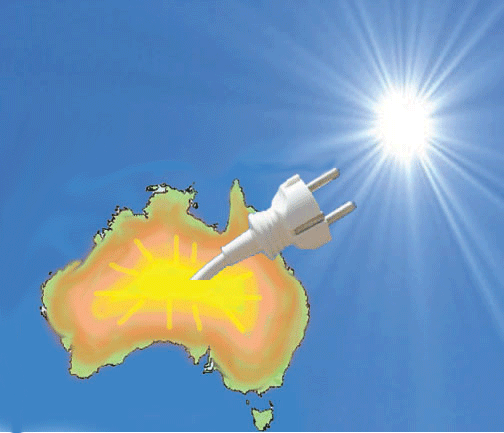 Solar and wind energy backed by huge majority of Australians, poll shows, The Guardian, Oliver Milman, 9 Dec 14 Renewables among top three energy choices and a separate review debunks fears of health damage from wind turbines Solar and wind energy enjoy strong support from the Australian public, with 80% of people putting them both among their top three energy choices in a poll for the Australia Institute.
By contrast, coal and coal seam gas were chosen by 35% and 38% of those polled as being among the best three future energy sources.
A separate review of medical literature by the Australia Institute debunked the fear that wind power damaged people’s health, finding “no credible evidence” directly linking exposure to turbines with negative health effects.
The poll of more than 1,400 people showed that solar was the popular energy choice of the future, cited by 63% of respondents. Nine out of 10 people said they wanted more solar energy. Six in 10 people said they were concerned about the impact of coal and coal seam gas on the landscape.
Despite this apparent desire for renewables – as well as the country’s vast capacity for such energy – the Australia Institute report states that Australia now produces “only the world average level” of solar energy.
While the production of solar PV panels is relatively energy intensive, the report concedes, solar’s output of greenhouse gases, and its impact on air quality, is completely overshadowed by the burning of coal.
Wind has the potential to supply 40% of Australia’s energy needs, the report says, but the industry has been blighted by the “considerable attention” placed on the perceived health effects of wind turbines.
The Australia Institute points out that the National Health and Medical Research Council recently conducted a review of the scientific literature on the connection between windfarms and health and found there was “no consistent association between adverse health effects and estimated noise from wind turbines”……….http://www.theguardian.com/environment/2014/dec/08/solar-wind-energy-sources-huge-majority-australians-poll-shows
Australian businesses lose $millions as action on renewable energy is delayed
 RET Impasse Costing Australian Renewables Millions http://www.energymatters.com.au/renewable-news/ret-impasse-cost-em4594/ December 11, 2014 Energy Matters The Federal Government’s drawn-out review of Australia’s Renewable Energy Target is costing the sector between $400 and $500 million a year in lost investment, according to the Clean Energy Council.
An analysis by the CEC says the ongoing impasse will continue to wreak more than $400 million of damage every year to renewable energy projects already operating.
CEC Chief Executive Kane Thornton said the RET had delivered $10 billion worth of investment in large-scale projects to date; investments made in good faith that the legislated target would continue unchanged.
“A breakdown in that bipartisanship has had a material impact on the market confidence in the policy and is affecting the revenue that flows to those projects,” Mr Thornton said.
“We are staring down the barrel of job losses, business closures, negative financial effects on the $10 billion of renewable energy projects already operating, and a halt in the development of new large-scale renewable energy projects across the country.”
Referring to 2014 as a dark year for large scale renewables, Mr. Thornton points out more than $2 billion was invested in 2013, but the first three quarters of this year has seen a comparatively paltry $238 million invested – directly the result of the Federal Government’s apparent determination to gut the RET.
“If the government is genuine about its intent to resolve the current political impasse, move beyond its previous position and support a target that delivers a strong future for renewable energy in Australia, we would encourage Labor to return to negotiations,” said Mr. Thornton.n November, the ALP walked away from negotiations with the Federal Government that would have resulted in the dilution of the RET.
The CEC briefing paper “Lost opportunity and big costs: The impact of an unresolved RET review” can be downloaded here.
A very recent example of the impact the situation is having is in the NSW Southern Tablelands where a fourth generation farmer had hit tough times – and wind turbines were to be his saviour. However, with the continuing RET uncertainty,the farmer may still have to sell his property – one that has been in his family for four generations. This particular situation goes beyond this single farmer’s woes, with jobs and investment in the local region also at stake.
In October, a major wind turbine tower manufacturer in Victoria announced it will be shedding 100 jobs; partly due to the RET situation.
Even where concessions have been made concerning the RET, there still appears to be a great deal of devil in the detail. Yesterday, ClimateSpectator reported Environment Minister Hunt’s office communicated that “solar up to 100kw is proposed to stay in the SRES due to the red tape that would be involved if it moved into the LRET.”
There had been fears commercial solar would be lumped in with the large-scale target. Even this good news came with a potential barb. It’s unclear if up-front deeming will remain; i.e. whether the full government subsidy will continue to be made available upfront when a system is installed; rather than incrementally as the power is generated – as is the case with projects under the LRET
Australia well represented at Vienna Conference on the Humanitarian Impact of Nuclear Weapons, (though not by government)
 Gem Romuld ,Outreach Coordinator International Campaign to Abolish Nuclear Weapons- Australia www.icanw.org.au gem@icanw.org 10 Dec 14 The Vienna Conference on the Humanitarian Impact of Nuclear Weapons concluded last night. It went for two days after ICAN’s Civil Society Forum.
Australian Aboriginal atomic test survivor speaks at Vienna Conference
TRANSCRIPT Speech by Sue Coleman-Haseldine http://www.icanw.org/campaign-news/australia/australian-test-survivor-to-speak-in-vienna/ – 8 December 2014 Rosemary Lester, who was originally going to speak here, became too ill to travel to Vienna. She sent me instead and said to “tell it as it is”.
I was born on Koonibba Aboriginal Mission in 1951. From east to west, Koonibba is in the middle of Australia but right down south where the desert meets the sea.
Atomic bomb tests began in the desert areas north of my birthplace in 1953 when I was two years old. First at Emu Fields and then Maralinga.
The area was picked because the British and Australian governments didn’t think our land was valuable. But Aboriginal people were still looking after and living off the land.
There are lots of different Aboriginal groups in Australia. For all of us our land is the basis of our culture. It is our supermarket for our food, our pharmacy for our medicine, our school and our church.
Aboriginal people have special places throughout Australia, including in the vast arid areas. Looking after these places is our religion.
Our old people remember the good life of hunting for wild game and collecting bush fruits. Life was healthy.
There were still Aboriginal people living and travelling this way in the Emu Field and Maralinga region when the bomb tests started.
The government was no good at ensuring everyone was safe.
Australia was even more racist then. At this time Aboriginal people did not even have the right to vote. The government really didn’t care what happened to Aboriginal people.
Many people died and became sick in the immediate test areas. So did the animals. We shouldn’t forget about the animals.
The first atomic bomb called “Totem 1” spread far and wide and there are lots of stories about the “black mist” it created, which killed, blinded and made people very sick.
The bomb tests continued for many years right until 1963. Big atomic tests that the British and Australian governments were proud of and then a whole lot of secret tests that the British did with plutonium.
These tests contaminated a huge area and everything in it but people hundreds of kilometres away were also impacted. This includes my family and the broader community where I live.
I remember older people talking about Nullabor dust storms. It was the fallout from the Maralinga tests.
We weren’t on ground zero, but the dust didn’t stay in one place. It went wherever the winds took it.
I noticed people dying of cancer, something that was new to us.
There’s a cemetery at Woomera which we call the children’s cemetery. It’s filled with children who died around the time of the tests. And these were just the non-Aboriginal children.
There’s no record of how many Aboriginal children died. The Aboriginals were not allowed to be buried in white cemeteries.
In 2006 I went to an Australian Nuclear Free Alliance meeting to learn more about radiation fallout. What I learnt devastated me. To find out that our bush foods were possibly contaminated was a real blow to me.
It was at these meetings I also learnt about other nuclear bombs. About other places where tests happened and also more about Japan during the war.
I also learnt that uranium mined in Australia was used in these weapons of destruction. To know that uranium from our country was devastating other countries and people was a horrible lesson for me. I decided to fight any kind of mining then.
There are too many cancer deaths in our Country. I believe it is caused from radiation contamination, but I can’t prove it. I think any kind of mining in our area would be digging up contaminated earth and sending it back to us on the north, north-west winds.
I am not the only one to notice the sickness and death that remains in this part of Australia. It doesn’t matter if you’re Aboriginal or not, or as I say Black, White or Brindle, everyone has a sad story about premature sickness and death in their families.
Cancer is the big one but it is also common for people to suffer from thyroid conditions. This is the case for myself and one of my granddaughters.
Fertility problems, still births, birth defects became more common at the time of the testing.
But even today we wonder if women have trouble because of the ongoing radiation in the area or genetic changes passed down through generations.
Not knowing the true impact of the nuclear tests causes a lot of anguish and we would like to have answers and hopefully find some solutions. We don’t want others to suffer as we have.
The bombs have destroyed a large part of Australia and despite several attempts it will never be safe or clean.
There are many Aboriginal people who cannot go back to their ancestral lands and their children and their children’s children and so on will never know the special religious places it contains.
Having whole displaced communities has also created confusion and conflict between Aboriginal groups. These are ongoing issues which cause stress and heartbreak.
Thank you for listening about our situation in Australia. We are telling the story so that our history is not forgotten but also to create a better future for all people, all over the world.
This is why we want nuclear weapons permanently banned and the uranium that can create them left in the ground.
If you love your own children and care for the children of the world, you will find the courage to stand up and say “enough”.
Always keeping in mind that the future forever belongs to the next generation.
Tough scrutiny now needed on uranium deal between Australia and India
Doubts over uranium deal between Australia and India, The Age December 9, 2014 Daniel Flitton The treaty to sell uranium to India will face tough scrutiny after the former chief atomic watchdog warned the deal lacked safeguards to ensure Australia did not inadvertently fuel India’s nuclear bombs.
The treaties committee of Parliament must endorse the deal, signed by Prime Minister Tony Abbott in September, before uranium exports can start.
But John Carlson, the former chief of Australia’s nuclear safeguards organisation, has told the committee India’s nuclear weapons program is expanding and has complex links to civilian reactors.
The warning is likely to rattle Labor’s lukewarm support for sales, the party having opposed uranium exports to India initially and scotched a Howard-era proposal……….
In a detailed submission to the committee, Mr Carlson said that under the proposed deal Australia could not definitively track uranium used in India’s nuclear program and what happened subsequently to fuel reprocessed into plutonium.
Nor would Australia have the right to demand the return of uranium should the agreement be breached, as it can with 41 other countries covered by similar export deals.
India is estimated to have between 90 and 110 nuclear weapons and has refused to sign international disarmament treaties. Several Indian nuclear reactors are designated “dual use” for civilian energy and military needs.
The deal would not be the first on uranium to run afoul of the treaties committee, with the Russia deal held up almost two years over concerns that yellowcake could be diverted into nuclear weapons.
Labor MP Kelvin Thomson said the committee had received detailed submissions expressing concern not so much at the idea of supplying uranium to India but about the provisions of the agreement……..
several other submissions, including one from Ron Walker, a former governor of the International Atomic Energy Agency, expressed concern.
The committee is expected to hold public hearings before reporting in February or March.
Labor foreign affairs spokeswoman Tanya Plibersek said last month that any exports to India must be with the highest possible level of safeguards.
Mr Carlson was in charge of the Australian Safeguards and Non-Proliferation Office for more than 20 years until 2010 and was criticised during that time by anti-nuclear campaigners for facilitating uranium exports.
He said there were good reasons for concluding a nuclear co-operation agreement with India, “but not this agreement”……..http://www.theage.com.au/federal-politics/political-news/doubts-over-uranium-deal-between-australia-and-india-20141208-121zoi.html
The Maralinga radiation experiment – a scandal and a warning
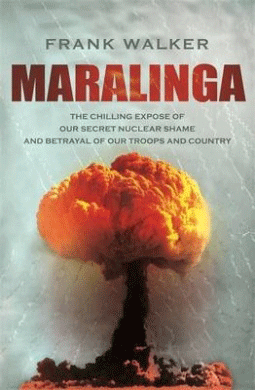 The 16,000 Australian service men involved in the tests were sworn to secrecy by ASIO agents under the threat of jail. The general population was made part a large secret experiment to see whether the human race could survive a nuclear attack.
This book is also a warning for the present. Prime Minister Tony Abbott wants to create a nuclear waste dump in central Australia to bring in millions of dollars. The Australian people must be vigilant and active as our governments and politicians cannot be trusted.
Australia’s two decades as a radioactive laboratory https://www.greenleft.org.au/node/57965, December 8, 2014 By Coral Wynter The British government, with the complicity of the Menzies government, used Australia as a laboratory to test the short and long-term effects of exposure to radioactivity.
Maralinga: The Chilling Expose of Our Secret Nuclear Shame & Betrayal of Our Troops & Country By Frank Walker Hachette, 2014
Frank Walker, who worked as a journalist for Australian and international publications for 38 years, was talking to his daughter’s university friends one day and discovered they had no idea atomic bombs had been exploded in Australia.
In fact, 12 had ― excluding the 300-600 minor trials at Maralinga, Emu Field, both in the South Australian desert, and Monte Bello Islands off the Western Australian coast.
Walker had been interviewing soldiers, navy and air force victims and decided to expose the veil of secrecy on their ghastly experiences.
The atomic tests began in 1952 and continued until 1957. However, minor trials with dirty radioactive clouds, and uranium and plutonium waste, did not stop until 1963.
The British government, with the total complicity of the then-Menzies government, used Australian land and people as a laboratory to test the short and long-term effects of exposure to radioactivity. Continue reading
Australian governments’ sorry history of deception over India uranium deal, revealed by Wikileaks
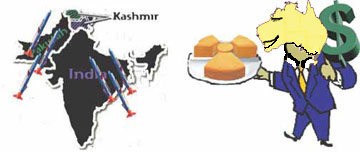 Australia will now contribute to spreading nuclear weaponry as India will be able to use Australian-supplied uranium for civilian purposes and reserve its indigenous supplies for its nuclear weapons program.
Moreover, India has a poor nuclear safety record.
 WikiLeaks exposes gov’t lies, shifts on India uranium deal, Green Left December 8, 2014 By Linda Pearson Prime Minister Tony Abbott signed an agreement in September to allow sales of Australian uranium to India for the first time. Uranium sales were initially approved by then-Coalition PM John Howard in August 2007 but Howard’s successor, Kevin Rudd, reinstated the ban.
Rudd’s action was in accordance with long-standing Labor Party policy that uranium should only be sold to countries that have signed the Nuclear Non-Proliferation Treaty (NPT). A 2008 Lowy Institute poll found that 88% of Australians supported this policy.
By the end of 2011, however, Labor had switched to the Liberal Party’s position at the behest of Rudd’s successor, Julia Gillard.
As US diplomatic cables published by WikiLeaks show, both parties were ultimately willing to change Australia’s long-standing nuclear policy to aid the Australian uranium industry and match strategic US objectives…………..
The US Embassy in Canberra regarded Rudd as a strong supporter of the US alliance. But there was concern over whether Labor’s nuclear policy would stop Australia supporting the US position at the NSG.
The cables show that pressure on the Rudd government to back the exemption came from the Australian High Commission in India as well as the US. They reveal how Labor’s official position on nuclear matters differed from the private views of individual members of the government.
This made the government’s support for the exemption and the party’s eventual approval of uranium sales in 2011 all but inevitable……………..
Secret support
The Rudd government’s public position before the NSG meeting in August 2008 was that it would consider the arguments on both sides and then decide whether to support the exemption. On July 24, 2008, Smith stuck to the official line during a joint interview with US Secretary of State Condoleezza Rice, saying “we haven’t made a decision”.
However, the cables suggest the government had already decided to support the exemption……………
After several days of deliberation and more intense US lobbying, the NSG approved the exemption on September 6, 2008. A cable reported that Canada’s ambassador to the United Nations, Marius Grinius, said “most NSG members ‘gave up’ and ‘joined the bandwagon’ rather than fully supporting a nuclear agreement with India”.http://wikileaks.org/cable/2009/05/09USUNNEWYORK497.htmlhttp://wikileaks…
The NSG decision opened the door to uranium sales to India. But while the Rudd government supported this exemption, its public position remained that Australia would not sell uranium to India unless it joined the NPT. On a visit to India shortly after the NSG decision, Smith said this policy “remains unaffected by the NSG decision”.
However, US diplomatic cables published by WikiLeaks suggest Labor leaders were already preparing to change its policy………………
[2009] According to another cable from Canberra, federal resources minister Martin Ferguson confirmed to US Ambassador Jeffrey Bleich that the ALP’s policy could change.
Bleich wrote in November 2009 that in Ferguson’s view, “the recent expansion in uranium development in Australia reflected a shift in willingness to consider nuclear energy”.
Additionally, according to the cable, Ferguson had said that the Australian government might have to revisit the issue of nuclear energy if other technologies “failed to develop commercially quickly enough” for Australia to meet its “clean” energy goals.
Moreover, Ferguson had told Bleich that he had “personally supported the US-India nuclear agreement” and believed that “a deal to supply India with nuclear fuel could be reached in 3-5 years”.
These comments contradicted his party’s official position at the time, but Ferguson’s support for the uranium industry was no secret. He led efforts to overturn Labor’s three-mines policy at the party’s 2007 conference.
After his comments on India in this cable were divulged by Fairfax in February 2011, Ferguson side-stepped questions and repeated the official line, saying: “We will only supply uranium to countries that are signatories to the NPT and have signed a bilateral agreement with Australia.”
Corporate advice
US diplomats in Australia also consulted representatives of mining giant BHP for their views on the industry and the prospect of uranium sales to India.
In April 2009, a cable from the US Consulate in Melbourne reported that BHP manager for integrated planning Barry Hewlett had told the consul-general that “India represents a potentially massive market” for the uranium in BHP’s Olympic Dam mine.
However, in November 2009, another cable from the consulate in Melbourne reported comments by BHP CEO Marius Kloppers that suggested the renewed international nuclear cooperation with India permitted by the NSG waiver was more important to BHP than the Australian government’s position on uranium exports.
“As long as someone can sell to the Indians,” Klopper said, “the world market will continue to expand, which helps us.”
Ferguson’s prediction in relation to uranium sales turned out to be true. In November 2011, Gillard announced she would push for the ALP to change its policy at its December party conference.
Gillard’s decision was motivated in part by a desire to help the uranium industry recover from the effects of the March 2011 Fukushima nuclear disaster. Demand dropped in the wake of the disaster and the price of uranium plummeted.
Smith publicly backed Gillard ahead of the vote. Smith said Rudd also supported the policy change. With the help of Ferguson and Australian Workers Union head Paul Howes, Gillard was able to overcome the opposition from the party’s left and the conference voted narrowly to allow uranium sales to India.
The decision was not supported by the Australian public. A 2012 opinion poll by the Lowy institute found that 61% of Australians opposed uranium sales to India, with only 9% strongly in favour.
Nevertheless, the Gillard government began talks with India on a bilateral nuclear safeguards agreement in March last year, which were concluded by Tony Abbott in September.
India’s record
Both Labor and the Coalition claim India has an “impeccable” record on non-proliferation and therefore deserves an exemption from the rules that apply to other states. This is not true.
India’s new status as a “responsible nuclear state” is more a reflection of the power of the US to influence international bodies, like the NSG and the International Atomic Energy Agency, to do favours for its friends and punish its enemies.
India chose to stay outside the NPT so it would be free to develop nuclear weapons. India’s first nuclear test in 1974 was carried out using plutonium from a nuclear reactor supplied by Canada strictly for civilian purposes.
The US and Australia imposed sanctions on India after it carried out another series of nuclear tests during its escalating arms race with Pakistan in 1998.
Australia will now contribute to spreading nuclear weaponry as India will be able to use Australian-supplied uranium for civilian purposes and reserve its indigenous supplies for its nuclear weapons program.
Moreover, India has a poor nuclear safety record. In 2012, the country’s auditor-general warned that a Fukushima-like disaster could result from the absence of effective industry regulation…………..https://www.greenleft.org.au/node/57962
Australian Renewable Energy Agency (ARENA) survives and thrives
 ARENA was set up in 2012 by the Gillard government to boost the competitiveness of renewable energy technologies in Australia, and to increase the supply of renewable energy
Having announced $2 million funding for a renewable biomass project last week, ARENA’s CEO says the organisation has no intention of stopping any time soon.
Prime Minister Tony Abbott announced in the May budget that the government would axe the statutory organisation, grab its unallocated $1.3 billion project funding and roll any of its leftover functions into the Department of Industry.
Since then, the organisation — which can only be dismantled by repealing the Australian Renewable Energy Agency Act 2011 — has been fighting for its life.
Australia’s federal Lower House voted on September 1 to repeal the act and abolish ARENA, but the ensuing stalemate in the Senate has meant a stay of execution for the ardent champion of renewable energy.
Indeed while the government’s original plan might have been to eliminate ARENA, expectations of its death now appear exaggerated. The body was granted a last minute reprieve after Palmer United Party Senator Clive Palmer struck a deal with the government to retain ARENA; but to cut its project funding by $435 million – which also covers some of the organisation’s operating costs – and defer $370 million, in return for backing the carbon tax repeal.
 The effect is that the public service now has what amounts to zombie agency: Finance Minister Mathias Cormann has made no bones about the fact he wants to see ARENA scrapped, he just doesn’t have the numbers in the Senate to do it.……………
When Government News spoke to ARENA chief executive Ivor Frischknecht, he said the organisation was still firing on all cylinders.
“We still have the money. We are still accepting applications and making grant awards,” Mr Frischknecht said.
“We’re very much in business. Continue reading
1 This month
17 October, Free Public Talk on Nuclear Issues in South Australia
David Noonan will speak on public interest concerns over the new Roxby Downs Indenture Act 2026 on BHP copper-uranium mining and ore processing in SA, and on how AUKUS may face SA with a High-Level nuclear waste agenda.
Dr Jim Green will discuss international developments in the field of nuclear power including ‘small modular reactors’ and Generation 4 ‘advanced’ nuclear reactor concepts.


Help Aunty Sue Protect Her Land and Sacred Sites From Destructive Rocket Testing.
.

Australians deserve the truth
about
AUKUS – https://aukuspublicinquiry.com/

PETITION – To: Prime Minister Anthony Albanese and the Australian Labor Government

of the week – Australians for War Powers Reform (AWPR)
To see nuclear-related stories in greater depth and intensity

