Clean energy industry wants a renewable energy target that will ensure a business future for clean energy
Clean energy industry urges Labor to resume RET talks, The Age December 10, 2014 – Lisa Cox National political reporter Clean energy companies are urging Labor to resume talks with the government over Australia’s renewable energy target to try to break an impasse they say is crippling the industry.
It comes as the Clean Energy Council publishes a report that says the breakdown of bipartisanship will strip existing investments in the clean energy sector of hundreds of millions of dollars each year.
The Clean Energy Council’s report finds that if bipartisanship is not restored, “an unresolved RET review would cause a further collapse in the value of Renewable Energy Certificates” leading to annual revenue losses of $400 to $500 million for existing renewable energy projects.
In some cases this would lead to the collapse and closure of businesses, significant job losses from an industry that directly employs 21,000 people, and the “loss or postponement of more than $14.5 billion in future investment out to 2020”, according to the study…………….
The government has not budged from its starting point, which would reduce the target from 41,000 gigawatt hours of baseline power by 2020, to about 27,000 gigawatt hours – a so called “real 20 per cent”……………….
Clean Energy Council chief executive Kane Thornton said a possible deal with the cross bench would not restore investment certainty and both major parties would have to find an acceptable compromise.
“We’re encouraged from the sentiment from the government to want to move forward and resolve this,” Mr Thornton said.
“Our assumption is that the government is therefore prepared to move from its previously stated position of real 20 per cent.
“Clearly that proposal was entirely unacceptable for the industry.
“If they are we’d encourage Labor to return to the negotiations to achieve an outcome that guarantees a strong future.” Since the government launched its review of Australia’s target, headed by climate sceptic and businessman Dick Warburton, investment in renewable energy has stalled.
Bloomberg New Energy Finance reported that investment for the first three quarters of 2014 was just $238 million, compared to $2 billion for the whole of 2013.
Mr Thornton said a target in the twenties or low thirties would destroy investment in the sector, but the industry was “open to talking about trajectory and numbers” in the mid-thirties range.
Mr Butler said on Tuesday: “We haven’t seen any commitment from the Government that they’re moving from their position of a 40 per cent cut to the RET.
“We’re up for a discussion if they are prepared to shift their position but this industry has said no deal is better than a bad deal.” http://www.theage.com.au/federal-politics/political-news/clean-energy-industry-urges-labor-to-resume-ret-talks-20141209-123kkj.html
Australia faces a costly future with climate change’s weather extremes
Poor planning leaves Australia exposed to climate change and massive damage bills, CSIRO says ABC News, By environment and science reporter Jake Sturmer and the National Reporting Team’s Mazoe Ford 9 Dec 2014,
As Sydney and Brisbane clean up from severe storms and the planet heads towards its hottest year on record, the CSIRO is warning the damage caused by extreme weather could cost Australia more than $1 trillion.
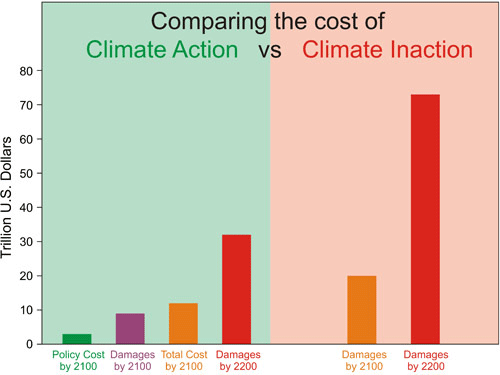
The ABC has obtained advice from the nation’s premier science agency warning climate change and poor planning were leaving the nation increasingly exposed to natural disasters.
The CSIRO draft discussion paper said the cost of replacing homes and other buildings exposed to bushfires, inland flooding and coastal inundation could almost double by 2100 to $1.38 trillion.
“All evidence suggests that the current trend of increasing disaster costs will continue into the future with a direct impact on Commonwealth expenditure,” the CSIRO said.
“Climate change is likely to increase this trend in the longer term for many hazards.”………………http://www.abc.net.au/news/2014-12-09/damage-bill-for-extreme-natural-disasters-could-top-1-trillion/5955734
Lest we forget: Aboriginal victims of Maralinga atomic bomb testing- theme for June19
 Australian atomic massacre still ignored By David T. Rowlands from Green Left Weekly issue 971 June 29, 2013
 Lallie Lennon provided convincing testimony of the injuries suffered from the fall-out.
Nearly 60 years have passed since Totem 1, a British nuclear test in the Australian desert, was recklessly conducted in unfavourable meteorological conditions.Nuclear testing of any sort, even in the most “controlled” of circumstances, is inherently abusive, a crime against the environment and humanity for countless generations to come. Yet the effects of Totem 1 were particularly bad, even by the warped standards of the era.The mushroom cloud did not behave in the way it was supposed to. Instead of rising uniformly, part of it spread laterally, causing fallout to roll menacingly at ground level over a remote yet still populated corner of South Australia, sowing injury, illness and death in its wake.
The number of casualties is unknown because the secretive and unaccountable nuclear establishment has always declined to investigate the full impact of its own criminal negligence. But it has been suggested by investigators that perhaps 50 short-term Aboriginal fatalities resulted.
In addition to those who died, many others were exposed to harmful levels of radiation. The long-term health effects on these individuals have never been charted — but anecdotal reports of high cancer rates and horrendous birth defects in isolated “downwinder” communities have circulated.
At the time of the tests, it was well known by authorities that communities of Aboriginal people were close by. Yet the official attitude was that the concerns of a “handful of natives” could not be allowed to interfere with the “interests” of the British Commonwealth.
Imagine you are out with your family one morning when suddenly a loud explosion issues from the distant horizon. The ground rumbles and shakes, as though it were about to open up. Minutes later, a thick, churning dark dust cloud engulfs the surrounding desert countryside.
Terrified, with all your senses in recoil from these unnatural developments, you wonder if an event of apocalyptic proportions is taking place. And your troubles are only just beginning.
This is what happened to 22-year-old Yankunytjatjara woman Lallie Lennon and her three young children at Mintabie on October 15, 1953. A 10-kiloton device (roughly two-thirds the yield of the Hiroshima bomb) was detonated 180 kilometres away at Emu Field, near Maralinga.
Lallie and her son Bruce, aged 3, were covered in the gunpowder-smelling dust and smoke that came rushing through the trees with such intensity that it apparently created eclipse-like visibility conditions. “It went dark and dark,” recalled Lallie in 2006. “Dark — we couldn’t see anything. The place was black, you couldn’t see nothing.”
The levels of beta radiation contained in this toxic plume were so great that it felt like being “rolled in a fire”. The “kids were [ ing] … it was terrible … We was glad we was alive but we got sick. We were sicker and sicker.”
About a year later, both Lallie and her son Bruce developed a debilitating skin condition that involves the periodic eruption of oozing, agonising sores all over the body.
Lallie said: “It went away and then came back and the sores were getting bigger and bigger every time … I was in a mess after the sores.” Her two daughters, who were in a tent at the time the mist swept through, were spared the beta burns, but developed other symptoms consistent with radiological contamination.
Lallie’s story first achieved public recognition when she spoke about her experiences for a 1981 documentary, “Backs to the Blast”.
World first – Australian breakthrough in solar energy efficiency
Solar energy world first in Australia http://www.brisbanetimes.com.au/environment/climate-change/solar-energy-world-first-in-australia-20141207-121w8n.html December 8, 2014 Peter Hannam
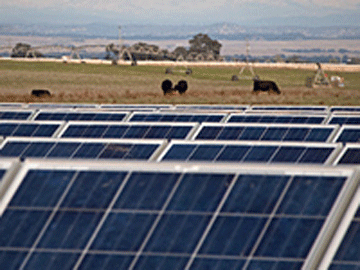 Australian solar power researchers have achieved world-beating levels of efficiency, potentially making large solar plants more competitive with other energy sources such as coal.
A team from the Australian Centre for Advanced Photovoltaics (PV) at the University of NSW has achieved 40.4 per cent “conversion efficiency” by using commercially available solar cells combined with a mirror and filters that reduce wasted energy.
Martin Green, the centre’s director, said the independently verified breakthrough eclipsed previous records without resorting to special laboratory PV cells that “you’ve got no chance of buying commercially”. Other top-performing solar panels convert about 36 per cent of the sunlight that falls on them into electricity.
The advance involved two steps. Three solar panels were stacked to capture energy from different wave lengths of sunlight, and then excess light from the stacked panels was directed by a mirror and filters to a fourth PV cell, making use of energy previously discarded.
“This is our first re-emergence into the focused-sunlight area,” said Professor Green, who pioneered 20 per cent-efficiency levels in similar technology in 1989.
The institute was prompted to revisit the technology in part because of Australian companies’ efforts to develop large-scale solar towers using arrays of mirrors to focus sunlight on PV cells.
One of those firms, Melbourne-based RayGen, collaborated with UNSW on the project. It is building a plant in China with an solar conversion rate of about 28 per cent. “We’d take them to the mid-30s” for future projects with the technology jump, Professor Green said.
Professor Green was critical of the federal government’s efforts to scrap the Australian Renewable Energy Agency – which chipped in $550,000 to the $1.3 million Power Cube project – and for its ongoing attempts to reduce the Renewable Energy Target set for 2020.
“A positive attitude to renewables would boost all these initiatives, a negative attitude will suppress them,” he said. “Clamping down on deployment of renewables will make it more difficult for developments like this to see the light of day.”
The next goal is to raise efficiency levels to 42 per cent next year, about half way to the theoretical maximum level of 86 per cent.
“It’s horse and buggy days as far as solar is concerned at the moment. There’s just this enormous potential for improvement in efficiency,” Professor Green said.
“To turn your back on those types of developments doesn’t seem to me to be a very sensible strategy.”
The university’s Mark Keevers led the engineering work on the so-called high efficiency spectrum splitting prototype, and its results were confirmed by the National Renewable Energy Laboratory (NREL) at its outdoor test facility in the US.
Shutting down Australia’s Aboriginal areas -(opening lands up for what?)
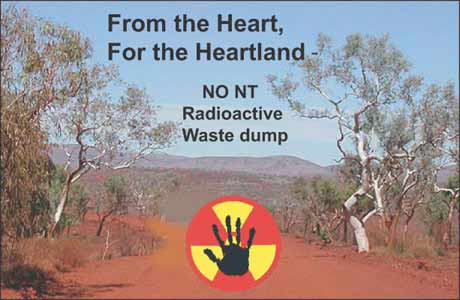 Shutting down Australia’s Aboriginal areas, Aljazeera, New funding laws threaten the existence of remote indigenous communities already facing profound social issues. Royce Kurmelovs 07 Dec 2014 Perth, Australia – The West Australian state government may bulldoze 150 remote indigenous communities that it says are too expensive to keep open under a new funding arrangement between federal and state authorities.
Canberra has offered each state a one-time, lump-sum payment to take over the responsibility of financing remote Aboriginal communities indefinitely.
In an ultimatum, Western Australia was offered $90m, enough to fund remote communities through to 2017.
But as of June 30, 2015, past federal funding agreements will end, effectively giving Western Australia authorities about seven months before they must start working out how to fund remote communities in the future – and which ones will have to close.
Similar arrangements have been made with South Australian, Queensland, Victorian and Tasmanian state governments.
All have so far remained silent on the details with the exception of South Australia, which rejected a $10m payment on the basis that it was not enough for the obligation being created.
South Australia’s Minister for Aboriginal Affairs and Reconciliation Ian Hunter warned if his government was forced to accept the new arrangement, 60 remote communities – home to 4,000 people – would have to close.
Futures in question
So far, Western Australian Premier Colin Barnett has taken a cautionary tone, telling Al Jazeera it is “still very early”, while admitting that community closures are inevitable……………
The fear is that changes to federal policy and funding arrangements that have raised the possibility of community closures only threatens to derail any achievements made to date.
That such closures may occur around the country is also what has lead the National Congress of Australia’s First Peoples (NCAFP) to label the issue one of the “most significant” facing Australia’s indigenous peoples to date.
“This is about our people’s right to stay on our land,” NCAFP co-chair Kirstie Parker told Al Jazeera. “People are very frightened that the days are numbered and their communities will be closed.”
In an effort to address the issue, Parker and her co-chair Les Malezer called on Prime Minister Tony Abbott to act in an open letter last week, but so far they have not received a response.
For others such as Tammy Solonec, Amnesty International Australia’s (AIA) indigenous peoples rights manager, there are serious questions about the Western Australia government’s ability to properly manage the transition………….
Lessons to be learned
The risk now is that the experience of Oombulgurri’s closure may be repeated across the country, and for Solonec this would be the worst case scenario.
“We can never let it happen again. If we’re going to talk about closing communities, we need to do it in a better way,” said Solonec.
What’s needed she said are “creative solutions” to actually solve the profound social issues within some remote communities, and prevent people being removed from their land.
Her view is echoed by Parker, who said self-determination is the key and closing down communities merely on the basis that they are “dysfunctional” will not solve problems, but only push them onto other communities.
“Our communities are left wondering about the future of our communities and of our children,” said Parker.
“This scenario doesn’t address the problems in our communities everyone knows are there, it doesn’t deal with the people. To do that you sit down and talk with them.” http://www.aljazeera.com/indepth/features/2014/12/shutting-down-australia-aboriginal-areas-2014124124749741868.html
Need to be alert on solar panel safety, too
Solar panel safety warning http://www.watoday.com.au/wa-news/solar-panel-safety-warning-20141206-121n4t.html December 6, 2014 The state’s energy safety watchdog has issued a warning about solar panels installed during the past year.
The Director of Energy Safety, Ken Bowron, said some of the systems had used dangerous power switches.
“The switches are used to disconnect the current produced by solar panels so electricians can work safely on a home or business,” he said. The defective switches are NHP dc Solar Isolator Swtiches KDA-432 and KDM-432. The supplier of the switches has issued a product recall.
“The defective switches were sold between July 2013 and October 2014. It is important that anyone who had a solar system installed between these dates checks if any of the defective switches have been fitted to the installation,” Mr Bowron said.
Australia’s pro nuclear lobbyists get cracking
Business groups want Government to ‘get out of the way’ of nuclear power ABC NewsBy political reporter Nick Pedley 4 Dec 2014,
The organisation’s chief executive, Nigel McBride, has welcomed the comments from senior figures within the Federal Government.

“I do welcome what is, to me, a very important sign from the Prime Minister that this Government is not closed to what could be a significant game-changer in our fight for affordable energy,” he said.
At the moment legislation bans nuclear power from becoming a reality.
Mr McBride’s view of the legislative ban is blunt.
“What we need from Government is we need governments to get out of the way,” he said.
Business SA is pushing for a debate about building a $3 billion micro reactor known as a Prism power plant designed by General Electric and Hitachi.
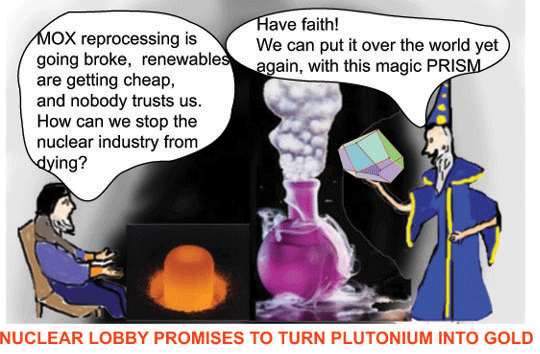
The plant converts used nuclear fuel rods and surplus plutonium into energy.
Mr McBride argued the proposal would pay its own way after five years.
He said the technology was safe and innovative and would also see nuclear nations pay Australia to take their spent fuel rods.
Tony Abbott welcomes nuclear energy ideas……….
Mr McBride has reassured the Prime Minister there would not be a push for government assistance.
“We’re not asking for subsidies,” he said.
“We’re asking for the Government to allow this to proceed.”
Engineers call for ‘simple legislation change’
The body that represents the nation’s engineers, Engineers Australia, has joined the call for Government to remove the legislative barriers to nuclear power.
Tony Irwin from Engineers Australia said the Prime Minister’s comments showed nuclear power was “seriously being considered”.
He also called for “simple legislation change”.
Mr Irwin said there were already regulators in place who could monitor the industry.
“We need a process to see how we’re going to change the legislation,” he said.
Mr Irwin is also the technical director of a company called SMR Nuclear Technology…………
He said it might be difficult to win support for the micro reactor because it was new technology and there was not enough regulatory approval in other nations for the Prism plant.
The Opposition’s foreign affairs spokeswoman, Tanya Plibersek, earlier this week dismissed nuclear power as an alternative.
“I don’t think it’s a viable option for Australia,” Ms Plibersek said.
“We know that it’s expensive.
“It takes a long time to get nuclear energy underway and in fact countries that have been relying on nuclear energy like Japan and Germany are actually retreating from the use of it.”
Senior Labor frontbencher Jenny Macklin said it was unnecessary for more nuclear energy in Australia.
She also wanted to know where the power stations would be located.http://www.abc.net.au/news/2014-12-05/governments-urged-to-embrace-nuclear-power/5945072
Will Australia again be notorious for climate change denial policies, at the COP20?
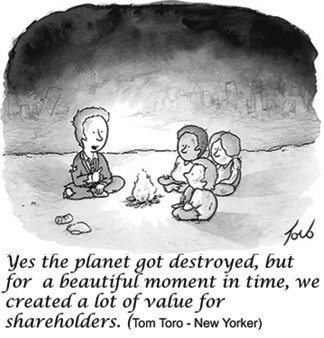 Will Australia be the great coal defender at Lima climate talks? Guardian, Graham Readfearn 3 Dec 14, Australia heads to major climate negotiations in the wake of high level defence of its coal industry. When a climate science denialist starts congratulating your country on its stance at major international climate change talks, you know things have gone decidedly bad.
That was a year ago in Warsaw, Poland, where Australia was establishing a new reputation as a negative force on global climate negotiations.
“Australia gets it,” said the climate science denialist talking head Marc Morano, a man most often seen verballing peer-reviewed science on conservative American cable news channels.
But Morano made another statement that seemed to be an attempt make the brains of as many greenies as possible go kaboom.
“Coal is the moral choice,” said Morano.
But what appeared then to be a ridiculous statement, is now Australia’s official political position. We’ve had Prime Minister Tony Abbott’s “coal is good for humanity”, the Treasurer Joe Hockey’s “we export coal to lift nations out of poverty” and the Finance Minister Matthias Cormann’s “coal is good”.
Kaboom! Kaboom! Kaboom!
Since Warsaw, Australia has also become the first nation in the world to actually remove laws to price greenhouse gas emissions and the Abbott Government continues to push for a cut to its own target on renewable energy generation.
Australia also declared its hottest year on record – 2013 – with 2014 likely to also be among the five hottest years on record (we have also just had the hottest November on record and the hottest spring on record).
Now the United Nations Framework Convention on Climate Change 20thConference of the Parties meeting in Lima (to be hereafter mercifully referred to as COP20) is underway (I’ll be there in three days time).
The key task for negotiators is to have in place the draft text of a new deal to be signed in Paris in late 2015 (at COP21) that for the first time will include all countries – both developed and developing.
Countries won’t need to declare exactly what steps they’ll take in Lima (known as Intended National Determined Contributions, or INDCS) and can wait until March next year, although some have started that ball rolling already. http://www.theguardian.com/environment/planet-oz/2014/dec/03/will-australia-be-the-great-coal-defender-at-lima-climate-talks
COP20 United Nations Framework Convention on Climate Change 20thConference
 The narrative of nuclear being good, carbon-free and safe needs to be countered, or nuclear plants could start proliferating.
Nuclear energy is definitively not the solution
Phase out Fossils. Phase in Nuclear? http://adoptanegotiator.org/phase-out-fossils-phase-in-nuclear/Anna Pérez Català December 3, 2014
 Second day of the COP20, and the plenary is full of delegates discussing the Ad Hoc Working Group on the Durban Platform for Enhanced Action (ADP). The atmosphere is really hot, like if we could feel the 2 degrees temperature rise due to climate change, and delegates are discussing the beginning of the draft and how it would look in a screen.
The ADP document is very important, because it aims to define the new climate agreement in 2015 and foster greenhouse gas reduction. Continue reading
City of Sydney’s Renewable Energy Master Plan has won the European Solar Prize 2014 award
 Sydney gets international recognition for renewable energy plan http://www.thefifthestate.com.au/politics/local-government/sydney-gets-international-recognition-for-renewable-energy-plan/70135 2 December 2014
The City of Sydney’s Renewable Energy Master Plan has won the European Solar Prize 2014 award for excellence and innovation.
The award from not-for-profit organisation EUROSOLAR recognises outstanding commitment and contributions to the renewable energy sector.
“Our Renewable Energy Master Plan will help us transform Sydney into a city run entirely on renewable energy by 2030,” Lord Mayor Clover Moore said.
“The City is Australia’s first carbon-neutral government with ambitious targets to reduce emissions by 70 per cent by 2030. We are delighted that our renewable energy master plan has received this prestigious recognition on a global scale.”
The City’s renewable energy master plan was nominated by renewable expert and president of EUROSOLAR Peter Droege.
“The City of Sydney’s renewable energy master plan demonstrates civic vision, technological leadership and political courage,” Mr Droege said.
“The plan demonstrates a commitment to a fully renewable energy based community and is a stellar model for other communities around the world to aspire to.”
South Australia’s innovative solar powered farm Sundrop goes from strength to strength
Sundrop gets $100m injection from KKR to grow tomatoes in SA desert http://www.theage.com.au/business/sundrop-gets-100m-injection-from-kkr-to-grow-tomatoes-in-sa-desert-20141204-1208fm.html December 4, 2014 Simon Evans
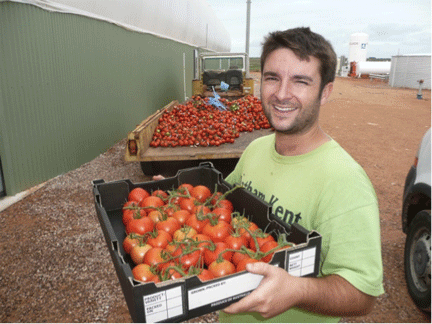
Sundrop Farms has received a capital injection from private equity firm Kohlberg Kravis Roberts to aggressively expand its operations, which grow tomatoes on desert land north of Port Augusta in South Australia using solar thermal energy and desalination. Continue reading
The Bishop – Julie – Australia’s great defender of the Coal Faith
Will Australia be the great coal defender at Lima climate talks? Guardian, Graham Readfearn 3 Dec 14,”………whereas in Warsaw the government decided not to send any ministers, this year the Australian delegation will be joined by two – Foreign Minister Julie Bishop and Trade Minister Andrew Robb (Robb was sh adow minister for Industry and Climate Change for a year in 2008).
While in opposition in 2011, Bishop was striking a denialist tone on climate change science in a column published in Fairfax newspapers.
Bloggers later found that Bishop had likely cut and pasted the material from climate science denial blogs.
Bishop’s sympathy for people who rejected the multiple lines of evidence for human caused climate change was similar to a piece she had written in 2008.
In a mining industry conference speech earlier this year, Robb celebrated the future of brown coal – the dirtiest form of the already dirty fossil fuel.
Robb said brown coal was “a resource that is often demonised, particularly by those who oppose growth and development”.
A few weeks ago Robb also jumped to the defence of Bishop, who had said the Great Barrier Reef was “not in danger” – contradicting the view of her government’s own science agencies.
So what will Bishop, Robb and Australia be looking for in Lima?
In October, Australia laid out its starting position in a document submitted to the UNFCCC secretariat.
In the document, Australia said it wanted all countries to be working on a “common playing field” and that countries must be allowed to take action that would “sustain economic growth”.
The action needed to be “appropriate to their national circumstances and policy choices” and any pledges “must include clear, credible and quantifiable emissions reduction commitments by all” that would “deliver real global outcomes”.
This is the language of multi-lateral climate negotiations – broad, woolly and open to a wide array of interpretations…….
Australia’s policy choice is to do away with pricing greenhouse gas emissions and cut ambition for renewable energy.
The “national circumstance” appears to be the world’s greatest defender of coal.http://www.theguardian.com/environment/planet-oz/2014/dec/03/will-australia-be-the-great-coal-defender-at-lima-climate-talks
Success of solar energy plus storage in remote and rural Australia
Solar plus storage becoming “new normal” in rural and remote Australia, pv magazine, 03. DECEMBER 2014 | BY: JONATHAN GIFFORD
PV arrays coupled with battery storage systems are becoming the “new normal” in Australia’s wide-open spaces. The number of installations continue to increase as governments and businesses begin to realize the new reality of off or edge-of-grid solar+storage affordability.
Rapidly falling costs in solar and battery storage technology, coupled with an increasing familiarity with the technology is driving these solutions into the mainstream in remote areas of Australia. In Western Australia a growing number of innovative solutions are providing proof of the technological solution and its economic advantages.
In a demonstration of the shift in thinking that is taking place, the state’s Minister of Energy Mike Nahan has acknowledged the strong economic case for solar+storage and has called for the state’s rural and remote utility to accelerate its uptake. Nahan has previously expressed doubts about renewable energy and, as a strong advocate of free-market principals, is not a supporter of subsidies for renewable deployment.
In response to questions raised in the WA parliament last week about the poor level electricity supply to the remote mining town of Ravensthorpe, Nahan said that the local utility Horizon is investigating a number of solutions including a micro-grid with decentralized solar component.
“I am not a technologist,” Nahan initially cautioned. “[However] we could tell everybody in Ravensthorpe to put in solar and have a wind–diesel–solar combination. They already have a micro-grid. These are the things that Horizon is supposed to look at, and we will go down and discuss it.”
Nahan continued that he had “entrusted” the utility to come up with alternative electricity solutions for supplies to remote towns such as Ravensthorpe. He has also appointed a renewable energy expert, Ray Wills, to the board of the utility. Wills is the former head of the now-defunct Sustainable Energy Association.
The parliamentary exchange was reported by the leading Australian cleantech site RenewEconomy.
This shift in thinking comes after a UBS report last month that solar+storage is already economic in some parts of Australia.
Real-world applications
While the apparent about-face of the WA Energy Minister is impressive, solar+storage arrays are going into remote Australian communities on an increasingly regular basis.
In the mid-west region of Western Australia, the Meta Maya Regional Aboriginal Corporation has announced that it will install a 100 kW solar+storage system at its headquarters in Wedgefield, Port Hedland. The array will be coupled with a 76 kWh lithium ion battery bank and backed up by a 40 kW diesel generator………….http://www.pv-magazine.com/news/details/beitrag/solar-plus-storage-becoming-new-normal-in-rural-and-remote-australia_100017360/#axzz3L3cb1lHh
Media excluded, Aboriginals protest, as Minerals Council meets in Darwin
 Traditional owners target Minerals Council HERALD SUN, NEDA VANOVAC AAP DECEMBER 04, 2014 ABORIGINAL traditional owners have heckled government and mining industry representatives at a Minerals Council summit, calling for an end to mining on their lands. ABOUT 30 traditional owners and family members drove to Darwin from Maningrida, with some driving all night to make the 1400km from Borroloola by morning.
Conrad Rory, a Yanyula and Garrawa man from Borroloola, told AAP the MacArthur River Mine near his community was having a detrimental impact on the tidal river. The mine’s independent monitor reported last year that 90 per cent of fish caught downstream of the mine exceeded maximum permitted concentrations of metals and isotopes as outlined by the national food standards guidelines.
“What we’re really hoping to accomplish is shutting down the mine,” Mr Rory said. “Since they diverted the river it’s been flowing really slow, the colour’s changed, we’ve found dead fish and crabs.”
Jackie Green, an elder from Borroloola, was critical of mine operators he saw as plundering Aboriginal land and then moving on………. Mr Green accused the government of separating families to obtain consent for mining on Aboriginal land.”They grab one Aboriginal person and take him aside and chuck a chocolate across his table and he eats that and other Aboriginal people don’t know what’s going on.”Five police cars were sent to monitor the small protest, and the doors to Darwin’s convention centre were locked.Media were barred from attending sessions with industry leaders such as Andrea Sutton, CEO of Energy Resources of Australia, and Sam Strohmayr, general manager of Glencore……… http://www.heraldsun.com.au/news/breaking-news/traditional-owners-target-minerals-council/story-fni0xqi4-1227144612565
Red Cross research shows 80% of Australians want legally binding treaty to ban the use of nuclear weapons
 Aussies Want Nuclear Weapons Ban – NFP Report http://www.probonoaustralia.com.au/news/2014/12/aussies-want-nuclear-weapons-ban-nfp-report#, December 2, 2014 More than 80 per cent of Australians support a legally binding treaty to ban the use of nuclear weapons, according to new research on attitudes towards nuclear weapons released by Australian Red Cross.
The survey found an overwhelming majority – 84 per cent – of the 1,001 Australians interviewed in the nation-wide survey feel the world would be a safer place if there were no nuclear weapons.
“A resounding 88 per cent said there would be no winners in a nuclear war given the devastating humanitarian consequences that would result. People over 65 were significantly more likely to feel there would be no winners in a nuclear war,” Australian Red Cross said.
“The message from the Australian community is clear,” Australian Red Cross’ CEO Robert Tickner said.
“It’s time for the international community to create a treaty to ban the use of nuclear weapons and ensure they are not passed as an inheritance of horror to future generations.
“Even a limited nuclear war would have immense human, environmental and agricultural destructive consequences transcending national boundaries. This situation would be beyond the power of governments and aid agencies to respond with any meaningful humanitarian assistance.”
Since their first use in Hiroshima in August 1945, Red Cross Red Crescent has voiced deep humanitarian concerns about nuclear weapons.
“While other weapons such as chemical weapons, land mines and cluster munitions have been conclusively dealt with by international treaties, nuclear weapons have not,” the humanitarian NFP said.
“The International Red Cross Red Crescent Movement has been appealing to Governments to prohibit the use of and eliminate nuclear weapons through a legally binding international agreement for some time.
Movement representatives – including Australian Red Cross delegates – will join Governments and non-governmental organisations from around the world on 8 and 9 December when they come together in Vienna to further examine the humanitarian impact of nuclear weapons.
Key Survey Findings
· 81 per cent of Australians support a legally binding treaty to ban the use of nuclear weapons.
· 84 per cent feel the world would be a safer place if there were no nuclear weapons.
· 88 per cent said there would be no winners in a nuclear war given the devastating humanitarian consequences.
· 43 per cent rate the risk of an accidental explosion or intentional use of a nuclear weapon as high or medium.
1 This month
17 October, Free Public Talk on Nuclear Issues in South Australia
David Noonan will speak on public interest concerns over the new Roxby Downs Indenture Act 2026 on BHP copper-uranium mining and ore processing in SA, and on how AUKUS may face SA with a High-Level nuclear waste agenda.
Dr Jim Green will discuss international developments in the field of nuclear power including ‘small modular reactors’ and Generation 4 ‘advanced’ nuclear reactor concepts.


Help Aunty Sue Protect Her Land and Sacred Sites From Destructive Rocket Testing.
.

Australians deserve the truth
about
AUKUS – https://aukuspublicinquiry.com/

PETITION – To: Prime Minister Anthony Albanese and the Australian Labor Government

of the week – Australians for War Powers Reform (AWPR)
To see nuclear-related stories in greater depth and intensity

