As usual, Tony Abbott is obeying his masters, Rio Tinto and BHP, on nuclear power
As the debate over nuclear power is thrown open again, Rio has told the Abbott government’s energy white paper taskforce that it is important to ensure Australia — a major uranium exporter — has the “broadest possible” range of options to bolster energy security……….
Rio Tinto says [this] in a new submission in response to the energy green paper released in September.
“The lead time for nuclear energy is long, and it would be prudent to start taking steps now towards building the capability to make informed decisions by 2020 on whether nuclear energy should be part of Australia’s energy mix.”………. The debate comes as a raft of submissions push for debate on nuclear power and companies including BHP Billiton, ANZ, Peabody Energy and Qantas Airways have made fresh submissions weighing into the debate on the nation’s energy future.
BHP, which like Rio is a major uranium producer, has told the taskforce that Australia is well-positioned to capitalise on an expected growth in demand……..
The government’s energy green paper says nuclear energy remains a “serious consideration for future low emissions energy”.
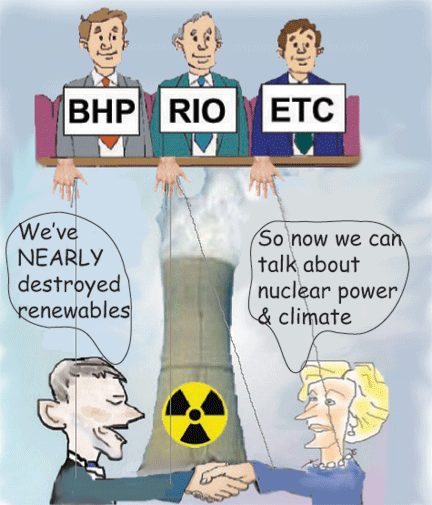
Australia has not deployed nuclear power because of government policy, including legal bans, community sentiment, and the abundance of cheap energy. Also, Australia’s glut of electricity generation is expected to last until 2023-24. http://www.theaustralian.com.au/business/mining-energy/rio-pushes-for-nuclear-power-in-energy-debate/story-e6frg9df-1227141384763
Tony Abbott’s laughable comment about “no subsidy” for nuclear power
 Tony Abbott is currently being caught up in the embarrassment of his many recent lies.
The government has received a number of submissions to its energy industry review calling for nuclear power to be part of the mix.
Some companies and scientists say small modular reactors, similar to that used in submarines, could be operational within a decade with the right policies in place.
 Prime Minister Tony Abbott has “no theological objection” to nuclear energy as a way of providing carbon emissions-free baseload power. But Australia didn’t have the same energy shortages as other countries because of the abundance of coal and gas.
“If someone wants to put a proposal for nuclear energy generation here in Australia, fine, but don’t expect a government subsidy,” Mr Abbott said in Canberra on Monday.
“If it’s going to happen, it’s going to happen because it is economically feasible, not because the government runs around offering a subsidy.”
Foreign Minister Julie Bishop said on the weekend nuclear power was an “obvious direction” for Australia as it contemplated new carbon emissions reduction targets.
Ms Bishop will be in Peru on Monday for a UN climate conference to discuss reduction targets beyond 2020.
Family First Senator Bob Day pushing for nuclear submarines for Australia
Poor South Australia! I don’t know what it is about South Australia. Such a beautiful State,with an amazing and interesting history.
And – it’ s the State that can truly boast of success in renewable energy.
 Unfortunately, South Australia is also saddled with that white elephant – the uranium industry.
It is also the hub of pro-nuclear promotion. There are the nuclear propagandists like Barry Brook, the universities infiltrated by pro nuclear proponents like Prof Simons, and the pro nuke business groups – all promoted by BHP. (Below Adelaide pro nuke promoters of nuclear power)

Now we have Senator Bob Day urging the government to develop nuclear submarines, as a recent Family First media release (3/12/14)revealed
89% of Australians support Renewable Energy Target
Almost 90% of Australians support renewable energy target, says poll, Guardian, Lenore Taylor, political editor Tuesday 2 December WWF poll finds overwhelming support for RET, particularly in Victoria, South Australia and Tasmania, as senators consider deal. Almost 89% of Australians want the renewable energy target increased or kept the same, according to new polling designed to shore up Senate opposition to plans by the government and some crossbench senators to wind back the policy.
The polling found support for the policy – which requires that 41,000 gigawatt hours of electricity be sourced from renewables in 2020 – was even higher in Victoria, South Australia and Tasmania, the home states of crossbench senators Ricky Muir, Nick Xenophon and Jacqui Lambie who hold deciding votes on any attempt to push RET change through the Senate.
Commissioned by WWF, the Reachtel polling found a strong majority of voters in the three states thought it was “very important” for the federal government to invest in renewable energy (60% in South Australia and 62.4% in Victoria and Tasmania, compared with 59.8% nationally).
Talks between the Abbott government and the Labor opposition to find a bipartisan agreement on the RET have broken down and a “compromise” plancirculated by Liberal Democrat senator David Leyonhjelm is understood not to have the support of senators Bob Day, John Madigan and Jacqui Lambie.
The government had originally signalled it wanted very deep cuts to the target – and commissioned the businessman and self-professed climate sceptic Dick Warburton to undertake a review, which recommended it be slashed to about 16,000 gigawatt hours……..
The poll found very high support for the RET among swing voters – those considering changing their voting preference from 2013. Some 88% of those voters think the RET should be increased or stay the same and 64% of those considering a change in vote supported an increase to the RET, with only 12% supporting a decrease. And 62% were more likely to vote for a party that supports keeping or increasing the current RET.
“Cutting the RET makes no sense. It will see Australia’s carbon pollution go up, sustainable energy jobs lost and investment shut out. It’s also out of line with public sentiment which is clearly in favour of supporting growth in Australia’s renewable energy sector, including wind and solar,” said WWF spokeswoman Kellie Caught.
Polling has repeatedly found very strong voter support for renewables. Another recent poll by the Australia Institute found 64% of self-identified Liberal voters supported an increased target.
But the current impasse has seen investment dry up, and if it is not resolved, electricity retailers will run out of new renewable energy to buy to meet their legislated requirements – forcing them to pay a “penalty” price.
The Reachtel poll, conducted on 26 November, contacted 5,036 voters around Australia, including 1216 in Victoria, 934 in Tasmania and 873 in South Australia. http://www.theguardian.com/environment/2014/dec/02/almost-90-of-australians-support-renewable-energy-target-says-poll
Benefits and harms of ultraviolet radiation
How to protect your skin while getting enough vitamin D , The Conversation 3 December 2014, Terry Slevin Honorary Senior Lecturer in Public Health at Curtin University; Education & Research Director, Cancer Council WA; Chair of the Occupational and Environmental Cancer Committee at Cancer Council Australia

“..….While limited dietary sources of vitamin D are available, exposure to ultraviolet radiation (UVR) is the most effective source of vitamin D for the majority of the world’s population.
Vitamin D deficiency is unquestionably linked to compromised bone health. While levels of evidence vary, it is also associated with a wide range of other potential health problems.
On the other hand, excess UVR exposure is strongly linked to increasing risk of skin cancer.
To confuse the issue further, a recently published papersuggested sun exposure might help reduce blood pressure and influence heart disease risk. But not through vitamin D. This research is still in its early days, but it may be that some of the benefits previously ascribed to vitamin D occur through other mechanisms related to sun exposure…………
What should we do?
So what does make sense when it comes to sun exposure, skin cancer and vitamin D? The trick is, of course, getting the balance right and avoiding extremes, in one direction or the other.
Adjusting sun exposure according to the time of year and time of day is important. The UV Index will be in the extreme range in the middle of the day through most, if not all, of summer. So avoiding exposure for the few hours in the in the middle of summer days is smart. The World Health Organization recommends sun protection once the UV Index reaches or exceeds three……..
Depending on where you live, five minutes of mid-morning or mid-afternoon sun two to three times a week – and certainly avoiding any sun burning – is a helpful rule. But it’s best to keep the head, face and neck protected as they get lots of sun and are at highest skin cancer risk.
Terry Slevin is editor of Sun, Skin and Health, CSIRO Publishing. https:// theconversation.com/how-to- protect-your-skin-while- getting-enough-vitamin-d-34143
Julie Bishop toes the Liberal Party line on nuclear power, climate, and renewable energy
View from the Street: Bishop goes nuclear, SMH November 30, 2014 Andrew P Street “………..Atomic! Meanwhile Foreign Minister and probable next Coalition PM Julie Bishop has come out in favour of nuclear energy.
“It’s an obvious conclusion that if you want to bring down your greenhouse gas emissions dramatically you have to embrace a form of low or zero-emissions energy and that’s nuclear, the only known 24/7 baseload power supply with zero emissions,” she said, in a statement that no-one especially asked for and that seems timed principally to give people something to talk about other than the Victorian election.
Now, nuclear power doesn’t emit greenhouse gases. It does, however, produce a lot of waste that’s incredibly radioactive – uranium, plutonium, neptunium, californium – and we have zero idea of how to store it aside from “bury it and walk away”.
Nuclear waste dumps are not unreasonably considered one of those things that absolutely everybody wants nowhere near them, making them a political nightmare.
And while things don’t generally go wrong in nuclear plants, those rare accidents tend to beome major disasters – as Fukushima and Chernobyl discovered to their considerable cost.
However, there’s another more immediate, practical reason why nuclear isn’t a likely alternative for Australia: our energy industry now almost entirely consists of private companies, who are not going to build nuclear reactors.
See, nuclear power plants take a long time to build. Depending on the design, construction takes between four and eight years, followed by six-to-twelve months of testing before it actually starts generating electricity. By comparison, building a wind farm takes six months.
As a result reactors are also extraordinarily expensive and typically take decades to turn a profit. AGL’s shareholders are very unlikely to back the company building something that won’t provide any return until most of them are dead.
So it’s not seriously going to happen in Australia. But there’s another issue in there.
Let’s look at that “baseload power” thing
The question of baseload revolves around the fact that people need power all the time including when there’s no sun or wind. Thanks a bunch, nature.
While this sounds at first blush like an insurmountable issue and is inevitably raised by people condescendingly dismissing renewable energy, it’s not that big an issue – and in fact the problem has already been solved.
Mark Diesendorf and colleagues at the University of NSW did a comprehensive study of Australia’s electricity demand and discovered that “It turns out that wind and solar photovoltaic are only unable to meet electricity demand a few times a year… Since the gaps are few in number and none exceeds two hours in duration, there only needs to be a small amount of generation from the so-called flexible renewables: hydro and biofuelled gas turbines. Concentrated solar thermal is also flexible while it has energy in its thermal storage.”
Then again, Bishop’s staying on message. After all, talking up nuclear energy is a great option if you want to move your political party away from your denialist position on climate change while still supporting the mining industry, doing nothing about reducing emissions, and keeping the conversation away from solar and wind.
So: expect the Coalition to be banging on about it for the foreseeable.
The cocktail hour: cities in dust
Speaking of Chernobyl, CBS cameraman Danny Cooke posted video he shot of the abandoned city of Pripyat mere days ago.
It’s haunting stuff – especially his sweeping drone shots – and it’s a timely reminder of what nuclear energy can cost. That’s an entire city falling to ruin, right there. http://www.smh.com.au/comment/view-from-the-street/view-from-the-street-bishop-goes-nuclear-20141130-11x4ns.html
Some people welcome Julie Bishop’s nuclear power push. Most want more renewable energy
Julie Bishop’s calls for nuclear power debate welcomed, SMH December 1, 2014 Lisa Cox National political reporter “………Environment Minister Greg Hunt said on Sunday that although nuclear power was not Coalition policy, he was supportive of a debate but any shift would require bipartisan support………
new polling for the clean energy industry showed voters want Australia to adopt more ambitious policies for renewable energy.
A survey of 1442 people commissioned by Solar Citizens, and conducted by the Australian Institute, found 76 per cent of people were either supportive or very supportive of increasing Australia’s renewable energy target, rather than scaling it back.
Thirty-five per cent favoured increasing the target to 50 per cent by 2030, while a further 30 per cent wanted a target greater than 50 per cent by 2030. http://www.smh.com.au/federal-politics/political-news/julie-bishops-calls-for-nuclear-power-debate-welcomed-20141130-11x4pl.html
Julie Bishop goes for nuclear power, as Ziggy Switkowski hedges his bets
But he [Dr Ziggy Switkowski] agreed that if there were improvements in wind and solar technology over the next two decades to make them more reliable around the clock, renewable energy sources could be more viable than nuclear.
Julie Bishop reopens nuclear debate as route to cut carbon dioxide emissions, SMH, November 30, 2014 Latika Bourke Foreign Minister Julie Bishop says nuclear energy remains an option for Australia, describing it as an “obvious direction” as it considers how to cut carbon dioxide emissions after 2020.
Ms Bishop called for a an open discussion about the feasibility of nuclear power, given Australia’s abundance of uranium, but accused Labor of resorting to a scare campaign when the issue was raised during the Howard government years
……….Ms Bishop flies to Lima, Peru, in just over a week to attend the annual United Nations climate conference, where Australia will face pressure to announce its climate targets for beyond 2020 and it’s understood the Prime Minster has personally requested Trade Minister Andrew Robb chaperone Ms Bishop so he can factor in the economic impacts of any new targets Australia considers. Continue reading
Australia pushed to nuclear deal with India, by USA strategic interests – Wikileaks reveals
WikiLeaks shows US push behind Australia-India nuke deal, Green Left November 30, 2014By Linda Pearson A deal to sell Australian uranium to India has been signed, despite opposition from most people in Australia.
In September, Prime Minister Tony Abbott signed an agreement which will allow sales of Australian uranium to India for the first time.
India has consistently refused to sign the Nuclear Non-Proliferation Treaty (NPT) and has manufactured up to 110 nuclear warheads, but has been given a free pass to take part in international nuclear trade by virtue of its new strategic relationship with the United States.
The Australia-India deal conflicts with Australia’s obligations under the South Pacific Nuclear Weapons Free Zone Treaty, as well as the NPT.
As Greens Senator Scott Ludlam said in September: “Australia will now be directly complicit in a nuclear arms race in South Asia, with India moving to lock in foreign uranium supplies for power generation so it can preserve its domestic uranium for weapons production.”
The deal is the culmination of a bipartisan shift in policy that began under the Howard government, stalled during the Rudd years, and was completed by the Gillard government in 2011.
As US diplomatic cables published by WikiLeaks illustrate, this shift took place despite most people in Australiaopposing uranium sales to India. It was pushed by governments bending to US interests.
New strategic partnership
In the three decades after India’s first successful nuclear test in 1974, relations between the US and India were cool. By the early 2000s, however, US policy-makers looking to maintain US dominance in Asia came to view India as a potential counterweight to China.
In January 2004, President Bush and India’s Prime Minister Bihari Vajpayee announced they had signed what would become known as the Next Steps in Strategic Partnership (NSSP) agreement.
Under the NSSP, the US and India pledged to take a series of reciprocal steps towards greater co-operation on civilian nuclear activities, space programs and high-technology trade.
The NSSP was hailed as a milestone in US-India relations. However, strong opposition within India threatened to derail the agreement.
When it became clear that a dramatic change in nuclear policy would be needed to win Indian support for the new strategic relationship, the US obliged. So did Australia……..https://www.greenleft.org.au/node/57915
For the Mirrar Aboriginal people, a new era may be opening up, if ERA’s Ranger uranium mine finally closes
 Uranium mining in Kakadu at a crucial point, SMH, 29 Nov 14 Peter Ker Resources reporter “……..place facing an uncertain future. Jabiru is a town in limbo. Four decades after arriving, uranium miner Energy Resources of Australia (ERA) will decide soon whether it will continue digging here. There is a chance it will choose not to, which will bring down the curtain on perhaps nation’s most controversial mine, Ranger.
Built on the faultlines of environmental and indigenous land rights policy, Ranger is at a defining moment. It has provided fuel to nuclear power stations of the world but the end of its working life is in doubt.
The end of mining at Ranger would be cause for celebration for some. Continue reading
Byron Bay to get Australia’s first community-owned clean energy generator?
 Byron Bay residents push for Australia’s first community-owned clean energy generator, ABC News By Kerry Brewster , 26 Nov 14 Australia’s first community-owned clean energy generator and retailer is taking shape in the counter-culture capital of Australia.
Known for its alternative lifestyles, the Northern Rivers region of New South Wales is hoping to establish a not-for-profit energy company – Northern Rivers Energy – to rival the big retailers………
Northern Rivers Energy wants to attract 20,000 members, who would be able to buy, generate or invest in the enterprise.
After a feasibility study funded by the NSW Government is completed, a series of public meetings will begin.
Ms Crook has little doubt the people of the Northern Rivers will seize the opportunity to take control of their energy production………..
Rooftop solar and other renewables attractive for communities
With a surge predicted in rooftop solar and other power sources, renewable energy expert Giles Parkinson said consumers should expect profound change to electricity systems.
“The traditional domination by the three big retailers, that’s something of the past. How it evolves will be very interesting to see but certainly community ownership and the community-owned retailer is one of those options and we’ve seen it happen in Germany and other parts of Europe where it’s very powerful because you have people grouping together,” Mr Parkinson said.
“They’re not trying to make massive profits and they’re responding to what the people want to do.”……..
John Truman, manager of civil services for Ballina Shire Council, said his was one local council keen to get involved.
“We’re very interested in renewable energy sources so the opportunity to talk to anybody to assist in our future projects is something we’d be very interested in,” Mr Truman said. http://www.abc.net.au/news/2014-11-27/byron-bay-pushes-for-community-owned-clean-energy/5920272
How the Renewable Energy Target benefits Tasmania (despite claims by Sen Jacqui Lambie)
Tasmania big net beneficiary from RET, Australia Institute report finds, SMH November 28, 2014 Peter Hannam
The report found the state generated about $125 million in renewable energy certificates in 2013 under the federal scheme with costs from consumers of only about $22.5 million.
One target of the report is claims by four big power users in the state that the RET was costing them alone $20 million a year, placing at risk thousands of jobs in the struggling state.
That claim was “bogus”, with partial exemption certificates covering 40-67 per cent of their costs under the scheme usually omitted from the analysis, Matt Grudnoff, a senior economist at the institute and author of the report, said………
The Australia Institute report is also aimed at discouraging newly independent Tasmanian Senator Jacqui Lambie adding her vote to the RET cut plan.
However, her chief of staff, Rob Messenger, said “trite, little studies” were unlikely to sway the former Palmer United Party senator’s views……..
Senator Lambie’s vote, should it swing to the Coalition, won’t alone be enough to force through a reduction of the RET.
So long as Labor and the Greens remain united in their opposition to the move, they need only Senator Nick Xenophon and the two remaining PUP senators – Dio Wang and Glenn Lazarus – to give them the 38 votes required to block any change. http://www.smh.com.au/environment/tasmania-big-net-beneficiary-from-ret-australia-institute-report-finds-20141128-11vbz9.html
The irrationality of Senator David Leyonhjelm’s plan for renewable energy in Australia
 The new conservative plan to shut down renewable energy, REneweconomy, By Giles Parkinson on 26 November 2014 More details have emerged about the plan hatched by a group of conservative cross-bench Senators to dramatically reduce the amount of new renewable energy projects to be built in Australia over the next five years, and to deliver a windfall subsidy to old hydro electric plants.
The plan outlined by libertarian (low taxes, minimal government) Senator David Leyonhjelm essentially delivers on the Coalition plan to limit new build renewables to around 26,000GWh, but has the bizarre inclusion of handing subsidies earmarked for new projects to state-owned hydro plants that were built decades ago.
The renewable energy industry has reacted with horror. The Clean Energy Council said it would result in a transfer of nearly $14 billion of wealth to those plants, remove more than $14 billion from new development, causing new projects to remain at a standstill and put 18,000 jobs at risk. (See its list below)
The proposal was described by The Australia Institute as a “shocker” and by the Australian Wind Alliance as “hair-bained” and “madness”. All agreed it would be worse than even what the controversial Waburton Review proposed. It is truly absurd. But what is really unsettling for the industry – and anyone who cares about the development of renewable energy in Australia – is how similar the policy is to what the ruling Coalition is proposing.
Now, while it seems preposterous that the Coalition would ever allow renewable energy certificates to be pocketed by the hydro operators (over and above the baseline currently in place), nothing can be ruled out from this government.
But it’s really just about mixing numbers to get to the same answer, and right now it seems that that answer is 51,000GWh – what the conservative side says is equivalent to a “real” 20 per cent of the revised demand forecast by 2020. They just propose different routes to get there, although the impact on the renewable energy industry would be equally devastating………………..
the Coalition doesn’t care. It’s mission is quite clearly to reduce the “new build” component of the RET to the 26,000GWh suggested by Warburton and endorsed by Macfarlane, Hunt and Abbott.
If it can do that with support of the cross-benchers, then that is exactly what it will do. Already, the idea has the stated support of John Madigan and Bob Day, Jacquie Lambie seems interested, Nick Xenophon will support anything that kills the wind industry, and even Clive Palmer – as we discussed in our article Can Palmer be tusted to defend the RET” – has made similar noises about pre-existing hydro.
Leyonhjelm’s ridiculous proposal will just be a smoke-screen for what is really on the agenda as confirmed by the support of the Coalition and many of these cross-benchers, including the Motorist Party’s Ricky Muir – of yet another investigation into wind energy and its economic impact.
The CEC described that “farcial” move – approved by the Senate on Monday – as “groundhog day”. It will be the 9th such inquiry – and all have so far supported the case for wind energy.
Here is the CEC’s list of reasons why the Leyonhjelm’s scheme is madness:
- Supporting existing hydro at the expense of new renewable energy. This proposal would provide additional support to existing hydro generation, reducing the amount of new renewable energy generation needed by over 60 per cent, from 25,000 Gigawatt-hours (GWh) to just over 9,000 GWh. This scale of reduction would have a devastating impact on existing market participants, while the flaws in this approach would likely undermine any new investment.
- Transfer of $13.5 billion to existing hydro operations. It would lead to a massive wealth transfer to existing hydro generation, at the expense of new renewable energy, worth more than $900 million per year, or $13.5 billion between now and 2030 when the policy ends. Almost 60 per cent of this would flow directly to Tasmania.
- Loss of broader economic benefits. The benefits of investment in new large-scale renewable energy would be lost. This includes the $14.5 billion of expected investment and thousands of new jobs in rural and regional parts of Australia.
- Loss of carbon abatement benefits. The new investment delivered by the current RET is expected to deliver carbon reductions of 194 megatonnes of carbon by 2030. If the policy was altered as proposed, taxpayers would need to fund additional measures through the Direct Action policy to replace this abatement.
- Higher power prices for consumers. A reduction in new electricity supply and competition in the wholesale electricity market would lead to higher power prices for consumers. The benefit of new renewable energy investment on power prices was demonstrated by the ACIL Allen modelling for the recent Warburton Review, which showed that any scenario which led to less renewable energy also led to higher power prices.
- Hydro power is already supported by the RET. Hydro is already eligible under the RET, where it generates above a pre-determined baseline. This provides an incentive for the maintenance and upgrade of existing hydro generation, and has provided revenue to Australia’s existing hydro power generators over the life of the policy. http://reneweconomy.com.au/2014/the-new-conservative-plan-to-shut-down-renewable-energy-96690
ERA’s very Bad Timing to consider a new Uranium Development
Uranium mining in Kakadu at a crucial point, SMH, Peter Ker, Resources Reporter, 29 Nov 14 “….. As fate would have it, ERA could barely have picked a worse time to evaluate a new uranium development.
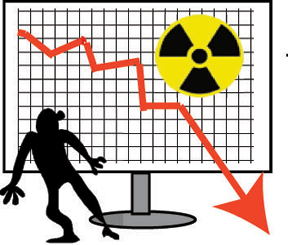 Prices for uranium have been depressed since an earthquake and tsunami sparked a nuclear crisis in Japan in 2011.
Most Australian uranium miners haven’t made a profit since. ERA has received just $US46 ($54) a pound for its product during most of this year. That is 12 per cent below the price it received in 2009.
Commodity prices are not the only threat to the project going ahead. A series of events over the past year have shaken investors’ confidence.
A tank failure in December last year spewed toxic substances around the Ranger site and prompted a six-month shutdown. Despite official surveys suggesting none of the substances escaped into Kakadu, a fierce debate ensued over the mine’s social licence to operate in such a delicate and difficult location.
The exploration results for the project have also fuelled concerns, with some analysts expressing alarm at the quality of some sections of the underground geology and cases of unstable rock formations.
At the same time ERA’s 68 per cent shareholder, Rio Tinto, is aggressively cutting back capital spending on new projects.
With Rio focused on boosting dividends rather than building large numbers of new mines, many doubt it will be willing to spend the hundreds of millions of dollars that would be required to go ahead with a new underground mine at Ranger.
When the geological concerns were reported to the market in July, Credit Suisse published the most pessimistic research note on the project to date.
“We believe the results of the Deeps resource drilling are poor,” the note said.
“Ranger Deeps either adds value or there is close to none, and risks are increasing towards the latter. If ERA announces at the end of this year that Ranger Deeps is not viable, then the share price should collapse to very low levels.”……..
JP Morgan analysts said the weak uranium prices, combined with the 2021 expiry of the mining lease, put ERA in a difficult position.
“We believe the project likely needs prices of $US50 per pound to $US60 per pound over the life of the project,” they wrote. ……..
ERA chief Andrea Sutton said the geological results had been consistent with expectations, and sufficiently good for the company to conduct less drilling than planned.
The spot uranium price enjoyed a small surge in early November, and while the longevity of that rise is unclear, Sutton said the company was confident the price would rebound in the medium term……….http://www.smh.com.au/business/mining-and-resources/uranium-mining-in-kakadu-at-a-crucial-point-20141128-11vmr3.html
Indigenous leaders’s at First Nations Summit for Freedom
Federal government cuts to Aboriginal legal services and frontline organisations and attempts by state and territory governments to water down land rights and other Indigenous legislation are also on the agenda
Indigenous leaders to meet at First Nations Summit for Freedom, Guardian, Helen Davidson, 27 Nov 14 Summit aims to reclaim Indigenous rights agenda and representation from a few high-profile voices First nations leaders and elders are holding a summit to establish a community-elected committee which would reclaim Indigenous rights and 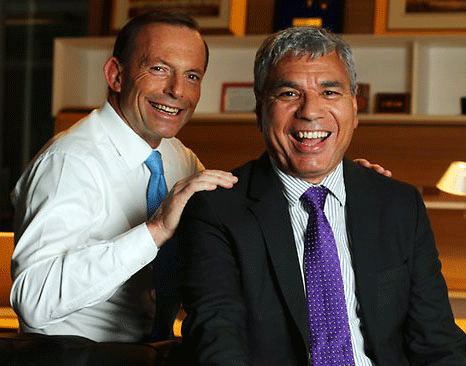 representation from a few high-profile voices.
About 100 people from across the country are expected to gather at the First Nations Summit for Freedom to discuss the major issues facing Indigenous people and address a feeling that the federal government is not speaking with Indigenous people when making decisions which have a direct impact on them.
The summit is being held on Thursday and Friday at the Old Telegraph Station in Mparntwe/Alice Springs. The site is the birthplace of the Aboriginal social activist Charlie Perkins.
“This is all about the local issues first and how the national agenda is responding to them, and how we’re not very happy about it,” said one of the summit organisers, Tauto Sansbury.
Sansbury pointed to attempts by the WA government to amend the Aboriginal Heritage Act, stripping traditional owners of a say over the cultural heritage value of their land and sacred sites, as well as a recent announcement that remote communities would likely be closed.
“The heritage act is having a big impact on Western Australia,” Sansbury, who is a long time Aboriginal advocate and was heavily involved in the royal commission into Aboriginal deaths in custody, told Guardian Australia.
“The closures of the communities over there … Aboriginal people are going to be removed off their land and there are suggestions that the SA government is thinking along the same lines.”
Federal government cuts to Aboriginal legal services and frontline organisations and attempts by state and territory governments to water down land rights and other Indigenous legislation are also on the agenda…………….http://www.theguardian.com/australia-news/2014/nov/27/indigenous-leaders-to-meet-at-first-nations-summit-for-freedom
1 This month
17 October, Free Public Talk on Nuclear Issues in South Australia
David Noonan will speak on public interest concerns over the new Roxby Downs Indenture Act 2026 on BHP copper-uranium mining and ore processing in SA, and on how AUKUS may face SA with a High-Level nuclear waste agenda.
Dr Jim Green will discuss international developments in the field of nuclear power including ‘small modular reactors’ and Generation 4 ‘advanced’ nuclear reactor concepts.


Help Aunty Sue Protect Her Land and Sacred Sites From Destructive Rocket Testing.
.

Australians deserve the truth
about
AUKUS – https://aukuspublicinquiry.com/

PETITION – To: Prime Minister Anthony Albanese and the Australian Labor Government

of the week – Australians for War Powers Reform (AWPR)
To see nuclear-related stories in greater depth and intensity

