Incident on nuclear waste ship illustrates why we should shut down Lucas Heights nuclear reactor
 Why Australia should shut down the Lucas Heights nuclear reactor, Independent Australia Last week’s fire on a nuclear waste ship off Scotland shows why Australia’s Lucas Heights nuclear reactor should to be shut down, writes Noel Wauchope. 15 Oct 14, “……. The ship, the Parida, was carrying radioactive wastes that were being returned to Belgium……
In the case of Dounreay, there is now pressure on the countries where the wastes originated, because the Dounreay nuclear site is being decommissioned and demolished……
Transport of radioactive wastes to and from Lucas Heights is indeed a hazardous operation, requiring much expensive security. However, transport is not the only safety consideration. The previous HIFAR reactor ‒ and the present OPAL one ‒ have troubled safety records…….
Australia’s most notorious terrorist, Willie Brigitte was gaoled in France in 2007 for joining an al-Qaeda backed Pakistani terror cell that had conspired to blow up the Lucas Heights nuclear plant. …….
We should shut Lucan Heights down before we regret it. http://www.independentaustralia.net/life/life-display/why-australia-should-shut-down-the-lucas-heights-nuclear-reactor,6999
Uranium companies rejoice, as universities and groups get out of fossil fuel investments?
 Divestors painting themselves into the uranium corner, JAMES KIRBY THE AUSTRALIAN OCTOBER 11, 2014
SUDDENLY the urge to “divest” is reaching fever pitch. Inside a couple of weeks there has been more noise than we have had in years as universities, religious groups and super funds announce they are “getting out of polluters”.
Indeed, the ANU’s plan to divest itself of seven resource companies, including oil and gas major Santos, has been branded a “disgrace” by federal Infrastructure Minister Jamie Briggs.
Like most trends, this started in the US where a number of leading funds have been loudly exiting resource stocks. The rush reached something of a climax in recent weeks when the heirs of Standard Oil founder John D Rockefeller said they were getting out of oil.
Now Australia will mark a national “Divestment Day of Action” targeted largely at banks that invest in resources on October 18, an initiative backed by 350.org………
Australia invites a nuclear non proliferation disaster, in its flawed deal with India
 Australia–India nuclear treaty: a non-proliferation disaster, The Strategist, the Australian Strategic Policy Institute Blog 14Oct 2014 By Crispin Rovere “…….Nuclear suppliers do have a responsibility, however, for ensuring their nuclear material isn’t used to build nuclear weapons, and must maintain strict mechanisms for that purpose. If countries can access nuclear supply without the attendant responsibilities, then support for longstanding non-proliferation regimes will be undermined, countries will see less value in treaties such as the NPT, and a key pillar of the nuclear arms control regime as a whole will be weakened.
The text of the proposed Australian export deal fails that basic test. In addition to a range of other flaws, for the first time in 40 years Australia won’t be able to guarantee how the nuclear material it supplies is being used. Specifically, the agreement allows India to reprocess uranium supplied by Australia to create plutonium, potentially at weapons grade, with no direct accounting by India to Australia for that material, and unusually, no provision for the return of the material in the event of it being misused. As former Director-General of ASNO, John Carlson, explains, Australia currently allows reprocessing only by two export partners, the EU and Japan, each with direct reporting requirements and specific permission being given by Australia as to how the reprocessed material is to be used.
Accordingly, the deal with India isn’t comparable to Australia’s other nuclear export agreements. Australia is privileging India by excluding key provisions normally included to ensure a recipient of nuclear material is accountable to the supplier. Australia’s other nuclear export partners might demand similar concessions, undermining the integrity of the non-proliferation regime as a whole.
Moreover, the concessions made by Australia are unnecessary. ………Not only does this agreement undermine long established non-proliferation regimes and Australia’s credibility as a nuclear supplier, it represents a missed opportunity to strengthen it. Given that what matters most to India is being treated on a par with China and the United States, India should be expected to ratify the Comprehensive Nuclear-Test-Ban Treaty (CTBT) after the US Senate does, just as China has already agreed to do……..
The agreement marks a significant departure from Australia’s longstanding practice. By excluding the normal provisions that ensure a nuclear recipient is directly accountable to the supplier, Australia is abrogating the principle that nuclear suppliers are accountable for how their exported nuclear material is used……..Crispin Rovere is a former PhD student at the Strategic and Defence Studies Centre, ANU and co-author of Non-strategic nuclear weapons: the next step in multilateral arms control. Image courtesy of Flickr user Indiawaterportal.org. http://www.aspistrategist.org.au/australia-india-nuclear-treaty-a-non-proliferation-disaster/
New South Wales town Uralla in the running for getting 100% renewable energy
 Uralla competes for more renewable energy http://www.armidaleexpress.com.au/story/2625862/uralla-competes-for-more-renewable-energy/?cs=12 By LYDIA ROBERTS 15 Oct 14 URALLA is vying with five other towns to become the first in Australia to rely solely on renewable energy.Mayor Michael Pearce says the move will cut power bills for the town’s ratepayers and businesses. It could also mean wind turbines become a fixture on the Uralla landscape.
“We already have solar panels powering our aged-care facilities and heating our swimming pool; our community is telling us they want more renewable initiatives and this could fit the bill,” Cr Pearce said yesterday.
Non-for-profit company Starfish Enterprises has secured a $105,000 state government grant to develop a blueprint for a zero net energy town, ideally located in the Northern Tablelands.
While more than 100 businesses have tendered to draw up the blueprint, the next step in the process is to find a suitable town willing to become the first to switch to 100 per cent green power.
Uralla, Walcha, Glen Innes, Inverell, Bingara and Manilla have all expressed an interest in becoming the model town. Cr Pearce said Uralla stood a good chance of becoming the selected town because there was substantial community support for the idea.
The move would follow several towns in the United States and Germany, all of which have shifted to zero net energy. This means the towns are powered by LED lighting, bio-gas plants, daytime solar panels and energy efficient pumping systems.
Starfish executive director Adam Blakester said expressions of interests from towns closed next Friday.
“An average town of 5000 people would spend up to $20 million a year on energy,” he said. “If we can produce that energy locally and competitively, we create a new industry.”
South Australia’s remarkably high renewable energy production
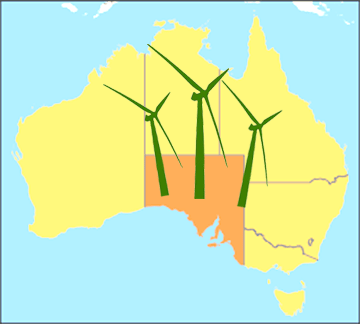
 South Australia Achieves 100% Renewable Energy For A Whole Working Day Clean Technica October 13th, 2014 by Giles Parkinson (good graphs)_ RenewEconomy. There have been several instances in recent months when wind energy has accounted for all, or nearly all, electricity demand in South Australia. Last Tuesday, however, set a new benchmark – the combination of wind energy and rooftop solar provided more than 100 per cent of the state’s electricity needs, for a whole working day between 9.30am and 6pm.
The data comes from Hugh Saddler, at consultants Pitt & Sherry, and is part of his monthly overview of electricity market, emissions and pricing trends in Australia.
Saddler notes there were several periods in South Australia from Saturday September 27, and over the following days, when wind generation was greater than total state NEM demand. (South Australia has nearly half the country’s wind capacity with around 1.5GW of wind energy).
It occurred briefly on Saturday afternoon, for much of Sunday, and again, most strikingly, between about 9.30am and 6.00pm on Tuesday, September 30, a normal working day.
In reality, renewables contributed well over 100 per cent because they were generating and consuming their own electricity from rooftop solar – the state has 550MW of rooftop solar, with nearly one in four houses with rooftop modules.
That meant that “true” demand by consumers on that day, i.e. the amount of electricity being used by consumers, including rooftop solar, was in fact considerably higher than NEM demand — up to 20 per cent according to the Australian Photovoltaic Institute — because of the contribution of rooftop PV to total electricity supply…….
Interestingly, the South Australia government has already exceeded its target of generating 33 per cent of the state’s electricity needs from renewables (over a full year), and has now set a 50 per cent target by 2025. In reality, it will likely reach that mark well before that, particularly if the Ceres wind farm and the Hornsdale wind farm are built. It could even be the first mainland state towards 100 per cent renewables over the whole year.
Considerable volumes of electricity were exported to Victoria. “In simple arithmetic terms, though not of course in how the grid actually operated, the state’s electricity supply was 100 per cent renewable while coal and gas-fired electricity was exported,” he says…..http://cleantechnica.com/2014/10/13/s-australia-achieves-100-renewable-energy-whole-working-day/
Expert, independent and public: Call grows for a new approach to radioactive waste management
 Australian civil society groups have called on the Federal Government to take a new approach to the vexed issue of radioactive waste management.
In an open letter to federal Industry Minister Ian Macfarlane national environment groups, the ACTU, public health and Aboriginal representatives have urged the Minister to move away from a search for a postcode for a remote dump in favour of a credible and open examination of the range of management options.
The groups’ letter states:
For over two decades, successive Australian governments have sought to manage Australia’s radioactive waste inventory through the development of a co-located remote central dump and store. This approach has repeatedly failed to win social license and has been characterised by division, contest and the inability of the Commonwealth to realise a site. There is no reason to think that repeating this approach in a new place would lead to a different outcome and seeking site nominations from communities that often suffer extensive economic disadvantage risks placing many in an invidious position. The approach taken to date on radioactive waste management has led to a polarisation of views and a lack of the consensus and discourse required to realise lasting solutions.
“As health practitioners we see that Australia now has both a real chance and the clear need to avoid another sweep it under the carpet response to our nuclear waste problem,” said Dr Peter Tait of the Public Health Association of Australia.
“A national inquiry into the long term, responsible management of Australia’s nuclear waste is overdue and necessary.” Continue reading
Australian Nuclear Free Alliance (ANFA) 2014 meeting statement
 Australian Nuclear Free Alliance 2014 meeting statement http://beyondnuclearinitiative.com/anfa-2014-meeting-statement/October 11, 2014
Meeting Statement – 2014
Against a background of strong community protest to the continuing government and industry push for an expanded nuclear sector in Australia, the Australian Nuclear Free Alliance (ANFA) held its 17th annual gathering of Aboriginal, environmental and public health representatives who share common concerns over the adverse impacts of the nuclear industry and a common aspiration for a future free of nuclear threats.
The 2014 ANFA meeting was held on Arrernte country in Alice Springs with representatives from the following nations, communities and organisations: Arabunna, Arrernte, Koara, Kokatha Mula, Larrakia, Luritja, Ngaanyatjarra, Tjiwarl, TI Meriam, Warlpiri, Waramungu, Warlmanpa, Wiradjuri, Wongutha, Yankunytjatjara.
Anti-Nuclear Alliance of WA, Arid Lands Environment Centre, Australian Conservation Foundation, Beyond Nuclear Initiative, Conservation Council WA, Environment Centre NT, Freedom Flotilla, Friends of the Earth (Brisbane and Melbourne), Indonesian Greens, International Campaign to Abolish Nuclear Weapons, Keep Queensland Nuclear Free, Medical Association for the Prevention of War, Nuclear Operations Watch Port Adelaide, Public Health Association Australia (NT Branch), Uranium Free NSW, West Papua.
Radioactive Waste
The ANFA meeting celebrated and acknowledged the seven-year campaign against a planned radioactive waste dump at Muckaty – an important human and environmental rights victory. Many people from Tennant Creek expressed thanks to ANFA for the strong support and solidarity over the years.
Community representatives shared concerns and experiences about the divisive impacts of the federal government’s approach to waste management. Continuing to pursue only remote dumping options further exploits disadvantaged communities. The meeting endorsed a national statement calling for an independent National Commission into responsible radioactive waste management based on science and evidence instead of a continuation of the flawed and failed process of targeting remote communities.
Uranium mining
Australian uranium fuelled the Fukushima disaster but there is ongoing pressure for new uranium mines in Western Australia, the Northern Territory, South Australia, Queensland and exploration threats in New South Wales. ANFA condemned the federal and state governments as out of step with the broad opposition to uranium mining across many communities and organisations. The meeting discussed specific action plans to target uranium mining projects across Australia.
Mine Rehabilitation
The meeting heard of the failures of rehabilitation of uranium mines and called for the national adoption and enforcement of the standard applied at the Ranger mine in Kakadu that requires radioactive mine tailings to be isolated from the environment for no less than ten thousand years.
Women’s Health
The meeting heard personal stories and long history of disease and impacts from the nuclear industry, including intergenerational sickness and mental health issues. Base-line studies from the past were not done but should be demanded for any proposed new projects for animals, plants, bush foods and people. There is a need to do healing: the pain and hurt caused by nuclear impacts will always be there but we should support each other through healing and engage our community medical services in collecting data and tracking impacts.
Men’s Health
The meeting heard about scientific studies that have demonstrated increases in cancer incidence among Australians exposed to radiation and we are seeing this in our communities. The consensus scientific view is that even the lowest doses of radiation can cause cancer and children and women are at greater risk. The impacts from radiation exposure are seen in our families’ health. In Australia uranium deposits have been known as poison or sickness country by Aboriginal people with strong cultural knowledge about the dangers – this traditional knowledge is still being ignored.
Weapons
The meeting heard that around 40,000 rounds of depleted uranium weapons have been deployed in Australian military training exercises. This raises serious concerns about where they were used and any subsequent health impacts from these weapons. We recognise the intergenerational health impacts from nuclear weapons testing as well as the documented use and impacts of depleted uranium weapons. The meeting called for all uranium weapons and nuclear weapons to be banned.
Rare Earths
The mining and refining of Rare Earth Elements (REE’s) was discussed. There is a need for roundtable discussion of stakeholders in the nuclear free, climate and renewable energy sectors to discuss the role of REE’s in renewable energy technologies such as wind and solar given that mining these elements involves the generation of radioactive uranium and thorium waste.
Land Councils
There was strong concern about the function of Aboriginal Land Councils in different states and territories. The meeting called for greater openess to ensure such bodies represent the wishes of Aboriginal people in their region. There were deep concerns expressed that full consultation does not always happen and ANFA representatives will be seeking to address these issues within their particular Land Councils.
ANFA Network
ANFA representatives in each states and territory committed to building the ANFA network and sourcing funds to produce and distribute resources needed for grassroots community education on nuclear issues.
In the shadow of Fukushima there can be no nuclear business as usual and meeting representatives reaffirmed their commitment to actively advance a nuclear free Australia through involvement in ANFA, their communities and organisations.
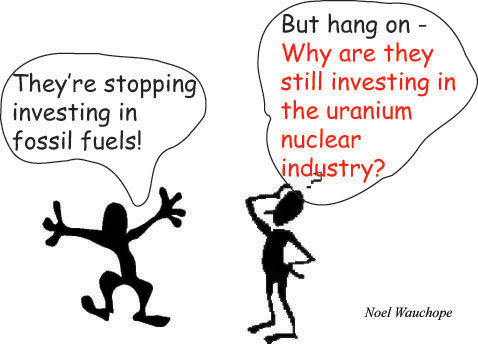
Australian National University divesting from fossil fuels, but not from uranium
ANU defends divestments, says fossil fuels companies must diversify into new energy, The Age Heath Aston, political correspondent October 13, 2014 – The head of the Australian National University has defended a decision to dump certain resources stocks from the university’s $1 billion investment portfolio on ethical grounds, saying fossil fuel-reliant companies will not survive the next 20 to 30 years unless they diversify into new energies……
ANU is the first Australian university to divest from fossil fuels but in the United States 19 universities have sold out of investments deemed unethical or a risk to the environment, including the prestigious Stanford University, which has purged its $US19 billion ($22 billion) investment fund. ANU modelled its socially responsible investment policy on that of Stanford.
Professor Young said there had been a “torrent of support” from students and the wider community.
“They have been saying ‘don’t back down’,” he said. “There is tremendous enthusiasm out there around environmental issues and investment.”
ANU Student Association president Cam Wilson said 82% of 2000 students polled before the university made its decision supported divestment.
In an opinion piece written for Fairfax Media, Professor Young, whose ocean research has resulted in his consulting to a range offshore gas and oil companies, questioned the short-term thinking of the divestment critics.
“What will our industries be in 20 or 30 years’ time?” he writes. “I am confident they will not be in producing fossil fuels.”
He told Fairfax Media: “I don’t think fossil fuels will be a big part of the world economy in 20 to 30 years’ time. But, that said, there is a big opportunity for these companies to change the mix of what they produce.”
While seven resources stocks were dumped, ANU has retained investments in mining groups BHP Billiton and Rio Tinto, as well as in Woodside Petroleum and Wesfarmers.
Professor Young said those groups were more diversified and showed signs of evolving to new energy sources in future……. http://www.theage.com.au/federal-politics/political-news/anu-defends-divestments-says-fossil-fuels-companies-must-diversify-into-new-energy-20141012-114ypp.html
Whistleblower exposes the rorting in electricity charges
Conflicts of interest abound in the way energy companies charge
 Rorting in the power industry about to be laid bare, SMH, October 13, 2014 Michael West Business columnist The government privatisation train is on course for a head-on collision with the parliamentary inquiry into “gold-plating” in the power industry.
At the very time the states are sprucing up their energy companies for sale, further revelations of regulatory rorting will be flowing thick and fast. Gold-plating, or excessive spending on poles and wires, has been shoring up industry returns for the past six years – and driving power bills higher, although demand for electricity actually has been falling.
Now a treasury analyst from Queensland electricity retailer Energex threatens to blow the lid on how the power industry “games the regulator” in unprecedented and gory detail. Cally Wilson walked out of her job at Energex three weeks ago and turned whistleblower, telling the press how her bosses had conspired to push up power prices.She says she was instructed to find a debt rate which would meet management’s targets — in other words, a high rate. “Unusually high” were her words.
The higher the WACC (weighted average cost of capital), the higher the return Energex could claim from the Australian Energy Regulator (AER) — and therefore the higher it would charge its customers.
Her allegations of data manipulation are the catalyst for the announcement of the parliamentary inquiry into “gold-plating”. Continue reading
Renewable energy plays a role in reducing Western Australia’s greenhouse emissions
Despite the result, WA continues to be one of the world’s biggest emitters on a per person basis.
According to Synergy, reasons for the fall included WA’s first large-scale solar power plant and a big wind farm near Geraldton coming online last year.
A spokesman noted the utility had generated more electricity from its cleaner gas-fired power stations, while closing a coal-fuelled generating unit earlier than expected. Adding to the turnaround had been an unprecedented fall in electricity demand across Australia.
The trend, which bucked decades of uninterrupted growth and has confounded industry players, has been caused by sharply higher power prices, more efficient energy appliances and rampant demand for rooftop solar panels. Another cause has been the recent closure of energy-hungry manufacturing plants.
Conservation Council of WA director Piers Verstegen welcomed the figures as good news and suggested the trend would continue on the back of the growing viability of renewable power. https://au.news.yahoo.com/thewest/wa/a/25241234/greenhouse-emissions-fall/
Aboriginal land was taken, but returning Aboriginal soldiers not entitled to soldier settlement blocks.
Racial issues were forgotten on the battlefield as allied troops united against the common enemy.
Initiatives such as the Soldier Settlement Scheme, which granted land to ex-servicemen was not extended to indigenous servicemen, despite the fact that much of the best farming land in Aboriginal reserves had been confiscated for soldier settlement blocks.
 Aborigines Equal On The WWI Front, But Not At Home Central Western Daily 13 Oct 14 IT is estimated that up to 800 indigenous servicemen served in the First World War. The exact number will never be known since ethnicity was not recorded on enlistment papers.
When war broke out in 1914, many indigenous Australians who attempted to enlist were rejected on the grounds of race, their attestation papers marked ‘Unsuitable physique – Aboriginal’ or ‘Unsuitable physique – Colour’. This was in accordance with the Commonwealth Defence Act 1909 which prevented those who were not of ‘substantially European descent’ from enlisting in the armed forces. Many indigenous men enlisted under false names and/or places of birth in an attempt to evade these conditions…..
After Prime Minister Billy Hughes’ conscription referendum was defeated in October 1916 and enlistment numbers were falling, legislation was introduced allowing “half-castes” to enlist.
A Military Order stated: “Half-castes may be enlisted in the Australian Imperial Force provided that the examining medical officers are satisfied that one of the parents is of European origin.”
Indigenous Australians were present in almost every Australian campaign of World War I. At least 34 Aboriginal men fought at Gallipoli, 12 of whom were killed. They also served in trenches on the Western Front and on horseback with the Light Horse in the Middle East. Continue reading
How the Abbott government has squashed Australia’s renewable energy industry
 Australia Crushes Its Renewable Energy Industry SustainableBusiness.com News by Rona Fried, 7 Oct 14 Who would have predicted that Central America would become a renewable energy leader, while Australia lags way behind?
Starting from practically zero renewable energy, Central America will install over 2.3 gigawatts (GW) over the next five years, a huge advance from the mere 100 megawatts in 2013.
Mexico is by far the leader, with $1.3 billion invested in the first half of 2014, almost double that of 2013. But last year, the other Central American countries combined also saw $1 billion in solar and wind investments. While financing for renewables still isn’t easy, most of the countries are amending policies to encourage greater investment, says Michel Di Capua of Bloomberg New Energy Finance.
Australia’s Government Squashes Renewable Energy
In contrast, Australia is in the midst of killing its renewable energy industry because of its new Prime Minister’s archaic policies.
After repealing the country’s carbon tax, investments dived 70% this year as the government decides whether to also eliminate or scale back the Renewable Energy Target (RET). Year-to-date, just $238 million has been invested in seven projects, the lowest level since 2002, says Bloomberg New Energy Finance.
Over the past year, Australia has dropped from #11 to #31 for investments in large-scale clean energy projects, even lagging Algeria and Myanmar, New Energy points out.
Last week, rallies across Australia called for the federal government to uphold the country’s commitment to 20% renewable energy by 2020. Meanwhile, South Australia is moving in the opposite direction. Already running on 32% clean energy – years ahead of its 2020 target – the local government says it will raise its Renewable Energy Target to 50% by 2025. …….
Companies On the Way Out
“We are talking about the destruction of an industry, with no apparent good reason,” Miles George, President of Infigen Energy, Australia’s largest public renewable energy company, toldRenewEconomy. His company could go under within months to be followed by many others, he says.
US-based Recurrent Energy has already closed its Australian office. It’s got 1.5 GW of large scale solar projects in the pipeline – worth around $3 billion – which won’t be developed without the Renewable Energy Target. With markets in other countries booming, many other companies including Acciona, First Solar, Yingli and Goldwind are also threatening leaving.
Solar Systems Pty tabled plans for a 100 MW concentrating PV plant and Suzlon is reconsidering its A$1.5 billion wind farm.
Abbott’s panel that’s reviewing the Renewable Energy Target consists of two climate sceptics and a fossil fuel lobbyist.
Emissions Rise
Immediately after Abbot axed carbon taxes, Australia’s emissions jumped 0.8% in just two months – the most in eight years, due to more use of coal, reports Sydney Morning Herald……….http://www.sustainablebusiness.com/index.cfm/go/news.display/id/25941
Tony Abbott a very false friend to Australia’s Aborigines
John Pilger: War, circus and injustice down under, Green Left, Saturday, October 11, 2014 By John Pilger There are times when farce and living caricature almost consume the cynicism and mendacity in the daily life of Australia’s rulers.
Across the front pages is a photograph of a resolute Tony Abbott with Aboriginal children in Arnhem Land, in Australia’s remote north. “Domestic policy one day,” says the caption, “focus on war the next.”
Reminiscent of a vintage anthropologist, the prime minister grasps the head of an Aboriginal child trying to shake his hand. He beams, as if incredulous at the success of his twin stunts: “running the nation” from a bushland tent on the Gove Peninsula while “taking the nation to war”. Like any “reality” show, he is surrounded by cameras and manic attendants, who alert the nation to his principled and decisive acts.
But wait; the leader of all Australians must fly south to farewell the SAS, off on its latest heroic mission since its triumph in the civilian bloodfest of Afghanistan. “Pursuing sheer evil” sounds familiar; of course, an historic mercenary role is unmentionable, this time backing the latest US-installed sectarian regime in Baghdad and re-branded ex-Kurdish “terrorists”, now guarding Chevron, Exxon Mobil, Marathon Oil and Hunt Oil.
No parliamentary debate is allowed; no fabricated invitation from foreigners in distress is necessary, as it was in Vietnam. Speed is the essence. What with US intelligence insisting there is no threat from Islamic State to America and presumably Australia, truth may deter the mission if time is lost. If the police and media show of “anti-terror” arrests in “the plot against Sydney” fails to arouse the suspicions of the nation, nothing will………
Far from being a “friend”, Abbott’s government is continuing the theft of Aboriginal land with a confidence trick called “99-year leases”. In return for surrendering their country — the essence of Aboriginality — communities will receive morsels of rent, which the government will take from Aboriginal mining royalties. Perhaps only in Australia can such deceit masquerade as policy.
Similarly, Abbott appears to be supporting constitutional reform that will “recognise” Aboriginal people in a proposed referendum. The “Recognise” campaign consists of familiar gestures and tokenism, promoted by a PR campaign “around which the nation can rally”, according to the Sydney Morning Herald — meaning the majority, or those who care, can feel they are doing something while doing nothing.
During all the years I have been reporting and filming Aboriginal Australia, one “need” has struck me as paramount. A treaty. By that I mean an effective bill of rights: land rights, resources rights, health rights, education rights, housing rights and more. None of the “advances” of recent years, such as Native Title, has delivered the rights and services most Australians take for granted.
As Arrente/Amatjere leader Rosalie Kunoth-Monks says: “We never ceded ownership of this land. This remains our land, and we need to negotiate a lawful treaty with those who seized our land.”
A great many if not most Aboriginal Australians agree with her; and a campaign for a treaty — all but ignored by the media — is growing fast, especially among the savvy Aboriginal young unrepresented by co-opted “leaders” who tell White society what it wants to hear.
That Australia has a prime minister who described this country as “unsettled” until the British came indicates the urgency of true reform — the end of paternalism and the enactment of a treaty negotiated between equals. For until we, who came later, give back to the first Australians their nationhood, we can never claim our own. https://www.greenleft.org.au/node/57493
Leaders of States plot to facilitate mining on Aboriginal land?
 COAG puts focus on land rights THE AUSTRALIAN 11 Oct 14 NORTHERN Territory indigenous land rights legislation will be reviewed in Tony Abbott’s northern Australia white paper after a meeting of state and national leaders was told it was holding back development.
The Prime Minister announced the review at the Council of Australian Governments meeting in Canberra………Northern Territory Chief Minister Adam Giles called for changes to indigenous land administration and land use to enable traditional owners to attract private-sector investment and finance for development.
He said all the operating mines in the Northern Territory had been approved before the current land rights laws were implemented in the 1970s. “The protracted and complicated processes for approving development projects on Aboriginal land are prohibiting indigenous Territorians from pulling themselves out of poverty through economic development,” Mr Giles said……..http://www.theaustralian.com.au/national-affairs/state-politics/coag-puts-focus-on-land-rights-to-get-territory-moving-on-jobs/story-e6frgczx-1227086931999
A vision for a modern outback in Australia
Another imagined future is to treat the Outback as a land ripe for unfettered development. It would divide the landscape into exploited and conserved (or neglected) sectors, and would seek to transform the areas by creating an economy highly reliant on intensive agriculture and mining.
It would seek to overcome logistical and environmental constraints of such industrialisation through government subsidies. This may create brief economic growth in a few districts. However, in the long term this approach would cause irredeemable loss to those values that make the Outback so distinctive and important.
 There is a different future that instead recognises the extraordinary existing inherent value in the Outback, and supports development that adapts to and works within the environmental and other constraints of remote and dry lands
A Modern Outback — nature, people and the future of remote Australia BARRY TRAILL THE AUSTRALIAN OCTOBER 11, 2014 “…… The Outback stands out as one of the great natural places globally, a place where nature remains in abundance; a landscape where the bush still stands, where the rivers still flow and where wildlife still moves as it always has to find food and shelter in a tough environment……..
There are especially magical, mysterious, spectacular places in the Outback — Kakadu, Uluru, the Kimberley — icons that draw visitors from the nation and beyond.
But these are parts of a whole, places embedded within a vast natural landscape, and dependent on the greater landscape for their ecological health. It’s essential that we think about the Outback as an entire and modern whole because its varied landscapes now face similar problems…….
The Outback is at a crossroads economically and environmentally. Social and economic development is highly dependent on maintaining the natural health of the Outback. The condition of many landscapes and wildlife species in the Outback is dependent on active human management.
It is possible, and Australia now faces the challenge and the opportunity, to create a modern Outback that depends on nature, which in turn supports people, jobs and regional economies…….. Continue reading
1 This month
17 October, Free Public Talk on Nuclear Issues in South Australia
David Noonan will speak on public interest concerns over the new Roxby Downs Indenture Act 2026 on BHP copper-uranium mining and ore processing in SA, and on how AUKUS may face SA with a High-Level nuclear waste agenda.
Dr Jim Green will discuss international developments in the field of nuclear power including ‘small modular reactors’ and Generation 4 ‘advanced’ nuclear reactor concepts.


Help Aunty Sue Protect Her Land and Sacred Sites From Destructive Rocket Testing.
.

Australians deserve the truth
about
AUKUS – https://aukuspublicinquiry.com/

PETITION – To: Prime Minister Anthony Albanese and the Australian Labor Government

of the week – Australians for War Powers Reform (AWPR)
To see nuclear-related stories in greater depth and intensity

