Aboriginal poverty increased through self-serving corporations and highly paid executives
according to the Office of the Registrar of Indigenous Corporations, mining is returning millions to Aboriginal owned corporations. Western Australia’s Pilbara is the engine room of the nation’s mining boom. But the two billion years old 400,000 square kilometres Pilbara is home to some pretty sad poverty, all of it First Peoples – Roebourne and Wickham for starters, and any of the cluster of communities around Marble Bar, Tom Price, Nullogine, Port Hedland.
Port Hedland is Australia’s busiest port, with ships leaving daily filled with iron ore extracted from Aboriginal land but with the profits returned to multinationals – next-to-nothing for the communities where many of the native title claimants live . Native title owners? A fool’s gold many say.
But if not billions of dollars there are millions of dollars going the way of Aboriginal corporations. Continue reading
High level nuclear waste (not medical) soon to be returned to Australia
 Mr Karamoskos says the public has been sold a furphy about what nuclear waste will be stored in any waste site.
He says most of the waste will not be medical waste.
‘Accumulated waste over the last 60 years from Lucas Heights, industrial and defence waste.
Time is running out to find a nuclear waste site in Australia http://www.abc.net.au/radionational/programs/bushtelegraph/nuclear-waste/5798278 Cameron Wilson, 10 Oct 14 The Federal Government is running out of time to find a safe nuclear waste site.
Within a year, nuclear fuel rods the French have been reprocessing for us will be returned to Australia. By 2020 more nuclear waste, which was being reprocessed in the UK, will be sent back too; and 60 years of accumulated industrial and defence nuclear waste, along with future medical waste, will also need a new home.
The government had hoped to bury the waste on Indigenous land in South Australia and then the NT but both attempts failed.Now, the government is considering allowing pastoralists with free-hold land to nominate their properties as nuclear waste storage sites.
Resources Minister Ian McFarlane says as of November 10, 2014, the tender process will be opened up to interested parties. John Armstrong is a cattleman in the Northern Territory. He’s expressed interest in nominating his land for hosting the nuclear waste. He believes it could bring infrastructure and investment to more isolated parts of the country. Continue reading
ASIO involved in secret collection of bones of dead children
 Australia’s new secret police, Eureka Street Brian Toohey | 09 October 2014 When Greg James QC recently launched Frank Walker’s book Maralinga on British nuclear tests in Australia, the former NSW Supreme Court judge said the Australian Security Intelligence Organisation was involved in an associated program to collect the bones of dead children without the parents’ permission.
Jones later explained that he obtained this previously unpublished information, although not precise details, while representing military veterans exposed to radiation from the tests in 50s and 60s. However, the book provides a powerful reminder of the harm that can be done by using national security to conceal indefensible 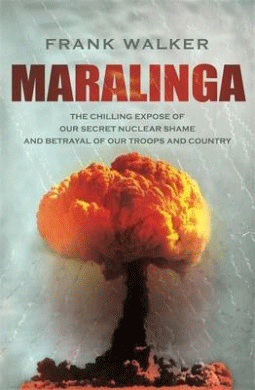 behaviour.
Walker sets out how 22,000 bones, mostly of babies and young children, were removed from corpses as part of a secret program to examine the effects of the radiation, which the tests spread across large parts of Australia. The program, that began in 1957 and lasted 21 years, was kept secret until 2001.
Walker says the grieving parents, in the overwhelming majority of cases, were not asked if the bodies of their children could be used for scientific studies relating to the development of nuclear weapons. The book also gives harrowing accounts of the experiences of servicemen and technicians who were exposed — in some cases deliberately— to dangerous levels of radiation without their permission. All were warned they would be severely punished if they said anything about what happened.
This is only one of many examples of the disturbing consequences of excessive secrecy in the name of national security. President Kennedy is a rare example of a politician who acknowledged that suppressing information can actually damage national security, as occurred in 1961………..http://www.eurekastreet.com.au/article.aspx?aeid=42125#.VDg3TGddUnk
Senator Nick Xenophon will not commit to full support of the Renewable Energy Target (RET)
 AUDIO: Listen to Natalie Whiting’s report (PM) Renewable Energy Target campaigners fail to win Nick Xenophon’s commitment, ABC Radio PM By Natalie Whiting 9 Oct 14 Climate change campaigners in South Australia have kept up pressure on the independent Senator Nick Xenophon to commit himself to protecting the Renewable Energy Target (RET). Hundreds of people attended a forum this week to demand the Senator commit to blocking any potential changes to the RET. They said renewable energy employment could make up for some of South Australia’s job losses in other fields.
But Senator Xenophon refused to promise anything, saying only that he was open to RET negotiations……..
Mr Green was worried the potential changes to the target could produce more job losses.
“There are 13,000 people employed in the solar industry at the moment and conservative estimates suggest that between a third and a half of those jobs would be lost if these [federal] recommendations were adopted,” he said.
“There are also 21,000 people employed in the renewable energy sector as a whole, so including wind, and many of those wind workers would be out of a job by Christmas as well.”
Mr Green was among a number of pro-RET speakers at the Adelaide forum……..
Forum attendees demanded Senator Xenophon commit to blocking any potential changes to the RET, but he refused……… Continue reading
Abbott govt is turning ASIO into a secret police agency

 Australia’s new secret police, Eureka Street Brian Toohey | 09 October 2014 “……..Numerous official inquiries and media reports have shown that highly secretive bodies will abuse their powers in the absence of strong checks and balances. Undeterred, the Coalition and Labor parties have backed a new law that imposes 5-10 year jail sentences on anyone who reveals anything about what ASIO designates a Special Intelligence Operation. This prohibition covers exposing murder, endemic incompetence or dangerous bungling. The loosely worded law covers ASIO officials, agents and ‘affiliates’. The latter could include other Australian and overseas intelligence agencies, police forces and special military squads.
The law removes the long-standing defence that publication in the public interest can be legally justified. The US does not have an equivalent law. These days the mere utterance of the words ‘national security’ seems to mesmerise mainstream Australian politicians, such as the Attorney General George Brandis, who normally see themselves as resolute opponents of the unconstrained expansion of state power.
In this case, journalists and others who report on stuff-ups and abuses of power can’t even know whether they are committing a crime — ASIO will not say whether a Special Intelligence Operation exists. Bank robbers at least know they are breaking the law. Australian media reporting has never resulted in the death of any intelligence operatives or undercover police. In contrast, far more people have been killed as a result of intelligence operations being kept secret. This is not a fanciful concern when the Australia’s overseas intelligence partners assassinate people. If the CIA wants to kill someone in Spain, for example, it could ask ASIO to use its coercive questioning powers to force an innocent relative in Australia to reveal the target’s location.
Intelligence information is often wrong. Identities can be confused, intercepts misconstrued and informants give false information about rivals. This is one reason police are not allowed to assassinate people suspected of committing a crime.
If it were a crime at the time to report on ASIS operations, the media could not have informed the public about the 1983 folly in which masked ASIS trainees ran around the Melbourne Sheraton, armed with silenced machines guns, sledge hammers and hypodermic syringes, recklessly indifferent to public safety. Likewise, the new law could be used to suppress future media reports about a similar injustice to one where a NSW Supreme Court Judge Michael Adams said in 2007 that two ASIO officers ‘committed the criminal offences of false imprisonment and kidnapping at common law’. No one in ASIO was subsequently charged.
Originally, ASIO was purely an information gathering body with no power to detain people or compel answers to questions. It now has these powers, without the safeguards that apply to police investigations of serious crimes where they must identify themselves can’t compel answers. As others note, Israel’s security service does not have these ASIO powers. In this context, one former ASIO officer privately told this writer that he feared the changes ‘would turn ASIO into a secret police agency’. http://www.eurekastreet.com.au/article.aspx?aeid=42125#.VDg3TGddUnk
After 86 years, traditional owners get back land where 100 Aboriginals were massacred
Coniston massacre: Nigel Scullion returns site to traditional owners 86 years after killings 7 News, ANTHONY STEWART October 9, 2014, The site of Australia’s last recorded massacre of Aboriginal people has been returned to its traditional owners.
Indigenous Affairs Minister Nigel Scullion travelled to Yurrkuru 274 kilometres north-west of Alice Springs to present native title deeds to traditional owners.
Here, in 1928, up to 100 Aboriginal people were killed near the Coniston cattle station in reprisal for the death of a white man. The murders later became known as the Coniston massacre.
Warlpiri and Anmatyerr people welcomed Senator Nigel Scullion on to their land with traditional song and dance.
Senior Anmatyerr man Teddy Long said generations of his family had been fighting to have the massacre acknowledged and the land returned. “My old man, my father been explaining to me what happened to me, the shooting days,” he said.
“In the massacre days many people were killed here and that’s why [I’ve] been fighting real hard for this land”
Land returned decades after Land Rights claim Traditional owners initially lodged a claim under the Aboriginal Land Rights Act for the land in 1985………
In 1928 The prime minister at the time, Stanley Bruce, launched an a board of inquiry into the actions of police and pastoralists.
It ruled the police had “acted in self-defence”……https://au.news.yahoo.com/a/25219778/coniston-massacre-nigel-scullion-returns-site-to-traditional-owners-86-years-after-killings/
NEW KAKADU URANIUM MINE CONTESTED – RIO MUST TAKE RESPONSIBILITY FOR RANGER REHAB
“The writing is on the wall for Rio – post-Fukushima the uranium commodity price is at an historic low, the global market outlook shows no signs of recovery and the company continue to lose millions at Ranger mine every year. NT and Commonwealth regulators need to use the Ranger 3 Deeps EIA process to take a sobering look at the mine’s struggling financial position, it’s poor worker safety, nuclear security and environmental record and use this opportunity to close the door on this costly and contaminating trade for good.”
7 Oct 14 The Environment Centre has vowed to contest any new uranium mining in Kakadu National Park and called on Rio Tinto to commit to a comprehensive closure and rehabilitation plan for Ranger uranium mine. The call coincided with an international day of action on October 7th with trade unions, communities and Indigenous groups protesting to highlight the health, environment and social impacts of Rio Tinto’s multinational mining operations.

Rio Tinto and subsidiary Energy Resources of Australia are currently seeking an approval to develop a new underground uranium deposit, Ranger 3 Deeps, despite recent claims that the company is unwilling to take responsibility for the $600 million plus clean-up costs from its open pit operation.
Rio’s Chief Executive Sam Walsh has repeatedly refused to take responsibility for rehabilitation, most recently at the company’s Melbourne AGM, suggesting instead that its subsidiary Energy Resources of Australia, 68% owned by Rio should bear sole responsibility despite its weak financial position.
Lauren Mellor from the Environment Centre NT said “We are supporting the international call today to hold Rio Tinto to account for its appalling track record on environmental, social and industrial safety issues. Here in the NT Rio’s Ranger uranium mine has recorded over 200 license and security breaches, spills, and accidents in its 30 year history. Continue reading
Age Editorial: Government drops ball on climate change
 Government drops ball on climate change http://www.theage.com.au/comment/the-age-editorial/government-drops-ball-on-climate-change-20141007-3hhgq.html 8 oct 14 Two weeks ago, when Prime Minister Tony Abbott spoke before the General Assembly of the United Nations, he named four dire problems facing the world: the dangers posed by the Islamic State in Iraq and the Levant (ISIL), Russia’s destabilising influence in eastern Ukraine, the outbreak and spread of the Ebola virus in western Africa and the economic malaise that continues to afflict many countries.
But Mr Abbott did not mention climate change at all. That failure was conspicuous because just two days earlier, at the same podium, US President Barack Obama had outlined the same four threats to the world (”terrorism, instability, inequality and disease”) but added one more. Mr Obama told more than 120 leaders attending the UN Climate Summit that ”there’s one issue that will define the contours of this century more dramatically than any other, and that is the urgent and growing threat of a changing climate”. Mr Obama said the US had a duty to lead on emissions reduction strategies, and he urged other nations to do their part, saying no nation could afford to pretend climate change was not real.
Mr Abbott, though, did not even bother to attend the Climate Summit. He sent Foreign Minister Julie Bishop instead, and she chose to promote the government’s Direct Action strategy, under which businesses would be paid to cut their emissions. Sure, there are several other nations – India, for one – that obstinately shuck off any responsibility for initiating emissions-abatement strategies and which do so because they perceive their economies would be significantly disadvantaged. But Australia under the Abbott government has become an international joke on matters related to climate change. Only last year, for example, Mr Abbott suggested the UN’s climate chief, Christiana Figueres, was ”talking out of her hat” when she said bushfires in Australia were linked to climate change. Soon after, Environment Minister Greg Hunt sought to defend the PM in an interview with the BBC. During that interview, Mr Hunt said he had ”looked up what Wikipedia says”, and then sought to downplay the notion that climate change could influence the likelihood of bushfires.
But as Fairfax Media reported this week, Mr Hunt was thoroughly briefed just weeks before the interview by officials of the Bureau of Meteorology who explained the effects of climate change on weather patterns. They told the minister that a pattern of recent episodes of extreme heat was ”consistent with the general pattern of warming”. Last week, five separate studies published by Australian universities all concluded that record temperatures in Australia in 2013 were almost certainly caused by man-made climate change.
The governments of the world’s biggest economies and biggest emitters – the United States and China – are focused on emissions reduction strategies. In Australia, while the Abbott government says it supports the science indicating man’s influence on climate change, there is a distinctly grudging aspect to its attitude, a deliberate effort to minimise the scale or urgency of the problem and a clear intention to focus instead on the economic impact of emissions abatement strategies. The government has scrapped the carbon tax and it wants to wind back the renewable energy target, which is intended to ensure that one-fifth of Australia’s energy supply in 2020 will come from renewable sources.
This is a highly educated nation, whose scientists have made valuable contributions to the growing body of knowledge on climate change, and it is a wealthy nation with great economic opportunity. But it is being governed by a party that refuses to acknowledge the vital role it must play at this point in history.
Victorian Labor pledges to fund renewable energy and to ensure a Renewable Energy Target for Victoria
 Vic Labor to fund ‘new energy’ technologies http://www.heraldsun.com.au/business/breaking-news/vic-labor-to-fund-new-energy-technologies/story-fnn9c0hb-1227082408352?nk=6c424c7410ec34b2f61e3ed41d392e3a JOHN CONROY
OCTOBER 07, 2014 The Victorian Labor opposition has identified renewable energy as a key growth sector in a new jobs plan.
Labor’s Back to Work policy released yesterday commits the party to “Establish a $200 million Future Industries Fund to drive the six high-growth sectors.” This fund will support “new energy technologies.”
The party also announced a $200 million Regional Jobs Fund that will support job-creating projects, including “companies investing in renewable energy.”
Friends of the Earth welcome the focus on renewable energy in the lead up to a state election on November 29.
“Renewable energy is a high-growth, job-creating sector globally. Victoria’s economy can benefit from the shift to renewables, but only with political leadership,” said Friends of the Earth renewable energy spokesperson, Leigh Ewbank.
The Back to Work policy announcement comes a week after Labor candidate for the hotly contested seat of Ripon, Daniel McGlone, supported a Victorian Renewable Energy Target. Mr McGlone told The Maryborough Advertiser:
“Daniel Andrews has made a commitment that should the RET be scrapped at a federal level Labor will revist the VRET and re-instate it,” he said. “I’m obviously going to be deeply in favour of that.”
Yes 2 Renewables say credible energy policy must include a state target for renewable energy, saying the renewable energy sector was languishing due to uncertainty around the federal government’s RET.
Toro Energy hoping against hope that the uranium market picks up in the future
 Toro seeks to expand planned WA uranium mine ABC News By David Weber 8 Oct 14
A company hoping to become the first to export uranium from Western Australia has released plans for an expansion of its currently untapped mine in the state’s mid-west.
Toro Energy last year received federal environmental approval for the Wiluna project to exploit the Lake Way and Centipede deposits.
But a new environmental scoping document included two more deposits, Millipede and Lake Maitland.
The plans are open for comment with the state’s Environmental Protection Authority (EPA)………
the WA Conservation Council said the existing conditional approval should be revoked and a completely new assessment done.The council’s Mia Pepper said the added impacts of an expansion needed to be considered.”While they might think that they know a lot, there’s a lot of impacts that are unknown when you add additional deposits,” she said.
“You add additional land clearing and impact area.”What they need to do and what they should be doing as any responsible company would is look at the cumulative impacts of that increase.”
Mr Yeeles said the start of mining was some way off.
“The market is not right, the price is not right for mining at the moment but by the time we complete the assessment for Millipede and Lake Maitland, we would expect the market conditions to have improved,” he said.
Toro expects the assessment process may take up to two years. http://www.abc.net.au/news/2014-10-06/uranium-miners-toro-seek-project-expansion-at-wiluna-site/5794318
Does Australia have any ethical banks?

Market Forces, an Australian ethical banking advocacy group, says the company [Westpac] has invested in fossil fuels. Market Forces reckons between them, the big four, “ANZ, Commonwealth, NAB and Westpac have loaned almost $20 billion to fossil fuel projects in Australia.”…….The advocacy group, Market Forces, is suggesting that Australians concerned the ethics of their current bank, particularly those funding the fossil fuel industry, should consider moving their hard earned dollars to a institution more in line with their personal values. Their campaign is known as Divestment Day. On October 18, they’re asking Australians to consider the ethics of their bank and switch, if necessary.
On the money when it comes to ethical investing WARREN MCLAREN, ABC, 6 OCT 14 “………….Does Australia have any ethical banks?
Ethisphere thinks so. In its global register of what it labels as the World’s Most Ethical (WME) companies, the 2014 compilation included five banks. Impressively three of those were Australian. This was Westpac’s seventh consecutive year, on the eight-year-old list. NAB nabbed a fourth year, and Teachers Mutual was a first timer.
The Global Alliance for Banking on Values is an international organisation whose member banks have combined assets of approximately $100 billion in 25 countries. Earlier this year it held its annual conference in Melbourne, even though it has but only one Australian member: bankmecu.
Formed from an amalgam of over 50 credit unions bankmecu was Australia’s first customer owned bank, and is currently its largest. Not surprising for a customer owned bank, their customer approval rating have been greater than 90 per cent for more than a decade.
That’s not to suggest that bankmecu has the market all to their lonesome. The Australian Customer Owned Banking Association includes 96 such member institutions. Continue reading
Anglican Church transfers investments from fossil fuels to renewables, calls for carbon pricing, and assessment of fracking
 Anglican Church divests from fossil fuels, calls for fracking scrutiny in WA http://www.abc.net.au/news/2014-10-06/anglican-church-moves-out-of-fossil-fuels/5793884 By Jacob Kagi and Katrina Alarkon 6 Oct 2014, The Anglican Diocese of Perth has decided to divest itself of fossil fuel investments over what it says is a responsibility to act on climate change.
The diocese made the decision at its annual synod over the weekend and now plans to put funds into renewable energy investments. It also passed a motion calling on the Federal Government to put in place an “effective carbon pricing mechanism”.
Father Evan Pederick said he hoped the measures would help to increase pressure for action to stop climate change.”Divestment was used very successfully in relation to apartheid,” he said. “It’s people power basically, it means we’re actually withdrawing energy from the offending industries and there’s no more effective message than the price message.
“In the absence especially of effective government action in this country, I think it is actually up to private institutions, or private individuals and institutions, to show the way,” he said.
Another motion appealed for the State Government to evaluate the effects of fracking in Western Australia. Father Pederick said he feared health concerns and social impacts in relation to fracking were not being adequately explored.”At the moment shale gas fracking proposals aren’t subject to the usual environmental protection agency controls,” he said.
Its investment board, the Perth Diocesan Trustees, will release a report within the next 12 months detailing how it will redirect investments into renewable energy. In August, the Uniting Church in Australia also moved to divest itself of investments in companies involved in the extraction of fossil fuels.
Northern Rivers Energy (NRE)’s comprehensive Community Renewable Energy plan
Energy company plans for region to go renewable http://www.echo.net.au/2014/10/energy-company-plans-region-go-renewable/ Simeon Michaels 8 Oct 14 Northern Rivers Energy (NRE), Australia’s first community-based renewable energy retailer in the northern rivers, plans for the region to become fossil free within years.
Mark Byrne of the Total Environment Centre, which teamed with the Office of Environment and Heritage to provide the grant, told The Echo, ‘We had several excellent tenders, but the NRE tender won because they had the most sophisticated and thorough understanding of the ways that the northern rivers community could be involved in the company.’
As reported in Echonetdaily last week, this is the first Australian attempt to adopt the community energy company model that has had dramatic effects in Hamburg (Germany) and Colorado (USA).
 NRE company will focus on encouraging the wider take-up of solar energy, selling power at lower tarrifs and paying customers a fair price for their rooftop-generated electricity.
‘The potential is enormous,’ says NRE spokesperson Alison Crook. ‘The northern rivers already has a high level of take-up of solar PV.
‘We have a community that really understands what it means to support each other.
‘We are aware of the reality of climate change and want to do something constructive about it.
‘We can work with existing generators and there is plenty of scope for new projects.
Model for Australia
‘Our aim is to generate sufficient renewable energy to cover our use within the region – a long-term goal and a moving target, but a model for Australia.’ The $54,000 grant will assist NRE to develop its business plan, which is expected to focus on providing renewable energy at competitive rates while purchasing solar and other renewable energy at a fair price from existing residential, commercial and government system owners. Continue reading
Four Mile uranium mine ships batch to Canada
Alliance Resources ships first batch of uranium ore Four Mile mine, Australia http://nuclearfuels.energy-business-review.com/news/alliance-resources-ships-first-batch-of-uranium-ore-four-mile-mine-australia-061014-4395242 EBR Staff Writer 06 October 2014 Alliance Resources has shipped first batch of uranium ore concentrate from its Four Mile mine in South Australia.
The ore concentrate has been shipped to Cameco’s facility at Blind River, Ontario, in September for further testing prior to sale.
The company is set to make a second shipment in mid-October to Canada.Alliance said that the first shipment comprised 300,000lb, while second shipment contains 210,000lb.
Due to limited availability of maritime transport, the first shipment of uranium was delayed.
Located 550km north of Adelaide, the Four Mile project is a joint venture of Alliance Resources and Quasar Resources, which owns 75% of the mine. It was commissioned in March and was opened in June.Alliance’s, Alliance Craton Explorer holds 25% of ML6402 and EL5017.
ERA digs itself into a deeper hole with underground uranium plan
Dave Sweeney, 6 Oct 14 Today’s announcement that Energy Resources of Australia (ERA) has lodged its Environmental Impact Statement for underground mining (the Ranger 3 Deeps or R3D project) at its embattled Ranger uranium mine in Kakadu raises serious concerns about the project’s environmental impacts and economic viability, the Australian Conservation Foundation said today.
This application faces significant procedural and market hurdles and will be actively contested by national and NT environment groups.
“Uranium mining at Ranger has been the source of headlines, heartache and hazard for years but all mining and mineral processing ends in January 2021 when a mandated rehabilitation and closure process commences. ERA faces a serious management challenge to rehabilitate the Ranger site to a standard suitable for inclusion in the surrounding World Heritage listed Kakadu National Park”, said ACF nuclear free campaigner Dave Sweeney.
“Ranger 3 Deeps would add considerable cost and complexity to this challenge. Instead of literally digging itself into a deeper hole ERA and parent company Rio Tinto should be advancing a comprehensive clean-up and closure program at Ranger”.
“ERA runs a failing mine in a fragile place. Kakadu deserves the highest protection and ERA requires the highest scrutiny. Instead of promises and plans to go underground Rio Tinto needs to ensure its under-performing subsidiary ERA meets its rehabilitation requirements in time and in total. After decades of being able to mine and mill Rio Tinto must not now be allowed to cut and run”.
Concerns around the planned R3D project include:
- the projects impact on the required rehabilitation of the Ranger site (note: ERA’s authority for mining and mineral processing expires in January 2021)
- doubts over the capacity of ERA and the commitment of parent company Rio Tinto to fund required rehabilitation works at Ranger. The former mine will need to be rehabilitated to a standard suitable for inclusion in the surrounding World Heritage listed Kakadu National Park. This complex and costly task is being actively undermined by the lack of certainty surrounding rehabilitation financing. Rio Tinto argue they have no legal obligation to do the job, while ERA say they do not have the money. One corporation lacks commitment, the other capacity and Kakadu is held to ransom.
- uncertainty surrounding the safety and adequacy of related infrastructure at the Ranger site (most starkly highlighted by the collapse of a leach tank and spill of overa million litres of radioactive and acidic slurry in December 2013)
- ERA’s poor operational history which has seen over 200 leaks, spill, licence breaches and incidents at the Ranger mine and detailed concerns raised over the adequacy of the mine’s regulatory regime.
- The poor uranium commodity price post Fukushima – a continuing nuclear crisis directly fuelled by Australian uranium – ERA’s revenue has been steadily declining and net profit after tax has been negative in the last three years (2011-13). There is a real concern that falling costs will lead to ERA cutting corners.
Context and comment: Dave Sweeney, ACF – 0408 317 812
1 This month
17 October, Free Public Talk on Nuclear Issues in South Australia
David Noonan will speak on public interest concerns over the new Roxby Downs Indenture Act 2026 on BHP copper-uranium mining and ore processing in SA, and on how AUKUS may face SA with a High-Level nuclear waste agenda.
Dr Jim Green will discuss international developments in the field of nuclear power including ‘small modular reactors’ and Generation 4 ‘advanced’ nuclear reactor concepts.


Help Aunty Sue Protect Her Land and Sacred Sites From Destructive Rocket Testing.
.

Australians deserve the truth
about
AUKUS – https://aukuspublicinquiry.com/

PETITION – To: Prime Minister Anthony Albanese and the Australian Labor Government

of the week – Australians for War Powers Reform (AWPR)
To see nuclear-related stories in greater depth and intensity

