Ranger uranium mine new plan, dubious, now scrutinised by Aborignal land owners
 Traditional owners scrutinise environment plan for Ranger uranium mine SMH October 6, 2014 Angela Macdonald-Smith The traditional owners of the Ranger uranium mine will look carefully at a draft environmental impact statement for an underground expansion lodged by Energy Resources of Australia on Friday, says Gundjeihmi Aboriginal Corporation chief executive Justin O’Brien.
He said the group, which represents the Mirarr people, would “weigh up the cultural, social and environmental considerations that will bring to bear on our decision-making”.
Rio Tinto-controlled ERA has pressed ahead with the potential expansion of the mine, near Kakadu, despite heightened fears among traditional owners over safety and health since a radioactive leak at the site late last year.
Chief executive officer Andrea Sutton said the company would “continue to seek their support” for the Ranger 3 Deeps project, which could start producing ore in December 2015……concerns over safety and health were still high since a leach tank accident last December and due to “the history of leaks and spills and accidents over many decades”.
ERA does not technically need the backing of the Mirarr traditional owners to go ahead with the underground mine, but Ms Sutton said “we certainly are seeking their support”.
Mr O’Brien said the economic dependence of Jabiru and the Mirarr people on Ranger, as well as cultural considerations would come into play in the Gundjeihmi Aboriginal Corporation’s decision, alongside the environmental issues.
The open pit at Ranger has already been depleted and is being re-filled, leaving ERA dependent on the processing of low-grade ore for production until production starts from any underground mine.
However, some analysts have voiced doubts about the underground project after ERA warned earlier this year that geotechnical conditions at the site were “less favourable than assumed”, leading to expectations it could cost more than originally anticipated.
Ms Sutton said it was too early to estimate costs for the underground project for which a pre-feasibility study is due for completion by the year-end. It is then due to be considered by the board in the first quarter of 2015……..
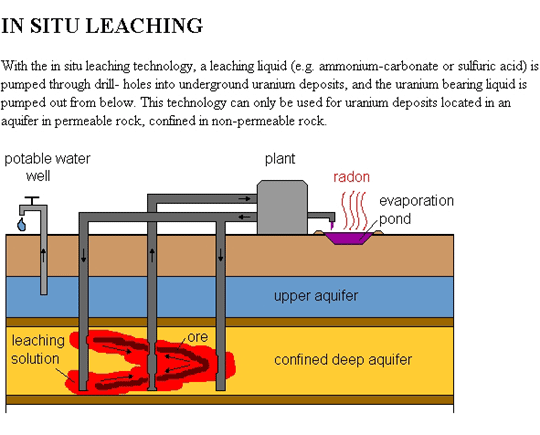
Making the project more difficult is the weak uranium price, which has recovered from this year’s low of $US28 ($32) to about $35 but still remains less than half of the level most analysts say is required for a new green-field mine.
However, Ranger Deeps would be a brown-field expansion and Ms Sutton said ERA was not in any case counting on a material lift in the price until “mid to late this decade”. http://www.smh.com.au/business/mining-and-resources/traditional-owners-scrutinise-environment-plan-for-ranger-uranium-mine-20141005-10qhbd.html#ixzz3FOVx41Yf
Would YOU buy meat from land hosting a radioactive trash dump?
 NT cattleman offers to host nuclear waste dump 6 Oct 14 “…….recently Federal Resources Minister Ian Macfarlane has been looking at pastoral leases, and his problem could soon be over.

A Northern Territory cattleman, John Armstrong, from Gilknockie Station, 250 kms south of Katherine, says he’s willing to have the nuclear waste dump built on his property. Why? Because it’s a money spinner………
But something’s not right here. There’s no way in the world I would buy meat from a supermarket or a butcher if I had the slightest suspicion it was produced on the same property housing a nuclear waste dump. It’s just not cricket.
To date, Mr Armstrong hasn’t been in touch with the federal minister but he’s watching and waiting for a government announcement for interested parties to apply……http://annamariacom.blogspot.com.au/
Government cover-up of Australia’s involvement in nuclear bomb testing
The following summarizes some of the key conclusions of the Royal Commission:
- The Australian government controlled media reporting such that news items provided what the UK government deemed suitable only;
- Prior to the first tests on the Australian mainland, the Government Cabinet, Parliament and news media were not informed of what was happening;
- It is likely that the major tests resulted in a general increase in cancer within the Australian population;
- Exposure to radiation increased the risk of cancer in nuclear veterans;
- There was a failure to adequately take into account the distinctive lifestyle of Aboriginal people living in the region;
- The authorities were negligent in their management, equipping and briefing of the crews of the Lincoln aircraft who were directed to fly through the nuclear cloud in the Totem 1 test;
- In the Buffalo tests, “. . . the attempts to ensure Aboriginal safety during the Buffalo series demonstrate ignorance, incompetence and cynicism on the part of those responsible for that safety.” (12)
This summary is a very small and selective account of the content of the Royal Commission’s Report.
Since Hiroshima: Australia’s Active Involvement in the Use and Abuse of Nuclear Energy Sunday, 05 October 2014 09:59By Lindsay Fitzclarence, Truthout “………..By 1952, the government had signed a contract with the CDA (Combined Development Agency) representing the UK and United States to supply uranium (5).

At the same time, in a remarkable expression of executive power, the pro-royalist prime minister of Australia, Robert Menzies, agreed to a British request to begin testing of atomic weapons in its former colony (6). At the dawn of the Cold War nuclear arms race, Australia was an active participant at both ends of the weapons cycle: the source of primary nuclear fuel and as a nuclear testing ground. Continue reading
NT News reports Aboriginal owners wanting to host radioactive trash dump
 Northern Territory land councils race clock to nominate a radioactive dump site, NT News BY ZACH HOPE OCTOBER 04, 2014 TRADITIONAL owners are racing against the clock to nominate a site to house Australia’s nuclear waste before the Federal Government opens the process to a national tender.
Traditional owner Geoffrey Wangapa Barnes, from the Ngatijirri clan of the Tanami Desert, said about 50 of 60 traditional owners gave in-principle support for a site northwest of Yuendumu during a meeting with Commonwealth staff and scientists last month.
It comes as the Northern Land Council continues its talks with traditional owners of the Muckaty Land Trust for a nomination north of the controversial site scuttled in June because of clan and family divisions.
Mr Barnes, a delegate of the Central Land Council, said traditional owners were left confused when the desert meeting ended without a compensation package put on the table.
It prompted him to email Indigenous Affairs Minister Nigel Scullion but he said he received no response.
Industry Minister Ian Macfarlane, who has responsibility for finding the radioactive waste site, said the department staff were only at the meeting to explain the issue and not negotiate a package.
“They (the traditional owners) need to write to me and put their case but they haven’t done that,” he said…….
Mr Barnes and his uncle, ousted CLC chairman Maurie Japarta Ryan, have called for another meeting between traditional owners, scientists and the Government before the next CLC meeting in the first week of November.
Despite an arbitrary deadline expiring on September 30, the land councils still have exclusive rights to nominate a site until November 10, when Mr Macfarlane will open a tender to groups anywhere in Australia. …….http://www.ntnews.com.au/news/northern-territory/northern-territory-land-councils-race-clock-to-nominate-a-radioactive-dump-site/story-fnk0b1zt-1227079798955
A worry for the govt when John Carlson gets worried about the India nuclear deal
 Nuclear deal with India compromised by ‘vague’ details on keeping track of uranium The Age October 5, 2014
Daniel Flitton Senior Correspondent “…….Prime Minister Tony Abbott signed such a deal with India last month, a ‘‘treaty for co-operation in the peaceful uses of nuclear energy’’. But there is a worry that this difficult agreement, years in the making, might not have the same careful protections as Australia’s other arrangements.
This concern hardly comes from a usual left-of-field suspect, stridently opposed to anything nuclear. Instead, the alarm is from the former chief of Australia’s atomic watchdog and, in assessing the India deal, he used words like vague and meaningless.
John Carlson headed the Australian Safeguards and Non-Proliferation office for more than two decades until 2010. Continue reading
Tony Abbott’s profound ignorance about the effect of climate change on Aborigines
 Abbott Hasn’t Joined The Dots On Black Affairs And Climate Change, SaysActivist https://newmatilda.com/2014/09/30/abbott-hasnt-joined-dots-black-affairs-and-climate-change-says-activistThe gaping hole in Australian Prime Minister Tony Abbott’s self-declared interest in Aboriginal aspirations is his ignorance on climate change. Amy McQuire reports.
Tony Abbott’s ambition to become the “Prime Minister for Aboriginal affairs” doesn’t align with his position on climate change, with First Nations communities the most vulnerable to the disastrous effects of global warming, according to a young Bundjalung environment warrior. Continue reading
Southern hemisphere ocean heating has been under-estimated
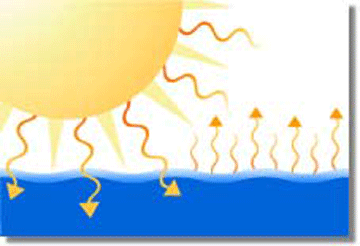 Oceans heating up faster than we thought: study, SMH October 6, 2014 Hannah Francis Oceans in the southern hemisphere are warming faster than anticipated, with implications for rising sea levels and climate modelling.
A team of scientists in California has studied rising temperatures of the southern hemisphere over the decades between 1970 and 2004, and recommended lifting estimates of ocean heat content by between 48 and 152 per cent.
Lead author Paul Durack said it was the first time scientists have been able to quantify how big the gap is between earlier estimates and the reality of rising ocean temperatures.
Sea temperatures are a crucial yardstick for global warming as the ocean stores more than 90 per cent of human-induced excess heat.
Higher sea level temperatures are also closely linked with rising sea levels, because water expands as it warms.
Ocean warming down to two kilometres below the surface accounts for around a third of the annual rate of global mean sea-level rises.
The study by Lawrence Livermore National Laboratory and the California Institute of Technology, published in the journal Nature Climate Change on Monday, attributed the missed estimates to a history of poor sampling of temperatures in the southern hemisphere oceans, which make up 60 per cent of the world’s oceans.
The region, which includes the Indian and South Pacific oceans as well as the South Atlantic and Southern oceans, has not been sampled nearly as frequently to date as oceans in the northern hemisphere…….. http://www.smh.com.au/environment/climate-change/oceans-heating-up-faster-than-we-thought-study-20141005-10qgfn.html#ixzz3FPcZ9tZW
Australian National University sells off fossil fuel interests – but not enough of them
ANU decision to sell fossil fuel company holdings not enough: students By Lisa Mosley ABC News, 3 Oct 2014, An Australian National University (ANU) decision to sell off about $16 million worth of its investments in seven fossil fuel companies does not go far enough, a students’ group says.
ANU said it would divesting itself of shares in Newcrest Mining, Iluka Resources, Oil Search and Santos, among other companies.
Vice-chancellor Professor Ian Young said it was important that the university did not invest in companies that are doing some form of social harm……….
Louis Klee from the group ANU Fossil Free said while it was a big achievement for the university, the decision did not go far enough.
He said the ANU still had major holdings in BHP Billiton, Rio Tinto and Woodside Petroleum.
“It is wrong for ANU to continue to profit from these industries that are responsible for the wreckage of the planet,” he said. …….http://www.abc.net.au/news/2014-10-03/anu-selling-fossil-fuel-company-holdings-not-enough-student-says/5789748
Abbott govt’s Review of Renewable Energy Target has caused slump in investment in renewables
Australia’s investment in renewable energy slumps 70% in one year The Coalition’s review of the Renewable Energy Target has caused investment in clean energy to drop below that of Algeria, Thailand and Myanmar theguardian.com, Friday 3 October 2014 Australia’s investment in renewable energy projects has slumped below that of Algeria, Thailand and Myanmar, new figures have shown, with the sector “paralysed” by the government’s review of the Renewable Energy Target.
Just $193m was invested in new large-scale clean energy projects in the third quarter of 2014, according to Bloomberg New Energy Finance. Investment in the year to date is $238m.
This represents a massive 70% slump on 2013 investment and has resulted in Australia slipping from the world’s 11th largest investor in clean energy to 31st in 2014.
This ranking is below Algeria, Myanmar, Thailand and Uruguay. By comparison, Canada has invested $US3.1bn in large clean energy projects so far in 2014.
The slowdown in renewable energy investment is pinned squarely by Bloomberg on the government’s review of the RET, which mandates that 41,000 gigawatt hours of Australia’s energy comes from renewable sources by 2020………
Kobad Bhavnagri, an analyst at Bloomberg New Energy Finance, told Guardian Australia that the renewables sector is “in the doldrums.”
The government’s position has caused this, it has had some pretty strong anti-renewables rhetoric, particularly anti-wind, and wants to close certain clean energy programs,” he said. “The review has been particularly protracted. The industry was fearful the recommendations would be extreme and they were. It has been shattering.
“I think the government has backed itself into a corner because the Warburton review lacks credibility. I don’t think it’s in Labor’s interest to agree to any changes to the target.”
Bhavnagri said that should the RET be scaled back rather than abolished, investment would resume but at around half its current level, meaning that $10bn would be invested between now and 2020.
The figures follow an analysis done by the Clean Energy Council and, separately, the Greens, which shows that New South Wales would suffer most if the RET was scrapped. An estimated $4.24bn in projected investment and 4,410 jobs in the state would be at risk if the scheme was dismantled.
“NSW will be the hardest hit if the RET is dumped, with huge negative implications for jobs growth, power prices and the environment,” said Greens senator Lee Rhiannon.
“The Greens will continue to work to retain and expand the Renewable Energy Target and to give the industry certainty.”http://www.theguardian.com/australia-news/2014/oct/03/australias-investment-in-renewable-energy-slumps-70-in-one-year
US Solar company hopes for an RET deal that will specifically benefit them
US solar company hopes RET compromise will allow projects to go ahead, SMH October 3, 2014 Angela Macdonald-Smith US solar power company First Solar is optimistic a compromise will be hammered out on the Renewable Energy Target that will allow it to press ahead with up to $150 million of proposed projects in Australia, although other projects would still be delayed.
Jack Curtis, regional manager for Asia Pacific, said that 2-3 months ago the outlook for the RET legislation that supports the sector looked “more dire”, likely forcing an exit from Australia for the Arizona-based company.
But now he was more confident the legislation that supports the renewable industry would largely survive after the Coalition government distanced itself from the recommendations of the Warburton review into the RET…….
Government and Opposition spokespeople on energy and the environment met in Canberra on Wednesday for talks on the RET.
Opposition resources spokesman Gary Gray, who took part in the talks, signalled a compromise could be on the cards.
“There is a long-standing tradition of the government of the day and the opposition of the day finding common ground on renewable energy,” Mr Gray said on Thursday……
Both the Nyngan and Broken Hill plants being developed by First Solar and AGL are under construction and should come into operation next year.
First Solar is also planning a solar plant at Rio Tinto’s remote Weipa bauxite mine in Queensland, and it has similar ventures with a mining company and with a utility planned but not yet made public.
John Carlson calls for full parliamentary scrutiny on Australia-India nuclear deal
Australia-India nuclear deal: The need for full parliamentary scrutiny, The Interpreter, John Carlson, 1 Oct 14 In a previous post, I pointed out how the Australia-India nuclear cooperation agreement departs from Australia’s longstanding safeguards requirements. In particular, there is a risk that the follow-on ‘administrative arrangement’ could deprive Australia of the ability to track and account for Australian uranium supplied to India.
It is not too late to address this problem in a way that ensures the agreement is meaningful and can command bipartisan support in Australia. There will be a crucial role here for the Australian Parliament’s Joint Standing Committee on Treaties (JSCOT), which will have the opportunity to scrutinise the agreement and to ask the necessary and difficult questions about the administrative arrangement.
Here there are two practical issues: the administrative arrangement has not yet, as far as we know, been negotiated, so it will not be available when JSCOT commences its review of the agreement; and in any case it is the usual practice to treat administrative arrangements as being confidential.
The Abbott Government should proceed no further with the agreement unless it can give an assurance that all of Australia’s longstanding safeguards requirements will be met. Continue reading
Community rights disappearing under Campbell Newman’s uranium mining push
 To many Traditional Owners, these places are known as sickness country, or poison country, and are often considered sacred. Upsetting the poison and letting out into the landscape would be a disaster, particularly in the life giving and food providing Mitchel River basin.
The Bill, passed in parliament in early September, gives the Coordinator General the power to exclude community objection rights over some of the largest mining projects
Mining companies now have more rights than the community in Newman’s Queensland http://www.sbs.com.au/news/article/2014/10/01/comment-mining-companies-now-have-more-rights-community-newmans-queensland 1 Oct 14 Queenslanders have more reason than ever to be concerned about uranium mining in the sunshine state. By Andrew Picone Back in 2012 Queensland Premier Campbell Newman made a series of ‘crystal clear’ commitments to keep the door closed to uranium mining in Queensland. In a letter to former ACF CEO Don Henry, Newman wrote “I take this opportunity to reaffirm my statements, made before the last election, that the State Government has no plans to approve the development of uranium in Queensland”.
It proved to be one of his first broken promises. Just a fortnight later this commitment was dumped, without any independent assessment or community consultation. Uranium mining would not just be permitted in Queensland, the Premier started actively encouraging uranium mining companies to set up shop in the sunshine state.
Fast forward to 2014 and Queenslanders have more reason than ever to be concerned. In an echo of the heavy handed police state politics that so characterized former Queensland Premier Joh Bjelke Petersen, the Queensland government’s hand-picked co-ordinator general will now have sole authority over major new mining projects.
Proposed legislative changes introduced in the Mineral and Energy Resources (Common Provisions) Bill 2014, literally rushed through the Parliament at five minutes to midnight on September 9th 2014, in particular provision 47D entitled ‘restriction in giving of objection notice under the Environmental Protection Act’ – should sound the community alarm. Continue reading
Northern Region takes first step to community renewable energy
 First step to first community renewable energy retailer http://www.northernstar.com.au/news/nre-awarded-54000-to-work-on-business-plan/2407390/ Rodney Stevens | 3rd Oct 2014 THE first step towards the Rainbow Region becoming Australia’s first community energy retailer has been taken with Northern Rivers Energy (NRE) being awarded $54,000 to develop a business plan.
Formed by a consortium of environmentally conscious citizens, Northern Rivers Energy NRE was awarded the grant from the Office of Environment and Heritage and the Total Environment Centre.
NRE spokeswoman Alison Crook said the company would encompass energy retailing, generation and asset management, and an educational energy literacy arm.
She said NRE would service the entire Northern Rivers Region, covering the Tweed, Kyogle, Byron, Lismore, Ballina, Richmond Valley and Clarence Valley council areas.
“Here on the Northern Rivers we have all the ingredients necessary to demonstrate that communities can meet their energy needs without relying on fossil fuels and can live in greater harmony with the environment, and still flourish,” she said.
“The Northern Rivers already has a high level of take-up of solar PV. We have a community that really understands what it means to be a community and to support each other.
“If any region can show how the renewable industry can both create employment and reduce our impact on the environment, this region can.
“Once the NRE business plan and feasibility study are complete, community consultation will begin.”
Northern Rivers Energy aims
- Provide renewable energy and purchase solar and other renewable energy from residential, commercial and government system owners at fair prices.
- Facilitate community investment in medium scale renewable energy projects.
- Provide and maintain renewable energy equipment.
- Enable purchase of equipment by consumers through lease or finance arrangements.
- Partner with social housing providers, caravan parks and retirement villages to facilitate access to renewable energy and efficient solutions for people on low incomes.
Chief Minister Giles may offer Northern Territory site to host nuclear waste dump
 Adam Giles may offer NT nuclear waste site if traditional owners fail to nominate location 105.7 ABC Darwin By Rick Hind 1 Oct 2014, NT Chief Minister Adam Giles has suggested his Government may put up a site for a national nuclear waste dump if traditional owners fail to nominate one.
Traditional owners in the Northern Territory were asked to nominate their land for a nuclear waste facility by September 30.
Federal Industry Minister Ian Macfarlane had indicated that if a site was not nominated, a selection process involving land owners from anywhere else in the country would start in November……..
“We haven’t decided whether we will at the moment, but I think we will look at it if the land councils don’t nominate a site,” he said…….
“Potentially it’s an economic opportunity for the Territory, but it’s also an opportunity for the Northern Territory to show leadership on the national stage about where to store nuclear waste,” Mr Giles said……..
However, Mr Giles added that any discussion of a possible location for a waste facility was jumping the gun.
“Let’s not get too far in this argument because we haven’t done all the analysis at this stage,” he said……..
The Northern Land Council and the Industry Minister Ian Macfarlane have declined to comment until the nomination deadline passes. http://www.abc.net.au/news/2014-09-30/giles-may-offer-up-nuclear-waste-site-if-traditional-owners-dont/5779394
John Carlson, former head of Australian Safeguards, condemns uranium deal with India
 See below a very strong critique of the Australia-India nuclear cooperation agreement from John Carlson, former head of the Australian Safeguards and Non-Proliferation Office, who worked tirelessly for many years to weaken safeguards standards …
It is not good enough to simply say that we trust India because it has an ‘impeccable’ non-proliferation record (and India’s record in any case is not ‘impeccable’).The reporting procedures are not optional; they are fundamental to Australia’s ability to confirm that our safeguards conditions are being met. They have long applied to close and trusted partners such as the US, the EU, Japan and South Korea. There is absolutely no case to waive them for India.
Is the Abbott Government abandoning Australia’s nuclear safeguards standards for India? John Carlson AM is a Nonresident Fellow at the Lowy Institute. He was Director General of the Australian Safeguards and Non-Proliferation Office and its predecessor the Australian Safeguards Office from 1989 to 2010. Lowy Interpreter, 1 October 2014http://www.lowyinterpreter.org/?COLLCC=737147385&
The signing last month of a civil nuclear cooperation agreement between Australia and India has been greeted as an important step towards closer relations between the two countries, as well as bringing India into the global nuclear energy mainstream. These are worthy objectives, but not at any cost. Continue reading
1 This month
17 October, Free Public Talk on Nuclear Issues in South Australia
David Noonan will speak on public interest concerns over the new Roxby Downs Indenture Act 2026 on BHP copper-uranium mining and ore processing in SA, and on how AUKUS may face SA with a High-Level nuclear waste agenda.
Dr Jim Green will discuss international developments in the field of nuclear power including ‘small modular reactors’ and Generation 4 ‘advanced’ nuclear reactor concepts.


Help Aunty Sue Protect Her Land and Sacred Sites From Destructive Rocket Testing.
.

Australians deserve the truth
about
AUKUS – https://aukuspublicinquiry.com/

PETITION – To: Prime Minister Anthony Albanese and the Australian Labor Government

of the week – Australians for War Powers Reform (AWPR)
To see nuclear-related stories in greater depth and intensity

