Yea! Boo! Australian government destabilises the solar power industry
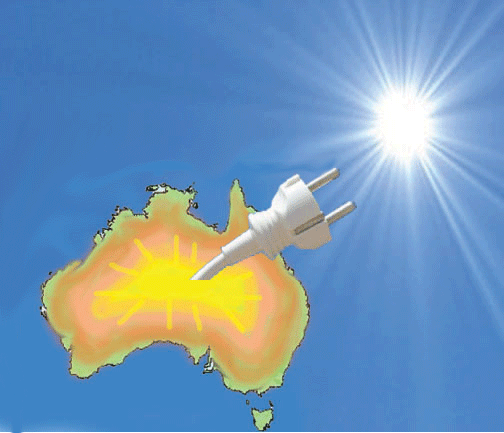 Australia’s solar installers face another boom and bust http://www.smh.com.au/environment/climate-change/australias-solar-installers-face-another-boom-and-bust-20140829-10a17h.html#ixzz3C28RqcIn Solar energy installers are expecting a boom then sharp contraction of their businesses as the Abbott government prepares to take an axe to renewable energy support. Continue reading
Australia led the world in solar power – and then what happened?
 How Australia Perfected Solar Power and Then Went Back to Coal https://news.vice.com/article/how-australia-perfected-solar-power-and-then-went-back-to-coal By Julian Morgans August 30, 2014 There was a time in the 1980s when Australia led the world in solar technology. To begin with, Australia receives more solar radiation per square foot than anywhere on the planet, and that presents an obvious advantage. But the true catalyst was geography: two thirds of the country consists of uninhabited desert. This posed problems for engineers tasked with constructing a national telephone network in the early 1970s. The solution was to build remote relay stations powered with solar energy, which at the time was a fledgling, expensive technology. Yet by 1978 the national provider, Telecom, had developed reliable solar cells that could be installed affordably across the country and be infrequently maintained. International recognition came in 1983 when Perth was tapped with hosting the Solar World Congress.
Fast-forward to 2014 and Australian solar power is in a very different place. This week a proposed solar farm with 2,000 dishes—capable of powering 30,000 homes—was canceled amid uncertainty about the future of renewable energy. This comes at a time when every one of the country’s proposed solar farms are on hold and coal operators push legislation to strangle solar proliferation. So what happened? Continue reading
Tasmania urging Federal government not to scrap Renewable Energy Target
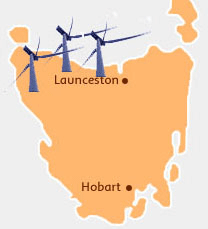 Greens urges Hodgman Government to ‘utterly reject’ RET review recommendations http://www.abc.net.au/news/2014-08-31/tasmania-energy-minister-canberra-ret-renewable-energy-target/5708488 31 Aug 14, By Ellen Coulter Greens leader Christine Milne has urged the Hodgman Government to stand up for renewable energy and “utterly reject” the Warburton report’s recommendations.
The review of the Renewable Energy Target (RET), chaired by Dick Warburton, has recommended the scheme be drastically cut back.
The prospect that the findings will be adopted by the Abbott Government has cast a pall over the renewable energy industry Australia wide.
In Tasmania, Hydro Tasmania has warned any winding back would threaten billions of dollars in investment and doubt prevails over proposals such as the Granville Harbour wind farm on Tasmania’s west coast.
Liberal Premier Will Hodgman says he is worried about the Commonwealth’s response to the review, which is expected in about a fortnight.
State Energy Minister Matthew Groom is planning to fly to Canberra this week to urge the Federal Government against scrapping the RET. “We’re very anxious about any decision that the Federal Government might make to this scheme that could disadvantage the state,” Mr Hodgman said.
“I urge the Federal Government to look very carefully at Tasmania, consider our investment and also further opportunities in the future.”
Mr Hodgman said he has been arguing Tasmania’s case for months and that Mr Groom would again be pushing the cause to his federal counterparts.
But Ms Milne said the Tasmanian Liberals were not doing enough.
She maintained that Prime Minister Tony Abbott was determined to “destroy renewable energy”.
“It was his idea to abolish the Renewable Energy Target altogether,” she said.
She said the Tasmanian Government was “attacking the Federal Government with a wet lettuce leaf” and needed to present a strong rejection of the Warburton review.
“I think it is time that if Matthew Green supports a clean energy future, supports renewable energy, that he stands up and really condemns the direction of the Abbott Government and rejects utterly the Warburton report on renewable energy,” Ms Milne said.
“Frankly, it is pathetic. If they are going to make a stand they need to stand with the jobs, with the university [UTAS], with the renewable energy future and against Eric Abetz.”
No surprise! Abbott’s RET Review Panel comes up with a climate sceptic report
 Costs of Australia’s renewable energy target ‘not justifiable’: review, SMH, August 28, 2014 – Lisa Cox National political reporter Tony Abbott has been given cover to break an election promise not to touch Australia’s renewable energy target after his hand-picked review panel recommended the scheme be dramatically cut back.
Clean energy industry leaders said the findings of the review, headed by businessman and climate sceptic Dick Warburton, represented the “worst case scenario” and would cost thousands of jobs and more than $10 billion in investment if the government adopted its recommendations. Clean Energy Council acting chief executive Kane Thornton said the proposals would “shut down the future of the industry” in Australia………
The panel recommended two options for Australia’s renewable energy target, which is currently set at 41,000 gigawatt hours of electricity from large-scale renewable energy by 2020 – now equivalent to about 27 per cent of expected generation.
Under the first option, the scheme would be closed to new investment beyond those under construction or winning full financial commitment within a month of the change. This scenario would slash the target to about 15 per cent.
Under the second option, the target would be set at 20 per cent. The target would be reset each year and new renewable energy power stations be given approval only if electricity demand increased. The target was one of the few climate change-related measures to enjoy bipartisan support before last year’s election………
Any change proposed by the government will set the scene for another parliamentary fight, with Labor, the Greens and Palmer United Party all opposed.
Analysis conducted for the report found coal-fired power stations would be the biggest beneficiaries of a cut in the target. The review acknowledged that the scheme had lowered wholesale electricity prices and that its impact on household bills over time would be “relatively small”. But the panel found the cost for emissions-intensive companies was not justifiable, and called on the government to find lower cost alternatives to cut carbon emissions.
The Greens said it was no surprise that a review led by a climate sceptic had “trashed” the target. Greens leader Christine Milne said both options put forward would destroy the renewable energy sector. “I’m glad this dangerous and ignorant report is finally public so everyone can see it for the climate denier drivel it is,” she said.
It is expected to be at least a fortnight before the government responds. http://www.smh.com.au/federal-politics/political-news/costs-of-australias-renewable-energy-target-not-justifiable-review-20140828-109m04.html#ixzz3BoVhIvbL.
Review of Renewable Energy Target helps fossil fuel lobby, aims to close large scale renewable energy schemes
 RET Review panel calls for large-scale, solar schemes to close REneweconomy, By Giles Parkinson on 28 August 2014 The RET Review panel appointed by Prime Minister Tony Abbott has effectively rubber stamped the lobbying of the fossil fuel industry and called for the closure of Australia’s renewable energy target to new entrants as one of two options it is recommending to the government.
It is also calling for the immediate closure, or rapid wind back, of the small-scale renewable energy scheme, which supports rooftop solar and solar hot water. It says this scheme should either close now, or by 2020 at the latest. It also says it should be restricted to installations of less than 10kW – effectively cutting out the commercial-scale solar market. (It was previously open to 100kW systems).
As for the large-scale scheme, the panel says the two options are effective closure to new entrants, or a form of modification to restrict it to a “real” 20 per cent of demand.
If the government accepts either of the recommendations, Australia would become the first country to either ditch a renewable energy target, or wind it back – in much the same way as it was the first to scrap a carbon price.
Abbott is said to be in favour of the most drastic action, which is effective closure to new entrants. He personally appointed the panel, rather than follow the statutory requirements to have the review done by the Climate Change Authority, which just 18 months ago rejected the same arguments that the new panel has now accepted.
Although any legislative changes will be resisted and probably stopped in the Senate, the uncertainty will be enough to kill investment in large scale renewables. Changes to the small scale target could be done without the need for parliamentary approval……..
Here is the full list of recommendations:……..
http://reneweconomy.com.au/2014/ret-review-panel-calls-for-large-scale-solar-schemes-to-close-39648
Australian National University devises lightweight solar gear for soldiers
Australia’s Solar Soldiers http://www.energymatters.com.au/index.php?main_page=news_article&article_id=4467 28  Aug 14 The Australian National University says it will seek to commercialise its design of a wearable solar panel system for soldiers after successful field tests demonstrated the technology could easily replace heavy battery packs normally used to power combat equipment.
The Soldier Integrated Power System (SIPS) was developed by scientists at the ANU Centre for Sustainable Energy Systems. SIPS will dramatically reduce the weight members of the Australian Defence Force must now carry in order to power an increasingly tech-heavy arsenal.
“Much of the equipment carried by Australian soldiers requires heavy battery packs, such as night-vision goggles, lights, GPS devices and communication systems. Currently, soldiers depend on conventional batteries to power these devices,” said ANU Project Development Manager Dr Igor Skryabin.
Energy Matters reported on the ANU’s plan to integrate SLIVER cells into a solar vest for soldiers in 2011, when nations such as the USA and UK were fitting infantry with portable solar panels and inverters for use in combat missions. But the ANU team were primarily focused on designing a simple system that would ensure the mobility of Australian infantry.
The solar panel system is based on the ANU’s SLIVER solar cell – flexible solar cells the thickness of a human hair but with a high power-to-weight ratio of more than 200 watts per kilogram. They are also bi-facial, allowing either side of the cell to convert light to energy.
In a 72-hour field test under real mission conditions, the ANU flexible panels produced sufficient power to maintain battery charge. In sunny conditions the panels fully charged the batteries.
“The trials were performed by soldiers in a real mission environment with normal usage of power,” Dr Skryabin said. “Based on the success of this demonstration, ANU will be commercialising the project outcomes with industrial partners.”
The SIPS project was a collaboration between the ANU, CSIRO and Tectonica Australia, as part of a $2.3 million contract awarded under round 15 by the Capability and Technology Demonstrator (CTD) Program managed by the Defence Science and Technology Organisation.
Pandering to coal-fired utility companies. Tony Abbott is out to destroy the Renewable Energy Target
Abbott and some in his Cabinet are close to the coal-fired electricity generators whose business model the target is helping to destroy.
Unused to competition, even competition that coal-fired generators knew was coming, they feel wronged.
But their beef is nothing to that of the less well-connected solar and wind generators who would be hung out to dry by a changed or axed target.
They’ve invested $11 billion to date on the understanding that both sides of politics meant what they said when they set the requirement at 41,000 gigawatt hours. Some will go bankrupt if the Renewable Energy Target is abandoned. Others will never invest in Australia again.
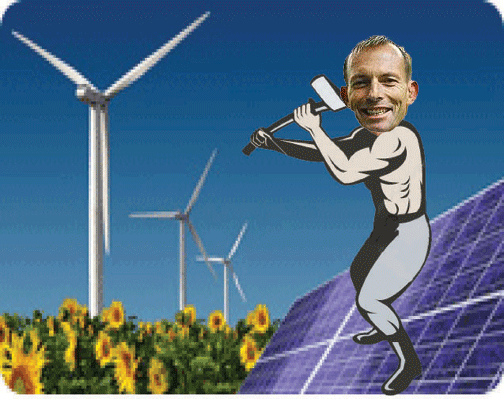 Renewable energy target in the spotlight http://www.smh.com.au/comment/renewable-energy-target-in-the-spotlight-20140825-107zn1.html August 26, 2014 Peter Martin Economics Editor, The Age So concerned was Greg Hunt about the future of the solar industry that he went skydiving at Tooradin in his electorate of Flinders to back an industry he said was in freefall.
That was in 2008 when he was shadow environment minister. Labor had means tested its solar panel rebate. More recently, after the 2013 election, he promised $500 million for a One Million Solar Roofs program and a further $50 million each for a Solar Towns and Solar Schools program. He was going to plant 20 million trees and keep the Renewable Energy Target.
The budget killed his One Million Solar Roofs program, shrank his Solar Towns program to just over $2 million and made no mention of his Solar Schools program.
The Renewable Energy Target stands, just. Introduced by the Howard government in 2001, it forces electricity retailers to buy an increasing number of gigawatt hours of electricity from renewable sources peaking at 41,000 a year in 2020 and staying there for a decade.
It’s given foreign and Australian investors the confidence to build $10 billion of new wind and solar farms knowing there’ll be a market for what they produce.
Even better, it’s had bipartisan support. The targets are locked in by law.
Cutting or axing them mid stream would leave the investors stranded with little hope of making good on the money they’ve outlaid. Continue reading
Dr Helen Caldicott- a brief outline of Australia’s anti-nuclear movement
 Australia – uranium and nuclear power, Online opinion By Helen Caldicott -, 26 August 2014 The Australian anti-nuclear movement started in Adelaide in 1971 when fallout from French atmospheric nuclear tests polluted Adelaide’s water supply. People were warned that strontium 90 concentrating in milk would further concentrate in childrens’ teeth and bones and years later could cause leukemia or bone cancer. Australians in general were not enamoured of the French, and were so incensed that they were polluting the southern hemisphere with their tests that a huge movement erupted. Spontaneous marches occurred in Adelaide streets, people stopped buying French wine and cheese, postal workers refused to deliver French mail and whole pages were devoted to indignant letters to the editor.
Within nine months 75% of Australians fervently opposed the tests. Jim Cairns, deputy Prime Minister, Ken Newcomb, Union of Australian Students, and I then travelled to Paris to inform the French Government of our opposition. Australia and New Zealand took France to the International Court of Justice and they were forced to test underground.
Despite this international victory, three years later Whitlam decided to mine and export uranium. I knew nothing about medical hazards of nuclear power until I read “Poisoned Power” by Gofman and Tamplin who had been commissioned by the US Atomic Energy Commission to research the dangers of nuclear power. I then travelled to Canberra to warn Whitlam of the medical dangers of the enterprise, but to no avail.
A group began in Adelaide called Campaign Against Nuclear Energy CANE and in Melbourne, Movement Against Uranium Mining MAUM. Unions learned of the dangers and became so deeply concerned that when a man refused to shunt a truck containing yellow cake in Brisbane, the Australian Railways Union called a 24 hour nationwide strike. The medical dangers of uranium and nuclear power hit the headlines. Finally in 1978 the ACTU passed a resolution to ban uranium mining, transport and export which lasted for five years until Bob Hawke introduced the Three Mine Policy ending the ban. The antinuclear movement in Australia was very powerful and prevailed for many years…….http://www.onlineopinion.com.au/view.asp?article=16621
Growing public anxiety in Greenland, over Australian uranium miner Greenland Minerals and Energy Limited (GMEL)
 the people of Greenland are “split down the middle regarding the repeal of the ban.”
Hooge explains that the “mineral authorities” have fed the public disinformation over the last years but the tide may be turning, with growing concerns over environmental effects and the leftist party Inuit Ataqatigiit pledging to roll back the repeal if it wins back power.
The prospect of a relatively unknown Australian company exploiting massive untapped resources in Greenland deserves a robust public and political debate. It has thus far received nothing in Australia, and little in Denmark and Greenland.
In an age of worsening climate change, mining uranium is an arguably unsafe and potentially explosive answer to the problem
Australian uranium mining in Greenland is tearing the country in half jagadees.wordpress.com August 23, 2014 Antony Loewenstein. source theecologist.org
This is a story about an Australian company you’ve never heard of, operating in a nation that rarely enters the global media: Greenland. It’s a story about the intense search for energy sources in a world that’s moving away from the dirtiest fossil fuels.
Aleqa Hammond, the prime minister of Greenland, is the first woman to lead this autonomous country within the Kingdom of Denmark. She also welcomes the financial opportunities from climate change and a melting Arctic Circle……..
In October last year, Hammond pushed legislation through Greenland’s parliament to overturn a 25 year old ban on the extraction of radioactive materials, including uranium, despite countless leading environmental NGOs urging otherwise.
It attracted global interest from the rare earth and uranium industries, including from China. Concerns were also raised about Greenland’s ability to manage a toxic substance in the wake of Fukushima and Chernobyl.
The company Greenland Minerals and Energy Limited (GMEL) is based in Perth, Western Australia. This year GMEL announced a major step forward in their plan to open one of the world’s largest uranium mines in southern Greenland, at Kvanefjeld, near Narsaq. The mine will also produce fluoride, thorium and other rare earths.
There is still significant opposition to the Kvanefjeld project. The Ecological Council, a Danish NGO, organised a conference to discuss the potential contamination risks in March, noting that the mine poses serious risks for the inhabitants of the nearby village, Narsaq.
Many locals told the BBC that they worried about pollution and challenges to traditional ways of life if GMEL moved ahead with its plans.
Unsurprisingly, Danish green groups have pushed for a continued ban on uranium mining. They claim that rare earth elements can be extracted without uranium mining in Greenland.
Who owns GMEL?
This would have been an important but fairly typical contest over resources, but after issues surrounding the ownership and status of Perth-based GMEL were raised in the Greenlandic parliament, the prospects of the Australian firm may be in jeopardy. Continue reading
AUDIO: Over 20,00 jobs at risk if Renewable Energy Target is changed
 AUDIO Jobs at risk from renewable energy target changes http://www.abc.net.au/am/content/2014/s4073035.htm Matthew Doran reported this story on Saturday, August 23, 2014 ELIZABETH JACKSON: A green energy analyst says any changes to the Renewable Energy Target, which is currently under Federal Government review, will affect far more than the environmental sector in Australia.
 It’s estimated that more than 20,000 people are employed in a variety of roles across the renewable industry sector, from construction to research and development. But the ongoing uncertainty is spooking a growing number of developers.From Adelaide, Matthew Doran reports. Continue reading
 Australians’ defence of the Renewable Energy Target underway, with Brisbane pro solar rally
 Australia: Pro-solar rally slams attack on renewable target, PV Magazine 21. AUGUST 2014 | BY: JONATHAN GIFFORD
The organized opposition to the federal government’s moves to abolish or reduce Australia’s Renewable Energy Target (RET) has begun. More than 500 people attended a rally in Brisbane to protest against changes to the RET. The Australian Solar Council launched a campaign against the federal government  making changes to the RET. Its first event in the northeastern state of Queensland on Thursday attracted 500 attendees.
The council’s CEO John Grimes said that a clear message has been sent to the government that Australians in key electorates are willing to vote to defend renewable energy in the country.
“Tonight over 500 solar heroes have come forward to send a clear warning to the Abbott government,” said Grimes. He said the message to Abbott’s conservative government has been clear: “We love solar, solar saves us money on power bills [and] we will vote to defend the Renewable Energy Target!”
The Save Solar campaign has also raised the ire of the government. Environment Minister Greg Hunt slammed John Grimes on ABC Radio……..
“The Environment Minister should be attacking the Prime Minister’s radical plan to shut down the solar industry, not shooting the messenger,” said Grimes. “Today’s outburst shows how scared the Government is of this national campaign to Save Solar taking hold.”
There have been a host of surveys showing that Australians are supportive of renewable energy and the RET. With over 1.3 million solar households around the country, certainly a large number of people have first hand experience of solar.
The Australian Newspaper, a Rupert Murdoch owned publication that is generally skeptical of climate change and is often critical of renewable energy has been running a series of surveys about Australian’s attitudes towards renewables. In its most recent survey, it found that 88% of Australians support renewable energy, while only 8% report being “totally against.”
The Australian currently has a second survey live here.
Australia’s Clean Energy Council is also currently campaigning against changes to the RET. It’s CEO Kane Thornton argues that even a reduction of the RET to a “true 20%,” proposed as a compromise measure, would devastate the renewable energy industry in Australia. http://www.pv-magazine.com/news/details/beitrag/australia–pro-solar-rally-slams-attack-on-renewable-target_100016170/#axzz3BRV0obrI
Chinese solar energy firm to close its research in Australia, due to Abbott govt policies
Solar giant to close Australian R&D unit August 22, 2014 Peter Hannam ENVIRONMENT EDITOR, THE SYDNEY MORNING HERALD A GIANT CHINESE SOLAR ENERGY FIRM, ORIGINALLY BASED ON AUSTRALIAN TECHNOLOGY, PLANS TO CLOSE ITS LOCAL RESEARCH ARM AMID CONCERNS ABOUT THE FUTURE OF RENEWABLE ENERGY IN THE COUNTRY.
Suntech, founded by Australian-trained former “Sun King” billionaire Shi Zhengrong, will next month close its Suntech R&D Australia unit with the loss of about a dozen jobs.
The company, now owned by a Hong Kong solar tycoon Cheng Kin Ming and renamed Wuxi Suntech, said in May it invests more than $3 million a year in Australian research and development.
“Suntech wants to continue a relationship with Australia, but it no longer makes the same sense to keep a research team [here],” Renate Egan, managing director of the Sydney-based R&D unit, said.
“Clearly the market’s not going to grow here,” Dr Egan said, referring to large-scale projects.
The government is yet to release the recommendations of its hand-picked panel reviewing the Renewable Energy Target. Clean energy investors fear the panel, headed by former Caltex chairman and climate change sceptic Dick Warburton, will back a cut of the current goal of supplying 41,000 gigawatt-hours of renewable energy by 2020 – if not scrap it entirely for new entrants……….
Richard Corkish, chief operating officer of the Australian Centre for Advanced Photovoltaics at the UNSW, said the loss of the Suntech unit could see significant talent head overseas.
“We hope as big a fraction as possible [of the researchers] can remain in Australia,” Dr Corkish said, adding that there has “not been too much good news” lately for the industry’s outlook in Australia.
While Australia continues to conduct world-leading research into aspects of solar PV research – such as UNSW’s work on increasing the productivity of solar panels – the level of support is likely to shrink because of government cutbacks, Dr Corkish said.
The Australian Renewable Energy Agency currently provides grants for UNSW, Monash University and other institutions.
However, the Abbott government has vowed to scrap the agency and is expected to try again in the Senate………
While Australia’s take-up of renewable energy may be about to slow markedly, other nations are likely to press ahead.
A research report out this week by investment giant UBS estimates solar panels combined with storage are likely to be competitive with conventional power grids by 2020. Battery prices are likely to halve by the decade’s end – and continue to fall – giving the solar-storage combination a payback period of six to eight years by then……..http://www.smh.com.au/environment/climate-change/solar-giant-to-close-australian-rd-unit-20140822-10758l.html
Sad news for the nuclear free movement. Vale Mrs Wingfield.
Suzanne Haseldine wunyie@gmail.com 22 Aug 14, After an amazing life fighting for country and culture Kokatha Elder Mrs Wingfield passed away at her home in Port Augusta on August 8,2014.
Mrs Wingfield experienced first hand the impacts of the nuclear testing in the South Australian desert. She dedicated her life to protecting her desert country and future generations from the effects of the nuclear industry. At Cane Grass Swamp in the early 1980s she lay in front of bulldozers to try and stop the construction of the Olympic Dam uranium mine. Her tireless work continued in the 1990s with the Kupa Piti Kungka Tjuta, a senior women’s council based in Coober Pedy who led and won a successful campaign against the federal government’s plan for a nuclear waste dump in SA.
Mrs Wingfield worked with people and groups of many backgrounds, she traveled extensively to attend forums and events and lobby politicians. In 2009 she was made honorary president of the Australian Nuclear Free Alliance in recognition of her significant involvement. Mrs Wingfield will be widely remembered and acknowledged for her contribution to the nuclear free and peace movements in Australia and worldwide. Her resilience, passion and dedication remains an inspiration to everyone that met her.
May she Rest in Peace.
Funeral details: Friday August 29, 2014. 11am at the Lutheran Church, cnr of Dartmouth and Fern St, Port Augusta. The family have asked that everyone feel welcome to attend.
You can send a message to Mrs Wingfield family: 2 Cain Street, Port Augusta SA 5700.
Memories or photos to be passed on to the family when appropriate, can be emailed to: wunyie@gmail.com
Financial contributions towards Mrs Wingfield’s wake would also be greatly appreciated by her family and friends. Donate to:
Janice Wingfield Commonwealth Bank SAV BSB: 065507 AC: 10213429
In selling uranium to India, Australia will violate its international obligations
 Seen from the perspective of adherence to non-proliferation norms and commitments If Australia exports uranium to India, Australia would violate its obligations of the Treaty of Rarotonga, which binds it from not indulging in such trade. Article 4 of the Rarotonga Treaty requires India to comply with safeguards requirements of Article III(1) of the Nuclear Nonproliferation Treaty (NPT). Article III(1) of the NPT is about reaching a comprehensive safeguards agreement with IAEA. Instead, India has only acknowledged safeguards on certain foreign-supplied reactors and facilities. India’s safeguards agreement is based upon the IAEA’s ‘facility specific’ safeguards.
Australian uranium sale to India will be subjected to weak monitoring safeguards or ‘facility specific’ of IAEA, contrary to nuclear deals Australia has with other countries
AUSTRALIAN PROSPECTIVE NUCLEAR TRADE WITH INDIA – THE CONTROVERSY http://www.eurasiareview.com/21082014-australian-prospective-nuclear-trade-india-controversy/AUGUST 21, 2014 EURASIA REVIEW BY HASAN EHTISHAM
These protests have been a regular feature in Koodankulam (Tamil Nadu), Jaitapur (Maharashtra) and Gorakhpur (Haryana) and at least five activists have lost their lives since 2010 in their struggle against the Indian government’s decision without taking the affected parties on board. Radioactive waste from uranium mining in the country’s east is reportedly affecting adjacent communities. Thousands of Indians suffer from the effects of uranium mining as related to poor technical and management practices. Continue reading
Tony Abbott does not have the international clout to keep Climate Change off G20
 Australian opposition ‘unlikely’ to keep climate off G20 agenda RTCC 20 August 2014, Australia lacks gravitas to cast off climate talk, with US and China likely to put pressure on Tony Abbott By Sophie Yeo
Climate change is likely to be discussed at the G20 summit in Brisbane, despite Australia’s decision to leave it off the agenda. This is the finding of a new report, released this week by the centre-right think-tank Committee for Economic Development in Australia (CEDA).
Australia lacks the diplomatic weight to dismiss the issue while heavyweights such as China and the US are ramping up their own efforts to combat carbon pollution, say the authors.
“As a middle-power economy, Australia’s leadership and influence may be limited,” writes Sarah-Jane Derby, senior economist at CEDA, in the report.
“For example, members may be receptive to Australia introducing new ideas and changing the agenda, but without the support of players who are more powerful, these ideas may not be taken seriously.”
Climate criticism
Australia prime minister Tony Abbott has faced heavy criticism from environmentalists over his decision to axe many of the country’s flagship climate policies, such as the tax on carbon.
Reports from Australia suggest he knocked climate change off the G20 agenda as it did not fit with the summit’s focus on economic growth……. This year’s G20 takes place two weeks before a major UN summit on climate change takes place in the Peruvian capital, Lima.
The UN meets annually to work towards a solution on climate change, but the G20 provides opportunities for “open discussions” between the world’s major economic players that are not possible during international meetings, says the report.
It adds that the tight economic focus of the Brisbane summit could add value to climate change discussions, by considering the financial risks and consequences of heating the planet……
In June, the US ambassador to Australia said that Obama planned on raising climate change during the leaders’ summit and at “every international forum”, as it was a critical issue “not only to Americans but to the world”. – See more at: http://www.rtcc.org/2014/08/20/australian-opposition-unlikely-to-keep-climate-off-g20-agenda/#sthash.Gl6EU0Jf.dpuf
1 This month
17 October, Free Public Talk on Nuclear Issues in South Australia
David Noonan will speak on public interest concerns over the new Roxby Downs Indenture Act 2026 on BHP copper-uranium mining and ore processing in SA, and on how AUKUS may face SA with a High-Level nuclear waste agenda.
Dr Jim Green will discuss international developments in the field of nuclear power including ‘small modular reactors’ and Generation 4 ‘advanced’ nuclear reactor concepts.


Help Aunty Sue Protect Her Land and Sacred Sites From Destructive Rocket Testing.
.

Australians deserve the truth
about
AUKUS – https://aukuspublicinquiry.com/

PETITION – To: Prime Minister Anthony Albanese and the Australian Labor Government

of the week – Australians for War Powers Reform (AWPR)
To see nuclear-related stories in greater depth and intensity

