Australian Solar Council will campaign in marginal seats over Abbott’s broken promises on renewable energy
 Australian Solar Council attacks Prime Minister’s ‘broken promises’ on renewable energy support ABC News, By Matt Eaton, 21 Aug 14 The Australian Solar Council is beginning a campaign to target marginal federal seats over so-called broken promises on support for renewable energy.
Solar council CEO John Grimes has accused Prime Minister Tony Abbott and Treasurer Joe Hockey of breaking a series of election promises by moving to abolish the renewable energy target (RET).
“This comes as a big surprise to many people in the community,” Mr Grimes told 612 ABC Brisbane.
The RET scheme commits Australia to a target of generating 20 per cent of electricity from renewable sources by 2020.
“Before the election he [Mr Abbott] was committed to renewable energy, he was committed to the RET, he was committed to a million solar roofs,” Mr Grimes said.
“After the election, promise after promise broken, million solar roofs gone, the RET he wants abolished – he and Joe Hockey are working hard for that outcome……….
Mr Grimes said Mr Hunt and the Government would continue applying pressure to get their way.
“They will destroy any character, to stop this movement, to stop this gaining hold in the electorate,” he said.
“In that call, [Mr Hunt] told me that if I didn’t shut it down, that he would be launching a pointed, public attack at me and my character – that’s what he said to me on that call.”
Mr Grimes said Mr Hunt was under great pressure on the issue and needed to “attack his personal credibility”………http://www.abc.net.au/news/2014-08-21/solar-council-attacks-broken-promises-on-renewables/568606
From the beginning Abbott as P.M. was determined to kill the Renewable Energy Target
 Why the Renewable Energy Target never stood a chance, Smart Company, Thursday, 21 August 2014 GILES PARKINSON THE AUSTRALIAN FINANCIAL REVIEW, CONFIRMED THE WORST FEARS OF THE RENEWABLE ENERGY INDUSTRY IN A FRONT-PAGE STORY ON MONDAY, REPORTING THAT THE PANEL CHARGED WITH REVIEWING THE RENEWABLE ENERGY TARGET HAD BEEN “INSTRUCTED” BY PRIME MINISTER TONY ABBOTT TO LOOK AT WAYS TO SHUT DOWN THE SCHEME.
Shutting down the RET would bring to an end a $20 billion industry, cost thousands of jobs and force household and business bills to soar. But that is what the government has wanted from the beginning. It appointed a panel composed of climate sceptics, pro-nuclear advocates and fossil fuel lobbyists.
Killing the RET would satisfy the right-wing ideologues and deep-lined antipathy to renewable energy within the Abbott government. The AFR also confirms what has long been suspected: that Environment Minister Greg Hunt and Industry Minister Ian Macfarlane have been effectively sidelined from the process, despite the issue crossing into their portfolios.
The PM’s office has had carriage of the project since the start, and his intentions have long been clear. The secretarial support has been housed within Abbott’s office — and within reach of his principal business advisers, including climate sceptic and renewables opponent Maurice Newman and Abbott’s own energy adviser, former AGL executive Sarah McNamara.
Government insiders who have worked on the RET Review say the intent of the review has always been to cut the current 41,000GWh Renewable Energy Target to a maximum of 25,000GWh (what might be called a “true” 20% target), and possibly close it to new entrants altogether.
There were glimmers of hope that the RET could be retained, particularly when the panel’s own modeling dismissed the two major arguments to drop the target …….
A report released today by consulting firm Jacobs, on behalf of The Climate Institute, Australian Conservation Foundation and WWF Australia, says that the biggest beneficiaries to dumping the RET would be the fossil fuel generators. The Jacobs report suggested $8 billion in additional profits to coal-fired generators out to 2030 and an extra $2 billion to gas generators. The big three retailers, AGL Energy, Origin Energy and EnergyAustralia, would be the biggest beneficiaries………
Whether the Abbott government finally agrees with a scaled back target or an effective closure, any changes seem likely to be blocked in the Senate, where the Palmer United Party has promised to side with Labor and the Greens.
But it matters not. The large-scale renewable energy industry has already ground to a halt. No new projects have reached financial closure since the election of the Abbott government, and the Abbott government knows that even by doing nothing — apart from allowing continued uncertainty — no new projects will come to market.
Households will also be affected. They have so far contributed $12 billion of the $18 billion invested in renewables over recent years, initially driven by generous feed — in tariffs and then as a hedge against rising electricity prices once those tariffs were removed. The government, though, can remove some of those remaining incentives that defray the upfront cost of the system, without needing legislative changes. Industry experts say that could cause the rooftop solar market to fall by one-third or even half, with the loss of thousands of jobs.
Meanwhile, state governments — with huge vested interests in state-owned networks and generators — continue to act against renewables. The Western Australian government is even canvassing importing coal from Indonesia rather than moving to develop renewable energy projects at home, while in Queensland, businesses have been hit by a whopping $500-a-day service charge (essentially to read the meter) to dissuade them from installing solar………
ome international groups, such as US solar developer Recurrent Energy, have already packed up. Others, including Goldwind and Trina, have warned of the potential fallout, while Australian groups Pacific Hydro and Infigen Energy are directing their efforts overseas.
The Australian Solar Council echoed the CEC remarks. It is taking its “Save Solar” campaign to marginal electorates, with the first stop at the northern Brisbane seat of Petrie, held by the LNP’s Luke Howarth, this Thursday. The ability to make solar a potent political issue — many marginal electorates boast more than 20% solar penetration — appears to be their last resort.
“Solar saves money, creates jobs and shifts votes. The Abbott government is about to find out how much Australians love solar and the Renewable Energy Target,” American Solar Council CEO John Grimes said. http://www.smartcompany.com.au/growth/economy/43378-why-the-renewable-energy-target-never-stood-a-chance.html#
Internet trolls try to trash climate change science
What I learned from debating science with trolls, Business Spectator MICHAEL BROWN 20 AUG “………I have received an education in the tactics many trolls use. These tactics are common not just to trolls but to bloggers, journalists and politicians who attack science, from climate to cancer research.
Some techniques are comically simple. Emotionally charged, yet evidence-free, accusations of scams, fraud and cover-ups are common. While they mostly lack credibility, such accusations may be effective at polarising debate and reducing understanding.
And I wish I had a dollar each time a scientifically incompetent ideologue claimed science is a religion. The chairman of the Prime Minister’s Business Advisory Council, Maurice Newman, trotted out that old chestnut in The Australian last week. Australia’s Chief Scientist, Ian Chubb, was less than impressed by Newman’s use of that tactic.
Unfortunately there are too many tactics to discuss in just one article (sorry Gish Gallop andStrawman), so I will focus on just a few that I’ve encountered online and in the media recently. Continue reading
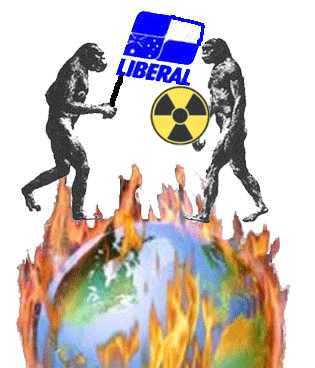
Abbott facing trouble with Liberal Party in his zeal to kill the Renewable Energy Target
 Coalition battle looms over new Renewable Energy Target THE AUSTRALIAN SID MAHER AUGUST 19, 2014
A BRUISING battle looms within the Coalition over the extent of cuts to the Renewable Energy Target as clean energy companies warn any weakening of the policy will cause projects to collapse and undermine international investor confidence in Australia.
A review of the RET headed by businessman Dick Warburton has been handed to Tony Abbott, igniting internal jockeying over the future of the policy, ahead of a decision expected within weeks.
Some senior members of the government want to scrap it completely while Environment Minister Greg Hunt and 25 backbenchers support reducing the target to a “true 20 per cent’’, which would see the large-scale scheme rolled back from its current 41,000GWh to about 25,000GWh.
Supporters of a “true 20 per cent’’ told The Australian yesterday abandoning the policy would amount to breaking an election promise and would risk a Senate stalemate that would entrench the current target.
With no legislative partner, the Prime Minister would be left in the same position as with his attempt to change Section 18C of the Racial Discrimination Act, and be unable to act.
Labor environment spokesman Mark Butler, Greens leader Christine Milne and Clive Palmer yesterday ruled out allowing any weakening of the 41,000GWh target…….
Victorian Liberal backbencher Sarah Henderson also spoke out in support of maintaining the RET. “The RET is so important for local jobs and for regional prosperity. As a strong supporter of renewable energy, I will continue my campaign to ensure the RET remains in place,’’ Ms Henderson said.
Opposition Treasury spokesman Chris Bowen said apparent intentions to wind back the RET represented a sovereign risk.
“We have $11 billion of investment in renewable energy based on clear government policy, a policy which had been bipartisan, and we see the government floating, walking away from that target. That creates sovereign risk for Australia’s investors,’’ he said. http://www.theaustralian.com.au/national-affairs/coalition-battle-looms-over-new-renewable-energy-target/story-fn59niix-1227028613526
Northern Territory: Indigenous Affairs Minister Nigel Scullion manouvres on behalf of mining companies

By removing powers from the statutory authorities of the land councils, Scullion will undermine the collective authority of traditional owners over huge tracts of land. This collective ownership is the Aboriginal way; Tjukurrpa defines our relationships with the land. These relationships will be diminished by the government attitude of divide and conquer.
Perhaps it is an easy sales pitch to the mainstream world, to claim that we, remote Aboriginal people, are holding ourselves back. Or to claim that there will be no progress unless we are split into smaller, more containable, groups. Why? Because smaller numbers are easier to buy off? Because the lack of an independent Environment Protection Authority or an independent Development Consent Authority in the Territory means that this is the prime time to rape and pillage the land, before anyone looks too closely?
For Aboriginal people, the value of our land is deeper than a simple market value. It is a lasting legacy for our families. That does not mean that no development is warranted, but it needs to be on our terms. The land has to last us forever, not just for a brief boom-and-bust cycle that mostly benefits people from elsewhere.
Disassembling the collective authority over our land will not drive development. ……..
If the white knights want to ride in from distant lands and heroically try to save us from ourselves, why don’t they start by offering our children access to a real education? Nothing more, nothing less. The chance for our children to compete with any other children across Australia. Without this step in remote communities, no other development will be sustainable or meaningful.
After years of skimming commonwealth funds earmarked to ameliorate Aboriginal disadvantage, the source is finally drying up. The Territory government is close to the precipice of economic stagnation. Now the government must try to leverage Aboriginal lands in a squalid bid to attract corporate money to the Territory. It is a strategy doomed to failure.
Uninspiring catchphrases such as “Creating Parity” and “Developing the North” cannot become a reality without the participation of Aboriginal people. The economic wealth of the Territory depends on Aboriginal participation, including that of Aboriginal lands. That responsibility is not one that we will give up lightly under pressure from the commonwealth, the Territory or vested interests.
The governments of the day have made their motivations clear. They fear the collective power of Aboriginal people. They fear the power of the very statutory authorities that they created. But they do not speak with us and they definitely do not speak for us. We will have the last word.
Alison Anderson is the member for Namatjira in the Northern Territory Legislative Assembly. http://www.theaustralian.com.au/opinion/nothing-for-aborigines-in-scullions-manoeuvres/story-e6frg6zo-1227029853648
Australia’s uranium industry digging anew hole – for its coffin?
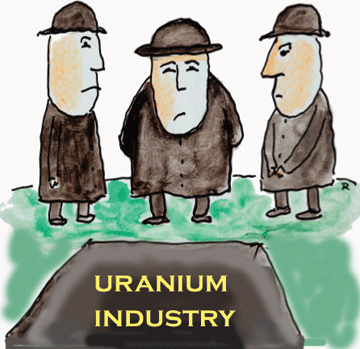 Australia’s uranium industry in a hole Nuclear Monitor #789, August 2014 Developments in South Australia highlight the uranium industry’s ongoing problems. The opening of the state’s latest uranium mine − the Beverley Four Mile in-situ leach mine − would normally be accompanied by considerable fanfare. The Advertiser − a Murdoch tabloid, and the only mass circulation newspaper in the state − might be expected to parrot industry lies about jobs and export revenue.[1,2]
But as The Advertiser said: “South Australia’s newest mine will lose money and won’t create any jobs.” Part of the problem is that the uranium price is well below the cost of production. And General Atomics has put the nearby Beverley mine into care-and-maintenance and shifted the workforce to Beverley Four Mile − so no jobs have been created. Alliance Resources Ltd. which holds a 25% stake in Beverley Four Mile, is seeking to sell out of the project.[1,2]
The Honeymoon uranium mining, also in the north-east of South Australia, was equally underwhelming. Just months after first production in 2011, project partner Mitsui announced its decision to withdraw as it “could not foresee sufficient economic return from the project”. And last year the mine owner − a subsidiary of Russia’s Rosatom − put the mine into care-and-maintenance because it was running at a loss.
Another Murdoch newspaper, The Australian, says it may be years before uranium regains its “sexy sector”.[3]
In Western Australia, United Uranium, which holds several uranium exploration licences, has decided to get out of uranium exploration and instead focus on property development. The company said its strategic review “underlined a consistent theme, that junior resource companies and in particular uranium focussed companies, are currently ‘unloved’ by the investment community”.[4]
Also in Western Australia, Areva Resources Australia, a subsidiary of the French nuclear giant, has formally withdrawn from the North Canning exploration project because it was not viable. It is believed Areva spent up to A$5 million on the project. Aboriginal Traditional Owners in the region were opposed to the project and refused to negotiate with Areva.[5]
In June, RBC Capital Markets Analysts cut its 2014 spot price forecast to US$31.50 a pound, down from US$45. The 2015 target was cut to US$40 (from US$60), and targets for 2016−2018 fell to just US$40-US$45 from US$75-US$80. RBC believes the uranium market is going to be in surplus until 2021. “Active annual supply exceeds demand by a significant margin, and on top of that, significant excess inventories have been and continue to be accumulated post the Fukushima disaster, particularly in Japan,” RBC said, adding that it believes only four Japanese reactors will restart this year, and just 28 (out of 50) will be online by 2018.[6]
[2] www.abc.net.au/news/2014-06-25/four-mile-becomes-newest-uranium-mine/5549648
[4] www.miningaustralia.com.au/news/price-collapse-sees-junior-miner-ditch-uranium-to
[5] https://au.news.yahoo.com/thewest/business/wa/a/24679387/areva-quits-nw-nuke-project/
[6] http://business.financialpost.com/2014/06/05/rbc-annihilates-uranium-price-outlook/
Australian uranium sales to India could breach international obligations
 19 Aug 14 News that Australian officials have concluded a deal to sell uranium to India raises concerns the federal government may have violated its international nuclear non-proliferation obligations, the Australian Conservation Foundation said today.
“India’s nuclear industry has many continuing and unresolved safety and security problems,” said ACF’s nuclear free campaigner Dave Sweeney.
“In 2012 the Indian Auditor General released a damning report warning of ‘a Fukushima or Chernobyl-like disaster if the nuclear safety issue is not addressed’.
“ACF is concerned a uranium export deal with India would violate the 1995 nuclear non-proliferation (NPT) Review and Extension Conference commitment to require full-scope safeguards as a condition of supply, and Article IV of the Treaty of Rarotonga – the South Pacific Nuclear Weapons Free Zone Treaty – which obliges signatories to not supply equipment or material to countries not under full scope safeguards. India is not under full scope safeguards.”
The former head of the national security advisory board in India, K. Subrahmanyam, said in 2005: ‘Given India’s uranium ore crunch and the need to build up our … nuclear deterrent arsenal as fast as possible, it is to India’s advantage to categorise as many power reactors as possible as civilian ones to be refuelled by imported uranium and conserve our native uranium fuel for weapons-grade plutonium production’.
“Clearly, Australian uranium would boost India’s nuclear weapons capacity,” Dave Sweeney said.
“Australian uranium in India will free up India’s uranium stockpiles to be used in its nuclear weapons program.
“Australian uranium is definitely fuelling radioactive waste and risk. It is also potentially fuelling the spread of nuclear weapons. Neither is desirable or acceptable.
“Before PM Tony Abbott inks a deal with New Delhi, the federal government must show that any bilateral agreement requires India to take measureable disarmament actions and does not breach international agreements to which Australia is a party.” For context and comment contact: Dave Sweeney, 0408 317 812
Solar employs, Nuclear destroys: still time to halt India uranium deal
Scott Ludlam Greens spokesperson for Nuclear Senator for WA S August 18, 2014 Australia will be directly complicit in fuelling the nuclear arms-race between India and Pakistan if reports are confirmed that a uranium deal with India is on the cards.
Prime Minister Abbott seems set to continue his high-profile series of international gaffes, missteps and humiliations, this one for the sole benefit of the mortally wounded uranium sector.
India’s scandal-prone nuclear industry has been plagued with accidents and near-misses at reactor sites; events including fires, floods, partial reactor collapses and more recently the construction of two Russian-designed plants in the tsunami-zone in the south of Tamil Nadu.
- Subrahmanyam, former head of the National Security Advisory Board in India, said: ‘it is to India’s advantage to categorise as many power reactors as possible as civilian ones to be refuelled by imported uranium and conserve our native uranium fuel for weapons-grade plutonium production’.
India first produced weapons-grade plutonium from a Canadian-supplied reactor it pledged to use only for ‘peaceful purposes’. Instead of fuelling this arms race, Australian industry should be partnering with India’s vibrant solar sector
Australia is bound to take back nuclear wastes, but govt hypocrisy continues about its destination
 Note that the Australian government has learned nothing from the Muckaty experience. They will still try to barter with Aboriginal communities – with decent living conditions as most Australians have now offered in exchange for radioactive trash dumping on Aboriginal land land.
Note that the government is still lying about the main purpose of the Lucas heights nuclear reactor – pretending that the tacked-on nuclear medicine facility is the main thing.
That’s nonsense – the Lucas Heights reactor was set up originally in 1958 as the precursor to nuclear weapons and nuclear power for Australia. Medical radionuclides can be obtained without a nuclear reactor.
 Australian authorities are searching for a site to store 14 tonnes of nuclear waste heading from overseas http://www.heraldsun.com.au/news/australian-authorities-are-searching-for-a-site-to-store-14-tonnes-of-nuclear-waste-heading-from-overseas/story-fni0fiyv-1227027497896 ELLEN WHINNETT NATIONAL POLITICAL EDITOR HERALD SUN AUGUST 18, 2014 A NATIONWIDE hunt is under way to find somewhere to store 28 containers of nuclear waste due to return to Australian shores by the end of next year.
The Federal Government is searching for a suitable site to permanently house the waste, which will be shipped back to Australia from France and the UK by the end of 2015.
The hunt follows the collapse in June of an agreement to store the waste on Aboriginal land at remote Muckaty Station in the Northern Territory.
The six cubic metres of treated waste will be held in stainless steel containers, which will weigh up to 14 tonnes. The containers will be returned to Australia in a purpose-built storage container about a third the size of a shipping container.
The Government is seeking a remote site which has low rainfall and is geologically stable, and has identified Central Australia as potentially the most suitable region. Tens of millions of dollars could be expected to be paid to any community that agrees to house the waste on their land.
Industry Minister Ian Macfarlane said the Government was looking for sites submitted by landowners.
He said several land councils in Central Australia had been invited to consider nominating a site. A national tender will be held if no site is nominated by the Northern Land Council or Central Land Council by September 30.
The Commonwealth Government owns land at Woomera, in outback South Australia, and has been considering it as a potential site for a nuclear waste dump since the Howard government.
“The Government is committed to ensuring Australia has an appropriate facility for the management of radioactive waste created within Australia, largely as a result of nuclear medicine production,’’ Mr Macfarlane said.
The waste was created by the now-defunct HIFAR and Moata nuclear reactors which operated at the Lucas Heights reactor in Sydney.
Under international agreements in the 1990s, Australia shipped the waste offshore to countries with more experience managing nuclear waste, including France, the UK and the US, for processing and storage. These countries reprocessed the waste, removing further radioactive materials from it before storing it.
The move has put pressure on the Government to find a permanent site to house the waste, and a further six drums of technological waste, generated during the reprocessing of our spent fuel.
French law does not permit the Australian waste to be held beyond 2015 and the Australian Government is not aware of any mechanism under which it could delay the return of the waste.
Tony Abbott’s plan to axe the Renewable Energy Target
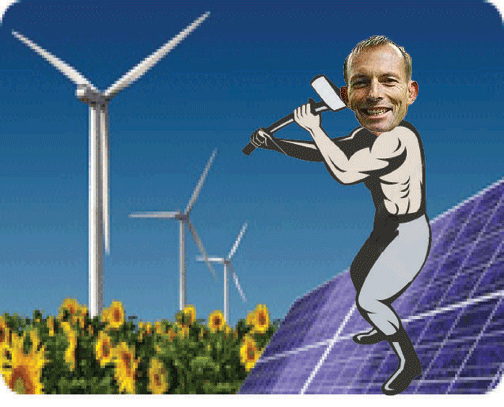 Abbott’s plan to axe RET Financial Review, PHILLIP COOREY Chief political correspondent, 18 Aug 14 The federal government is moving towards abolishing the Renewable Energy Target rather than scaling it back in a move that will cost almost $11 billion in proposed investment and which is at odds with the views of its own Environment Minister.
The Australian Financial Review understands Prime Minister Tony Abbott has asked businessman Dick Warburton, whom he handpicked after the election to review the RET, to do more work on the option of terminating the target altogether. This was after Mr Warburton’s review leant towards scaling back the RET.
Sources said Environment Minister Greg Hunt, who advocated scaling back the RET as a compromise, has been sidelined from the process and is understood to be unhappy. They said Mr Abbott, Treasurer Joe Hockey and Finance Minister Mathias Cormann are pushing the issue now.
A government source said when the government announced its decision, possibly before the end of this month, it was now “more likely’’ the RET will be abolished under a so-called “closed to new entrants scenario’’ in which existing contracts only would be honoured.
Given Clive Palmer has vowed to block any change to the RET until after the 2016 election, it remains unclear when the government could declare the RET terminated.
Independent modelling commissioned by the Climate Institute and other environmental groups, and which will be released Monday, found that under the termination scenario, coal-fired power generators would reap an extra $25 billion in profits between 2015 and 2030.
There would be no reduction to household power prices and carbon emissions would climb by 15 million tonnes a year on the back of a 9 percent increase in coal-fired power.
DIMINISHED INVESTMENTS
Abolishing the RET would diminish investment in renewable energy by $10.6 billion, said the modelling, conducted by consulting firm Jacobs…….
Miles George, managing director of renewable company Infigen Energy, said either scaling back or terminating the RET “would be devastating”.
He said the creation of sovereign risk would be significant and the very issue had been raised by prospective foreign investors, including Canadian pension funds which Mr Abbott sought to woo when abroad in June.
“Infigen’s shareholder base of over 20,000 investors has invested in renewable energy in Australia on the basis of a fixed target of 41,000 GWh by 2020,’’ Mr George said. “This is no different to investors in private public partnerships acquiring a toll road concession, or a port lease.
“If the Government pulls the rug from under institutional investors in renewable energy we shouldn’t expect those investors to come back to buy other infrastructure assets here, including the electricity networks and generation assets that the governments of NSW and Queensland are proposing to sell or lease.” http://www.afr.com/p/national/abbott_plan_to_axe_ret_H2znp8ix2CuwbJe6jyb5ZP
Australia is declared a military threat, by China

 China Declares Australia a Military Threat Over US Pact http://www.therealnewsmatters.com/2014/08/china-declares-australia-military.html By Joshua Philipp, Epoch Times , 17 Aug 14 China’s state-run media have declared Australia a threat to its national security, after Australia finalized a 25-year military pact with the United States.
The United States currently has 1,200 troops from the Marine Corps and Air Force training with Australian troops for humanitarian and disaster relief. The defense agreement will increase the number of U.S. troops at Darwin in northern Australia to 2,500.
The Chinese regime is none too pleased about the agreement, however.
Li Jie, rear admiral of China’s People’s Liberation Army Navy, told Want China Times that Australia could pressure China’s supply lines in the Strait of Malacca in a conflict over the South China Sea.
“Australia is therefore likely to become a threat to China’s national security,” it states.
Global Times reported that if a war broke out between China and Vietnam or the Philippines, the United States could deploy submarines and aircraft from Australia….
http://www.theepochtimes.com/n3/877760-china-declares-australia-a-military-threat-over-u-s-pact/
99% support for Australia’s Renewable Energy Target in submissions to the Review
 RET review swamped by pro-clean energy submissions, The Age, August 17, 2014 Peter Hannam Environment Editor, The Sydney Morning Herald The overwhelming majority of submissions received by the Abbott government’s hand-picked panel reviewing the Renewable Energy Target back its goals.
Analysis by the Clean Energy Council of the 865 detailed submissions found 754, or more than 87 per cent, in favour of the RET being retained or expanded. Of the rest, 55 were mixed or neutral, and 56 called for it to be abolished.
When the 23,272 community submissions are added, support swells closer to 99 per cent, the council said.
 “Five years ago when the [RET] was expanded with bipartisan support, Australians overwhelmingly wanted more clean energy – and that is more apparent now than ever,” Kane Thornton, the council’s acting chief executive, said.
Meanwhile, a separate Senate inquiry into the government’s plan to scrap the Australian Renewable Energy Agency found 125 of the 127 submissions in favour of retaining the body, the council said. ARENA provides grants to emerging clean energy technologies…. http://www.smh.com.au/business/carbon-economy/ret-review-swamped-by-proclean-energy-submissions-20140817-1050j1.html#ixzz3Amte0SEG
The high economic cost of reducing Renewable Energy Target
 Renewable Energy Target cut would hit budget: modelling, The Conversation, 18 Aug 14 Michelle Grattan Professorial Fellow at University of Canberra Reducing the renewable energy target would cost the federal budget about $680 million more to meet Australia’s target of 5% emissions reduction by 2020, according to modelling released today by climate and conservation groups.
The modelling found that cutting the RET would increase the profits of coal power stations while boosting the costs for the public through more pollution without reducing electricity prices for consumers.
It would see “the loss of billions of dollars of investment in the short term”; by further destabilising the policy environment for investors, it would drive up the costs of power sector investment in the future.
“Outright abolition of the RET would further increase pollution and undermine clean energy investment.”
The government has an inquiry underway into the RET. But Clive Palmer has said his senators will oppose any change in the term of this Parliament.
The modelling was done by Jacobs SKM and commissioned by the Climate Institute, the Australian Conservation Foundation and WWF Australia……..
….The modelling found electricity prices would not be reduced and could rise slightly if the RET were reduced – by 15% wholesale and 2.5 % retail on average in the period to 2030. “This is consistent with modelling commissioned by the government and studies conducted independently,” the report said.
“For a household consuming 6.5 MWh of electricity annually (NSW average), reducing the RET would add about $35 to the annual power bill, with most of this increase taking place after 2020. Abolition of the RET would add about $80 a year.”
Reducing the RET would diminish investment in renewable energy in Australia out to 2040 by $8 billion in present value terms. Scrapping it would increase the loss to $10.6 billion, the modelling found.
Reducing the target would mean 150 million extra tonnes of carbon pollution by 2030, and 240 million tonnes by 2040. “Higher levels of pollution lead to socialised costs we estimate conservatively to be $14 billion.” http://theconversation.com/renewable-energy-target-cut-would-hit-budget-modelling-30598
Maurice Newman’s anti-science slammed by Australia’s Chief Scientist
 Australia’s chief scientist tells PM’s business adviser to stick to economics , Guardian , Lenore Taylor, political editor, 18 Aug 14, Global cooling proponent Maurice Newman urged not to ‘trawl the internet’ for papers questioning scientific opinion Australia’s chief scientist has suggested Tony Abbott’s top business adviser should stick to economics rather than “trawl the internet” for papers questioning the overwhelming scientific opinion on global warming…….
“Almost everyone with knowledge would say Mr Newman’s comments are at odds with what they know, but people with no scientific knowledge persist in the view that they can find three or four papers from the hundreds and hundreds of papers on the subject and then dismiss the overwhelming bulk of evidence … it is a silly response to a very important issue.”
Chubb’s response is not the first time the prime minister’s scientific adviser has taken issue with his business adviser’s views. Continue reading
New South Wales: new Bill to enforce environmental protection laws
 Australia: Tough new environmental enforcement measures under NSW Bill Mondaq Clayton Utz, 17 August 2014 A range of new and much higher penalties, and a new power for the EPA to require bank guarantees for remediation, are the key features of the Protection of the Environment Legislation Amendment Bill 2014, introduced into the New South Wales Parliament on Tuesday.
If passed, the Bill will amend
- the Contaminated Land Management Act 1997;
- the Protection of the Environment Operations Act 1997; and
- the Radiation Control Act 1990.
Bank guarantees for remediation work
The EPA will be able to require financial assurances, such as a bank guarantee or bond, as part of a management order under the Contaminated Land Management Act. The EPA can set the amount, but it cannot exceed the EPA’s reasonable estimate of the total cost of carrying out the relevant action (including EPA supervision costs).
If the person fails to carry out the required action, the EPA can then do the action itself or contract someone else to do it, and then make a claim on the financial assurance to cover its costs.
The Court can also use this mechanism in proceedings under the Contaminated Land Management Act if it orders an offender to carry out a specified work or program for the restoration or enhancement of the environment……….
New penalties, including restorative justice
For some offences under the Contaminated Land Management Act and Radiation Control Act, the Land & Environment Court will be able to order new penalties, including ordering the offender:
- to publicise the offence and its environmental and other consequences;
- to notify specified persons, such as shareholders of the offence, via the annual report or other methods;
- to carry out a specified project for the restoration or enhancement of the environment in a public place or for the public benefit; or
- to carry out any social or community activity for the benefit of the community or persons that are adversely affected by the offence (a restorative justice activity) that the offender has agreed to carry out………
Waste tracking
It will now be an offence not to fit GPS tracking to waste transportation vehicles………http://www.mondaq.com/australia/x/334704/Environmental+Law/Tough+new+environmental+enforcement+measures+under+NSW+Bill
1 This month
17 October, Free Public Talk on Nuclear Issues in South Australia
David Noonan will speak on public interest concerns over the new Roxby Downs Indenture Act 2026 on BHP copper-uranium mining and ore processing in SA, and on how AUKUS may face SA with a High-Level nuclear waste agenda.
Dr Jim Green will discuss international developments in the field of nuclear power including ‘small modular reactors’ and Generation 4 ‘advanced’ nuclear reactor concepts.


Help Aunty Sue Protect Her Land and Sacred Sites From Destructive Rocket Testing.
.

Australians deserve the truth
about
AUKUS – https://aukuspublicinquiry.com/

PETITION – To: Prime Minister Anthony Albanese and the Australian Labor Government

of the week – Australians for War Powers Reform (AWPR)
To see nuclear-related stories in greater depth and intensity

