Victoria’s Napthine govt governs for coal and gas lobbies, and against the environment
Sandi Keane: Citizens unite against Alcoa’s dirty brown coal mine and pitiful power plant
The Victorian Napthine Government’s dismal record on stewardship of the environment is only equalled by its blatant disregard for the health and welfare of some of its citizens — especially the most vulnerable, our children. In May this year, with its smelter operation due to close this month, Alcoa was issued a fresh licence to generate and sell its electricity into the grid. This filthy, sulphur-belching brown coal plant at Angelsea on Victoria’s iconic Great Ocean Road – now up for sale – operates just over one kilometre from a primary school and 500 metres from residents’ homes.
This is the Government that demanded two kilometre setbacks for clean energy wind farms. In spite of the 2011 Senate finding and twenty reviews since proving no link between wind turbines and illness, the Government’s complicity in fostering these debunked claims saw an estimated $3 billion in wind investment go into free-fall.
So much for Victoria’s slice of the future low carbon economy. That’s the price Victorians and future generations will pay for the lax donor laws in this country that allow vested interests, like mining and developers, to launder millions into Liberal party campaign coffers through so-called trusts (as recently revealed by ICAC in New South Wales) and, thus, dictate policy outcomes. …
Denis Napthine once damned the Labor Government as “hypocritical when it comes to climate change” but has watered down the bilateral agreement with the former Labor Government of a 20 per cent reduction in emissions by 2020 to just “aspirational” only. As the saying goes: ‘If you take the King’s shilling, you do the King’s bidding.’
Profits for EnergyAustralia, AGL, and Origin Energy if RET is cut
 Renewable Energy Target cut would hit budget: modelling, The Conversation, 18 Aug 14 Michelle Grattan Professorial Fellow at University of Canberra “……..The current arrangement (including the large-scale RET plus existing hydro and small-scale solar PV panels) would lead to about 28% of national electricity coming from renewables by 2020-21. The modelling looked at capping it at 20% (the “reduced” scenario) as well as abolishing the RET altogether.
Reduction of the large-scale RET as proposed by some power companies would bring $8 billion extra profit to coal and $2 billion to gas generators (net present value of future profits 2015-30).
Under current ownership arrangements, EnergyAustralia is the company that would stand to gain the most. Its potential extra profit would be about $1.9 billion if the RET were reduced (and $2.2 billion if it was abolished).
But “if AGL purchases Macquarie Generation, it would become by far the biggest beneficiary of reducing the RET”, with combined extra profits of $2.7 billion if the RET were reduced.
“Origin Energy’s total extra profit would be about $1.5 billion. Origin owns the power station that would emit the largest amount of additional pollution under a reduced RET.” ……..http://theconversation.com/renewable-energy-target-cut-would-hit-budget-modelling-30598
What is the best thing to do with Australia’s radioactive waste?
it is time to restore trust, credibility and common ground in relation to radioactive waste management based on good science, good process and acceptance that social and human concerns are valid and need to be addressed alongside technical criteria.
What is clear is that the approach taken to date has failed – and if it is simply tried again in another place it is likely to fail again. The government holds a duty of care to all Australians, including future generations, to get this issue right and the best start is through a dedicated National Commission into responsible waste management.
 Many years, many debate and countless column inches later, the nation is no closer to a lasting solution to nuclear pollution. Why? http://www.sbs.com.au/news/article/2014/08/15/comment-radioactive-waste-time-new-approach-old-issue By Dave Sweeney
It’s now just two months since the federal government’s long held plan to relocate Australia’s radioactive waste to a remote site in the Northern Territory collapsed during a high profile Federal Court action bought by Aboriginal Traditional Owners opposed to a dump on their country.
After seven years of sustained and against the odds campaigning the people of Muckaty and Tennant Creek dodged a forever bullet, but the celebrations have been clouded by the continuing radioactive rumour mill.
NT Senator Nigel Scullion has joined Chief Minister Adam Giles and former Prime Minister Bob Hawke in banging the nuclear drum and are now actively promoting a new Territory dump site for Australia’s, and possibly the world’s, radioactive waste. A recent flying visit to Tennant Creek by Federal Industry Minister Ian Macfarlane has also raised renewed emotions and concerns about the dump push.
Like the waste itself, the issue is far from dead.
But all this political re-positioning continues to miss the central and long-standing question – what is the best thing to do with Australia’s radioactive waste? Continue reading
Former coal executive calls on corporate Australia to stop denying climate change
Corporate Australia in denial over climate change, former coal exec Ian Dunlop says, ABC News, By Nonee Walsh 15 Aug 2014, Corporate Australia is in complete denial about climate change, according to former fossil fuels executive and energy commentator Ian Dunlop.
Mr Dunlop, a former chairman of the Coal Association, said business should be condemning the chairman of the Prime Minister’s Business Advisory Council (BAC), Maurice Newman, for claiming the Earth is cooling…….
Mr Dunlop said not a single voice had been raised by peak business about the appointment of so-called climate change deniers to advise government.
 “The appointment of Maurice Newman, Dick Warbuton and David Murray are evidence of the real problem that we have,” Mr Dunlop said.
“The Government is in complete denial on this and unfortunately I believe that most of corporate Australia is in the same position.
“I would have expected that corporate leaders would be coming out and really making their voices heard, because this is the big issue that is going to affect the corporate world.”
Mr Dunlop said the scientists Mr Newman quoted had been debunked………
Mr Dunlop does not expect to see political leadership on the issue, “because it is too hard under the adversarial system”.
“We have never had in this country a serious discussion on what climate change really means, it been dumbed down by both sides of politics,” he said.
“Here it is going to have to be business that leads … it requires people at the top of the corporations to get off their backsides and start to take account of the risks that we face and the opportunities, in a genuinely objective way.” http://www.abc.net.au/news/2014-08-15/corporate-australia-in-denial-over-climate-change-dunlop-says/5674122
AGL, Energy Australia and Origin Energy lobbying to dismantle Australia Renewable Energy Target
 Greenpeace slams Big 3 “dirty” energy retailers http://reneweconomy.com.au/2014/greenpeace-slams-dirty-big-3-energy-retailers-43991 By Giles Parkinson on 15 August 2014 Environmental group Greenpeace has slammed the “Big 3” energy retailers in Australia, accusing them of “greenwash” and doing little to promote the adoption of green energy.
Among the worst greenwash offenders it says are AGL, EnergyAustralia and Origin Energy – the biggest retailers in the country with more than three quarters of the national market.
“The ‘Dirty Three’ go to great efforts to advertise their ‘clean and green’ credentials but invest relatively little in renewables,” Greenpeace says in its new Green Electricity Guide.
“The ‘Dirty Three’ are also using their political muscle to try to dismantle the Renewable Energy Target. “This means locking out solar and wind, and locking in higher household bills and climate change driving coal and gas power for decades to come.” Continue reading
ACT’s Uriarra solar project is important to the nation
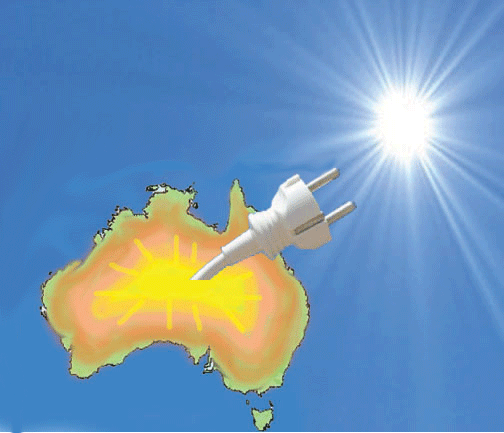 National significance of Uriarra solar should not be underestimated, says ACT Environment Minister Simon Corbell August 14, 2014 Kirsten Lawson Chief Assembly reporter for The Canberra Times.
View more articles from Kirsten Lawson With the country’s biggest solar farm in Canberra’s south about to go live, Environment Minister Simon Corbell has defended the controversial Uriarra solar farm in the face of bushfire concerns and overwhelming opposition from local residents.
Mr Corbell said the 20MW array off the Monaro Highway at Royalla, which will go live in a couple of weeks, was twice the size of any other solar farm in the country and the largest feeding into the national grid. Its nearest rival was a 10MW solar farm in Western Australia.
He said the Uriarra solar project, now in planning, would also be 10MW and its significance on the national scale should not be underestimated. He rejected residents’ characterisation of the 27-hectare solar array at Uriarra as an industrial site.
“These are PV panels sitting in a field,” he told the ACT Assembly. “They don’t create noise, they don’t create emissions, they don’t create all of those things that are associated with an industrial plant. But, of course, the opponents … want to characterise it as that because in doing so … they hope to attach the emotional language that comes with industrial, manufacturing or mining or other resource-intense facility.”
The solar farm was low impact, environmentally beneficial and simply harnessed the power of sunlight, Mr Corbell said………
The Liberals’ Andrew Wall said the project had a litany of flaws, including the damage it would do to property values in Uriarra and the bushfire risk. Residents were not opposed to solar power but to the site, he said.
But Mr Corbell rejected concerns about the power line, saying the village was already powered by an overhead electricity line through the same corridor as the planned solar-farm line.
The ActewAGL line is 11V, but Mr Corbell said it was “not a big difference when it comes to starting a fire”. “One spark will start a fire, it doesn’t matter about the power of the line,” he said.
Farmers wanted solar and wind farms because it helped them diversify and access a reliable income stream, he said.
The importance of the project should not be underestimated at a time when the federal government was sending a message to companies and countries around the world that Australia was not interested in renewable energy.
When Royalla begins operating in September, ActewAGL will pay it $186 for each megawatt hour fed into the grid. The company is expected to generate about 37,000 megawatt hours a year, and the maximum it will be paid for is 42,293 megawatt hours. http://www.canberratimes.com.au/act-news/national-significance-of-uriarra-solar-should-not-be-underestimated-says-act-environment-minister-simon-corbell-20140814-103www.html#ixzz3AcIlV6Od
Australia’s Pine Gap now an intrinsic part of USA’s drone killing system (and a terrorism target, too)
 Pine Gap communications facility’s operations ‘ethically unacceptable’, Professor Des Ball says, ABC News By Dylan Wench 12 Aug 14 A senior strategic analyst has called for the Federal Government to rethink the Pine Gap communications facility, saying some of its work now is “ethically unacceptable”.Australian National University Professor Des Ball previously supported the joint Australia-US communications facility near Alice Springs, but changes to its role since the Al Qaeda attacks in 2001 have changed his mind.
“I’ve reached the point now where I can no longer stand up and provide the verbal, conceptual justification for the facility that I was able to do in the past,” he said.
Pine Gap is the jewel in the crown of Australia-US intelligence sharing, detecting nuclear weapons and intercepting communications around the globe. But for the past decade it has also been involved in the US drone program, which has killed thousands of militants and some civilians in countries including Afghanistan, Pakistan, Yemen, Somalia and Iraq.
“We’re now locked into this global network where intelligence and operations have become essentially fused,” Professor Ball told 7.30. “And Pine Gap is a key node in that network – that war machine, if you want to use that term – which is doing things which are very, very difficult I think, as an Australian, to justify.”…….
“We’ve already entered into a new phase of warfare where intelligence and unmanned vehicles of various sorts, under the water, killer satellites in space, are being fed from intelligence sources like Pine Gap – still one of the two biggest stations of this sort in the world – and we’re thoroughly embedded into it,” Professor Ball said……….
…..what is causing Professor Ball concern. “The drone program puts some of these dilemmas on a plate in front of you,” he said. “You have to start confronting this conflation of intelligence and operations, which has been an ongoing process now for some time.
“But the drones bring it right out in front, including on your television sets, and including the fact that I don’t know either how many terrorists have been killed by drones.
“But I would not be surprised if the total number of children exceeds the total number of terrorists. I don’t know.”
And he fears support of lethal US operations is becoming a steadily increasing part of what Pine Gap does.
“Aspects of what is collected there, the general surveillance function expanding, and the now increasing military operational uses, if they were really to change the balance around so that Pine Gap basically became a war fighting machine rather than an intelligence collector, then I think we all have to have second thoughts.” http://www.abc.net.au/news/2014-08-13/pine-gap-us-drone-program-ethically-unacceptable-analyst/5669336
Queensland government quite prepared to export uranium through Great Barrier Reef
 Darwin and Adelaide likely export hubs for Queensland uranium (includes audios) ABC Rural By Marty McCarthy 14 Aug 14 “……….Mr Sweeney also says he’s not convinced by the Queensland Government’s assertions that Queensland ports won’t export uranium in the near future, negating the need for transfer to Darwin or Adelaide. “The Queensland Government has had a number of direct opportunities to rule [exporting from Queensland] out and it hasn’t,” he said.
“They’ve kept the door open for future uranium exports from a Queensland Port, and particularly from the Port of Townsville.”
“We’ve seen in both the Federal Government’s energy white paper, and in clear statements by the Australian Uranium Association, an industry body, a desire to develop an east coast port for uranium exports,” he said.
Mr Sweeney suspects Townsville is the most likely city to become a future Queensland-based export hub for uranium, despite Mr Cripps’ saying it is unlikely. “The Ben Lomond [uranium] project is 50 kilometres up the road from Townsville, now you join those dots and you get a picture of ships through the Great Barrier Reef,” he said.
Canadian miner Mega Uranium, although interested in the Ben Lomond site, it is yet to announce plans to re-open it.
However, a French-owned mining company is spending millions of dollars on uranium exploration near remote towns in north-west Queensland, in a race to be the state’s first uranium miner since the ban 32 years ago.
AREVA Resources has drilled more than 90 holes since late 2012, and managing director Joe Potter says the company plans to continue searching.
“The change in policy and the certainty around the ability to mine uranium in Queensland has given us the confidence to press on with our exploration and see if we can become the first uranium miner,” he said.
The company plans to continue searching around Cloncurry, west of Mt Isa, later this year……http://www.abc.net.au/news/2014-08-13/queensland-looks-to-adelaide-anddarwin-to-export-uranium/5666458
Kintyre uranium project will poison groundwater
 Proposed WA uranium mine will poison groundwater opponents say http://www.sbs.com.au/news/article/2014/08/12/proposed-wa-uranium-mine-will-poison-groundwater-opponents-say Environmental groups say they fear a proposed WA uranium mine will poison groundwater and affect food supplies. By Ryan Emery 12 AUG 2014 LEADING ENVIRONMENTAL GROUPS ARE CLAIMING THAT A PROPOSED URANIUM MINE WILL POISON GROUNDWATER AND AFFECT FOOD SOURCES IN WESTERN AUSTRALIA’S EASTERN PILBARA REGION.
The Kintyre project, 260km northeast of Newman, will be WA’s second most advanced uranium mine if it gets final environmental approval from the state’s Environment Minister Albert Jacob.
Uranium mining had been banned in the state until the then Liberal-National government was elected in 2008.
The state’s Environmental Protection Authority has recommended that the project, backed by Canadian uranium miner Cameco, be given conditional environmental approval.
However, opponents of the mine say the assessment was flawed.Mia Pepper from the Conservation Council of Western Australia says a hydrology report failed to consider the traditional owners’ knowledge of rainfall patterns and water flow at the proposed site.
She says they claim water flows from the site into the nearby Karlamilyi National Park, not into the Great Sandy Desert.
“The difference between those two scenarios are really significant when you’re talking about a uranium mine and the pathways for radioactive mine waste to leak into that groundwater and just how far that contamination could spread and what areas it could impact on,” she said.
“And we’re talking about a national park, and we’re talking about communities so the impacts are really significant.”
Concerns have also beeing raised over radioactive waste management, and the impactof the mine on rare and threatened species.
The mine’s proponent Cameco has previously said it is confident it can mine in the area “in a way which maintains the ecological functions and environmental values in the area.”
A decision on ministerial environmental approval is expected in the coming months.
Western Australian Uranium mine abandoned but what about taxpayer subsidies it gets?
 http://tonyserve.wordpress.com/2014/08/12/uranium-mine-abandoned-but-what-about-taxpayer-subsidies-to-mining-co-australia-wapol-auspol/ Uranium miner Areva quizzed over Royalties for Regions payment, 12 August 2014 Greens Member for Mining and Pastoral Region, Robin Chapple MLC has quizzed the State Government over its funding support of a subsidiary of French uranium miner Areva, for its North Canning Project.
Earlier this week, Areva Resources Australia announced that it would move to abandon the Kimberley uranium project because it is not technically feasible.
“Did they get Royalties for Regions funding? Was it utilised or if not, was it returned? If not, why not?” Mr Chapple said.
“I am gobsmacked at the constant allocations of funding being poured into the pockets of those already at the very top of the super-rich mining pyramid. It’s an inequity of the highest order.
“The Royalties for Regions Scheme should be taking from the exploitative, extractive industries and supporting true regional development. We should be funding future industries, affordable housing and community infrastructure that will ensure sustainability beyond this limited mining boom. Why are we using these precious funds to facilitate unsustainable mining practices?
“It’s obvious that the State is struggling to provide affordable housing, energy infrastructure, good public transport options, community and health services, let alone take care of our fragile environment.
“Whichever way we look at it, we cannot justify this expenditure,” Mr Chapple said.
Queensland uranium to be exported through Darwin, Adelaide (or Townsville?)
 Darwin and Adelaide likely export hubs for Queensland uranium (includes audios) ABC Rural By Marty McCarthy 14 Aug 14 “……..Queensland announced this month it is now accepting applications from uranium miners wanting to operate in the state after a 32 year ban, raising questions about where the uranium will be exported from.
There are no ports in Queensland licensed to export the material, and the Newman Government says ports in Adelaide and Darwin will likely be used instead, rather than shipping over the Great Barrier Reef.
Queensland’s Minister for Natural Resources and Mines, Andrew Cripps, says it’s not up to him to decide which city becomes the hub for Queensland’s uranium exports. …….
Mr Cripps would not rule out exporting uranium from Queensland directly……..
not everyone sees trucking uranium across the country as an opportunity. Continue reading
Sundrop Farms in the news again for all the right reasons
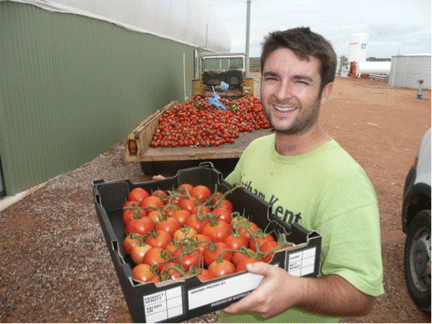 Sundrop Farms’ greenhouse expansion project approved by council | PHOTOS, The Transconntinental By Steph Say and Ryan Smith Aug. 13, 2014,
Sundrop Farms gets the green light Sundrop Farms’ innovative greenhouse expansion project has been given the green light with the support of Port Augusta City Council.
Provisional development approval was granted at Tuesday night’s Development Assessment Panel meeting.
Sundrop Farms will now start making detailed designs for the 20 hectare expansion before getting a final construction price from a selected contractor. This process is expected to take two months when the final decision on whether the development will go ahead will be made.
If the expansion does go ahead it is expected to create 200 ongoing jobs for the city and a major economic boost.
Sundrop Farms chief technology officer Reinier Wolterbeek said the provisional approval was one of the major boxes that needed to be ticked to get the expansion underway. “It’s a major milestone, we’ve worked a long time to get to this stage,” he said. We’ve worked with the .2 hectares here [inPort Augusta] for about four years…with ups and downs but we’ve achieved the yields we are after.”
Sundrop Farms uses cutting-edge solar thermal technology to desalinateseawater for irrigation and to heat and cool greenhouses.The expansion would involve the building of a 20 hectare, four greenhouse facility which will produce more than 15,000 tonnes of tomatoes a year for metropolitan markets across Australia.
Solar energy will be harnessed using a power tower which absorbs heat reflected from a field of mirrors………http://www.transcontinental.com.au/story/2484815/sundrop-farms-greenhouse-expansion-project-approved-by-council-photos/?cs=1286
Solar power used for greenhouse farming in a dry harsh area
Growing Food In The Desert With Solar Power http://www.energymatters.com.au/index.php?main_page=news_article&article_id=3488 by Energy Matters, 27 Nov 12,
Australia is home to a food production revolution – Sundrop Farms near Port Augusta is successfully growing high-value crops using seawater and sunlight in what would be considered extremely hostile conditions for horticulture.
With energy and water costs responsible for up to 70% of total farm expenses in some regions and irrigation accounting for 70 percent of the 3,240 cubic kilometres of water withdrawn for human use, Sundrop Farms’ progress is being keenly monitored.
The Sundrop Farms System uses solar power to desalinate seawater to produce freshwater for irrigation and to generate electricity to power its climate-controlled greenhouse.
The seawater based greenhouse ventilation also cleans and sterilises the air, making it possible to grow crops without chemical pesticides.
The Sundrop Farms System allows land normally not deemed suitable for agriculture or horticulture to produce large quantities of food. The company claims its hydroponics based greenhouse growing methods yield 15-30 times more produce per hectare than conventional field production. Each hectare of Sundrop Farms greenhouses also directly employs between 5-7 people
Even the salt by-product of desalination has value – it’s mostly sold to third parties and some of the minerals are at times re-used in Sundrop Farms’ greenhouse as plant nutrients.
In addition to horticultural applications, the system can also be used for floriculture and aquaculture.
With modern food systems sometimes resulting in production occurring thousands of kilometres away from the point of consumption, Sundrop Farms type systems can also play a role in substantially reducing food miles; which can significantly add to the carbon footprint of food.
A planned 8 hectare expansion of the Port Augusta facility aims to produce 2.8 million kg of tomatoes and 1.2 million kg of peppers annually while saving the equivalent of approximately 4.6 million barrels of oil equivalent and 280 million litres of fresh water per year compared to a standard greenhouse in a similar location.
In coal hub Gladstone, solar energy powers 26% of housholds
 Quarter of houses rely on renewable energy http://www.gladstoneobserver.com.au/news/Why-we-rule-solar-race/2350835/ Ebony Battersby | 14th Aug 2014 DESPITE living in a coal-centric town, Gladstone residents are leading the nation in the switch to solar.
New figures reveal Gladstone homes are installing solar powered energy at rates faster than the rest of the country, coming in second on the list behind Bundaberg. About 26 per cent of Gladstone households are now relying on renewable energies.
Bundaberg tops the list with 38 per cent of households now solar users, with Mackay falling shortly behind at 23 per cent.
The Climate Council CEO Amanda McKenzie praised the efforts of Gladstone residents. “It’s great to see Gladstone residents are taking matters into their own hands, taking control of their power bills and reducing their carbon emissions at the same time,” she said. “Gladstone households already know that renewables make sense economically and environmentally, now it’s time for the rest of the country to catch up.”
Renewable energies are the one-way road to the future, according to local solar consultant Murray Kay. “We power the shop here entirely on solar,” he said.”Business has been great here in Gladstone. Solar is the way of the future.”
However, the solar versus coal argument presents a conundrum for local who invested in both the renewable and finite industries. On July 2, Queensland breached the negative energy price barrier for several hours, driven by the prevalence of rooftop solar.
This is not uncommon during the evening when power use is minimal. But on July 2, the milestone was reached in the middle of the day.
Regularly priced at around $40-$50 per megawatt hour, the plunge to zero confirmed solar was not only powering the state.
Predictions declare that 75 per cent of Australia’s residential buildings and 90 per cent of commercial buildings will be powered by rooftop solar in as little as ten years, according to UBS data. It is estimated that the demand for electricity has plummeted by 13 per cent over the past four years.
Yawuru People lead Broome protest against fracking
Yawuru People – Making a stand against fracking reaching thousands of people as they make their way to the races in Broome today. Damian Kelly 13 Aug 14 http://handsoffcountry.blogspot.com.au/2014/08/normal-0-false-false-false-en-us-ja-x.html
The Mining Company Buru – lead this risky environmental venture which could be just another failed attempt by a Company to run roughshod over communities in NW Australia. Woodside’s withdrawal from James Price Point in 2013 and more recently French nuclear power giant Areva has abandoned a Kimberley uranium project. With Buru’s falling share price, No Social Licence, delays and low cash flow the writing seems to be on the wall. Buru are also refusing to release information to the community regarding the chemicals they plan to use.
In short – Fracking is the process of drilling then injecting fluid, much of it toxic, into the ground at high pressure, to fracture gas-bearing rocks to release natural gas.
During this process, methane gas and toxic chemicals can leak from wells and contaminate nearby groundwater. Broome draws its drinking water from the ground. Buru Energy have plans to frack the Kimberley. The US, there have been more than 1000 documented cases of water contamination near areas of gas drilling. Some of the countries that have banned fracking are France, Bulgaria and Northern Ireland. The Australian state of Victoria currently has a moratorium on fracking.
Here in WA the state Government fully supports fracking.
1 This month
17 October, Free Public Talk on Nuclear Issues in South Australia
David Noonan will speak on public interest concerns over the new Roxby Downs Indenture Act 2026 on BHP copper-uranium mining and ore processing in SA, and on how AUKUS may face SA with a High-Level nuclear waste agenda.
Dr Jim Green will discuss international developments in the field of nuclear power including ‘small modular reactors’ and Generation 4 ‘advanced’ nuclear reactor concepts.


Help Aunty Sue Protect Her Land and Sacred Sites From Destructive Rocket Testing.
.

Australians deserve the truth
about
AUKUS – https://aukuspublicinquiry.com/

PETITION – To: Prime Minister Anthony Albanese and the Australian Labor Government

of the week – Australians for War Powers Reform (AWPR)
To see nuclear-related stories in greater depth and intensity

