Submissions will challenge Western Australia’s EPA report approving Kintyre uranium project
New WA uranium mine given environmental approval amid concerns, Australian Mining 29 July, 2014 Ben Hagemann The Environmental Protection Agency (EPA) in Western Australia has given conditional approval to the proposed Kintyre uranium mine in the Little Sandy Desert.
Canadian-based mining company Cameco plans to truck uranium oxide from 270 kilometres north east of Newman to the Port of Adelaide. The EPA’s report is open for a two-week appeal period starting Monday, July 28, and closing on August 11……….
Environmental groups have voiced concerns about impacts on the nearby Karlamilyi National Park, with the Conservation Council expressing their disappointment with the EPA approval.
Conservation Council spokesperson Mia Pepper said most of the EPAs conditions were administrative, and that environmental protections have been deferred to the Department of Mines and Petroleum.
“In this case, that includes mine closure, rehabilitation and tailings management and those are the aspects where uranium mines have failed in Australia to deliver good environmental outcomes,” she said.
“That’s something that we think the EPA should be looking at more closely.”
Pepper said the Conservation Council will make a submission regarding the EPAs report, and will support other organisations wishing to do the same.http://www.miningaustralia.com.au/news/new-wa-uranium-mine-given-environmental-approval-a
BHP expansion of Olympic Damn uranium mine just isn’t happening
Olympic expansion years away, says BHP THE AUSTRALIAN JULY 29, 2014 by Matt Chambers and Barry Fitzgerald BHP Billiton is unlikely to approve a long awaited expansion of the Olympic Dam copper and uranium mine in South Australia’s outback this decade, with the miner revealing it will take four years to trial a processing method it hopes will help make the project profitable.
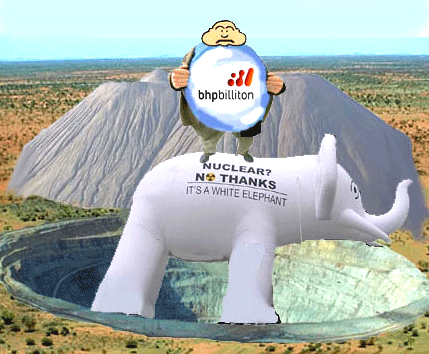 In documents filed with the federal Environment Department yesterday, BHP kicked off the approvals process for a trial plant to test heap-leaching of copper and uranium ores as a lower-cost alternative to the previous expansion plan. If all goes to plan, the earliest a demonstration plant would start construction is July next year, with a three-year operation period targeted to start in October 2016. “While the application is for a trial, a successful trial will not necessarily lead to a full-scale heap-leach project,” BHP said. “Further, the extent and nature of any potential full-scale project is not known at this stage.”
- The application is only to study processing the ore, with no mention of how BHP would access the deep orebody…………
Under previous government-approved plans, BHP had been planning a staged increase in annual production to a world-class 750,000 tonnes of copper and 19,000 tonnes of uranium, the latter being problematic given the collapse in prices and demand for the nuclear material in the wake of the 2011 Fukushima disaster. The big-bang approach to expansion was abandoned by BHP in August 2012 in line with the new era of capital austerity that swept the industry in response to weaker commodity prices. It involved the development of a super pit which would have taken more than five years to complete, with the Olympic Dam orebody sitting under 400m of overburden. The lack of cash flow during the time it would take to develop the open-cut mine spooked both BHP and the market, where agitation for greater shareholder returns over more big expansions has been become the new mantra. South Australia had been banking on the original $30bn plan to underpin an economic surge for the struggling state. Mr Mackenzie undertook in September to update the state on the way forward for Olympic Dam inside of a year. The investigation of the heap-leach option has been an open secret, with laboratory test work at Wingfield in suburban Adelaide under way since the expansion was canned….. In order to test the processing method at a larger and more integrated scale, BHP has lodged an application for assessment by the federal and South Australian governments to build and operate a demonstration plant on the existing mining lease at Olympic Dam. “Should approval be granted, and subject to BHP approvals, construction of the demonstration plant is expected to commence in the second half of (calendar) 2015, with a projected trial period of 36 months which is expected to commence in late 2016,’’ the company said. The heap-leach trial is only part of the thought process BHP has to go through to determine the best, and lowest-cost, way to maximise returns from Olympic Dam, one of the world’s biggest deposits of copper and uranium. The initial plan was supported by a mine-life capability from the underlying resource base of more than 40 years. BHP has yet to elaborate on what the move towards a heap-leach operation would mean for the end products produced at Olympic Dam. http://www.theaustralian.com.au/business/olympic-expansion-years-away-says-bhp/story-e6frg8zx-1227004910155
Senator Larissa Waters slams Abbott Government decision for massive coal mine
Green (Black) Light For Australia’s Largest Coal Mine http://www.energymatters.com.au/index.php?main_page=news_article&article_id=4417 29 July 14 Australia’s biggest coal mine, the $16.5 billion Carmichael Coal and Rail Project in Queensland’s Galilee Basin, has been given the nod by Federal Environment Minister Greg Hunt; much to the dismay of environmental groups and many Australians.
Minister Hunt has said the project proposed by Indian company Adani could go ahead, subject to 36 conditions (PDF) designed to reduce environmental impact.
The Australian Greens have blasted the decision.
 “History will look back on the Abbott Government’s decision today as an act of climate criminality,” said Senator Larissa Waters, Australian Greens environment spokesperson.
“The Abbott Government’s claims that it has put ‘stringent’ conditions on the approval are a joke given the Auditor General last month found that the federal environment department is so under-resourced it is failing to monitor and enforce environmental conditions. Adani has a track record of non-compliance with environmental conditions in India – why take the risk with our climate and Great Barrier Reef?”
Greenpeace also has a list of grievances; among them, the 12 billion litres of water each year from local rivers and underground aquifers that will be needed by the operation, the 60 species at risk and the burning of coal from Carmichael mine producing four times the fossil fuel emissions of New Zealand.
“It is a catastrophe for the climate,” says the group. Environmental issues aside, there may be massive financial risks involved too.
The Greens state Adani is already in “dire financial straits” and earlier this yearan analysis found major coal projects that rely on new export markets such as India face a very uncertain future. India’s Finance Minister also recently announced plans to double the nation’s tax on coal in order to help finance renewable energy projects.
The Institute for Energy Economics and Financial Analysis (IEEFA) says building renewables is cheaper than constructing imported coal power capacity, they are cheaper to maintain and can be constructed more rapidly.
“The notion that anyone will want to buy our coal in 60 years is economic lunacy, so this project is economically foolhardy as well as an environmental disaster,” said Senator Waters.
Questionable EPA approval for Cameco’s proposed Kyntyre uranium mine
 Increased scrutiny needed as EPA radioactive rubber stamp fails the nuclear test National and state environment groups have called for a dedicated public inquiry into plans for increased uranium mining in WA following an EPA recommendation to conditionally approve the proposed Kintyre mine next to Kalamilyi National Park in the Pilbara.
“The proposal to mine uranium five hundred metres from a creek system that is part of a network of significant waterways in a national park is reckless and should not be approved,” said CCWA campaigner Mia Pepper.
“This polluting plan would put great pressure on one of WA’s special places – our largest national park – and would impact on scarce water resources and a number of significant and vulnerable species including the bilby, marsupial mole and rock wallaby.
The approval recommendation follows recent disturbing allegations that former mine owner Rio Tinto made secret payments of around $21 million to silence Aboriginal concerns and opposition while it negotiated the project’s sale to current owner Cameco.
“Uranium mining is a high risk, low return activity where the proven risks far outweigh any promised rewards,” said ACF campaigner Dave Sweeney.
“Uranium is currently trading at US$28/lb. Cameco has stated it will not mine unless the uranium prices reaches upwards of US$75/lb. The EPA is recommending a green light for yellowcake when the company has stated the finances and the plan don’t stack up.
“Uranium mining poses unique risks and long term human and environmental hazards. It demands the highest level of scrutiny and assessment – instead we have a lower order EPA report based on the hope of ‘satisfactory implementation by the proponent of the recommended conditions’. This inadequate approach is out of step with community expectations and fails to reflect the uranium sectors proven history of leaks and failure.”
“In the shadow of Fukushima, a continuing nuclear crisis directly fuelled by Australian uranium, Bill Marmion and Colin Barnett should put this controversial and contaminating sector before the people and under the spotlight via a public inquiry.”
For comment contact: Dave Sweeney 0408 317 812 or Mia Pepper 0415 380 808
Transport of toxic chemical and radioactive wastes – France says NO to Orica
 For a long time, I’ve been posting away about radioactive waste, as if it were the only pollution problem. But of course it’s not. Indeed the same stupid white males who brought us radioactive wastes also bring us chemical wastes – in a sort of mindless onslaught on the very ecosystem we need for our survival.
I thought it ironic that France is now refusing to accept toxic chemical wastes from Australia.
Meanwhile a few very greedy business individuals, and a few not very bright worthies like Bob Hawke, Martin Ferguson, Alexander Downer – are advocating that Australia import radioactive wastes from France and everybody else.
The French have woken up now to the danger and diseconomics of nuclear power, and they’ve also woken up to the dangers of transporting chemical wastes. These wastes are best stored near the point of origin. The same goes for radioactive wastes.
Fortunately, most Australians reject the idea of importing radioactive wastes. The Abbott government and the Labor opposition are forced by public opinion to pretend that they oppose this too. However, under the power of their corporate funders, both parties would be ever so amenable to a business idea like that – anything to get corporate and media support to be in office.
 French reject Orica’s toxic waste, SMH July 27, 2014 Natalie O’Brien More than 100 tonnes of highly toxic waste will have to remain at Botany after the French government vetoed plans by chemical giant Orica to ship it from Sydney to France for incineration.
Environmentalists across the world have applauded the decision after angry protests during the Tour de France bicycle race and a petition with 23,746 signatures was collected calling for the shipment to be stopped.
French Ecology Minister Segolene Royal said she would not back the plan to send the Hexachlorobenzene (HCB) waste to an area in south-east France because of fears something could go wrong to the ship which could cause marine pollution.
“The transport of dangerous waste … is an environmental aberration,” she was reported as saying.
She also said such waste “should be treated near their source of production”. ……..
It is Orica’s third attempt to ship the HCB, a carcinogenic pollutant banned in Europe since 1981, from Botany to an overseas destination for incineration. Protests stopped its planned export in 2007 to Germany and in 2010 to Denmark. Experts have said that the longer it remains at Botany the more waste is generated because it has to be repackaged every four years to keep it secure.
Objections had also been made to the Australian government from numerous lobby groups including Doctors for the Environment Australia, Friends of the Earth, the Nature Conservation Council, The National Toxics Network, Greenpeace Australia, International POPs Elimination Network, and the Basel Action Network (the Global Alliance for Incineration Alternatives).
Dr Mariann LLoyd-Smith from the National Toxics Network, said they shared Ms Royal’s concerns about transporting such a large amount of toxic waste by sea to France and they were also concerned about the repeated engineering failures and toxic emissions of the intended French incinerator.
“Now as a matter of urgency, we need to bring all the parties together and decide on a suitable non-combustion destruction technology not only for Orica’s HCB wastes but also to address current and future toxic waste,” she said.
“We then need to start the process to allow the Australian community to select an appropriate site where we can deal with our own hazardous waste in an environmentally sound way in line with Australia’s international obligations.” : http://www.smh.com.au/environment/french-reject-oricas-toxic-waste-20140725-zwd3k.html#ixzz38oF7vOkW
Forget Australia’s Abbott government – Capital cities are going ahead with renewable energy!
 Sydney and Melbourne going green despite uncertainty over future of Renewable Energy Target
http://www.abc.net.au/news/2014-07-26/sydney-and-melbourne-going-green-despite-ret-uncertainty/5625976 By Lisa Tucker Australia’s biggest cities are setting ambitious targets to cut carbon emissions despite signs the Federal Government will wind back the Renewable Energy Target (RET).
The review into the country’s RET is expected to make its recommendations next week.
But when it comes to going green, Melbourne and Sydney are on the same page and are determined to make it happen, whatever direction Canberra takes.
The cities are rolling out solar panels, installing LED light systems and designing energy efficient buildings.
Sydney plans to reduce its emissions by 70 per cent by 2030 while Melbourne aims to have zero net emissions in just five-and-a-half years.
City of Melbourne Councillor, Arron Wood, says environmental action is at the forefront of everything the council is doing.
“We’re certainly making big inroads, but to reach that goal by 2020, there’s some pretty big numbers,” he said.
“[But] I am absolutely vehemently opposed to any relaxing of the renewable energy target. It’s done wonderful things in terms of renewable energy investment.
“Interestingly enough we talk about the cost that renewable energy targets add to people’s bills, but when you look at the wholesale cost, it’s one of the only measures which is actually putting pressure on wholesale electricity prices.”
Renewable energy key factor in reducing emissions.
Sydney’s goal is to produce 70 per cent of its electricity needs from tri-generation, a more environmentally friendly, low-carbon production method with solar and wind power making up the rest.
Melbourne is aiming for a renewable energy contribution of 50 per cent.
“Really, you do have to have a large proportion of your energy mix coming from renewable to have a hope of reaching that target,” Cr Wood said.
“Even the Urban Forest Strategy, which is about cooling our city: we’ve got a target of doubling the canopy cover in the city by 2040.
“That’s really about decreasing ambient temperatures and meeting the urban heat effect. But what it does is, it also makes the city look good.”
Sydney’s Lord Mayor Clover Moore says any change to the target will make Sydney’s goal more difficult to achieve.
“It’s much better if the national Government is also committed to taking action on climate change,” Ms Moore said.
“We already know with the winding back of the carbon pricing that it’s making it harder to achieve our tri-generation precincts in Sydney. So that would have an effect.”
Ms Moore says the steps being taken have the community’s full support.
“We are the most urbanised country in the world and we know that our cities are where 70 per cent of emissions occur,” she said.
“I think it’s really incumbent upon city leaders to commit to taking this action and follow through on it.”
Lucas Heights nuclear reactor – safety fears, as safety supervisors dumped
 Fears for safety at Lucas Heights nuclear reactor: permanent supervisors to be dumped as part of cost-cutting GEOFF CHAMBERS THE DAILY TELEGRAPH JULY 25, 2014 PERMANENT frontline safety supervisors will be dumped and Australian Federal Police roles overhauled as part of cost-cutting measures at the Lucas Heights nuclear reactor.
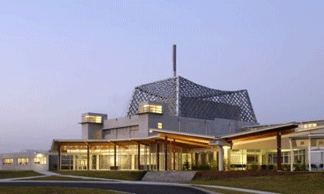 The Daily Telegraph can reveal that six permanent safety positions will be outsourced from next month at the Australian Nuclear Science and Technology Organisation (ANSTO).
Workers at the facility in Sydney’s south have expressed concern about the removal of permanent safety inspectors.
The AFP will retain an armed presence but it is expected that light duties, including boom gate operation and CCTV monitoring, will be outsourced.
With 260 production, laboratory and technical staff on its books, the Australian Manufacturing Workers’ Union has firmly opposed what it describes as a “cost-cutting exercise” by ANSTO.
The union’s state secretary, Tim Ayres, said that the reactor site was an important local employer and crucial for the innovation and manufacturing industry.
“This is in no way an improvement to safety at Sydney’s only nuclear facility, this is a decision to wind back the safety protections purely on the basis of costs,” he said.
Mr Ayres said having permanent safety inspectors on staff should be a priority for management.
The inspectors, many with years of experience, are the first point of contact at Lucas Heights during an emergency situation.
- “This sends a message that safety is a second-order issue. It will set the safety culture back,” he said………
Bill Shorten, Labor Leader urges that climate change must be on the G20 agenda

Press Council raps THE AUSTRALIAN newspaper over its false story of climate change denial
 ‘Considerable concern’: Oz in hot water over climate denial errors, Crikey, by Myriam Robin, 24 July 14 The Press Council has handed down an adverse ruling against The Australian for a front-page article published in September last year that relied on a rapidly debunked Daily Mail story claiming the Intergovernmental Panel on Climate Change had revised down the rate of global warming since 1951.
In highly unusual language for the Press Council, it says it is a matter of “considerable concern” that The Australian delayed in acknowledging its errors. Asked to explain the strong language, Press Council executive director John Pender told Crikey ”the initial error was very serious and prominent, was repeated unequivocally in a later editorial, and was not corrected with sufficient speed, clarity and prominence”.
In a September 16 article, since changed online but archived here on the Media Watch website, The Australian environment editor Graham Lloyd rehashed a British story published a week before the Fifth Assessment Report of the IPCC was released that claimed the report update would say the true figure of warming since 1951 had been 0.12 degrees Celsius per decade, and not the 0.2 degrees Celsius claimed in previous reports.
The Oz’s piece continued:
“Last week, the IPCC was forced to deny it was locked in crisis talks as reports intensified that scientists were preparing to revise down the speed at which climate change is happening and its likely impact.
“It is believed the IPCC draft report will still conclude there is now greater confidence that climate change is real, humans are having a major impact and that the world will continue to warm catastrophically unless drastic action is taken to curb greenhouse gas emissions. The impacts would include big rises in the sea level, floods, droughts and the disappearance of the Arctic icecap.
“But claimed contradictions in the report have led to calls for the IPCC report process to be scrapped.”
These reports were wrong. The Daily Mail got its numbers wrong, and The Australian repeated the error, as Media Watch and The Guardian pointed out last year. The long-term trend in the IPCC report is 0.13 degrees of global warming a decade, and has been for some time — there was no retreat from higher figures……..http://www.crikey.com.au/2014/07/24/considerable-concern-oz-in-hot-water-over-climate-denial-errors/
Australian Renewable Energy Agency (ARENA) funding Lord Howe Island’s hybrid renewable energy project
Lord Howe Island’s Clean, Renewable Energy Future http://www.energymatters.com.au/index.php?main_page=news_article&article_id=4411 25 July 14 The Australian Renewable Energy Agency (ARENA) is helping to fund a hybrid renewable energy project on Lord Howe Island that will include energy storage.
ARENA will contribute $4.5 million in support for the 1 MW, $11.6 million wind, solar, storage and diesel hybrid system that will reduce the Island’s consumption of diesel by 70%.
“Lord Howe Island is 600 km off the east coast of Australia and, like other remote off-grid communities across the country, is heavily reliant on diesel generators that are costly to run and subject to volatile fuel prices,” said ARENA CEO Ivor Frischknech.
“It is another significant project to come out of ARENA’s Regional Australia’s Renewables Initiative, which is focused on increasing the uptake of renewables in offgrid Australia.”
It’s been a long road to reach this point according to Lord Howe Island Board CEO Penny Holloway; who said said the community had been working towards a renewable energy future for more than ten years and ARENA’s support means it can now become a reality.
The Lord Howe Island Group is part of the state of New South Wales; administered by the Lord Howe Island Board.
NSW Environment and Heritage Minister Rob Stokes congratulated ARENA and the Lord Howe Island Board for their vision and commitment.
“Lord Howe Island was included on the World Heritage List because of its unique natural and heritage values and this initiative is a powerful way of protecting these into the future,” he said.
In other recent news from ARENA, the body announced it is also providing $500,000 to the Clean Energy Council (CEC) to support the execution of the first stage of a project to future-proof Australia’s energy system and improve the electricity grid to support the growth of clean energy.
The CEC will be working with industry, government, regulators and consumers and commissioning various related analyses; with the first stage of the future proofing project due to be completed by the middle of next year.
New South Wales on the way to renewable energy success
Renewable energy: NSW to be ‘Australia’s answer to California’, SMH, July 22, 2014 Peter Hannam Environment Editor, The Sydney Morning Herald New South Wales aims to be “Australia’s answer to California”, accelerating the use of renewable energy and finding new ways to curb waste, in a push that puts it at odds with Coalition counterparts in other states and at the federal level.
The Baird government says it plans to adorn as many of its buildings with solar panels as possible and ease the way for more wind farms.
The announcement comes days after the Abbott government secured its almost five-year quest to axe the carbon price and amid ongoing signs it will weaken the national renewable energy target (RET), “We are making NSW number one in energy and environmental policy,” Environment Minister Rob Stokes told the Clean Energy Week gathering in Sydney……….
Mr Stokes said NSW was committed to the 41,000 GW-h goal – a target that was the federal Coalition’s pre-election commitment. Maverick MP Clive Palmer has said his party will use its balance of power in the Senate to block any effort by the Abbott government to cut the renewable energy target.
Star watch
The NSW Resource Efficiency Policy will take advantage of the government’s scale – with more than half a billion dollars spent on energy, water and waste each year – to demand savings.
Investment over the next decade is likely to reach $290 million and deliver savings to energy bills of $55 million a year by then, Mr Stokes said.“We are the country’s largest employer,” he said of the NSW government. “We purchase 1 per cent of all new cars in Australia and we own half of all the land in the state – around 400,000 square kilometres.”
All new electrical equipment bought by the state will have to meet at least the average energy efficiency star rating for each appliance. For dishwashers that means 4 stars or higher and 3.5 stars for small air conditioners.
The Energy Efficiency Council said it applauded NSW’s leadership.
“Other governments around Australia should watch what NSW is doing and follow its lead,” said chief executive Rob Murray-Leach.
Improving energy performance was “a no-brainer”, strengthening the budget, as well as forcing through higher standards that build industry capacity, benefiting other parts of the economy, Mr Murray-Leach said. Mr Stokes told Fairfax Media: “It’s never been anyone’s job in the Department of Health or Department of Education to go and look at these efficiency opportunities.
“It’s a big opportunity, we’ve got a vast building stock, and there’s been nothing to activate it.”
As part of the policy, the Health Department will be required to audit energy use for 55 per cent of their power bills by June 2018; other departments will have to audit 40 per cent of their bills. The rate will rise to 90 per cent by 2024.
Wind-farm noise
In a separate nod to the renewable energy sector, Mr Stokes said he has recommended that the Environment Protection Authority treat noise from wind farms as it would noise from other mining and resources projects.
“I’ve asked the NSW EPA to consider the inclusion of the draft noise standards for wind energy projects into the Industrial Noise Policy, which is due to be finalised by December,” Mr Stokes said.
“This will provide clarity and certainty for wind farm operators, and will facilitate appropriate and responsible siting of wind farms in regional and rural areas,” he said……. http://www.smh.com.au/environment/renewable-energy-nsw-to-be-australias-answer-to-california-20140722-zvl60.html#ixzz38YKi2HqG
South Australia’s contaminated groundwater – thousands of sites
 Toxic sites in Adelaide’s suburbs number in their thousands BRAD CROUCH THE ADVERTISER JULY 22, 2014 THE Opposition has demanded a statewide audit of contaminated sites, as it emerges the dangers of trichloroethene entering groundwater was suspected as far back as the 1940s.
The call for an audit comes after Environmental Protection Authority chief executive Tony Circelli confirmed that “thousands” of sites were contaminated with various chemicals and the EPA received about 100 new notifications each year.
The State Government and Environment Minister Ian Hunter are under increasing pressure over the contamination scandal in Clovelly Park , where dozens of people have been forced to leave their homes because of health risks from the vapours of trichloroethene (TCE) rising up through the soil from industrially poisoned groundwater.
Mr Circelli, was responding to a claim by UniSA Professor Ravi Naidu, the managing director of the Cooperative Research Centre for Contamination Assessment and Remediation, that there are about 4000 contaminated sites in SA.
Mr Circelli said that claim was incorrect, but conceded the number “is in the thousands”.
Opposition Leader Steven Marshall said an audit was needed to clarify the exact number of contaminated sites and their locations. “The purpose of conducting a statewide audit would be to establish a hierarchy of sites based on potential public health risks,” he said.
“As well as playing an important community awareness role, the audit could also provide a benchmark for ongoing monitoring and evaluation of contaminated sites for the EPA and assist with any future contamination investigations………http://www.adelaidenow.com.au/news/south-australia/toxic-sites-in-adelaides-suburbs-number-in-their-thousands/story-fni6uo1m-1226998071395?nk=38b4e03626cff750bb726e65c1a3e9f4
Despite Tony Abbott, Solar Power is shining in Alice Springs
Red Centre keeps shining as solar technology hub http://www.abc.net.au/news/2014-07-22/alice-springs-solar-hub-technology/5613534 ABC Rural By Lauren Fitzgerald Central Australia is continuing to attract international investment from the solar industry, despite the Alice Solar City initiative wrapping up more than a year ago. In its five-year history, the program helped hundreds of homes and businesses install solar panels and solar hot water systems.
The general manager of the Centre for Appropriate Technology (CAT), Lyndon Frearson, says Alice Springs now also has a reputation as a hub for developing technology.
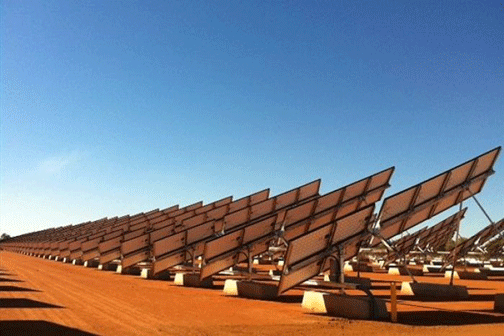
He says companies from China, Japan, Taiwan, Germany, Switzerland and America are all installing different solar PV modules at the CAT site. “The range of their investment varies depending on the size of the facility that they want to put in,” he said.
“Some of them are putting in little five-kilowatt systems as a test site, where they might be putting a number of small test sites around the world, through to a Swiss-based company which only has three R & D [research and development] facilities in the world, and they chose to build one of them here.
“And certainly those investments are in the order of hundreds of thousands of dollars.”
Mr Frearson says local businesses like the Alice Springs Airport are also demonstrating an ongoing commitment to solar. “They received a subsidy to do their original project, but they’ve just [installed] 320 kilowatts off their own bat, completely their own investment. “And that’s both a maturing of the economics, that the solar panels are cheaper and the energy prices have changed.
“But it also shows a degree of confidence that they as an organisation and their board have in the technology to better run their business. “And there are a number of examples within Alice and broader afield throughout central Australia where different entities are making those decisions.
“So I think the legacy of Alice Solar City in central Australia is strong. “Certainly it’s something we see people talking about with pride, and we still see people outside of Alice focus very heavily on and see Alice Springs as a leader in this space.”
Victoria’s wind farms may be able to expand, after all
 Wind companies question planning office response ENERGY companies will be allowed to make minor changes to wind farm planning permits from next month. Weekly Times 22 July 14, The move — which will pave the way for up to 964 turbines to be built across the state creating up to 2376 megawatts of wind energy — has been labelled a “change of heart” by Greens leader Greg Barber.
Planning Minister Matthew Guy said “we’re making a small adjustment to the planning scheme to allow existing wind farm planning permits to be amended, which may assist with upgrading turbine technology”……….http://www.weeklytimesnow.com.au/news/politics/wind-companies-question-planning-office-response/story-fnkerdda-1226997709510
Australia’s Clean Energy Finance Corporation doing well, expanding
Clean Energy Finance Corporation plans expansion after dodging axe http://www.smh.com.au/business/clean-energy-finance-corporation-plans-expansion-after-dodging-axe-20140721-zvdhg.html#ixzz38MD2vaOK July 22, 2014 Peter Hannam Environment Editor, The Sydney Morning Herald The Clean Energy Finance Corporation has capped its first year of operations, managing to avoid the federal government’s axe and generating more than $3 billion in investment in renewable energy and energy efficiency projects.
The CEFC issued more than $900 million in loans in the year to June 30 – backed by the private sector at the rate of $2.20 for each of its own dollars – securing the annual abatement of at least 4.2 million tonnes of carbon dioxide in the process.
Chief executive Oliver Yates said the fund generated a “reasonable return” for the taxpayer, raising funds at the government rate of about 3.5 per cent and lending under commercial terms at about 7 per cent.
The CEFC aims to at least match last year’s investments this financial year, with many of the projects “very complementary” to the government’s $2.55 billion Direct Action plan to pay polluters, Mr Yates said.
“Our numbers to date are that energy efficiency upgrades to buildings are saving about 45 per cent in energy costs,” Mr Yates said. “The challenge for Direct Action is that you need to fund all the action before you get paid for it, and that comes down to who actually funds these projects.”
In its first year, the CEFC’s investments were split about 60-40 in favour of renewable energy – largely solar – over energy efficiency projects.
Insiders say morale remains high among the 50 or so staff despite the Coalition’s vow to scrap the fund, a move blocked by Labor, the Greens and lately the Palmer United Party.
“It’s a game of snakes and ladders and has been for a while,” Mr Yates said, noting the regular policy shifts including last week’s repeal of the carbon price and uncertainty over the government’s support for large-scale renewable energy target.
Despite that uncertainty, companies and banks continue to line up for new investment, particularly in small-scale solar photovoltaics (PV).
The CEFC announced on Tuesday it will provide as much as $120 million for three new solar PV financing programs, including $70 million for US-based SunEdison. Tindo Solar, the country’s only solar PV panel maker, will also get $20 million in loans.
The fund will also provide up to $80 million as part of a cornerstone investment with a unit of Colonial First State to create Australia’s first unlisted clean energy investment platform for institutional investors. Colonial First State will aim to raise as much as $500 million for investments.
Falling solar PV prices have made panels more attractive for residential and commercial users alike. Globally, solar PV investment fell 22 per cent last year but actual new capacity rose 27 per cent because of tumbling costs, according to the Renewable Energy Policy Network.
1 This month
17 October, Free Public Talk on Nuclear Issues in South Australia
David Noonan will speak on public interest concerns over the new Roxby Downs Indenture Act 2026 on BHP copper-uranium mining and ore processing in SA, and on how AUKUS may face SA with a High-Level nuclear waste agenda.
Dr Jim Green will discuss international developments in the field of nuclear power including ‘small modular reactors’ and Generation 4 ‘advanced’ nuclear reactor concepts.


Help Aunty Sue Protect Her Land and Sacred Sites From Destructive Rocket Testing.
.

Australians deserve the truth
about
AUKUS – https://aukuspublicinquiry.com/

PETITION – To: Prime Minister Anthony Albanese and the Australian Labor Government

of the week – Australians for War Powers Reform (AWPR)
To see nuclear-related stories in greater depth and intensity

