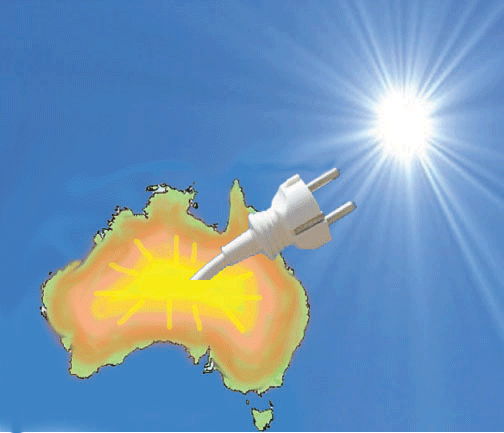
Game-changing rooftop solar boom is squeezing the profits out of coal power in Australia http://www.treehugger.com/renewable-energy/rooftop-solar-boom-squeezing-profits-coal-power-autralia.html Michael Graham Richard (@Michael_GR) 14 July 14
Solar power briefly turned electricity prices negative in Queensland Australia is known for its coal, which provides over 80% of its electricity and is a big export, but someday soon it might be known for its solar power. Thanks to rapidly falling solar PV prices, there’s been a rooftop solar boom in Australia. It’s now reaching a point where few coal generators made money last year, and even fewer will make profits this year… Wholesale energy pricing even briefly went negative in the middle of the day (see graph below) recently in the middle of the day in Queensland where there is 1.1 gigawatt of solar spread over more than 350,000 buildings.
Australia as a whole has about 3.4GW on 1.2 million buildings! Eventually, coal won’t be able to compete with solar at any price:
let’s imagine that the wholesale price of electricity fell to zero and stayed there, and that the benefits were passed on to consumers. In effect, that coal-fired energy suddenly became free. Could it then compete with rooftop solar?
The answer is no. Just the network charges and the retailer charges alone add up to more than 19c/kWh, according to estimates by the Australian energy market commissioner. According to industry estimates, solar ranges from 12c/kWh to 18c/kWh, depending on solar resources of the area, Those costs are forecast to come down even further, to around 10c/kWh and lower. (source)
The next step will be for people to get some storage and go off the grid to avoid having to pay these network charges. Australian solar installers are already reporting that “between 15 and 20 per cent of solar customers are asking about storage, and that rate is increasing each month.”
With companies like Tesla having ambitious goals to cut battery prices down over the next few years with gigafactories, the combo of cheap solar PV + cheap battery storage will be hard to beat. Dirty power sources will simply stop being competitive. Australia has lots of sun and high network costs, so it’s at the forefront of this movement. But most other countries will follow at their own pace. The best things we can do to accelerate the switch over to clean energy is to stop subsidizing fossil fuels, create regulation that is more friendly to rooftop solar (net-metering, for example), and put a price on carbon emissions.
July 21, 2014
Posted by Christina Macpherson |
AUSTRALIA - NATIONAL, solar |
Leave a comment
 Photon to build solar plus storage unit for NSW broadcast tower REneweconmy, By Giles Parkinson on 15 July 2014 German-based solar group Photon Energy is to install a large scale solar plus battery storage hybrid power system at a telecommunications tower in New South Wales that it says could be the fore-runner of thousands of such installations across the country.
The system, to be installed at a broadcast tower operated by BAI near Muswellbrook, will provide 24/7 power through a 39kW solar array and a 215kWh battery storage installation. An 8kW diesel generator will provide standby in emergencies.
Photon Energy says once successfully tested the concept could be implemented on thousands of sites across Australia.
Michael Gartner, the head of Photon Energy‘s Australian operations, said the project was a great step forward“ for solar power to provide clean and economically viable power supply for remote sites.
“The potential for solar PV in the replacement of conventional energy sources is substantial and will bring cost benefits and emissions savings for Australia in the coming years and decades.“
“… We can show how to incorporate solar PV into any given energy system and prove that using abundant sunlight for your own power consumption is the way forward.”……..http://reneweconomy.com.au/2014/photon-build-solar-plus-storage-nsw-broadcast-tower-37262
July 21, 2014
Posted by Christina Macpherson |
New South Wales, solar |
Leave a comment
The Carbon Tax Is Dead, Long Live the ..? http://www.energymatters.com.au/index.php?main_page=news_article&article_id=4399 18 July 14 The carbon tax is dead; but don’t expect to see a major difference in power bills – or for too long.
It doesn’t matter that many households were compensated for any impact of the scheme under the Household Assistance Package, or that the carbon tax prevented 11 to 17 million tonnes of carbon emissions.
Nor does it matter higher it resulted in some filthy brown-coal fired power stations being mothballed.
Like it or loathe it, it’s kaput. Spin bettered substance and Thursday’s passing of the repeal turned Australia from a leader to laggard.
“The repeal of Australia’s carbon price is a tragedy, not a triumph” said Michael Raupach Director, Climate Change Institute, Australian National University.
“It flies in the face of three giant realities: human-induced climate change, the proper role of government as a defender of the common good, and the emerging quiet energy-carbon revolution”.
According to the ABC, , consumers can expect to save between 20 and 50 cents each day on their electricity bills now the carbon tax has been repealed.
However, any financial benefit relating to power bills could quickly be eaten up by increases in other charges.For example, in New South Wales, Ausgrid wants increases of around 2 per cent a year over the next five years and TransGrid wants to raise prices by almost 4 per cent – this is just in relation to network charges.
Other states including South Australia have just implemented more electricity price rises. The average South Australian household will pay around $85 a year more.
In Queensland, households were recently hit with a 13.6 per cent increase, expected to cost the average household an extra $190 a year.
Depending what end of the scale of carbon tax savings are to be had, any relief may have already been gobbled up before many will receive their post-carbon tax bill. Anyone planning to do something other than pay power bills with the perceived windfall may need to re-evaluate those plans.
July 21, 2014
Posted by Christina Macpherson |
AUSTRALIA - NATIONAL, energy |
Leave a comment
Australian War Memorial should recognise revised Aboriginal death toll: researcher, Brisbane Times July 17, 2014 Cameron Atfield Brisbane Times and Sun-Herald journalist New research that has calculated an Aboriginal death toll of more than 65,000 in Queensland alone during the so-called frontier wars has renewed calls for formal recognition at the Australian War Memorial.
But the AWM in Canberra has dismissed the idea, saying recognition should instead be in the National Museum.
The research, presented to the Australian Historical Association’s Conflict in History conference last week at the University of Queensland, estimated 66,680 deaths between 1788 and 1930.
Of those deaths, 65,180 were indigenous, which is more than six times what was previously thought. The report’s co-author, historian Professor Raymond Evans, said the calculations were based on official records, witnesses’ reports and the number of patrols undertaken by the colonial Queensland government’s Native Police.
Professor Evans said the 65,180 figure was “conservative” and could be as high as 115,000.
“This is just Queensland – imagine what the nation-wide figure could be,” he said.
“If you say it’s a war, you at least allow the fact that Aboriginal people fought hard to defend their lands, so you can say they were warriors and they were fighting for their country. “They were fighting for Australia, for their land.”
Professor Evans said the estimated death toll was at least on a par with Australian casualties during World War I.
“The Australian War Memorial should recognise this as a war. It’s got such a high death rate, it was fought over a long period of time and it was fought between different communities, different nations, for territory,” he said.
“It’s a fight for land and territorial possession and it has many features of warfare and, of course, a huge death rate.” http://www.brisbanetimes.com.au/queensland/australian-war-memorial-should-recognise-revised-aboriginal-death-toll-researcher-20140716-ztqr6.html#ixzz388vSgyg2
July 21, 2014
Posted by Christina Macpherson |
aboriginal issues, AUSTRALIA - NATIONAL, Queensland |
Leave a comment
 The search for the clean coal holy grail http://www.abc.net.au/radionational/programs/backgroundbriefing/ The Abbott government and a group of investors are pinning
  their environmental hopes on a clean coal technology that is still in the very early stages of development. Paddy Manning tracks the quest for the clean coal holy grail and investigates the men getting unspeakably rich from the search.
The federal government is pinning its hopes of cleaning up Australia’s electricity  sector on a new clean coal technology that is still at the laboratory stage.
Environment Minister Greg Hunt has made clear that a key plank of the government’s plan to tackle climate change is reducing emissions from existing black and brown coal-fired power stations……
Ignite Energy Resources, a member of the DICE network, recently recieved a $20 million grant to produce liquid fuel for DICE engines from brown coal, among other things………
photo – Dr John White Executive Director, Ignite Energy Resources
July 20, 2014
Posted by Christina Macpherson |
AUSTRALIA - NATIONAL, energy, secrets and lies |
Leave a comment
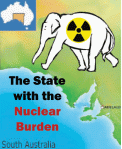
 The nuclear war against Australia’s Aboriginal people, Ecologist Jim Green 14th July 2014 Dumping on South Australia “……….The failed attempt to establish a dump at Muckaty followed the failed attempt to establish a dump in South Australia. In 1998, the Howard government announced its intention to build a nuclear waste dump near Woomera in South Australia.
Leading the battle against the dump were the Kupa Piti Kungka Tjuta, a council of senior Aboriginal women from northern SA. Many of the Kungkas personally suffered the impacts of the British nuclear bomb tests at Maralinga and Emu in the 1950s.
The proposed dump generated such controversy in SA that the federal government hired a public relations company. Correspondence between the company and the government was released under Freedom of Information laws.
In one exchange, a government official asked the PR company to remove sand-dunes from a photo to be used in a brochure. The explanation provided by the government official was that: “Dunes are a sensitive area with respect to Aboriginal Heritage”.
The sand-dunes were removed from the photo, only for the government official to ask if the horizon could be straightened up as well. ‘Terra nullius’!
In 2003, the federal government used the Lands Acquisition Act 1989 to seize land for the dump. Native Title rights and interests were extinguished with the stroke of a pen. This took place with no forewarning and no consultation with Aboriginal people.
Victory in the Federal Court
The Kungkas continued to implore the federal government to ‘get their ears out of their pockets’, and after six years the government did just that.
In the lead-up to the 2004 federal election – after a Federal Court ruling that the federal government had acted illegally in stripping Traditional Owners of their native title rights, and with the dump issue biting politically in SA – the Howard government decided to cut its losses and abandon the dump plan.
The Kungkas wrote in an open letter: “People said that you can’t win against the Government. Just a few women. We just kept talking and telling them to get their ears out of their pockets and listen. We never said we were going to give up. Government has big money to buy their way out but we never gave up.”
The Kungkas victory had broader ramifications – it was a set-back for everyone who likes the idea of stripping Aboriginal people of their land and their land rights, and it was a set-back for the nuclear power lobby.
Senator Nick Minchin, one of the Howard government ministers in charge of the failed attempt to impose a nuclear dump in SA, said in 2005:
“My experience with dealing with just low-level radioactive waste from our research reactor tells me it would be impossible to get any sort of consensus in this country around the management of the high-level waste a nuclear [power] reactor would produce.”
Minchin told a Liberal Party council meeting that “we must avoid being lumbered as the party that favours nuclear energy in this country” and that “we would be political mugs if we got sucked into this”…….. http://www.theecologist.org/News/news_analysis/2476704/the_nuclear_war_against_australias_aboriginal_people.html
July 19, 2014
Posted by Christina Macpherson |
aboriginal issues, AUSTRALIA - NATIONAL, history, South Australia, wastes |
Leave a comment
Cr Veitch, who will address an anti-uranium protest rally in Townsville later this month, said he believed that aside from the “extreme consequences” for Townsville if something went wrong at the mine, it could invite terrorists into our backyard.
“There is a risk nuclear products could fall into the wrong hands in the Middle East or Eastern Asia,” he said.
Cr Veitch said “there is always that possibility,” that the uranium mine could make Townsville a target for terrorists. Especially with the large military base (at Lavarack).”…….
With any uranium mining operations at Ben Lomond certain to include a highly radioactive tailings dam, he said it was an “impossibility” to ensure safety at the mine in a tropical region prone to cyclones.
“They definitely haven’t been able to contain spills in tropical Australia and I think it would be an impossibility at this location,” he said.
“The State Mining Warden of the time closed it down (in 1981) because they considered it unsafe … what makes it safe now?……
Citizens Against Mining Ben Lomond spokesman David Sewell fears radioactive materials could be transported via the city to the port and then on to the Great Barrier Reef.
The protest march will start at 9.30am on July 27 on the grassed area behind the Picnic Bay Surf Life Saving Club.
July 19, 2014
Posted by Christina Macpherson |
Queensland, safety, uranium |
Leave a comment
 Dennis Matthews 18 July 14 Electricity retailers in SA are required by law to pay domestic solar electricity generators only 7.6c a kWh (the minimum retailer payment) and this will automatically decrease to 6c/kWh now that the carbon pricing legislation has been repealed by the Abbott government. Yes, no ifs or buts, automatically!
Given the grossly unequal lobbying and market power of electricity retailers versus domestic solar generators then this can only be described as a travesty. And things are only going to get worse for the household consumer with price increases already flagged by retailers and the monopoly network provider.
Whilst we wait with bated breath to see what happens to what retailers are going to charge us, thanks to Essential Services Commission (ESCOSA), retailers already know that they will pay 20% less to domestic solar generators.
July 19, 2014
Posted by Christina Macpherson |
solar, South Australia |
Leave a comment
The nuclear war against Australia’s Aboriginal people, Ecologist Jim Green 14th July 2014 Australia’s nuclear industry has a shameful history of ‘radioactive racism’ that dates from the British bomb tests in the 1950s, writes Jim Green. The same attitudes have been evident in recent debates over uranium mines and nuclear waste, but Aboriginal peoples are fighting back! The British government conducted 12 nuclear bomb tests in Australia in the 1950s, most of them at Maralinga in South Australia.
Permission was not sought from affected Aboriginal groups such as the Pitjantjatjara, Yankunytjatjara, Tjarutja and Kokatha.
Thousands of people were adversely affected and the impact on Aboriginal people was particularly profound.
Many Aboriginal people suffered from radiological poisoning. There are tragic accounts of families sleeping in the bomb craters. So-called ‘Native Patrol Officers’ patrolled thousands of square kilometres to try to ensure that Aboriginal people were removed before nuclear tests took place – with little success.
‘Ignorance, incompetence and cynicism’
The 1985 Royal Commission found that regard for Aboriginal safety was characterised by“ignorance, incompetence and cynicism”. Many Aboriginal people were forcibly removed from their homelands and taken to places such as the Yalata mission in South Australia, which was effectively a prison camp.
In the late-1990s, the Australian government carried out a clean-up of the Maralinga nuclear test site. It was done on the cheap and many tonnes of debris contaminated with kilograms of plutonium remain buried in shallow, unlined pits in totally unsuitable geology.
As nuclear engineer and whistleblower Alan Parkinson said of the ‘clean-up’ on ABC radio in August 2002: “What was done at Maralinga was a cheap and nasty solution that wouldn’t be adopted on white-fellas land.”
Barely a decade after the ‘clean-up’, a survey revealed that 19 of the 85 contaminated debris pits had been subject to erosion or subsidence. The half-life of plutonium-239 is 24,100 years.
Despite the residual contamination, the Australian government off-loaded responsibility for the land onto the Maralinga Tjarutja Traditional Owners.
The government portrayed this land transfer as an act of reconciliation, but the real agenda was spelt out in a 1996 government document which states that the ‘clean-up’ was “aimed at reducing Commonwealth liability arising from residual contamination.” ………..http://www.theecologist.org/News/news_analysis/2476704/the_nuclear_war_against_australias_aboriginal_people.html
July 19, 2014
Posted by Christina Macpherson |
aboriginal issues, AUSTRALIA - NATIONAL, history, South Australia |
Leave a comment
American scientists have just confirmed that parts of Australia are being slowly parched because of greenhouse gas emissions.
A report in Nature Geoscience shows that the long-term decline in rainfall over south and south-west Australia is a consequence of fossil fuel burning and depletion of the ozone layer by human activity. Such a finding is significant for two reasons. One remains contentious: it is one thing to make generalised predictions about the consequences overall of greenhouse gas levels, but it is quite another to pin a measured regional climatic shift directly on human causes, rather than some possible as-yet-unidentified natural cycle of climatic change.
The other is contentiously political.
Australia’s prime minister, Tony Abbott, has in the past dismissed climate science as “crap”, and more recently has cut back on Australian research spending.
Bush fires and catastrophic flooding
Australia has already experienced a pattern of heat waves and drought – punctuated by catastrophic flooding – and even now, in the Australian winter, New South Wales is being hit by bush fires.
Tom Delworth, a research scientist at the US National Oceanic and Atmospheric Administration, reports in Nature Geoscience that he and a colleague conducted a series of long-term climate simulations to study changes in rainfall across the globe.
One striking pattern of change emerged in Australia, where winter and autumn rainfall patterns are increasingly a cause of distress for farmers and growers in two states.
The simulation showed that the decline in rainfall was primarily a response to man-made increases in greenhouse gases, as well as to a thinning of the stratospheric ozone layer in response to emissions of destructive gases by human sources.
The computer simulations tested a series of possible causes for this decline, such as volcanic eruptions and changes in solar radiation. But the only cause that made sense of the observed data was the greenhouse explanation.
It began in 1970, and it hasn’t stopped yet
South Australia has never been conspicuously lush and wet, but decline in precipitation set in around 1970, and this decline has increased in the last four decades.
The simulations predict that the decline will go on, and that average rainfall will drop by 40% over south-west Australia later this century.
Dr Delworth described his model as “a major step forward in our effort to improve the prediction of regional climate change”.
In May, scientists proposed that greenhouse gas emissions were responsible for a change in Southern Ocean wind patterns, which in turn resets the thermostat for the world’s largest island.
Australian scientists report in Geophysical Research Letters that they, too, have been using climate models to examine Antarctic wind patterns and their possible consequences for the rest of the planet.
Another consequence: accelerated ice sheet melt
“When we included projected Antarctic wind shifts in a detailed global ocean model, we found water up to 4°C warmer than current temperatures rose up to meet the base of the Antarctic ice shelves”, said Paul Spence, a researcher at Australian Research Council’s Centre of Excellence for Climate System Science. This temperature rise is twice previous estimates.
“This relatively warm water provides a huge reservoir of melt potential right near the grounding lines of ice shelves around Antarctica. It could lead to a massive increase in the rate of ice sheet melt, with direct consequences for global sea level rise.”
Since the West Antarctic ice sheet holds enough water to raise sea levels by 3.3 metres, the consequences would indeed be considerable.
“When we first saw the results it was quite a shock”, said Dr Spence. “It was one of the few cases where I hoped the science was wrong.”
July 19, 2014
Posted by Christina Macpherson |
AUSTRALIA - NATIONAL, climate change - global warming |
Leave a comment
The nuclear war against Australia’s Aboriginal people, Ecologist Jim Green 14th July 2014 Nuclear war“……….Muckaty Traditional Owners have won a significant battle for country and culture, but the problems and patterns of radioactive racism persist. Racism in the uranium mining industry involves: ignoring the concerns of Traditional Owners; divide-and-rule tactics; radioactive ransom; ‘humbugging’ Traditional Owners (exerting persistent, unwanted pressure); providing Traditional Owners with false information; and threats, including legal threats.
One example concerns the 1982 South Australian Roxby Downs Indenture Act, which sets the legal framework for the operation of BHP Billiton’s Olympic Dam uranium mine in SA.
The Act was amended in 2011 but it retains exemptions from the SA Aboriginal Heritage Act. Traditional Owners were not even consulted. The SA government’s spokesperson in Parliament said:
“BHP were satisfied with the current arrangements and insisted on the continuation of these arrangements, and the government did not consult further than that.”
That disgraceful performance illustrates a broader pattern. Aboriginal land rights and heritage protections are feeble at the best of times. But the legal rights and protections are repeatedly stripped away whenever they get in the way of nuclear or mining interests.
Nuclear interests trump aboriginal rights
Thus the Olympic Dam mine is largely exempt from the SA Aboriginal Heritage Act. Sub-section 40(6) of the Commonwealth’s Aboriginal Land Rights Act exempts the Ranger uranium mine in the NT from the Act and thus removed the right of veto that Mirarr Traditional Owners would otherwise have enjoyed.
New South Wales legislation exempts uranium mines from provisions of the NSW Aboriginal Land Rights Act. The Western Australian government is in the process ofgutting the WA Aboriginal Heritage Act 1972 at the behest of the mining industry.
Native Title rights were extinguished with the stroke of a pen to seize land for a radioactive waste dump in SA, and Aboriginal heritage laws and land rights were repeatedly overridden with the push to dump nuclear waste in the NT.
Most of those laws are supported by the Liberal / National Coalition and Labor. Radioactive racism in Australia enjoys bipartisan support.
Muckaty Traditional Owners have won a famous victory, but the nuclear war against Aboriginal people continues – and it will continue to be resisted, with the Aboriginal-ledAustralian Nuclear Free Alliance playing a leading role Jim Green is the national nuclear campaigner with Friends of the Earth, Australia, and editor of Nuclear Monitor.
Nuclear Monitor has been publishing deeply researched, often strongly critical articles on all aspects of the nuclear cycle since 1978. A must-read for all those who work on this issue! http://www.wiseinternational.org/node/36 http://www.theecologist.org/News/news_analysis/2476704/the_nuclear_war_against_australias_aboriginal_people.html
July 19, 2014
Posted by Christina Macpherson |
aboriginal issues, AUSTRALIA - NATIONAL, politics, uranium |
Leave a comment
Victoria Editor Melbourne
THE Prime Minister’s senior indigenous adviser, Warren Mundine, plans to sue Fairfax after he was accused of brokering a “highly questionable deal” that gave a mining company access to an Aboriginal sacred site in Western Australia.
“The allegations against me published in Fairfax Media last weekend are false,” Mr Mundine says in the statement to be released today.
July 17, 2014
Posted by Christina Macpherson |
aboriginal issues, AUSTRALIA - NATIONAL, legal |
Leave a comment
 First principles owed to our first people July 14, 2014 The Age Transparency, accountability and rigorous governance are tenets of good public and corporate policy. Without them, there can be little confidence that outcomes will be decent and fair, let alone optimal.
The Age‘s investigative team on Saturday revealed that conflicts of interest compromised the process and outcome of a land deal that gave a mining company access to an Aboriginal sacred site in Western Australia. The evidence raises concerns that the traditional owners of the land, the Martu people, have shamefully been denied the financial benefits they ought to have received.
It also casts doubt on the judgment and suitability of the federal government’s indigenous policy supremo, former ALP national president and head of the Indigenous Advisory Council Warren Mundine, because a company he part owned and of which he was a director helped broker the deal. The company, Indigenous Investment Management Pty Ltd (IIM), was appointed by mining company Reward Minerals to negotiate the deal to mine for potash at Lake Disappointment with the organisation supposed to be representing the Martu people’s interest, the Western Desert Lands Aboriginal Corporation.
The probity of the deal is brought into question by a clear potential conflict of interest: the chief financial officer of the corporation also held shares in IIM. IIM succeeded in getting the corporation to abandon its opposition to allowing the mining company access to the sacred site. Further, confidential advice to the corporation’s board from its lawyers said the negotiation process had “no validity” and had put directors and executives at risk of breaching legal obligations to act honestly and eschew self-interest.
Mr Mundine’s integrity and competence need to be seen to be beyond reproach, as his national leadership role involves a delicate balance. He is seeking to prevent the corruption that can sully indigenous organisations receiving mining money, while promoting Aboriginal economic development by opening up more land…….
In coming days, Mr Mundine and Prime Minister Tony Abbott are meeting to discuss a report that could revolutionise the participation of indigenous people in the economy. This newspaper considers improving the lot of Australia’s indigenous people one of the most pressing issues for our nation. Our investigation casts doubt on Mr Mundine’s authority to lead such overdue and crucial change.
http://www.theage.com.au/comment/the-age-editorial/first-principles-owed-to-our-first-people-20140713-3buyq.html#ixzz37mmeLw4r
July 17, 2014
Posted by Christina Macpherson |
aboriginal issues, AUSTRALIA - NATIONAL |
Leave a comment
 Legal advice questioned controversial mining deal: http://www.smh.com.au/national/legal-advice-questioned-controversial-mining-deal-20140715-ztbnd.html#ixzz37mgd7Zbq July 15, 2014 Richard Baker and Nick McKenzie More legal advice has emerged questioning the process that led to a controversial deal between a West Australian aboriginal corporation and a mining company.
Fairfax Media has obtained advice from a third in-house lawyer for the Western Desert Lands Aboriginal Corporation which cast doubt over the process that lead to a deal with Reward Minerals to mine a Martu sacred site in outback WA called Lake Disappointment.
At the weekend, Fairfax Media revealed how two other in-house lawyers for the Western Desert corporation wrote an explosive July, 2011 memo warning that a soon-to-be signed deal with Reward had “no validity”, in part because the corporation’s board and executives had, in their opinion, not acted in the best interests of the Martu people.
A 2009 email reveals that a separate in-house lawyer for the corporation also raised concerns about the Martu people not having given “proper informed consent” to an in-principle agreement signed with Reward to mine Lake Disappointment a year earlier.
In March, 2009, the Western Desert corporation’s then in-house lawyer, Christina Araujo, emailed acting chief executive Tony Wright to advise that she was not “prepared to state that I believe WDLAC has the informed consent of the common law holders” because it could put her practising certificate at risk.
“Tony, further to our conversation on the 6th of March, I am confirming in writing concerns I have in relation to the Reward negotiations,” Ms Araujo wrote. “Apart from my personal observations, I have also had discussions with a number of others who were also of the view that proper informed consent is or may be lacking.
“Going through the files, it appears Katherine Hill [another legal adviser], on numerous occasions provided advice on proper informed consent and it is noted in a file note dated 16/10/2007 that she spoke to Joe Procter and Clinton Wolf about her concern that people did not seem to understand there was a mining proposal over Lake Disappointment.
“It does not appear in the files that the matter was discussed in detail with the common law holders … it is an issue for WDLAC if we do not have informed consent for the Reward matter. Any agreement which may result may be invalid.”
Mr Procter was a consultant helping the Western Desert corporation negotiate the initial 2008 deal and Mr Wolf was then the corporation’s chief executive.
Ms Araujo’s March, 2009 email came at the same time the Native Title Tribunal heard Martu elders testify about the cultural significance of the Lake Disappointment site.
The tribunal was asked to rule on Reward’s proposal after relations between the mining company and the Western Desert corporation stalled in mid-2008 amid an argument over legal costs. In a historic ruling, the tribunal rejected Reward’s bid on the basis of Lake Disappointment’s cultural importance to the Martu people. It was the first time the tribunal had refused a mining company’s application.
But, as reported by Fairfax Media at the weekend, the Western Desert corporation altered it stance on the Reward proposal in 2011, despite strong doubts from another set of in-house lawyers about the negotiation process not being conducted in the best interests of the Martu people.
Ms Araujo’s successors as the Western Desert corporation’s in-house lawyers warned that the Reward negotiation process had in their opinion put the corporation in breach of most of its legal obligations as the trustee body for Martu people.
In a January, 2011 announcement to the Australian Stock Exchange, Reward revealed it had in late 2010 approached the Western Desert corporation to re-open talks over Lake Disappointment.
On April 1, 2011, Reward announced to the ASX: “Reward has appointed Azure Capital and its affiliate Indigenous Investment Management (IIM) as advisers to assist in discussions with the Martu traditional owners.”
Company documents show at the time of this announcement that IIM’s shareholders and directors included former Western Desert chief executive Mr Wolf, senior Azure Capital executives and Warren Mundine, who was last year appointed as the federal government’s top indigenous adviser.
Another shareholder at this time was the Western Desert corporation’s chief financial officer Mr Wright.
Mr Mundine has confirmed that he was not personally involved in the negotiations nor benefited from the deal.
Western Desert corporation chief executive Noel Whitehead and Mr Wolf said external legal advisers were engaged in 2011 to ensure the deal was done properly and fairly.
Reward this week rejected any inference its negotiations over Lake Disappointment were unfair. It said independent legal and financial advisers were involved and great care had been taken to treat the Martu people with respect.
July 17, 2014
Posted by Christina Macpherson |
aboriginal issues, legal, Western Australia |
Leave a comment
Cameco: Australia Regulator to Rule on Uranium Mine Within Weeks By Stephen Bell Capiyal Gr. 16 July 14 PERTH-–Canada’s Cameco Corp. (CCJ) expects Australian regulators to decide on its proposed Kintyre uranium mine within weeks, but will likely delay construction after prices of the nuclear fuel slumped to nine-year lows.
Brian Reilly, managing director of Cameco Australia, said Wednesday he expects Western Australia state’s Environmental Protection Authority to release a report into the project soon.
“The EPA is sitting on the report and recommendations–we anticipate seeing that released publicly within the next few weeks,” Mr Reilly told The Wall Street Journal on the sidelines of a uranium conference in Perth.
The regulator will make a recommendation to state and federal ministers, who will then make a final decision on whether the project can go ahead.
Mr. Reilly said Cameco hopes to “be in a position by the end of this year to have this project approved.”
However, Cameco would need uranium prices to recover sharply before starting construction of the mine. It would also look to discover more uranium reserves at the mine site.
In mid-2012, Cameco deferred development of Kintyre due to a collapse in the uranium price in the wake of the Fukushima nuclear accident in Japan. At the time, Cameco said the project likely wouldn’t be viable if uranium prices fell below US$67 a pound.
Spot uranium prices are currently around US$28 a pound because of a slower-than expected restart of Japanese nuclear reactors idled soon after the Fukushima crisis. There has also been a build-up in global uranium inventories as nuclear facilities recycle more fuel……http://english.capital.gr/News.asp?id=2064849
July 17, 2014
Posted by Christina Macpherson |
politics, uranium, Western Australia |
Leave a comment