Tony Abbott was elected to destroy action on climate change
History will condemn climate change denialists Robert Manne theguardian.com, Wednesday 16 July 2014
Tony Abbott was elected by the right-wing of his party for a single purpose: to destroy any meaningful action in Australia against the threat of climate change ……..

Climate change denialism soon spread beyond the US, especially to the countries of the English-speaking world. As Australia is a country extremely sensitive to the cultural winds blowing in from the US, reliant on the export and consumption of coal, and where the denialist Murdoch newspapers exercise enormous unhealthy influence, it is hardly surprising that over the past decade climate change denialism quickly sunk deep roots here.
The impact was seen in late 2009 with the coup inside the Liberal party which replaced Malcolm Turnbull, a rational believer in climate science, by a complacent opportunist, Tony Abbott, who regarded and still regards climate science as “crap”. The anti-Turnbull coup represents the most critical moment in the recent history of Australia. Abbott was elected by the right-wing of his party for a single purpose: to destroy any meaningful action in Australia against the threat of climate change. When the carbon tax is repealed, the leaders of the coup and the fossil fuel interests they represent will receive from a dutiful prime minister their anticipated reward.
The right-wing denialists, now dominant within the Coalition, often call themselves conservatives. They are not. At the heart of true conservatism is the belief that each new generation forms the vital bridge between past and future, and is charged with the responsibility of passing the earth and its cultural treasures to their children and grandchildren in sound order. History will condemn the climate change denialists, here and elsewhere, for their contribution to the coming catastrophe that their cupidity, their arrogance, their myopia and their selfishness have bequeathed to the young and the generations still unborn. http://www.theguardian.com/commentisfree/2014/jul/16/history-will-condemn-climate-change-denialists
Annual investments in large-scale renewable energy in Australia
Annual investments in large-scale renewable energy in Australia http://www.smh.com.au/business/carbon-economy/annual-investments-in-largescale-renewable-energy-in-australia-20140716-ztkwl.html July 16, 2014Tally of Australia’s investment in large-scale renewable energy, according to Bloomberg New Energy Finance.
2000: $54.5 million
2001: $85.8 million
2002: $255 million
2003: $543.7 million
2004: $721.6 million
2005: 1.472 billion
2006: 1.797 billion
2007: $1.222 billion
2008: $1.198 billion
2009: $1.756 billion
2010: $3.091 billion
2011: $1.649 billion
2012: $1.924 billion
2013: $2.691 billion
Renewable energy and diesel hybrid power for remote Coober Pedy
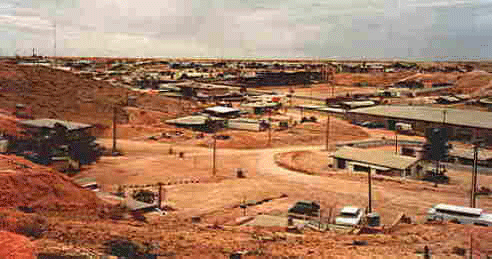 PROPOSED $18M RENEWABLE ENERGY DIESEL HYBRID PROJECT AT COOBER PEDY Coober Pedy Regional Times July 14, 2014 Coober Pedy in the Far North of South Australia, hosting a population of around 3,000 people, derives it’s electricity from a 3.9 MW diesel power station, and a 0.15MW wind turbine.
Power capacity in the small desert town is set to increase to a massive 8.9 MW pending outcomes of today’s announcement that the Australian Renewable Energy Agency has approved $18.5 million of support for a renewable energy, diesel hybrid project at Coober Pedy in South Australia.
The project is subject to a final investment decision by power provider Energy Developments Limited (EDL), along with approvals and agreements. If approved, completion is anticipated in mid-2017.
ARENA CEO Ivor Frischknecht said Energy Developments Limited (EDL) is proposing to combine wind, solar and diesel to provide the town with 70 per cent renewable energy over the life of the project. (picture below adapted from .http://cooberpedyregionaltimes.wordpress.com/2014/07/14/proposed-18m-renewable-energy-diesel-hybrid-project-at-coober-pedy/#more-8751)

“With ARENA’s support, EDL is seeking to integrate up to 2 MW of solar PV, 3 MW of wind generation and enabling technologies into its existing 3.9 MW diesel power station at Coober Pedy,” Mr Frischknecht said.
This ambitious project may demonstrate a combined approach for powering off-grid Australian communities that currently rely solely on expensive trucked-in diesel.
Yanni Athanasiadis, the Vice Chairman of Coober Pedy’s Retail Business and Tourism Association said today, “This is very good news for Coober Pedy that ARENA have allocated $18.5M towards a potential renewable energy diesel hybrid plant.”……….
Vice President of Coober Pedy Opal Miners Association John Dunstan said that the Miners Associaton has offered to allow the Solar and Wind infrastructure to be situated on a site opposite the existing power station, that the Association uses for it’s own industry purposes.
“If it’s going to help bring cheaper power to the Coober Pedy residents and businesses, the Miners Association are very willing to allow the installations of the 2 MW of solar PV, 3 MW of wind generation on it’s land.”
“Currently EDL have erected a wind monitor at the location to monitor wind speeds at Coober Pedy for the next 12 months to help determine what size turbines will be used”, said Dunstan. “Coober Pedy’s current wind turbine is 0.15MW but these new turbines will be over twice the size.” he said.
.Mr Frischknecht said the project will include short-term energy storage, fast start diesel engines and an advanced control system to enable smooth operation.
“These enabling technologies have been successfully tried and tested by Hydro Tasmania at the ARENA-supported King Island Renewable Energy Integration Project and this represents an opportunity to see them evolve for use on the mainland and in an outback community that has few alternative energy options,” Mr Frischknecht said.
“Further demonstration of these technologies is expected to reduce costs over time and improve opportunities for future deployment without subsidies…….http://cooberpedyregionaltimes.wordpress.com/2014/07/14/proposed-18m-renewable-energy-diesel-hybrid-project-at-coober-pedy/#more-8751
AUDIO: Australian land management a failure, compared to traditional Aboriginal methods
 AUDIO: Modern mismanagement of the Australian landscape? http://www.abc.net.au/news/2014-07-14/mis-managing-a-huge-land-mass3f/5593848 NSW Country Hour By Sally Bryant Bill Gammage says modern Australians are missing the point in how we look after our natural heritage, ignoring lessons from one of the most successful and sustainable management regimes in history.
 His view of traditional Aboriginal land management is at odds with the theory held by European settlers; that the traditional owners were hunter gatherers, opportunistic and simplistic in their approach to the land and native flora and fauna.
As an historian, Professor Gammage has studied written and visual records, from the history of the Australian landscape and he says it’s clear to him that Aboriginal people had developed a complex and sophisticated suite of tools, to keep their country healthy and productive.
He says he first became interested in the issue while working on a rural property in the New South Wales Riverina, and from writing a history of the town of Narrandera.
“It became clear that what was now trees had been grassland when Europeans arrived, the riverbanks for example are described as being grassy and a pastoral paradise,…………
Professor Gammage says it’s not surprising that European settlers disregarded Aboriginal people when it came to land management; he says it is typical of the European consciousness and disregard of indigenous knowledge.
“It’s pretty typical of how Europeans treated Aboriginal people.”
And what outcome would Professor Gammage like to see, if any, from discussion of his theories? “I’d like to see us using fire to manage the landscape, to control regrowth so we’re not as exposed to the really big bushfires. “But it has to be done in conjunction with species protection.
“This is something that Aboriginal people are really good at, managing species survival; and this is when they’re managing animals and plants they are using as a food sources.” He concedes that fire might not be an ideal tool to manage large tracts of farmland, and heavily populated areas, but says there are vast tracts of Australia under natural bushland which need to be better managed.
Australian banks face risks if Renewable Energy Target is gutted or abolished
 Banks Also At Risk From RET Threat http://www.energymatters.com.au/index.php?main_page=news_article&article_id=4392 15 July 14, There’s a lot more riding on Australia’s Renewable Energy Target than just clean power, Australians taking control of their energy bills and thousands of jobs. Last week we mentioned a risk to the retirement savings of millions of Australians should the RET be gutted or abolished.
Now its been revealed Australian banks are holding nearly $900 million worth of large scale energy certificates (LGCs) connected to the Renewable Energy Target. The Australian states the banks include ANZ, Macquarie Group, Westpac and Commonwealth Bank; which hold 20 per cent of LGCs.
The value of these certificates has been fluctuating wildly as the argy-bargy over the RET continues. The Australian cites an example of LGCs plummeting from $30.50 per megawatt hour to $26.05 shortly after the appointment of climate-change sceptic Dick Warburton as head of the RET review. LGCs then hit a low of $22.43 in June due to uncertainty of the outcome of the review.
However, when Senator Ricky Muir weighed in on the subject of supporting renewables last week, their value reached $30.80. Uncertainty over the future of the RET isn’t just affecting LGC value. The situation is driving investment away from Australia and the longer the situation goes on, the more difficult it will be to attract local and foreign investment back as these investors will increasingly see Australia as wishy-washy on renewables and subsequently, high risk.
Pacific Hydro recently announced plans to cut 10 per cent of its Australian workforce due to uncertainty over the carbon tax and Renewable Energy Target.
It’s quite a ridiculous situation given the amount of investment and number of jobs at risk; along with other benefits. It’s become even more incredulous in light of the the Government’s own modelling showing the RET will reduce power bills for end consumers. Even with the facts firmly established, the Government is instead choosing to perpetuate myths about the RET.
Australia’s nuclear waste from Lucas Heights is returning home – but to where?
Australia Has Nowhere to Put Its Shipment of French Nuclear Waste VICE News, By David Wood July 13, 2014 In the second half of next year France will be sending nuclear waste to Australia for permanent storage. The waste comes from uranium and plutonium exported to France between 1999 and 2004 to run its nuclear power plants. It’s coming home because of an international agreement that states that Australia — as the nation of origin — must take the spent fuel back. This same agreement means we’ll also be taking waste back from the UK sometime before 2020.

The bulk of the French waste consists of unrecycled nuclear fuel mixed into molten glass to form what’s known as a durable product. This will be accompanied by six drums ofintermediate level refuse including gloves, protective clothing, and old equipment, embedded in cement. All this makes a total volume of about 13.2 cubic meters, roughly one third the size of a shipping container, with a half-life of 24,000 years.
Despite having known about this arrangement since the ’90s, Canberra now has just 17 months to build something deep, strong, and stable enough to house 14 tons of radioactive rubble. And to make matters worse, no one even knows where to put it.
In the second half of next year France will be sending nuclear waste to Australia for permanent storage. The waste comes from uranium and plutonium exported to France between 1999 and 2004 to run its nuclear power plants. It’s coming home because of an international agreement that states that Australia — as the nation of origin — must take the spent fuel back. This same agreement means we’ll also be taking waste back from the UK sometime before 2020.
The bulk of the French waste consists of unrecycled nuclear fuel mixed into molten glass to form what’s known as a durable product. This will be accompanied by six drums ofintermediate level refuse including gloves, protective clothing, and old equipment, embedded in cement. All this makes a total volume of about 13.2 cubic meters, roughly one third the size of a shipping container, with a half-life of 24,000 years.
 Despite having known about this arrangement since the ’90s, Canberra now has just 17 months to build something deep, strong, and stable enough to house 14 tons of radioactive rubble. And to make matters worse, no one even knows where to put it.
The issue that brought the plan undone was that the government never properly negotiated with the land’s traditional owners. Muckaty has the overland telegraph built on it, has at times had cattle on it, as well as the Stuart Hwy across it. But for tens of thousands of years it’s belonged to the Warlmanpa Aboriginal people. That fact brought the issue to head in the Federal Court where it was eventually thrown out last month.
To celebrate, a party was thrown at Tennant Creek’s Nyinkka Nyunyu Aboriginal Art and Culture Centre for what was a reclaiming of land for its traditional custodians. During the event a 20-year old muso and Milwayi woman, Kylie Sambo, sang her song “Muckaty.”
“Don’t waste the Territory, this land means a lot to me,”she sang proudly. “Been living here for centuries. This place we call Muckaty.”
This sentiment makes sense to anyone who lives anywhere. Former NSW premier, Bob Carr, who comes from a markedly different background from Kylie, similarly resisted the waste being stored at Sydney’s Lucas Heights. “The Federal Government has got to look at locations that are remote, geologically stable, and dry,” he told Canberra back in 2005. “The optimal locations are going to be outside NSW.”
Both cases are textbook examples of the not-in-my-backyard philosophy. And as it turns out, if a long-term solution can’t be cobbled together before next December, the waste will most likely end up in Lucas Heights anyway — a fact which a whole new bunch of Sydney residents are now fighting………https://news.vice.com/article/australia-has-nowhere-to-put-its-shipment-of-french-nuclear-waste
Aboriginal land rights and economic prosperity
 RICH SOIL: CAN INDIGENOUS LAND RIGHTS AND AUSTRALIA’S ECONOMIC INTERESTS COEXIST? RIGHT NOW, By Christine Todd 14 July 14 The Indigenous population in Australia has a long and proud history of careful land management. In the many centuries preceding British colonial settlement, Aboriginal people maximised productivity of the land, using their knowledge of navigation, the tides and the cyclical nature of the seasons to regulate their travel and food supply. They worked in tandem with the land; where the land didn’t suit their needs, they managed burns to clear undergrowth and fuel, with new growth luring grazing animals to hunt. Ecological management shaped the land and ensured continuity and balance.
With colonial settlement came European ideas of what it meant to manage the land. European agriculturalists worked the land to the extent they needed within their boundary fences. Lost was the management of the land as a cohesive, sustainable whole, replaced by a fragmented, needs-based exploitation of the land to achieve economic ends.
Dispossessed from the land they knew so intimately, entire Indigenous communities were often placed on reserves that remained under the control of the Crown. Even here, the right to merely exist on reserve land was not secure, if the government of the day chose to revoke use of the reserves.
Economic development in Australia and the management of traditional Indigenous land has been viewed as mutually exclusive, if not directly conflicting.
In 1963 the Commonwealth government chose to do just that, granting mining company Nabalco a long-term mining lease on Yirrkala Aboriginal Reserve in Arnhem Land. Home to the Yolgnu people, the decision provoked anxiety in the local community. A now-famous bark petition was organised by the Yolgnu to illustrate that the excised land was sacred to them, and vital to their present-day livelihood.
Despite a strong community response, the government ignored their claims to the land, instituting the Mining (Gove Peninsula Nabalco Agreement) Ordinance 1968 (NT), which revoked part of Yirrkala Aboriginal Reserve to enable the development of a mine by Nabalco. Those impacted by the government’s decision challenged the legislation in the Supreme Court in the now famous “Gove land rights case”, however lost on account of a lack of recognition for communal native title within Australian law.
Historically, the economic needs of the Australian government, particularly in the granting of mining projects and the management of vast mineral resources, has conflicted sharply with the acknowledgement of Indigenous land ownership. Small progress has been made over the past three decades as governments initiate land rights legislation and slowly navigate native title to return land to the Indigenous population.
But the mere acquisition of land is only the first step in a process of comprehensive reunification with the land for Indigenous communities. For years, economic development in Australia and the management of traditional Indigenous land has been viewed as mutually exclusive, if not directly conflicting. On the contrary, mutually beneficial enterprise and economic development of Indigenous land must occur in regions that can sustain it, not for the Indigenous population, but by the Indigenous population.
Statutory authorities, such as the Indigenous Land Council (ILC), are already assisting in achieving this goal. Central to their work is the belief that Indigenous land management can lead to the provision of training and employment outcomes for Indigenous people, resulting in a sustainable cycle of Indigenous-driven economic development.
A 2010 Northern Australia Land and Water Taskforce report strengthened this resolve……….
Other bodies, such as the Indigenous Chamber of Commerce, also aim to link the interests of Indigenous business with the economic prosperity of Australia, by facilitating Indigenous self-reliance and business management. Again, the sentiment here is that ownership of traditional Indigenous land and the economic prosperity of Australia ought not to be viewed as mutually exclusive. They can potentially operate hand in hand, with Indigenous knowledge of the land integrating into the Australian corporate landscape through the development of uniquely Indigenous business initiatives.
Case studies of this approach are plentiful. …….
This approach to creating Indigenous business enterprise, in partnership with building the business capacity of the community, is innovative in its ability to marry social and economic use of the land. Protection of culturally important regions can be achieved alongside an acknowledgement of Indigenous land as a unique environmental resource that the communities themselves can manage. To provide long-term benefits to Indigenous communities, a sustainable Indigenous economic foundation must be laid on Indigenous-held land. Here, opportunity, enterprise, and cultural pride may strengthen a connection to the land that many had considered lost.
Christine Todd is a staff writer for Right Now. http://rightnow.org.au/writing-cat/article/rich-soil-can-indigenous-land-rights-and-australias-economic-interests-coexist/
Home renewable energy storage now available in Australia
 PowerLegato Energy Storage System Available In Australia http://www.energymatters.com.au/index.php?main_page=news_article&article_id=4390 14 July 14 AU Optronics Corp. (AUO) has announced its PowerLegato commercial and home energy storage system is now available to Australian customers.
Available in 7.2, 4.8 and 2.4 kWh models, PowerLegato can be used in both on-grid and off-grid applications and boasts among the world’s highest energy density in such a unit. AUO says the PowerLegato can store an average 25% more energy per kilogram of weight than competing products.
Very competitively priced, the PowerLegato is the recipient of iF and Reddot design awards and the software that runs the system, EnergyOptimizer, also won this year’s iF Communication Award.
The PowerLegato’s hybrid inverter and charger architecture, EnergyOptimizer software and battery management system (BMS) helps ensure maximized power independence, safe operation and longer battery life. The system has been made to be as user-friendly as possible and incorporates a password protected touch panel.
The PowerLegato’s 48v lithium-ion batteries are made in Japan and feature over current, over temperature, over voltage and undervoltage protection.
The unit is IP31 rated, meaning it is protected from condensation.When PowerLegato is installed in conjunction with a solar panel system, the main power supply will come from the PV system during favourable conditions and once the PowerLegato is fully charged; surplus exported to the mains grid. During the night or on days with heavy cloud, the energy stored in PowerLegato can be used first and the mains grid acts as a backup. The system can also operate fully stand-alone from the grid.
The PowerLegato 7200, 4800 and 2400 is available in Australia from Energy Matters. For further enquiries and pricing details, call 133 SUN or contact Energy Matters via www.energymatters.com.au.
In April 2010, AU Optronics Corp was listed among the top 100 green companies in China. One of its subsidiary companies is BenQ Solar, the manufacturers ofBenQ solar panels.
The home energy storage revolution is at a point reminiscent of the rooftop solar revolution just a few years ago – the products are rapidly decreasing in price and the range available is growing at a fairly rapid clip. Just last week we announced the Samsung SDI All In One home energy storage system is now also available in Australia from Energy Matters
Related:
PowerLegato datasheet (PDF)
Greenhouse gases and ozone depletion are causing southwestern Australia’s long-term dry
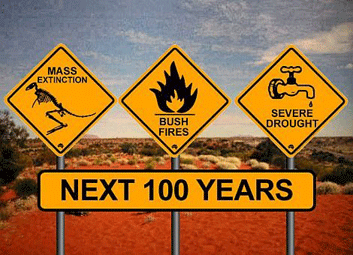 Australia drying caused by greenhouse gases and ozone depletion http://phys.org/news/2014-07-australia-greenhouse-gases-ozone.html#j Cp NOAA scientists have developed a new high-resolution climate model that shows southwestern Australia’s long-term decline in fall and winter rainfall is caused by increases in manmade greenhouse gas emissions and ozone depletion, according to research published today in Nature Geoscience. “This new high-resolution climate model is able to simulate regional-scale precipitation with considerably improved accuracy compared to previous generation models,” said Tom Delworth, a research scientist at NOAA’s Geophysical Fluid Dynamics Laboratory in Princeton, N.J., who helped develop the new model and is co-author of the paper. “This model is a major step forward in our effort to improve the prediction of regional climate change, particularly involving water resources.”
NOAA researchers conducted several climate simulations using this global climate model to study long-term changes in rainfall in various regions across the globe. One of the most striking signals of change emerged over Australia, where a long-term decline in fall and winter rainfall has been observed over parts of southern Australia. Simulating natural and manmade climate drivers, scientists showed that the decline in rainfall is primarily a response to manmade increases in greenhouse gases as well as a thinning of the ozone caused by manmade aerosol emissions. Several natural causes were tested with the model, including volcano eruptions and changes in the sun’s radiation. But none of these natural climate drivers reproduced the long-term observed drying, indicating this trend is due to human activity.
Southern Australia’s decline in rainfall began around 1970 and has increased over the last four decades. The model projects a continued decline in winter rainfall throughout the rest of the 21st century, with significant implications for regional water resources. The drying is most severe over southwest Australia where the model forecasts a 40 percent decline in average rainfall by the late 21st century.
“Predicting potential future changes in water resources, including drought, are an immense societal challenge,” said Delworth. “This new climate model will help us more accurately and quickly provide resource planners with environmental intelligence at the regional level. The study of Australian drought helps to validate this new model, and thus builds confidence in this model for ongoing studies of North American drought.”
Doubts on whether ERA’s Ranger 3 uranium mine can go ahead
Technical hitches bedevil ERA’s Ranger mine by: Matt Chambers The Australian July 12, 2014 http://www.theaustralian.com.au/business/mining-energy/technical-hitches-bedevil-eras-ranger-mine/story-e6frg9df-1226986174550 URANIUM producer Energy Resources of Australia could face more problems at its Ranger uranium mine in Kakadu National Park, flagging potential higher costs that Credit Suisse says could stop a planned underground expansion.

The Darwin-based Rio Tinto subsidiary said its Ranger 3 Deeps exploration decline project was experiencing tougher than expected geotechnical conditions. “Some geotechnical conditions have been encountered that are less favourable than assumed,” ERA said in its June quarter report, released on Thursday.
“These findings are being factored in to the mine design and the pre-feasibility study.”
While the market was little moved by the report on Thursday, Credit Suisse analyst Matthew Hope saw red flags.“We believe the results of the Deeps resource drilling are poor,” Mr Hope said yesterday in a note to clients.“The rock is probably heavily fractured, so extensive rock bolting and meshing will likely be required to prevent the access drives from collapsing,” Mr Hope said.
Credit Suisse downgraded its rating on ERA from outperform to underperform, and cut its target price by two-thirds from $1.50 to just 50c.
Mr Hope said value in ERA was almost entirely based on whether Ranger 3 Deeps would be mined. “If ERA announces at the end of this year that Ranger Deeps is not viable, then the share price should collapse to very low levels, with only option value remaining,” he said.
“Ranger Deeps either adds value or there is close to none, and risks are increasing towards the latter.”Ranger shares slipped 0.5c to $1.16 yesterday, giving the company a market value of $600m.
Conflict of interest: Abbott’s Aboriginal man Warren Mundine and the Martu people’s missing $millions

For Mundine, today’s revelations raise questions about his business judgment – and specifically about his company’s role in the Reward Minerals deal. How could anyone believe that the Martu people were being properly represented by the Western Desert corporation during negotiations when one of its top executives had an undisclosed interest in a predetermined outcome?
The sorry tale of Lake Disappointment, the missing mining millions and Warren Mundine, SMH. July 10, 2014 Richard Baker and Nick McKenzie “……once again, he [Darren Farmer] was doing what he had been told not to do. This time he was asking questions. He strode towards Biljabu, who was deputy chairman of the [Western Desert] Corporation. Where, he demanded to know, was the paperwork? And why couldn’t he or the others see it?
The paperwork in question outlined details of the deals Western Desert had struck with mining companies to allow them to dig on the 136,000 square kilometres of resource-rich Pilbara that are the Martu’s traditional lands.
These deals had brought about $50million into the corporation, a non-profit prescribed body corporate that is meant to use the money to benefit all Martu. But little of the money had gone into improving Martu townships.
Farmer kept on with his questions. Why had the Western Desert corporation spent $7million in four years on its handful of employees and paid directors more than $1million? How had well-connected corporate advisers pocketed millions, while much of the Martu mob lived in poverty? Why had the views of senior elders on mining proposals been ignored? Everyone at the meeting that day could tell it was not going to end well.
There are conflicting accounts of what happened next……….
Heated debate – and sometimes violence – is nothing new at indigenous land-council meetings across Australia. These are the forums where the future clashes with the past; where members of some of Australia’s most impoverished communities weigh up the riches that mining can deliver against the cultural cost of digging up their sacred sites.
But what was different about that meeting last July was that the deals at the centre of all the trouble had been brokered by companies owned by the biggest names in Australia’s indigenous community, including the nation’s most influential Aboriginal, Warren Mundine.
The accountant Dalgleish, true to stereotype, was a stickler for detail and decided to dig further into Wolf and Wright’s activities. He found that in mid 2008 they had separately bought more than $1million worth of Perth property. This was close to the time Wright joined WDLAC and the Rio Tinto $21million deal was done.
Although he had no proof that the property purchases involved money from Rio Tinto, Dalgleish was intrigued by the confluence of events and brought them to the attention of WDLAC’s board. On May 7, 2009, Dalgleish wrote a confidential memo to WDLAC’s chairman in which he wondered how Wolf could have approved such an “outrageously excessive fee” as the $2.35million paid to Procter.
A day later, Wright paid out Dalgleish’s contract and asked him to leave. He was able to do this because he had become the corporation’s acting chief executive following Wolf’s departure, a promotion that had bumped his salary to $250,000.
Three days after his departure, Dalgleish reported his concerns to the WA police fraud squad, which in turn contacted Western Desert corporation. According to the police file, detectives were assured by Western Desert in September 2009 that Procter no longer acted for the corporation, and that an “independent third party” would examine the issues and provide recommendations.
A WA police spokeswoman says police never received a copy of any third-party review.
‘‘The matter is currently filed pending further contact from WDLAC as the complainant,’’ she says.
Procter is bewildered as to why anyone would seek police attention over the Rio deal. His company, he says, acted with integrity and its role was supported by the Martu people, who were $20million richer because of IndiEnergy’s involvement.
Dalgleish also contacted the federal regulator, the Office of the Registrar of Indigenous Corporations, which is meant to ensure good governance and financial probity at the more than 2500 indigenous bodies across Australia. ORIC also decided not to investigate.
Meanwhile, in early 2009, the Australian Uranium Association – the peak body for uranium miners – announced the members of its indigenous dialogue group. Wolf and Mundine were among those named to promote the potential for uranium mining to enrich indigenous communities.
At the same time, Procter was busy expanding the reach of his company, IndiEnergy. He began appointing ‘‘special advisers’’ from the mining, legal and financial worlds. By far his most important appointment was that of Mundine as a special adviser and advisory board member.
The two had known each other since 2004 when the Howard government appointed them as members of the body that replaced ATSIC.
By the time Abbott announced Mundine as head of his Indigenous Advisory Council in September 2013, he was a close business associate of both Wolf and Procter.
Australia may be a big country, but the indigenous business and politics scene is small and replete with overlapping interests. It was only a matter of time before one of Mundine’s business relationships would clash with his quasi-ministerial role.
Mundine’s potential for a conflict of interest became a reality in February when Procter announced IndiEnergy had taken a stake in an indigenous company whose co-owner, Larrakia Development Corporation, is actively seeking Commonwealth support.
Procter highlighted Mundine in the February announcement of his new venture, praising him and Abbott for promoting indigenous business opportunities. ‘‘Skin in the game is the only way indigenous organisations can attract the right people to assist them in reaching their commercial dreams,’’ Procter said.
But having skin in the game means you risk losing some. And this is the risk that emerged for Mundine when a company he part-owned became involved in the Western Desert corporation’s most contentious mining deal…………
For Mundine, today’s revelations raise questions about his business judgment – and specifically about his company’s role in the Reward Minerals deal. How could anyone believe that the Martu people were being properly represented by the Western Desert corporation during negotiations when one of its top executives had an undisclosed interest in a predetermined outcome?……………
In December 2011, Reward announced it would pay the Western Desert corporation $500,000 upon the signing of an agreement. Another $500,000 would come when mining began and there would also be royalties of 1.25per cent on potash sales. This money was meant to be held in trust for all Martu.
But the biggest prize was Reward’s issuing of 9.5million share options to the Western Desert corporation and Poynton’s Azure Capital, which was in effect the parent company of Indigenous Investment Management. The value of the options at the time was almost $10 million. The Martu will get millions more options as the project progresses.
With money now in the bank, the Western Desert corporation went on a spending spree. Despite its own rules banning the handing out of funds without the approval of all members, the board decided on February 16, 2012, to use the first $500,000 from Reward and $100,000 from the corporation’s operating budget to pay 30 select elders $20,000 each.
Five board members, including Biljabu’s brother, received $20,000 each. Another recipient had just finished his term as a director, and the parents of three board members were also paid. Wolf says ensuring money is properly handled is easier said than done. ‘‘Some Martu live on $9000 a year and so when money hits the account you say ‘that should go to education or something’ but it’s hard when you live in poverty.’’
Still, Farmer says many Martu people are bewildered by their board’s capitulation over Lake Disappointment. ‘‘Why did we fight so hard, only to let it go?’’
So where has the federal regulator been in all this? ORIC has long been aware of governance issues at Western Desert corporation. In 2010, it found the Western Desert corporation had failed to keep proper records, paid money to the board’s chair and deputy in breach of its rules and provided cars to directors – including Biljabu – without member approval. But no disciplinary action was taken against individuals responsible.
Farmer’s fight for answers has taken a toll. ‘‘I’ve been isolated, lost sleep, become ill and [been] made out to be the troublemaker who is stopping people getting their money,’’ he says.
Meanwhile, he says, the Martu communities have not benefited as much as they should have from the mining deals. ‘‘Go out into the communities and there is f— all to show for all the millions.’’………: http://www.smh.com.au/national/the-sorry-tale-of-lake-disappointment-the-missing-mining-millions-and-warren-mundine-20140711-zt2b8.html#ixzz37Iu9KYXJ
Former Liberal leader supports Renewable Energy Target
Liberal veteran Hewson backs Renewable Energy Target, Sunshine Coast Daily Daniel Burdon | 11th Jul 2014 A FORMER Liberal Party leader has urged the Abbott government not just to retain the renewable energy target, but increase it to ensure carbon emissions can be curbed.
 But Dr Hewson said the RET, likely the only specific target for reducing Australia’s emissions left once the carbon tax is removed, is doing the job. He said while the RET and other climate change policies could help to reduce emissions, in less than a week, Australia could be without any overarching policy on climate change………http://www.sunshinecoastdaily.com.au/news/former-liberal-party-john-hewson-renewable/2315456/
Tony Abbott’s Aboriginal Adviser Warren Mundine, involved in murky mining deal

 Questions over Warren Mundine’s involvement in mining deal http://www.afr.com/p/national/questions_over_warren_mundine_involvement_DJUrsCD9hl6GHsajefKFoI RICHARD BAKER AND NICK MCKENZIE 12 July 14 A company part owned by Warren Mundine, the federal government’s chief indigenous adviser, helped broker a contentious deal that gave a mining company access to an Aboriginal sacred site in outback Western Australia.
The revelation raises questions about Mr Mundine’s past business relationships and comes as he seeks to drive reforms to ensure good governance in Aboriginal corporations through his role as head of Prime Minister Tony Abbott’s Indigenous Advisory Council.
Documents show Indigenous Investment Management, which was part owned by Mr Mundine at the time, was hired in 2010-11 by Reward Minerals. Continue reading
Radioactive racism, the war to dump nuclear waste on Aboriglnal land in Australia

legal rights and protections are repeatedly stripped away whenever they get in the way of nuclear or mining interests. Thus the Olympic Dam mine is largely exempt from the SA Aboriginal Heritage Act. Sub-section 40(6) of the Commonwealth’s Aboriginal Land Rights Act exempts the Ranger uranium mine in the NT from the Act and thus removed the right of veto that Mirarr Traditional Owners would otherwise have enjoyed. NSW legislationexempts uranium mines from provisions of the NSW Aboriginal Land Rights Act. Native Title rights were extinguished with the stroke of a pen to seize land for a radioactive waste dump in SA, and Aboriginal heritage laws and land rights were repeatedly overridden with the push to dump nuclear waste in the NT
The bipartisan nuclear war against Aboriginal people, Dr Jim Green, Online opinion 11 July 14 The nuclear industry has been responsible for some of the crudest racism in Australia’s history. This radioactive racism dates from the British bomb tests in the 1950s and it has been evident in more recent debates over nuclear waste.
 Since 2006 successive federal governments have been attempting to establish a nuclear waste dump at Muckaty, 110 kms north of Tennant Creek in the Northern Territory. A toxic trade-off of basic services for a radioactive waste dump has been part of this story from the start. The nomination of the Muckaty site was made with the promise of $12 million compensation package comprising roads, houses and scholarships. Muckaty Traditional Owner Kylie Sambo objected to this radioactive ransom: “I think that is a very, very stupid idea for us to sell our land to get better education and scholarships. As an Australian we should be already entitled to that.”
While a small group of Traditional Owners supported the dump, a large majority were opposed and some initiated legal action in the Federal Court challenging the nomination of the Muckaty site by the federal government and the Northern Land Council (NLC). Continue reading
Jeff McMullen on Aboriginal policy run in the interests of mining companies
Jeff McMullen: Neoliberalism, market fundamentalism and the colonization of Aboriginal policy The Stringer, by Colin Penter March 14th, 2014 “Neo-liberalism is a hungry beast and this 21st Century strain of capitalism is shaping the agenda for control of Aboriginal lands………..Australian Government policy is heavily influenced by neo-liberalism through its extraordinary emphasis on managing access for mining companies to resources on Aboriginal lands. This involves controlling what is still perceived as ‘the Aboriginal problem’ and forcing a social transition from traditional values and cultural practice to ‘mainstream’ modernism of a particular brand. It also involves displacing many Aboriginal people from their traditional lands and concentrating them in ‘growth towns…….To make any sense of the aggression behind most current Indigenous policy in Australia you need to study the impact of neo-liberalism around the globe” Jeff McMullen……..
Analyzing Aboriginal policy through the lens of neoliberalism as McMullen does, helps us to understand what drives social policies such as the Northern Territory Intervention and the social engineering to control Aboriginal people still living on traditional lands, as well as the aggressive land grab by mining and resource companies, aided and abetted by Federal and State Governments, which divides Aboriginal communities, and even Aboriginal families. He writes:
‘Neoliberalism connects the agendas of modernising Aboriginal culture and allowing mining companies to vigorously exploit and minimal cost the mineral treasures on Aboriginal lands’.
McMullen points to the divide and conquer tactics of mining companies and governments in the Kimberley and Pilbara in Western Australia, across the Northern Territory, on Cape York and in parts of NSW and South Australia, as manifestation of these neoliberal agendas.
McMullen is scathing about the role played by influential Aboriginal leaders, such as Noel Pearson, Marcia Langton and Warren Mundine who have become influential advocates and brokers for neoliberal policies and have gathered adherents and supporters in both political parties and corporate Australia.http://thestringer.com.au/jeff-mcmullen-neoliberalism-market-fundamentalism-and-the-colonization-of-aboriginal-policy/#.U8H2JZRdUnk
1 This month
17 October, Free Public Talk on Nuclear Issues in South Australia
David Noonan will speak on public interest concerns over the new Roxby Downs Indenture Act 2026 on BHP copper-uranium mining and ore processing in SA, and on how AUKUS may face SA with a High-Level nuclear waste agenda.
Dr Jim Green will discuss international developments in the field of nuclear power including ‘small modular reactors’ and Generation 4 ‘advanced’ nuclear reactor concepts.


Help Aunty Sue Protect Her Land and Sacred Sites From Destructive Rocket Testing.
.

Australians deserve the truth
about
AUKUS – https://aukuspublicinquiry.com/

PETITION – To: Prime Minister Anthony Albanese and the Australian Labor Government

of the week – Australians for War Powers Reform (AWPR)
To see nuclear-related stories in greater depth and intensity

