Why nuclear energy won’t work in Australia
Scott Ludlam, https://www.thesaturdaypaper.com.au/opinion/topic/2022/06/18/why-nuclear-energy-wont-work-australia#mtr Scott Ludlam is a writer and activist, and a former Greens senator. 18 June 22, There is something almost comical about the Liberals and Nationals throwing the forlorn spectre of nuclear power back into national energy debates, right after their loss in the 2022 “climate election”.
The incoming Energy minister, Chris Bowen, immediately slapped down the idea, calling it a “complete joke” and noting that nuclear is the most expensive form of energy. He’s right, and that should be the end of the argument, but we know it won’t be, because Peter Dutton and his colleagues are not engaged in a good faith debate about Australia’s future energy mix. For them, this is about something else entirely.
Not everyone who invites discussion on nuclear power acts in bad faith. In a climate emergency, it’s essential to have all viable, low-carbon energy sources on the table, which does entail a periodic assessment of where the nuclear industry actually stands. Has any progress been made on the intractable question of nuclear waste? How permeable is the barrier between civil and military applications? How are safety concerns over the world’s ageing reactor fleet being managed? How is the industry planning to clean up the enormous volumes of radioactive wastes left behind at uranium mines?
Can this technology compete against low-cost renewables?

It’s tempting to imagine the nuclear industry stumbling around like the Black Knight in Monty Python and the Holy Grail, bleeding freely, mortally wounded and yet stubbornly defiant and refusing to die.
The best independent analysis of the state of the industry is provided by the World Nuclear Industry Status Report. Since 2007, these reports have provided an annual, country-by-country snapshot of nuclear plant construction, start-ups, accidents and closures.
They make for forbidding reading, painting a picture of an industry in deep trouble. The number of reactors in operation has declined by two dozen since 2002, as the share of global electricity generation provided by nuclear power fell from about 17 per cent in 1996 to just above 10 per cent in 2020. Part of the problem is that the age of the industry is catching up with it. In the two decades to 2020, there were 95 new nuclear plant start-ups and 98 closures. As plants built in the 1970s and ’80s reach the end of their design life, and construction dries up nearly everywhere other than China, there is no real prospect of them being replaced at anything like the rate of closure. This decline is structural and inexorable.
There is an additional wildcard, which the industry refuses to acknowledge: the risk of future catastrophic reactor accidents. The industry insists it has learnt the lessons of Three Mile Island, Chernobyl and Fukushima, and it is true that plant redesigns and additional safety systems are a major factor driving up the costs of new reactors. But despite this, any accident, disaster or attack that shuts down the cooling system inside a nuclear power plant runs the risk of a meltdown. One study from 2017 analysed the frequency and intensity of 216 nuclear accidents between 1950 and 2014, estimating that “there is presently a 50 per cent chance that a Fukushima event (or larger) occurs every 60-150 years, and a Three Mile Island event (or larger) occurs every 10-20 years”.
These are shocking odds, both for host communities and for energy planners trying to manage the transition to zero-carbon electricity supply. People organising against nuclear power stations, waste dumps and uranium mines are commonly accused of being emotional, hysterical or delusional, when in fact these actions are usually informed by a willingness to look honestly at the difficult truths of this industry.
Someone who has seen those truths close up is Naoto Kan, who was prime minister of Japan at the time of the Fukushima disaster in 2011. In his introduction to the 2021 World Nuclear Industry Status Report, he writes: “The reactors in Units 1 to 3 suffered not only meltdowns, but also melt-through of the nuclear fuel, while the spent fuel pool at Unit 4 came close to evaporating entirely. Had this come to pass, it would have necessitated the evacuation of all residents within a radius of 250 kilometres – an area including the metropolis of Tokyo, the consequences of which would have been unimaginable.”
On the awful day we learn the name of the next Fukushima, whether it be in France, China, the United States or Russia, neither the industry nor its investors will be able to say they weren’t warned.
Surprisingly, it turns out these arguments are now accepted by a growing number of pro-nuclear advocates. Many of them tacitly or openly acknowledge that the technology they’ve been promoting for decades has no future. They have ceased arguing for the giant, water-cooled fission reactors that have been the backbone of the commercial nuclear energy sector since the 1960s.

Instead, they now advocate for a bewildering variety of experimental reactor types, fuelled by uranium or thorium or plutonium, cooled with helium or molten salt or liquid metal. These designs are proclaimed to be simultaneously cheap, safe and efficient, free of proliferation, waste and accident risks, and ready for commercial deployment any decade now.
What unifies many of them is not so much the technology type, but the smaller scale and the fact that they don’t really exist.
A pilot plant of one such small modular reactor (SMR) went into operation at Shidao Bay in China late in 2021, but outside the Chinese nuclear establishment, nobody knows how much it cost to build. According to the World Nuclear Industry Status Report, “There appear to be no plans to construct more reactors of the same design.” These plants are not an answer to climate change. Even the most ambitious estimates for commercial deployment of SMRs stretch into the 2030s and 2040s, long after the heavy lifting of global decarbonisation needs to have been done. Allison Macfarlane, the former chair of the US Nuclear Regulatory Commission, stated in 2021: “When it comes to averting the imminent effects of climate change, even the cutting edge of nuclear technology will prove to be too little, too late.”
This is where what Peter Dutton and his colleagues are really up to comes into sharper focus.
The speed and scale of low-cost solar and wind energy backed up by batteries and hydro power has hit critical mass worldwide. According to the International Renewable Energy Agency, 2015 was the first year that more renewable energy capacity was added to the grid than non-renewable, including fossil and nuclear. By 2021, clean energy technologies accounted for 81 per cent of new generation capacity globally. Closer to home, the signs are everywhere, from the early closure of AGL’s coal-fired power stations to the announcement of huge new renewable energy zones across multiple Australian states.
Into this fast-closing gap, the nuclear industry is making its final pitch before obsolescence: enormous public subsidies in exchange for an imaginary generation of small, cheap, safe reactors that exist nowhere but on paper. Complicating the message for those who still insist that there is no connection between nuclear weapons and nuclear power, the Morrison government’s reckless entry into the AUKUS agreement threatens to enmesh Australia in the trafficking and disposal of high-level spent nuclear fuel from submarine reactors, with all the public health, national security and proliferation risks this entails.
Importing this staggering debacle into Australian energy markets would be much more than just financially irresponsible: it would lock us into a high-risk dead end just as the clean energy revolution is finally under way at scale. But unlike the Black Knight, nuclear technology still retains the capacity to do enormous harm, even in its present enfeebled state. The UN Secretary-General’s special adviser on climate change, Selwin Hart, put it like this in a statement last year: “Where countries are depending on technologies that have not yet been developed, or indicating they intend to cut in the 2030 and 2040s, quite frankly, that’s reckless and irresponsible.”
The foundation of the global anti-nuclear movement has always been in the frontline communities that have suffered the harshest impacts of this technology. Whether it be the First Nations communities in Central and Western Australia, whose lands and health were sacrificed for nuclear weapons testing decades ago, or those who won an end to uranium mining in Kakadu or nuclear waste dumping in Central and South Australia: these debates are won and lost on Country, not in op-ed pages or analysts’ spreadsheets. So, while a combination of lived experience, mockery and hard data may be enough to put Dutton and his colleagues’ latest deranged foray to rest for the time being, the “debate” over nuclear power seems likely to hang around until the solar age puts it to the sword once and for all.
Julian Assange and family suffer as unjust detention continues.
Independent Australia By Binoy Kampmark | 16 June 2022,
The documentary Ithaka powerfully depicts the fight Julian Assange’s family is putting up for him, writes Dr Binoy Kampmark.
JOHN Shipton, despite his size, glides with insect-like grace across surfaces. He moves with a hovering sense, a holy man with message and meaning. As Julian Assange’s father, he has found himself a bearer of messages and meaning, attempting to convince those in power that good sense and justice should prevail over brute stupidity and callousness.
His one object: release Julian………………………..
The documentary Ithaka powerfully depicts the fight Julian Assange’s family is putting up for him, writes Dr Binoy Kampmark.
JOHN Shipton, despite his size, glides with insect-like grace across surfaces. He moves with a hovering sense, a holy man with message and meaning. As Julian Assange’s father, he has found himself a bearer of messages and meaning, attempting to convince those in power that good sense and justice should prevail over brute stupidity and callousness.
His one object: release Julian…………………..
The documentary Ithaka powerfully depicts the fight Julian Assange’s family is putting up for him, writes Dr Binoy Kampmark.
JOHN Shipton, despite his size, glides with insect-like grace across surfaces. He moves with a hovering sense, a holy man with message and meaning. As Julian Assange’s father, he has found himself a bearer of messages and meaning, attempting to convince those in power that good sense and justice should prevail over brute stupidity and callousness.
His one object: release Julian……………………………….
Soft, a voice of reed and bird song, Shipton urged activists and citizens to join the fray, to save his son, to battle for a cause imperishably golden and pure. From this summit, power would be held accountable, institutions would function with sublime transparency, and citizens could be assured that their privacy would be protected.
In the documentary Ithaka, directed by Ben Lawrence, we see Shipton, Assange’s partner, Stella Moris, the two children, the cat and glimpses of brother Gabriel, all pointing to the common cause that rises to the summit of purpose. The central figure, who only ever manifests in spectral form – on-screen via phone or fleeting footage – is one of moral reminder, the purpose that supplies blood for all these figures.
Assange is being held at Belmarsh, Britain’s most secure and infamous of prisons, denied bail and being crushed by judicial procedure. But in these supporters, he has some vestigial reminders of a life outside.
The film’s promotion site describes the subject as ‘the world’s most famous political prisoner, WikiLeaks founder Julian Assange’ a figure who has ‘become an emblem of an international arm wrestle over freedom of journalism, government corruption and unpunished war crimes’. ………..
suffer he shall, if the UK Home Secretary Priti Patel decides to agree to the wishes of the U.S. Department of Justice (DOJ).
The DOJ insists that their man face 17 charges framed, disgracefully and archaically, from a U.S. law passed during World War I and inimical to free press protections. The Espionage Act of 1917 has become the crutch and support for prosecutors who see, in Assange, less a journalist than an opportunistic hacker who outed informants and betrayed confidences. ……………………..
Through the film, the exhausting sense of media, that estate ever-present but not always listening, comes through. This point is significant enough; the media – at least in terms of the traditional fourth estate – put huge stock in the release of material from WikiLeaks in 2010, hailing the effort and praising the man behind it.
But relations soured, and tabloid nastiness set in. The Left found tell-all information and tales of Hillary Clinton too much to handle while the Right, having initially revelled in the revelations of WikiLeaks in 2016, took to demonising the herald. Perversely, in the United States, accord was reached across a good number of political denizens: Assange had to go, and to go, he had to be prosecuted in the United Kingdom and extradited to the United States.
The documentary covers the usual highlights without overly pressing the viewer. A decent run-up is given to the Ecuadorian stint lasting seven years, with Assange’s bundling out, and the Old Bailey proceedings covering extradition. But Shipton and Moris are the ones who provide the balancing acts in this mission to aid the man they both love……….
The film has faced, as with its subject, the usual problems of distribution and discussion. When Assange is mentioned, the dull-minded exit for fear of reputation, and the hysterical pronounce and pounce.
In Gabriel Shipton’s words:
“All of the negative propaganda and character assassination is so pervasive that many people in the sector and the traditional distribution outlets don’t want to be seen as engaging in advocacy for Julian.”
Where Assange goes, the power monopolies recoil. Distribution and the review of a documentary such as Ithaka is bound to face problems in the face of such a compromised, potted media terrain. Assange is a reminder of the plague in the patient of democracy, a pox on the body politic. ……….. https://independentaustralia.net/life/life-display/julian-assange-and-family-suffer-as-unjust-detention-continues,16470#.YqqqxM6TP0M.twitter
Earthworks approved for nuclear waste dump despite opposition from traditional owners, court hears

Barngarla traditional owners vie to overturn federal government’s decision to develop site near Kimba in South Australia
Australian Associated Press, Wed 15 Jun 2022
Traditional owners attempting to block the construction of a nuclear waste dump in South Australia have told a court the federal government has already approved plans to begin earthworks, despite an active legal challenge.
The Barngarla Determination Aboriginal Corporation applied for a judicial review of the project in December, and a directions hearing was held in the federal court in Adelaide on Wednesday.
Legal argument will be heard in July ahead of a substantive hearing, most likely before the end of this year. The court was told that there were plans to begin earthworks at the Napandee site, near Kimba on SA’s Eyre Peninsula, before September…….
Justice Natalie Charlesworth asked that sufficient notice be provided to allow time for the court to hear applications to halt the works. Charlesworth said such notice would avoid the need for an urgent hearing.
“What I would like to avoid is what I might call a pyjama hearing where it’s called at midnight and we all come in here in our pyjamas and we have an unnecessarily urgent argument,” she said.
The Barngarla are seeking to overturn the Coalition government’s decision to develop the site by quashing the declaration of former resources minister Keith Pitt.
The corporation also wrote to the prime minister, Anthony Albanese, and the resources minister, Madeleine King, a week after the federal election, urging them to scrap plans for the dump.
It said the previous federal government had tried to silence the traditional owners at every turn, denying their right to participate in a community ballot to gauge local support for the site.
The corporation said the Coalition also refused access to the land to undertake a proper heritage survey and tried to remove its right to judicial review.
“Although we appreciate all that Labor have done in opposition, the Barngarla people unequivocally make it clear that we request that the new Labor minister revoke the declaration or consent to the orders quashing the declaration,” it wrote in its letter to Albanese.
The Labor government has given no indication that it would take a different view on the matter than the previous administration. https://www.theguardian.com/australia-news/2022/jun/15/earthworks-approved-for-nuclear-waste-dump-despite-opposition-from-traditional-owners-court-hears
Nuclear Waste Dispute in Court Wednesday 15 June
Kimba Radioactive Waste Facility Judicial Review in Federal Court. Wednesday 15 June 2022:
initial directions hearing and hearing on discovery
Barngarla Determination Aboriginal Corporation RNTBC ICN 8603
• The first directions hearing will occur in the Federal Court of Australia this Wednesday at
9:00am in Adelaide, with some solicitors and counsel attending by MS Teams.
• The directions hearing will start off the long process of judicial review on the facility.
• An immediate issue is that the former Minister Pitt would not provide the Barngarla
documents Barngarla needed for the judicial review. It is not clear what the new Labor
Minister’s position is now that they have won Government.
• The dispute on discovery includes records of all of the commitments Minister Pitt and
Minister Canavan made that a facility would not be placed on an unwilling community.
Minister Pitt abandoned this requirement in his reasons when he made the declaration to
select Napandee.
The Government is refusing to provide these records and the matter may now need to be
argued as a contested discovery application.
• Any dispute on discovery is likely to take several months.
• Barngarla, Indigenous leaders around Australia, and the environmental movement have all
called for the declaration to be withdrawn now that Labor has won Government.
Barngarla spokesperson quote:
“There were serious failings when the National Party selected Napandee, too many to outline of the area, trying to legislate away judicial review, breaching UNDRIP and abandoning the test ofbroad community support at the last minute without any warning to anyone. The former Ministerwouldn’t provide us the material we need to run our case. Leaving aside these tricks and theseefforts to exhaust us, we remain confident that we will win this if we have to go to Court. However,because of the terrible mishandling by the National Party, we again call upon the new Labor Ministerto quash the declaration. We do not want to spend the next two years in Court against the LaborGovernment. They know what the National Party did and they should do the right thing andwithdraw the declaration.”
For further comment, please contact: barngarlamedia@gmail.comhere.They included, denying the First Peoples the right to vote, not conducting a proper heritage survey
Julian Assange’s wife Stella Moris reveals how they raise children together while he is in jail waiting an extradition decision
In court, Julian has not been permitted to sit with his lawyers. And despite many applications since January 21, he has not been allowed to attend his own court hearings in person. https://www.abc.net.au/news/2022-06-08/stella-moris-my-life-with-julian-assange-extradition/101132624, My Australian husband Julian Assange is fighting for his life from within the confines of a three-by-two-metre cell in Britain’s harshest prison, Belmarsh.
The US has accused him of espionage as a result of his work with WikiLeaks in 2010-2011 and wants to extradite him to face court.
If his extradition goes ahead, Julian faces a maximum 175-year prison sentence. As his wife, I fear he will be buried in the deepest, darkest corner of the US prison system until he dies.
During another extradition hearing last year a UK magistrate blocked Julian’s transfer to the US over fears of “oppressive” conditions that could drive him to take his life.
On July 3, Julian turns 51. It will be the fourth year he has spent his birthday alone in a cell, without conviction.
Is our time together running out?
When Julian is taken from his cell to the prison yard he tilts his head up so his eyes can focus on the distance. If he narrows his eyes, the double razor wire above becomes a blur. Beyond is the open sky.
Julian recently discovered a family of nesting magpies. He spotted their home subversively nestled between the razor wire. I think our family is like those magpies.
When we are together, we are always a few metres from their nest. Our children — Gabriel, who is five, and Max, three — only have memories of their father within the brutal surroundings of Belmarsh prison.
We don’t know how long our children have left with their father. We don’t know if we can visit him or even talk to him on the phone. If the extradition goes ahead, US authorities retain the right to put Julian in conditions so cruel that no one in his position is likely to survive.
It is impossible for Julian and me to escape a feeling that he is on death row. Our weekly visits may be the only time we have left together. But for how much longer? A few months more, a few weeks, a few days and then only a few hours? I fear in the end we will count the minutes and the seconds.
Guards search inside my children’s mouths
Were it not for our children, this approaching catastrophe would be all-consuming. But Julian and I know these may be the only memories that our children will have of their father. We make our visits as joyous as possible.
I don’t need to explain to Gabriel and Max the reality of this place where we go to visit their father. They live it. The children walk under razor wire and past layers and layers of security to reach their daddy.
Guards search inside their mouths, behind their ears and under their feet. The prison dogs sniff them head to toe, front and back.
Last week, Gabriel slipped some daisies he had picked by the prison walls into his pocket to give to his father. After he passed through the metal detector his daisies were confiscated during the pat-down search by one of the guards, albeit reluctantly.
During visits, our family is allowed to embrace at the beginning and end. We can hold each others’ hands across the table. Julian and I are not allowed to kiss. But Julian would rather kiss his wife and be penalised than have that taken away from him too. So, we kiss.
Precious moments for life lessons
The children love visiting their daddy. Julian reads them stories. Gabriel shares his father’s fascination with numbers. Julian teaches them nifty tricks: the best way to peel an orange, how to open chips without losing any of the contents.
These things may sound small to most people, but they are our precious moments together. A canteen selling chips and oranges and the prison’s collection of children’s books are all that is on offer in the visitor’s hall we share with 30-or-so prisoners and their families once or twice a week.
On March 23, we were married in Belmarsh. The prison – normally filled with tragedy and isolation – was turned on its head for a few hours to celebrate our love and commitment. Our nest in the razor wire.
The last time the media photographed Julian was in 2019, through the scratched windows of a prison van. The UK Authorities insist that our wedding photos not be made public ‘on security grounds’. In court, Julian has not been permitted to sit with his lawyers. And despite many applications since January 21, he has not been allowed to attend his own court hearings in person.
Australia’s Energy Minister rejects nuclear power push
Hawkesbury Gazette By Paul Osborne and Dominic Giannini June 9 2022
Energy Minister Chris Bowen has attacked the Nationals for suggesting nuclear power be considered in Australia’s energy mix, saying the party had no credibility after nine years in government.
Mr Bowen says nuclear would be the most expensive form of energy when Australians are already facing rising costs and inflationary pressures.
“Seriously? Nine years in office and then coming up with bright ideas on the other side of the election is point one. No credibility,” he said on Thursday.
“Nuclear is the most expensive form of energy. We have a cost of living crisis, energy prices going through the roof and what’s their big bright idea? Let’s have the most expensive form of energy we can possibly think of.”
………………….. Labor has rejected the technology as too expensive and not a serious solution to reducing power costs or cutting emissions. https://www.hawkesburygazette.com.au/story/7773300/energy-minister-rejects-nuclear-power-push/
Disgraced Victorian Liberal MP Tim Smith – quitting politics – backs Dutton’s call for nuclear power
Smith backs Dutton’s nuclear push as colleagues dodge debate, By Annika Smethurst, The Age June 12, 2022 Victorian Coalition leaders won’t endorse calls from their federal counterparts to consider nuclear energy generation, despite the plan having the support of several state MPs.
Following the federal election loss, newly installed Liberal leader Peter Dutton and Nationals leader David Littleproud have both hinted that nuclear energy could be part of the Coalition’s future policy platform…………….
While nuclear power has some support among Victorian Coalition MPs, the state opposition has attempted to distance itself from the federal push, repeatedly refusing to endorse or reject nuclear energy when approached by The Age.
In response to individual questions on the policy, Opposition Leader Matthew Guy, Victorian Nationals’ leader Peter Walsh and shadow minister for energy and renewables Craig Ondarchie issued a joint statement claiming nuclear energy in Australia is regulated by the Commonwealth, and therefore not a state issue.
“As such any move would need to be taken at a federal level,” the Coalition spokesman said.
The statement was slammed by outgoing Liberal MP and former shadow attorney-general Tim Smith, who said: “Any serious opposition or government must at the very least put nuclear energy on the table.”
There is currently a federal ban prohibiting the use of nuclear materials for energy production, while Victorian legislation prohibits uranium and thorium mining and exploration………………………..
Another backbencher told The Age there should be an open conversation about the use of nuclear technologies given soaring energy costs.
Smith, who is quitting politics in November after crashing his car while drink-driving last year, agreed, saying the federal debate was both “timely and welcome” given the state’s baseload energy requirements…………………… https://www.theage.com.au/national/victoria/smith-backs-dutton-s-nuclear-push-as-colleagues-dodge-debate-20220612-p5at31.html
Another episode in the unlawful spying and harassment of Julian Assange and his legal team, by the UK and USA governments
Julian Assange’s Australian lawyer who counts Amal Clooney and Amber Heard as friends says she has reached settlement with government ‘over breach of her human rights after it admitted she was likely put under covert surveillance’
- Jennifer Robinson has reached settlement with Government over surveillance
- She said it accepted covert surveillance of her ‘likely breached her human rights’
- She was one of the three lead claimants in a complaint against the Government
- She said it raises ‘grave concerns’ over interference with ‘journalistic material
By JESSICA WARREN FOR MAILONLINE, DAILY MAIL, 10 June 2022
One of WikiLeaks founder Julian Assange‘s lawyers has reached a settlement with the Government after it accepted it was likely she was the subject of ‘covert surveillance which breached her human rights’, she said.
Jennifer Robinson welcomed a statement by the European Court of Human Rights which she said meant the UK Government has ‘accepted her rights were breached by surveillance’.
She was one of the three lead claimants in a complaint against the UK Government which went to the court.
Ms Robinson said the UK Government has reached a ‘friendly settlement’, admitting there was reasonable cause to believe she was the subject of surveillance.
She said: ‘The UK Government has now admitted that its surveillance and information-sharing arrangements with the US violated my rights. That includes in relation to the protection of confidential journalistic material.
‘This follows a pattern of unlawful spying on Julian Assange and his legal team, and it raises grave concerns about government interference with journalistic material and privilege.
‘It also raises serious questions about what information the UK and US governments have been sharing about Mr Assange’s case against extradition to the US.’
The development came as Mr Assange awaits a decision by Home Secretary Priti Patel on whether he should be extradited to the United States.
Ms Robinson, who works from the respected Doughty Chambers in London, has represented Assange for some 12 years.
She is the go-to barrister for the rich and famous, and counts the Hollywood elite among her inner circle, travelling to George and Amal Clooney’s wedding on a speedboat with actor Bill Murray.
In 2019, she was named international pro bono barrister of the year and prior to lockdown, was pictured at events with Prince Charles and Cherie Blair.
She has also appeared on BBC Question Time and supported Amber Heard during the Johnny Depp’s libel case against The Sun newspaper in 2020…………………. https://www.dailymail.co.uk/news/article-10901023/Julian-Assanges-lawyer-reached-settlement-government-breach-human-rights.html
Peter Dutton’s claim he planned to buy US nuclear subs is ‘political point-scoring’, defence experts say
These are sensitive negotiations and I think the great concern here is that Peter Dutton has basically worked against the national interest in an attempt for some domestic political point-scoring.”
Liberal leader is in damage control after his comments raised eyebrows, one analyst saying ‘there’s no way this is a plan’ Guardian. Paul Karp @Paul_Karp Fri 10 Jun 2022
Experts are critical of Peter Dutton’s claim he planned to buy two US nuclear submarines to plug a looming capability gap, as the Liberal leader goes into damage control over the disclosure.
Dutton has been accused of “political point-scoring” and being “unhelpful” in a campaign to pressure Labor’s Richard Marles to rule out other options to plug the gap between the retirement of Collins class submarines and Australia’s plan to build a nuclear fleet.
On Thursday Dutton, the former defence minister, revealed a plan he devised before the election to buy two Virginia-class submarines by 2030, claiming he had “formed a judgment the Americans would have facilitated exactly that”.
The comments raised eyebrows, both because Australia had not formally decided whether to opt for US or UK nuclear submarines and because experts have suggested it is unlikely the US would give up two of its own submarines by 2030.
Marles labelled the intervention “rank politics” and “completely inconsistent with everything Peter Dutton was doing and saying in government”…………….
Marcus Hellyer, a senior analyst at the Australian Strategic Policy Institute, told Guardian Australia Dutton had “put out an idea or concept”.
There’s no way this is a plan, it hasn’t been agreed by the US government, nor Australia, nobody has actually agreed to it.”
“If it were a plan it would be a pretty serious kind of breach or leak [to disclose it].”…….,
“No boats are available before 2030 unless the US gives up its own – that would be quite remarkable – the US has been clear there is no way they can build additional submarines.”
The chair of defence studies at the University of Western Australia, Dr Peter Dean, also expressed concerns about Dutton’s intervention.
“I’m sure that the UK wouldn’t be happy to learn from a newspaper article that, potentially, their submarine is not an option and I’m sure there’s plenty of people in the US Congress, the Pentagon and other parts of the US who were very interested to read these possible developments,” Dean reportedly told the ABC
These are sensitive negotiations and I think the great concern here is that Peter Dutton has basically worked against the national interest in an attempt for some domestic political point-scoring.”……………. https://www.theguardian.com/australia-news/2022/jun/10/peter-duttons-claim-he-planned-to-buy-us-nuclear-subs-political-point-scoring-defence-experts-say
Kerry Schott: why new coal or nuclear plants are a dumb idea
Mark Ludlow AFR, 7 June 22, ”…………………………………………It seems whenever there is an energy crunch or crisis, supporters of a nuclear industry say it would be the solution to Australia’s energy woes? Do you think nuclear will ever be an option in Australia?
My view of it, at the moment, is it’s a price thing. The last plant the English built cost an enormous amount of money. It’s much more expensive than coal.
It’s the cost of building the plant and dealing with the waste. Once up and running it’s not too bad, but the capital costs and the operating cost of dealing with the radioactive waste is a problem.
If you’re in the UK or France you have a population of 50 million. We don’t have that many people.
And the small-size modular plants they talk about are not being built because they are expensive.
Having gas as a standby is far cheaper. And nuclear, like coal, has to run all the time.
You still have the problem that it’s producing radioactive waste and not being dispatched.
Any other solutions to smooth out the bumps in the transition to a low-emissions economy?
The other thing we need is more transmission. To get prices down you need more zero-cost power, which is the wind and the sun. So, you need more of that in and need more transition.
Yes, there is a cost of transmission, but it’s bringing in many gigawatts of renewable energy at zero cost. So net-net, it’s a benefit.
The danger of building too much transmission is very slim because it takes ages to build it for starters. If anything, we’re lagging in the race rather than getting ahead of it…………………………… https://www.afr.com/companies/energy/kerry-schott-why-new-coal-or-nuclear-plants-are-a-dumb-idea-20220607-p5arru
Nuclear energy does not stack up economically- Labor Senator Tony Sheldon
Nuclear energy ‘doesn’t stack up’ economically, https://www.skynews.com.au/opinion/chris-kenny/nuclear-energy-doesnt-stack-up-economically/video/3e02c64737aafec67a9c82349c30c4db Labor Senator Tony Sheldon says nuclear energy does not “stack up economically”.
“If it was going to work … the market would be jumping up and down and knocking over our doors right now, right at this minute, to put nuclear energy in place,” he told Sky News Australia.
“The reality is, the energy market itself is saying that is not the best option.
“It is cheaper to have renewables, it’s cheaper to have eventually hydrogen and we have to make sure we have the coal and gas mix.”
Forgotten fuel: Australia’s failure on energy efficiency is a global embarrassment

In Europe, the mantra is “energy efficiency first” and the IEA calls energy efficiency the “first fuel.” In Australia, it is the “forgotten fuel” – to our great cost. The post Forgotten fuel: Australia’s failure on energy efficiency is a global embarrassment appeared first on RenewEconomy.
Forgotten fuel: Australia’s failure on energy efficiency is a global embarrassment — RenewEconomy
Assange is still in jail – what can the new government do?
https://michaelwest.com.au/assange-is-still-in-jail-what-can-the-new-government-do/ by Greg Barns | Jun 7, 2022
There are signs that Prime Minister Anthony Albanese seems more interested in dealing with the plight of Julian Assange than was the Morrison government. UK Home Secretary Priti Patel has to decide whether or not to sign off on Assange’s extradition to the US by the middle of this month. Albanese must act now, writes Greg Barns.
Julian Assange is an Australian citizen facing over 170 years in a US prison for revealing the truth about US war crimes in Iraq and Afghanistan. His case is important for a number of reasons, including the inhumanity of keeping him locked up in the notorious Belmarsh prison in the UK as his mental and physical health declines. Assange’s case is an attack on freedom of speech. It also represents a dangerous development for citizens, journalists and publishers around the world because the United States is using its domestic laws to snare an individual who has no connection to the jurisdiction. This is the sort of law which Australia has condemned in the context of Beijing imposed laws on Hong Kong.
Tonight, the ABC broadcasts a documentary Ithaka, a film by Julian’s brother Gabriel Shipton which follows their father John Shipton across the world as he campaigns for his son. The broadcast is a milestone in the Australian campaign to free Assange from the shackles that the US and UK have bound him since 2012, when he sought asylum in the Ecuadorean embassy in London, fearing, rightly, that he would extradited to the US.
Anthony Albanese is taking an interest in this case, in contrast to Scott Morrison’s government that showed little interest in pushing Washington on behalf of an Australian citizen facing cruel and unusual punishment in the US It was manifested in an answer he gave last week in a media conference and was confirmed by his Foreign Minister Penny Wong in an interview on the ABC last Friday.
Asked whether he would intervene with the US to save Assange, Albanese replied that his “position is that not all foreign affairs is best done with the loudhailer.” In other words, as one foreign affairs expert told this writer, Albanese is rightly respecting the US-Australia relationship by raising the Assange issue in private with the White House.
Wong’s comments last week should also be seen as a positive sign that, at last, some action will be taken to stand up for freedom of speech by ending the Assange case. Speaking on Radio National last Friday, Wong said:
The Prime Minister has expressed that it’s hard to see what is served by keeping Mr Assange incarcerated and expressed a view that it’s time for the case to be brought to an end.
As former Labor foreign minister Bob Carr has written, it is perfectly legitimate for Australia to ask the US to withdraw its case against Assange. Carr has also pointed to the dangerous precedent set by the case – the extraterritorial reach of the US to seize anyone anywhere in the world who exposes something which embarrasses Washington. On September 8, 2020 Carr told The Sydney Morning Herald:
If America can get away with this — that is digging up an Australian in London and putting him on trial for breaching their laws — why can’t another government do the same thing? For example, an Australian campaigning for human rights in Myanmar, that Australian in theory could be sought by the government of Myanmar and brought back to Myanmar from London and put on trial there for breach of their national security laws.
Ironically the Morrison government opposed the security law that China imposed on Hong Kong in 2020 in part because it includes a provision which catches foreign citizens who criticise Beijing’s rule in Hong Kong.
The case of Assange cannot be allowed to continue. It represents an affront to fundamental democratic values and it shows Washington to be no better than authoritarian regimes that hunt down critics the world over. The early signs are the Albanese government is uncomfortable about the case, which is a welcome development, but there is little time to do so.
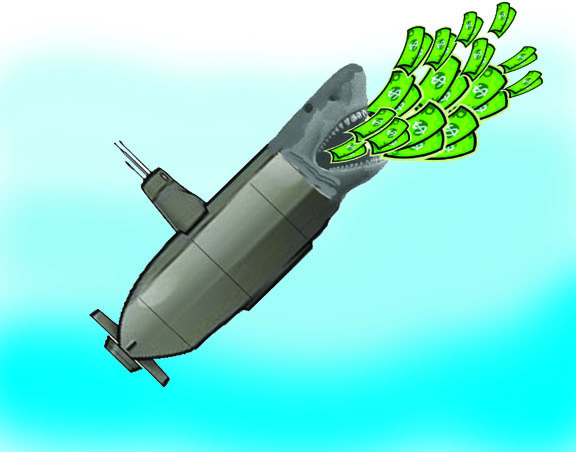
Defence faces budget blowout with Aukus nuclear submarines to cost more than scrapped French project
New analysis says ‘megaprojects’ often end up costing more than projected and predicts inflation will impact on defence budgets, Daniel Hurst Foreign affairs and defence correspondent https://www.theguardian.com/australia-news/2022/jun/08/defence-faces-budget-blowout-with-aukus-nuclear-submarines-to-cost-more-than-failed-french-project@danielhurstbne Wed 8 Jun 2022
The Albanese government faces the prospect of a blowout in defence spending, with analysts warning that the nuclear-powered submarines will cost “significantly more” than the cancelled $90bn French project.
A new report has also questioned whether the Australian defence force would be able to meet a target to increase the number of uniformed personnel by 20,000 over the next 20 years, given that it is averaging net annual growth of only 300.
Australia’s total defence funding stood at $48.6bn this financial year, or 2.11% of GDP.
That figure – which included the Department of Defence and the Australian Signals Directorate – worked out to be $133,191,781 a day, according to the Australian Strategic Policy Institute’s annual report on the defence budget.
The report’s author, senior analyst Dr Marcus Hellyer, said there was “no doubt that the ADF was getting better” but he also warned of risks inherent in an acquisition program built around “megaprojects”.
“Such projects take years or decades to design and deliver, while spending huge sums for little benefit in the short term,” Hellyer wrote.
“When they encounter problems, those problems are big.”
The report noted that the now-abandoned French Attack-class submarine program had “cost over $4bn and delivered nothing”, while the Hunter frigate program continued to experience delays “and won’t get a vessel into service for over a decade”.
It said even though the nuclear-powered submarine program envisaged under the Aukus deal had “the potential to deliver a huge step-up in undersea warfare capability”, it was “the mother of all megaprojects” with a risk profile to match.
Continue readingThe Liberal National Coalition’s flirtation with nuclear energy will not be well received by the electorate, especially in Gilmore on the NSW South Coast.
Nuclear option might trigger an electoral meltdown, The Echidna, John Hanscombe, Tuesday June 7, 2022,
The Coalition is flirting with nuclear energy. The public musings started when David Littleproud won the Nationals leadership last week. He said nuclear power was a clean energy option that ought to be discussed. Outgoing Barnaby Joyce echoed the sentiment. Peter Dutton did the same yesterday.
There’s been a chain reaction of sorts in the conservative camp, which is a major turnaround, given it was only last September when Scott Morrison ruled out nuclear energy. His proscription came just after he announced the landmark AUKUS deal with the United Kingdom and the United States to acquire a fleet of nuclear powered submarines………..
As the next election approaches, such talk is likely to become muted or disappear altogether because it will indeed lead to a scare campaign, especially in the ultra marginal seat of Gilmore on the NSW South Coast. Jervis Bay sits in the middle of the electorate and in the 1960s was slated as the site of a nuclear reactor. There was even talk of producing weapons grade plutonium there – of Australia arming itself with nukes. The idea was shelved after Australia signed the Non-Proliferation of Nuclear Weapons Treaty in 1973. A reminder of how close the plans came to fruition can be found at Murrays Beach, where concrete footings for the reactor are still visible under the water. Every time nuclear energy is mentioned by either party, people who love Jervis Bay for its natural beauty go into meltdown. The very idea is toxic.
Talk is cheap when you’re newly in opposition – and likely to remain there for the next six years – but the electorate’s reluctance to embrace nuclear energy will quickly lay the Coalition’s newfound enthusiasm for it to rest…………………………….. for all the buzz around small modular reactors, which are touted as lessening the likelihood of accidents, that technology is still in development. Not even the International Atomic Energy Agency is prepared to say whether it will be cost effective………….. https://view.mc.austcommunitymedia.com.au/?qs=2bef209076d2e92cad0ffbe50cfe6117f6de9b563c7f216a55f25b25a465ef4053920d84e8c319c1ee827faf2abd014eaf6af926304d34acbc4913de77c01ab76b3971c3c352c700fbcb032e2a19e72e
1 This month
17 October, Free Public Talk on Nuclear Issues in South Australia
David Noonan will speak on public interest concerns over the new Roxby Downs Indenture Act 2026 on BHP copper-uranium mining and ore processing in SA, and on how AUKUS may face SA with a High-Level nuclear waste agenda.
Dr Jim Green will discuss international developments in the field of nuclear power including ‘small modular reactors’ and Generation 4 ‘advanced’ nuclear reactor concepts.


Help Aunty Sue Protect Her Land and Sacred Sites From Destructive Rocket Testing.
.

Australians deserve the truth
about
AUKUS – https://aukuspublicinquiry.com/

PETITION – To: Prime Minister Anthony Albanese and the Australian Labor Government

of the week – Australians for War Powers Reform (AWPR)
To see nuclear-related stories in greater depth and intensity

