Can things get any worse for Australia’s uranium industry?
Specious comparisons between Australian uranium and Saudi oil have also been made by former South Australia premier Mike Rann, pseudo-academics Ian Plimer and Haydon Manning, Access Economics, and Comrade Paul Howes from the Australian Workers Union.
But Australia’s uranium export revenue in 2011 was 466 times lower than Saudi oil revenue in the same year − Australia would need to supply entire global uranium demand 31 times over to match Saudi oil revenue. The uranium industry accounts for 0.015 per cent of jobs in Australia, and in the 10 years from 2002-11 it accounted for just 0.29 per cent of national export revenue (with most of that revenue never coming anywhere near Australia because of the high level of foreign ownership).
The uranium industry hoped that the post-Fukushima spot price would rebound after it fell to $US50/pound … but then it fell to $US40 … and now it has fallen below $US30.
The uranium spot price fell to $US29/pound U3O8 on May 5 and has not budged since. Not since mid-2005 has the price been so low. The price is less than one-half of the pre-Fukushima price, and less than one-quarter of the price at the peak of the 2007 bubble.Uranium Investing News notes that “the phrase ‘uranium renaissance’ has been uttered so often that it has begun to feel like a bad joke”.
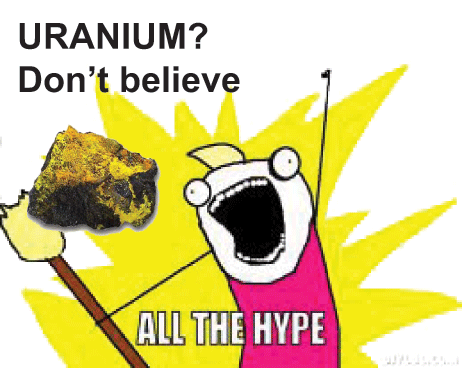
What’s going on?
The uranium lobby has been arguing that plans to begin restarting reactors in Japan later this year (all of Japan’s 48 reactors are currently shut-down in the wake of the Fukushima disaster) will lead to higher uranium prices. But as As FNArena notes, progress towards reactor restarts in Japan “has been glacial and anti-nuclear protest has been powerful”.
Japan’s uranium inventories probably amount to around 100 million pounds (45,400 tonnes) according to David Sadowski, a Raymond James analyst.
Sadowski added that many utilities around the world “are sitting on near-record piles” of uranium. It could take a decade or more before Japanese utilities exhaust existing inventories.
China is buying uranium − but is now sitting on stockpiles sufficient to meet current annual consumption eight times over. The uranium lobby hoped that the December 2013 end of a US-Russian agreement to downblend weapons uranium for use in power reactors would stimulate a price increase. But the spot price has fallen 17 per cent this year alone.
French state-controlled nuclear group Areva’s first-quarter revenue from its uranium mining unitfell 63 per cent. The mining arm of Russia’s state-controlled utility Rosatom has frozen uranium expansion projects in Russia and elsewhere (hence the Honeymoon mine in South Australia has been put into care-and-maintenance). Canadian giant Cameco has abandonedits earlier uranium production growth targets (and scaled back uranium exploration and development work in Australia). In 2012 BHP Billiton cancelled its planned expansion of Olympic Dam in South Australia and disbanded its uranium division. Wannabe uranium miner Marathon Resources gave up on the uranium game last year, stating that the “risks were more likely to exceed rewards”. Energy Resources of Australia is struggling with the political and economic fallout of a December 2013 leach tank collapse at the Ranger mine in the Northern Territory resulting in the spillage of 1.4 million tonnes of radioactive slurry; the collapse of a ventilation shaft a few weeks ago; and the revelations of a whistleblower published in the Mining Australiamagazine on May 5.
Australian-based Paladin Energy operated two mines in Africa but production at one of those mines has been suspended and the company is at risk of going bankrupt. As Paladin Energy chief executive John Borshoff said last July, “the uranium industry is definitely in crisis”.
A nuclear insider’s view
Just about everyone in and around the uranium industry consoles themselves with the thought that uranium prices will have to rebound sooner or later to stimulate new production, which will be required even if global nuclear power capacity continues to stagnate. A contrary view comes from Steve Kidd, an independent consultant and economist with 17 years of work at the World Nuclear Association and its predecessor, the Uranium Institute.
Writing in the Nuclear Engineering International Magazine on May 6, Kidd states that “the case made by the uranium bulls is in reality full of holes” and he predicts “a long period of relatively low prices, in which uranium producers will find it hard to make a living”……http://www.businessspectator.com.au/article/2014/5/29/energy-markets/uranium-%E2%88%92-how-low-can-it-go
Background to the Federal Court case on the proposed Muckaty radioactive wastes dump
 Comment: Australia’s radioactive waste management on trial Australia has never had an independent examination of the best way to manage our nation’s radioactive waste. It’s time for that to change. By Dave Sweeney 28 MAY 2014 IT IS A LONG WAY FROM THE LORE OF THE WORLD’S OLDEST CONTINUING CULTURE TO THE LAW COURTS OF MELBOURNE BUT A STORY THAT STARTED YEARS AGO IN CENTRAL AUSTRALIA WILL SOON BE THE FOCUS OF A MONTH LONG FEDERAL COURT TRIAL SEEN BY MANY AS A TEST OF BOTH AUSTRALIA’S SOCIAL CONTRACT WITH ITS FIRST NATION PEOPLE’S AND COMMITMENT TO RESPONSIBLE ENVIRONMENTAL STEWARDSHIP.
In May 2007 the Northern Land Council nominated an area of land on a pastoral station called Muckaty around 120 kilometres north of Tennant Creek in the Northern Territory as a site for a national radioactive waste dump.
The proposal was advanced through a commercial in confidence agreement between the NLC, an Aboriginal clan group and the then Howard government that saw the group “volunteer” an area of the shared Muckaty Land Trust for the burial and above ground storage of radioactive waste in return for federal payments, promises and a “package of benefits” worth around $12 million.
The dump plans lack of transparency, inclusion and scientific or procedural rigour left the majority of Aboriginal land-owners without any awareness of or ability to input into the process or the plan.
Like all things nuclear, this is an issue with shelf life and now after years of sustained community opposition a Federal Court trial is set to explore the unresolved issues of ownership, consultation and consent at hearings in Melbourne, Tennant Creek and Darwin throughout June.
Critics maintain that the dump plan fails two fundamental tests: it has explicitly excluded and marginalised Aboriginal landowners from decision making processes and power and it is based on an approach to radioactive waste management that is increasing at odds with international industry best practise and sound thinking.
The Federal Court’s focus will be the question of consent and control, and these concerns are of pivotal importance. Shared title for the Muckaty lands was only formally granted to Aboriginal people fifteen years ago and now many are saddened and angry that access to this area could be lost for centuries to come through a secretive process and without their knowledge or consent. Further, it is unreasonable and unconscionable for any government to play the politics of carrot and stick with some of the nation’s poorest people in order to find a remote place to dump some of the nation’s nastiest industrial waste.
The need to responsibly manage the serious and long term environmental and human risks posed from any industrial waste is a clear test of a mature society. When that risk involves the unique properties of radioactive waste then the need is magnified and multiplied.
Radioactive waste is a serious environmental management challenge. The material is often hot, always hazardous and extremely long-lived. Current problems at waste facilities in the US and elsewhere highlight the complexity of the issue and no nation on earth currently has a safe, final disposal facility for high level radioactive waste. This issue demands and deserves genuine attention but for too long been mismanaged by successive politicians seeking a short term ‘fix’ to a long term threat……. http://www.sbs.com.au/news/article/2014/05/28/comment-australia-s-radioactive-waste-management-trial
Terminally ill? Paladin closes its uranium mine in Malawi
 Paladin to shut its uranium mine, Australian Mining, 27 May, 2014 Cole Latimer Paladin has announced it will cease production at its Kayelekera uranium mine in Malawi.
It comes after the miner advised it would place the operation in to care and maintenance earlier this year.
According to Paladin it is ceasing production “due to reasons beyond the company’s control and related to the depressed uranium prices”.
On May 21 it halted all operations at the mine, and will now cease supplying uranium to the global market, causing a drop of around 3.3 million pounds of supply per annum.
“The outcome is an unfortunate but direct consequence of the continuing deterioration in the uranium price,” the company said in a statement. “Certain estimates now place up to 60% of current annual global production with costs above the current spot price, which is unsustainable.”…..http://www.miningaustralia.com.au/news/paladin-to-shut-its-uranium-mine
Pacific Island Delegates urge Australia to change climate change policy
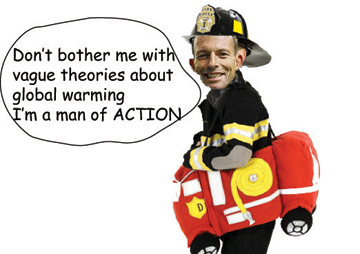 Pacific nations urge climate change action, ask Australia for help http://www.abc.net.au/news/2014-05-27/pacific-countries-make-climate-change-appeal/5481050 Australian Network political editor Catherine McGrath 27 May 2014 Songs of the Pacific have been heard at Parliament House as islanders from countries likely to be most at threat from rising sea levels braved the Canberra winter to highlight the issue of climate change.
In traditional dress, the group performed a cultural dance and spoke about their concerns.
When it comes to high tide you can see the tide everywhere it seeps through the whole island. It kills the crops – it kills our traditional root crops.
Maina Talia
The delegates, from Kiribati, Tuvalu and Papua New Guinea, are meeting federal politicians and officials representing the Minister for Foreign Affairs Julie Bishop and Environment Minister Greg Hunt.
They are seeking a cut in carbon emissions and more assistance for their countries’ climate change mitigation.
Kiribati, which is only about two to three metres above sea level, and Tuvalu, at four metres above sea level, are already battling rising sea levels and crop losses.
The delegate from Wewak in PNG says her region in the East Sepik province is also in danger.
Apisaloma Tawati, 19, from Kiribati says the group is taking its campaign to the world.”I am here today to make everyone aware of our hardship and to convince you that we need your help and … you can help us,” he said. “As a youth I am afraid of climate change. I see our land is becoming thinner and thinner. “We live near the coast and we see a lot of things. We saw coastal erosion, the land has been eroded away, sea walls have broken.
“I come to Australia to tell the world of our hardship and our stories back in Kiribati.”Kiribati is enduring a lot of problems due to climate change.”
Delegates urge Australia to change climate change policy
Maina Talia, 29, from Tuvalu wants Australia to rethink its climate change policy. “We are the most vulnerable of the most vulnerable countries,” he said. “Since we don’t have any mountains or rivers, for us to adapt is very difficult. It is a burden to the people of Tuvalu as to how they can adapt. “Now when it comes to high tide you can see the tide everywhere it seeps through the whole island. “It kills the crops – it kills our traditional root crops. “It (the rising sea levels) are just there and we don’t know how that happens but we believe it is climate change.”
Mr Talia says it is important to keep campaigning because people from Tuvalu feel so vulnerable. “It is difficult to determine who is listening and who is not listening,” he said.”I believe they have heard our message so many times but we keep on pushing and advocating for Tuvalu and Kiribati and low lying atolls [so] that leaders of Australia and other industrialised countries will continue to hear our voice.”
Tony Abbott’s blatant lie to the Aboriginal people on land rights
 PM Abbott’s top 40 broken promises and blatant hypocrisies — so far, Independent Australia Alan Austin 24 May 2014, Alan Austin updates IA’s running tally of hypocrisies and broken promises by Australia’s most mendacious ever prime minister — Tony Abbott…….
35. Aboriginal land rights
At the Garma festival in north-east Arnhem Land last August Abbott promised to
“… do whatever I humanly can in government to bring this [improved land rights for Aboriginal people] about.”
As funding for research and for legal aid for land claims across Australia is critical, all Aboriginal land claimants were looking expectantly at the May budget.
They got nothing..….http://www.independentaustralia.net/politics/politics-display/pm-abbotts-top-40-broken-promises-and-blatant-hypocrisies–so-far,6512#.U4Umyx0K8pE.twitter …@IndependentAus
Tennant Creek taken over by anti nuclear, anti -waste-dump protest, led by Aboriginal elders
 Elders lead dump demo http://www.ntnews.com.au/news/northern-territory/elders-lead-dump-demo/story-fnk0b1zt-1226932228540 BY MONIKA O’HANLON NT NEWS MAY 26, 2014 THE main street of a Territory town was flooded with more than 250 people protesting the proposed nuclear waste dump at Muckaty Station yesterday. Tennant Creek was overrun by a sea of yellow signs reading “Don’t radioactive waste the Territory” as kids led the march, holding up homemade banners and chanting “land rights not dump sites”.
Seven years ago the Northern Land Council nominated Muckaty Station as a potential site for a nuclear waste storage facility, including waste from nuclear medicine and operations of the Lucas Heights nuclear reactor in Sydney.
The site is part of a land trust shared by five interrelated indigenous groups – Milway, Ngapa, Ngarrka, Wirntiku and Yapayapa. Most traditional owners oppose the plan but some said “yes” to the proposed storage facility.
Bunny Nabarula – a senior traditional elder and part of the Milway group – is among those who have spent years fighting to preserve Muckaty.
“I was eight years of age when my grandfather first showed me country, but I never forget,” Ms Nabarula said.
“We don’t want the waste here. NLC picked out the wrong people. Us mob fight for this land.”
Dianne Stokes has worked tirelessly over the years to protect the Muckaty site, and on Saturday was named an ambassador at the Tennant Creek and Barkly Region Golden Hearts Awards.
“We won’t be stopping – we will continue to talk about it,” Ms Stokes said. “It’s time to put my foot down and protect the elders’ words. They’ve passed away and now they left it to us to protect our country.”
Wirntiku woman Penelope Phillips said she was concerned what would happen if the land wasn’t protected for the next generations. “We want to send a clear message out to the politicians and the people who said yes to it,” she said. “Tell them that we are still strong and we don’t want a nuclear waste dump in our country. Come back and meet the people. See what it looks like. “The politicians don’t talk to us. They don’t reply.”
The protest comes a week before a Federal Court hearing challenging the proposal for the dump on Muckaty begins in Melbourne. The hearing will continue in Tennant Creek before finishing in Darwin on July 4.
No future in sight for Yeelirrie or Kintyre uranium mines, nor for Olympic dam expansion
Uranium fall dents Olympic outlook BARRY FITZGERALD THE AUSTRALIAN MAY 27, 2014 BHP Billiton’s recasting of its expansion plans for its Olympic Dam copper/uranium mine in South Australia’s outback have been served up a new challenge — the collapse in uranium prices.
Spot uranium has fallen 30 per cent in the past 12 months to $US28.15 a pound, plunging most of the world’s uranium-only mines into losses. More telling has been the steady decline from the record price of $US137 a pound in mid-2007, due in part to the fall in demand in the wake of Japan’s Fukushima nuclear disaster in 2011.
BHP dropped plans for a big-bang expansion of Olympic Dam in mid-2012, blaming the $30 billion cancellation on the over-heated resources sector and the country’s high-cost environment. Concerns about uranium’s outlook post-Fukushima was also a factor……….
When it shelved the big-bang expansion plan, BHP said it would investigate a less capital-intensive design, and one that drew on new mining and processing technologies to improve the economics of the project.
BHP chief executive Andrew Mackenzie also undertook in September to say more about plans for the expansion “within about a year’’. While that timing is almost up, BHP’s considerations of what the price slump means for the future of what is the world’s biggest uranium deposit makes its planning for an expansion all the more complex.
Like the rest of the industry, BHP will be pinning its hopes on the restart of nuclear power plants in Japan, and the forecast surge in China’s nuclear power industry, to eventually produce more sustainable prices — in the context of being able to make a profit from the material at any rate……..
“uranium prices continue to suffer downward pressure and we do not see any reason to expect improvement soon.’’ -Tim Gitzel, the chief executive of Canadian uranium giant Cameco, which owns two of the world’s biggest undeveloped uranium deposits in Western Australia — Yeelirrie and Kintyre.
That means that neither Yeelirrie, acquired from BHP, and Kintyre, acquired from Rio Tinto, are about to be developed anytime soon…..
Australia needs to learn from traditional Aboriginal knowledge about fire
 Living sustainably with fire, Aboriginal Knowing 26 May 14,
Where to burn, where to grow”………..I would suggest that the planning of Adelaide, surrounded by parklands with open spaces is based on this Aboriginal model of clearing land to create clear space around where you live. Australians need to think in this manner to protect ourselves from intense and destructive bushfires. We need to clear the trees around where we live, and we need to grow trees and plants in the right places.
Decisions of when and where to burn are informed by many environmental and social considerations, and vary with country. Our sophisticated patterns of land burning, the knowledge of what and where to burn is encoded within traditional knowledge. Such rules tell of wind directions, cloud formations, smoke patterns, soil condition, the position and movement of constellations and planets, the type of plants and stage of growth, the presence or absence of particular plant and animal species and so on.
Fire and water are interconnected. Water is a fuel for fire and fire fuels the rain. After a large fire, it usually rains.
Burning and planting in the right place can increase rainfall. (excellent references) http://aboriginalknowing.com/2014/05/22/living-sustainably-with-fire/
Murdoch media takes its”facts” on renewable energy from fossil fuel and right-wing promoters
 Why the Murdoch media hates renewable energy so much, REneweconomy, By Giles Parkinson on 26 May 2014 Here is an admission. For more than two years, over two stints, I wrote a weekly column on green energy for The Australian newspaper, called Greenchip.
It appeared prominently on the business pages, and on no occasion was I ever instructed by any editor to take a certain angle, and my copy was never changed to convey another meaning – although one sub-editor did choose the word “seaweed” in a story about algae fuels.
That’s the way it should be. And possibly the way it still is. But I make mention of it now because the position of the Murdoch media towards renewable energy has become a major issue: It appears designed to bring a multi-billion dollar industry to a halt, and apart from ideological reasons, or sympathy with vested interests, it is not clear why.
Certainly, it is not based on the facts.
Some of the reporting on renewables from the Murdoch global network has been laughable, such as the assertion by one Fox News reporter that solar could never work in the US because it didn’t have as much sun as Germany. Continue reading
A sun smart school in Perth is tracking UV radiation
 St Hilda’s Anglican School for Girls the first in Australia to install UV meter http://www.perthnow.com.au/news/western-australia/st-hildas-anglican-school-for-girls-the-first-in-australia-to-install-uv-meter/story-fnhocxo3-1226931735377 RACHEL NORMAN PERTHNOW MAY 16, 2014 ST Hilda’s Anglican School for Girls is now the most sunsmart school in Australia. The Mosman Park school has become the first in the country to install a meter that tracks ultraviolet radiation from the sun. If the meter hits level 3 or above, students have to cover up.
The move is an attempt to mitigate the prevalence of Australia’s most common form of cancer.
The Cancer Council says almost 77,000 skin cancer cases are treated each year in WA alone. Mark Strickland, the Cancer Council of WA’s SunSmart manager, said installation of the meter on the school’s junior campus was a positive step towards reducing skin cancer in the community.
“It has been shown that reducing lifetime UV radiation goes a long way to reducing the risk of skin cancer,” he said.
“A UV meter is another way of reminding people that the sun’s radiation in WA is strong enough that they need sun protection.
“It’s a silent but constant reminder of the ever-present need to cover up.”
Andrea McNally, the head of Junior School at St Hilda’s, said childhood was a particularly important time to recognise the need to seek shade and form good habits for the future.
“Having the visual prompt of the UV meter has taught the students that it’s not the heat that determines danger, but the UV index; and hopefully that will create a lifelong awareness and a change in their attitudes,” she said.
Data from the UV meter will also be used as part of the junior school curriculum, with students from year 1 currently monitoring and recording data every day.
Australia’s first public UV meter was installed at Deep Water Point in Melville last year.
There is also a Cancer Council meter at the Surfing WA club house at Trigg Beach.
St Hilda’s year 6 pupil Angelique Preau said she and her fellow students were paying close attention to the meter – regardless of the sort of day it was.
“When it gets to 7 or more it’s bad and you have to go into the shade and/or put sunscreen on,” the 11-year-old said.
Solar power proving a good investment for Western Australians
 Solar Helps Delay New Power Station In Western Australia http://www.energymatters.com.au/index.php?main_page=news_article&article_id=4319 26 May 14, WA’s solar households and businesses are collectively generating as much power as a major traditional power station. According to The West Australian’s Daniel Mercer, given forecasts from Synergy of a continuing increase in solar uptake, the State Government now says a new power station would not need to be constructed in the state until 2029.
Synergy predicts there could be as much as 1500MW of solar capacity feeding into Western Australia’s electricity grid by 2020.
The rate that Western Australians have embraced solar is quite stunning. The numbers of solar power systems connected to the grid has grown from just three in June 2007 to 135,419 (Synergy customers) as of March 2014.
According to solar provider Energy Matters, a 5kW solar panel system installed in Perth can return a financial benefit of between $1,577 and $2,196 annually. In some cases, a system of this size can basically blow away an average household’s power bills.
Energy Matters’ Australian Solar Index estimates the internal rate of return of a system installed in Perth to be 17.8%; making it one of the best investments around.
However, as is the case in the rest of Australia, clouds are gathering on the horizon for WA’s solar industry and potential new solar households. The Renewable Energy Target review is currently under way and concerns have been expressed regarding possible outcomes; including a gutting of subsidies.
Current support for acquiring systems can translate to thousands of dollars off the cost of going solar. The uncertainty surrounding the review means the best time to go solar in Western Australia could be right now.
Going solar in WA doesn’t necessarily mean a significant up-front financial outlay. Energy Matters offers a zero-deposit “Save As You Go” arrangement to eligible customers where monthly repayments can be less than what would otherwise be spent on mains-grid supplied electricity.
How BHP determined Abbott government energy policy
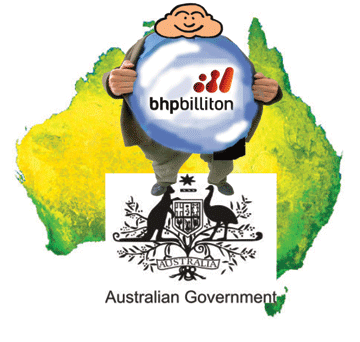 Worried BHP CEO pressed Hockey to keep diesel rebate. Financial Review 23 May 14 BHP Billiton chief executive Andrew Mackenzie was among several mining executives who directly lobbied the federal government against cutting the industry’s rebate for diesel excise at last week’s budget. (subscribers only) http://www.afr.com/p/national/worried_bhp_ceo_pressed_hockey_to_byOkNSIXbue5I2qIxnFZPP
A quick meeting with the Government reassured them that by ‘everyone’ the Liberals meant the young, the sick & the poor, not big miners.
TAKE ACTION to call on the Senate to #BustTheBudget here:http://campaigns.greens.org.au/ea-action/action?ea.client.id=1792&ea.campaign.id=28562&ea.tracking.id=fb
Rio Tinto finds that solar is the best way to power Queensland off-grid mine
Rio Tinto to deploy 6.7MW solar PV + storage at off-grid mine
REneweconomy By Giles Parkinson on 22 May 2014 A ground-breaking, $23.4 million project to cut out daytime diesel consumption at Rio Tinto bauxite mine at Weipa could unlock billions of dollars of similar investments in the mining industry – which is weighed down by soaring energy costs.
Mining giant Rio Tinto is to host a $23.4 million solar PV plus storage facility at its Weipa bauxite mine, that is the first of its type and scale in the world and could unleash billions of dollars of similar investment. Rio Tinto Alcan – with the help of the Australian Renewable Energy Agency – is to install a 1.7MW solar PV array at its Weipa bauxite mine later this year, and then add a further 5MW of solar PV and battery storage.
The Weipa mine is located on the Cape York Peninsula at the very northern tip of eastern Australia, and relies on expensive diesel that has to be shipped in.
The first phase of the solar project – to be built with First Solar thin-film modules and constructed by Australian solar firm Ingenero – is expected to reduce daytime diesel demand from the mine’s 26MW diesel generator by up to 20 per cent.
However, the addition of more solar and storage to balance out intermittency could reduce daytime diesel consumption altogether at certain times.
The Weipa project was the first of around 70 submissions – worth several billion dollars of investment – from mining operators in Australia for funding for such ground breaking projects under ARENA’s $400 million remote energy program.
The ending of the commodities boom has made miners more focused on energy costs. Continue reading
Victoria’s Ararat wind farm project in jeopardy, due to uncertainty over Renewable Energy Target
 Wind future up in the air with renewable energy target uncertainty http://www.thecourier.com.au/story/2301438/wind-future-up-in-the-air-with-renewable-energy-target-uncertainty/?cs=12 By KARA IRVING May 22, 2014, THE developer of the Ararat Wind Farm project believes the federal government’s renewable energy target (RET) review has caused uncertainty among green energy developers, investors and retailers. RES Australia is behind the $450 million Ararat Wind Farm to be built on the Pyrenees Highway about 17 kilometres from Ararat. Head of development Annette Deveson said the ongoing RET review had stirred uncertainty in the green energy sector.
“We are working very hard to get the Ararat Wind Farm ready for construction,” Ms Deveson said. “But the government is causing uncertainty in the industry and for us.” The federal government is currently reviewing the RET to examine the operation, costs and benefits of the scheme.
The RET was developed to ensure 20 per cent of Australia’s electricity comes from renewable sources by 2020.
Although a decision had yet to be made about the renewable energy targets, Ms Deveson said the review had caused difficulties for prospective green energy developers. “They are not out there in the market looking for new projects,” she said. “As a business you are uncertain of your future market.”
Ms Deveson said the potential change impacted on investor confidence. Ararat Rural City Council last Friday made a submission to the RET review to pledge the importance of the project.
Mayor Paul Hooper said it was likely the wind farm would not be built because of the review. “The project will create 13 full time jobs after the construction has finished,” he said. “About $75,000 will be put back into community grants.”Mr Harper said the Ararat community would miss out if the project were to cease.“We will not see those benefits come to town, nor the long term employment opportunities,” he said.
“The community misses out.” kara.irving@fairfaxmedia.com.au
Renewable Energy Target must stay – call by Australia’s sugar industry
Sugar industry calls for Renewable Energy Target to stay http://www.abc.net.au/news/2014-05-22/sugar-industry-calls-for-renewable-energy-target-to-stay/5471258 22 May 14, Sugar millers say any move to scrap the Federal Government’s Renewable Energy Target would be a ‘retrograde’ step.
Set up under the Howard government with the goal of having 20 per cent of Australia’s electricity generated through renewable sources by 2020, the RET scheme is currently under review.
The Australian Sugar Milling Council, in a meeting with the review panel today in Brisbane, described the program as being ‘absolutely critical’ for the industry.
ASMC chief executive Dominic Nolan, says the sugar industry has invested heavily in renewable energy and the current uncertainty surrounding the scheme’s future, places further development in jeopardy. “The sugar milling sector has invested over $300 million over the past 5 years [and] we’ve got more than $1 billion identified for further investment in energy efficiency and co-generation.”
The review is considering what role the RET scheme has had on reducing emissions and its impact on electricity prices as well as the costs and benefits to industry.
Mr Nolan insists any change to the current scheme could force sugar millers to ‘undo’ their more recent advances in burning the fibrous by-product ‘bagasse’, to produce electricity for the national grid.
He says the industry would take a $35 million hit in lost revenue and there would be no cost incentive for millers to be more energy efficient.
“We export 80 per cent of what we make, we price our sugar on the global market, we live and die on the basis of our cost of production.
“Our major competitors, Brazil, Thailand and even India, are heavily down the path around co-generation and biofuels and we need to keep pace in order to maintain our international competitiveness.”
1 This month
17 October, Free Public Talk on Nuclear Issues in South Australia
David Noonan will speak on public interest concerns over the new Roxby Downs Indenture Act 2026 on BHP copper-uranium mining and ore processing in SA, and on how AUKUS may face SA with a High-Level nuclear waste agenda.
Dr Jim Green will discuss international developments in the field of nuclear power including ‘small modular reactors’ and Generation 4 ‘advanced’ nuclear reactor concepts.


Help Aunty Sue Protect Her Land and Sacred Sites From Destructive Rocket Testing.
.

Australians deserve the truth
about
AUKUS – https://aukuspublicinquiry.com/

PETITION – To: Prime Minister Anthony Albanese and the Australian Labor Government

of the week – Australians for War Powers Reform (AWPR)
To see nuclear-related stories in greater depth and intensity

