Rio Tinto dodging its responsibilities for radioactive pollution of Kakadu National Park
 Rio Tinto dismisses Ranger rehab funding concerns as “hypothetical” Mining Australia, 8 May, 2014 Rio Tinto has stated that concerns about the funding for rehabilitation of the Northern Territory Ranger mine site are hypothetical, and remain the concerns of the ERA board of directors.
CEO Sam Walsh once again shrugged off suggestions that Rio Tinto, as 68 per cent shareholder in ERA, is responsible as the parent company for any of ERAs financial shortcomings in regard to rehabilitation and clean-up at the Ranger uranium mine…….David Sweeney of the Australian Conservation Federation, in his question to Sam Walsh and the Rio Tinto board of executives, suggested that because ERA reports to RioTinto’s energy division, it will be “closely watched and long judged on its actions regarding ERA”……..
“I thought his response was very partial and legalistic,” Sweeney said.
“Clearly Energy Resources Australia is a separate legal entity to Rio Tinto, but Rio provides the mining instructions, they provide the management, the CEO of ERA is appointed by Rio and is always a Rio person, Rio’s energy division manages ERA.
“It is absolutely a Rio Tinto subsidiary, it is a Rio Tinto child, and it concerns us greatly now that, when it’s coming to the pointy end of what will be a costly and complex rehabilitation exercise, ERA is saying they don’t have the funding capacity and Rio Tinto is saying they don’t have the responsibility.
“Just this week, Rio bailed ERA out of a problem caused by the suspension of mineral processing, by saying that they will pool Australian and Namibian uranium through the Rio Tinto marketing authority.”……http://www.miningaustralia.com.au/news/breaking-rio-tinto-dismisses-ranger-rehab-funding
Why the Walinu Martu People will do everything possible to prevent Toro Energy’s Wiluna Uranium project
 WESTERN AUSTRALIA’S WILUNA MARTU CONDEMN EXPANSION OF URANIUM MINING PROJECT , InterContinental Cry, by Curtis Kline on May 7, 2014 In Western Australia, plans of expanding Toro Energy’s mine site into a much larger uranium mining wasteland–spanning 100km and two lake systems–has been condemned by elders of the Wiluna Martu people.
“The lives of not only our people today are at stake but the future of our people into time immemorial. This uranium mining if it goes ahead will spell the end of us as custodians of the land. It will make toxic the land, preventing us from caring for the land, it will poison the rivers that we swim in, drink and fish from,” said Wiluna Elder, Glen Cooke to The Stringer.
On March 25, Western Australia’s EPA made the Toro Wiluna uranium expansion project open for public review. Wongi anti-nuclear campaigner, Kylie Fitzwater, commented that Toro had a long way to go before gaining new approvals to expand their single-mine approved project. “The company needs to complete additional environmental management, mine closure, tailings management and transport plans for assessment before any mining can commence at the Wiluna site,” she said.
Included in the proposal, Toro Energy wants to double its water consumption and store radioactive mine waste from several mine sites in a Lake bed. The company’s new plan also involves four more deposits covering over one hundred kilometers – Lake Way, Centipede, Millipede and Lake Maitland, with longer term plans including mining an additional three deposits at Nowthanna, Dawson Hinkler and Firestrike – covering another one hundred kilometers in the other direction.
Stop the bull – the Wiluna uranium program
This region is also home to Western Australia’s largest uranium deposit at Yeelirrie, owned by the Canadian uranium mining giant, CAMECO. This project has been consistently opposed for forty years by Traditional Owners, now led by Kado Muir. Mr. Muir has said “The only safe place for uranium is in the ground, where it belongs. For 40 years my people have campaigned to protect Yeelirrie. We have walked this Country for thousands of years, it should not become Country that we fear to tred.”
While Toro’s original mine plan is expected to be operational next year, the traditional lands on which it is situated is covered by two native title claims at an advanced stage towards a consent determination of native title under the Native Title Act………
As the majority of uranium exploration and mining occurs on Indigenous lands all over the world, this project would continue the denial of the Walinu Martu Peoples right of free, prior and informed consent and their self-determination. They have particularly been striving for the right to negotiate with uranium explorers directly to ensure that their culture and rights are adequately protected.
As the first of Western Australia’s mining projects, the government and industry are hoping this will be the first of many. This is why, the Walinu MArtu People will do everything possible to prevent it. http://intercontinentalcry.org/western-australias-wiluna-martu-condemn-expansion-of-uranium-mining-project-22980/
Australia’s radiation protection not good enough, especially in remote areas
 Audit finds nuclear shortcomings PS News 8 May 14 An audit of the regulation of nuclear radiation and related activities in Australia has found that while the Agency responsible had been generally effective in managing key aspects of the regulatory framework, shortcomings identified in a 2005 audit had yet to be rectified.
In his audit report on the Australian Radiation Protection and Nuclear Safety Agency (ARPANSA), Auditor-General, Ian McPhee found that only 11 of the 19 recommendations made by the previous 2005 audit had been implemented.
The 2005 audit found ARPANSA “did not have a systematic approach to planning, undertaking and monitoring its activities”.
“By not implementing agreed recommendations in a timely manner, ARPANSA has foregone opportunities to enhance its performance,” the Auditor-General said……..Mr McPhee said the licence assessment process could be further improved and there was also scope for ARPANSA to extend its risk‑based regulatory approach.
The audit found that aspects of the inspection process, particularly unannounced inspections, were largely driven by geographical convenience rather than risk.
He also recommended ARPANSA strengthen its approach to managing conflicts of interest, assisted by its Audit and Risk Committee.
The audit team was Stewart Ashe, Tara Rutter and Donna Burton. http://www.psnews.com.au/Page_psn408f6.html
Uranium long-term market forecast is as bad as its short term – from Nuclear Energy Institute
 www.neimagazine.com/opinion/opinionthe-future-of-uranium-higher-prices-to-come-4259437/ Predictions of the rise in price of uranium are unjustified; they do not fully appreciate the segmented nature of the market. Steve Kidd 6 May 14
The world uranium market has fallen back substantially from the highs it sustained in the period around 2005-2010, when the spot price peaked at over $130 per pound in summer 2007. After the Fukushima accident in 2011, the price drifted down further and has been stable at the $35 per pound level since last summer. Although this is well above the $10 per pound that prevailed for the long period from the late 1980s up until 2003, it is universally agreed that very few (if any) new mines can be developed at today’s price level. The suggestion is therefore made (particularly by uranium producers and their financial sector backers) that with rising demand, there will be shortages of supply in future unless we soon have much higher prices to encourage new production. On the demand side, a lot of attention is currently being to the upcoming Japanese reactor restart programme, in terms of timing and number of reactors.
A recent report from my company (East Cliff Consulting, ‘The Fifth Age of Uranium’) shows why the case made by the uranium bulls is in reality full of holes. We are now more likely to see a long period of relatively low prices, in which uranium producers will find it hard to make a living.

Substantial oversupply in the Fourth Age
The starting point is to understand the full history of uranium supply and demand. This is covered in the WNA’s biennial fuel market report, which identifies four distinct ages running from 1945 until today. The fourth of these began in 2003, when prices started rising sharply to mark the end of the third age, which was the long period of inventory rundown and constrained production lasting from the late 1980s. Talk in 2003 was of a “renaissance” of nuclear power and lots of new mines were apparently needed to meet their fuel requirements, while previously abundant secondary supplies would gradually wither away. Not so different from what the optimists are saying about uranium today.
World production certainly responded strongly to the obvious price signal back then and it had risen by half by 2010. One curious feature, however, was that the increase was almost entirely concentrated in only one country, namely Kazakhstan. Apart from this, hundreds of “junior” uranium companies suddenly appeared but the only company successful in establishing new large-scale production facilities was Paladin, with Langer Heinrich in Namibia and Kayelekera in Malawi. The others succeeded in mining only the financial markets.
Another remarkable fact was that despite all the hype about nuclear growth plans, the level of underlying uranium demand did not rise at all during this period. This is even without the adverse impact of the accident at Fukushima in 2011. Shutdowns of ageing reactors in various countries were just balanced by the commissioning of new units (increasingly in China). Another crucial factor has been a fundamental realignment in the relationship between uranium and enrichment requirements. The closure of the inefficient gaseous diffusion enrichment plants removed the high marginal cost production which had propped up prices, while notably higher uranium prices in themselves encouraged the use of higher enrichment (through reducing the optimum “tails assay”). Enrichment is now expected to remain cheap and abundant as centrifuge plants are modular and capacity can be expanded relatively easily to meet demand, so this substitution of enrichment for uranium will continue to be important.
The impact of much higher production combined with static demand during this fourth uranium age is substantial over-supply in the world uranium market, with prices naturally falling back to lower levels. The other obvious corollary of this period has been a renewed upsurge in uranium inventory levels in the United States, Europe and (with the shutdown of reactors since Fukushima) Japan. Some of this has been entirely voluntary on the part of the fuel buyers, who want more security of supply. The biggest increase has been in China, which has been building huge inventory balances to provide security for the anticipated fuel requirements of its rapid reactor building programme. On the other hand, some of the accumulation (such as in Japan) has been involuntary and this material can be used to balance the market over the next period, effectively at the expense of fresh production.
In fact China can be seen as the mirror image of the production growth in Kazakhstan, as the majority of Chinese imports have been sourced from there. The rest of the world has continued much as before, with no overall nuclear growth and not much of any real substance happening in the development of new uranium mines, except a few key projects such as Cigar Lake in Canada.
Uranium demand to increase in China and Russia
The uranium bulls continue to point to the prospects for nuclear growth to 2030. The problem is that most of this will be concentrated in China and Russia. Over half will likely be in China and the Chinese may also become important in supplying reactors to other countries in the 2020s. The Russian domestic nuclear programme is now progressing quite well, and they too will be a key supplier of reactors to other countries in the period to 2030. When the Russians supply a reactor, they invariably include long-term fuel contracts. What is important is that uranium demand will almost certainly fall in the key markets in Western Europe and North America, which are satisfied by the established uranium producers. Many Japanese reactors will undoubtedly restart but it will take a long time to unwind the inventory accumulation there.
Those who believe in higher uranium prices take an over-optimistic demand scenario. It can now be argued that the range of possibilities has actually narrowed considerably and it is appropriate to centre discussion on just one main case to 2030. Upper scenarios showing rapid nuclear growth in many countries including plants starting up in new countries now look very unlikely, certainly before the late 2020s. If there is to be a nuclear renaissance, it is now much more likely to happen later, and with a new generation of reactors. On the other hand, predictions that another major accident would shut down nuclear in lots of countries have been negated by the experience of Fukushima. Although there remain some uncertainties, the outlying upper and lower cases are much less credible than before.
Uranium market split into three
So we are entering a fifth era of uranium, where the market is split into three.
The Chinese will favour investing directly in mines to satisfy their requirements. These (like Husab in Namibia) will not necessarily be at the low end of the cost curve: there are important geopolitical considerations too and the Chinese are keen to get involved directly in the economic development of many countries, particularly in Africa. They are also not going to “play ball” with the established uranium market. Although they will maintain a presence in the spot market and sign further long-term supply contracts with producers, they have learned their lesson from the iron ore market. In that sector their heavy dependence on imports from BHP Billiton, Rio Tinto and Vale has given these producers fantastic profits.
The Russians will continue to be significant nuclear fuel exporters but their own market will remain essentially closed to outsiders. They still have secondary supplies to tap into (plenty of surplus HEU remains to be down-blended) and they will follow the Chinese and invest directly in uranium assets if their own domestic production remains constrained. Their recent acquisition of the producer Uranium One can be seen very much in this vein.
The established uranium producers will have the remainder of the market to satisfy and that will likely be declining in magnitude. There are bright spots are South Korea and the Middle East (where Saudi Arabia may join the UAE in having a nuclear programme) but the prospects in North America and Europe are not so good. In the United States, the number of operating reactors will fall by 2030, with a small number of new units not sufficient to compensate for closures due to cheap shale gas and the incursion of subsidised renewable energy into power markets. Although reactors may well be licensed for up to 80 years, they will not operate unless the economic fundamentals are right. In Canada too, it seems unlikely that all three nuclear stations in Ontario will be refurbished, and there is a strong possibility that Pickering will close. InEurope, even in France the future of the currently operating units is now in question. It is likely that there will be a gradual reduction in the nuclear share of electricity in France towards 50% and so older units (beyond Fessenheim) will likely close by 2030. New-build in the United Kingdom will only compensate for units shutting down, while further new units will only happen in a few countries such as Finland and (possibly) the Czech Republic. So with countries like Belgium and Switzerland following Germany into a nuclear phase-out, the overall European situation is one of gentle decline.
This market segmentation and the way the Chinese and Russians will operate means that the two prime analytical devices utilised in the uranium market are both now useless. First, calculated annual world supply-demand balances (miraculously often showing a shortage after 3-5 years) are irrelevant in a segmented market, where key actors with expanding demand choose to go it alone. For a time in the early 2000s, it looked as if a globalised world nuclear fuel market could emerge, but this has not happened and it is arguably now going into reverse. Secondly, uranium supply curves (based on mine cost data), demonstrating the need for higher prices as demand expands, are also invalidated. China and Russia (and probably India too, if it eventually gets its nuclear act together) will develop uranium assets wherever it best suits them. They have the confidence to bypass the conventional market, which could increasingly become merely a sideshow.
Another issue to watch is the persistence of secondary supplies beyond Russia. Only part of the 2.5 million tonnes of uranium mined since 1945 has been utilised. Almost 2 million tonnes of depleted uranium is an attractive resource while there is overcapacity in enrichment and cheaper prices. In the very long term, China, Russia and India are committed to reprocessing their used fuel and will probably eventually succeed in tempering their uranium use by building large reprocessing plants. Any substantial replacement of uranium, however, will have to await the next generation of reactors, which will be fuelled very differently from today’s large light water designs.
Fifth Age price predictions
In this fifth age of uranium, prices will essentially be determined by the cash costs of production of operating mines (and not by the full costs of future mines). This means a reversion to the long period of low (but relatively stable) uranium prices of the late 1980s and 1990s (the third age), but at a higher level to reflect the greater level of production now, the escalation of mining costs and the movements in currency exchange rates. The shortages predicted by many analysts (leading to rapid price increases to provide good rates of return on their favourite projects) are purely a mirage.
The outlook is therefore not favourable for either current or prospective uranium producers. Only those with low-cost operations will prosper. Others will struggle to stay in business and further mine closures (beyond Paladin’s Kayelekera which is now on “care and maintenance”) are definitely on the horizon. A high-profile mine closure is one factor that could cause the price to spike, but historical experience is actually rather different: once mines get into operation, owners will usually withstand short-term financial losses so long as they are convinced that there are better times around the corner. And they tend to be incurable optimists.
Steve Kidd is an independent nuclear consultant and economist with 17 years of work in senior positions at the World Nuclear Association and its predecessor organization, the Uranium Institute.
Coalition government utterly dependent on funding from mining industry
The fossil fuel industry and who really runs Australia Independent Australia Sandi Keane 6 May 2014,The age of entitlement is over in Australia — except for the dominant fossil fuel industry and those rich enough to be able to buy political patronage.“……..Last month, at global talks in Nairobi, energy experts at were calling on subsidies to oil, gas and coal prices to be cut:
‘According to the International Energy Agency, the elimination of fossil fuel subsidies will be the single most effective measure for climate change mitigation and would be one of the most effective measures for keeping the temperature rise beneath two degrees, which has been agreed upon in the international climate negotiations.’
The talks were organized by Germany’s development agency GIZ, the UN’s Environment Program and the International Monetary Fund. It was noted that most European countries have already cut their fossil fuel subsidies.
There’s little chance of the Abbott Government following suit while its policy outcomes continue to favour Australia’s richest corporate elites in return for hefty political donations. (See below – graph explains donations from mining industries)

At this point, donations – other than certain donations, such as from developers as in NSW – are not illegal.
Until such time as there is a national ICAC and an appetite to clean up the corrupt practice of political donations being tied to favourable decisions, we know who really governs Australia — the miners and the moguls. http://www.independentaustralia.net/business/business-display/who-really-runs-australia-the-miners-and-the-moguls,6450
Wind haters control Abbott government policy – poor prospects for future wind energy development
 This may be as good as it gets for Australian wind energy http://reneweconomy.com.au/2014/may-good-gets-australian-wind-energy-72276 By Giles Parkinson on 6 May 2014 New data released on Monday suggested that Australia in the month of April had reached its record level of output for wind energy – 4.6 per cent of total generation from the National Electricity Market.
Accurately measuring the solar energy potential for South West Australia
South-west Australia’s potential solar output measured with accuracy Phys Org 7 May by Rebecca Graham Researchers have developed an algorithm that can be used to simulate the hour-by-hour power output of both photovoltaic and concentrated solar thermal power systems for any location in the south-west corner of Australia. The model is simple enough to run inside a web-browser by the general public and could be tailored to other regions around the world.
Led by Murdoch University’s Dean Laslett, an engineering PhD candidate, the research forms part of a series of studies originated by Sustainable Energy Now aimed at developing an accessible and interactive computer simulation of renewable energy power systems for the South-West Interconnected System (SWIS); WA’s main electricity grid.
As clouds affect how the three main components of solar radiation – direct, diffuse and reflected – reach the earth’s surface, the algorithm was developed through a series of calculations using seasonal rainfall patterns and the three solar radiation components; leading to estimates of daily and hourly cloudiness across the region.
“The seasonal rainfall pattern across WA generally decreases with distance from the coast, with a zone of high rainfall in the south-west corner and the Kimberley,” Mr Laslett says.
“Seasonal cloudiness follows the same pattern. Hence if the longitude and latitude of a location is converted into a distance along the coast-line and a distance inland, estimation of seasonal cloudiness can be simplified.
“An estimate of all three solar radiation components is [also] needed…………”Because the model can be used to estimate all three components of solar irradiance, it’s possible to change the location of one or several photovoltaic or concentrated solar thermal systems and get an idea of how overall energy generation might change.”
“Also because our model can run inside a web-browser, this ability becomes widely accessible to the general public … they can play around and see for themselves what a solar energy power system for the SWIS might look like.” : http://phys.org/news/2014-05-south-west-australia-potential-solar-output.html#jCp
Queensland uranium mining not to happen any time soon (perhaps never?)
 Uranium mining to face delays North West Star By CHRIS BURNS May 5, 2014,
QUEENSLAND Resources Council chief executive Michael Roche says he does not expect a rush of uranium mine development in the North West when Queensland regulations are approved later this year.
Unsatisfactory answers on coal seam gas radiation leak
 More questions on CSG uranium scare #agchatoz http://coalseamgasnews.org/news/world/australia/nsw/more-questions-on-csg-uranium-scare-agchatoz/ May 5, 2014 Mike Foley A RANGE of unanswered questions have emerged over Santos’ Pilliga uranium aquifer contamination , as the environmental watchdog’s investigation report comes to light.
In March 26, 2013, Santos advised the NSW Environment Protection Authority (EPA) its monitoring measures had detected aquifer contamination was caused by a leaking storage pond at the Bibblewindi site, which contained salty water which had been sucked up from underground during coal seam gas (CSG) activates.
Nearly a year after Santos was fined, in March 2014, the EPA finalised its report on the contamination.
But the EPA investigation leaves key questions unanswered concerning remediation of the Pilliga’s groundwater, the reliance of the authority on companies for information and public health risks. It confirmed a groundwater system beneath the Bibblewindi storage pond contained heavy metals and other elements, including elevating uranium levels to 20 times the safe drinking limits. Santos was fined $1500 by the EPA for causing the contamination.
The investigation report details correspondence between the EPA and other government agencies, highlighting areas requiring further information, including:
Can the contaminated groundwater be repaired? Santos advised the EPA in October its trial efforts to remove contaminated water had failed.
“The results of the trial concluded that recovering the perched water by abstraction in the surrounding shallow perched bores is impractical,” Santos said. Further remediation plans are not discussed.
Have all potential health concerns been laid to rest?
The NSW Office of Health was consulted on potential impacts on drinking water. Its advice, reproduced in the EPA’s report, noted the “nearest public drinking water supply is 27 kilometres away (Narrabri) and does not appear to be affected by the Bibblewindi site.
NSW Health said it “would be appropriate” for the NSW Office of Water to independently review the technical information Santos’ provided to the EPA to establish its accuracy. “This is considered somewhat justified given that the report has some comprehensive limitation attached,” NSW Health said.
Does the EPA have enough resources to monitor effectively?
The data on which the EPA’s report is based has been provided by Santos. The Land does not suggest impropriety on either Santos or the EPA’s behalf, but this does highlight the limitations of the government regulator and the significant role the gas proponent plays in monitoring its environmental impacts.
Wilderness Society Newcastle campaign manager Naomi Hogan said: “Santos said it would never threaten groundwater, but it has polluted an aquifer with uranium and other toxic heavy metals and the EPA report says Santos can’t fully clean up the mess”.
A Santos spokeswoman said “rehabilitation works are continuing”, noting the contamination poses no health risk. The water from the storage pond will be transferred to a treatment facility, she said. “Monitoring will continue to ensure the isolated groundwater underlying the pond is rehabilitated. There remains no risk to people or livestock.”
Marshall Islands deplores Australia’s backward steps on climate change
 Australia risks ‘going backwards’ on climate change and straining Pacific ties Marshall Islands foreign minister says ‘it is as if our big brother doesn’t understand us’ theguardian.com, Monday 5 May 2014 17 John Vidal Australia risks going “backwards” on climate change, straining relations with small Pacific island states that are being hit by unusually powerful storms, floods, droughts and massive tides, according to the foreign minister of the Marshall Islands.
“Australia has always been our friend but the change in their government last year has resulted in problems,” said Tony de Brum on a visit to London to address British and other countries’ economic and political leaders about the physical plight that Pacific states such as the Marshall Islands find themselves in.
“We are having difficulty understanding Australia’s climate change policies and their new environmental regime. We don’t understand what they are thinking. We worry that the change in their policy may result in movement backwards.”
Australia’s Coalition government is trying to repeal carbon pricing in favour of a grants system for businesses to lower their emissions. Repeated independent analysis has shown its Direct Action plan is unlikely to achieve its target of a 5% cut on emissions by 2020, based on 2000 levels.
The Coalition has also set about abolishing climate change agencies, slashed staff numbers at the Department of the Environment and declined to send a minister to international climate talks.
Small island states around the Pacific are sending Australia the same message about climate change, according to De Brum. “Australia has always been generous,” he said. “But it is as if our big brother doesn’t understand us. The same message is going to Australia from other countries in the Pacific forum. Little brother is saying, ‘Big brother should get up and smell the flowers.’ ”
Scattered across 2m square kilometres of ocean, the Marshalls have all experienced extremes linked to climate change in the past year, he said. “We have had major drought in the north, floods in the south, seawater intrusion of groundwater, and thousands of people displaced by a king tide. That is the reality. What does Australia not understand?”
Pacific states including Kiribati, Tuvalu and the Marshalls are suffering at the present level of emissions, he said, making the prospect of future sea level rises and more powerful cyclones frightening.
“Some islands and atolls are already disappearing. One, called Enebok … is now underwater. Yet 20 years ago it had coconut palms and houses. At the moment we are [able to move] people around the islands. But any prudent leader would always have evacuation at the back of their mind.”
Climate change and the lack of cash to invest in renewable energy technologies, such as ocean thermal energy conversion, is now putting a brake on development, he said…… http://www.theguardian.com/environment/2014/may/05/australia-risks-going-backwards-on-climate-change-and-straining-pacific-ties
USA urges Australia to join in real action against climate change
US urges closer ties on climate change http://www.heraldsun.com.au/news/breaking-news/us-urges-closer-ties-on-climate-change/story-fni0xqi4-1226906292654 NICK PERRY MAY 05, 2014 UNITED States ambassador John Berry has urged Australia to work closely with its ally in Washington on climate change, pointing to the major economic opportunities available in tackling the global challenge.
The US is one of the world’s largest polluters, but has made significant progress reducing its emissions since climate change was made a top-priority issue by the Obama administration.
Data in April showed the US had slashed greenhouse gas emissions 10 per cent below 2005 levels, meaning it’s more than halfway to achieving its target of a 17 per cent reduction by 2020.
Ambassador Berry said the US had managed to cut pollution while maintaining economic growth, defying the argument that achieving green outcomes was too expensive and hard on business.
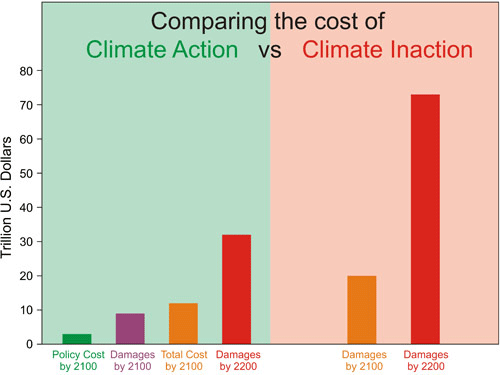
The US would lead by example and be challenging world leaders to do their part by adopting “aggressive” pollution goals of their own.
“The issue is serious, it deserves everyone’s attention,” Ambassador Berry told a climate summit attended by Environment Minister Greg Hunt on Monday. “We know you will continue to work with us – both bilaterally and in multilateral organisations – on the tremendous challenges climate change presents in the region.”
The federal government has promised to reduce emissions by five per cent of 2000 levels by 2020, but will review this target in 2015 as world leaders prepare to hammer out a new binding climate deal.
The US has forged agreements with other major polluters like India and China in the lead up to the 2015 summit, and wants to see climate change on the G20 agenda in Brisbane in November.
Ambassador Berry said the US should work closer with Australia to chase the huge economic benefits posed by the growth of renewable energy. “It’s not only good environmental policy, it’s also good business,” he said.
As Australia’s coal industry winds down, wind energy surges ahead
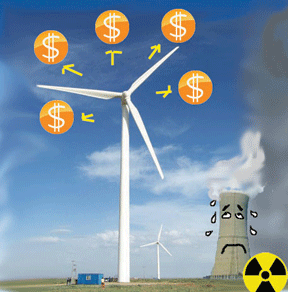 Wind energy surges to record share as coal ebbs May 5, 2014 Peter Hannam Environment Editor, The Sydney Morning Herald Wind energy’s share of Australia’s main electricity market jumped to a record last month, helping to curb emissions from the power sector even as hydro output shrank, according to energy consultancy Pitt & Sherry.
Wind farms, derided last week by Treasurer Joe Hockey as “utterly offensive” blights on the landscape, increased their share of the market to a record 4.6 per cent, up one percentage point from a year earlier, the company said in its monthly CEDEX report.
With major black-coal fired plants such as Liddell and Bayswater in NSW continuing to operate well short of capacity, greenhouse gas emissions from the National Electricity Market for the month were 5.8 million tonnes lower than a year earlier, or down 3.5 per cent.
Coal’s share of the market remained near its record low of 73.8 per cent.
However, the shift away from coal may soon be reversed as politics and markets combine to alter the economics of energy.
The Abbott government remains steadfast in its plans to remove the carbon tax – now at $24.15 a tonne – which has helped make black coal-fired plants, in particular, relatively expensive.
Senior members, including Prime Minister Tony Abbott, have also signalled their intent to weaken the Renewable Energy Target, a move likely to freeze new investments in wind farms………
Broken promise in the offing?
Mark Butler, the opposition’s climate change spokesman, said the Abbott government was “crab-walking” away from its pre-election promise to leave the Renewable Energy Target unchanged at 41,000 gigawatt-hours by 2020.
The government has set up a review of the target, led by climate change sceptic Dick Warburton, with many in the clean energy industry fearing the panel will recommend a delay and or weakening of the goals.
“This is a just another broken promise driven by ideology in face of the clear evidence that this has been a major policy success,” Mr Butler said.
While falling energy demand has contributed to falling emissions, “the big driver” for the industry has been the rise of renewables, he said.
Two-thirds of the emissions drop has been “because renewable energy increased its market share by 25 per cent in the first 12 months” of the carbon tax’s start, he said. http://www.smh.com.au/environment/climate-change/wind-energy-surges-to-record-share-as-coal-ebbs-20140505-zr4rg.html#ixzz30zIKSJIQ
Australia’s coal mining in decline as India and China turn to renewable energy
 Australian coalmining is entering ‘structural decline’, reports says. Oliver Milman, The Guardian 6 May 14 Demand from India and China predicted to falter due to higher uptake of renewables and make huge projects commercially unattractive Coalmining in Australia is entering a “structural decline”, with projects set to become unviable due to unrealistic expectations over the potential to export the fossil fuels to China and India, according to a new report.
The study, by the US-based Institute for Energy Economics and Financial Analysis, suggests that two huge coalmining projects in central Queensland, backed by Indian cash, “are likely to prove uncommercial” due to unfavourable market conditions.
The projects, backed by Adani and GVK, which bought its coal assets from Gina Rinehart in 2011, will attempt to open up vast deposits of coal buried in the Galilee Basin region. Clive Palmer’s China First mine is also slated for completion by 2017, removing a projected 40m tonnes of coal a year for export.
But the IEEFA analysis shows that the wholesale cost of electricity in India, a key export market, is half that of Galilee coal-fired power, making it financially unattractive for the Indian government.
That, coupled with a new focus on renewable energy such as solar and wind, and a falling coal price due to the flood of new resource from the Galilee Basin, will cause significant problems for Australian projects, the study found.
“Renewables are a lower cost, cleaner solution, particularly when the deflationary impact of wind and solar is incorporated,” the study state The price of coal has dropped sharply in the past three years. The mining industry has claimed this is part of a cyclical reverse in fortunes as the resources boom cools.
However, several high-profile projects have been cancelled recently, including the departure of BHP, Anglo American and Lend Lease from the vast mine, rail and port operation required to mine and ship coal from the Galilee Basin.
Tim Buckley, director of IEEFA, told Guardian Australia that India is likely to follow China in looking more to renewable energy than coal-fired power.
“People think India will just follow the same growth of China, but India’s economy has choked on coal energy and it doesn’t need more expensive coal imports,” he said…..
Buckley said China’s huge investment in renewable energy will be replicated, albeit on a smaller scale, by India, influenced by the pro-solar policies of prime ministerial front-runner Narendra Modi. The cost of electricity generation from solar in India has fallen 65% in the last three years.
“The last thing Australia should do is flood the market with extra coal, there’s no way it can handle the number of projects currently in train,” Buckley said…….http://www.theguardian.com/world/2014/may/05/australian-coal-mining-is-entering-structural-decline-reports-claims
Greg Hunt gets his ‘do nothing’ climate policy from Bjorn Lomborg
Lomborg’s particular brand of environmentalism – which says yes, the world is warming but it is nothing to worry about – is particularly appealing to the Coalition government. It is an approach that doesn’t have to get tangled up with opposing the science and also public opinion, while it is able to take a purely economic approach to doing nothing.
Or better yet, do something, but not at the expense of big business.
In fact, it is better to pay big business not to pollute, which makes the debt levy being flagged for the upcoming budget all the more comedic. The A$2.4 billion per year fuel tax credit scheme, which managed to escape the Commission of Audit, are simply handouts that go directly to the immense profits of mining companies.
 The Direct Action path to poverty, The Conversation,5 May 14 David Holmes The current gallery of columnists at The Australian are always interesting to read. There is a core of them that display the views of Coalition politicians only with more colour and erudition, and often more transparently than Canberra soundbites and doorstops would allow.
Where government ministers might be seen attacking an institution or a policy, these columnists are adept at rallying to such an attack, be it on the ABC, human rights, education, health, foreign affairs, the public service and, of course, climate.
One such occasional columnist who chimes in over climate change is the Danish “sceptical environmentalist Bjorn Lomborg. Lomborg is well-known for subordinating the importance of climate change to other global issues such as health and development. His work effectively focuses on short-term solutions to “immediate” problems, arguing that global warming will actually provide a net benefit to the globe up until 2065 by reducing cold-related deaths and improving crop production, after which, he tells us, heat will take over as a health and food security problem.
Lomborg’s disregard for the plight of subsequent generations might appeal to politicians whose sense of time is tightly bound to electoral cycles. But it does not sit well with anyone who has even the smallest appreciation of telos.
In his column last week, Renewables pave path to poverty, Lomborg went all-out attacking renewables, just as the Renewable Energy Target (RET) and Direct Action was beginning to spike in news cycles across the country.
Lomborg is unusual. He is not your regular climate change denier and says, as government ministers do, that climate change is real and that we have to tackle it.
But also like the government, Lomborg’s suggestions for tackling climate change are so riddled with doublethink as to render his claims to have accepted the science as implausible and disingenuous.
Critics of Lomborg’s work on the economics of addressing climate change describe him as a dangerous propagandist working on behalf of vested interests (namely the fossil fuel industry); that he “advocates what he does not believe in”; and that “all he cares about is how he can make the general public react the way that he wants”.
Does this sound familiar? Continue reading
Radiation exposure to workers at Ranger uranium mine – sloppy controls
 Running amok at Ranger Mining Australia, 5 May, 2014 Ben Hagemann“…….The job was to clean out one of the CCD (Counter-Current Decantation) tanks, ready for inspecting and repairing the rubber lining, and to change pump impellers underneath the tank.
A CCD tank is like an enormous, open-topped butter churn, but rather than mastitus-ridden, bovine squeezings, the tank is filled with a mixture of milled ore, water, some kind of flocculant (guar gum, maybe) and of course, sulphuric acid.
If I remember correctly, the acid comes from the leach tanks where the ore sits for a while so that the uranium can dissolve into solution, then that solution is decanted in the CCD tank where the flocculant is frothed up so that it can bond with the uranium and float to the surface, turning the whole lot into one big, bubbly, radioactive milkshake.
Of all the tanks only one of them was shut down so that we could do maintenance, and judging by the look of them, we were the first guys to take on this job in a very long time.
Once drained, the tank was one or two feet deep in the extremely heavy ore slurry and the arms were piled with sulphur sediment, hard as sandstone. We needed to disconnect the pumps below and hose all the sludge down the drainhole in the middle, a task that we were instructed to do with process water.
Now, process water… little did I know that’s the water that was used to “process” the ore… duh.
This means the water contained traces of the uranium in solution, fully dissolved and ready to soak into porous, human skin. Although we wore gumboots, long gloves and faceshields, naturally we wound up completely soaked after a few minutes of waving a two inch fire hose on high pressure, trying in vain to get the dense rock sediment to lift up and go down the drain.
It took four weeks to clean one tank, and that included digging out the gutter around the top of the tank from a scissor lift, as well as smashing all the piled up sulphur residue off the enormous arms of the churn (crawling around the lattice structure with a gympie hammer, bashing our way through and getting covered in the yellow muck).
If this sounds like a horrifying degree of physical contact with some very noxious material, you’d be right. It was about two weeks into the job that management finally got around to giving us our radiation inductions.
There I learned that the water with which I’d been soaking myself was actually radioactive, and you shouldn’t let it get on your skin!
We couldn’t know the degree of radiation we faced, as we weren’t issued with personal radiation monitors (not necessary for shutdown crews, we were told) but workers would reassure us that it wasn’t much.
The next week I took myself to the radiation lab during lunch, where the radiation officers expressed bemusement, then horror when I told them that the grey material all over my shirt was ore.
A quick sweep with the scintillometer revealed slow ticking over my body, which was reassuring, but my leather boots crackled like static on a black and white TV.
They were, as they say in the uranium game, “hot”, and were promptly discarded and replaced with a fresh pair from the stores, along with a full complement of new socks……..
Leaving alone the forgetfulness of management when it came to educating a shutdown crew about the full extent of radioactive hazards, Ranger’s production plant was in pretty bad shape, even to my uneducated eye – It was like the mine that time forgot. There was gridmesh rusted out, full of holes in some spots, so you really had to watch your step on the stairs and catwalks, not to mention the rotted-out, RSJ beams, steel nearly two inches thick you could push a screwdriver through.
I guess that’s what happens when you have sulphuric acid fumes mixing with the sultry, jungle atmosphere- It rots the steel away from under you.
I don’t know whether the site was under-maintained or not, but the fact that a leach tank actually busted open and spilled a full load of radioactive acid slurry last year is a pretty bad sign.
It’s good that ERA is replacing the baffle supports in all the leach tanks, but that kind of corrosion incident points to the prospect that the Ranger plant will be up for a lot more maintenance than that.
It makes me wonder what could happen if ERA were allowed to start a new mine expansion?
Would they look after it? Or would it simply rot away over the years, mismanaged and scraping by on the barest minimum of maintenance?
What do I know? I’m just a simple rigger.
1 This month
17 October, Free Public Talk on Nuclear Issues in South Australia
David Noonan will speak on public interest concerns over the new Roxby Downs Indenture Act 2026 on BHP copper-uranium mining and ore processing in SA, and on how AUKUS may face SA with a High-Level nuclear waste agenda.
Dr Jim Green will discuss international developments in the field of nuclear power including ‘small modular reactors’ and Generation 4 ‘advanced’ nuclear reactor concepts.


Help Aunty Sue Protect Her Land and Sacred Sites From Destructive Rocket Testing.
.

Australians deserve the truth
about
AUKUS – https://aukuspublicinquiry.com/

PETITION – To: Prime Minister Anthony Albanese and the Australian Labor Government

of the week – Australians for War Powers Reform (AWPR)
To see nuclear-related stories in greater depth and intensity

