South Australian State govt aiming for uranium enrichment !
 South Australia digs deep on future of uranium http://www.heraldsun.com.au/news/national/south-australia-digs-deep-on-future-of-uranium/story-fnii5yv7-1226905247217 SHERADYN HOLDERHEAD MILES KEMP THE ADVERTISER MAY 04, 2014
THE State Government’s mining department has continued to explore uranium enrichment, despite the minister saying there is no business case for it. Documents released under Freedom of Information also show the State Government wants to ship the uranium ore already mined in SA through eastern ports to make it more cost effective.
Emails between Manufacturing, Innovation, Trade, Resources and Energy Department executives shows they planned a meeting in December with a University College London Master’s graduate whose thesis showed the State Government should invest in uranium enrichment.

The emails suggested the graduate give a talk to the Olympic Dam Task Force and attached a summary of the paper, which stated that the SA Government should invest in uranium enrichment company URENCO.
The summary states a strategic investment would provide access to profits without the risk of developing a new technology and leaving options open for Australia to construct a future uranium enrichment facility.
Another report prepared for the State Government into how to make the state’s uranium industry more profitable and allow new mines to open suggests eastern states be lobbied to allow shipment from higher-traffic ports such as Sydney, Brisbane and Melbourne. Its report says found government should take a leadership role in lobbying for improvement which included a “discussion document around options for addressing access to east coast shipping ports”. Adelaide and Darwin are the only ports from which uranium shipping is now permitted.
A spokeswoman for Queensland Premier Campbell Newman said there were no plans to export uranium from Queensland ports. A Victorian Government spokesman said that “the proposal is not something that has been considered … Any proposal would need to be assessed to consider environmental implications, port handling and also transport arrangements’’.
In 2011, Mining Minister Tom Koutsantonis, publicly backed by then treasurer Kevin Foley, called for change from the traditional approach of simply mining uranium and sending it offshore.
“We’ve got to value add here in SA. Down the track, I would like to see some form of enrichment, some sort of value add. We have to go out and passionately support the uranium industry,’’ he said at the time.
But in April last year, he said there was no case for it “any time in the near future” because it was not commercially viable.
Mr Koutsantonis said the department was not “investigating” uranium enrichment but that it was “keen to foster relationships between universities” and was often approached to discuss a range of policy issues.
He said that SA Government has not been presented with a viable business case for enrichment, and had not approached the eastern states to use their ports.
Family First MLC Robert Brokenshire said the government needed to “come clean” with their plans for uranium. “They’ve tricked their way back into office and it’s no longer acceptable for them to sidestep important issues on alternative energy sources,” he said.
“Why are they doing secret work, what are their intentions? And if they’re not considering it, then why allow the department to look at options?”
Some Australians are finding Joe Hockey’s opinion on wind energy offensive and silly
 Joe Hockey’s turbine huff stokes coals of discontent WA Today, 4 May 14
 Simeon Glasson Mr Hockey is right. As a lover of nature I agree with him 100 per cent. Wind farms are an offensive blight on nature’s beauty. As are open-cut coal mines, gold mines, uranium mines, and iron ore mines. The buildings around Sydney Harbour including the Opera House and Harbour Bridge surely spoil the sublime beauty of what must have been a pristine environment before white man arrived. LNG terminals on the (no longer so) Great Barrier Reef? Say no more. I suggest we do away with human civilisation altogether – leave the planet in all its original glory. Hmmm – maybe it’s too late for that.
So unless Mr Hockey wants to live in the Dark Ages let’s keep the wind farms – they look at least as good as some of the alternative sources of energy without the enormous environmental cost.
Andy Royal Joe Hockey is entitled to dislike wind turbines and hold other foolish opinions but he should not try to ram his “ideas” down other people’s throats or, worse, threaten to withdraw government support for green power initiatives designed to help secure a safe and secure future for our children.
Kevin Atkins Joe Hockey, of North Sydney, the epicentre of ugly concrete and steel monstrosities, is offended by a few scattered wind turbines in country Australia which are a “blight on the landscape”. Astonishing.
Doug Steley Joe Hockey says wind farms are “utterly offensive” and “a blight on the landscape”. I did not see him in Morewell when it was covered in toxic choking smoke and ash from the brown-coal-fired power station mine fire recently.
If he thinks a coal-fired power station is more attractive than wind turbines then I would suggest he moves and chooses to live closer to one of them.
Mona Finley Mr Hockey’s opinion of wind farms as ‘‘a blight on the landscape’’ could well go down as one of those ‘‘silly chump’’ statements that will have future generations spluttering with disbelief. Beauty is truly in the eye of the beholder, and every time I have caught sight of wind turbines, whether in Europe, New Zealand, or Australia, they appeared to me like art installations or sculpture – gleaming white, so tall and graceful, vanes turning in a meditative manner – and on top of all that, they’re producing lovely pollution-free energy. What’s not to like?
Anne Cooper I see the wind farms on the road to Canberra and am transfixed by their clean lines and simple efficiency. Conversely, a drive through the blighted Hunter Valley coal region is truly offensive. Get some perspective, Mr Hockey. Wind turbines are just big versions of the iconic Aussie windmills.
Thos Puckett Given his tilt at “utterly offensive” wind farms is the Treasurer the Joe Quixote of the 21st century?…….http://www.watoday.com.au/comment/smh-letters/joe-hockeys-turbine-huff-stokes-coals-of-discontent-20140504-zr4ae.html#ixzz30sXmyRE3
Australia’s Treasurer Joe Hockey on the attack against wind energy
 What hope green energy? Hockey says turbines “utterly offensive” http://reneweconomy.com.au/2014/hope-green-energy-hockey-says-turbines-utterly-offensive-72824 By Giles Parkinson on 2 May 2014 The prospects of a re-start of large scale renewable energy projects in Australia dimmed further on Friday when Treasurer Joe Hockey described the sight of wind turbines as “utterly offensive.” Hockey, speaking to ultra-conservative shock-jock Alan Jones on radio 2GB, said wind turbines were a “blight on the landscape” and vowed to axe “the vast number” of environmental agencies
Hockey’s comments were made after Jones asked him about the “nonsense” of climate change, and renewable energy policies, and asked why – when the government had rejected support for SPC Admona and car makers – was it “chasing” Thai and Chinese-made wind turbines.
This is the conversation from there:
Hockey: “If I can be a little indulgent, I drive to Canberra to go to parliament and I must say I find those wind turbines around Lake George to be utterly offensive.”
Jones: “Correct.”
Hockey: “I think they’re just a blight on the landscape.”
Jones: “Correct. The people you are talking to are paying for them. When are you going to knock them off?”
Hockey: (chuckling) “Well, we can’t knock those ones off, they are into locked into a scheme. There is a certain contractual obligation, I’m told, associated with those things. But you will see in the budget we will address the massive duplication that you have talked about, the vast number of agencies involved in the same thing. We have considered that very carefully. When I say we’ve seen the age of entitlement, that applies to business as much as it applies to the rest of us.”
Hockey also told Jones that the government would cut a swathe through environmental agencies, including, he said, the Clean Energy Regulator, which environment minister Greg Hunt says we need to manage and operate the emissions reduction fund in the ludicrous Direct Action scheme.
Hockey probably meant the Clean Energy Finance Corporation. Attention to detail has not been the government’s strong point, and it has been determined to dismantle any authority or scheme with the words “clean” or “climate” or “carbon” in front of it – the carbon price, the Climate Commission, the Climate Change Authority – even the Cleantech awards had to be renamed.
The CEFC, along with the Export Finance Investment Corporation, attracts private funds, and delivers a positive return to the government. But even EFIC has been slated for closure in what the AFR’s Chanticleer columnist described as one of a series of “brain explosions” from the Far Right revealed in the National Audit Commission.
The wind turbines around Lake George that Hockey finds so offensive are part of Infigen Energy’s Capital wind farm (pictured). Neighbouring regions areas are a hot-bed of anti-wind farm activitism, particularly from business leaders such as Maurice Newman, Abbott’s hand-picked head of his business advisory body.
Local state MP Pru Goward, the newly appointed minister of planning for NSW, has described wind turbines as “hideous”, and federal MP Angus Taylor is one of the many fierce opponents of wind farms in the Coalition. Amid all this, the ACT government is trying to commission 200MW of wind capacity as part of its plans to go 90 per cent renewable.
The federal government, on the other hand, appears comfortable with 90 per cent fossil fuels. It has commissioned a review panel to assess the renewable energy target, and has chosen a team led by climate change denier Dick Warburton, who has said that nuclear energy is the only viable alternative to coal, to make a judgement on the scheme that is designed to bring in more wind and solar energy to the energy system.
The constant uncertainty about green energy policy has meant that no new large scale wind farms have been committed in Australia since 2012 – apart from some solar farms supported by other schemes, and the massive investment by Australian households in rooftop solar. The emergence of solar, and soon enough storage, as a cost competitive alternative to energy delivered through expensive networks, is causing Australia’s major utilities to reassess their business models, and the way they deliver electricity. However, they lament that politicians and regulators are looking to the past, rather than the future.
They have argued, as has Tony Abbott, that the renewables scheme is very expensive, even though regulators note that it adds only about 3 per cent to consumer bills.
The Clean Energy Council this week produced a report that suggested that the fall in wholesale prices caused by the influx of renewables would offset the cost of certificates and actually lead to cheaper bills for consumers in the medium to long term.
This assessment was rejected by Hunt this week. And in a further sign of the government’s, and the panel’s hard-line attitude to renewables, Warburton said a complete dismantling of the renewable energy target could not be ruled out, even though this would lead to billions of dollars in losses, and to the removal of the “contractual obligation” that Hockey appeared to lament.
The Australian Renewable Energy Agency is also in danger of having its funding stripped and of being absorbed back into a government department.
As solar energy storage comes in, electricity costs will become a whole new ball game
Storing solar power is the key to cutting energy bills, CSIRO says May 2, 2014 Peter Hannam Environment Editor, The Sydney Morning Herald :”…………From the roofs of 1.3 million Australian homes – with about 50,000 added in the first three months of this year – PV panels are already hurting baseload fossil-fuel generators by flattening the peak demand periods that used to deliver windfall profits.
The real disruption, though, will come if batteries linked to solar PV and other renewable energy sources such as wind become affordable.
“The whole system is built on the fact that you can’t store energy,” Dr Graham said. “If electrical storage could actually become a reality that really turns the whole system on its head.”
“If you’ve got that, (consumers) can potentially disconnect from the grid.”……….
Don’t pull the plug just yet, said Damien Moyse, research director at the Alternative Technology Association.
“You have to pay $15,000 to $20,000 now for batteries” that would enable most families to exit the grid,” Moyse said, so making the move economic “is a fair way off at the moment”.
Entrepreneurs such as Elon Musk, though, plan to bring that day a lot closer. The US billionaire is close to picking a location for a $US5 billion ($5.4 billion) “gigafactory” to mass produce batteries for his Tesla electric cars, aiming to drive down costs by 30 per cent.
“Storage is where PV was five or 10 years ago,” Tom Werner, SunPower’s chief executive said during his first visit to Australia this week. “Consumers will go from being essentially passive to having total control of your energy bill within five to 10 years.”
SunPower, which last month joined Google to lease out PV to about 18,000 US households, will soon start a pilot in Australia to finance PV and storage with plans to broaden the offering “in a small number of years”, Werner said.
However, big incumbent generators, such as Origin Energy and EnergyAustralia, have made it clear they plan to resist further erosion of their business models………
The clean energy industry fears the review panel, led by businessman and climate change sceptic Dick Warburton, will recommend the target be delayed or cut.
For the solar PV industry, though, the worry is the hammer will fall hardest on the small-scale renewable energy scheme that gives an upfront credit for up to 15 years on power their panels will produce.
Ric Brazzale, president of industry group REC Agents Association, said the sale of the small-scale technology certificates brought the cost of a typical 3.5-kilowatt capacity PV panel down about a third from $9500 to $7000.
“People are very concerned about the future of the (solar PV) support,” said John Grimes, chief executive of the Australian Solar Council.
The industry is on course to install 800 megawatts of PV this year, nudging the total towards 4 gigawatts, a rate that would probably halve next year without the aid, Grimes said.
Technology advances, though, will eventually catch up with incumbents. The CSIRO unit has moved on, and among other things, is working on flexible “organic” solar cells.
“They can be less efficient (than silicon-based PV) but they can be more ubiquitous,” Dr Graham said. “It’s the whole roof, not just what you have to attach to it.”…….http://www.theage.com.au/environment/energy-smart/storing-solar-power-is-the-key-to-cutting-energy-bills-csiro-says-20140502-zr2zw.html
Uranium industry not economic for Mt Isa, and fraught with environmental problems for Queensland
 Uranium debate heats up in Mount Isa Queensland labour senator Jan McLucas says the state’s uranium deposits are too small to warrant developing the industry. ABC Rural By Virginia Tapp, 1 May 14
“These mines at Valhalla and Westmoreland are not huge deposits, they will not employ large numbers of people like Mount Isa, Cloncurry and Century have done.
“These are small mines and I don’t think they are the answer to the question of employment in the Mount Isa region.”…….Senator McLucas also claims there is not enough information about managing uranium mines in areas that experience intermittent periods of very high rain fall and flooding.
She says parts of the abandoned Mary Kathleen uranium mine, situation between Mount Isa and Cloncurry, are still radioactive.
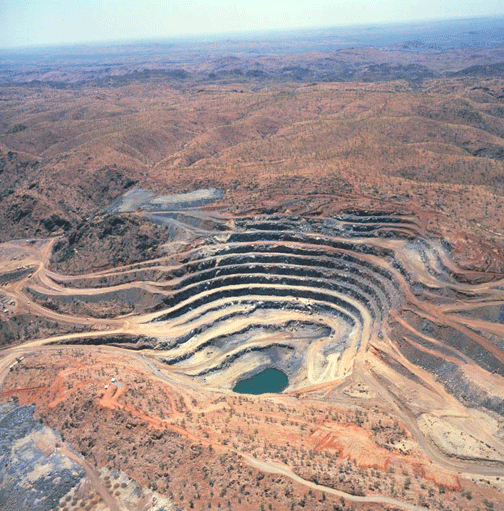
“The residents of Mount Isa are still living with the results of that mine and the inadequate capping of the spoil and the contamination of the land that even graziers today won’t go near.”…….
[Queensland Department of Natural Resources and Mines and the Department of Environment and Heritage Protection joint statement] ……”We are still assessing the condition of the Mary Kathleen site and looking at whether it could be mined again in the future.
“Contamination issues at the site may not have been properly addressed in the past.”…..http://www.abc.net.au/news/2014-05-01/uranium-debate-queensland/5423232
A new model of small scale solar power production to be piloted in Australia
Australia to pilot new power plan GREGG BORSCHMANN, ABC Environment1 MAY 2014 Householders have the potential to disconnect from the grid under a new system proposed by Sunpower
One of the largest solar companies in the world has chosen Australia as the proving ground for a new model of power production that promises to give householders more control – and cut bills. ‘WHAT DO YOU DO when the sun doesn’t shine?’
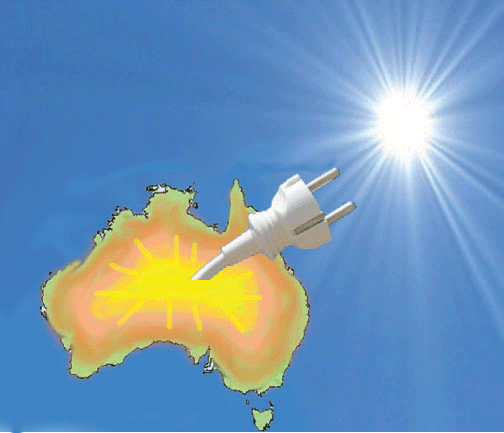
It’s been one of the criticisms levelled at the solar panels that are now so common on residential and commercial roofs across Australia.
Australia has the world’s greatest penetration of solar photovoltaic panels (PV). By the end of 2013, more than 3,000 megawatts of small-scale solar was installed across 1.1 million households, with the average system now 3.9 kilowatts in size.
Now Sunpower Corporation – which builds solar panels but also large-scale solar plants – has flagged that it will be using Australia as a global testing ground for a new model for providing electricity.
An announcement on a pilot project in Victoria, focused on the economics of storing domestically produced solar power, is expected in the next two months.
For years, it’s been keenly understood that the next big thing – the Holy Grail if you like for solar – would be the ability to store energy generated from solar panels for later use at a reasonable cost. At the moment, domestic solar PV generators can be supplying power into the grid but only getting paid 8 cents kw/hour during daylight hours, and then be charged as much as 30 cents kw/hour if they use electricity in the early evening peak. Solar storage gets around this problem.
For consumers it could mean being able to manipulate power use – and cut bills by avoiding expensive peak electricity times.
While Sunpower operates in 10 countries across the globe, president Tom Werner has told the ABC that his company has chosen Australia as the country to prove up the economics of power generation from many small-scale sources.
“Australia has a great solar resource,” says Werner. “We see penetration rates in Australia that are higher than other parts of the world, it has frankly expensive power and therefore solar can compete, [and] it has largely de-regulated the electricity markets, so it opens the market up to innovative structures”.
Perhaps the most important of those ‘innovative structures’ is what’s called distributed power generation. “What’s cool is that the consumer will be their own generator and then they’ll use things like storage and energy management to control load. When you combine the control of load – or when you use electricity and how much you use – with generation and being able to use storage … the combination of those two become really, really powerful…
“We see Australia as a market where we can do that early on, learn from that and do that in other parts of the world”.
It seems at first blush impossible to believe. Solar PV installations have slowed since the winding back of generous tariffs for homeowners supplying power to the grid. And then there’s all the uncertainty associated with yet another government review of the 2020 Renewable Energy Target (RET).
But Werner believes Sunpower’s model could be a game changer.
“Think of transitions like wired phones to cell phones to smart phones – it’s going to take a while, but in the next 10 years the way we get electricity will be considerably different.
“To say that the landscape will look a lot different in the next five to ten years is virtually certain, I think the disruptive nature of cost effective renewable has already happened, and it’s very hard to put that genie back in the bottle, so to speak”.
He also believes that distributed solar energy generation can provide cheaper power for consumers.
“We can build distributed generation and have economic energy and that’s what consumers want, they want renewable energy, and they want it to be economic… so the more solar there is, the more economic energy is going to be in Australia. If you combine that with economic storage and energy management and then you add creative financing schemes like we have in the US, you could have an offering where the consumer has way, way more control over their energy bill than they do today”.
Disconnecting
Some retailers are already offering finance packages and loans for home solar systems. Chris O’Brien, General Manager, Sunpower Corporation Australia, says consumers can install solar PV systems with no upfront cost. The loan repayments are covered with the savings on their energy bill, and they can be ahead from year one.
If careful energy use and cheap, sustainable storage is added to this offering, it has major implications for the future of the grid – the network of poles and wires in Australia. http://www.abc.net.au/environment/articles/2014/05/01/3995957.htm
Renewable Energy Target 2013 Administrative Report from Australia’s Clean Energy Regulator
The report provides information about how the Renewable Energy Target is performing against its legislated objectives and details information about who and what is producing renewable energy and benefiting from the scheme.
Some highlights from 2013 report, include:
- 26 renewable energy power stations were accredited in 2013, bringing the total number accredited renewable energy power stations to 394.
- 238,769 small-scale renewable energy system installations were validated by the Clean Energy Regulator in 2013. This saw the total number of small-scale systems installed under the Renewable Energy Target exceed two million.
- 90 liable entities in 2013, who achieved 99.97% small-scale technology certificate compliance and 99.98% large-scale generation certificate compliance.
- more than 20.4 million (20,457,324) small-scale technology certificates and more than 14.6 million (14,649,036) large-scale generation certificates were validly created in 2013.
Australia’s Anti Environment Minister either doesn’t understand renewable energy modelling, or is working for the coal industry
Hunt disputes CEC modeling on renewable energy target http://reneweconomy.com.au/2014/hunt-disputes-cec-modeling-renewable-target-82441 By Giles Parkinson on 1 May 2014 Every day there is a new reason for the renewable energy industry in Australia to become increasingly despondent about its future.
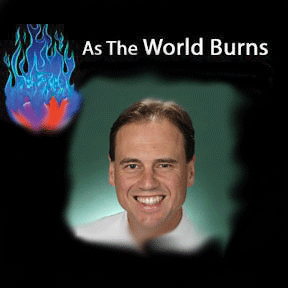 On Thursday, it was environment minister Greg Hunt, who ostensibly has some influence over renewables policy, taking issue with modelling released by the Clean Energy Council which showed thatconsumer bills would fall, not rise, if the RET was retained, or even increased. Hunt said he had read the report, and agreed with some of it, and disagreed with other bits. On the latter, it appeared to be the idea of a “negative cost” of the RET policy that “did not make sense” to the minister for the environment. Hunt said that if that was the case, then renewable energy projects would not need a subsidy. “Some say that it is a negative cost, but that doesn’t make any sense because you wouldn’t need subsidy if that was the case. It is effectively a cross subsidy from one form of electricity to another, ” he told the Municipal Association of Victoria Environment Conference in Melbourne, in response to a question from Surf Coast Shire Councillor Eve Fisher.
The CEC modelling said that the cost of the RET, in the form of certificates bought by retailers and the cost passed on to consumers, would be around 3-4 per cent of electricity bills – a figure agreed on by Hunt. But the CEC modelling also noted that this impact would be offset by the reductions in the wholesale price, caused by the presence of more renewable energy, which has a minimal short-run cost and forces wholesale electricity prices down. These are conclusions arrived at elsewhere in the world, including by the International Energy Agency, and for what it’s worth is the very argument presented by the fossil fuel industry, as it seeks to have the RET reduced or dismantled entirely. They fear that their profits will be eroded by the expected fall in wholesale prices. They argue that the wholesale cost reductions should not be passed on to consumers. The reason why a RET is warranted – apart from its obvious environmental benefits – is that it requires retailers to write contracts for new wind or solar farms. Without this mechanism, they wouldn’t be built, because of an oversupply of coal and gas fired generators. The incumbents simply want to keep operating these as long as they can. The fact that Hunt doesn’t understand how this works suggests one of two things. The first is that he is possibly confusing the concept of negative cost abatement with his emissions reduction fund, which will allocate money to the cheapest bid in an auction. (Hardly likely that any of those bids would be negative, otherwise it would be the private sector giving a grant to the government.) The Abbott government is already struggling with the concept of negative abatement, given its refusal to allow the Clean Energy Finance Corporation to continue despite its promise that it could do the same by unlocking vast sums of private money. It also suggests that Hunt’s instinct is to side with the fossil fuel industry rather than consumers, which is why the Abbott government insisted on the RET review in the first place, and insisted it be led by the likes of Warburton, rather than the Climate Change Authority, which made the very point that the Clean Energy Council was making this week.
Australia to be hit by $40 billion costs due to Tony Abbott’s climate ppolicies
 Tony Abbott’s climate policies a $40 billion budget slug, says Climate Institute – Peter Hannam
Environment Editor, The Sydney Morning Herald 1 May 14, The Abbott government’s changes to existing climate change policies would cost the budget as much as $40 billion by 2020, according to the Climate Institute, and the cost will blow out even further if it weakens the renewable energy target.
The estimated costs stem in part from payments to polluters to curb greenhouse gas emissions under the government’s Direct Action emissions reduction plan. This tally includes the $2.55 billion for the first four years of the Emissions 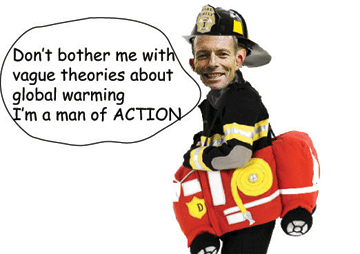 Reduction Fund and an estimated $1.2 billion annually after that.
“This is a friendless piece of policy and not many people are standing up to defend it,” said John Connor, chief executive of the Climate Institute.
A bigger blow to the budget, though, will come from the loss of the carbon tax revenues if, as expected, the new Senate votes to repeal it after July 1. Current laws indicate the price – now a tax but due to convert to a floating price by mid-2016 at the latest – will bring in more than $18 billion.
That combined tally, at about $24 billion, swells to more than $40 billion by 2020 if the Abbott government sticks with its plan to block the purchase of cheaper international emission reductions to meet domestic commitments, the institute said……..
The costs of the Direct Action will balloon further if the government undermines other policies limiting carbon emissions, such as the Renewable Energy Target. The target, now set at supplying 41,000 gigawatt-hours of renewable energy by 2020, is currently being reviewed by businessman and climate change sceptic, Dick Warburton.
The current climate policies of the government are “a growing slug on taxpayers, and barely tenable now”, Mr Connor said. “If they start to weaken other measures, they’ll have to buy more” carbon abatement, he said.: http://www.smh.com.au/federal-politics/political-news/tony-abbotts-climate-policies-a-40-billion-budget-slug-says-climate-institute-20140430-zr1yh.html#ixzz30V7Nazbj
Warren Mundine helping uranium mining companies to get Aborigines off their land?
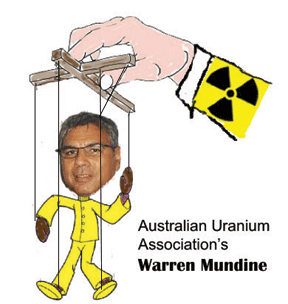 Cut land councils, says Warren Mundine PATRICIA KARVELAS THE AUSTRALIAN MAY 01, 2014 TONY Abbott’s top adviser on indigenous affairs has called for the reform of land rights and the slashing of the number of land councils with gatekeeper powers over development.
Prime Minister’s Indigenous Advisory Council chairman Warren Mundine also called for an end to the requirement to establish a continuous connection with land to establish native title, arguing it “discourages indigenous people from moving away”.
In an address to the West Australian Chamber of Minerals and Energy, Mr Mundine attacked green groups for holding up indigenous development.
“I’m not aware of one new development project in mining, energy or infrastructure that has been supported by green groups,’’ he said yesterday…….http://www.theaustralian.com.au/national-affairs/policy/cut-land-councils-says-warren-mundine/story-fn9hm1pm-1226901405997#
Clive Palmer’s poor record on Aboriginal relations –
Clive Palmer firm Mineralogy’s ‘poor’ indigenous relations HEDLEY THOMAS AND PAIGE TAYLOR THE 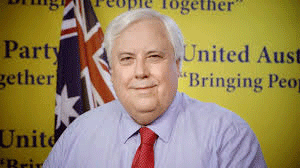 AUSTRALIAN MAY 01, 2014 CLIVE Palmer’s flagship company Mineralogy has a “particularly poor” record of working with Aborigines, who say their rights and culture have been trampled in his pursuit of mineral wealth on sacred sites.
Mr Palmer’s new political merger with three indigenous Northern Territory politicians comes amid his expressions of grave concern about the health and poverty of Aborigines.
But an examination by The Australian of findings by magistrates in mining court and native title cases show his main company has failed to act in good faith, flouted rules, operated combatively, had little regard for indigenous landowners and may even have destroyed ancient burial sites.
A key witness and senior member of the native title claim group whose evidence was accepted by the mining court, Mathew Sampi, said yesterday he had no confidence in Mr Palmer as the tycoon had broken past pledges to spend money on indigenous health.
“We don’t believe anything he says now,’’ said Mr Sampi, who represents the Kuruma Marthudunera people and grew up fishing and hunting in the Cape Preston area in the Pilbara, near an iron ore project built by Chinese companyCITIC Pacific.Findings by magistrates include that Mr Palmer’s company and staff exhibited “a sense of absolute entitlement in relation to mining endeavours” and “adopted an unduly confrontational approach” with indigenous owners. One of Mr Palmer’s top executives was found to have been an unreliable witness and the architect of “misleading” sworn documents.
Trumpeting the defection of the three indigenous MPs to his Palmer United Party this week, Mr Palmer appealed to indigenous voters to trust his commitment to reduce child deaths above other parties.
“He can suck a lot of Aboriginal people in and some of them really don’t know what they have been talked into. He seemed real good in the beginning, saying he was going to help the Aboriginal people in the area. They destroyed a lot of things, they disturbed special places where there used to be ancient tools.”……
In an earlier Native Title Tribunal case, Mineralogy was found to have given a “take it or leave it” ultimatum to indigenous owners of the land the company wanted to mine. Tribunal deputy president John Sosso found that Mineralogy had not acted prudently, reasonably or responsibly in its dealings with Aborigines. In a case involving the Kuruma Marthudundera group, elders Neil Ricky Finlay and Mr Sampi told the court of bad experiences with the company in the Pilbara region, which includes sacred burial grounds near the Cane River and the town of Karratha.
The Mining Court’s magistrate, Elaine Campione, described the two elders as “respected, senior and knowledgeable men” and she accepted their evidence………http://www.theaustralian.com.au/news/investigations/clive-palmer-firm-mineralogys-poor-indigenous-relations/story-fnk76wj3-1226901468114#
A treaty with Australia’s Aboriginal people
 TREATIES ARE AGREEMENTS BETWEEN EQUALS IC Magazine, by Callum Clayton-Dixon on April 28, 2014 All of a sudden [Australia’s] conservative coalition government is welcoming discussion about something we have demanded for decades, something Prime Minister Bob Hawke promised to deliver by 1990, and a proposal the current Labor opposition has labelled “stupid”.
While Herald Sun columnist Andrew Bolt claims treaties will cause “racial division”, Indigenous Affairs Minister Nigel Scullion says they are “agreements between equals” and considers this to be one of the issues Abbott’s Indigenous Advisory Council (IAC) should be looking at.
However, many would dispute whether a handpicked government advisory body has the mandate to control such a debate. The nature of any treaty process must be owned by Aboriginal people on the ground.
WHAT IS OUR STATUS?
Before going any deeper, it’s probably a good idea to take a step back and have a look at what exactly is our status as First Nations peoples. Continue reading
Bernie Fraser on ABC radio “sick and disappointed” about Abbott’s attack on renewable energy

The price of power http://www.abc.net.au/radionational/programs/backgroundbriefing/
Abbott’s renewables attack makes Fraser “sick and disappointed” http://reneweconomy.com.au/2014/abbotts-renewables-attack-makes-fraser-sick-and-disappointed-19255 By Giles Parkinson on 28 April 2014
Fraser says investment in large-scale renewables was being cut back and delayed, and it was quite likely that the current 41,000GWh target would not be reached because of the uncertainty caused by Abbott’s new RET review. The CCA in late 2012 rejected attempts by the incumbent coal-fired industry and network operators to wind back the RET, saying it had clear benefits and little cost to consumers.
However, one of its chief recommendations, to replace the two-yearly review with a four-yearly review to provide the market with certainty, was not adopted by the then Labor government, clearing the way for Abbott to commission another review. This review, being led by a panel led by climate change denier and pro-nuclear advocate Dick Warburton, rather than the CCA, has effectively stalled investment.
“Investment is actually being cut back and delayed, and I think because of that I think it is apparent that the 41,000GWh for large-scale renewable energy power plans it not going to happen,” Fraser told the ABC Radio National’s Background Briefing program.
“ I think that is what the opponents and the critics of renewable energy want to see.” Asked about the political rhetoric around renewables in Australia, Fraser said:
“It makes me feel sick and disappointed. Policy makers need to look beyond short-term economic considerations and the interests of some of the big companies, and to longer term community interests. That’s what governments are supposed to do. Unfortunately, it’s not happening at the present time.
“It’s very disappointing that we are we falling behind, and we are falling behind what many other countries are doing.”
Fraser’s comments about the stalling in projects is supported by data that shows no new large-scale renewable energy projects have been committed since the start of 2013. The only four projects that are going ahead are those supported by either the ACT government’s auction scheme, the now defunct solar flagships proposal, and the Clean Energy Finance Corporation, which the government wants to close.
The appointment of Warburton, the narrow terms of reference that ignores many of the benefits of renewables, and the hiring of a consultancy firm whose highly contested modeling formed the basis of the coal industry’s attack on the RET in 2012, has left the renewables industry despondent about its future.
The Australian Solar Council predicts that the entire government rebate for small-scale rooftop systems could be removed. Larger project developers believe that the 41,000GWh will be severely diluted.
“We know that the government is going side with big business,” ASC’s chief executive John Grimes told the program.
“They want to protect the big utilities. And the way they will do that is to eliminate all support for rooftop solar. And we think that that’s outrageous.”
Matthew Warren, the head of the Energy Supply Association of Australia, which represents major suppliers, says the RET is “broken” and needs to be wound back.
The ABC said that neither Industry minister Ian Macfarlane, whose portfolio covers energy, nor environment minister Greg Hunt would agree to be interviewed for the program.
(We recommend the program as an excellent backgrounder on the economics and the politics of renewables. RenewEconomy even makes some cameo appearances!)
Abbott’s Direct Action plan will cost tax-payers, not the polluting industries
Direct Action transfers emission cutting costs from polluters to taxpayers, SMH, April 26, 2014
“…..the Abbott government’s official position is that greenhouse emissions created by humans are contributing to the dangerous warming of the planet, and that it must do something about it. Precisely what this government proposes to do is a matter of great public interest.
So it was unhelpful that Hunt chose to release those details – as scant as they were – shortly before the close of business on the eve of the Anzac Day long weekend.
Taxpayers have every reason to be sceptical about his motives. They, after all, will be the ones paying for the government’s so-called Direct Action climate change strategy. Its centrepiece is an ‘‘emissions reduction fund’’, a pool of $2.55 billion of taxpayers’ money in the first four years, from which some of the nation’s biggest polluters will be paid incentives to cut their greenhouse gases.
To be clear, creating this fund will transfer the cost of cutting emissions from the polluter to the taxpayer, should the government succeed in pushing its bill through the Senate.
The fund would displace both the carbon tax and the emissions trading scheme that had been advocated not only by Labor but by the Howard government in 2007. ‘‘To reduce domestic emissions at least economic cost, we will establish a world-class domestic emissions trading scheme,’’ the Howard policy had promised.
The Liberals now in power may still believe in market forces, but not yet for carbon abatement. Instead of making the biggest emitters pay, they are asking taxpayers to reward them for reducing their pollution. This would be done by means of a ‘‘reverse auction’’. The firms proffering the lowest bids – the least expensive way to reduce emissions – would get government subsidies…….
government is asking taxpayers to relieve industry of the cost of carbon abatement at the same time that it tells Australians they must make many other sacrifices. …….
The case for shifting the carbon burden from polluters to taxpayers, however, is yet to be made. The government still needs to convince Australians and a hostile Senate.
It could have done much better than calling a news conference at 3pm on the eve of Anzac Day to produce a flimsy policy in the hope that nobody would notice. ……. http://www.smh.com.au/comment/smh-editorial/direct-action-transfers-emission-cutting-costs-from-polluters-to-taxpayers-20140427-zr04d.html#ixzz30DsXmZG3
Aboriginal climate ambassadors assess impact of climate change
 Indigenous ambassadors assess climate impact on native land SBS World News, Two young Indigenous climate ambassadors have been touring Australia to document the impact of the changing natural environment on traditional communities. By Gary Cox Source NITV News, 27 April 14 Narelle Long and Malcolm Lynch were the first young Indigenous people to set foot in Antarctica back in 2012.
1 This month
17 October, Free Public Talk on Nuclear Issues in South Australia
David Noonan will speak on public interest concerns over the new Roxby Downs Indenture Act 2026 on BHP copper-uranium mining and ore processing in SA, and on how AUKUS may face SA with a High-Level nuclear waste agenda.
Dr Jim Green will discuss international developments in the field of nuclear power including ‘small modular reactors’ and Generation 4 ‘advanced’ nuclear reactor concepts.


Help Aunty Sue Protect Her Land and Sacred Sites From Destructive Rocket Testing.
.

Australians deserve the truth
about
AUKUS – https://aukuspublicinquiry.com/

PETITION – To: Prime Minister Anthony Albanese and the Australian Labor Government

of the week – Australians for War Powers Reform (AWPR)
To see nuclear-related stories in greater depth and intensity

