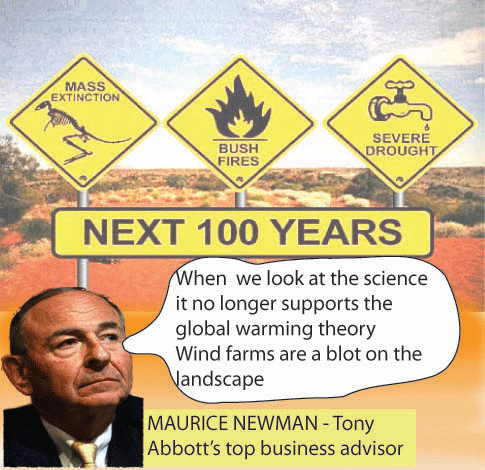
Maurice Newman, Abbott’s top adviser, informs us that climate change is not real!
 No evidence that man has caused warming Australian Broadcasting Corporation, Lateline Broadcast: 22/04/2014 Reporter: Emma Alberici
Maurice Newman, the chairman of the Prime Minister’s Business Advisory Council discusses climate change and says that there is little correlation between carbon dioxide and the warming of the planet.
Transcript
EMMA ALBERICI, PRESENTER: One of Tony Abbott’s first acts in Government was to appoint Maurice Newman as the head of his Business Advisory Council. Mr Newman is the former Chairman of both the Stock Exchange and the ABC. He’s our guest this evening and he joined me earlier in the studio for this exclusive interview. ……..
EMMA ALBERICI: It’s no secret that you don’t agree that man-made CO2 is causing global warming. Given there is now consensus among 97 per cent or so of climate scientists across the world that the view – around the view that human activity is responsible for climate change, what would it take to convince you?………
MAURICE NEWMAN: I just look at the evidence. There is no evidence. If people can show there is a correlation between increasing CO2 and global temperature, well then of course that’s something which we would pay attention to. But when you look at the last 17.5 years where we’ve had a multitude of climate models, and this was the basis on which this whole so-called science rests, it’s on models, computer models. And those models have been shown to be 98 per cent inaccurate.
EMMA ALBERICI: By?
MAURICE NEWMAN: By Roy Spencer, who’s carried out a thorough review of all of the models and the empirical data which against both land-based and satellite-based measuring. And they were found to be wrong………
EMMA ALBERICI: He is. He was at NASA. His colleagues at NASA disagree with him…………
Australian uranium miner Paladin continues its revenue fall
 Paladin’s revenue continues to slide Revenue for uranium miner Paladin Energy fell in the three months to the end of March.
The company’s sales revenue of $US88.56 million in the three months to March 31 was down from $US106 million in the same period a year earlier.
Its average sales price in the March quarter was $US36.82 per pound, down from $US38.40 in the first six months of the 2013/14 financial year, and $US55.22 in same quarter a year earlier…….http://www.sbs.com.au/news/article/2014/04/22/paladins-revenue-continues-slide
Australian uranium miner Paladin’s production declines
During the quarter under review, Paladin reported a combined production of just over two-million pounds from its Kayelekera and Langer Heinrich mines. This compared with the 2.2-million pounds of uranium oxide (U3O8) in the previous quarter.
The Kayelekera operation produced 696 710 lb during the quarter, compared with the 777 015 lb produced in the previous three months.
Paladin suspended operations at Kayelekera in February this year, citing the depressed price of U3O8, and the unsustainable cash demand to maintain the loss-making operation.
Production at the Langer Heinrich operation, in Namibia, declined to 1.39-million pounds during the three months to March, compared with the 1.43-million pounds produced over the three months to December……..http://www.miningweekly.com/article/paladin-production-declines-on-kayelekera-close-2014-04-22
Clive Palmer says that Abbott’s “Direct Action” climate policy useless and a waste of money
 Direct Action is a waste of money: Palmer Herald Sun, 21 April 14 FEDERAL MP Clive Palmer has strongly indicated his party won’t support the Abbott government’s climate change direct action plan, labelling it a “token gesture” and a waste of money.
The Palmer United Party leader and mining magnate said the money allocated for the policy should be used for pensions, which could be under review in the May budget.
Mr Palmer said the rights of pensioners were more important and had greater priority than “a token gesture to addressing carbon issues”…….http://www.heraldsun.com.au/news/breaking-news/direct-action-is-a-waste-of-money-palmer/story-fni0xqi4-1226891204355
British-Australian mining giant Rio Tinto and uranium deaths in Africa
 Uranium kills in Namibia http://www.news24.com/Columnists/AndreasSpath/Uranium-kills-in-Namibia-20140422 2014-04-22 Andreas Wilson-Späth
That uranium is a radioactive and toxic substance with potentially lethal impacts on the people who dig it out of the ground is generally glossed over by those among us who argue for nuclear power as a clean, green, safe and sustainable source of electricity.
Along with other intractable problems faced by the atomic energy industry – like its propensity to lay to waste entire landscapes if and when things go wrong and the fact that we still don’t have a long-term solution for storing its noxious waste products – this is not in dispute. It’s merely a matter of unintended side-effects. Collateral damage.
For uranium miners in Namibia, however, their occupation in proximity to the metal has much more first-hand and personal consequences. A report soon to be released by Earthlife Namibia and the Labour Resource and Research Institute argues that long-time workers at the Rössing uranium mine are routinely exposed to unhealthy working conditions, radiation and dust.
The survey of current and former Rössing employees suggests that an anomalous number of them are dying of cancer and other mysteriously unexplained illnesses caused by their working conditions.
Rössing, which is located in central Namibia and employs over 1500 people, is majority owned (69%) by British-Australian mining giant Rio Tinto. The next biggest shareholders of the mine are the government of Iran (10%) and our own Industrial Development Corporation (10%).
Rio Tinto officials have consistently denied that they’re to blame for any harm, insisting that their operations at Rössing and elsewhere, including their copper, gold, coal, bauxite, iron ore and diamond mines around the world, are well monitored and run ethically, for the benefit of local communities, respecting human rights and protecting the environment.
But a closer look at the multinational’s global operations reveals that Rio Tinto isn’t quite as squeaky clean as they would like us to believe:
• At the end of last year, radioactive and acidic slurry spilled from a uranium processing tank at Rössing. Two weeks later the damaged rubber lining of a similar tank at the company’s Ranger mine in Australia’s Northern Territory leaked more than a million litres of the stuff.
• In 2013, 33 miners perished when a tunnel collapsed at Rio Tinto’s Grasberg gold and copper mine in Indonesia – the largest portion of the total of 41 deaths at their global operations during that year which international trade union IndustriAll claims the company should have done more to prevent.
• Locals have blamed the Grasberg mine for pollution affecting the environment and population.
• In Madagascar, activists have accused Rio Tinto of “land grabbing and environmental devastation”.
• A lawsuit has been filed against Rio Tinto’s Bingham Canyon mine in the US state of Utah for five-year breaches in air pollution regulations. The organisations that brought the case claim, that on some days the dust from the mine has a similar “effect on people who are consistently outdoors” as “smoking a pack of cigarettes a day”
• In Mongolia, indigenous nomadic herders have raised concerns that an expansion of Rio Tinto’s Oyu Tolgoi copper and gold mine in the Gobi desert would threaten the integrity of the local ecosystem along with their access to fresh water.
Of course Rio Tinto also made over $1 billion in profits last year. I guess in the minds of the company’s executives that justifies the occasional mishap.
– Andreas is a freelance writer with a PhD in geochemistry. Follow him on Twitter:@Andreas_Spath
Does Australia really need to buy $14 billion joint air strikefighter jets?
JOINT STRIKE FIGHTER $14BN LEAP OF FAITH: BANDT HTTP://WWW.ADAMBANDT.COM/JOINT_STRIKE_FIGHTER_14BN_LEAP_OF_FAITH_BANDT 23 April 14
Greens Acting Leader Adam Bandt today said that Tony Abbott’s plan to spend close to $14 billion on 58 plagued joint strike fighter jets was a poor use of taxpayer funds at a time of supposed Budget restraint.
“Tony Abbott’s priority should be pensions not poorly performing planes,” said Mr Bandt.
“Tony Abbott is taking us on a $14bn leap of faith. So much for the Budget emergency.
“The JSF project has been plagued by delays, overruns and blowouts. There are even doubts about the jet’s performance capability.
“The Government should be 100% certain before spending close to $14 billion of taxpayers’ money that the jets are fit for purpose and genuinely in the national interest. “There are too many uncertainties over this project for Australia to commit to it in this way,” said Mr Bandt.
Why did The Age TV promote an American pro nuclear film?
 Noel Wauchope, 22 April 14, And, more importantly, when will The Age restore balance with an Australian documentary on nuclear/uranium issues, such as one of David Bradbury’s films?
Early this month The Age TV prominently featured “Pandora’s Promise”, so people across Australia could watch this glossy piece of advertising from the American nuclear front group, The Breakthrough Institute.
Today, I wasn’t able to find that nuclear infomercial on The Age’s TV site. Which is a little reassuring – they seem to be not continuing the promotion.
However, I am disappointed that I have not received a reply to my fully addressed, signed and posted.letter to The Age:
The Age
Online Editor
PO Box 257 Melbourne VIC 3001
3 April 2014
I came across The Age TV site, and found the Breakthrough Institute’s film “Pandora’s Promise” there.
I had recently reviewed this film, on its Australian premiere in Melbourne, and found it to be very glossy and engaging, but essentially a promotional feature for the nuclear industry.
So it would bring in some balance if The Age were to show a film with a different point of view – and perhaps an Australian film, rather than American. David Bradbury, for example, has made a number of films on nuclear/uranium issues – http://www.frontlinefilms.com.au/
Can you tell me how The Age came to be showing this film? I assume that Robert Stone and the Breakthrough Institute did not pay The Age to show it
Sincerely
Noel Wauchope
Australia’s very misplaced enthusiasm for Small Modular Nuclear Reactors (SMRs)
 Strange time to suggest a LEGO nuclear future for Australia , Independent Australia, Noel Wauchope 21 April 2014, By 2022, Australia could have many “Lego-like” small nuclear reactors in operation, dotted about the nation. This is being proposed now, not just by the long-term fervent believers in Small Modular Reactors (SMRs), but in formal submissions to the coming Energy White Paper.
Last month, the Department of Industry’s submission to the Energy White Paper pitched Small Modular Reactors as an energy solution for isolated areas in Australia, where there is no access to the electricity grid.
The Energy Policy Institute of Australia (EPI) agreed in its submission, suggesting in its submission small modular reactors (SMRs) are particularly suitable for use in mines and towns in remote locations around Australia.
The BHP-funded Grattan Institute’s submission envisages a string of these little nuclear reactors, connected to the grid, along Australia’s Eastern coast.
Keith Orchison reports on the Grattan Institute submission:
‘The Abbott government is being told that now is the time to flick the switch to “technology neutral,” opening the way for nuclear options.’
Orchison described the advantages of SMRs as ‘Lego-like’.
Why now?
In 2014, it was becoming clear that Small Modular Reactors (SMRs) were not likely to become an operational reality for many decades — and perhaps never.
America was the pioneer of small reactor design in the 1970s. Again recently, Westinghouse and Babcock and Wilcox have been the leaders in designing and developing SMRs.
But in 2014, the bottom has fallen out of these projects………..
It should be noted that nowhere in [the original article about China, does the author] Chen mention “small” reactors. However, Australian proponents of ‘small’ reactors welcomed this article, as the Thorium Small Nuclear Reactor is the favourite type proposed for Australia from all 15 possible small designs.
So, while we’re being told that China is racing ahead in the scramble to get these wonderful SMRs, in fact, China has been very much encouraged and helped into this by the U.S. Department of Energy.
This is understandable, seeing that for China it is a government project, with no required expectation of being commercially viable.
In their enthusiasm for China’s thorium nuclear project, writers neglected to mention the sobering points that Stephen Chen made in his South China Morning Post article, such as:
- ‘Researchers working on the project said they were under unprecedented ‘war-like’ pressure to succeed and some of the technical challenges they faced were difficult, if not impossible to solve.’
- ‘… opposition from sections of the Chinese public.’
- ‘… technical difficulties – the molten salt produces highly corrosive chemicals that could damage the reactor.’
- ‘The power plant would also have to operate at extremely high temperatures, raising concerns about safety. In addition, researchers have limited knowledge of how to use thorium.’
- ‘… engineering difficulties .…The thorium reactors would need years, if not decades, to overcome the corrosion issue.’
- ‘These projects are beautiful to scientists, but nightmarish to engineers.’……….
Australia’s SMR enthusiasts discount the known problems of SMRs. Some brief reminders from the September 2013 report, from the United States’ Institute for Energy and Environmental Research:
- ‘Economics: $90 billion manufacturing order book could be required for mass production of SMRs …the industry’s forecast of relatively inexpensive individual SMRs is predicated on major orders and assembly line production.’
- ‘SMRs will lose the economies of scale of large reactors.’
- ‘SMRs could reduce some safety risks but also create new ones.’
- ‘It breaks, you bought it: no thought is evident on how to handle SMR recalls.’
- Not a proliferation solution. ‘The use of enriched uranium or plutonium in thorium fuel has proliferation implications.’
- Not a waste solution: ‘The fission of thorium creates long-lived fission products like technetium-99 (half-life over 200,000 years).’
- Ongoing technical problems. ……….http://www.independentaustralia.net/environment/environment-display/strange-timing-to-suggest-a-lego-nuclear-future-for-australia,6404
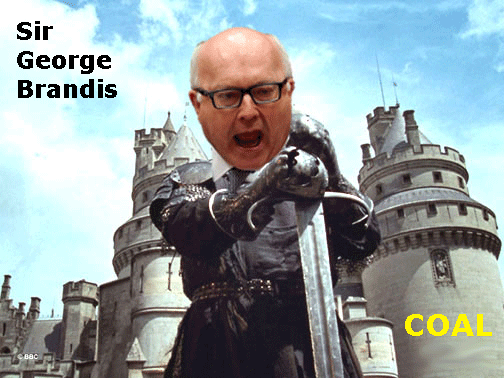
Sir George Brandis, Defender of the Fossil Fuel Faith
 Greens hit back at Brandis’ comments on climate change, ABC Radio Saturday AM 19 April 14 Will Ockenden reported this story on Saturday, April 19, 2014 ASHLEY HALL: The Attorney-General, Senator George Brandis, says people who say the science is settled on climate change are ignorant and medieval.
In an article published in the online political magazine Spiked, Senator Brandis says he’s been shocked by the “sheer authoritarianism” of those who’ve excluded climate-change deniers from the debate.
The Greens have hit back, saying it’s a feudal way of thinking to say that everyone’s view of climate change is equally valid.
Will Ockenden spoke to acting leader of the Greens, Adam Bandt.
ADAM BANDT: This Abbott Government is using every trick in the book to hide the fact that they’re not taking the action that the science calls for on climate change. And to suggest that somehow people in this country are being restricted from airing albeit very wrong views on climate change is completely misleading. I mean, if someone said ‘two plus two equals five’, would you insist on giving them as much airtime in the media as someone who said ‘two plus two equals four’? That’s in effect what the country’s highest law officer is arguing, and it’s very worrying……..
WILL OCKENDEN: Should people be able to, though, nonetheless be able to say that climate change doesn’t exist?
ADAM BANDT: Well people are saying that, and they’re saying it at the moment and they’re wrong. The science community is now essentially speaking with one voice.
To say someone without science training can somehow simply on a free speech basis say that they’re all wrong is a very feudal way of thinking….
Saturday AM requested an interview with Senator George Brandis, but we haven’t heard back from him. http://www.abc.net.au/am/content/2014/s3988495.htm
Aboriginal science: their knowledge completely underestimated by white Australia
Aboriginal people – how to misunderstand their science, The Conversation, Ray Norris, 21 April 14 Just one generation ago Australian schoolkids were taught that Aboriginal people couldn’t count beyond five, wandered the desert scavenging for food, had no civilisation, couldn’t navigate and peacefully acquiesced when Western Civilisation rescued them in 1788.
How did we get it so wrong?
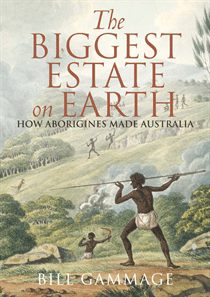 Australian historian Bill Gammage and others have shown that for many years land was carefully managed by Aboriginal people to maximise productivity. This resulted in fantastically fertile soils, now exploited and almost destroyed by intensive agriculture.
In some cases, Aboriginal people had sophisticated number systems, knew bush medicine, and navigated using stars and oral maps to support flourishing trade routes across the country.
They mounted fierce resistance to the British invaders, and sometimes won significant military victories such as the raids by Aboriginal warrior Pemulwuy. Only now are we starting to understand Aboriginal intellectual and scientific achievements.
The Yolngu people, in north eastern Arnhem Land in the Northern Territory, long recognised how the tides are linked to the phases of the moon.
Back in the early 17th century, Italian scientistGalileo Galilei was still proclaiming, incorrectly, that the moon had nothing to do with tides.
Some Aboriginal people had figured out how eclipses work, and knew how the planets moved differently from the stars. They used this knowledge to regulate the cycles of travel from one place to another, maximising the availability of seasonal foods.
Why are we only finding this out now?………..
Still to learn
In recent years, it has become clear that traditional Aboriginal people knew a great deal about the sky, knew the cycles of movements of the stars and the complex motions of the sun, moon and planets………
kids studying science today could also learn much from the way that pre-contact Aboriginal people used observation to build a picture of the world around them.
This “ethno-science” is similar to modern science in many ways, but is couched in appropriate cultural terms, without expensive telescopes and particle accelerators.
So if you want to learn about the essence of how science works, how people learn to solve practical problems, the answer may be clearer in an Aboriginal community than in a high-tech laboratory. http://theconversation.com/aboriginal-people-how-to-misunderstand-their-science-23835
Coal industry pretends to have grassroots support
The Minerals Council of Australia (MCA) launched the Australians for Coal website on Monday, before a television advertisement campaign, in order to extol the economic benefits of coal. The MCA has said the “silent majority” of Australians support coal, as opposed to a small but vocal group of anti-coal activists.
The site urges supporters to email their local MPs with a template letter that calls upon them to support the mining industry, which is “under attack from activists and extremists”.
When users enter a postcode, the website attributes their letter to all MPs in their home state, rather than just their local MP.
But the letters are also forwarded to “anti-coal activists”, with the Australian Conservation Foundation and Friends of the Earth confirming receipt of 28 emails. It is understood Greenpeace and anti-coal group Quit Coal were also sent emails. The emails sent to the environmental groups display each supporter’s name, postcode and email address. The emails to the non-government organisations abruptly stopped on Monday.
“It’s a really bizarre strategy – I now have these people’s names, emails and postcodes,” said Cam Walker, a campaigner at Friends of the Earth. “From go to woe this has been a pretty sloppy campaign.”
Walker said the MCA’s campaign had been “soundly trounced” by a largely critical reaction on social media……Bandt, the deputy leader of the Greens, said: “One of the emails came from Dame Gina Rinehart, so I’m not sure of its authenticity.
“The coal barons are terrified and rightly so. Coal is the next asbestos or tobacco and big coal is trying to fight that. I’m pleased this campaign has galvanised people who want to phase out coal.
“If everyday Australians love coal so much, why have one million of them put solar panels on their roofs? People are voting with their feet.”………
The MCA didn’t respond to questions put to it by Guardian Australia.http://www.theguardian.com/world/2014/apr/18/australians-for-coal-sent-supporters-letters-to-environmental-groups
Australia to co-operate with United Arab Emirates in nuclear-related activities
 Australia hopes to lure Emirati students to its institutions while selling uranium to the UAE The National, Caline Malek
April 17, 2014 ABU DHABI Higher education and nuclear power are areas in which the UAE and Australia will start collaborating.
During a visit to the UAE this week by Andrew Robb, Australia’s trade and investment minister, an agreement was signed with Sheikh Hamdan bin Mubarak, the Minister for Higher Education. The countries will collaborate on vocational education, training and research cooperation in higher education……..
Mr Robb said the UAE was investing in infrastructure and restructuring its economy, creating opportunities in sectors where Australia had a proven track record.
He also met senior ministers to advocate for a resumption of negotiations for a free trade agreement with the GCC.
“I [used] my visit to set out the Australian government’s trade and investment agenda, to emphasise that Australia is open for business and that we are committed to deepening our economic engagement with the region,” he said.
Australia will also begin to export uranium to the UAE for its nuclear power plants.
The Nuclear Cooperation Agreement was signed in July 2012 but was ratified and came into force only on Monday. It could lead to the export to the UAE of up to 800 tonnes of uranium a year by the end of the decade. “The agreement should now pave the way for separate commercial agreements between potential Australian uranium suppliers and the Emirates Nuclear Energy Corporation,” said Mr Kang. “The [first exports] are subject to the timeline for the construction of the UAE’s nuclear power plants, but I understand the first of these plants is scheduled for completion in 2017.”
Under the agreement, Australia will supply uranium for use in the UAE’s developing civil nuclear power programme and cooperate in nuclear-related activities, such as safeguards, security, safety and science.
“The agreement has been secured because Australia is a reliable supplier of uranium and the UAE is a responsible user of nuclear energy for civilian purposes,” said Mr Robb, who met Sheikh Abdullah bin Zayed, the Foreign Minister, this week in Abu Dhabi.
“This will open up a new long-term market for Australian uranium producers.”……….Sheikh Abdullah said the ratification of the agreement would offer more opportunities for collaboration between the Government and private sectors of both countries. He said this falls in line with the UAE’s policy of developing its peaceful nuclear energy programme in collaboration with other countries that shared the same commitment.
Hamad Alkaabi, the UAE’s permanent representative to the International Atomic Energy Agency, said the agreement constituted a governmental framework for cooperation in nuclear activities between both countries……..http://www.thenational.ae/uae/australia-hopes-to-lure-emirati-students-to-its-institutions-while-selling-uranium-to-the-uae
Tony Abbott has effectively stopped Australian large scale renewable energy
 Australian large-scale renewable energy projects at standstill http://reneweconomy.com.au/2014/australian-large-scale-renewable-energy-projects-standstill-59733 By Giles Parkinson on 16 April 2014
This is despite the fact that existing policy calls for 41,000GWh of renewable energy to be provided across Australia by 2020. However, the renewable energy industry, along with the utilities that must acquit their obligations, and the banks that would finance these projects, are convinced that the target will be severely reduced, if not dismantled.
This pessimism is reflected in the market for large-scale renewable energy certificates, which have slumped to $28.55, down 15 per cent from late December, and down nearly half from before the election of the Abbott government last September.
The pessimism has infected the industry since early 2013, when, despite the findings by the Climate Change Authority that the LRET should stay as is, the equivocation of the Coalition, and its presumed success in the September poll, brought the market to a halt.
According to data from Green Energy Trading – a major player in the market for renewable energy certificates, only four new projects have been “committed” since the start of 2013. Of these, the 53MW Broken Hill and 102MW Nyngan solar power stations are mostly financed from the now defunct Solar Flagships project, with large grants from the federal and state governments; and the 20MW Royalla solar plant in Canberra is getting a fixed tariff as part of the local government’s reverse auction program.
The only new wind farm approved in the last year – a 47MW extension to Pacific Hydro’s Portland projects – seems to have been committed because it received financing from the Clean Energy Finance Corporation, the $10 billion green bank that the Coalition wants to dismantle, despite it making a profitfor the government.
The only other new projects that are likely to be committed in the short-term are the other solar projects in the ACT, and the wind projects that will be awarded in its forthcoming auction. (It should be noted that committed projects are different to “approved” projects, which merely means they have approval to be built, but not necessarily the finance).
Those solar and wind projects, part of the ACT government’s commitment to a 90 per cent renewable energy target, do not rely on the LRET. However, the proposal for new wind farms is being vigorously opposed by conservative politicians, both state and federal, as well as the Murdoch press.
Green Energy Trading estimates that if the market for LRECS is to maintain an acceptable level of market liquidity, around 4,450 MW of new projects need to be committed in the three-year period from 2014 to 2016. That is unlikely to happen until the RET review is completed mid year, and then considered by the Abbott government.
However, if the incumbent electricity industry has its way, there will be no new projects built before 2017 at the least. This is its estimate of the impact of the LRET target being reduced to a “real” 20 per cent target, which might equate to a new fixed target of around 26,000GWh.
Numerous studies have shows that not only will this result in a sharp fall in the deployment of wind and solar, it will also mean more coal-fired generation. And a new study from French energy products giantSchneider Electric says cutting the renewables target will also mean higher prices for consumers. This came as a surprise to the large energy users that commissioned the Schneider analysis. They had anticipated the opposite finding.
Still, the renewable energy industry is finding doors closed in Canberra, with ministers and advisors promising only that projects already built will not be impacted by any changes to the RET, which will be recommended by a review headed by climate science sceptic and nuclear advocate Dick Warburton.
International groups such as First Solar and Acciona have already signalled their intention to re-assess their commitment to projects in Australia, in a likely repeat of the exodus that was caused when the current energy minister Ian Macfarlane ended the then MRET (mandatory renewable energy target) when he was last in the same job a decade ago – and that decision was taken despite an independent review recommending the MRET be expanded.
Michael Denborough, medical researcher and anti nuclear activist
Life-saving researcher fought nuclear power April 18, 2014 SMH, David Denborough
Michael Denborough Medical researcher, activist 11-7-1929 — 8-2-2014
On the day of his death, Michael Denborough, Australian medical researcher, activist and founder of the Nuclear Disarmament Party, declared quietly to his loved ones: ”I’ve lived the luckiest life.”……..
There was another field in which Michael Denborough was influential – activism to prevent nuclear war. In 1970 he learned from a colleague, Roger Melick, that every time an atmospheric French nuclear test was conducted in the Pacific the levels of radioactive iodine in sheep’s thyroid glands across Australia would rise alarmingly. We were all being radiated by these tests.
Michael and Roger penned a letter to national newspapers notifying the public and so began the scientific and political protests which led to the International Court in the Hague forcing nuclear tests underground.In 1983, as acting director of the Centre for Research and Environmental Studies in Canberra, Michael convened a symposium, Consequences of Nuclear War for Australia and its Region. Its aim was to promote international nuclear disarmament. Patrick White and other distinguished speakers accepted his invitation. Physicians and scientists from Eastern and Western countries, including the USSR and the US, came to see what they could do to fix the greatest threat to world health.
In 1984, as a response to the Labor Government’s sell-out on its anti-nuclear platform, Michael Denborough and others founded the Nuclear Disarmament Party. It was a single-issue party with three policies – no uranium mining, no nuclear weapons and no US bases on Australian soil. The NDP was the political voice of a strong grass-roots social movement. People from all walks of life, and of all ages, came together to try to save the planet. Two NDP senators were elected, one in 1984 and one in 1987. The NDP continued to highlight nuclear issues in elections until 2009.
In 2003, Michael set up a lone vigil for 52 days outside Parliament House to protest what almost everybody admits now was going to be an unjust invasion of Iraq. On the day John Howard committed Australian troops Michael was thrown out of Parliament for protesting loudly from the gallery. He was 74 years old.
Michael will be remembered for his passionate opposition to war and the nuclear industry. Lives will continue to be saved as the result of his medical discoveries. ….http://www.smh.com.au/comment/obituaries/lifesaving-researcher-fought-nuclear-power-20140417-36utf.html
Small scale solar energy triumphing globally, and especially in Australia
 Small Scale Solar A Stand-Out Performer http://www.energymatters.com.au/index.php?main_page=news_article&article_id=4267 Global investment in renewable energy jumped in the first quarter – and in Australia, it’s still citizens leading the revolution through rooftop solar power.
According to Bloomberg New Energy Finance (BNEF), investment in clean energy around the world reached USD $47.7bn during the first 3 months of this year.
The stand-out sector was small scale solar power (less than 1MW systems); which skyrocketed by as much as 42%. Overall investment in solar (large and small) was up 23% at $27.5bn.
RenewEconomy, drawing on data from BNEF and Pew Charitable Trusts, states Australian households accounted for nearly two thirds of total investment in renewables in the nation in 2013 ($2.8 billion), and practically all of it so far this year.
RenewEconomy states more than 4,000 applications to install small systems are being a lodged a month in the south-east Queensland region managed by Energex. In South Australia and Western Australia, small scale system uptake is more than 2,500 a month, and in Victoria just below that level.
That uptake is so strong isn’t surprising. In addition to the lure of households being able to slash or even wipe out their power bills; there is an added sense of urgency given fears with regard to the future of Australia’s Renewable Energy Target (RET). The RET provides support for the purchase of small-scale solar power systems; which can amount to thousands of dollars.
Another factor helping to drive uptake is the availability of innovative financing arrangements – such as zero dollar deposit payment plans. National provider Energy Matters’ Save As You Go initiative is structured in a way that in addition to the zero deposit; repayments are structured so many households will repay less per week than what they would spend on equivalent mains electricity supply.
According to Energy Matters, solar is still one the highest returning investmentsin Australia – outperforming shares, property, gold, global fixed interest or even fine art.
1 This month
17 October, Free Public Talk on Nuclear Issues in South Australia
David Noonan will speak on public interest concerns over the new Roxby Downs Indenture Act 2026 on BHP copper-uranium mining and ore processing in SA, and on how AUKUS may face SA with a High-Level nuclear waste agenda.
Dr Jim Green will discuss international developments in the field of nuclear power including ‘small modular reactors’ and Generation 4 ‘advanced’ nuclear reactor concepts.


Help Aunty Sue Protect Her Land and Sacred Sites From Destructive Rocket Testing.
.

Australians deserve the truth
about
AUKUS – https://aukuspublicinquiry.com/

PETITION – To: Prime Minister Anthony Albanese and the Australian Labor Government

of the week – Australians for War Powers Reform (AWPR)
To see nuclear-related stories in greater depth and intensity

