Australian right-wing politicians surprisingly may vote against Abbott’s “Direct Action” climate policy
 Direct action could fail even without Palmer United Party April 26, 2014 Lisa Cox , 26 April 14 National political reporterTony Abbott’s “direct action” climate change policy is almost certain not to pass the Senate in its present form – even if the Palmer United Party were to change its position and vote for the plan.
Independent senator Nick Xenophon said on Friday that he would not vote for the Coalition’s policy unless there were substantial changes, including measures to ensure companies comply with the scheme.
Fellow crossbench senator John Madigan, of the Democratic Labour Party, said he doubted whether the government was committed to the policy.
Environment Minister Greg Hunt on Thursday unveiled key details of the centrepiece of direct action, an emissions reduction fund, and declared the government would ”easily” reach an emissions reduction target of a 5 per cent cut below 2000 levels by 2020.
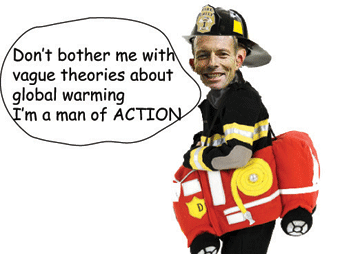 Senator Xenophon said he was not convinced by the white paper, which proposes a $2.55 billion fund to pay polluters to cut their emissions. Companies would bid for funding through a reverse auction process run by the Clean Energy Regulator……..
Tony Abbott has a Creation Science believer as his top adviser!
Maurice Newman Rejects Climate Change, Because God. In Other Words, by Tom Cummings, 24 April 14 “…….Newman rejects the findings of thousands of scientists from hundreds of organisations scattered across 195 countries, because of the analysis of one man: Roy Spencer.

Remembering that other war: the war against Australian Aborigines
Lest we forget, wars undeclared Canberra Times April 25, 2014 Although war was never declared, armed conflict between Australia’s indigenous people and Europeans was widespread. The consequences echo still. In an extract from his book Forgotten War, Henry Reynolds examines the evidence. Anyone acquainted with conditions on the Australian frontier knew that bloody work had been done. Writing in 1880 the pioneer ethnographers Lorimer Fison and Alfred Howitt declared:
”It may be stated broadly that the advance of settlement has, upon the frontier at least, been marked by a line of blood. The actual conflict of the two races has varied in intensity and in duration . . . But the tide of settlement has advanced along an ever-widening line, breaking the native tribes with its first waves and overwhelming their wrecks with its flood.”
We will never know how many Aborigines died directly or indirectly as a result of the conflict, how wide or how deep was the line of blood. Contemporaries often estimated the death rate in particular districts and a few observers attempted to calculate a more general figure. But then as now problems abound with making such estimations.
We are uncertain of the size of the indigenous population when settlement began. We have no idea how many people died in the smallpox epidemic that swept across south-eastern Australia in advance of settlement. We are unsure what the population was in particular regions when the tide of settlement arrived. We are even unsure of the number of indigenous people alive after localised conflict came to an end. There appears to have been no official estimate of those killed in conflict anywhere in Australia.
Even if a government had sought out such information the task would have been immensely difficult. Much of the killing happened on the edge of settlement in regions remote from the reach of authority. Because there was no official recognition of a state of war any killing was technically murder. Frontier communities were notorious for keeping secret their exploits in the war. Killing was referred to using a lexicon of known euphemisms. Punitive parties may often not have known how effective their attacks were, particularly when they operated in the dark or if they shot at groups some distance away. When the bodies of victims were encountered they were almost universally burnt to destroy the evidence. The long career of the Queensland Native Police was cloaked in official secrecy and most of the records were destroyed. If it is difficult to determine how many people died in direct conflict with the settlers. It is even harder to estimate how many more must have subsequently died of wounds or from the fierce rigours of prolonged and uneven warfare.
There was considerable interest in the question in the late 19th century but as the Aborigines themselves disappeared from the historiography of the first half of the 20th century, no one seems to have thought it an important matter for speculation. With the new interest in Aboriginal history that arose in the 1970s and 1980s attempts were made to assess how many people, both white and black, died in the frontier wars.
Historian and author Henry Reynolds: “Much of the killing happened on the edge of settlement in regions remote from the reach of authority. Because there was no official recognition of a state of war, any killing was technically murder.” Photo: Justin McManus
In my book The Other Side of the Frontier (1981), I argued that it was ”reasonable to suppose that at least 20,000 Aborigines were killed as a direct result of conflict with the settlers”…………
A compilation of regional studies does not allow us to assess the overall death rate in Australia’s frontier wars. But some things are clear. Aborigines were killed by settlers every year somewhere in Australia from 1788 to the early years of the 20th century, and died in disproportionate numbers. The research of the last decade has led most engaged scholars to conclude that the controversial 1981 estimate of 20,000 Aboriginal dead needs to be revised not downwards but steeply upwards to 30,000 and beyond, perhaps well beyond. And the dead do matter. They intimidate us. They force us to reassess many other aspects of Australian history. That is the least that can be done.
This is an edited extract from Forgotten War. It is published by NewSouth and won the 2014 Victorian Premier’s award for non-fiction. Henry Reynolds is a Tasmanian historian. http://www.canberratimes.com.au/national/lest-we-forget-wars-undeclared-20140424-376r3.html#ixzz2zvtw4pCi
The farce that is the Australian government’s Renewable Energy Review
 “Farcical” start to Tony Abbott’s renewable energy review, REneweconomy, By Giles Parkinson on 24 April 2014 Tony Abbott’s controversial review of Australia’s renewable energy target (RET) made a “farcical” start to its public deliberations on Wednesday, attracting new accusations of bias and of having a pre-determined outcome.
Clean energy representatives were shocked by the panel’s appointment as chief advisor and modeller of ACIL Allen, a consultancy seen as close to the fossil fuel industry, and whose highly contested research formed the basis of the coal industry’s attempts to dismantle the RET in 2012.
Not only will ACIL Allen do the modelling for the RET Review panel, some of the assumptions that will form the basis of that modelling have also stunned the clean energy industry, and been branded as a farce.
This includes an apparent refusal to measure the benefits of renewable energy – including the health benefits, job benefits, and the network benefits – which the panel has dismissed as “too hard to model” and little more than a “transfer of wealth”, presumably away from the coal generators and network providers. There is concern about how it will model the reduction in wholesale prices – the main complaint from the existing fossil fuel industry.
Around 50 people who attended the RET Review panel’s modelling forum at the Mercure hotel near Sydney’s international airport were also told that the modelling will assume that there will be no carbon price out to 2030, and will not factor in any abatement targets. In other words, it is assuming there will be no carbon restrictions on the sector for another two decades.
John Grimes, the CEO of the Australian Solar Council, echoed the thoughts of many who attended the meeting and were interviewed by RenewEconomy when he said it appeared clear that the RET Review will serve only to protect the vested interests in the current electricity market.
“I’ve got to say – this is much worse than we had anticipated,” Grimes said. “This entire review process needs to be revealed for the sham that it is … we can only conclude that the RET Review process is heading to a biased and predetermined outcome.
“Instead of making customer benefits the key measure of a successful energy market, this review is set to side with big business, giving little or no weight to the benefits of solar for householders, business and the community.
“Clearly any model that fails to consider a carbon price (in any form) up to 2030, in the face of international action on climate change, is negligent and lacks any credibility. “ The RET review was already controversial because of the Abbott government’s decision to by-pass the Climate Change Authority (which dismissed the ACIL Allen modelling and the coal industry’s protestations in its 2012 review), and appoint a panel led by climate change denierand pro-nuclear advocate Dick Warburton.
He will be supported by fossil fuel lobbyist and former ABARE chief Brian Fisher, and Shirley In’t Veld, the former head of WA’s biggest coal generator, Verve Energy. The secretariat will be housed in Abbott’s own department.
Clean energy attendees said they were shocked by some of the statements – including Warburton’s apparent ignorance that the Abbott government went to the election with a “million solar rooftops” commitment, as well as assumptions by the panel that the current 41,000GWh could not physically be met.
The panel reportedly claimed that no large renewable energy projects would be able to be built for another 18 months, and no more than 1,000MW to 1,200MW of wind capacity would be possible in a single year, making it impossible to reach the current target. Both these claims were reportedly vigorously contested by the representative of the Clean Energy Council.
However, it was ACIL Allen’s appointment that confirmed the worst fears of the renewable energy industry……….
Even the Murdoch-owned Business Spectator made a spectacular demolition of ACIL Allen’s research, pointing to its previous reports that claimed that carbon pricing would eradicate the LNG industry, would force the closure of all brown coal generators by 2020, its predictions that geothermal would account for 30 per cent of the Renewable Energy Target, and how on two occasions it grossly miscalculated the uptake of rooftop solar……..
the problem that the renewable energy industry faces – incumbents and ageing engineers and business people who reject the science, simply do not understand or accept that renewable energy sources can be effective and cost competitive, and cannot imagine an energy system any different to the centralised model that has dominated for the past 100 years, and/or who are merely seeking to protect their vested interests.
The problem is that not only do they now have the ear of the current government, they have their hand on the wheels – and their foot on the brakes. http://reneweconomy.com.au/2014/farcical-start-to-tony-abbotts-renewable-energy-review-14978
South Australian scheme to install solar panels at no cost
Tindo Solar will install solar panels free for 5000 businesses and households http://www.adelaidenow.com.au/business/tindo-solar-will-install-solar-panels-free-for-5000-businesses-and-households/story-fni6uma6-1226893885057 RICHARD EVANS THE ADVERTISER APRIL 23, 2014 A NEW solar scheme could get thousands of SA households equipped with free panels and paying cheaper bills for life.
Mawson Lakes solar panel manufacturer Tindo Solar will install solar panels free for an estimated 5000 businesses and households around the state in the next year.
However, if the scheme proves popular the company says there will be no cap on the number of people able to sign up.
Customers will pay for electricity for an agreed time frame of up to 15 years before owning the panels outright.Tindo business and people manager Richard Inwood said the scheme would be a “game changer” and revolutionise the electricity market in Australia.
“Instead of us selling the system, we’re selling the electricity that that system is generating – that electricity is going to pay off that system,” he said.“We have now become a retailer of 100 per cent green energy that is cheaper than what can be purchased from the grid.”

“SA Power Networks made more than $300 million profit last financial year – that shows how much fat is in there.”
Tindo Solar secured a $30 million loan, under the Federal Government-funded Clean Energy Finance Corporation, last week to install the systems with more money available if demand exceeds expectations, Mr Inwood said.
He said the scheme would provide customers with daytime electricity prices that were 20 to 30 per cent cheaper than most other providers. “Energy has increased around 70 per cent in the last seven years,” he said. “If you look at the average electricity cost per kilowatt it’s 35 to 42 cents per kilowatt – we will provide you with a price of around 25c a kilowatt.”
“Price rises will be no more than one per cent per annum and we want to take the worry around energy price increases away from the public generally and give them certainty. It’s the long term certainty over your energy bills that is exciting.”
Mr Inwood said the company guaranteed its flagship panels had a 240V AC output, with testing at Tindo of other imported panels installed in South Australia revealing the actual output often does not always match the higher voltage promise and brings associated safety compromises.
He said an anticipated upsurge in business for the Mawson Lakes business could mean more jobs for the company.
“Recruiting and on-boarding of factory staff could take as little as four weeks,” he said.
“We currently have 24 staff and would see this at least treble if we are to get the $30 million spent in two years which is what is required.”
Mr Inwood said the State Government also supported the scheme with a tender for 200 public housing homes in the pipeline.
FACTS:
Upfront cost – $0.
Repayment time frame – up to 15 years – longer in some cases. Customer will own the system at the end of the agreement.
Price per kilowatt – 20-30 per cent cheaper than traditional energy providers.
Annual price rises – up to 1 per cent a year.
Expected uptake – 5000 businesses and households in the next year.
READ MORE: Tindo Solar welcomes ACCC probe into solar advertising
Tony Abbott’s review of Renewable Energy Target – a complete scam!
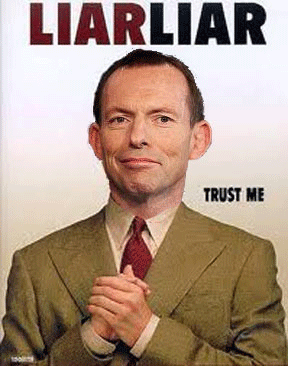 Coalition’s renewable energy review an ‘unprecedented scam’, industry says, The Guardian, Lenore Taylor,
Review assumes fossil fuel investors won’t need to factor in any risk due to climate policies for decades theguardian.com, Thursday 24 April 2014 The renewable energy industry has labelled a controversial Abbott government review an “unprecedented scam” and a “stitch-up” after learning that it was conducting electricity industry modelling on the assumption there would be no risk or cost to investments in coal-fired power stations in the next few decades.
The review of the renewable energy target – headed by veteran businessman and self-professed climate sceptic Dick Warburton – and its modellers from ACIL Allen consulting held a workshop with industry participants on Wednesday at which they revealed the modelling would assume investors in fossil fuel generation would not need to factor in any risk due to climate policies for decades – neither a carbon price, nor a requirement to invest in emission-reducing technologies, nor any cost from any other government policy or regulation.
Many of the 50 participants said this assumption was entirely unrealistic………
n setting up its own RET review, the government bypassed the Climate Change Authority – which it wants to abolish – but which is required by legislation to undertake regular reviews of the RET. http://www.theguardian.com/environment/2014/apr/24/coalitions-renewable-energy-review-unprecedented-scam
AUIDIO: Australia falling behind in the electricity energy revolution
AUDIO: The price of power ABC Radio Background Briefng 27 Apr 14 With Australian electricity prices amongst the highest in the world, more and more households are going solar. The big power companies say the Renewable Energy Target is undermining their businesses and they want it wound back. The federal government agrees, so who is to blame for the high price of power? Jess Hill investigates……….Mr Abbott’s claim that the renewable energy target is expensive is not supported by the data. The Australian Energy Markets Commission says the renewable energy target adds four per cent to the average electricity bill. For an average household, that’s about a dollar a week.
‘For all of the attention that carbon price has got, from the increasing attention the renewable energy target’s got, the main reason that electricity has been getting dearer is the overinvestment in poles and wires, and the fundamental inefficiency in the way that the national electricity market’s working,’ says Richard Denniss, executive director of the Australia Institute.
Federal Treasury estimates that 51 per cent of an average household bill is spent on network costs. Most of that is going towards paying off the $45 billion network companies have spent on updating our poles and wires over the last five years………Solar rooftops are wreaking havoc on the traditional power industry, says Mr Denniss, because they produce the most amount of energy at the time of day when the power industry makes the most money.
‘Solar panels have got this great trick, they make lots of electricity when the sun is shining; that’s when we like to turn our air conditioners on,’ he says. ‘When everybody turns their electricity on at four o’clock on a hot Thursday afternoon, we have enormous demand for electricity for these short periods of peak demand. And that’s when solar panels are at their best.’
‘Solar panels are actually pumping quite a large amount of energy in during these periods of peak demand, and that’s pushing down the peak price. Now that’s great for everybody, except the so-called baseload power stations. Because the baseload power stations used to be able to sell their electricity for a much higher price at four o’clock on that hot Thursday afternoon. From the coal-fired power station point of view, you couldn’t have a worse competitor, because solar is at its best when the market is at its most profitable.’
What that means is that the big coal-fired power plants are earning less for the energy they produce. That’s because Australia has more electricity than it can use………The chair of the Climate Change Authority is Bernie Fraser, a former Reserve Bank governor. He says that just by holding another review, the government has ensured that the 41,000 gigawatt-target won’t be met. ‘Investment is actually being cut back and delayed, and I think because of that, I think it’s apparent now that the 41,000 gigawatts for large renewable energy power plants, is not going to happen. It’s going to be a lesser figure and I think that’s what the opponents, the critics of renewable energy want to see.’
‘Policymakers need to look beyond short-term economic considerations in the interests of some of the big companies to longer-term community interests. And that’s what governments are supposed to do, but unfortunately it’s not happening at the present time,’ he says.
So it’s a bit… well, it’s more than a bit, it’s very disappointing that we’re falling behind, and we are falling behind what many other countries are doing.’ http://www.abc.net.au/radionational/programs/backgroundbriefing/2014-04-27/5406022
Radioactive Tour brings anti nuclear discussion to Olympic Dam, Alice Springs and Tenant Creek
 Uranium deal with India a hot topic – 23-Apr-2014 http://www.themonitor.com.au/news-articles/140423-uranium-deal-with-india-a-hot-topicThe Australian Government’s signing of a uranium export deal with India was a hot topic of discussion at the recent Olympic Dam visit by members of environmental group Friends of the Earth.
The annual radioactive tour has been operating since the 1980s, and has taken thousands of people to the heart of the industry at destinations from Melbourne to Tenant Creek.
Local BHP Billiton employees from various sectors of the Olympic Dam operation, including environmental, radiation, community and external affairs took time to show the group through the operation on Tuesday, April 16.
The tour was followed by an informal question time in Richardson Place, where members of the group particularly focused on the company’s commitment to indigenous traditional land owners and the Federal Government’s stance on direct supply or uranium to India.
A BHP Billiton spokesperson told the group the company was working closely with the traditional land owners, including through employment programs and through financial dispensation into a trust.
He said the amount of money awarded to the trust was ‘confidential’, but ‘substantial’.
The group asked many questions regarding the company’s ethical stance on supply of Olympic Dam Uranium to countries which could be using the product to fuel their nuclear armament programs.
The topic was particularly sensitive for one Indian representative , who said his country’s unstable government, lack of regulation, extremist religious groups and dense population were recipes for disaster.
The representative said India’s suspected nuclear armament activities were of major concern to humanity across the globe, and that companies like BHP Billiton should have an moral and ethical commitment to ensure their uranium did not reach the hands to those planning to build nuclear weapons.
Currently, BHP Billiton and other Australian uranium miners have legislative and regulatory obligations that cover mining, processing and the transport of uranium on road and by sea.
The onus of responsibility for the product then passes to the Government at the port of destination.
The group continued on to Alice Springs and Tenant Creek on Tuesday afternoon as part of the 14 day tour, and will return to Melbourne on Sunday, April 27.
Australian government, and Renewable Energy Panel chief Dick Warburton are fans of nuclear power
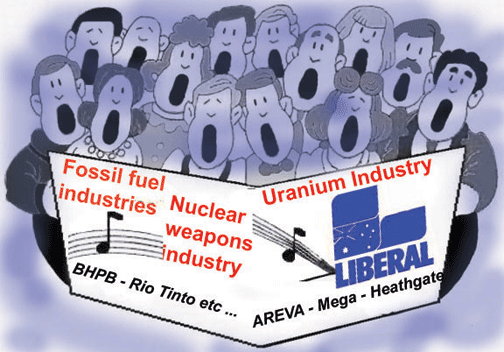 Wind and solar generation half the cost of nuclear REneweconomy, By Sophie Vorrath on 23 April 2014 “………in Australia, the government looks to be eyeing nuclear power as a clean energy option for the country’s future, alongside its dreams of abundant “clean coal.”Last year, an issues paper released ahead of the Abbott government’s energy white paper noted that slow development in carbon capture and storage, and difficulties with hydro, meant nuclear technologies continued “to present an option for future reliable energy that can be readily dispatched into the market.”
And Dick Warburton, Abbott’s hand-picked head of the federal government’s RET review panel, hasrevealed himself as a big fan of nuclear energy, describing it once as the only alternative to fossil fuel generation.
In an article published in Australia’s Quadrant magazine in 2011, Warburton and his c0-author wrote that “except for nuclear power, there are no straightforward strategies for reducing dependence on fossil fuels without large economic costs.” http://reneweconomy.com.au/2014/wind-and-solar-generation-half-the-cost-of-nuclear-95493
Sydney shows the way – communities can switch to clean renewable energy

The City of Sydney has recognised the potential of community energy in its roadmap to move the city towards 100 per cent renewable energy by 2030. Sydney’s Lord Mayor Clover Moore said the IPCC’s most recent report has again underlined the extreme urgency of action on climate change. “Addressing climate change will require action at all levels. Empowering communities to develop their own local, renewable energy projects will help deliver more clean energy,” Cr Moore said.
Communities can drive urgent switch to clean energy http://phys.org/news/2014-04-urgent-energy.html Apr 22, 2014 Australia will continue to lag behind countries like the United States and Germany in heeding the UN’s latest call to urgently switch to clean sources of energy unless the burgeoning community energy sector is allowed to thrive, according to a UTS researcher. Community-owned renewable energy generation in towns and cities around the country can stimulate regional development, provide more resilient and inexpensive energy security and significantly contribute to Australia’s climate mitigation targets, UTS Institute for Sustainable Futures researcher Nicola Ison said.
“A growing number of communities, including local councils, are recognising this, however there are significant regulatory and institutional barriers that need to be overcome,” Ms Ison said.
“Across the world renewable energy is changing the way citizens and organisations think about and use energy. In the United States, more than 1,500 wind farms are owned by communities across 27 states and in Germany, customers own two thirds of all renewable energy generated.
“Councils, as large energy users in local communities and facilitators of local action in their own right, can play an increasingly important role in this transition.”
The City of Sydney has recognised the potential of community energy in its roadmap to move the city towards 100 per cent renewable energy by 2030. Sydney’s Lord Mayor Clover Moore said the IPCC’s most recent report has again underlined the extreme urgency of action on climate change. Community-owned renewable energy generation in towns and cities around the country can stimulate regional development, provide more resilient and inexpensive energy security and significantly contribute to Australia’s climate mitigation targets, UTS Institute for Sustainable Futures researcher Nicola Ison said.
“A growing number of communities, including local councils, are recognising this, however there are significant regulatory and institutional barriers that need to be overcome,” Ms Ison said.
“Across the world renewable energy is changing the way citizens and organisations think about and use energy. In the United States, more than 1,500 wind farms are owned by communities across 27 states and in Germany, customers own two thirds of all renewable energy generated.
“Councils, as large energy users in local communities and facilitators of local action in their own right, can play an increasingly important role in this transition.” Continue reading
Labor and Liberal keen on uranium mining, and on promoting geothermal energy
 Dennis Matthews, 24 April 14 The hot rocks geothermal energy industry has been generously supported by both Labor and Liberal governments. The first grant was $1million from the Federal government to the University of NSW in September 1999. Since then grants totaling about $300million have been made in support of the industry.
Focusing on one particular grant (The Advertiser, 24/4/14) obscures the real problem of why so much effort has gone into supporting this industry.
Funding has often been accompanied by considerable media hype. Claims of cheap, low greenhouse gas emission, renewable, electricity have not been realised and issues of water use and radioactivity have not been adequately addressed.
Although wishful thinking seems to have been a major factor, bi-partisan political support for the mining industry, particularly uranium mining, seems to have played a major role.
Australia deliberately prevented a nuclear-free Pacific treaty, to obey USA’s interests
Declassified documents from the National Archives of Australia, including the 1985 Cabinet minute about the SPNFZ Treaty, show clearly that Australia designed the treaty to protect US interests in the Pacific, including the deployment of nuclear-armed warships and the testing of nuclear missiles.
 International legal experts, including Don Rothwell, professor of international law at the Australian National University, have raised concerns that uranium sales to India would breach Australia’s obligations under the treaty. Rothwell has prepared a legal opinion stating that the SPNFZ Treaty prohibits members from selling uranium to countries that do not accept full-scope nuclear safeguards under the Nuclear Non-Proliferation Treaty.
This is consistent with past Australian government policy.
Delaying The Nuclear-Free Zone In The Pacific http://concernedyapcitizens.wordpress.com/2014/04/23/pacific-islands-report-delaying-the-nuclear-free-zone-in-the-pacific/ By Nic Maclellan At the height of the nuclear arms race between the United States and Soviet Union, a treaty to create a South Pacific Nuclear Free Zone, or SPNFZ, was opened for signature on Hiroshima Day, 6 August 1985, at the Pacific Islands Forum meeting in Rarotonga.
Twenty-eight years after it was signed on that day by Australia, New Zealand and island nations, the United States still hasn’t ratified its protocols, in spite of a request from president Barack Obama to the US Senate more than two years ago.
Next week, as Forum leaders gather in the Marshall Islands – site of sixty-seven US nuclear tests at Bikini and Enewetak Atolls – the US government will be eager to keep nuclear issues off the agenda, as it has been since the Treaty was first mooted. Declassified documents from the National Archives of Australia, and US diplomatic cables published by WikiLeaks, highlight longstanding opposition in Canberra and Washington to a comprehensive nuclear-free zone that might hamper US nuclear deployments in the Pacific.
The Forum meeting, and the US Senate’s continued stalling, coincide with on-going concerns that Australia’s decision to sell uranium to India threatens to breach Australian treaty obligations. As Conservative Australian governments in the 1960s debated the acquisition of nuclear weapons and purchased aircraft capable of delivering nuclear strikes in Southeast Asia, the labour movement across the region proposed a nuclear free zone designed to ban the bomb in this part of the world. The SPNFZ Treaty was finally negotiated in the 1980s after decades of campaigning by unions, Pacific churches and the Nuclear Free and Independent Pacific movement. Continue reading
ABORIGINAL AUSTRALIANS AND THE WAR OF INVASION ,
ACKNOWLEDGEMENT SOUGHT: KEVIN GILBERT, ABORIGINAL AUSTRALIANS AND THE WAR OF INVASION , Philippa Scarlett 24 April 2014 by Indigenous Histories In early September 1991 Kevin Gilbert was photographed by Richard Briggs against the background of the Australian War Memorial. He carries a cross in almost Christ like manner as he walks towards Anzac Parade. However it is unlikely that this symbolism was Christian. Gilbert’s creation spirit was Baiame. Rather the cross was generally symbolic of the sacrifice of the Aboriginal inhabitants of Australia during more than 200 years of undeclared war against invasion and of the ongoing suffering of his people. Gilbert himself said at the time
I represent Aboriginal people who have fought with honour and given their lives for justice and for the land – as none have done for so long as my people. This is a memorial to those who have fought and died and continue to die in the continuing massacre against us. Interview with Amanda Uhlmann, Canberra Times 3 September 1991.
In seeking recognition of Australia’s first and unfinished war, and commemoration of the sacrifice of its participants he brought his plea and protest to the hub of remembrance of the war service of Australians and linked it with the phrase used to encapsulate the act of remembering war: LEST WE FORGET. The wayside memorial he constructed in a then vacant space on Anzac parade – already lined with officially sanctioned memorials – bears the sign THIS SITE IS A MEMORIAL TO ALL ABORIGINAL PEOPLE WHO HAVE DIED IN DEFENSE OF OUR LAND LEST WE FORGET…… http://indigenoushistories.com/2014/04/23/acknowledgement-sought-kevin-gilbert-aboriginal-australians-and-the-war-of-invasion/
Australia’s commission of audit not allowed to cost Abbott’s “Direct Action” climate policy
 Audit not privy to multibillion-dollar direct action plan to reduce emissions http://www.smh.com.au/federal-politics/political-news/audit-not-privy-to-multibilliondollar-direct-action-plan-to-reduce-emissions-20140424-zqya6.html#ixzz2zro4nYhK April 24, 2014 Lisa Cox National political reporter The Abbott government’s multibillion-dollar “direct action” carbon reduction plan was not considered by the commission of audit, and key details of the scheme remain unknown.
The head of the audit of government spending, Tony Shepherd, told Fairfax Media that the commission had not considered the controversial $3.2 billion policy because it was not provided with any details.
The comments come ahead of the imminent release of the government’s “direct action” white paper – expected as early as Thursday – elements of which have been closely guarded by the office of Environment Minister Greg Hunt. The paper is expected to clarify key pieces of information, including how “direct action” will work and the mechanisms behind the key component of the policy, the $1.55 billion emissions reduction fund.
Mr Shepherd said on Wednesday the commission had been unable to assess “direct action” because there was no information available on the policy during the three months it was conducting its review.
“The Commission of Audit couldn’t really look at it because we didn’t have a policy to look at,” he said.
“If they had a policy and it was out there we would have had a look at it, but in the absence of any detail we couldn’t.”
Mr Shepherd said that as a result, the commission’s report contained no information on “direct action”, although he did not necessarily view that as a problem, despite the scheme carrying a price tag of up to $3.2 billion.
“There’s a number of other government policies and things that are evolving at the moment,” he said.
“You’ve got to draw the line somewhere.”
The government is facing a tough battle to win over MPs with its plan to replace Labor’s carbon tax.
Labor and the Greens do not support “direct action” and Fairfax MP Clive Palmer declared this week that his Palmer United Party also would not back the “hopeless” policy.
Mr Palmer has threatened to reconsider his position on the carbon and mining taxes if the government does not bring direct action legislation to the Senate for debate.
Australian government’s unseemly haste in selling uranium to volatile Middle East region
Robb Fast-Tracks UAE Uranium Deal https://newmatilda.com/2014/04/23/robb-fast-tracks-uae-uranium-dea By Dave Sweeney, 23 April 14 The Federal Government has signed another uranium export deal with a dubious overseas partner – and without inspecting the country’s facilities. We need an independent inquiry, writes Dave Sweeney
In a move that marks the first time Australia uranium would be sold to the Middle East, Trade Minister Andrew Robb is fast-tracking a nuclear cooperation agreement with the United Arab Emirates (UAE). Last week hesigned a new treaty in Dubai worth 800 tonnes of Uranium a year from 2020. But in doing so, the Minister is treating our Parliament as little more than a radioactive rubber stamp.
The foundation for these sales was laid by former foreign minister and airline food critic Bob Carr, who signed the initial agreement with the UAE — a country with a secretive, unelected government situated in one of the world’s most insecure regions.
Consequently, the Joint Standing Committee on Treaties recently recommended that prior to any ratification of the sales plan, the International Atomic Energy Agency undertake physical inspections of UAE facilities.
But the Federal Government’s failure to take this or any other prudent step, in favour of providing “certainty” to the ailing uranium sector shows it has confused the commercial interest of Australia’s small, high-risk low-return uranium sector with our national interest. Uranium is a small contributor to Australian export revenue and employment, but when it comes to global impact and risk Australian uranium is playing in the major league. The Australian Conservation Foundation has used industry data to examine the sustained gap between the sector’s promise and performance.
The report, Yellowcake Fever: Exposing the Uranium Industry’s Economic Myths, highlights the urgent need for an independent cost-benefit analysis and a comprehensive and transparent assessment of Australia’s uranium trade. The sector’s employment contribution is tiny: the World Nuclear Association estimates there are less than 1800 jobs in Australia’s entire uranium industry, representing just 0.015 per cent of Australian jobs. From 2002 to 2011, uranium sales averaged $627 million annually and accounted for only 0.29 per cent of all national export revenue: small beer, but with a big hangover.
Why sell to the UAE? The seven emirates, including Abu Dhabi and Dubai, have one of the least participatory political systems in the world. In 2012, more than 50 human rights activists in the UAE were rounded up and detained without charge following calls for political reform. The Human Rights Watch 2013 world Report describes a worsening human rights situation in the country, with labour rights a particular issue.
The planned uranium sale treaty doesn’t take into account local human rights issues, political changes or broader social upheavals in one of the world’s most volatile regions. It states that the agreement “shall remain in force for an initial period of thirty years and upon expiry of this initial period shall be renewed automatically for successive thirty year periods”. If this is advanced Australia would be locked in. As Greens Senator Scott Ludlam said, the Federal Government should “take a deep breath” and ask “do they really want to be selling uranium into the Middle East at the moment?”
Despite the Federal Government’s repeated insistence that the uranium must and will only be used for peaceful purposes, there is clear evidence that international nuclear safeguards are stressed, under-resourced and effectively impossible to police. To simply state that Australian uranium will not be misused is dangerously naïve.
In the shadow of Fukushima — a continuing nuclear crisis directly fuelled by Australian uranium — we need policy based on evidence. Instead of fast-tracking irresponsible uranium sales to the UAE and India — or continuing to provide nuclear fuel to nuclear weapon states — we urgently need an independent assessment of the full impacts of Australia’s radioactive and risky uranium trade.
1 This month
17 October, Free Public Talk on Nuclear Issues in South Australia
David Noonan will speak on public interest concerns over the new Roxby Downs Indenture Act 2026 on BHP copper-uranium mining and ore processing in SA, and on how AUKUS may face SA with a High-Level nuclear waste agenda.
Dr Jim Green will discuss international developments in the field of nuclear power including ‘small modular reactors’ and Generation 4 ‘advanced’ nuclear reactor concepts.


Help Aunty Sue Protect Her Land and Sacred Sites From Destructive Rocket Testing.
.

Australians deserve the truth
about
AUKUS – https://aukuspublicinquiry.com/

PETITION – To: Prime Minister Anthony Albanese and the Australian Labor Government

of the week – Australians for War Powers Reform (AWPR)
To see nuclear-related stories in greater depth and intensity

