Australia’s government sets out to derail Renewable Energy
Australian Government ‘Derailing’ Renewables –http://www.energymatters.com.au/index.php?main_page=news_article&article_id=4200 1 March 14 The Australian Government’s approach towards renewable energy has been a major factor in Australia slipping in Ernst & Young’s (EY) latest renewable energy rankings.
According to the latest Renewable energy country attractiveness index (RECAI), Australia has dropped two places to eighth position. The nation’s highest ranking was no.4.
“Government measures to scrap carbon pricing and clean energy funding are derailing the country’s progress to create an economically viable renewables market,” states the report.
“September’s Liberal/National Party Coalition election victory prompted a dramatic policy U-turn, with proposed legislation to abolish carbon pricing and the US$9b Clean Energy Finance Corporation, and increasing speculation over the scaling back of the national Renewable Energy Target. Australia’s attractiveness therefore remains in limbo.”
However, it also notes elsewhere in the report:
“Troubled markets such as Spain and Australia could see resurgence in project activity as solar and wind applications become economically viable without subsidization.”
Adjustments to the technology weightings that better reflect the increasing impact of solar power have created significant movement in the latest index. The top 10 countries are as follows – figures in brackets show previous rankings:
2. China (2)
3. Germany (3)
4. Japan (5)
5. UK (4)
6. Canada (8)
7. India (9)
8. Australia (6)
9. France (7)
10.South Korea (10)
Looking ahead, EY says with renewable energy now a truly global market; stakeholders must also think globally. It also believes continuous innovation in generation technologies and supporting infrastructure will drive cost efficiencies and provide significant opportunities in all markets.
While financing of renewable energy project is no longer the exclusive realm of banks and utilities and there are significant amounts of capital to be accessed, “creative solutions and new conduits must be identified to open up the finance markets once again.”
Established in 2003, the quarterly RECAI ranks 40 countries on the attractiveness of their renewable energy investment and deployment opportunities.
The latest RECAI can be downloaded here.
Need to educate public and politicians on the facts of the Renewable Energy Target
 What You Can Do About Australia’s Renewable Energy Target,Energy Collective, February 16, 2014 “…….Step 8 is to repeatedly focus on this one, simple, crucial fact courtesy of the AEMC:
The SRES is virtually the only scheme that supports PV and in 2013/2014 adds around $0.005 to the average cost of electricity (assuming $0.27kWh ave) and is already declining. Therefore, removing or changing the SRES will have absolutely no meaningful impact on the price of electricity but will have an enormous impact on one of the fastest growth industries in the country.
Educate politicians.
Motivate consumers.
Support your advocates.
The RET and SRES Fact Pack:
I have compiled all the great facts that many people and organisations have put together below Continue reading
Traditional Aboriginal methods would control bushfires
How Aborigines could solve Australia’s bushfire problem, BBC News, By Jim Carey 1 March 14, Strong winds and soaring temperatures have led to dozens of bushfires in southern Australia. Could Aboriginal “gardening” techniques be used to control them in future? “…..Having lived and evolved on the continent for millennia, Aborigines managed the land almost like a garden – effectively using expertly controlled fires to keep the flora in check.
The resulting grasslands not only attracted animals which the Aborigines could hunt, they also provided massive firebreaks preventing the kind of destructive fires Australia is increasingly suffering.
When the Europeans arrived they kicked the gardeners out of the garden. And the garden went wild…….
It is too late to reverse the clock back to 1788,” says Prof Gammage. “But the kind of damage we are looking at today could be lessened if we employed Aborigines to do something they spent tens of thousands of years perfecting.”….http://www.bbc.com/news/magazine-26174177
Preference fixing for the South Australian election
 The Editor The Advertiser from Dennis Matthews, 2 March 14 John Patterson has the right idea (The Advertiser, 1/3/14), there is a lack of transparency in what happens to our vote in the Legislative Council.
However it is not as simple as requiring the minor parties and independents to let us know how their preferences are distributed. This is already done and the information can be found on the South Australian Electoral Commission’s website.
The problem is that some candidates participate in a preference fixing cartel, the members of which agree to give preferences to each other. On their own, none of the cartel members are likely to get a seat, but together they are assured of enough votes for at least one member of the cartel to get a seat.
You would think that preference fixing would be illegal, but it is not, and recent changes to the Electoral Act have not solved the problem but instead gave the Liberal-Labor duopoly an equally anti-competitive advantage in the House of Assembly.
Huge losses for Australian coal and gas company, as demand falls, and solar power rises
 Massive losses hit Energy Australia as demand falls, solar soars REneweconomy, By Giles Parkinson on 28 February 2014 EnergyAustralia, one of the big three utilities in the country, has slumped to a loss of $350 million for calendar 2013 after slashing the value of its Yallourn brown coal generator, as well as some of its gas-fired generation assets.
The write-down came as the company, owned by Hong Kong based CLP Holdings, returned a profit of just $18 million (down from $236 million in 2012) for the year from its portfolio of coal and gas generation and its large retail customer base – a result it blamed mostly on an “unprecedented” fall in demand, and the popularity of solar PV. Continue reading
A boost for wind energy as ACT plans big renewables projects
 Clean energy boost stirs stalled wind farms, Canberra Times, March 1, 2014 Kirsten Lawson Chief Assembly reporter . The ACT government’s planned roll-out of large-scale clean energy projects is set to give new life to stalled wind farms near Canberra.
Infigen Energy, the company that runs the Capital 1 wind farm near Bungendore, already has approval for another 41 wind turbines at the site, generating about 100 megawatts of energy. General manager of development David Griffin confirmed his company hoped to take part in an auction expected later this year to win the right to supply the ACT with renewable energy for a guaranteed price over 20 years.
A second big project, near Collector, was approved last year for 55 wind turbines, generating 187 megawatts, and run by Ratch-Australia (80 per cent Thai owned, 20 per cent Transfield). Ratch could not be reached on Friday.
Environment Minister Simon Corbell announced a vast increase in the ACT’s commitment to renewable energy last week, more than doubling the cap on feed-in projects to 550 megawatts, with the bulk of the funded projects in wind farms around Canberra.
Solar would make up most of the rest, but it is undecided whether solar projects outside the ACT will qualify…….http://www.canberratimes.com.au/act-news/clean-energy-boost-stirs-stalled-wind-farms-20140228-33rrx.html
Northern Territory is no place for Sydney’s radioactive waste
 The NT is no place for Sydney’s radioactive waste: Time for evidence, not expedience, Natalie Wasley, 28 Feb 14, A plan by the NSW Government to move large volumes of radioactive waste from suburban Sydney to a proposed but non-existent dump site at Muckaty north of Tennant Creek highlights the confused and short-term thinking surrounding radioactive waste management in Australia, according to national radioactive waste watchdog the Beyond Nuclear Initiative.
BNI has condemned the suggestion by NSW Finance Minister Andrew Constance that radioactive soil from Hunter’s Hill should be transported to the proposed national radioactive waste dump at Muckaty. “The NSW Liberals’ first plan to transport contaminated soil to politically vulnerable areas of Western Sydney was strongly challenged by the community, local councils and trade unions,” said BNI coordinator Natalie Wasley.
“The latest plan – calculated to move the waste out of the sight and mind of residents in the affluent suburb of Hunter’s Hill – shows extreme contempt for Muckaty Traditional Owners who have been campaigning for almost seven years against the NT dump plan.”
“A strong alliance between Traditional Owners, health and environment groups, trade unions and social justice organisations has stymied and delayed the Muckaty plan. The Muckaty site nomination is the subject of Federal Court action set for trial in June. Any attempts to move radioactive waste there from NSW would be actively challenged by the local community and their growing national network of supporters.”
“Mr Constance’s ‘viable option’ of a 3500km road trip for 5000 tonnes of waste is a long way from international standards that call for community participation in decision making on radioactive waste storage. Transporting radioactive materials long distances presents an unacceptable risk to transport and emergency workers as well as communities along the route.”
“The NSW government clearly does not have a strategy for responsible waste management beyond attempts to find a disenfranchised community to dump it on.”
“Instead of short term dump and run politics we urgently need an independent national commission into advancing responsible radioactive waste management. Minister Constance’s proposal highlights the pressing need for this inquiry to go ahead while the Muckaty site nomination is contested in court. Instead of political plans and toxic trucks we need a genuine and evidence based assessment.”
In Australia the mining industries are intrinsic to racism and Aboriginal disadvantage
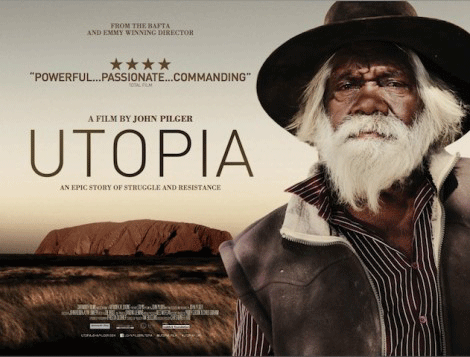 Utopia: An Aboriginal perspective, Black Feminist Blogspot, BY TRACKER, JANUARY 7, 2014 “………There are two huge points Pilger investigates through this section of the film. One is that the greater Australian public has been more than happy to accept the intervention because they readily accept horrible and racist stereotypes of Aboriginal people as fact.
 its mineral resources, the demonisation of Indigenous Australia is a small price to pay. It’s almost completely impossible to deny the truth of Pilger’s assertions here. Pilger has already so poignantly highlighted many layers of Australian racism by this point, and has juxtaposed this racism with wealth generation repeatedly.
Abbott govt ignores Chief Scientist, takes advice from climate denier
Tony Abbott’s scientific and business advisers at odds over climate change, Guardian 28 Feb 14, Chief scientist says it is not an illusion while head of PM’s business advisory group refers to ‘groupthink’ Tony Abbott’s top scientific and business advisers are at odds over the science of climate change with the chief scientist, Ian Chubb, strongly rejecting assertions that climate science is a “delusion” or a result of “groupthink”.
Chubb said the scientific evidence for human-induced global warming was so overwhelming that those who reject it are usually forced to “impugn the messenger” with “stupid expressions like ‘groupthink’” or “silly” arguments that global warming is a “delusion”.
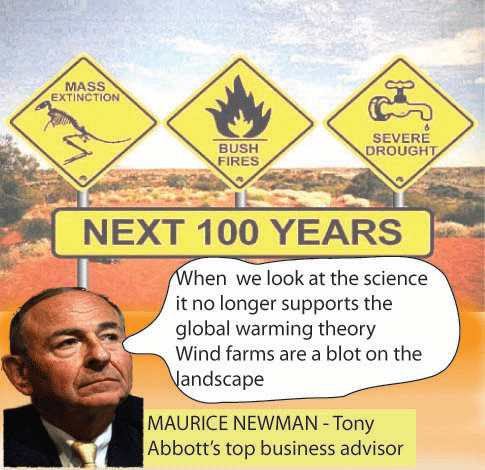 Among those who have used the phrase “groupthink” in relation to the debate about climate science are the head of the prime minister’s business advisory group, Maurice Newman, and the man chosen by the prime minister to head the review of the renewable energy target, businessman Dick Warburton. Two months ago Newman wrote a newspaper article describing climate science as a “scientific delusion”.
Chubb, who as chief scientist is supposed to provide high-level independent advice to the prime minister and other ministers, was speaking at the launch of the final report on Australia’s greenhouse gas reduction efforts by the independent climate change authority, a body the Abbott government is seeking to abolish.
“Climate science is one of the most heavily scrutinised areas of science I have ever experienced,” said Chubb.
“The overwhelming bulk of it has stood the test of that scrutiny … I find a lot of the science compelling.”…
 The chairman of the climate change authority, Bernie Fraser, a former governor of the Reserve Bank, said he agreed with Chubb’s assessment of the compelling nature of climate science and said he thought those who did not accept it were either “mavericks at the fringes” or “those who speak in the short-term interests of industry”.
And Fraser also took issue with the “uncivilised” nature of Australia’s climate debate, including “the wild assertions blaming every lost job on the carbon tax … assertions not based on any objective consideration of the evidence”. http://www.theguardian.com/environment/2014/feb/27/abbotts-advisers-at-odds-climate-change
Australia NEEDS to see “Utopia”- and stop white-washing its Aboriginal history
It’s nothing new that other countries are expressing shock and outrage over this film, whilst Australia tries to ignore its content. For further information, check out the mounting pile of political denials following reports from visiting UN officials.Utopia: An Aboriginal perspective, Black Feminist Blogspot, BY TRACKER, JANUARY 7, 2014 Award winning investigative journalist John Pilger’s new film Utopia will be a powerful weapon to raise awareness about Aboriginal Australia, according to Arrente writer Celeste Liddle*. On flicking through the UK reviews of John Pilger’s new documentary film “Utopia”, one thing quickly becomes apparent: Pilger has created a hard-hitting film that is of extraordinary importance.
Queensland govt moves to restrict objections to mining applications
 Move to limit ideological objections to Qld mining projects, ABC News, 28 Feb 14 By environment and science reporter Jake Sturmer The Queensland Government is looking to restrict who can object to mining applications, in a bid to crack down on what it calls philosophical opposition to projects.
Currently any group or person can object to applications, potentially sending the decision to the Land Court.
Deputy Premier Jeff Seeney said it was “frustrating” for the Government.
“It’s obvious that the current process allows individuals or groups who are fundamentally opposed to the coal industry – for whatever reason – to use the objection process to frustrate and delay those projects,” he said. “The people of Queensland have elected us as a Government based on developing our coal industry to supply the world markets and our processes need to allow us to do that.”
In the next few weeks, the State Government will release a discussion paper looking at who can object to applications….
“The people of Queensland have elected us as a Government based on developing our coal industry to supply the world markets and our processes need to allow us to do that.”
In the next few weeks, the State Government will release a discussion paper looking at who can object to applications……http://www.abc.net.au/news/2014-02-27/move-to-limit-ideological-objections-to-qld-mining-projects/5289246
Insight into Australia’s rich history through Mungo Man
Mungo Man is a physical reminder of the need for Indigenous recognition Forty years on from the discovery of Mungo Man, what he represents is as pertinent now as ever, Guardian, 25 Feb 14 Jim Bowler “………….Mungo Man has given us a rich insight into a dynamic and ancient world. He has delivered an exciting range of scientific firsts, played a significant role in the establishment of the Willandra Lakes as a world heritage area, and, for many Indigenous people, his status has given a sense of pride to the very notion of being Aboriginal. As one of the two foundational burials, with Mungo Lady, he exemplifies Aboriginal Australia’s proudest traditions of antiquity and cultural development on the international stage…….
In emerging from that grave Mungo Man continues to challenge ignorance and prejudice. Such status takes on further legitimacy in the light of his liturgical burial. That action of ceremonial anointing with the earth, the ochre drama, defines new levels of communal self-perception, an awareness and celebration of a people-nature mystique, an acknowledgement of a power beyond. In that sense the burial stands arguably as the world’s oldest example of overt religious expression.
In my pursuit of rational science, those lakeshore sands, originally solely of geological interest, have been transformed into sacred grounds. My eyes have been opened to glimpse and share in some small way that inner view long entrusted to Mungo Man’s Aboriginal descendants, a deep connection to country, to their ancestral spirit-charged lands. I remain ever conscious of Mutthi Mutthi elder Mary Pappin’s admonition: “You did not find Mungo Lady and Mungo Man – they found you!”
Already taking his place in the school curriculum as a key focus in Aboriginal history, Mungo Man’s place as messenger stands in firm justification for national recognition. While Aboriginal Australia must speak in its own voice, as a scientist with a sense of humanity already much deepened by Mungo Man’s contribution, I confidently hope that what has been changed in me will be shared in the lives of many others.
The return opens a new chapter, one in which the voices from the past – the voices from those graves – return in spirit with the bones. My burden remains to speak to and for those voices, to interpret their meaning and to deliver in their death the messages they may have voiced in life.
Mungo Man crosses many boundaries, boundaries between science and traditional cultures, between past and present, between black and white, between life and death. On returning home, his voice takes on new urgency, defining messages for his land and for his people. That occasion, after 40 years in waiting, brings new hope, a reassurance to Indigenous Australians of the nation’s debt to their ancestral history……..http://www.theguardian.com/world/2014/feb/25/mungo-man-physical-reminder-need-for-indigenous-recognition
Bizarre election in South Australia, rigged by Liberal-Labor duopoly
Dennis Matthews, 27 Feb 14, Thanks to dangerously defective changes to the Electoral Act rushed through the South Australian Parliament at the last minute by the Liberal-Labor duopoly, organized harvesting of preferences in the 2014 Legislative Council elections appears to be in full swing.
This “gaming” of the system produces unpredictable preference flows such as those that gave bizarre results in the recent Senate elections.
It is highly likely that gaming will result in the balance of power being held by a party that the vast majority of voters had no intention of electing to the Legislative Council.
Thanks to the Liberal-Labor duopoly, governing South Australia could soon become more difficult.
ACT to keep electricity prices low by extending solar and wind energy
 ACT extends renewables FiT to 550MW to drive big solar, wind, Reneweconomy, http://reneweconomy.com.au/2014/act-large-scale-fit-solar-wind-26551 By Sophie Vorrath on 27 February 2014
Australia the only country to wind back national climate legislation.
Abbott’s climate policy: ‘So unintellectual to as to be unacceptable’ REeweconomy,By Jonathan Gifford on 27 February 2014 The latest update of a report that assessed 66 countries on their climate change mitigation strategies has singled out Australia as being the only country to wind back national climate legislation.
The report was complied by Globe International, a body which assesses climate mitigation laws worldwide, and its head, Lord Deben, described moves to abolish the carbon tax in Australia as being “very disappointing” – in an interview with theFinancial Times.
Lord Deben, when he was John Gummer, was a former UK government minister under Prime Ministers Margaret Thatcher and John Major. He has lashed out at the Abbott government’s climate policies as being, “so unintellectual as to be unacceptable; I mean it is just amazing.”
The British peer’s remarks to the Financial Times, itself hardly a bastion of radicalism, included a stab at the climate analysts from which Abbott bases his climate policy, describing their work as “very dubious.”
“[This is] the last example of a government coming to power on the basis that really all this [climate change] is nonsense,” said Deben……
Lord Deben is a Conservative Party peer and his comments echo those made toRenewEconomy last week by Australian economist and climate policy advisor Ross Garnaut.
“This isn’t a conservative government in Australia, this is radical government,” Garnaut said. “A conservative government would’ve wanted to conserve all the good things about Australian life wouldn’t be seeking to undermine the current climate policies.”.http://reneweconomy.com.au/2014/abbotts-climate-policy-so-unintellectual-to-as-to-be-unacceptable-21542
1 This month
17 October, Free Public Talk on Nuclear Issues in South Australia
David Noonan will speak on public interest concerns over the new Roxby Downs Indenture Act 2026 on BHP copper-uranium mining and ore processing in SA, and on how AUKUS may face SA with a High-Level nuclear waste agenda.
Dr Jim Green will discuss international developments in the field of nuclear power including ‘small modular reactors’ and Generation 4 ‘advanced’ nuclear reactor concepts.


Help Aunty Sue Protect Her Land and Sacred Sites From Destructive Rocket Testing.
.

Australians deserve the truth
about
AUKUS – https://aukuspublicinquiry.com/

PETITION – To: Prime Minister Anthony Albanese and the Australian Labor Government

of the week – Australians for War Powers Reform (AWPR)
To see nuclear-related stories in greater depth and intensity

