99 year leases for Australian Aboriginals – a cosy arrangement to suit mining companies?
as traditional owners in the NT enjoy free prior informed consent rights, it is imperative they understand what might be at stake before finalising any long-term leases.
It is far from clear if this cosy arrangement administered from Canberra will ensure best outcomes for traditional owners.
Abbott government peddles De Soto on Arnhem Land rights CRIKEY, PROFESSOR JON ALTMAN | DEC 04, 2013 Economist Hernando de Soto’s ideas on capitalism and poverty don’t fit the Australian Aboriginal experience. So why is the Abbott government trying to apply them, asks ANU professor Jon Altman?
The Coalition’s policy for indigenous affairs states indigenous people in remote areas have no property rights. Which is plain wrong; one-third of the Australian continent is under some form of statutory land rights or exclusive and non-exclusive native title determination following successful land claims and native title determinations over the past 35 years. Continue reading
Large scale solar energy company to begin operations in Australia
SolarReserve Sets Up Shop In Australia, Renewable Energy News, 6 Dec 13 SolarReserve has announced the company’s international expansion into Australia through the opening of an office in Perth. The company says its Australian operations will focus on large-scale concentrating solar power (CSP) and photovoltaic (PV) projects, particularly in the off-grid mining sector.
“In Australia, the best solar resources are commonly found in remote areas where mines operate, presenting the off-grid mining sector with a substantial opportunity to offset the high price of electricity generation in these remote locations with a solar energy alternative,” says SolarReserve’s CEO Kevin Smith.
There are more than 1,000 operating mines in Western Australia – and many of those are powered by high-priced and polluting diesel fuel.
“In the face of impending policy decisions by the Australian government related to renewable energy and carbon emissions, solar energy for the mining sector is a win-win: good for business and good for the environment.”
The company was one of the participants in a meeting earlier this year in the gold mining city of Kalgoorlie in Western Australia to plan the Goldfields’ renewable energy future……http://www.energymatters.com.au/index.php?main_page=news_article&article_id=4062
Australian government’s 99 year lease plan to hand Aboriginal land over to mining interests
 The dismantling of the Land Rights Act (NT) 1976 forum http://acmsydney.wordpress.com/2013/11/29/the-dismantling-of-the-land-rights-act-nt-1976-forum/ November 29, 2013
On Wednesday Graeme and I attended a forum held by ‘concerned Australians’. It was a wonderful opportunity to hear Utopia Elder Rosalie Kunoth-Monks speak about her concerns with 99 year leases and other challenges communities are facing. It was also an opportunity to hear expert legal and political analysis of the Federal Government’s proposed 99 year leases. Below is a letter that Michele Harris has sent out today regarding the forum.
Also attached is a letter from Rev. Dr Djiniyini Gondarra sent to the Australian newspaper Djiniyini and The Australian– referred to by Michele below. As Michele says this letter is of great educational value and I would recommend it to you.
Regards,
Gabrielle
—————————-
Dear Friends,
I would like to thank all those who attended the conversation on the “Dismantling of the Aboriginal land Rights Act (NT) 1976″ yesterday [Wednesday 27th]. To those who were unable to attend I wanted to let you know that we will attempt to use the material from the event to make a couple of you tubes which we will be able to send to you sometime soon.
It is clear from the legal advice that was provided, from both Alastair Nicholson and Frank Vincent, that there is a great deal for NT communities to be concerned about as our new Government offers considerable sums of money in return for 99-year leases. The intent of the land right act was spelt out by Gough Whitlam when he spoke to Vincent Lingiari in 1975. He said:
Vincent Lingiari, I solemnly hand to you these deeds as proof, in Australian law, that these lands belong to the Gurindji people and I put into your hands part of the earth itself as a sign that this land will be the possession of you and your children forever.
Forever!
We were very fortunate to have with us Malcolm Fraser whose government was in power when the Land Rights legislation was passed into law. He stated, “If the government is wanting 99-year leases, it goes a long way to making sure Aboriginals can no longer control their own land.”
Rosalie Kunoth-Monks from Utopia shared her concerns of the increasing trauma within her community. She said. “Right now we are again traumatised because that’s the last stable thing we feel under our feet: our earth, our ground, our home of thousands of years.“
There is little doubt that government is eager to regain control over land as part of its economic drive for business and mining development.
Dr Djiniyini Gondarra from Galiwin’ku posed questions to Alastair Nicholson, former Chief Justice of the Family Court of Australia and answers to these and Rosalie’s questions will be circulated soon. Dr Djiniyini has been travelling around communities in Arnhem Land discussing the implications of the 99 -year leases. He has also been engaged in refuting claims made in The Australians regarding its misunderstanding of the meaning of a “Traditional Owner’ His letter, to which a clarification was made by the paper, is of great educational value and so I am attaching a copy for those who wish to read it.
Thank you.
Michele Harris ‘concerned Australians’
National survey on energy affordability
Aussies Want Cheaper Power – But Hands Off Renewables http://www.energymatters.com.au/index.php?main_page=news_article&article_id=4056 3 Dec 13 While not the largest cost-of-living expense, electricity bills are the bogeyman that concern Australians most.
A national survey on energy affordability carried out by CHOICE, the Brotherhood of St Laurence and Energy Efficiency Council revealed 84 per cent of Australian households are concerned or very concerned about energy costs. The same percentage felt it was important or very important for their State Government to help rein in these costs.
However, instead of screaming for renewable energy support to be hit to cut the cost of power – a default choice it seems for many politicians – this was the least popular action in the survey. In fact, knee-capping renewables had a negative net approval rating in every state.
Nearly double the percentage of respondents strongly opposed such action compared to those who strongly supported it. This is a message Australia’s government would be well-advised to heed; particularly given it appears to have its sights set on the Renewable Energy Target next year.
Energy Efficiency Council’s chief executive officer, Rob Murray-Leach, said there was also a danger the national debate about the carbon bill meant other expenditures that have an even bigger impact on energy costs, like poles and wires, could be ignored or overlooked.
The most popular methods for reducing power costs emerging from the survey were:
– Government helping homes and businesses save energy
– The introduction of time of use pricing
– The use tax revenue to subsidise energy bills for low-income households
While many Australians spend far more on petrol than electricity, CHOICE says the fear stirred up by power bills could be due to several factors – electricity costs jumping far more rapidly than transport costs over the past two years, the “sticker shock” aspect of larger than expected bills and that electricity bills tend to be a significant outlay given they are received quarterly.
The summary results of the Survey of Community Views on Energy Affordability for Australia can be viewed here (PDF).
Trial of electric cars shows they can be effective for Australia
 Trial complete: electric vehicles can work in Australia The Conversation, 3 Dec 13 Australia’s first electric vehicle trial has been completed. It ran from early 2010 to the end of 2012 with 11 electric Ford Focus and 23 fast-AC charging bays (Level-2). We found few technological barriers to the adoption of electric vehicles (EVs) in Australia, but government incentives for early adopters and government programs for the roll-out of fast-DC charging stations would help Australia fully embrace these cars……..
When are cars charged?
We were particularly interested in what time of day drivers charged their cars. This determines how much renewable energy can be used for charging (to make an EV really emission-free) and whether electricity utilities have to worry about an increase of peak demand in the future, when there might be millions of EVs.
The fleet EVs did most of their charging in the morning until mid-day, so most of the charging energy could be supplied by solar photovoltaics. This finding is significant, as company fleets are not only an early adopter of new car technology, but are also the largest customer segment for the new vehicles market in Australia………
Recommendations We found:
EVs can function as regular fleet pool cars for most applications. Continue reading
Aboriginal opposition to Wiluna and and to all uranium mining in Western Australia
“We are calling on the State and Federal Governments to stop any further approvals or development of the Wiluna uranium mine until the full project can be assessed and made public.”
Forty uranium mines is the plan for Western Australia The Stringer, by Gerry Georgatos November 29th, 2013“ Credible sources in the uranium sections of resource companies first told The Stringer, in February, of futurist uranium mining plans that are being deliberated by mining companies for Western Australia –……. A couple of insiders estimate potentially 40 uranium mines will arise right throughout Western Australia in the decades to come.
Environmentalists reject that this is possible while Aboriginal Elders resident on Country say they will resist uranium mining at all costs.Local Aboriginal Elder Mr Glen Cooke has travelled from Wiluna to attend Toro Energy’s annual meeting today to highlight community concern over Toro’s plans for uranium mining in the region. Mr Cooke and another proxy shareholder, Kylie Fitzwater, have come to Perth to raise concerns about Toro’s long term plans and the company’s failure to communicate these to Wiluna residents.
“Toro have been talking about one project on the Lake and now we hear that they are planning lots of uranium mines from Meekatharra all the way to Lake Maitland.”
“They never talked to us about that,” said Mr Cooke.
“Me and my family we never wanted one uranium mine, we sure don’t want seven of them scattered through that country.”
“Does this mean they will put uranium on trucks from all over and bring it to Wiluna and if so what will they do with the radioactive mine waste, and where will they get the water?”
“It’s just too dangerous. This is people’s homes, not just in town but we live all over and love all of that country. That place is a very special place – for all men north to south, east to west. It’s is too important to muck it up, once it’s broken it is broken forever, we could never get that back.” Continue reading
Australia has hottest Spring on record
 Australia records its warmest spring after blazing September, http://www.thebull.com.au/premium/a/42492-australia-records-its-warmest-spring-after-blazing-september.html Blair Trewin Climatologist, National Climate Centre at Australian Bureau of Meteorology. 1 Dec 13,
The spring of 2013 has been Australia’s warmest on record. Mean temperatures for the season were 1.57C above the 1961-1990 average, surpassing the previous record of 1.43C (set in 2006) by 0.14C. Daytime maximum temperatures were also the highest on record, coming in 2.07C above average and 0.24C above the previous record (also set in 2006), while overnight minimum temperatures were the fourth-warmest on record.
The warmth was most dramatic in September, which saw a mean temperature anomaly of +2.75C, setting a new monthly record by more than a degree. October was also a very warm month, 1.43C above average. Temperatures during November were closer to normal, 0.52C above average, but were still warm enough to complete a record spring.
The warmth was extensive, with virtually the entire country experiencing above-average mean temperatures for the spring. It was the warmest spring on record over an area covering most of western Queensland (sufficient to give Queensland its warmest spring on record), and extending into the eastern interior of the Northern Territory.
Records were also set on the west coast around Perth, on the east coast around Sydney, and on parts of the Nullarbor. The spring ranked in the 10 warmest on record over 83% of the country. The record warm spring leaves Australia on track to have its warmest calendar year on record. Mean temperatures for Australia for the 11 months ending in November were 1.23C above average and 0.18C above the previous record year, 2005.AUTHOR

Blair Trewin
Climatologist, National Climate Centre at Australian Bureau of Meteorology
Solar Citizens a formidable lobbying force in Australia
 Sun Tax’ Petition Hits 25,000 Signatures http://www.energymatters.com.au/index.php?main_page=news_article&article_id=4054 2 Dec 13 20 advocates associated with Solar Citizens will be travelling to Canberra on Monday to present a petition signed by more than 25,000 Australians who are demanding politicians to not tax the sun.
The group will be meeting with dozens of federal politicians, dispelling the myths and highlighting the need for positive measures to help the growth of solar throughout Australia. Prime Minister Abbott signalled he had renewable energy in his crosshairsrecently and incorrectly stated that the RET was contributing significantly to electricity bills. That certainly isn’t the case, even with home solar.
“Solar is a small portion – less than 6%. So, why is solar being blamed?” said Adrian Brown, a spokesperson for Solar Citizens. “The simple answer is that it appears that big energy companies are trying to dictate our energy future, attempting to salvage their profit margins and investment in the network – and penalising solar along the way.”
Mr. Brown stated the ‘sun tax’ concept may have just been a recommendation and is by no means set in stone, but slugging solar seems to be the default solution for politicians.
More than 1.1 million Australian households have invested $8 billion to take power over their bills says the group; saving families collectively many hundreds of millions of dollars on energy bills annually. “Making the move to solar is a real way for families to take power over their bills and do their part for our environment,” Mr Brown says.
In addition to the substantial power bill savings, the solar revolution in Australia has created many thousands of jobs. Geoff Bragg, NSW Chairman of the Solar Energy Industries Association (SEIA), says the industry could continue to grow; however, stability must be ensured. The trip to Canberra is only another step in the anti-sun tax campaign, not the end. Later this month, the group intends presenting the petition to State Premiers and Energy Ministers.
Solar Citizens is a grassroots initiative bringing together existing and future solar owners to ensure their rights are protected and to help see solar panels on every rooftop in Australia.
Sutherland Shire happy to host nuclear reactor, but not so keen on hosting radioactive wastes
 Sutherland Shire to get radioactive waste storage facility St George and Sutherland Shire Leader By Jim Gainsford and Kate Carr Nov. 29, 2013 The Australian Radiation Protection and Nuclear Safety Agency has given the green light to the controversial plan to build a nuclear waste storage facility at ANSTO.
Sutherland Shire mayor Steve Simpson said this afternoon that the council was ‘‘strongly supportive of the work ANSTO does but we are still calling on the federal government to expedite a permanent waste storage facility for nuclear waste collected throughout Australia’’………
This waste is returning from France in 2015 in accordance with agreements relating to the processing of the waste. The waste will comprise one flask of processed nuclear fuel and six smaller drums of waste. Fortunately the licence from ARPANSA will not cover waste to be returned from the UK which we’re told is due to be returned at a later date.
“The fact that the waste will end up at ANSTO as there is no National Radioactive Waste Repository is not good enough for the residents of the Sutherland Shire who are concerned about the safe transportation and storage of this nuclear waste.
“Indeed the ARPANSA approval notes that the interim storage of the waste at ANSTO is not in line with international best practice and ARPANSA stresses the need to establish a National Radioactive Waste Management Facility (NRWMF), as storage of nuclear waste at Lucas Heights is not an acceptable long term solution.
“The continued transportation of Intermediate Level Radioactive Waste to Lucas Heights in the form of reprocessed fuel represents an unnecessary risk to the surrounding residents and communities”….. http://www.theleader.com.au/story/1941466/sutherland-shire-to-get-radioactive-waste-storage-facility/?cs=12
Trans Pacific Partnership can allow foreign companies to sue Australian governments
If you believe that Australians should get to choose their own policies and have their basic democratic rights honoured and protected, without fear of legal retribution by foreign corporations then please sign this petition!
Don’t let foreign corporations sue Australia over our policies on GE crops, coal seam gas, health & more! https://secure.avaaz.org/en/petition/Dont_let_foreign_corporations_sue_Australia_for_millionsbillions_over_our_policies_on_GE_crops_coal_seam_gas_more/ The decision by Prime Minister Abbott to reverse the blanket prohibition on ‘investor-state dispute settlement’ (ISDS) provisions in Australia’s upcoming trade negotiations has the potential to irreversibly damage Australia’s national interests by limiting Australia’s ability to set its own policies when it comes to health, the environment, social policies and more.

This is because this new policy will give foreign corporations the right to sue the Australian Government if they believe our policies will damage their corporate interests.
This means that biotechnology corporations could sue Tasmania and South Australia over their respective moratoriums / bans on Genetically Engineered (GE) crops. New South Wales could be sued over their environmental guidelines on coal seam gas extraction and any communities choosing to enact a moratorium on coal seam gas extraction could be sued as well. Pharmaceutical companies could sue Australia over our Pharmaceutical Benefit Scheme (PBS). We could also be sued if we ever wanted to ban harmful pesticides or institute stricter environmental standards in any area of our economy that might impact the interests of a foreign corporation. And that’s just to name a few…
And if you think this all sounds so totally outrageous that it couldn’t possibly happen to us here in Australia, then its well worth considering the impact of what ISDS provisions are currently doing in Canada Continue reading
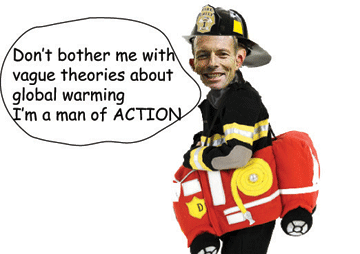
Tony Abbott has trashed Australia’s international reputation on climate change
But over the next six months, Abbott intends to trash the very mechanisms that could deliver this increased ambition – the carbon price, the renewable energy target and the Clean Energy Finance Corporation – along with the independent advisory body, the Climate Change Authority, that could possibly counter the advice from his inner circle of mad ideologues to whom the words “climate change”, “green” and “clean energy” are as inflammatory as the names Fairfax and the ABC.
On the international stage, in the climate change arena, Australia’s reputation has been shattered
 Australia backing into climate change corner, MacroBusiness, 29 Nov 13, Carbon Economyon November 25, 2013 Cross-posted from Giles Parkinson at Reneweconomy. Tony Abbott has some homework to do. Over the next 15 months he is going to have to figure out how it is that Australia will meet its contribution to a new treaty that aims to limit global warming to 2°C.
He’s not the only one. More than 190 nations associated with the UN climate talks agreed on Saturday on a series of milestones that will hopefully take the world to a meaningful climate agreement in Paris in 2015. As part of that agreement, ministers will meet in June next year, country leaders in September, and by the first quarter of 2015, they will need to lay their targets on the table.
For Abbott this could be quite a challenge. Firstly, Australia, as one of the wealthiest nations in the world, and the biggest emitter per capita of any industrialised nation, will be expected to pull its weight. Continue reading
Citizen donations fund New South Wales solar energy project
 Australian Solar Project Loan Funded By Citizen Donations http://www.energymatters.com.au/index.php?main_page=news_article&article_id=4052 29 Nov 13, CORENA (Citizens Own Renewable Energy Network Australia Inc.) has provided Tulgeen Disabilty Services an interest-free loan of $12,000 to install solar; with the loan funded entirely by donations from the public.
Two rooftop solar PV systems have been installed for Tulgeen; located in Bega, New South Wales. The Tulgeen cheese packaging facility, which employs people with disabilities, has a 4kW system that will supply 58% of its electricity needs. A 3kW solar panel array installed at the Training and Education Services day programs centre will provide 21% of that building’s requirements.
CORENA uses donations from the public to fund projects; then electricity sales and loan repayments from completed projects to help finance future projects, thus continuously recycling donated money. “Eventually, when we have funded around 120 such projects, repayments from earlier projects will be enough to continue funding one new project per month forever, without ever needing more donations,” said CORENA spokesperson Margaret Hender.
Operating on a shoe-string budget, 100% of the money donated is spent the projects themselves. Currently the group relies on volunteers’ time for administrative functions. “It enables everyone who wants more renewable energy now to collectively get on with the job, rather than just waiting on government action,” states the CORENA web site. Patron of the organisation is Monica Oliphant, who, among many other roles, was President of the International Solar Energy Society (ISES) in 2008/09.
Community-serving organisations are encouraged to apply for funding underCORENA’s Small Projects scheme.
Community-funded solar; both under an investment model or donation basis, has generated a great deal of interest in Australia; with dozens of communities and initiatives attempting to set the wheels in motion.
Government support for such initiatives has been scant to date, although a new ARENA-supported project due to commence early next year will delve into how to best realise the potential of community-owned renewable energy projects in Australia.
Australians must learn from Aboriginal culture, to survive in this land
there can never be a return to the pre-1788 situation, his cry is that we must redouble our efforts to understand it and learn from it
“We have a continent to learn. If we are to survive, let alone feel at home, we must begin to understand our country. If we succeed, we might one day become Australian’.
 The answer to burning questions, Online opinion, By Roger Underwood, 29 Nov 13 “…………The Biggest Estate on Earth, subtitled How Aborigines Made Australia is a large and beautifully presented book. The author, Bill Gammage, is well-known in historical and literary circles, regarded by many as the foremost historian of Australian participation in the First World War. Gammage’s capacity for painstaking research and careful scholarship, formerly directed at military history, has now been turned to the Australian landscape and Aboriginal land management. The result is compelling.
He rejects the view that Aboriginal people were backward and uncivilised, or that they were people who “trod lightly on the ground” as a minor component of the ecosystem. Instead, he argues that Aboriginal people were skilful, determined and experienced land managers who were active across the breadth of the Australian continent and Tasmania, operating to a strict set of rules (‘The Law’) about what areas must be burned, when, how, for what purpose, and by whom. They not only knew how to manipulate the Australian landscape and biota to optimise their food resources, but they knew how to sustain pleasing and safe living conditions, and to facilitate their comfortable life style and their spiritual demands. Continue reading
Largest native title area – South Australia win for Aboriginal people
Native title recognised after 18-year legal battle ABC Indigenous News, November 28, 2013 South Australia’s largest native title determination will be granted to Aboriginal people in the state’s far west next week. The claim covers 80-thousand square kilometres of land from the Western Australian border, to Tarcoola in the north and Streaky Bay in the south.
The recognition comes after nearly 18 years of struggle by the Wirangu, Kokatha, Mirning and Anangu people. The groups’ connection to the land will be formally recognised at a special Federal Court hearing at Lake Pidinga, north of Yalata, next Thursday……..
National Park gets new name Last year, the Arabana people were granted native title over 70,000 square kilometres of land in the state’s far north, including Lake Eyre. Lake Eyre National Park has now been officially renamed to include the traditional Aboriginal name for the landmark. At the request of the newly-formed Arabana Parks Advisory Committee, the park will now be known as Kati Thanda – Lake Eyre National Park. The park is co-managed between the State Government and Arabana people.http://www.abc.net.au/news/2013-11-28/aboriginal-groups-granted-native-title-in-far-west-sa/5122788/?site=indigenous&topic=latest
The power of suggestion in attitudes to wind power and health
 The results showed that the experience of symptoms and mood during exposure to audible windfarm sound and infrasound was influenced by the type of expectations provided before exposure periods.
The onus falls on the media to report on health fears about wind farms cautiously, particularly given strong evidence that it is the discussion itself that may be creating and perpetuating health complaints.
 Wind turbines don’t make you feel sick or healthy, but spin can http://theconversation.com/wind-turbines-dont-make-you-feel-sick-or-healthy-but-spin-can-20845 Fiona Crichton PhD candidate in psychological medicine at University of Auckland 29 Nov 13
Despite at least 19 reviews of the scientific evidence universally concluding that exposure to wind farm sound doesn’t trigger adverse health effects, people continue to report feeling unwell because they live near wind turbines.
We’ve known for some time that exposure to negative messages about wind farms makes people more likely to report feeling sick after exposure to turbines. And new research, published by my colleagues and I this week in the journal Health Psychology, shows positive messages about wind farms may have the opposite effect – improve perceptions of health.
Infrasound
Speculation in the media and on the internet often attributes the symptoms to sub-audible sound produced by operating wind farms (infrasound). But the reality is that infrasound (sound below 16 hertz) is consistently present in the environment and is caused by wind, ocean waves and traffic. Importantly, research demonstrates there is nothing unusual about the levels of infrasound produced by wind farms. Continue reading
1 This month
17 October, Free Public Talk on Nuclear Issues in South Australia
David Noonan will speak on public interest concerns over the new Roxby Downs Indenture Act 2026 on BHP copper-uranium mining and ore processing in SA, and on how AUKUS may face SA with a High-Level nuclear waste agenda.
Dr Jim Green will discuss international developments in the field of nuclear power including ‘small modular reactors’ and Generation 4 ‘advanced’ nuclear reactor concepts.


Help Aunty Sue Protect Her Land and Sacred Sites From Destructive Rocket Testing.
.

Australians deserve the truth
about
AUKUS – https://aukuspublicinquiry.com/

PETITION – To: Prime Minister Anthony Albanese and the Australian Labor Government

of the week – Australians for War Powers Reform (AWPR)
To see nuclear-related stories in greater depth and intensity

