Abbott government’s spin against renewable energy
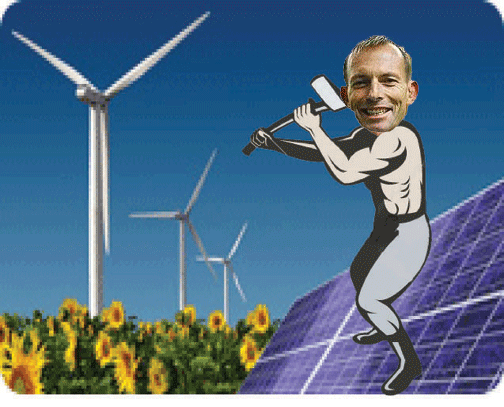 The document rightly sheets home the blame for most of the electricity price rises on network costs, but how it spins that tale is a different matter.
Canberra’s new energy mantra: Renewables bad, demand good (excellent graphs) http://reneweconomy.com.au/2013/canberras-new-energy-mantra-renewables-bad-demand-good-52964 By Giles Parkinson on 28 November 2013 The apparent antipathy of the new Australian government towards renewable energy, and its attachment to the centralised generation model, is betrayed in an unusual document on electricity prices published recently.
The “Facts on Electricity Prices” document, posted by the Department of Resources and Energy (now part of the Industry portfolio), purports to explain to consumers the reason for recent electricity price rises, and what they, and the government, can do about it.
That’s a fair enough proposition. But it is the unusual language, selective information and outdated data that raises suspicion that this document serves another purpose. Continue reading
Uranium under pressure means tough times for Toro
 Toro Energy – the company seeking to open WA’s first uranium mine – will be the focus of critical attention from local residents, Traditional Owners and State and National environment groups at its annual meeting in Perth today.
Opponents of the company’s uranium mining plans will greet Toro executives and shareholders with an independent report casting doubt on the economic viability of the company as well as the broader nuclear industry.
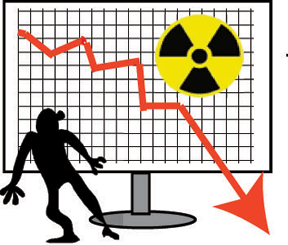
A theatrical performance outside the AGM will also demonstrate that the nuclear industry’s vital signs are ‘flat lining’.
“Toro have expanded their proposal from one risky and unviable uranium mine in Wiluna, to a series of equally small and risky deposits in the region” said CCWA campaigner Mia Pepper. “What they won’t tell shareholders is that this expansion plan will represent more delays, more costs, more environmental problems, and more community opposition.”
“Toro have failed to fully disclose the complexity, risk and lack of formal approval for its long term plans.”
“CCWA and the Australian Conservation Foundation oppose the current proposal and will actively contest the company’s plan for seven uranium mines across 200km and 2 lake systems which will involve a doubling of water use and radioactive mine waste”.
“Toro’s shareholders will have a very long wait before this company will be profitable, if ever. The conditional approval granted for the Wiluna mining proposal prohibits the company from doing any other preparatory works for a mine until thirty six conditions are met and further management plans are approved.”
“Financial problems have dogged the uranium sector with low uranium prices, high operating costs and a lack of investor confidence following the global decline in nuclear power post Fukushima,” said Ms Pepper.
“While some companies are cutting their losses Toro is on track for tough times ahead”.
A win for local communities as Tribunal finds wind farms are not harmful to health
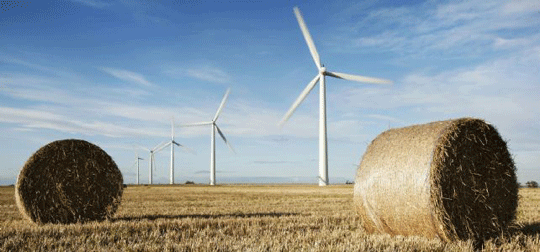 Wind farm ruling a win for communities: Clean energy group http://www.abc.net.au/news/2013-11-27/wind-farm-health-findings-a-win-for-communities/5120036 ABC Rural By Babs McHugh The Clean Energy Council says the latest rejection of claims of negative health effects of wind farms is adding more certainty to the future of the industry for investors.
The Victoria Civil and Administrative Tribunal (VCAT) has approved a 16-turbine wind farm at Trawool, north of Melbourne, after finding there’s no evidence they have adverse effects on health and well being. Director of policy with the Clean Energy Council, Russell Marsh, says he wasn’t surprised by the findings. “Pretty much every wind farm that’s been proposed in recent years has been opposed on grounds of adverse health effects.
“What we’ve seen in the last 24 hours is that there’s yet more evidence to show that those claims are unfounded. “New South Wales and Victorian state health bodies, and federal departments also, have found there’s no scientific evidence to back up claims of ill- health effects, physical and psychological.
“And this is backed up by a noise study for the Waterloo wind farm released yesterday by the South Australian Environmental Protection Agency. “That found the noise from the wind farm fell below the thresholds set under the planning conditions.
“Also, the rumbling noise that some residents complained about (in diaries they were asked to keep) was present at times when the wind farm was switched off.” Mr Marsh says it’s not only wind farm operators who these findings benefit. “It is a significant win for the industry, but also for communities who live near wind farms. “Yet again, this is showing that when these adverse health (claims) are tested, they don’t stack up.
“So communities shouldn’t be concerned about a wind farm being located near them.”
South Australian Environment Protection Authority (EPA) finds Wind Farm Not Harming Residents
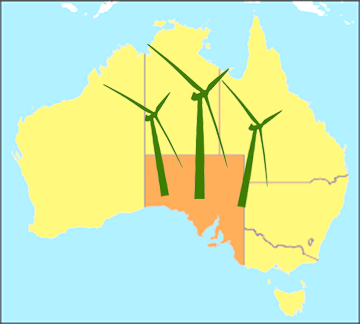 EPA study finds no evidence wind farm noise impacting residents ABC News, 27 Nov 2013, A study into the Waterloo Wind Farm, south-east of Clare, has found there is no evidence linking noise from the farm to any adverse effects on local residents.
The study was undertaken by the Environment Protection Authority (EPA) during April and June.
It has found noise produced does not breach authority guidelines and that low frequency infrasound levels are below internationally-accepted thresholds for perception.
The authority also says in some situations there was no association between events described by residents in noise diaries with audio records and data.
The authority’s Peter Dolan says he cannot say why local residents are complaining about health effects…….http://www.abc.net.au/news/2013-11-27/epa-study-finds-no-evidence-wind-farm-noise/5119556
Victorian Wind Farm gets the All Clear to Go Ahead
 Cherry Tree wind farm gets go ahead in Victoria ABC Rural By Babs McHugh 27 Nov 2013, The Victoria Civil and Administrative Tribunal (VCAT) has approved a wind farm after finding there’s no evidence wind farms have adverse effects on health and wellbeing. Infigen Energy’s proposal for a 16-turbine wind farm near Seymour, north of Melbourne, was rejected by the Mitchell Shire Council, which said there were widespread health concerns.
The council said it had received more than 100 objections to the project in the Trawool Valley, which also raised concerns about disruption to the landscape.
Infigen appealed the decision to the VCAT, and the Cherry Tree Wind Farm is now the first to be given the go-ahead under the Victorian Government’s new planning laws for wind farms which were introduced in 2011.
The Tribunal used information from the New South Wales and the Victorian health departments that shows there’s no scientific evidence to link wind turbines with adverse health effects or support claims that inaudible sound can have psychological effects……. http://www.abc.net.au/news/2013-11-27/wind-farm-go-ahead-victoria/5119518
Australians really should be worrying about Ultraviolet Radiation
 UV radiation: A central factor behind Queensland’s record rates of Merkel cell carcinoma http://www.news-medical.net/news/20131125/UV-radiation-A-central-factor-behind-Queenslande28099s-record-rates-of-Merkel-cell-carcinoma.aspx?page=2 November 25, 2013 Queensland has at least double the rates of the world’s deadliest skin cancer on record – yet much of the state are unaware the rare cancer even exists.
Merkel cell carcinoma is a highly aggressive form of skin cancer, with 60 per cent of patients dying within five years of diagnosis, compared to just 7 per cent of melanomapatients.
New research from Cancer Council Queensland, the University of Queensland and the Western Australia Institute of Medical Research has suggested ultraviolet radiation plays an important role in the development of Merkel cell carcinoma, contributing to Queensland’s record rates.
The findings will be presented at The Global Controversies and Advances in Skin Cancer Conference, hosted by Cancer Council Queensland in Brisbane today. Continue reading
Minister Macfarlane and Muckaty radioactive waste dump
 Statement from Muckaty Traditional Owner Penny Phillips re: meeting Minister Ian Macfarlane. We have heard through Senate questions that Ian Macfarlane is making plans to come and meet with Muckaty Traditional Owners (1).
Earlier this year I travelled a long way to Canberra by myself to talk to former Minister Gary Gray. At the same time the Northern Land Council was taking a group of people to Spain to look at the nuclear waste dump there. I invited Gary Gray to Tennant Creek to meet us, but the NLC mob didn’t ask me to come and meet him. They didn’t tell a lot of people about that meeting, just the ones they wanted to go along.
I went to the meeting in my own vehicle and told Gary Gray he could have stopped it then, but now we have to go around in circles again and tell the new Minister the same thing. I sent a letter to Minister Macfarlane, along with my mum Bunny Nabarula and my sister-in-law Dianne Stokes, to come here and meet with us. If he comes, we want the NLC to invite everyone to come along and meet him, not just pick one little group.
We all want to have our say. We aren’t going to let the dump go ahead because we are strong and want to protect the land from being destroyed. Contact Penny Phillips: 0459 715 223
For background on the Muckaty radioactive waste dump proposal: Natalie Wasley 0429 900 774
Australia lags in acknowledging the humanitarian impact of nuclear weapons
The next conference addressing the humanitarian impact of nuclear weapons will be held in Mexico City in February 2014. Australia should strongly support recognition of the following four points being argued by the Red Cross: 1) the catastrophic humanitarian consequences of any use of nuclear weapons; 2) the lack of any adequate humanitarian response capacity; 3) the incompatibility of any use of nuclear weapons with the rules of international humanitarian law; and 4) the need for concrete action leading to a prohibition on the use of nuclear weapons and their elimination.
 Underlining the horror of nuclear arms http://www.japantimes.co.jp/opinion/2013/11/26/commentary/underlining-the-horror-of-nuclear-arms/#.UpY1NNJwo7o BY RAMESH THAKUR NOV 26, 2013CANBERRA – Because of the unique destructive capacity and uncontrollable effects of nuclear weapons, the almost indescribable horror associated with their use informed the very first resolution of the U.N. General Assembly in 1946 and has been a recurring theme ever since in blue ribbon international commissions, NPT review conferences and preparatory committee meetings, and General Assembly committee debates.
Given the presently stalled nuclear disarmament agenda, the most productive way forward for both committed state and civil society actors to generate political momentum for the cause may be to emphasize the catastrophic humanitarian consequences of any use of nuclear weapons. The only way to guarantee their non-use ever is their total, irreversible and verifiable elimination under effective international control.
On Oct. 21, speaking in the U.N. General Assembly’s First Committee on behalf of 123 countries and the Holy See, New Zealand’s outgoing disarmament ambassador Dell Higgie issued a statement on the humanitarian consequences of nuclear weapons.
It noted that the broad participation at the March 2013 Oslo Conference, with attendance by 128 states (but not one nuclear-armed state nor most who shelter under their nuclear umbrellas), the ICRC, and several U,N, and civil society humanitarian organizations, reflected the recognition that the catastrophic humanitarian consequences of nuclear weapons are a major global concern. Yet no country or international body has the capacity to address the immediate humanitarian emergency caused by a nuclear weapon detonation or provide adequate assistance to victims.
Intriguingly because of their close relations on so many issues, on the same occasion Australia’s ambassador to the U.N. in Geneva, Peter Woolcott, issued a parallel statement on behalf of 17 countries, mainly those protected by U.S. nuclear weapons under extended nuclear deterrence (Belgium, Canada, Germany, Italy, Netherlands, Poland, Spain, Turkey, etc.).
Japan was the only country to sign both statements. The Australia statement emphasized “both the security and the humanitarian dimensions of the nuclear weapons debate.”
It is not clear that the different Australian position was actually ever signed off by the minister in the last Labor government, as opposed to being official Australian policy as determined and articulated by the bureaucracy. Continue reading
Abbot government has not bothered to do any modelling to compare its carbon policies with the ones they’re abolishing
 Lack of carbon models ‘shocks’ Xenophon, Herald Sun AAP NOVEMBER 26, 2013
INDEPENDENT Senator Nick Xenophon is “shocked” Treasury hasn’t done modelling to see if taxpayer dollars would be better spent reducing high greenhouse gas emissions activity or boosting clean energy generation.
That is what he told a Senate inquiry on Tuesday that was investigating laws to abolish the carbon tax, the Climate Change Authority and the Clean Energy Finance Corporation after the coalition government used its numbers to pass the package of repeal bills in the lower house……
A Treasury official said the department had not undertaken an analysis of the effectiveness of different programs for delivering abatement and its impact on prices, but would do so if the government asked……..
Senator Xenophon told the inquiry chairman he was surprised the modelling had not been done.
“I must say, chair, I am quite surprised, shocked in fact, that the treasury hasn’t taken any modelling in respect of this.” http://www.heraldsun.com.au/news/breaking-news/lack-of-carbon-models-shocks-xenophon/story-fni0xqi4-1226769046270
A new warning for Australia – on UV radiation and skin cancer
Christina Macpherson 27 Nov 13, Today’s item from the Courier Mail should concern people, especially Queenslanders –
“…..You can still get burnt on windy, cloudy and cool days. UV radiation can penetrate overcast conditions and may even be more intense due reflection off the bottom of clouds, says Cancer Council CEO, Professor Ian Olver.
“Australia experiences extremely high UV levels in summer around the country, so it’s important to slip on clothing, slop on sunscreen, slap on a hat, slide on sunglasses and seek shade,” he warned. http://www.couriermail.com.au/lifestyle/health/ways-to-prepare-for-a-wet-summer/story-fnivsueq-1226768585528
Australia tops the world for getting UV radiation of both types UVA and UVB. The “hole in the ozone layer” seems to be out of fashion as a news topic in Australia. The Antarctic ozone hole is a dramatic thinning of ozone in the stratosphere over Antarctica each spring. This means that Australians are getting much more UV radiation than ever before. We are vulnerable to all types of skin cancer, and now – the most dangerous type is on the increase. They thought that the rare Merkel cell skin cancer was caused by a virus. Now they’re finding that UV radiation may be the cause.
Warning on new killer skin cancer: Merkel cell carcinoma http://www.cqnews.com.au/news/warning-on-new-killer-skin-cancer-merkel-cell-carc/2093729/#comments 24th Nov 2013
THE world’s deadliest skin cancer has taken a grip on Queensland, yet many people have never heard of it. Merkel cell carcinoma is a highly aggressive form of skin cancer, with 60% of patients dying within five years of diagnosis.
That compares to just 7% of melanoma patients. Queensland has at least double the world rate of the rare cancer.
New research from Cancer Council Queensland, the University of Queensland and the Western Australia Institute of Medical Research suggests ultra-violet radiation plays an important role in the development of Merkel cell carcinoma, contributing to Queensland’s record rates. The findings have been presented at The Global Controversies and Advances in Skin Cancer Conference, hosted by Cancer Council Queensland, in Brisbane.
Cancer Council Queensland spokesperson Katie Clift said the five-year relative survival rate for Merkel cell carcinoma was just 41%, compared to 93% for melanoma. “A total of 340 cases of Merkel cell carcinoma were diagnosed in Queensland from 2006 to 2010,” Ms Clift said.
“As with most cancers, the best chance of survival is early diagnosis. “This is particularly important for Merkel cell carcinoma as these tumours tend to grow rapidly.”
It was essential health experts developed public health campaigns to educate people about the cancer, she said. “Merkel cell carcinomas can be difficult to identify, and are sometimes confused with benign skin cancers,” she said.
“It is therefore imperative that Queenslanders get to know their own skin. “If they notice a new spot or lesion, or a spot or lesion change in shape, colour or size, they should visit their GP immediately.”
Uranium loses its glow at SA mining conference
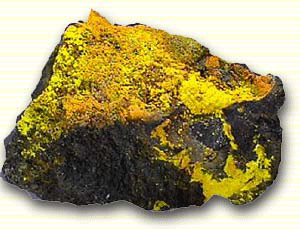 AUSTRALIAN CONSERVATION FOUNDATION, 26 Nov 13, Uranium hopefuls will be hard pressed to find a positive story about the embattled sector at a mining industry conference this week in South Australia. The last two weeks have seen further evidence of the continuing market fallout from Fukushima on SA’s embattled uranium sector with the closure of the Honeymoon operation and the decision by Marathon Resources to exit the uranium trade, declaring the sector’s ‘risks outweigh the rewards’.
 The news comes as a set of uranium junior companies join with the Beverley project’s Heathgate Resources to talk up the sector at the 2013 Mining South Australia conference, which starts today in Whyalla.
Australia’s uranium industry is suffering from:
- · The scrapping of plans for a massive expansion of BHP Billiton’s Olympic Dam mine in SA because of the ‘uncertain’ uranium market
- · A fall in the uranium commodity price of around 50 per cent and larger falls in the share value of uranium mining companies since Fukushima – a continuing crisis directly fuelled by Australian uranium
- · Sustained losses and operational failures at ERA’s Ranger mine in Kakadu
- · Attempts by Queensland uranium promoters to receive ‘royalty relief’ and public concessions even before making any formal applications to mine
- · Projects stalled, scrapped or deferred in WA, SA and the NT
“The uranium industry has long caused trouble, now it is increasingly in trouble,” said Australian Conservation Foundation nuclear free campaigner Dave Sweeney. “Uranium mining is a high-risk, low-return sector that poses unique, unresolved and long-lived threats and does not enjoy secure social license.
“It is time for politicians to stop accepting industry promises and start genuinely examining industry performance. “ACF urges state and federal governments to give effect to the UN Secretary General’s call that Australia conduct ‘an in-depth assessment of the net cost impact of the impacts of mining fissionable material (uranium) on local communities and ecosystems’.
“Instead of misplaced industry enthusiasm it is time for a comprehensive and independent assessment of the costs and consequences of the uranium sector.”
Tasmania on track for 100% renewable energy
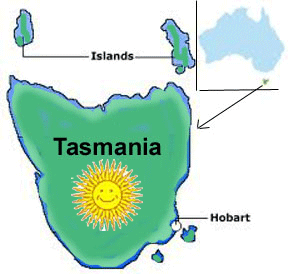 Tasmania aims for 100 pc renewable energy use in seven years http://au.news.yahoo.com/a/20024300/tasmania-aims-for-100-pc-renewable-energy-use-in-seven-years/ BY LUCY SHANNON -November 26, 2013 The Tasmanian Government has released a climate change strategy aimed at 100 percent renewable power usage by 2020.
The Climate Smart Tasmania plan includes energy reduction targets across government, land use, infrastructure, transport and waste systems. The Climate Change Minister, Cassy O’Connor, says its the most comprehensive plan by any Australian Government to reduce carbon emissions as well as adapt to a changing climate.
The strategy sets a new interim 2020 target to reduce carbon emissions to 35 percent below 1990 levels. Ms O’Connor says its about showing leadership on climate change. “We now have in Australia a climate denialist Government that is taking us backwards on climate change” she said.
“Tasmania here has extraordinary advantages with our Hydro power, with the carbon in our forests and we do need to show leadership; it’s also the economically sensible thing to do.”
Australian Industry Group not happy with the government’s climate plan
 AUDIO: Ai Group urges changes to climate plan (AM)
Ai Group warns of flaws in Coalition climate change plan as Warsaw talks wrap up ABC Radio News AM By Lexi Metherell 25 Nov 2013, The Federal Government now has a deadline of early 2015 to set a target for reducing carbon emissions after nearly 200 countries reached a deal at the end of international climate talks in Warsaw.
But a peak industry body says a central part of the Government’s climate change policy will not always work.The Warsaw meeting ended with an agreement on a timetable for nations to name their emissions cuts before another meeting in Paris in December 2015. The Paris meeting aims to produce an international agreement to replace the Kyoto Protocol that will come into place in 2020. The Government is proposing to pay polluters to reduce emissions under its $1.5 billion Emissions Reduction Fund, which it wants up and running in July.
In its submission on the scheme, industry lobby group Australian Industry Group says companies are not always going to be able to deliver as planned. While the Government wants the fund to target domestic emissions, Ai Group is urging it also to include international carbon emissions. Chief executive Innes Willox says the Government should spend a portion of the allocated budget on the reserve of international carbon credits. “We need to get our emission reductions done at least cost,” he said…….
Australia’s current target is to reduce emissions by 5 per cent by 2020 and the Climate Change Authority is recommending that it be at least 15 per cent.Ai Group says its proposal is a “prudent fallback” in case that target cannot be reached or if the Government wants to go further than 5 per cent.”…..
Federal Environment Minister Greg Hunt was unavailable for interview. http://www.abc.net.au/news/2013-11-25/business-group-warns-on-climate-policy-as-warsaw-talks-wrap-up/5114192
Busting the uranium industry’s propaganda that “all is well’ with that industry
 Time to spill truth on uranium sector, Townsville Bulletin, DAVE SWEENEY, 23 Nov 13, THERE is an old saying that no trader calls out ‘‘bad fish’’. So it comes as no surprise that a former uranium company executive now paid to do public relations for the uranium sector will say all is well in the industry (Uranium: safety first, TB, 18/11). The reality is the industry is in very poor shape, financially and operationally – as can be seen by the recent mothballing of the Honeymoon mine in South Australia, because the numbers didn’t add up, and the backroom push by the Queensland Resources Council to get ‘‘royalty relief for Queensland uranium mines that have not even filed an application to develop yet.
The most recent independent assessment of the Australian uranium industry – an inquiry by the Australian Senate in October 2003 – found the sector characterised by underperformance and noncompliance, an absence of reliable data to measure contamination or its impact and an operational culture focused on the short-term.
Uranium mining is a high-risk, low-return sector that poses unique unresolved and long-lived threats and does not enjoy secure social license. Australian uranium fuelled Fukushima. Every Australian uranium mining operation has a history of leaks and spills. The need to manage radioactive materials over extremely long periods, along with security and
proliferation concerns, make uranium mining fundamentally different from other mining. In the shadow of Fukushima, and given the call by the UN Secretary General in September 2011 that Australia conduct an indepth assessment of the net cost impact of the impacts of uranium mining on communities and ecosystems, it is time the industry and state and federal governments supported a comprehensive and independent assessment of the costs and consequences.
The continued failure to do so highlights the industry’s preference for public relations over public scrutiny– and the fact that uranium is a very smelly fish.
Bikini nuclear tests as cause of 1954 Adelaide earthquake?
The electromagnetic pulse and ionization of the atmosphere resulting from the high-yield nuclear bomb Bravo was clearly associated with Adelaide earthquake.
 The Castle Bravo nuclear explosion of 1954. Part 1: Bobby 1’s Blog 21 Nov 13 In the Adelaide, Australia earthquake in the early morning of March 1, 1954, residents of Adelaide, Australia were awakened to a violent shaking in their beds. When they went outside, they saw a brilliant glow in the east. The United States had just set off the Castle Bravo nuclear bomb on Bikini Island, 3,600 miles away.On March 1, 1954, the detonation of an estimated 15 megaton thermonuclear weapon, known as “Bravo” took place – as part of the “Castle” test series. According to the U.S. Radiochemistry Society, “the Bravo test created the worst radiological disaster in US history ….the yield of Bravo dramatically exceeded predictions, being about 2.5 times higher than the best guess and almost double the estimated maximum possible yield (6 Mt predicted, estimated yield range 4-8 Mt).” The bomb was over 1000 times more powerful than those exploded over Hiroshima and Nagasaki in 1945. The Bravo crater in the atoll reef had a diameter of 6,510 ft, with a depth of 250 ft. The cloud top rose and peaked at 130,000 feet (almost 40 km) after only six minutes. Eight minutes after the test the cloud had reached its full dimensions with a diameter of 100 km, a stem 7 km thick, and a cloud bottom rising above 55,000 feet (16.5 km), and after 10 minutes had a diameter of more than 60 miles.
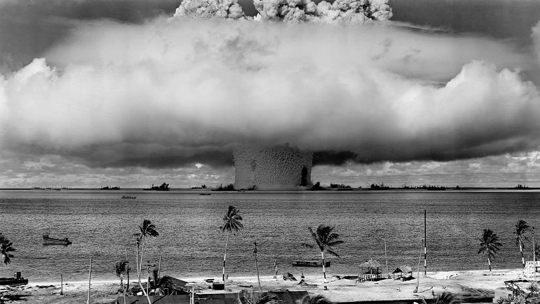
The radioactive fallout from Bravo covered the planet, including the Southern Hemisphere. It was a fission-fusion-fission bomb, designed to release high levels of radioactivity. Its yield was 15 megatons, but it released almost seven times as much radiation than the Russian Tsar Bomba, which had a yield of 50 megatons. Continue reading
1 This month
17 October, Free Public Talk on Nuclear Issues in South Australia
David Noonan will speak on public interest concerns over the new Roxby Downs Indenture Act 2026 on BHP copper-uranium mining and ore processing in SA, and on how AUKUS may face SA with a High-Level nuclear waste agenda.
Dr Jim Green will discuss international developments in the field of nuclear power including ‘small modular reactors’ and Generation 4 ‘advanced’ nuclear reactor concepts.


Help Aunty Sue Protect Her Land and Sacred Sites From Destructive Rocket Testing.
.

Australians deserve the truth
about
AUKUS – https://aukuspublicinquiry.com/

PETITION – To: Prime Minister Anthony Albanese and the Australian Labor Government

of the week – Australians for War Powers Reform (AWPR)
To see nuclear-related stories in greater depth and intensity

