Why medical isotopes produced in cyclotrons are so much better than those produced in a nuclear reactor.

This is probably the best explanation of the difference between the use of nuclear reactor produced isotopes in nuclear medicine, and cyclotron produced isotopes in nuclear medicine. It is a quote from TRIUMF Canada – an internationally recognised establishment which has celebrated 50 years in the world as a leading authority on subatomic physics.
This definition was released by them in 2011… “The field of nuclear medicine has evolved into what can be considered its third generation. Generation-I originated in the 1950s, with several reactors producing large enough quantities of simple radioisotope formulations that could be distributed for use globally. This allowed for the launch of the era of modern nuclear medicine, and for the next thirty years the medical community developed and implemented dedicated cameras needed to image patients injected with gamma-emitting isotopes. Generation-I radiopharmaceuticals were simple, perfusion-based compounds that distributed within the body based on simple properties such as molecular shape, size, and charge; and the isotopes injected were typically single photon emitters. The world came to adopt nuclear medicine as a cheap, yet powerful tool for the non-invasive diagnosis of disease.”
Generation-1 radiopharmaceuticals – That’s your nuclear reactor generated nuclear medicine isotopes – predominately the Technitium-99m (Tc-99m) used in diagnostic imaging. This is what the reactor in ANSTO Lucas Heights is predominately used to produce – the Molybednum-99 (Mo-99) which then decays to Tc-99m.
“Generation-II radiopharmaceuticals evolved during the 1980s and involved the development of compounds targeted to specific cellular biomarkers. With a rapid growth in understanding of the molecular basis of physiology and disease, and the expansion of a global cyclotron infrastructure, new and powerful positron-emitting compounds such as [18F]fluorodeoxyglucose, or FDG for short, were discovered and widely implemented for the safe and accurate diagnosis and evaluation of diseases affecting millions of patients. Over the next thirty years, the radiopharmaceutical research community spent an enormous amount of time and effort developing a myriad of targeted radiopharmaceuticals that have continued to feed our understanding of biology and medicine at the molecular level.”
Generation II radiopharmaceuticals – that’s your cyclotron generated nuclear medicine isotopes – predominately FDG amongst many others now – MET, FET, FLT, FCH, FMISO, FDOPA, Ga isotopes, Oxygen isotopes…the list goes on. There are currently 18 cyclotrons in Australia – this current list is from IAEA: https://nucleus.iaea.org/sites/accelerators/lists/cyclotron%20master%20list/public_cyclotron_db_view.aspx They are normally associated with diagnostic imaging partnerships on site.
“Today we are witnessing the evolution of Generation-III compounds, which have come to include both imaging and therapeutic isotopes. In a nearly synonymous way to which we came to appreciate the power and utility of imaging isotopes, therapeutic isotopes are now entering the active conscience of the medical community.”
This was remember published in 2011. The problem with radioisotopes is that you cannot control their emissions. You can certainly use low energy emitters, but regardless the ultimate aim of medicine now in 2022 is to have as little damage done to normal cells as is possible. That is why immunotherapy and nanotechnology are the foregrounds for cancer treatment now. https://www.triumf.ca/faq-medical-isotopes
AUKUS in the hypersonic missile wonderland
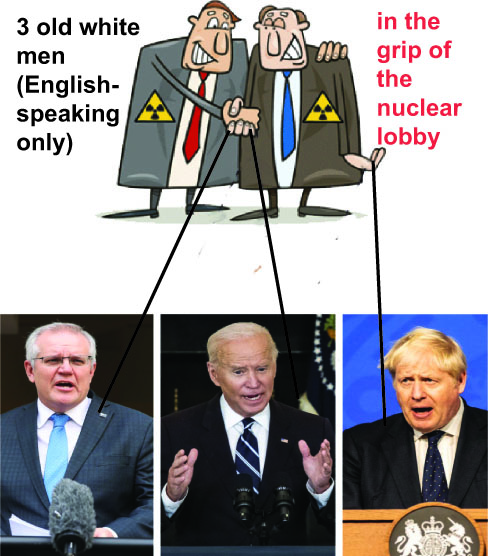
Pearls and Irritations By Binoy Kampmark, Apr 9, 2022,
As this idiotic, servile venture proceeds, Australian territory, sites and facilities will become every more attractive for assault in the fulness of time.
If further clues were needed as to why AUKUS, the security pact comprising the United States, the United Kingdom, and Australia, was created, the latest announcement on weapons would have given the game away. Australia, just as it became real estate to park British nuclear weapons experiments, is now looking promising as a site for hypersonic missile testing, development, and manufacture.
In a joint statement from US President Joe Biden, British Prime Minister Boris Johnson and Australian Prime Minister Scott Morrison, a commitment was made “to commence new trilateral cooperation on hypersonics and counter-hypersonics, and electronic warfare capabilities, as well as to expand information sharing and to deepen cooperation on defence innovation.”
To this can be added February efforts of officials from all three countries to, according to the ABC, scour Australia for sites best suited for the nascent nuclear-powered submarine program that seems all but pie in the sky. To date, the country has no infrastructure to speak of in this field, no skills that merit mention for the development of any such fleet, and a lack of clarity as to when the vessels might make it to sea. Nor is there any clear sign what model of submarine – UK or US – will be preferred…………………
The Morrison government is trying to leave the impression that this will eventually realise the dream of self-sufficiency, a notion repeatedly fed by such think tanks as the Australian Strategic Policy Institute. It describes this as “a major step in delivering a $1 billion Sovereign Guided Weapons and Explosive Ordnance Enterprise, officially announcing strategic partners Raytheon Australia and Lockheed Martin Australia.” The Prime Minister also sees such weapons as part of a broader Australia “strategic vision” dealing with long-range strike capabilities.
…………. As this idiotic, servile venture proceeds, Australian territory, sites and facilities will become every more attractive for assault in the fulness of time. That may well be quite a way off and, judging by any military ventures in Australia of this kind, we can hope that this will be more a case of decades rather than years. https://johnmenadue.com/aukus-in-the-hypersonic-missile-wonderland/
Defence Dept blocks access to advice on location choice for Australia’s nuclear submarines base
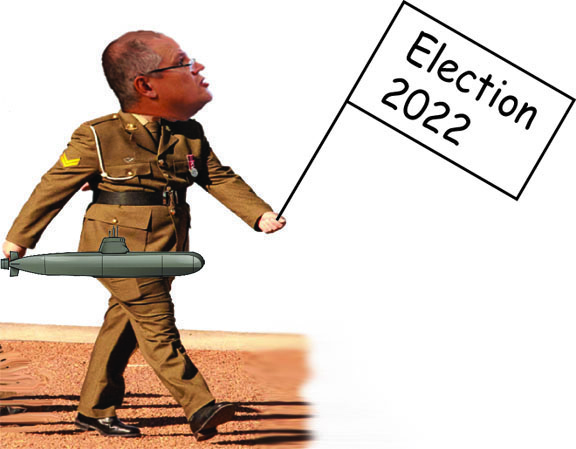
Labor’s defence spokesperson, Brendan O’Connor, questioned whether the government was “hiding their advice because the prime minister has made a political decision in shortlisting three east coast submarine bases”.
“Australians deserve to know if the government went through rigorous processes or if these bases have been chosen on a whim close to an election.”
“The timing of this announcement just before an election and the fact that it departs from the Navy’s previous analysis is quite inexplicable,” Patrick said.
Defence blocks access to advice on location choice for Australia’s nuclear submarines base https://www.theguardian.com/australia-news/2022/apr/09/defence-blocks-access-to-advice-on-location-choice-for-australias-nuclear-submarines-base
Labor demands government reveal how it shortlisted Brisbane, Newcastle and Port Kembla as potential sites for base Daniel Hurst Foreign affairs and defence correspondent, @danielhurstbne, Sat 9 Apr 2022
Voters will be kept in the dark on how Scott Morrison’s government selected three potential bases for Australia’s planned nuclear-powered submarines, after the advice was blocked from release.
With the prime minister preparing to formally call the election within days, Labor demanded the government reveal how it shortlisted the locations to prove the announcement was “not just a marketing ploy”.
Morrison named Brisbane, Newcastle and Wollongong’s Port Kembla as three contenders for a new eastern submarine base, and revealed Aukus-related infrastructure works would cost up to $10bn, in a keynote national security speech last month.
The government is expected to lock in one of these sites late next year, once further studies and negotiations are completed.
Morrison said the “three preferred locations” were identified “following significant work by Defence reviewing 19 potential sites”, although a minister later said it was the cabinet’s national security committee that had “narrowed it down to three”.
Guardian Australia applied to the Department of Defence under freedom of information laws seeking the site analysis. The request also covered any advice, briefings or submissions prepared for the defence minister, Peter Dutton, regarding the preferred locations.
Continue readingAUKUS hypersonic announcement will ‘escalate global tensions’, warns CND
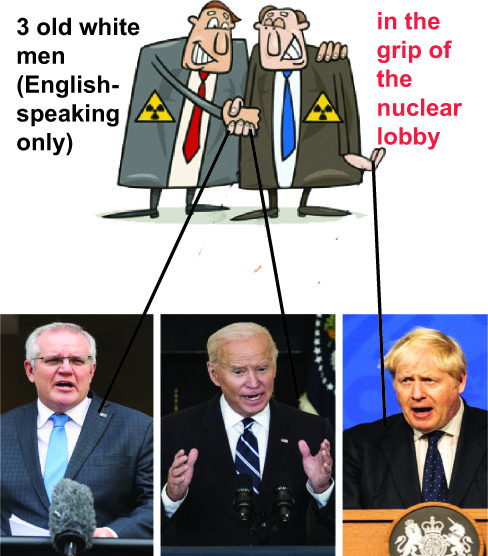
”………………… In a joint statement on Wednesday, the trio announced that they would now “commence new trilateral cooperation on hypersonics and counter-hypersonics, and electronic warfare capabilities. ”
Growing proliferation
Australia is already co-operating with Washington on hypersonic weapon development as part of the Southern Cross Integrated Flight Research Experiment (SCIFiRE). UK officials said they will not be formally joining SCIFiRE. They will instead co-operate in research and development in the area so they can expand their options.
Hypersonic missiles travel at five times the speed of sound and can be armed with either conventional or nuclear warheads. Faster than cruise missiles, they can in theory evade existing air defence systems. The US, Russia, and China have all undertaken testing of the weapon.
CND General Secretary Kate Hudson said: “The latest expansion of the AUKUS military pact will further escalate global tensions, at a time when the threat of nuclear war is at its highest in decades. The announcement that a programme initially centred on providing a non-nuclear state with nuclear-powered submarines – in itself risking wider nuclear proliferation – will now include hypersonic missiles, is of great concern. This AUKUS expansion will accelerate arms racing in the Asia-Pacific region, leading to increased militarisation, and potentially helping provoke conflict over Taiwan. Not to mention the fact that military budgets are already escalating – what will the opportunity cost be for embarking on a whole new class of weaponry be?” https://cnduk.org/aukus-hypersonic-announcement-will-escalate-global-tensions-warns-cnd/
No – it turns out that the nuclear submarines not likely to be built in Australia – Morrison

I am in awe. The man is a marketing genius. He managed to make sure that the submarine development plan for Adelaide was shut down – by promising an even better nuclear submarine development in Adelaide. Now that wondeful new job-making enterprise vanishes into the ether. But – no worries – he”ll be able to convince us that an attack on Australia by China is imminent, -so natioal security tops employment. So no doubt Australians will rejoice and re-elect the champion marketer.
PM won’t commit to build nuclear subs locally Joseph Brookes,, https://www.innovationaus.com/pm-wont-commit-to-build-nuclear-subs-locally/ 6 April 2022 Prime Minister Scott Morrison will not commit to building Australia’s nuclear powered submarines locally, saying any industry development considerations will be trumped by the need to acquire the capability as soon as possible.
The refusal, made Wednesday as the AUKUS arrangement was expanded to other technologies, follows Defence Minister Peter Dutton also flagging Australia would need to “get the balance right” between supporting local industry and securing capabilities in response to rising foreign threats.
The AUKUS arrangement was announced in September and the “intent” to build new nuclear powered submarines in Australia was a welcome direction for the local defence industry because the new plan also meant the previous submarine program was being scrapped.
A taskforce is continuing to assess options for acquiring the new submarines, including which vessel type and where they will be built.
In February, Defence Minister Peter Dutton had to address concerns about local industry missing out after a high-ranking Defence official told an industry conference the department is “maturing beyond ascribing a percentage” of local industry involvement and was unlikely to set a minimum like previous major ship builds.
A few weeks later the minister suggested a decision on submarine type would be revealed before the election after the taskforce made significant progress earlier this year.
But he was promptly contradicted by Prime Minister Scott Morrison who said a decision was not anticipated before the election because of the processes that would be required stretching into a caretaker period.
On Wednesday, during an announcement about the expansion of the AUKUS arrangement to hypersonic technologies and electronic warfare, the Prime Minister backed away from any commitment to local industry.
He was asked if he could guarantee if the new submarines, beyond the nuclear reactor, would be built in Australia.
“We’re working through all of those issues at present what, and that is certainly our intention to maximise all of that [local manufacturing]. Of course it is,” he told reporters.
“But it’s also the paramount goal is to ensure we get that capability as soon as we can, and it’s in the best form that it can be working with our partners.”
Conservation Council of Western Australia continue their long fight for the environment, and to stop uranium mining.

This week we are celebrating a huge step forward in our sustained campaign to keep the door closed to uranium mining in Yeelirrie. We have received word that a request made by the Canadian mining company Cameco to extend the environmental approval for the Yeelirrie uranium project has been rejected by Minister for Environment Reece Whitby. In 2018 and 2019, we challenged this approval in court. Now it has expired and time is running out for the uranium trade in WA.
This is a huge win for the local area, the communities and for life itself. The special and unique lives of the smallest of creatures, endemic subterranean fauna found nowhere else on earth would have most likely been made extinct had this project gone ahead, according to the WA EPA.
We are now pushing for further protection. Under new provisions in the Environmental Protection Act s47A – Minister Whitby can withdraw approvals where the “commencement” condition has not been met. We are calling on the Minister to withdraw approvals for Yeelirrie, Wiluna and Kintyre – as all three projects have failed to meet these commencement conditions. For over five decades Traditional Custodians from the Yeelirrie area have fought to protect the site from uranium mining.
Hundreds of supporters have spent time on country with Traditional Custodians, listening, walking, connecting with the country and standing up for a nuclear-free future. Traditional Owners, unions, faith groups, health groups, the WA and Australian Greens and WA Labor, and environment groups, we’ve all had a big part to play. For the full report and to heart what Traditional Owners, Kado Muir and Vicki Abdullah had to say please click here.
We are currently growing our campaign to protect Mulga Rock on Upurli Upurli Nguratja country, east of Kalgoorlie. This is WA’s one uranium project that has so far slipped through the next and last week through a merger this project is now being advanced by a team with links to the destruction at Juukan Gorge and dodgy mining operations in Malawi and Namibia. And we will continue to push for a withdrawal of approvals for Yeelirrie, Kintyre and Wiluna.
New cyclotron for Australia – to produce medical isotopes, with no need for dangerous nuclear reactor production
Fom Kazzi Jai, Fight to stop a nuclear waste dump in South Australia, 5 Apr 22, Announced by Scott Morrison today….another CYCLOTRON – this one high energy – to add to the cyclotrons we already have in Australia…. to CUSTOMISE our radioisotopes!
“”The Australian Precision Medicine Enterprise will help cement precision medicine development here in Australia, also helping deliver a stronger economy by growing opportunities for our medical sector and the highly-skilled jobs it supports.”
The 2022-23 Budget demonstrated the ongoing commitment to manufacturing with an additional $1 billion for the Morrison Government’s Modern Manufacturing Strategy, including an extra $750 million for the Modern Manufacturing Initiative.
Minister for Industry, Energy and Emissions Reduction Angus Taylor said these projects will help onshore technology and expertise not currently in Australia, while securing new sovereign capability.
“This project will see the construction of a new facility that will house a high energy 30 mega-electron volt (MeV ) cyclotron, which will be a new domestic source of critical radioisotopes – which are currently imported into Australia – and will be used in the treatment of cancer, kidney disease and other illnesses,” Minister Taylor said.
“By combining research and development and the manufacture of precision medicines locally we are shoring up our supply chain resilience,
“These projects will also create highly-skilled jobs in the medical sector, such as radiochemists, radio pharmacists and engineers, while also reducing our reliance on overseas suppliers of vital medications.”
Minister for Health and Aged Care Greg Hunt said the project will see incredible collaboration with the Monash Biomedical Imaging Centre, National Synchrotron and the Victorian Heart Hospital.
“Not only will this facility and the precision medicines it will help lead to better patient outcomes, it will help bolster Australia’s entire medical ecosystem,” Minister Hunt said.
“This project will help realise the incredible potential of medicines that are customised to patients, all the way from clinical trials to their local manufacture right here at home.”
The facility will directly support 42 jobs with 105 additional along the supply chain.“ https://www.pm.gov.au/media/locally-made-medicines?fbclid=IwAR0qgWbtvC434SHR7fHU3_fryScD-7_kOYxcczW1ua-i4zfVzIW-GxA1ONo from https://www.facebook.com/groups/344452605899556
Australia’s Parliament has little control over military matters, and Prime Ministers kow tow to USA and the White Anglosphere to go to war

Australia is an “active, eager participant in the US-led order” and restricting the Australian parliament’s control over the military has been “… a decision taken by the Australian government — at a bipartisan level — and implemented by senior policy planners.
Meanwhile the Australian parliament has “deliberately restricted its own powers on intelligence matters”
,Australia has ”reaffirmed its whiteness in its commitment to expansion of the “Five Eyes” intelligence sharing arrangements between the US, Britain, Canada, Australia and New Zealand and, of course, to the controversial 2021 AUKUS nuclear submarine deal, which was nurtured in great secrecy”
White and might is right: the secrets which push us into other people’s wars, https://www.michaelwest.com.au/the-dirty-secret-that-pushes-australia-into-other-peoples-wars/ By Zacharias Szumer|April 2, 2022 Is playing deputy to America’s sheriff the reason Australian war powers remain unreformed? It’s clear that our politicians remain muddled on this critical issue, writes Zacharias Szumer.
For decades, minor parties in Australia have introduced bills seeking to give parliament greater control over military deployments. In the debates and inquiries that have followed, a wide range of objections have been raised.
We are told that, as military deployments are often made on the basis of confidential information, this information cannot be publicly disclosed to the parliament. Another common objection is that parliamentary decision-making would reduce the flexibility and speed needed to carry out military operations safely and effectively.
Most of the opposition to war powers reform, received as part of Michael West Media’s ongoing survey of politicians, follows similar lines. You can see myriad responses here.
However, some experts think there might be another reason — one that Australian pollies may be uncomfortable acknowledging.
Kowtowing to empires
Clinton Fernandes, professor of international and political studies at the University of NSW and former Australian army intelligence officer, contends that the bipartisan reluctance to infringe upon this executive prerogative should be understood within Australia’s ”sub-imperial” geopolitical strategy.
In basic terms, Australia has sought to integrate itself into the global strategy of great powers — firstly the British and, from 1942 onwards, the United States. In a 2020 article, Fernandes argues that this sub-imperial strategy has meant the “effective exclusion of the legislative and judicial branches of government from Australia’s national-security policy”.
Fernandes does not believe that Australian politicians and policy officials have been forced against their will into this position. Rather, he argues that Australia is an “active, eager participant in the US-led order” and restricting the Australian parliament’s control over the military has been “… a decision taken by the Australian government — at a bipartisan level — and implemented by senior policy planners.
“Australian strategic planners understand that this means a reduction in sovereignty, but they accept it because it achieves a higher objective — upholding US imperial power.”
In addition to limiting parliament’s control over military deployments, Fernandes argues that Australia’s position as a “sub-imperial power” also limits parliamentary oversight of intelligence gathering. In the US, “intelligence committees and judiciary committees in the Senate and House of Representatives are regularly briefed about all authorised intelligence-collection programs, and relevant members of Congress receive detailed briefings prior to each re-authorisation,” Fernandes says.
Five Eyes and whiteness
Meanwhile the Australian parliament has “deliberately restricted its own powers on intelligence matters” through measures such as the Intelligence Services Act 2001 which ‘prevents the Parliamentary Joint Committee on Intelligence and Security from ‘reviewing the intelligence gathering and assessment priorities’ or ‘reviewing particular operations that have been, are being or are proposed to be undertaken’ by ASIS, ASIO and the other intelligence agencies, and likewise ‘the sources of information, other operational assistance or operational methods’ available to the agencies”.
Dr Greg Lockhart, an historian and Vietnam War veteran, supports Fernandes’ argument, but stresses the importance of seeing Australia’s sub-imperial strategy through the lens of a wider “cultural self-deception” around racial anxieties. “Fear of the ‘yellow peril’ meant that our Anzac expeditionary strategic reflex was from its inception race-based,” he says. ‘It was also primarily defensive; it depended on “great and powerful” white friends for protection in our region; it has always depended on being in the Anglosphere”.
Dr Lockhart argues that, although the overtly racist rhetoric of the White Australia policy is largely a thing of the past, “our strategic culture is still inseparable from the Anglosphere, from wherein we have never needed to reassess its whiteness”.
Recently, he says, Australia has ”reaffirmed its whiteness in its commitment to expansion of the “Five Eyes” intelligence sharing arrangements between the US, Britain, Canada, Australia and New Zealand and, of course, to the controversial 2021 AUKUS nuclear submarine deal, which was nurtured in great secrecy”.
“And with secrecy comes deception. Sounding like a US proxy in the Pacific while asserting Australian ‘sovereignty’, Scott Morrison’s government “announces it is in ‘lockstep’ with “our allies”, while trumpeting the threat of China’s communism, territorial expansion, abuse of human rights, or its implied role as the origin of Covid 19 — anything but the anxiety about Chinese numbers, ethnic difference, and independent power that has shadowed Australian history since the 1800s – and that now determines the security culture’s mindless dependence on the US.’’
Seen in this wider cultural context, Lockhart believes that “the Constitution was never going to impose legislative or judicial restraints on the autocratic war powers of the sub-imperial state. Since the First World War in 1914, almost every Anzac expedition has been a British or American imperial one. The exceptions are the Pacific campaign in 1942-1945 and Timor in 1999-2000. And in all those imperial campaigns the decision for war has been made undemocratically by the prime minister acting in secret conclave with only a handful of advisers”.
Parliamentary war powers
Fernandes and Lockhart aren’t alone in suggesting that there’s a relationship between strategic objectives and parliamentary control, or lack thereof, over the military. In their encyclopaedic 2010 study of war powers around the world, scholars Wolfgang Wagner, Dirk Peters and Cosima Glahn noted that several Central and Eastern European states — Bulgaria, the Czech Republic, Hungary and Slovakia — abolished parliamentary approval for war in the process of joining the US-led North Atlantic Treaty Organisation (NATO).
The authors argue that ‘’NATO accession apparently amplified the trade-off between creating legitimacy through procedures of ex ante parliamentary control and gaining efficiency through lean, executive-centred decision-making. From NATO’s perspective, having the governments of some member state tied by domestic parliamentary veto power must seem highly unattractive.’’
However, many of the more powerful NATO countries have far more wide-ranging parliamentary war powers than Australia or the aforementioned junior NATO partners. Although contested, the US War Powers Resolution significantly limits the President’s freedom to order military action without congressional authorisation.
For almost two decades in Germany, all major military deployments have been put to parliament for a vote. In the UK too, a parliamentary convention of seeking approval for military deployments in the House of Commons has also evolved over the past two decades.
Australian Radiation Protection and Nuclear Safety Agency Key explanatory ARPANSA quotes on nuclear waste management in Australia.
ARPANSA approves nuclear waste storage at Lucas Heights, Sydney until 2037 [So Kimba dump not only unwise, but also unnecessary]
In light of the established feasible alternative for decades of Extended Storage of ANSTO nuclear wastes at the existing Lucas Heights site there is now no credible reason to proceed with proposals for indefinite above ground storage of ANSTO nuclear wastes at Napandee near Kimba on Eyre Peninsula in SA.
Secure storage of ANSTO nuclear waste at Lucas Heights has been extended out to 2037 by the federal nuclear regulator ARPANSA (16 March 2022) see:
ARPANSA approves siting licence for ANSTO waste facility | ARPANSA
“An important consideration in granting the ILWCI siting licence was the conceptual safety and security design of the facility“, says Dr Carl-Magnus Larsson, Chief Executive Officer of ARPANSA.
This follows a $60 million investment by the federal gov in extended storage at Lucas Heights, made last year.
A detailed Statement of Reasons and the Regulatory Assessment Report for the newly issued licence to site the ILWCI Facility at Lucas Heights can be found in the following documents:
 Regulatory Assessment Report – A0339 Siting Licence for ILWCI FacilityCEO Statement of Reasons – A0339 ILWCI Facility Siting Licence Application –
Unions SA have a clear position (March 2022):
“Unions SA stands with Traditional Owners in rejecting nuclear waste dump
The Liberals want to dump nuclear waste in Kimba, South Australia.
Don’t let them!
We stand with the Traditional Owners against the dump.
This election, stand up for SA’s future.”
SA Unions > SA Unions stands with Traditional Owners in rejecting nuclear waste dump
For further info see David Noonan Submission No.1 to the CEO of ARPANSA (Nov 2021) on the Feasible Alternative of storing ANSTO’s “highly hazardous” nuclear fuel waste and ILW at Lucas Heights:
Public Submission 1 (arpansa.gov.au)
Conclusion: Extended storage of ANSTO’s ILW on-site at Lucas Heights is a warranted public interest
measure and a necessary Safety Contingency until availability of a final disposal option.
For further info see David Noonan Submission No.1 to the CEO of ARPANSA (Nov 2021) on the Feasible Alternative of storing ANSTO’s “highly hazardous” nuclear fuel waste and ILW at Lucas Heights:
Public Submission 1 (arpansa.gov.au)
Conclusion: Extended storage of ANSTO’s ILW on-site at Lucas Heights is a warranted public interest
measure and a necessary Safety Contingency until availability of a final disposal option.
And a 2 page Brief:”Why impose indefinite storage of ANSTO nuclear waste onto SA when its already in secure Extended Storage at Lucas Heights?”
(DN, August 2021)
citing Recommendations by MAPW:
• an open and independent review of nuclear waste production and disposal in Australia, and • progressing a shift to cyclotron rather that reactor-based production of isotopes for nuclear medicine as rapidly as feasible.–
Weapons corporations infiltrate our schools and charities, promoting war-mongering to our youth
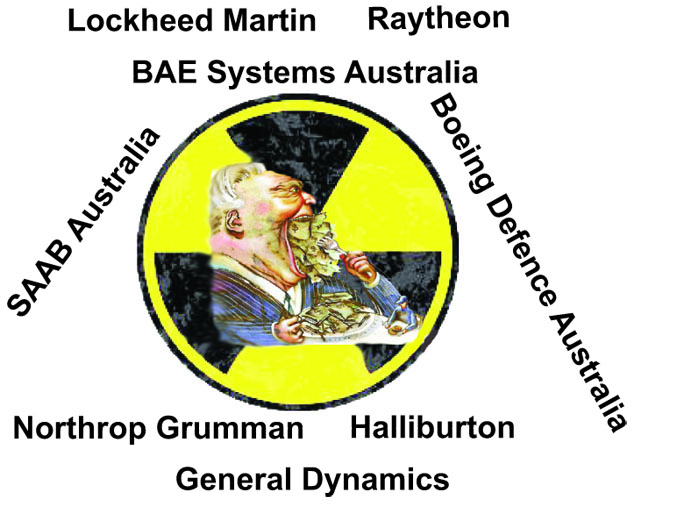
REPUTATION LAUNDERING,
https://declassifiedaus.org/2022/03/31/reputation-laundering/ DeclassifiedAUS2 The weapons companies spruiking the ‘benefits and opportunities’ of the wars in Ukraine and Yemen and tensions in the South China Sea are infiltrating our schools., MICHELLE FAHY, 31 MARCH 2022
A Lockheed Martin missile blows up a school bus in Yemen, while in Australia the company gains kudos by sponsoring the National Youth Science Forum.
BAE Systems supports the education of kids in Australia, while being complicit in the killing of thousands of children in Yemen.
Lockheed Martin, the world’s largest weapons-maker, is raking in billions from ongoing wars like the four-week Russian invasion of Ukraine, and the eight-year long Saudi-led war in Yemen.
A Lockheed Martin laser-guided bomb blew up a bus full of Yemeni school children in 2018, killing 40 children and injuring dozens more.
Meanwhile, in Australia, Lockheed Martin was busy cultivating kudos with kids as major sponsor of the National Youth Science Forum, a registered charity originally set up by Rotary.
Then there’s US missile-making giant Raytheon which now has a significant new manufacturing facility in Australia. It has continued to supply the Saudi-led coalition with weapons for the Yemen war, despite extensive evidence pointing to war crimes arising from its missiles being used to target and kill civilians.
In January 2022, a Raytheon missile killed at least 80 people and injured over 200 in a so-called precision strike in Sa’adah in Yemen.
Within days of this horrific incident, Raytheon’s CEO was telling investors that rising tensions represented “opportunities for international sales” and he fully expected to “see some benefit” from “the tensions in Eastern Europe [and] the South China Sea”.
There’s no mention in Australia’s media of the big profits Raytheon is making from the Yemen war, which has now entered its eighth year, killed or injured at least 19,000 civilians, and possibly many more, and also caused the deaths of tens of thousands of children through starvation, due to disruption of food supplies and militarily-enforced trade blockade.
Instead, we’ve seen pictures of Aussie school kids having fun with the Australian snowboarding Paralympian who Raytheon Australia hired to front the launch of its Maths Alive! educational exhibition.
And we also heard about Raytheon’s sponsorship of Soldier On and the Invictus Games, despite the irony of a weapons company using its support of injured military personnel as a public relations exercise.
There’s a name for this cynical behaviour by corporations: ‘reputation laundering’.
Weapons companies are now ‘Innovators’
The world’s weapons producers have also taken to promoting themselves as ‘innovators’ in the areas of science, technology, engineering and maths, called STEM.
This enables them to target children and young people as future employees (see, for example, BAE Systems Australia, Boeing Defence Australia, and Saab Australia), often with the willing partnership of respected institutions. Many Australian universities now have MOUs, joint ventures, strategic partnerships, or other forms of collaboration with the weapons industry.
This enthusiastic support of STEM serves a double purpose: reputation laundering, and a socially acceptable way to promote the weapons industry as a future employer directly to children and their parents.

Promoting STEM education is essential to creating a well-trained workforce for key industries of the future, particularly those that can tackle the existential risks associated with climate change. The concern with the weapons industry’s activities in this domain is the way it is using STEM to target children as young as primary school age for weapons-making careers, often with the support of government.
The spin and glamour being associated with Australia’s increased militarism is a concern on several levels, particularly as the marketing omits pertinent information: weapons and warfare aren’t mentioned.
Nor is there information about how children might use their STEM skills to enhance the ‘lethality’ of their employer’s products.
Nor about a future in which the need for human involvement in the ‘kill chain’ is eliminated by creating autonomous robots to make life and death decisions instead. (This is not science fiction, these research and development programs are already happening.)
Working for companies involved with nuclear weapons isn’t discussed, either.
Instead, a world of euphemism has been created: ‘advanced technology systems, products and services’, ‘high end technology company’, ‘leading systems integrator’, ‘security and aerospace company’, ‘defence technology and innovation company’.
It is also likely to be weapons company marketing material if the phrase ‘solving complex problems’ appears, especially if accompanied by claims of ‘making the world safer.
None of these euphemisms conjures up realistic images of the bloody and brutal destruction the world is witnessing in the world’s latest war in Ukraine.
The ways global weapons giants have cultivated relationships with organisations of good purpose in Australia is highlighted in the following examples.
Lockheed Martin and the National Youth Science Forum
The National Youth Science Forum was created by Rotary, which remains involved. The Forum, now a not-for-profit organisation overseen by a board, has numerous programs, the flagship program being for Year 12 students interested in a career in science.
“The ban treaty embodies the collective moral revulsion of the international community,” according to the Director of the Centre for Nuclear Non-Proliferation and Disarmament at the Australian National University, Professor Ramesh Thakur.
Lockheed Martin and the Gallipoli Sponsorship Fund
In 2020, Lockheed Martin Australia became the first corporate sponsor of the Gallipoli Scholarship Fund and provides $120,000 to fund 12 Lockheed Martin Australia bursaries for the educational benefit of descendants of Australian military veterans.
Lockheed Martin is providing these Australian educational bursaries through to the end of 2023, with an opportunity to extend.
Referring to Lockheed Martin as a “defence technology and innovation company”, the Gallipoli Sponsorship Fund’s website also does not disclose Lockheed’s status as the world’s dominant weapons-maker nor its position as a major nuclear weapons producer.
BAE Systems and The Smith Family
This example illustrates that public pressure can and does make a difference.
The UK’s largest weapons-maker, BAE Systems, has been working inside Saudi Arabia supporting the Saudi-led coalition’s role in Yemen since the start of the war.
A BAE maintenance employee was quoted in 2019 saying, “If we weren’t there, in 7 to 14 days there wouldn’t be a jet in the sky.” BAE Systems has sold nearly £18 billion worth of weaponry to the Saudis since the war in Yemen started in 2014.
Yet in Australia, BAE Systems started a $100,000 partnership with The Smith Family in August 2020, sponsoring a STEM education program for under-privileged children.
BAE’s role helping the Saudis prolong one of the world’s worst humanitarian crises in Yemen was pointed out numerous times to The Smith Family, a children’s charity, after news broke of its BAE sponsorship.
The Smith Family initially resisted but after increasing pressure and activism from peace organisations and many complaints from the public, The Smith Family soon dropped its controversial ‘partnership’ with BAE Systems Australia, mere months after it had started.
Morally indefensible positions
Benign-sounding sponsorships of Australian school children such as these might appear less self-serving if weapons companies behaved consistently and stopped supplying weapons to those nations known to be serial abusers of human rights.
Saying they are merely doing the bidding of their governments in supplying the Saudis, and other abusive and repressive regimes, as these companies have, is not a morally defensible position.
It is particularly not defensible in the face of evidence of ongoing war crimes being committed using their weaponry.
MICHELLE FAHY is an independent writer and researcher, specialising in the examination of connections between the weapons industry and government, and has written in various independent publications. She is on twitter @FahyMichelle, and on Substack at UndueInfluence.substack.com An earlier version of this article was published in Michael West Media in November 2020.
Today’s thought: Australia, Liberal and Labor, mindlessly toes the USA propaganda line

Christina Macpherson 1 April 22, UKraine President Volodymyr Zelensky addressed the Australian Parliament – to enthusiastic applause, a standing ovation. Fair enough. He’s a brave guy, with a good cause.
Did any of those donkeys in the Parliament understand that Zelensky has been trying to negotiate a peace deal with Russia? A dea lthat would involve Ukraine NOT joining NATO, and would involve fair treatment and some autonomy for the ethnic Russian areas in the Donbas, and recognition of Crimea as part of Russia. (nb. Crimea was not ”annexed” by Russia. They overwhelmingly voted to join Russia).
Do Australia’s sycophantic politicians understand that Joe Biden refuses to join in those negotiations? Do they understand that this war could have been prevented by the USA? That this is another, more sophisticated version of the proxy wars that USA has been orchestrating for decades?
Anthony Albanese, spineless opponent of the Liberal’s blustering bully Scott Morrison, joined in the fervour, comparing Putin to Hitler. All agreed that Australia must send more weapons so Ukraine – must join USA in continuing its lucrative, preferably endless, fight against Russia – a fight to the last Ukrainian!
Julian Assange’s family tirelessly advocate for his freedom
https://independentaustralia.net/politics/politics-display/julian-assanges-family-tirelessly-seek-his-freedom,16208 By John Jiggens | 31 March 2022,
The fight for Julian Assange’s freedom goes on in the face of Western intransigence, writes Dr John Jiggens.
FRESH FROM attending the marriage of his son Julian Assange to partner Stella Moris, Assange’s continent-hopping father, John Shipton, will address the Palm Sunday rally in Brisbane on 10 April and attend a Q&A at a preview screening of the film Ithaka.
Produced by Julian’s brother Gabriel Shipton, Ithaka was directed by multi-award-winning director Ben Lawrence. The yet-to-be-released documentary will be a special thank-you to Julian’s many Queensland supporters.
Filmed over two years across the UK, Europe, the U.S. and Australia, Ithaka follows John Shipton’s punishing schedule to save his son.
We witness John embark on a European odyssey to rally a global network of supporters, advocate to politicians and cautiously step into the media’s glare, where he is forced to confront the events that made Julian a global flashpoint.
In marked contrast to the war in Ukraine, the Iraqi war was covered by journalists embedded with the invading forces.
Civilian deaths were dismissed as “collateral damage”.
When WikiLeaks showed us what “collateral damage” looked like from the perspective of Iraqi civilians, releasing a video of a massacre by an Apache helicopter gun crew of Iraqi civilians and two Reuter journalists, Julian Assange called it Collateral Murder.
This intervention played an important role in ending the illegal UK, U.S. and Australian invasion of a sovereign nation, and because of this, the war criminals he exposed are destroying Julian Assange with the consent of the Australian Government, claiming he is the criminal.
But Assange was a hero for peace.
For the Apache helicopter crew, the civilians on the ground were dehumanised. Like boys playing a computer game, they exclaimed “light ‘em up!” as they blew apart their victims from their unseen platform a mile in the sky.
When a good samaritan stopped to help those still living, he and his children were ruthlessly machine-gunned. The crew blamed their father, saying he shouldn’t have brought children to a war zone.
Ithaka tracks John Shipton’s journey alongside Julian’s then-fiancée, Stella Moris, as they join forces to advocate for Julian.
Stella and Julian’s marriage was a rare joyful moment for this embattled family. The mainstream media, of course, presented it as a bizarro celebrity wedding. Knowing which details to ignore, they focussed on the bride and groom’s clothes, rather than the politics.
We learned that Julian, his brother Gabriel, and Stella and Julian’s two sons, Gabriel and Max, wore tartan kilts in honour of their Scottish heritage.
Vivienne Westwood, a long-time supporter, designed and made Stella a full-length wedding dress, which was adorned with graffiti and one of Westwood’s signature corsets.
The largest contingent of the wedding party were prison guards and one of them was given the task of being the official photographer. Before saying “I do”, Stella was searched multiple times and had to pass through security scanners and sniffer dogs.
She was patted down in her wedding gown and fingerprinted four times.
Two of the couple’s six guests, U.S. journalist Chris Hedges and Scottish journalist Craig Murray (who was to be one of the witnesses) were denied entry. They stayed outside with 150 supporters.
Craig Murray, who was the British Ambassador to Uzbekistan until he was fired for exposing the CIA black sites and torture centres in that country, was told that he could not enter because he would “endanger the security of the prison”.
As Stella admitted:
“It’s not the wedding we would have planned.”
She also said:
“But we’re choosing to take control of our lives. We’re doing it for love, for each other, for our sons and because Julian’s life has been put on hold for long enough, robbing him of years with his family.”
Belmarsh’s Governor Jenny Louis ordered the couple’s family out of the prison the minute the service was over and Julian was taken back to his cell, knowing he may never get to live with his family.
As their own bizarro wedding present, the UK Supreme Court dismissed Assange’s appeal against the High Court’s decision to allow his extradition to the USA.
With Julian facing a 175-year sentence if extradited to the U.S., his family members are confronting the prospect of losing Julian forever to the abyss of the U.S. justice system.
Dr John Jiggens is a writer and journalist currently working in the community newsroom at Bay-FM in Byron Bay.
You can book tickets to the screening of Ithaka in Brisbane here.
Australian Radioactive Waste Agency – a couple of English nuclear waste officials conning the Australian public?
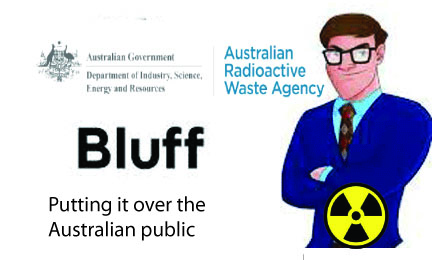
This should send shivers up any Australian’s spine! Nuclear Fuel Cycle Watch Australia, https://www.facebook.com/groups/1021186047913052 Kazzi Jai 28 Mar 22
This has scary echoes of Maralinga…..
We have the newly appointed CEO of Australian Radioactive Waste Agency – Sam Usher – who comes from the UK after working at Dounreay and Sellafield, and is now appointed to the newly created role of the CEO of ARWA in Australia, but has returned back to the UK to come back mid year…..doing a Memorandum of Understanding….. with the CEO David Peattie of Nuclear Decommissioning Authority Cumbria!
Sellafield is in Cumbria UK by the way…..
Despite the Memorandum of Understanding NOT being released to the Australian Public….we have an English man from Cumbria, doing a deal with an English man from Cumbria regarding AUSTRALIA’S INTERESTS!
And it will ALL LAND IN THE TINY COUNTRY TOWN OF KIMBA – in a TOTALLY ALL ABOVE GROUND NUCLEAR DUMP!
NO, NO, NO! ….They say – The nuclear dump won’t take nuclear waste generated from overseas!
Really? Then what is the SUBSTITUTED NUCLEAR WASTE or what they now call RADIOACTIVELY EQUIVALENT NUCLEAR WASTE called which landed in Port Kembla a couple of weekends ago in a second TN-81 CASK!
Whatever name you want to call it – it IS Nuclear Waste generated from overseas – from nuclear power and nuclear weapons generation from overseas! It is not our nuclear waste – it is overseas generated waste!
As much as ARWA wants to appear “established” it isn’t. It still remains bluff and bravado – acting as if everything is going as it should…..but it isn’t, and may never get there.
Antarctic heat – a horrifying reminder of the future with global heating
“Shocking,” said the Met Office head; “bonkers,” according to an Antarctic researcher. The heat at both ends of the planet this week has scientists straining for adjectives. 40°C above normal in Antarctica,
30°C hotter than usual in the Arctic.
With temperatures so much above anything on record, scientists had to confirm that, no, it isn’t a typo:
this is really happening.
Last week, the Conger ice shelf, which sits off the East Antarctic coast and is around 1,200 square kilometers across, collapsed completely. Ice sheets hold back the flow of ice into the sea.
“If they collapse, then ice flow from inland accelerates and leads to sea level rise,” said Andrew Mackintosh, a scientist at Monash University in Australia.
A natural reaction to such news is to fear the ice sheets might collapse entirely. If the West Antarctic ice sheet collapsed into theocean, global sea-levels could rise several metres – much faster and
further than expected – swamping coastal cities. That is not likely to happen soon, but the polar heat is a horrifying reminder of the stakes involved.
Independent 25th March 2022
https://www.independent.co.uk/climate-change/opinion/higher-food-prices-climate-crisis-b2043988.html
Gigantic Antarctic ice shelf collapses into the sea

An ice shelf about the size of Rome has completely collapsed in EastnnAntarctica within days of record high temperatures, according to satellite data. The Conger ice shelf, which had an approximate surface area of 1,200 sq km, collapsed around 15 March, scientists said on Friday.
East Antarctica saw unusually high temperatures last week, with Concordia station hitting a record temperature of -11.8C on 18 March, more than 40C warmer than seasonal norms. The record temperatures were the result of an atmospheric river that trapped heat over the continent.
Guardian 25th March 2022
1 This month
17 October, Free Public Talk on Nuclear Issues in South Australia
David Noonan will speak on public interest concerns over the new Roxby Downs Indenture Act 2026 on BHP copper-uranium mining and ore processing in SA, and on how AUKUS may face SA with a High-Level nuclear waste agenda.
Dr Jim Green will discuss international developments in the field of nuclear power including ‘small modular reactors’ and Generation 4 ‘advanced’ nuclear reactor concepts.


Help Aunty Sue Protect Her Land and Sacred Sites From Destructive Rocket Testing.
.

Australians deserve the truth
about
AUKUS – https://aukuspublicinquiry.com/

PETITION – To: Prime Minister Anthony Albanese and the Australian Labor Government

of the week – Australians for War Powers Reform (AWPR)
To see nuclear-related stories in greater depth and intensity

