Australian government will not intervene as Australian citizen Julian Assange is extradited from UK to USA
Australia won’t interfere in Assange case https://www.aapnews.com.au/news/australia-won-t-interfere-in-assange-case?share=PPzPIGP&fbclid=IwAR2z0saMHCLbT3dc-VMgelywE7ND1eEa4TahOq9wCQ2Ai7IG2CKRyzKmWVE, By Dominic Giannini, April 21, 2022 The Australian government will not make any representations to the British home secretary after a UK court approved the extradition of whistleblower Julian Assange to the US.
A British court has sent Mr Assange’s extradition order to Home Secretary Priti Patel, but the whistleblower can try to challenge the decision by judicial review if signed.
Finance Minister Simon Birmingham said the government maintained confidence in the UK’s justice system.
“We trust the independence and integrity of the UK justice system. Our expectation is that, as always, it operates in the proper and transparent and independent way,” he told the ABC.
“It, of course, has appeal processes built into it as well. This is the legal system upon which our own has been built on and established and we have confidence in the process.”
Labor foreign affairs spokeswoman Penny Wong said it was ultimately a decision for the UK home secretary.
“I do understand why not only Mr Assange’s personal supporters but many Australians more generally are worried about this. It has dragged on a long time,” she told the ABC.
“As an Australian citizen, he is entitled to consular assistance. We also expect the government to keep seeking assurances from both the UK and US that he’s treated fairly and humanely.”
But Senator Wong stopped short of saying a Labor government would make specific representations about the case.
“Consular matters are regularly raised with counterparts, they are regularly raised and this one would be no different,” she said.
The development comes 10 days after Mr Assange surpassed the three-year anniversary of his arrest.
The 50-year-old Australian was dragged from London’s Ecuador embassy on April 11 in 2019 to face extradition to the United States on espionage charges over WikiLeaks’ release of confidential US military records and diplomatic cables.
Deputy Prime Minister Barnaby Joyce has previously called for an end to Mr Assange’s extradition.
Mr Joyce said Mr Assange didn’t steal secret US files but only published them, which did not breach any Australian laws at the time, and he was not in the US when leaks were put online.
The Greens have criticised the extradition of Mr Assange, with senator Peter Whish-Wilson saying the US Espionage Act wasn’t intended to be used against publishers.
“We must support press freedoms and those who hold the powerful to account,” he said.
“Julian Assange’s prosecution has always been political. It needs political intervention of the highest order from our government to get justice for him.”
Assange Australia campaign adviser Greg Barnes says it’s important the matter has moved back into the political realm.
“Previously the Australian government has said we can’t even intervene because the matter is before the courts. It is no longer before the courts in that sense,” he told Sky News.
This is a political decision that will be made by Priti Patel and it’s a decision which the Australian government, and of course in this context the opposition, could influence.”
The Greens, crossbenchers such as Andrew Wilkie, and Liberal and Labor backbenchers had expressed support for Mr Assange, which could potentially influence a hung parliament in May, Mr Barnes said.
“That’s also an interesting factor as to what pressure is going to come on whoever gets elected in May to bring this Australian home.”
with Reuters
UNEXPLAINED ORDNANCE: A MISSILE ON ABORIGINAL LAND AND A BREAKTHROUGH LEGAL COMPLAINT
ARENA ONLINE, MICHELLE FAHY, 21 APR 2022
A ground-breaking legal complaint has arisen after First Nation’s elders Andrew and Robert Starkey discovered an unexploded missile on their country. The brothers discovered the missile, manufactured by arms multinational Saab, in Lake Hart West, a registered Indigenous heritage site within the vast Woomera Prohibited Area. The Starkeys are Kokatha Badu (respected senior figures, or lore men) from the Western Desert region of South Australia who have devoted decades to protecting heritage sites on their land.
In a complaint to the OECD, the Starkeys alleged that Saab had breached OECD guidelines by failing to undertake or maintain ‘adequate human rights due diligence which could prevent their product from being used in human rights violations’, and which also resulted in a failure to ‘protect and preserve the integrity of [those] heritage sites’ for which the Starkeys have custodial responsibilities
Michelle Fahy, 4 Feb 2022
Australia hasn’t seen anything like this case before. In fact, in the world of OECD complaints, it’s a first.
The Starkey complaint has resulted in a precedent-setting initial assessment from the OECD that could have ramifications for multinational weapons companies. The OECD’s Australian contact point has decided that arms export permits granted by national governments do not provide weapons companies with immunity from responsibility for human rights violations resulting from the use of their products or services.
This decision overturns earlier OECD precedents set by other countries, including the United Kingdom and the United States, which allowed weapons companies to shelter behind arms export permits. The initial assessment in the Starkey complaint says that government-issued arms export permits on their own are insufficient protection, and that the OECD guidelines require global arms manufacturers to conduct ongoing due diligence on human rights issues. Manufacturers of weaponry used to commit war crimes against civilians in Yemen, for example, could now be exposed to similar complaints.
The Defence Department, which has long fobbed off the Starkeys’ heritage concerns, took a year to remove the missile. Andrew says they next tried to approach Saab—whose marketing tagline is ‘It’s a human right to feel safe’—but were again brushed off and referred back to Defence. The Starkeys then lodged their complaint with the OECD’s Australian National Contact Point (AusNCP) in September 2021.
The OECD Guidelines for Multinational Enterprises are a comprehensive code of responsible business conduct that governments have committed to promoting. Each country that chooses to adhere to the guidelines must establish a national contact point to promote and implement the guidelines. The complaints procedure is intended to provide a non-adversarial ‘forum for discussion’ to examine and resolve complaints against multinationals.
The OECD covers most of the world’s weapons makers— 80 of the top 100 arms corporations, according to an analysis of data compiled by the Stockholm International Peace Research Institute. These companies represented 80 per cent (US$425 billion) of the US$531 billion in sales by the top 100 in 2020. Saab, ranked thirty-sixth, had US$3.4 billion in sales in 2020.
Saab responded to the Starkeys’ complaint saying, amongst other things, that its supply of weaponry to Defence was subject to ‘strict export control laws’ aimed at preventing their use in harmful ways and that Swedish export controls ‘require human rights issues to be considered’. This rote argument is parroted across the arms industry and is one that Australia’s Defence Exports Controls Office relies on to justify its continued arms exports to nations engaged in serial human rights abuses, including Saudi Arabia, the United Arab Emirates, Israel and Indonesia.
‘No nation gets to pick and choose which laws to comply with, nor do they get to choose who will or will not be held accountable’, says the Starkeys’ international human rights lawyer John Podgorelec. ‘The international law has to be applied as evenly to the Saudi Yemen conflict as it would to the Russia Ukraine conflict.’
Weapons companies have long benefited from a myopic reliance on one-off export permit approvals. However, the extensive evidence of war crimes and the resultant catastrophe still unfolding in Yemen, fuelled in large part by US– and UK supplied weaponry, shows that the so-called strict permit approval system is an abject failure in protecting human rights.
The AusNCP’s initial assessment sounds a warning to the arms industry worldwide. The AusNCP has now offered its ‘good offices’ to facilitate a negotiated resolution between the Starkeys and Saab. The Starkeys are ready to negotiate. Whether the ‘good offices’ phase proceeds depends on Saab, which has so far said it will ‘review the findings, and continue to engage with the AusNCP, to determine any further required actions’.
Andrew Starkey is pleased with the result so far, but his relief is tempered with discontent. ‘The situation is so bad in Australia. The legislation is so weak that we needed to rely on international law to get justice.’
Dr John Pace, who is also advising the Starkeys, is a globally recognised expert in human rights law with more than fifty years’ experience, including at the United Nations. Pace says that the obligation for due diligence on human rights grounds never abandons the equipment. ‘It is an ongoing, responsive and changing process, not a one-off rubber stamp.’
Amnesty International has noted, in Human rights policies in the defence sector, that, ‘There is now a clear global consensus that companies have a responsibility to respect all human rights wherever they operate’. There is also increasing acceptance that good business practices in one area do not offset harm in another. Corporate behaviour must be globally consistent.
A significant factor influencing the handling of the Starkeys’ complaint is the web of conflicting interests in which Saab features strongly. Such conflicts were not disclosed to the Starkeys during the complaint process. It is this inconsistency in its corporate behaviour that has brought Saab undone. As Andrew says, ‘Defence seems more interested in protecting a Swedish company than in protecting Australian culture’………………………………………………………………
The due diligence guidelines are clear about avoiding adverse impacts on human rights and, in particular, the importance of engaging with Indigenous peoples who might be affected by the activities of the business. One adverse impact noted by the OECD in relation to human rights is ‘Failing to identify and appropriately engage with indigenous peoples where they are present and potentially impacted by the enterprise’s activities’.
The Starkeys are concerned that similar problems will recur. Says Andrew, ‘For us this is the same as the British atomic tests. We are the ones left to deal with the mess. They are erasing us one site at a time up there’.
| Christina Macpherson <christinamacpherson@gmail.com> | Apr 22, 2022, 9:02 PM (11 hours ago) |  | |
| to me |
The US Cries About War Crimes While Imprisoning A Journalist For Exposing Its War Crimes

https://caitlinjohnstone.substack.com/p/the-us-cries-about-war-crimes-while?s=w. 20 Apr 22, In what his lawyers have described as a “brief but significant moment in the case,” a British magistrates’ court has signed off on Julian Assange’s extradition to the United States, bringing the WikiLeaks founder one step closer to a US trial under the Espionage Act which threatens press freedoms worldwide.
The extradition case now goes to UK Home Secretary Priti Patel for approval, which will likely be forthcoming as Patel is a reliably loyal empire manager. After that point, Assange’s legal team will be able to launch an appeal.
This is happening at the same time the United States and the United Kingdom are loudly demanding accountability for alleged war crimes by the Russian military in Ukraine, which is interesting because attempting to bring accountability for war crimes is precisely why Julian Assange is in prison.
“He is a war criminal,” President Biden said of Vladimir Putin following allegations of war crimes in Bucha, Ukraine earlier this month. “I think it is a war crime. … He should be held accountable.”
Biden: Putin should face war crimes trial for Bucha killings 4 April 2022
Wikileaks 5 April – 12 years ago today 5 Julian Assange published the Collateral Murder video detailing the gunning down of civilians, children & 2 Reuters journalists. Assange faces a 175 year sentence if extradited for revealing this and other war crimes
This is why the US government is trying to extradite Julian Assange: for revealing the US massacre of civilians, including two Reuters journalists in Iraq
And that’s all I’d like to say here today, really. That this discrepancy is very interesting.
I mean, can we take a moment to deeply appreciate the irony of this? Because it’s so obscene and outrageous it’s actually hard to take in unless you really let it absorb. The most powerful government in the world, which serves as the hub of the most powerful empire that has ever existed, is working to extradite a journalist for exposing its war crimes while simultaneously rending its garments over war crime allegations against another government.
I mean, damn. You would think a power structure that had recently been caught red-handed committing war crimes and is currently in the process of imprisoning a journalist for exposing those war crimes would at least have the sense not to yell too loudly about war crimes for a little while. But this is how confident the empire is in its ability to control the narrative.
Really take it in. Really digest it. The more you think about it, the freakier it gets. Not only is the empire persecuting a journalist for exposing its war crimes while at the same time demanding that others be held accountable for war crimes, it is also attacking the free press for reporting the truth about the powerful while at the very same time engaging in a massive propaganda operation which holds that it is involved in Ukraine to protect its freedom and democracy.
I mean, the gall. The absolute temerity. The balls on this empire, man.
I have said it before and I will say it again: Assange exposed many ugly realities about the powerful in his work with WikiLeaks, but everything that he has managed to expose thereafter simply by forcing them to prosecute him far surpasses the revelations in those publications.
If the highest form of journalism is exposing the darkest secrets of the most powerful people in the world, then Julian Assange is the highest form of journalist.
Australian politics – Grift, Lies and Influence
As we lurch from one scandal of misspent public money to the next, transparency and accountability in public life have never seemed rarer. Fiona McLeod is Chair of the Accountability Round Table. Her book, Easy Lies and Influence, documents how community interests have been undermined. Through his fiercely independent news site, Michael West is known for following the money, highlighting those corporations exercising insidious power over our democracy. They ask: where have we gone wrong and what should we do now?
The Australian media colludes with USA, UK and Australian governments’ persecution ofJulian Assange -”Crikey journal” typifies this
Australian media must stand up for Assange’s freedom, https://independentaustralia.net/life/life-display/australian-media-must-stand-up-for-assanges-freedom,15918 By Matilda Duncan | 10 January 2022, For far too long the Australian media has remained silent in the face of Julian Assange’s persecution and that must change, writes Matilda Duncan.
LAST MONTH, Crikey’s legal correspondent Michael Bradley wrote a bizarre analysis of Julian Assange’s impending extradition to the U.S. without any regard for basic facts.
It’s worth examining, as it typifies the failures and absurdities of Australian press responses to Assange going back a decade — filled with lies, smears and false narratives that prevent the public from understanding the significance and substance of his case.
In writing about one of the gravest threats to press freedom in years, Bradley went as far as to include a cringeworthy – if not downright pernicious, given Assange recently suffered a stroke and is in precarious health – reference to a Monty Python quote being inscribed on Assange’s tombstone that ‘he’s not the Messiah, he’s a very naughty boy’.
You couldn’t make this stuff up.
In allowing his thoughts to remain mired in diversionary debates and myths about WikiLeaks and Assange, Bradley completely misses the point of the U.S. extradition case and fails to mention the dire threat to investigative journalism around the world it presents.
He does not confront or condemn the alarming legal precedent of the United States charging a foreign national, one of our citizens, with espionage under U.S domestic law — despite Assange not being a U.S. citizen and WikiLeaks not being a U.S.-based publication.
Bradley writes:
‘WikiLeaks broke new ground but mainly in volume and approach, not content.’
In 2010, Assange and WikiLeaks – in partnership with numerous mainstream media outlets, including The New York Times, The Guardian and Der Spiegel – published a curated cache of 250,000 diplomatic cables revealing the corruption and destruction of the Bush-era and early Obama-era wars, into which Australia so subserviently followed.
Without Assange’s work, numerous war crimes, mass surveillance schemes and unreported civilian casualties would have gone uncovered. In one year, he generated more consequential journalistic scoops confronting Western centres of power than the rest of the world’s news organisations combined.
Some of the information published by Assange has since become the subject of criminal investigations into the CIA and U.S. authorities before the International Criminal Court, which, as lawyers for Assange testified during his extradition hearing, is further evidence that the U.S. case against him is politically motivated.
Further, irrefutable illustrations of the significance of the “content” of Assange’s work can be found in comparisons between it and the lies and deceptions fed to the Australian population by this country’s press in the Iraq War years. Consider, as just one example of many, WikiLeaks’ publishing of the detainee assessment briefs and manual for Guantanamo Bay, where children as young as 15 were held, in contrast with the vapid first-hand account of the illegal prison presented by one of the Australian Broadcasting Corporation’s top foreign correspondents, Leigh Sales.
In 2007, Sales wrote of her second visit to Gitmo:
‘At the same time, my own eyes and ears led me to believe that Guantanamo wasn’t as barbaric as it was made out to be either. None of the detainees came running to the wire, begging for help to get out.’
One Guantanamo Bay prisoner has recently waived his right to appear in court on numerous occasions because he suffered “rectal damage” while in custody of the CIA that makes it too painful for him to sit.
According to Bradley, it’s Assange that’s the “problem”, not the CIA spying on Assange and planning to kidnap or assassinate him with the help of UC Global as he held political asylum inside the Ecuadorian Embassy. After UC Global installed microphones in 2017, all of Assange’s conversations were recorded, including those he had with his lawyers outlining his defence strategy for the current case against him.
This is likely a violation of attorney-client privilege in itself and might be reason enough to throw out the U.S. case against him.
Bradley wasted his words on puerile arguments about Assange being a “tarnished hero” instead of communicating the most pressing things to know about Assange: six of the 18 counts against him are Espionage Act charges that criminalise the obtaining of ‘national defense information’, something journalists that report on their governments do every day.
Ten other counts relate to the disclosure of national defense information. Again, a regular task for many journalists. One further ‘conspiracy to commit computer intrusion’ count relates to Assange allegedly offering to help Chelsea Manning crack a security code to help her avoid detection while she was obtaining U.S. Government documents.
This is a charge that amounts to an attempt to criminalise a journalist assisting a source to protect themselves, yet another activity that responsible journalists regularly engage in.
Even more terrifyingly, the case against Assange centres around “national defence information”, a nebulous term that might be applied to whatever information the U.S. Government so chooses. It doesn’t even have to be classified or top-secret information — much of the information leaked by Manning was unclassified and widely accessible to others in government.
It has been recognised with press awards around the world for over a decade now, including a Walkley, and exposed human rights abuses globally. It is plain wrong to say that Assange did not redact the information he released — the compelling eyewitness testimony from Mark Davis can directly attest to that.
Further, there is no evidence of anyone becoming endangered by his reporting. In fact a 2013 investigation by McClatchy found officials couldn’t point to any examples of lives being endangered by WikiLeaks and in 2010, Obama officials privately admitted that any damage from the leaks was “limited” and that their public comments about the leaks having “seriously damaged American interests” were intended “to bolster legal efforts to shut down the WikiLeaks website and bring charges against the leakers”.
‘Like anyone who attains the status of iconic mystery, Assange – not actually seen freely moving in public in a decade – has become less person and more mirror reflecting the meanings we choose to attach to him and his experiences. What he actually thinks is known only to him, and his lawyers presumably.’
Bradley was correct on one thing: using the word “mirror” in connection with Assange. This citizen of ours bravely risked his life and liberty to tell us ugly truths about U.S. imperial power and military machinery, which this country so strongly enables and supports.
He reflected right back at this country snippets of the destruction and mass civilian deaths we willingly participated in. His brave journalism exposed the bulk of our country’s media as the petty, unserious talking heads they are: journalists that don’t actually serve the public, but parrot the lies they are told by governments.
Contrary to what Bradley says, what Assange “actually thinks” has been well-documented for years now.
After seven years of arbitrary detention followed by three years of solitary confinement and other tortures in London’s Belmarsh Prison, Assange thinks of suicide constantly. That the U.S. is slowly killing this Australian journalist, partner and father before our eyes for exposing war crimes while the Australian Government does nothing and the majority of our press either remains silent or – when they say anything at all – write flippant and inaccurate stories about him demonstrates just how broken this country’s media is.
It shows how unaware we are of the press freedom we are about to lose and how deeply needed the work of Julian Assange and others of his ilk is.
Scott Morrison, Angus Taylor stack clean energy agencies with fossil fuel mates
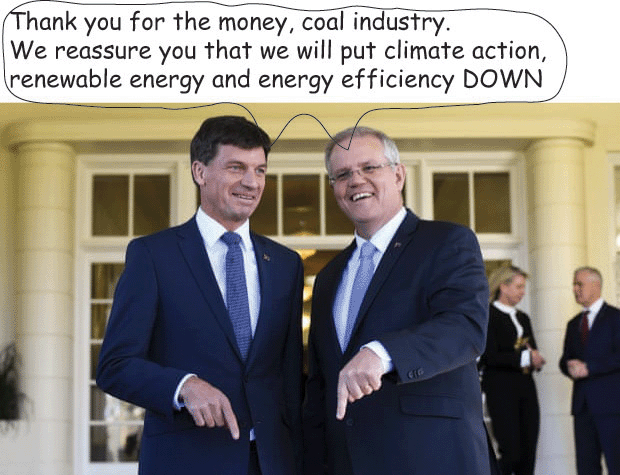
https://michaelwest.com.au/scott-morrison-angus-taylor-stack-clean-energy-agencies-with-fossil-fuel-mates/ by Callum Foote | Apr 20, 2022,
The Morrison government has slashed renewables funding and stacked Australia’s renewable energy agencies with fossil fuel executives, leaving the likes of ARENA, CEFC and Snowy Hydro controlled by potentially regressive political appointees for years. Callum Foote reports.
Eschewing common sense and proper process has become de rigeur for Scott Morrison and his energy minister Angus Taylor. And we are not hearing more than a whimper about this from Labor either. Political Mates deals. Jobs for the boys, Jobs for the girls.
Stacking the bureaucracy occurs under regimes of both stripes but, as is their wont, Prime Minister Scott Morrison and his energy minister Angus Taylor have taken their undemocratic agendas to the next level, to a grotesque art form.
They have been busy stacking public agencies, supposedly independent agencies, with their own people; not on merit but on party lines. We are of talking highly paid jobs, many between $250,000 and $500,000 going to people on the basis on political affiliations rather than ability or independence.
As if the government’s well-publicised stacking of the Administrative Appeals Tribunal (AAT) were not enough evidence of blatant abuse of process, the recent spate of mining or fossil-fuel related board appointments to government-run renewable energy bodies ARENA and the CEFC, will favour the agendas, indeed the profits, of large multinational mining companies for years to come.
CEFC Board appointments
The Clean Energy Finance Corporation (CEFC) was created under the Gillard government, dedicated to making investments in emerging clean energy technologies. Originally, and for many years it ran a profit while presiding judiciously over the financing of RE projects.
First, the Coalition under Tony Abbott tried to have it abolished, despite it being a net earner for government – therefore no drag on the public purse. Failing there, the government has undermined its mandate and stacked it with its own ever since.
The latest: chairman, Steven Skala, AO, has had his position renewed for another five years.
Skala is vice chairman of Deutsche Bank Australia and has been a director of the Centre for Independent Studies, a libertarian think tank, since 1995.
While being the vice president of Deutsche Bank Australia, the bank joined JP Morgan and Standard Chartered to loan US$1 billion to Adani Enterprises in July last year.
Matt Howell has been appointed to the CEFC board for the first time, leaving his position as CEO of Tomago Aluminium.
Howell is also a director of the Australian Aluminium Council, an organisation which has been labelled the most militant of the “greenhouse mafia” organisations – as dubbed in a 2006 ABC Four Corners investigation.
The Council funded and promoted the work of the Australian Bureau of Agricultural and Resource Economics (ABARE), whose “MEGABARE” economic model was, at the time, used to generate reports which were a go-to for Liberal and National Party politicians wanting to argue climate action would spell economic catastrophe.
Rod Campbell, director of research at The Australia Institute, says Howell’s recent switch to pro-renewable energy rhetoric shows he is ”more than willing to play games in the energy space rather than really be involved in constructive long-term planning”.
ARENA Board appointments
Elizabeth O’Leary, a senior director at Macquarie Asset Management and head of MAM Agriculture & Natural Assets, one of the world’s largest private land managers, has been appointed to the board of the Australian Renewable Energy Agency (ARENA).
O’Leary joins a long list of Macquarie Bank Alumni working for Australian clean energy financial bodies as revealed by a MWM investigation.
A consortium comprising private equity funds managed by the tax avoiding Brookfield Asset Management and Macquarie Capital acquired Apache Corporation’s Western Australian oil and gas assets for $US2.1 billion in 2019. This created Australia’s third largest oil and gas producer.
Snowy Hydro Board appointments
Snowy Hydro, which has become the government’s tool to intervene in the energy market – check out the highly questionable public subsidies for the Kurri Kurri gas plant – has appointed two new board members. These are Leanne Heywood who spent 10 years as an executive with Rio Tinto.
Timothy Longstaff was the government’s other pick for the role. Longstaff has previously been a director of Perenti, a Perth-based global mining services contractor.
Longstaff was also a senior advisor to the Finance Minister Simon Birmingham as recently as 2021. Birmingham is the minister who announced Longstaff’s appointment. Jobs for the boys, anyone?
Reduction in renewables funding:
The Climate Debt Statement, a measure introduced by Prime Minister Tony Abbott aggregates funding for the Clean Energy Finance Corporation (CEFC), the Australian Renewable Energy Agency (ARENA) and the Clean Energy Regulator (CER) to work out how much their expenditure contributes to total government debt. It shows a decline in spending from $2 billion in 2022-23 to $1.3 billion in 2025-26.
Angus Taylor attempting to co-opt CEFC
A previous attempt to amend the CEFC’s legislation was abandoned earlier this year, after a group of Nationals MPs – including current leader Barnaby Joyce – sought to move additional amendments to expand the agency’s investments into coal and nuclear projects.
The Morrison government had attempted to open up the CEFC to carbon capture and storage projects, announcing a plan to establish a new Low Emissions Technology Commercialisation Fund using the Clean Energy Finance Corporation (CEFC).
This was designed to skirt around the CEFC’s legislated ban on funding CCS projects.
Despite the government’s ten-year jihad on renewable energy, there is no stopping financial logic, or common sense for that matter. RE prices have dropped radically over the decade, even more than the sector’s advocates and analysts had anticipated. That is, the cost of building new renewable energy versus the cost of building new coal or gas.
Where government has failed, miserably, investors have taken up the slack, leaving our politicians in the dust trying to prop up their fossil fuel donors with public money. This, even to the point of espousing ludicrous schemes which do not measure up financially: Kurri Kurri, the examination of a new coal-fired power plant for Queensland, the public subsidies for gas companies to frack the NT’s Beetaloo Basin.
Future of Antarctica’s Larsen C ice-shelf will have consequences for sea level rise world-wide
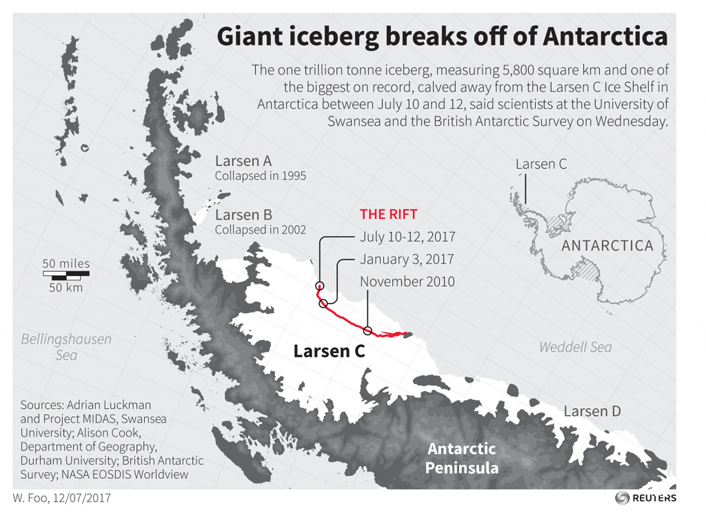
| Scientists know the surface of the Larsen C ice shelf in Antarctica is melting, making it vulnerable to collapse. For the first time, we can rank the most important causes of melting over the recent past. In a new two-part paper in Journal of Geophysical Research: Atmospheres, we show how the amount of energy reaching the ice from the sun is the dominant factor, followed by warm winds, clouds and weather patterns. These drivers of melting can interact and overlap to reinforce or counteract each other, so it is a complex picture. Understanding what is causing melting over Larsen C is vital as it will help predict the future of the ice shelf, which will have knock-on consequences for sea levels worldwide. In 2002, Larsen C’s neighbouring ice shelf, Larsen B, experienced melting so severe that it eventually caused the shelf to collapse completely. Larsen C restrains glaciers that contain enough ice to raise global sea levels by around 22mm. Carbon Brief 14th April 2022 https://www.carbonbrief.org/guest-post-ranking-the-reasons-why-the-larsen-c-ice-shelf-is-melting |
Will Australia’s nuclear submarines end up being built overseas?
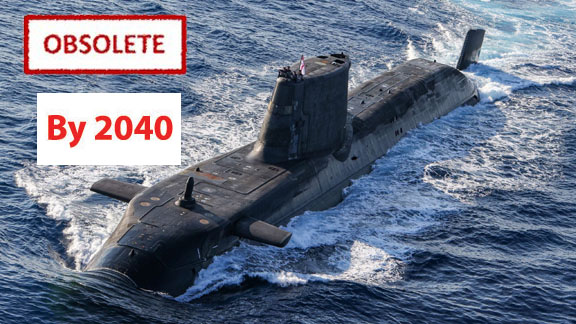
ABC, 7.30 / By Angelique Donnellan, 18 Apr 22, In 1938, wharfies at Port Kembla, south of Sydney refused to load smelted iron ore bound for military production in Japan for its war against China.
Key points:
Independent Senator Rex Patrick is concerned Australia’s nuclear submarines may end up being built overseas
Defence expert Clive Williams believes it would be cheaper to build the subs in the US or the UK
Port Kembla in NSW is being considered as a base for the nuclear submarines
Some locals, including Alexander Brown from Wollongong Against War and Nukes, says the peaceful legacy is reason for the town not to become a defence base for Australia’s new nuclear submarines.
“We’re a city of peace, and we’re a city of renewable and sustainable employment. We don’t want to turn into a defence industry town,” he told 7.30.
“If nuclear submarines are based here in Port Kembla, we’re looking at accident risks for us, for sea life, for the ecosystem that we all depend upon.”
Port Kembla is being considered as a potential $10 billion east coast nuclear submarine base location, along with Newcastle and Brisbane.
Debra Murphy from Illawarra Regional Development Australia said the town should embrace the opportunity.
Along with the base proposal, the historic AUKUS deal to deliver eight nuclear-powered submarines remains a work in progress during its initial 18-month consultation period…………
Defence Minister Peter Dutton wouldn’t be drawn on when the new nuclear submarines would be built and go into service, or the amount of construction work that would happen in Australia.
Under the previous French submarine deal, there was a public pledge to spend 60 per cent of the contract value in Australia………..
Concerns subs may be built overseas
South Australian Independent Senator and former submariner Rex Patrick said the language around a local build was too vague.
Every day, it looks more and more likely that this submarine will be built overseas,” Mr Patrick told 7.30.
“The government keeps squeezing on the schedule and that means that they have to reduce risk wherever they possibly can.
“The Australian Strategic Policy Institute has predicted that this project will cost about $170 billion. An overseas build is the exporting of $170 billion of taxpayers’ money and thousands of Australian jobs to foreign shipyards.”……………………..
Expert says subs should be built overseas
Defence researcher Clive Williams from Australian National University said considering the complexity of a nuclear submarine, taxpayers would get better value for money if the boats were constructed in the US or UK.
“I think building at Osborne in South Australia is fraught with danger and could well be another defence procurement disaster. I’m sure that it’ll wind up in cost overruns, changes to design, fiddling around with it, and so on,” he told 7.30.
“I think a much safer bet is to go with an overseas purchase.”………………………………
The government is pursuing the nuclear option after cancelling a contract last September with the French to build 12 diesel-electric submarines, a move that is likely to cost up to $5.5 billion in compensation to the companies involved, including Naval Group.
Mr Dutton said negotiations were ongoing and the settlement would be made public when finalised. https://www.abc.net.au/news/2022-04-19/australia-aukus-nuclear-submarines-building/100982778
Pine Gap’s role in China–US arms race makes Australia a target
Rakesh, April 15, 2022 https://community99.com/pine-gaps-role-in-the-arms-race-between-china-and-the-united-states-makes-australia-a-target/
Developments at the U.S.-Australian satellite intelligence base at Pine Gap near Alice Springs give the United States an unprecedented ability to detect Chinese spacecraft from space and potentially destroy them.
Previously, detection was mainly based on ground-based radars, which are no longer seen as suitable for identifying these spacecraft if they were weapons. China has said it has only tested new space vehicles.
As shown below, two different versions of the latest Pine Gap satellites can do this job together. The difficulty is how to further destabilize the nuclear balance between China and the United States in order to help maintain peace.
Last October, it was reported that China had tested a nuclear-capable highly maneuverable hypersonic glider after it was lifted into space by a missile. The nuclear warheads released from US intercontinental ballistic missiles are also manoeuvrable and independently targeted. But the United States sees a serious threat from these hypersonic vehicles that can drive at more than five times the speed of sound.
This development makes Australia more closely integrated with any American offensive in space, as well as with defensive capabilities. Yet there has been no political debate in Australia about the consequences of avoiding war. No senior politician is trying to create momentum to support a new arms control deal, as Presidents Richard Nixon and Leonid Brezhnev did in 1971, when the number of nuclear weapons escalated alarmingly, to more than 30,000 each.
The latest arms build-up is highlighted by a meeting in late March between Australian intelligence and military officials and senior US military officers at Pine Gap. Although the United States clearly considers Pine Gap to be crucial in fighting war in space, these military officers did not speak to the Australian media. Instead, they choose to talk to a London-based journalist Financial Times.
It is unclear whether the government intends to inform the Australian public about developments at Pine Gap. These have implications for Australia’s own security and its potential obligations under the outer space treaty, which limits the militarization of space without completely banning it. If Pine Gap was not already a Chinese nuclear target, it probably will be now.
That Financial Times reported the head of the U.S. Indo-Pacific Command, Admiral John Aquilino, said the United States wanted to integrate all elements of the U.S. military power with its allies. In this context, Aquilino said Australia has capabilities that make it an “extremely advanced partner”. He said increased visibility in space would help counter Chinese hypersonic weapons. “The ability to identify and track and defend against these hypersonics is really key.”
The head of the U.S. Space Command, General James Dickinson, was also interviewed for the play, saying Australia was a “critical partner” in efforts to improve space domain awareness and monitor Chinese space operations. He said, “This is the perfect place for many things to do.”
The deputy head of the U.S. Cyber Command, Lieutenant General Charles Moore, said digital convergence between the United States and Australia gives the Unit
Pine Gap’s own satellites also pick up signals from radars and weapon systems, such as ground-to-air missiles, anti-aircraft artillery, fighter jets, drones and spacecraft, along with other military and civilian communications. From Pine Gap, a huge amount of military data is fed into the American war machine in real time.ed States “the potential to conduct offensive operations.” He added that cooperation with allies created an “asymmetric advantage” over China, which lacks similar partnerships. One consequence is that China cannot gather near as much electronic intelligence from across the globe as the United States.
An idea of the growing importance of Pine Gaps for the United States is given by its extraordinary growth. Originally, it was a ground station for a single satellite to collect what is called signal intelligence as it orbited 36,000 kilometers above the Earth. There are now at least four much more powerful satellites connected to the base. Their antennas automatically intercept everything that is transmitted within their frequency range. This includes a large selection of electronic signals for intelligence analysis, including text messages, emails, phone calls and more. In addition, terrestrial antennas at Pine Gap and other Australian locations pick up a large amount of information transmitted via commercial satellites.
Pine Gap’s own satellites also pick up signals from radars and weapon systems, such as ground-to-air missiles, anti-aircraft artillery, fighter jets, drones and spacecraft, along with other military and civilian communications. From Pine Gap, a huge amount of military data is fed into the American war machine in real time.
Pine Gap operates in connection with similar interception satellites attached to a base at Menwith Hill in England. Their use to lead counterfeit drone strikes that have killed a large number of civilians has been much debated in England. The combined coverage of the two bases includes the former Soviet Union, China, Southeast Asia, East Asia, the Middle East, Eastern Europe, and the Atlantic landmass.
Pine Gap is also linked to infrared satellites, which are of great interest to Americans. Their original function, which is still important, is to provide early warning of the firing of nuclear-armed Russian or Chinese ballistic missiles. Added options now allow them to use their infrared telescopes to detect and track heat from spacecraft as well as from large and small missiles and military jets. Some satellites have very elliptical orbits that can go close to Earth instead of being 36,000 kilometers above Earth.
These satellites now provide highly coveted information about Chinese spacecraft, amplified by the data from the signal intelligence satellites. Taken together, this gives access to signals and infrared intelligence, and its location relative to China, Pine Gap plays a crucial role in the United States’ plans to fight wars in space. This capability will be enhanced by a new space-based detection and tracking system called Next Generation Overhead Persistent Infrared (Next-Gen OPIR).
On April 6, the leaders of the AUKUS pact – Boris Johnson, Scott Morrison and Joe Biden – announced that they would develop hypersonic missiles and subterranean robots after previously promising to supply Australia with nuclear submarines from around 2040.
These new missiles will also travel at more than five times the speed of sound, but are air-breathing unlike those designed for use in space. The United States and Australia had already developed hypersonic cruise missiles using ramjet engines.
No figures are available, but the cost of developing, building and testing very long-range missiles will be high. A large part of the test is expected to take place in Australia. The new missiles are also intended for use against Chinese targets.
Again, China can be expected to build more missiles with the ability to target Australian and US forces in the region. Separately, Secretary of Defense Peter Dutton announced that the Australian government will spend $ 3.5 billion on new missiles with a longer range of 900 kilometers for Australian ships and fighter jets.
The background to what is happening at Pine Gap illustrates how much more important the base is to the United States than any contribution Australia may have made by a pair of fighter jets or frigates to the United States’ integrated international force that was at a distance from China. At this stage, neither side of Australian policy seems willing to refuse participation in yet another US-led war that violates Australia’s obligations under both the UN Charter and Article 1 of the ANZUS Treaty. Both documents oblige Australia to reject the use of force in international relations, other than defensively.
Although rarely mentioned, Pine Gaps’ growing importance to the United States increases Australia’s leverage with the United States to refuse to contribute ships, aircraft and troops to an integrated military force should it violate international rules. It may be harder to dismiss some aspects of Pine Gap’s operations. But there are provisions in the ground rules that Australia only acts with “full knowledge and agreement” with what is happening. Australia does not have to agree.
A further question is how to revive arms control negotiations between Russia and the United States and include China. The two large ones have 1550 intercontinental warheads, but they also have smaller ones. According to the Pentagon, China had only about 100 intercontinental ballistic missiles by 2021 and about 200 smaller warheads. This gives China reasonable cause for concern that it does not have enough strategic warheads to be able to retaliate against a US first attack and thus perpetuate deterrence.
To overcome this, the Pentagon projects that China will have around 1,000 intercontinental warheads by 2030. All sides must reach a new agreement to make major cuts in the number of warheads if the chances of nuclear war are to be reduced.
Whether or not China develops hypersonic spacecraft, it is already committed to getting more traditional intercontinental ballistic missiles that can disperse maneuverable warheads. Restraint on all sides is necessary.
I asked the Secretary of State, Marise Payne, and her Labor counterpart, Penny Wong, if Australia could refuse to integrate with the United States and other forces if they considered a proposed deployment in violation of Article 1 of the ANZUS Treaty or the UN Charter. I also asked if Australia could withdraw its military assets from integrated US operations if there was a more urgent need for Australia to confront a local threat that was not of interest to the US. None of them responded before the print deadline.
This article was first published in the print edition of The Saturday Paper on April 16, 2022 as “Mind Pine Gap”.
Cameco Corp still set on WA uranium mine, despite government knockback, Indigenous opposition
ABC Goldfields / By Sean Tarek Goodwin, 14 Apr 2022
A multinational mining company says it remains committed to a controversial uranium project in WA, despite the state government declining to extend its environmental approval.
Key points:
- The WA Environment Minister has rejected an application to extend approval for a uranium mine near Wiluna
- Traditional owners and conservationists say the decision is a relief, after half a century of opposition
- The company says it is still determined to bring the project forward in the future
A multinational mining company says it remains committed to a controversial uranium project in WA, despite the state government declining to extend its environmental approval.
Canada-based Cameco Corporation spent US$430 million acquiring the Yeelirrie uranium deposit, near Wiluna in the northern Goldfields, in 2012.
It is one of the largest uranium deposits in the country.
Earlier this year, the project’s approval expired due to a failure to commence work.
Last week, WA Environment Minister Reece Whitby denied the firm’s application to have the approval extended.
Relief for traditional owners and conservationists
The Conservation Council of WA and Tjiwarl traditional owners welcomed that decision, after 50 years of campaigning against the project.
Traditional owner Vicky Abdullah said it meant a “threat” was over.
It was a bad decision in the first place and after years in court and fighting to defend our country this news is a great relief,” Ms Abdullah said.
Other conservationists also welcomed the decision.
“This is an important and responsible decision and is a further signal to the uranium sector that they’re not welcome in WA,” Dave Sweeney from the Australian Conservation Foundation said.
Cameco said it has also had a similar application for its Kintyre project in the Pilbara knocked back.
Conservation Council Nuclear Free campaigner Mia Pepper said uranium mining had no future in WA.
“Cameco has clearly shown that there is no economic case to mine uranium in WA, with the 2016 writedown of the Kintyre uranium proposal and the clear decision not to advance Yeelirrie,” Ms Pepper said.
But one mine, at Mulga Rock, also in the Goldfields region is pushing forward.
“There is a lesson here for Vimy Resources and their investors – who are bucking the trend and are continuing to throw more money at their beleaguered Mulga Rock project – that mining uranium in WA is uneconomic,” Ms Pepper said.
Company not backing away
Cameco Corporation declined an interview with the ABC, but said market conditions had hindered the project.
“Economic conditions and the state of the uranium market since the project was approved did not support significant expenditure on development activities,” communications director Jeff Hryhoriw said.
But the major mining company said it was committed to the long-term prospect of mining the mineral in WA. ……………………….
Project’s controversial history
The ABC revealed last year the mine was approved by the former federal environment minister Melissa Price without key protections strongly and repeatedly recommended by the government’s own experts.
The approval occurred on the eve of the 2019 election, which most expected the government to lose.
An email from Cameco chief Simon Williamson to the federal government in the days before the 2019 federal election.(ABC )
Secret emails obtained by the ABC showed the approval occurred following intervention by Cameco and then-resources minister Matt Canavan, both of whom asked for the process to be expedited. https://www.abc.net.au/news/2022-04-14/wa-uranium-mine-cameco-yeelirre-project-reece-whitby/100991146—
Propaganda on Ukraine – preparation for Australia fighting USA’s war against China?
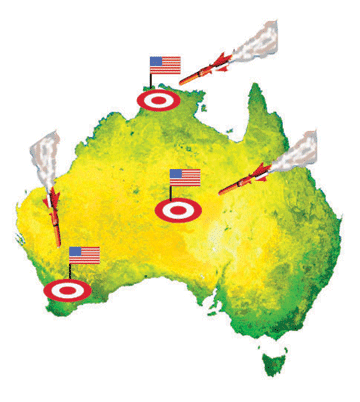
At some point, Australia armed to the teeth with US nuclear armaments will be targeted. From a strategic viewpoint, Australia is the low hanging fruit. The US will bluster but eventually come to a truce with China/Russia/India etc. Meanwhile Australia will be reduced to charred remain but will have Pine Gap and other US assets intact. It is a price the US is willing to pay.
Claudio Pompili, 17 Apr 22,
Ukraine has become the biggest fault line of our times…the US-led western powers and vassal states on one side; the BRICS and others on the other.
I’ve never experienced such blatant propaganda and censorship from the West in my lifetime. On the other hand, the West has played its trump card and, if there were ever any delusion about the US Imperial project. Concerns about global reach of the US military-industrial-complex, tech platforms and oligarchs have been validated.
Our Lib/Lab parties and state-controlled media ABC/SBS along with The Guardian, The Conversation etc have fallen into line with our Imperial master. Shockingly and sadly, so too have many of the faux Left such as Socialist Alliance, Red Flag and in Italy ‘il manifesto’ including global intellectuals eg Noam Chomsky.
Fortunately, the 100% wall to wall Australian MSM propaganda machine has thrown up indie/dissident voices, eg Caitlin Johnstone, John Menadue’s Pearls and Irritations, and globally: in the North America Consortium.news, Counterpunch, The Centre for Research on Globalization (CRG), The Saker, Jacobin etc; and in Europe A Time To Rage: Blog of the Solidarity Socialist Network, Freenations, Contropiano: Giornale Communista Online, L’Antiplomatico etc.
Fortunately too, for now in Australia we can still access voices from the other side of the US divide eg Sputnik, TASS, PRAVDA, Global Times, China Daily etc.
Our Lib/Lab political class, worryingly even The Greens, have joined the US-led chorus of evil Putin/Russia haters and have committed our foreign policy as a co-belligerent to being the US Deputy Sheriff especially against China (it was never about Ukraine and Russia) and made us a nuclear target. Inevitably, Australia will provoke an military conflict with conventional arms in the South China Seas around Taiwan threatening China’s sovereignty. China will have no option but to retaliate militarily with conventional arms. When the body bags of Australian ADF personnel return to our shores, the Lib/Lab/Greens troika will go apoplectic and ramp up even more aggressive military threats including nuclear strikes.
At some point, Australia armed to the teeth with US nuclear armaments will be targeted. From a strategic viewpoint, Australia is the low hanging fruit. The US will bluster but eventually come to a truce with China/Russia/India etc. Meanwhile Australia will be reduced to charred remain but will have Pine Gap and other US assets intact. It is a price the US is willing to pay…to echo US war criminal Madeleine Albright.
Defence expert spills the beans – small nuclear reactors for Australia are all about militarism, not ”peaceful energy”
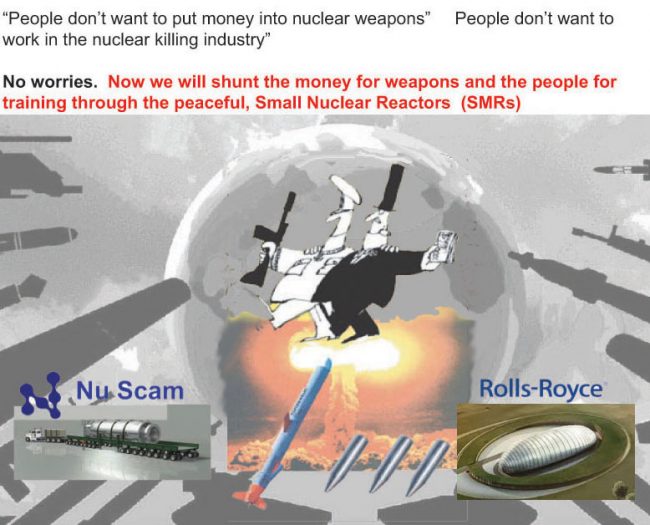
A Milestones Approach to introduction of small nuclear reactors in Australia, Defence Connect 13 Apr 22, Navy veteran and defence industry analyst Christopher Skinner examines whether the International Atomic Energy Agency (IAEA) Milestones Approach should be adopted in Australia in light of the AUKUS nuclear-powered submarine program.
Last Friday the Australian Nuclear Association (ANA) ran a very successful conference in the Aerial Centre of the University of Technology Sydney (UTS) which brought together members and interested people face-to-face for the first time in more than two years.
Significant information and viewpoints emerged, and among these, perhaps the most positive was the clear message from international expert on nuclear legal and regulatory matters Helen Cook that the International Atomic Energy Agency Milestones Approach for introduction of nuclear power, as proven in international use by many countries, is able to be progressed even within all the legislative constraints at federal and state level within Australia.
Passage through the full three phases takes 10 to 15 years which sounds realistic for Australia.
The IAEA Milestone Approach is very well explained in webpages, documents and videos all readily available from IAEA in several languages. This approach has three phases and the first of these, called the pre-project activities phase covers all 19 of listed nuclear infrastructure issues that Australia will face both for the AUKUS submarine acquisition program and any future consideration of small modular (nuclear) reactors (SMR) which unsurprisingly are remarkedly similar to nuclear attack submarine (SSN) reactors except for some additional criteria for military use, such as shock proofing and platform motion in six dimensions.
Applying the Pareto Principle, 80 per cent of the criteria for SSNs also apply to SMRs so why not progress those 80 per cent to save time later.
The suggestion was made that the IAEA Milestones Approach should be adopted right now for the AUKUS program with the expectation that most of the work could be applied to a future SMR program if and when that is approved as an optional carbon-free energy source to be included in Australia’s energy roadmap………….
It is encouraging that Defence has announced 300 scholarships for graduate and technical education in nuclear science, technology and engineering, and some of the recipients were attending the conference.
The AUKUS SSN program will be the largest technically complex program ever undertaken in Australia and it behoves all scientific, technical and engineering institutions to contribute to its success. Similarly for the workforce development institutions to create the courses and contribute to the more general knowledge of nuclear science, technology and engineering.
However there is still a level of fear and apprehension in the community about anything nuclear as was shown in the recent University of Queensland study report What would be required for nuclear energy plants to be operating in Australia from the 2030’s?, a timeframe not dissimilar to the AUKUS submarine program. At the end of the study, the team concluded there were only two main issues to be addressed to build public trust through:
- more detailed explanations of the processes involved over the entire nuclear fuel cycle to ensure safety, and long-term sustainability of radioactive waste; and
- greater assurance of the risks involved and especially the measures to be taken to minimise the risk of accidents and to mitigate the effects of such accidents when they did occur.
As the ANA conference clearly showed, there are parallel development paths being considered for SMRs and nuclear submarines for Australia, and there are many points of common interest that will benefit from a complementary approach.
The encouraging news from the conference was that the Australian Nuclear Science and Technology Organisation (ANSTO) is working closely with Defence’s Nuclear Powered Submarine Task Force in several working groups that were recently announced in the AUKUS progress report. https://www.defenceconnect.com.au/key-enablers/9855-a-milestone-approach-to-introduction-of-small-nuclear-reactors-in-australia
Today: AUKUS, nuclear submarines, hypersonic missiles – all lovely for Australia’s khaki election.
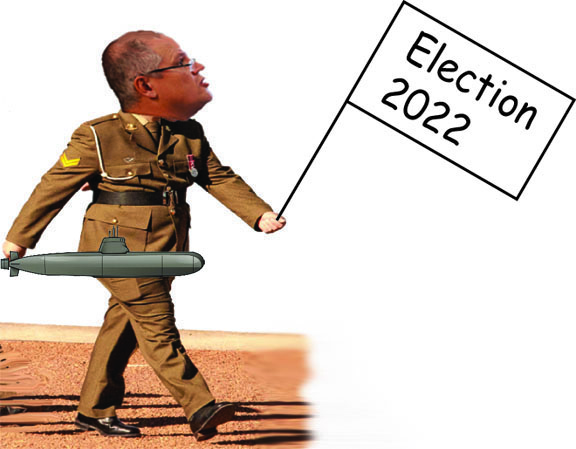
I must admit – the unsurpassed marketing genius Scotty Morrison has got off to a great start with the ”economics, jobs, jobs, ain’t it grand, mate” campaign. He was helped enormously by the Labor leader not being able to answer questions on unemployment and interest rates.
Nevertheless, I’m betting that dear old #ScotttyFromMarketing will before long revert to the war-mongering shtick. After all, he needs to nullify as much as possible, any criticism of the astronomic costs to all this militarism.

And – #ScottyFromMarketing needs to ward off any potential subversion by the gun-crazy Peter Dutton, who’s always there, salivating to take over the leadership.
Nuclear risks, the war in Ukraine, and Australia’s significant contribution to these dangers
The war in Ukraine: Nuclear power, weapons and winter, Pearls and Irritations, By Jim Green, Apr 11, 2022,
Six weeks into Russia’s invasion of Ukraine, the death and destruction has been devastating. In addition, the targeting of nuclear power plants by Russia’s military has raised the spectre of a nuclear disaster.
The Russian military’s seizure of the Zaporizhzhia nuclear power plant ‒ at a time when at least one of the plant’s six reactors was operating ‒ was the most dangerous incident. The partial loss of power to the plant further raised the risk of a disaster.
To say that the seizure of the Zaporizhzhia plant was reckless would be an understatement. Dr. Edwin Lyman from the Union of Concerned Scientists summarised the risks:
“There are a number of events that could trigger a worst-case scenario involving a reactor core or spent fuel pool located in a war zone: An accidental ‒ or intentional ‒ strike could directly damage one or more reactors. An upstream dam failure could flood a reactor downstream. A fire could disable plant electrical systems. Personnel under duress could make serious mistakes. The bottom line: Any extended loss of power that interrupted cooling system operations that personnel could not contain has the potential to cause a Fukushima-like disaster.”
The Russian military also seized control of the Chernobyl nuclear plant, the site of the world’s worst nuclear accident. Workers were held hostage for 25 days. Off-site power was lost for five days, but generators supplied the necessary power to cool nuclear waste stores. It has been difficult to extinguish forest fires in the contaminated Chernobyl Exclusion Zone due to military conflict.
Several other nuclear facilities have been hit by Russian military strikes, including a nuclear research facility at the Kharkiv Institute of Physics and Technology, and two radioactive waste storage sites.
At the time of writing, there haven’t been any major radiation releases resulting from Russia’s invasion. But the risk remains, and the International Atomic Energy Agency’s (IAEA) Director General Rafael Grossi continues to express “grave concern” and to note that “an accident involving the nuclear facilities in Ukraine could have severe consequences for public health and the environment.”……………….
The risk of nuclear warfare is low, but it is not zero. It doesn’t help that NATO and Russian military doctrines allow for the use of tactical nuclear weapons to fend off defeat in a major conventional war. It doesn’t help that some missiles can carry either conventional weapons or nuclear weapons, increasing the risk of worst-case thinking and a precipitous over-reaction by the adversary.
And it doesn’t help that Putin’s statements have included threats to use nuclear weapons, or that a referendum in Belarus revoked the constitution’s nuclear-weapon-free pledge, or that Belarusian president Aleksander Lukashenko joined Putin to watch the Russian military carry out a nuclear weapons exercise, or that Lukashenko has said Belarus would be open to hosting Russian nuclear weapons.
Beatrice Fihn, executive director of the International Campaign to Abolish Nuclear Weapons, points to other concerns:
“Russia and Belarus are not alone in their aggressive and irresponsible posture either. The United States continues to exploit a questionable reading of the Treaty on the Non-Proliferation of Nuclear Weapons (NPT) that prevents states from ‘possessing’ nuclear weapons but allows them to host those weapons. Five European states currently host approximately 100 US nuclear weapons: Belgium, the Netherlands, Germany, Italy and Turkey.”
In a worst-case scenario, the direct impacts of nuclear warfare would be followed by catastrophic climatic impacts known as ‘nuclear winter’. Earth and paleoclimate scientist Andrew Glikson noted in a recent article:…………………….
The myth of the peaceful atom
Russia’s deliberate and accidental strikes on nuclear sites in Ukraine aren’t the first attacks on nuclear facilities by hostile nation-states……….
For decades, the nuclear industry and its supporters denied and trivialised the connections between ‘peaceful’ nuclear programs and weapons proliferation. But nuclear power has been in such a desperate state in recent years that the industry now acknowledges and even celebrates the connections between power and weapons. Those connections are said to justify greater taxpayer bailouts and subsidies for nuclear power programs in the UK, the US, France and elsewhere.
In the UK, Rolls-Royce is promoting small modular reactors (SMRs) on the grounds that “a civil nuclear UK SMR programme would relieve the Ministry of Defence of the burden of developing and retaining skills and capability”. French President Emmanuel Macron said in a 2020 speech that without nuclear power there would be no nuclear weapons, and without nuclear weapons there would be no nuclear power (“Sans nucléaire civil, pas de nucléaire militaire, sans nucléaire militaire, pas de nucléaire civil”). In the US, the Nuclear Energy Institute argues that a failure to provide further subsidies for nuclear power would “stunt development of the nation’s defense nuclear complex”…………………………..
Australia’s contribution to global nuclear risks
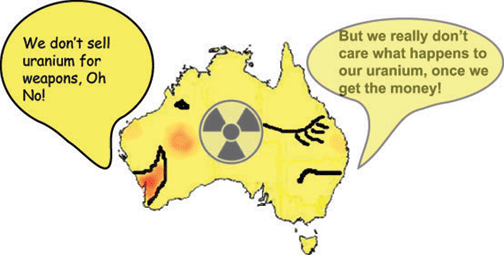
Australia has uranium export agreements with all of the ‘declared’ nuclear weapons states, all of them breaching their disarmament obligations under the Nuclear Non-Proliferation Treaty; countries with a history of weapons-related research based on their civil nuclear programs; countries that have not ratified the Comprehensive Test Ban Treaty; countries expanding their nuclear weapons capabilities; and undemocratic, secretive states with appalling human rights records.
Australia’s uranium export agreements with Russia and Ukraine were much of a muchness: federal parliament’s treaties committee issued strong warnings about the inadequacy of nuclear safeguards, the government of the day ignored those warnings, and no-one has any idea about the security or whereabouts of Australian uranium and its by-products in Russia or Ukraine.
Australian governments, and uranium companies operating in Australia, also contribute to global nuclear risks by exporting uranium to countries with lax safety standards and inadequate nuclear regulation. The most dramatic illustration of that problem is the fact that Australian uranium was in the poorly-managed, poorly-regulated Fukushima reactors during the explosions, meltdowns and fires in March 2011.
Ukraine provides another example. Even before the Russian invasion, Ukraine’s nuclear industry was corrupt, regulation was inadequate, and nuclear security measures left much room for improvement.
Australia also contributes to global nuclear risks because of the bipartisan support for the US alliance and ‘extended nuclear deterrence’. As a result, Australia routinely undermines global nuclear non-proliferation and disarmament initiatives. A case in point is Australia’s efforts to undermine the UN’s Treaty on the Prohibition of Nuclear Weapons, and the government’s refusal to sign or ratify the treaty.
And the Australian government’s pursuit of submarines powered by weapons-useable, highly-enriched uranium undermines global non-proliferation efforts. If it’s okay for Australia’s military to have access to weapons-useable nuclear material, then it’s okay for the world’s other 190-or-so countries to have access to weapons-useable nuclear material. What could possibly go wrong?
Detailed information on nuclear threats resulting from Russia’s invasion of Ukraine is posted at https://nuclear.foe.org.au/ukraine/
1 This month
17 October, Free Public Talk on Nuclear Issues in South Australia
David Noonan will speak on public interest concerns over the new Roxby Downs Indenture Act 2026 on BHP copper-uranium mining and ore processing in SA, and on how AUKUS may face SA with a High-Level nuclear waste agenda.
Dr Jim Green will discuss international developments in the field of nuclear power including ‘small modular reactors’ and Generation 4 ‘advanced’ nuclear reactor concepts.


Help Aunty Sue Protect Her Land and Sacred Sites From Destructive Rocket Testing.
.

Australians deserve the truth
about
AUKUS – https://aukuspublicinquiry.com/

PETITION – To: Prime Minister Anthony Albanese and the Australian Labor Government

of the week – Australians for War Powers Reform (AWPR)
To see nuclear-related stories in greater depth and intensity

