Tony Abbott’s Aboriginal stooge Warren Mundine wastes no time in pushing Abbott’s agenda
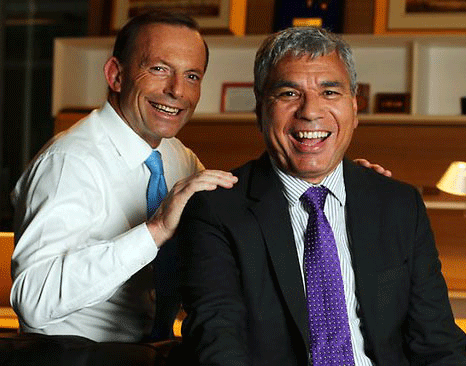 Aboriginal adviser Warren Mundines hits out at green campaigner Geoffrey Cousins October 4, 2013 Dan HarrisonHealth and Indigenous Affairs Correspondent Tony Abbott’s chief adviser on indigenous affairs has taken a swipe at businessman and environmentalist Geoffrey Cousins over his campaign against a gas hub at James Price Point in the Kimberley, suggesting he ”pull a bit of money out of his own pocket” to compensate Aboriginal people who will miss out on a $1.5 billion benefits package…….In an interview with Fairfax Media, Warren Mundine, the chairman of Mr Abbott’s advisory council on indigenous affairs, lashed Mr Cousins for his role in opposing the James Price Point development……
Mr Cousins said Mr Mundine was misguided, and he had not opposed the gas project but had argued James Price Point was the wrong location. He said processing the gas offshore would make the project even more profitable for Woodside and there was no reason why the company should not pay the promised benefits. http://www.smh.com.au/federal-politics/political-news/aboriginal-adviser-warren-mundines-hits-out-at-green-campaigner-geoffrey-cousins-20131003-2uxg1.html#ixzz2gmwfZi94
Business analysts downgrade Paladin Energy’s uranium operations
Translating business language – “outperform” – means good to invest. “Sector Perform” mean s not so good
Outperform. The stock’s total return is projected to exceed the average return of the industry (or its sector or its peers). This means the stock will perform better than the competition and is likely rated a “Buy”.
Sector Perform). The stock is expected to perform in line with the average return of the market or sector or its peers. Similar to a “Hold” or a “Neutral” rating.
 Paladin Energy Limited Downgraded to Sector Perform at RBC Capital (PDN) North fork vue.com October 2nd, 2013 Paladin Energy Limited (ASX:PDN) was downgraded by investment analysts at RBC Capital from an “outperform” rating to a “sector perform” rating in a note issued to investors on Wednesday, American Banking News reports. They currently have a A$0.80 ($0.75) price target on the stock……..
A number of other analysts have also recently weighed in on PDN. Analysts at TD Securities cut their price target on shares of Paladin Energy Limited (ASX:PDN) from A$0.90 ($0.84) to A$0.65 ($0.61) in a research note to investors on Friday, August 30th. They now have a “hold” rating on the stock. Separately, analysts at BMO Capital Markets cut their price target on shares of Paladin Energy Limited (ASX:PDN) from A$0.80 ($0.75) to A$0.60 ($0.56) in a research note to investors on Friday, August 30th. Finally, analysts at Raymond James downgraded shares of Paladin Energy Limited (ASX:PDN) from an “outperform” rating to a “market perform” rating in a research note to investors on Monday, August 5th. Three equities research analysts have rated the stock with a hold rating and one has issued a buy rating to the stock. The stock presently has an average rating of “Hold” and a consensus price target of A$0.96 ($0.90).
Paladin Energy Ltd (ASX:PDN) is a uranium production company with projects in Australia and two operating mines in Africa. http://www.northforkvue.com/finance/10712/paladin-energy-limited-downgraded-to-sector-perform-at-rbc-capital-pdn/
Paladin Energy cuts costs as uranium prices remain down the drain
 Paladin cuts top-echelon base salaries, overall spending amid low uranium price TIMES COLONIST OCTOBER 2, 2013 PERTH, Australia – Paladin Energy Ltd (TSX:PDN) is cutting the base salaries of its board and management by 10 per cent as part of cost-saving measures due to low spot prices for uranium — its main commodity.
In total, the miner — which lists its shares on the Toronto and Australian stock markets — is aiming to reduce cash costs for its 2014 financial year by US$23 million.
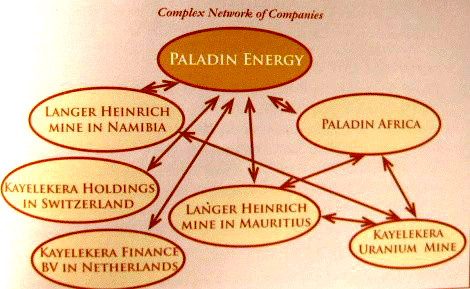
The cuts include a $10.8-million reduction in spending on overhead and exploration and a US$12.4-million reduction in discretionary capital spending at two mines in southern Africa….The Langer Heinrich mine in central Namibia will see its capital spending cut by US$10 million compared with the 2013 financial year while a further $2 million will be cut from the capital budget for the Kayelekera mine in Malawi. http://www.timescolonist.com/business/paladin-cuts-top-echelon-base-salaries-overall-spending-amid-low-uranium-price-1.645930
Hypocrisy of Australian Government’s opposition to nuclear disarmament
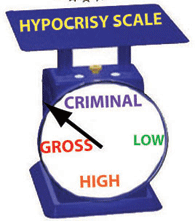 ”These declassified exchanges between government officials clearly demonstrate that Australia’s talk of nuclear disarmament has been insincere and hollow.”
Diplomats ducked push for nuclear ban in favour of defence http://www.smh.com.au/federal-politics/diplomats-ducked-push-for-nuclear-ban-in-favour-of-defence-20131001-2uqs2.html October 2, 2013 Philip Dorling The former Labor government in effect abandoned its advocacy of nuclear disarmament because it considered continued reliance on ”extended nuclear deterrence” provided by the US to be an essential foundation for Australia’s defence strategy.
Australian officials are also planning to work against humanitarian organisations campaigning for a ban on nuclear weapons, according to diplomatic documents released under freedom of information.
Declassified diplomatic cables, emails and briefings show the Australian government refused to endorse an 80-nation statement delivered at this year’s non-proliferation treaty meeting in Geneva in April because it included a reference to an International Red Cross resolution highlighting ”the incalculable human suffering associated with any use of nuclear weapons”.
Australian officials considered this reference to be part of a campaign to delegitimise the possession of nuclear weapons, including by Australia’s ally the US.
How will Tony Abbott reward Rupert Murdoch for the election gift?
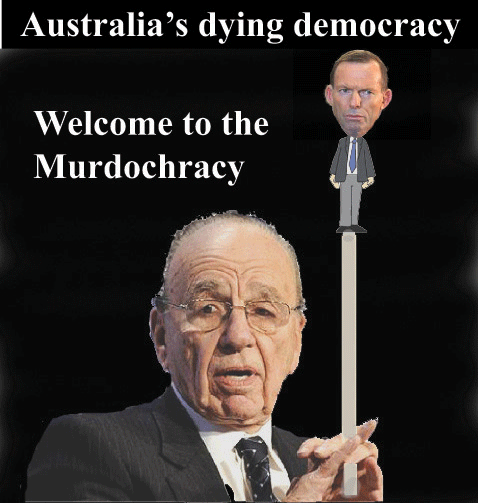 Reward and punishment: the making of media policy The Age October 2, 2013 Sally Young How will the government reward News Ltd for its wholehearted poll support? News Corp Australia (formerly News Limited) played an unusually active role during the election campaign in promoting a Tony Abbott-led Coalition government. The more cynical among us might be wondering then how long it will take for some form of quid pro quo to emerge in media policy.
……What News Corp did during the 2013 election campaign was unusual by Australian standards. We haven’t seen anything that aggressively partisan and directive since 1972 and 1975. ……hat might News Corp want from the government?
Any News Corp wish list will include ways to limit the ABC. Eighty years after the Lyons/Murdoch deals and in a new world of internet paywalls, the biggest newspaper group in the country still frets about competition from the ABC. Stopping the NBN and key recommendations from the Convergence Review can already be ticked off. But other desires may include watering down cross-media ownership rules and the anti-siphoning list that prevents Foxtel acquiring rights to televise certain sporting events, plus a crackdown on online piracy that infringes News Corp copyright.
The wish list might be larger and more ideological than mere commercial interests ………: http://www.theage.com.au/comment/reward-and-punishment-the-making-of-media-policy-20131001-2uqnz.html#ixzz2gbEFPL21
Australian Commonwealth keeping laws over nuclear and other environmental matters
 Commonwealth will keep environmental power over state projects , The Conversation, 30 September 2013,
 The Commonwealth will not delegate to the states decisions under its national environmental laws in which the states have a “conflict of interest”. Federal Environment Minister Greg Hunt confirmed this significant commitment in an interview on ABC radio last Thursday.
The Coalition’s pre-election Policy for Resources and Energy promised to deliver a “one-stop-shop” for environmental approvals. The policy read like a complete handover of all Commonwealth decisions to the states.
But the Minister qualified the Coalition’s policy before the election when he was the Coalition’s environment spokesperson. He said in an interview reported in theWeekend Australian in May 2013 that: “some matters would be reserved where the Commonwealth would be the one-stop-shop but overwhelmingly it would be the states.”
In his recent radio interview, the Minister confirmed that the Commonwealth will retain control over decisions involving offshore Commonwealth waters, nuclear actions, and projects for which state governments are “likely to have a significant conflict of interest” as the proponent.
This alleviates the most significant concern about the one-stop-shop policy: where the state is the proponent they’ll have difficulty making an independent assessment…….
Complications of water trigger
The new water trigger created under the EPBC Act also complicates the one-stop-shop policy. Now-retired MP, Tony Windsor, who championed the trigger, managed to include alegislative prohibition on it being delegated to state governments.
Just how big a complication this creates is evident in Greg Hunt’s recent announcement that 47 coal seam gas and mining projects currently being assessed will need to consider the water trigger. All in all, the “one-stop-shop” policy looks like creating the patchwork regulatory regime that the Gillard Government ultimately decided not to pursue.
Martin Ferguson – from Minister for Energy to Fossil Fuel Lobbyist?
 Ferguson’s resources posting mocks lobbying code of conduct – 1 Oct 13, Australian Greens Leader Senator Christine Milne says Martin Ferguson’s appointment as group executive of natural resources for Seven Group Holdings and as chair to a petroleum industry advisory board makes a mockery of the code of conduct which prevents former Ministers engaging in lobbying activities relating to any matter that they had official dealings in.
“The whole point of the code of conduct is to separate former Ministers from the industries they have been in direct contact with,” Senator Milne said.
‘It’s hard to see how a former Resources Minister going to work in the resources wing of Seven doesn’t make a complete mockery of the code.
“Mr Ferguson is an advocate of the fossil fuel industry. He’s on the exact same page as Ian Macfarlane when it comes to removing any kind of barrier to coal seam gas and resource extraction.
“Just today Mr Ferguson is reported to have urged NSW and Victoria to follow the lead of SA, WA, Queensland and the NT in encouraging gas development. He is also reported to have said the Santos project at Pilliga and the AGL project must be allowed to proceed.
“Mr Ferguson says he is conscious of the code, but in the same breath says he wants to build community support for gas and encourage development.
“The Australian Greens will be watching very closely to make sure former Minister Ferguson does not breach his responsibilities under the code.”
Community owned energy – the success story of Hepburn Wind farm, Victoria

”We’ve developed a model for community wind and a model for community solar energy,” she explains. ”There are about 70 different groups [in] Australia interested in developing … projects.”
Hepburn co-op sailing with the wind September 29, 2013 Michael Green There’s lots of energy behind locally owned wind power. http://theage.domain.com.au/real-estate-news/hepburn-coop-sailing-with-the-wind-20130928-2ula1.html Late last summer, Melbourne artist Ghostpatrol spent a week manoeuvring a crane in a paddock in Leonards Hill. With a small team, he painted a huge image of a girl dressed in green on one of the two wind turbines that comprise the Hepburn Wind farm, near Daylesford.
The artists camped under the turbine. They had to rise early to paint before the wind picked up, and for good reason: the girl’s name – and the turbine’s, too – is Gale. .The community-owned wind farm has now been operating for more than two years. It has produced more than 22 million kilowatt-hours of renewable energy, which more than matches the amount used by households in Daylesford and Hepburn.
Taryn Lane, Hepburn Wind’s community officer, conducts regular tours for school groups and university students. ”We’re the closest wind farm to Melbourne,” she says. ”We believe we’ve got a big role to play in helping to demystify wind power.”
Giving Gale a personality has helped with that, and so, too, will a new sign on the road at the front of the wind farm, which will click over with every kilowatt-hour the turbines produce. ”It will address the myth that wind energy is unreliable. Although it’s intermittent, it is really predictable,” she says. As well as electricity, the turbines generate money for the community. So far, more than three-dozen projects – from solar streetlights to public seating – have received a total of $72,000. Continue reading
Western Australia’s Mumbida Wind Farm officially opened
The WA Water Corporation will purchase 100 percent of the wind farm’s output for its Southern Seawater Desalination Plant near Binningup. That plant is also powered by the 10 megawatt Greenough River Solar Farm – Australia’s first utility-scale solar farm.
“In a typical year electricity production from the wind farm will be equivalent to the electricity consumption of 35,000 homes and will displace 200,000 tonnes of greenhouse gas emissions,” says Verve Energy.
The Mumbida Wind Farm has been designed to be expanded to 85MW in the future.
All Systems Go For Mumbida Wind Farm http://www.energymatters.com.au/index.php?main_page=news_article&article_id=3964 1 Oct 13 The 55MW Mumbida Wind Farm in Western Australia has been officially opened. A joint venture of Verve Energy and Infrastructure Capital Group (ICG), the facility is located on farmland situated approximately 40km southeast of Geraldton in the mid-west of Western Australia. Continue reading
Don’t let the Australian government lose oversight of the NATIONALLY important (and financially failing) uranium industry
 Uranium mining and export not a piece of yellow cake http://www.couriermail.com.au/news/opinion/opinion-uranium-mining-and-export-not-a-piece-of-yellow-cake/story-fnihsr9v-1226729513911 DAVE SWEENEY THE COURIER-MAIL SEPTEMBER 30, 2013
THIS week the Australian Uranium Association and other nuclear industry hopefuls will head to western Queensland for the Mining the Isa conference. Mt Isa is no stranger to mining but the region – and Queensland – would be well advised to treat the claims of the uranium sector with caution.
Globally the nuclear industry is under intense political, regulatory and community pressure since the Fukushima meltdown, a continuing nuclear crisis directly linked to Australia’s contested and contaminating uranium industry.
Recently the Newman Government released an “action plan” that seeks to open the door to uranium mining in Queensland but the LNP’s uranium road map is deeply flawed and in conflict with federal policy, global markets and community expectations. A key plank of the LNP’s plan is to have “all uranium mining proposals in Queensland assessed and approved by the state government”. Currently uranium mining and wider nuclear issues remain the clear responsibility of the federal government and this is as it should be.
Uranium mining is an issue of national interest and importance with extensive risks and long term impacts and is rightly a matter for the active consideration of the national government.
State governments, mining companies and the Australian Uranium Association, have long dreamt of the power to tick off on a new uranium mine being transferred to state governments in the hope that this would removing key checks and balances and speed up approvals. Continue reading
The impact of climate change on Australia
Australia has ‘much to lose’ from climate change SMH, September 28, 2013 Nick Miller and Nicole Hasham Australia has much to lose if climate change continues unabated, the head of a new review of climate science has warned.
Dr Qin Dahe, a glaciologist and respected Chinese academician, was co-chair of the working group that wrote the fifth major assessment of climate science for the UN’s Intergovernmental Panel on Climate Change, released on Friday. In an exclusive interview with Fairfax, he urged Australia not to think of itself as a small, unimportant player in climate change.
The Chinese government is very aware of the risks of a more extreme monsoon climate on its food supply, the economy and society.“Even if the climate changes slightly that would lead to very catastrophic consequences to China,” he said. “That is why the Chinese government attaches great importance to climate change, including its physical science basis.”
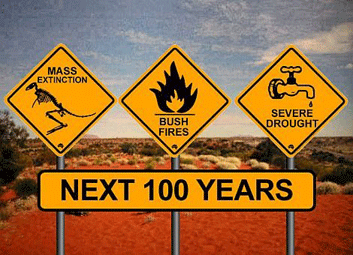
Australia, though smaller in population, has a land mass comparable to China and its population is concentrated along coastlines – “sea level rises pose a hazardous impact to cities such as Melbourne, Sydney and Brisbane,” he said. Climate change could disrupt farming. And the frequency of bushfires is indirectly linked to climate change…… http://www.smh.com.au/environment/climate-change/australia-has-much-to-lose-from-climate-change-20130928-2ukez.html#ixzz2gPQPMyYk
Visy group seeks funding grant for waste to energy plan, but will proceed anyway
Visy Group backs waste plan as funding flees http://www.theaustralian.com.au/business/companies/visy-group-backs-waste-plan-as-funding-flees/story-fn91v9q3-1226724734376 DAMON KITNEY SEPTEMBER 23, 2013
THE Pratt family’s Visy Group will not rule out proceeding with a revolutionary $300 million project to turn household garbage into energy that would generate 3000 jobs across the economy, despite federal government moves to slash funding for clean energy projects.
The government last week scrapped the Climate Commission and has previously indicated it wants to wind up the $10 billion Clean Energy Finance Corporation created by Labor to fund renewable energy projects that would otherwise struggle to get commercial backing.
Visy is seeking $100m in government funding for the $200m waste-to-energy plant from the Australian Renewable Energy Agency, or ARENA, the independent statutory body established to provide financing assistance for projects that strengthen renewable energy and energy efficiency technologies. Continue reading
Coverup of the brutal history of the taking of Aboriginal land
Frontier atrocities against Australian Indigenous people were appalling. Frontier conflict is not pleasant at the best of times, but what happened in Australia has been covered up for too long. I leave you with the words of Henry Reynolds (2006) when summing up attitudes towards frontier conflict – and conflict it was – real, bloodthirsty, brutal – a battlefield and a war, waged almost silently, and with little record of it.
It can be found in almost every type of document – official reports both public and confidential, newspapers, letters, reminiscences. Settlers often counted black bodies either in anger or in anguish; members of punitive expeditions confessed to their participation in a spirit of bravado or contrition. Later observers came across bones and skulls; burnt, buried or hidden and occasionally collected and put proudly on display (Reynolds 2006: 127).
Battlefield Australia : Frontier Conflict in Early Australian Settlement by Sue Carter : HeritageDaily , September 28, 2013 It has been estimated that the first people arrived in Australia possibly around 45,000 years ago and from that time, until the settlement of Europeans on the eastern coast, the Australian Aborigines had been turning space into place for much of that time.
It is equally quite easily demonstrated that Indigenous
people were frequently massacred indiscriminately
and with impunity in Colonial Queensland and
that their remains were treated with disrespect,
if not outright contempt (Ørsted-Jensen 2011: 169)
They viewed their lives as being part of an overall design where everything had a right to live, they carved their position nestled in the landscape, and viewed their lives within it as part of a design in which Country was seen as place. Everything within the Indigenous cultural paradigm was multidimensional and people were attached emotionally, psychologically and metaphysically to the land they inhabited (Bird 1996). They sang songs regarding the history and birth of their part of Country, painted and recited stories which were passed down through generation after generation. ……..
The settlement of the continent included invisible boundaries that were known by the various tribes. Each had their own district where they belonged through spiritual and ancestral bonds and there was interaction between neighbouring tribes where their boundaries overlapped in many complex ways, through spirituality, kinship ties and interaction. A major aspect of the inter-tribal and family relationships was that of sharing; no one owned anything – it belonged to all within the group (Reynolds 2006). They lived with and on the land – protecting, nurturing and preserving – for thousands of years. Continue reading
Australia’s anthropologists under fire, because of their support for Aboriginal Land Rights
Throughout the two centuries of colonisation, Aboriginal people, though vastly outnumbered, have done their best to resist European dominance: they fought to defend their land and, even under the enforced control of settlers, missionaries and the state, continued to lead subversive ‘double lives’ in which they tried to maintain their own cultural practices. They have struggled for greater social, economic and political equality, and they have tried desperately to reclaim their land.
Australia is one part of the world in which anthropologists have been able to make themselves genuinely useful to indigenous groups. For many decades now, they have been instrumental in assisting Aboriginal people in recording cultural knowledge and using this to support their claims to land and resources and their efforts to regain self-determination.
The latest development in Australia is for those opposed to land claims to spend very large sums of money suing anthropologists for millions of dollars,
Snippet #40: AUSTRALIA’S ABORIGINAL MINORITY – DISPOSSESSION AND LAND RIGHTS http://snippetysnippet.wordpress.com/2013/09/26/aboriginal-minority-snippet/ 26 Sept 13, “The Aboriginal minority in Australia represents about 2 per cent of the population as a whole. Colonisation of the country by Europeans has taken place over 200 years, with the major dispossession of the indigenous people occurring primarily in the first century of colonisation, but with some areas not fully ‘settled’ until early in the twentieth century. In some regions well into that century, the colonisation of land was accompanied by considerable violence and sometimes by outright genocide. Continue reading
‘Pandora’s Promise’ – film that is stinking its way around Australia
 The nuclear advertising film ‘ Pandora’s Promise’ will be showing around Australia, and in Edinburgh and London in the next couple of weeks. It is largely funded by people from the pro nuclear Breakthrough Institute, including people like Bill Gates, who has his own nuclear power company Terra Power. It is directed by passionate nuclear enthusiast, Robert Stone, who does Q and A afterwards, and over-talks any critical questioners.
Weaknesses of this film include the way that it:
- mocks anti nuclear opinions as a bunch extremists and zealots. It makes no effort to portray any sensible opposing opinion.
- minimises the health effects of ionising radaiation with downright untruths, for instance, telling us only that Chernobyl killed 56 people. It leaves out that a United Nations World Health Organization agency predicts 16,000 more will die from Chernobyl cancers and that the European Environment Agency estimates 34,000 more. It omits that non-fatal thyroid cancer struck another 6,000, mostly children
- does not mention the crippling economics that is now closing nuclear plants in USA (Florida, Wisconsin and California), nor the imperative for tax-payer subsidy
- does not mention insurance: the nuclear industry, alone among industries is exempt from risk through USA’s Price Anderson Act, as well as every home owner’s insurance policy stating that this policy does not compensate you for any radiation damage from a nuclear power plant.
- avoids the economics of Small Nuclear reactors (SMRs) Even under the best of circumstances, there will be no SMR prototype for as long as a decade or more. There are serious questions over the economics of mass producing these, over their safety, and the huge costs of maintaining security over thousands of little nuclear reactors scattered around the land. None of this is discussed in the film.
- promotes Integral Fast Reactors (IFRs) – fast breeder reactors. but doesn’t mention the past failure of these, in USA , France (Super Phoenix) Japan (Monju), and their enormous cost.
- Dishonestly minimises the nuclear waste problems of IFR’s. Film does not explain that the final wastes, while smaller in volume, are far more radioactive and dangerous than existing nuclear wastes, and therefore require the same amount of storage space and security.
1 This month
17 October, Free Public Talk on Nuclear Issues in South Australia
David Noonan will speak on public interest concerns over the new Roxby Downs Indenture Act 2026 on BHP copper-uranium mining and ore processing in SA, and on how AUKUS may face SA with a High-Level nuclear waste agenda.
Dr Jim Green will discuss international developments in the field of nuclear power including ‘small modular reactors’ and Generation 4 ‘advanced’ nuclear reactor concepts.


Help Aunty Sue Protect Her Land and Sacred Sites From Destructive Rocket Testing.
.

Australians deserve the truth
about
AUKUS – https://aukuspublicinquiry.com/

PETITION – To: Prime Minister Anthony Albanese and the Australian Labor Government

of the week – Australians for War Powers Reform (AWPR)
To see nuclear-related stories in greater depth and intensity

