The end of the line for Australian uranium company Paladin Energy?
 the fact remains that it has not had a profitable annual result since commencing operations. Our modelling forecasts continued negative cash flow and the company running out of cash in early 2014 and consequently [being] unable to service its substantial debt position.
Uranium price slumps, Paladin Energy in trouble Jim Green WISE/NIRS Nuclear Monitor #768, 27 Sept 2013 ” Paladin Energy ……….Australian-based Paladin Energy operates two uranium mines in Africa − Langer Heinrich in Namibia and Kayelekera in Malawi. CEO John Borshoff told a mining conference in Western Australia in July that the uranium industry faces a number of “major problems” such as the lack of greenfields development, dwindling investment capital and the sickly uranium price.[12]
Borshoff said: “[T]he uranium industry is definitely in crisis, I believe, and is showing all the symptoms of a mid-term paralysis if this situation does not demonstrably change. How can there not be a problem when you have an effective moratorium with nearly all major companies making no commitment to greenfields development until the price gets about US$70 and it is believed it can stay above that level. And how can there not be a problem when you have a strong chance that some of the more expensive, smaller operations will be mothballed − putting more pressure on current production. … Only at this price level [US$70/ lb] − and above − can sufficient capital for new products be raised and returns on investment be justified to finally give some risk reward to the shareholder. And this appears to be a long way away.” Continue reading
Never mind the latest climate change report, the Abbott government will dismantle carbon pricing

The Climate Institute said the government should retain the current carbon laws until it can demonstrate through independent analysis that its policy can achieve emission reductions of up to 25 per cent by 2020.
The Australian Conservation Foundation said the IPCC report finds Australia could get hotter and this should be acknowledged when parliament resumes in October or November.
“In the first week of Parliament, we urge all politicians to treat climate change as a serious threat needing serious action, and not a device for cheap political point scoring,” the ACF said.
Abbott govt keen to repeal carbon tax http://www.heraldsun.com.au/news/breaking-news/abbott-govt-keen-to-repeal-carbon-tax/story-fni0xqi4-1226728812968 AAP SEPTEMBER 27, THE federal government says it will push ahead with plans to dismantle Australia’s carbon pricing mechanism despite a key report on climate change declaring it “extremely likely” that human activity was the dominant cause of global warming.
That’s the strongest statement so far from the Intergovernmental Panel on Climate Change, which said on Friday a human footprint could be found in the warming of the atmosphere and oceans, rising sea levels, melting snow and ice, and changes in some climate extremes.
Environment Minister Greg Hunt said the coalition government would go ahead with repealing the market-based carbon-pricing mechanism set up by the former Labor government despite some calls for a rethink. Continue reading
Quality evidence for Victoria- that wind farms do not damage health
 Our own Victorian Department of Health published its findings on the matter in Wind farms, sound and health in April 2013. It rules out the potential for wind farms to have damaging effects…..Wind farm infrasound is at levels well below the hearing threshold, and evidence does not support claims that inaudible sounds can have direct physiological effects. Put simply: what we can’t hear can’t harm us.
Wind farms: What we can’t hear, can’t harm http://reneweconomy.com.au/2013/wind-farms-what-we-cant-hear-cant-harm-34870 By Sarah Durrant on 27 September 2013 In a new analysis, the Australian Energy Market Operator estimates Victoria will have 4,090 MW of new wind energy capacity installed by 2020. Those who support more renewables in the energy mix will welcome the forecast, yet it may be optimistic.
Today (Friday September 27), the Victorian Civil Administration Tribunal (VCAT) will resume the decision making process on the Cherry Tree Range wind farm proposed for central Victoria. Despite meeting the world’s strictest wind farm planning laws and laying outside the multitude of no-go zones imposed by the Baillieu government, the project could be thwarted. By what? The self interest and pseudo-science trumpeted by anti-wind farm groups.
The fate of the Cherry Tree Range wind farm is a test case for wind energy in Victoria. If it’s approved then there’s hope Victoria will achieve the high-penetration of wind energy AEMO predict by the end of the decade.
VCAT adjourned with an interim determination in April, finding the permit application was in accordance with all the planning considerations that the Mitchell Shire had contested. However the Tribunal decided it would await the outcome of an EPA SA study into alleged noise complaints at Waterloo wind farm, and also a newreview by the National Health and Medical Research Council.
VCAT left us to ponder the question: whether there is a causal link between sound pressure emissions from wind turbines and adverse health effects of a physiological nature.
BEAM Mitchell Environment Group – a local community group of which I’m a member – has taken a look at some of the most recent Australia/NZ sourced evidence to demonstrate that our support for the Cherry Tree project is backed up by quality evidence. Continue reading
The uranium industry in deep trouble
The industry hopes that reactor restarts in Japan will improve the situation − but restarts will be slow and in many cases strongly contested. The industry hopes that new build in China will improve the situation − but pre-Fukushima nuclear growth projections have been sharply reduced and China now plans to approve a “small number” of new reactors projects each year.
Uranium price slumps, Paladin Energy in trouble Jim Green WISE/NIRS Nuclear Monitor #768, 27 Sept 2013 The spot uranium price fell to US$34.50 / lb U3O8 in late July, a price not seen since December 2005 during the upswing of a spectacular price bubble which peaked in June 2007 at US$138 / lb. The 12% price slump in July was the biggest monthly loss since March 2011. Since September 2, the spot price has been still lower, at US$34.00. Those prices are just over half the spot price of US$66.50 / lb on 11 March 2011, the first day of the triple-disaster in north-east Japan.[1]
The long-term contract price has been reasonably stable in recent months at US$57 / lb. At that price, the value of annual global uranium requirements for power reactors is around US$10 billion.
FNArena wrote on September 17: “The issue of low uranium prices discouraging new supply is not just one of the spot price itself but one of the marginal cost of new supply. Producers suggested to Ux that the average marginal cost of production of operating mines is around where the spot price is now, but the marginal cost of developing a new mine is more like US$65-70/lb. From the nuclear energy prospective, respondents rated the most significant demand-side influences as, in descending order of influence, Japanese reactor restarts, Chinese reactor build, the premature shutdown of older US reactors and the emergence of newcomer countries to nuclear energy (about equal), and the upcoming French nuclear licence renewals.”[19]
Raymond James analyst David Sadowski expects an average spot price of $40 per pound this year, $52 in 2014, and $70 in both 2015 and 2016.[2] Michael Angwin from the Australian Uranium Association expects low prices until about 2017/18, and a nasdaq.com article states that “the road to recovery for this battered commodity will be a long haul”.[3,4] Rob Atkinson, outgoing CEO of Energy Resources of Australia, says the uranium spot price is woeful, making it extremely difficult to make the case for developing a new mine, and the market will remain difficult for at least another two years.[21] Continue reading
Imagine how it feels – the dispossession of Aboriginal land
 MY LIFE: THIS LAND IS MINE / THIS LAND IS ME QAGOMA BRUCE MCLEAN 26 SEPTEMBER 2013 “………One of the most important social movements toward positive change in recent decades has been the Reconciliation Movement, which gained momentum in the wake of then prime minister Paul Keating’s 1992 ‘Redfern Address’, perhaps the most significant and stirring oration concerning Indigenous people and issues by any Australian politician. In the address he asked Australians to imagine themselves in the shoes of Aboriginal and Torres Strait Islander peoples in a particularly poignant passage:
. . . it might help us if we non-Aboriginal Australians imagined ourselves dispossessed of land we have lived on for 50 000 years — and then imagined ourselves told that it had never been ours . . . Imagine if ours was the oldest culture in the world and we were told that it was worthless. Imagine if we had resisted this settlement, suffered and died in the defence of our land, and then were told in history books that we had given up without a fight . . . Imagine if we had suffered the injustice and then were blamed for it . . . It seems to me that if we can imagine the injustice then we can imagine its opposite. And we can have justice.13…….http://blog.qag.qld.gov.au/my-life-this-land-is-mine-this-land-is-me/
Investors warming to Western Australia’s Wave Energy Project
 Wave Energy wins over wary investors CRITERION THE AUSTRALIAN SEPTEMBER 27, 2013: “……….a jack-up rig is being towed from the North West Shelf to Perth’s naval base, to put in place Carnegie’s wave-power installation at Perth’s Garden Island naval base.
The 720-kilowatt plant will be the first manifestation of Carnegie’s CETO wave technology, which employs bulbous sub-sea structures anchored to the sea floor.
With the funding, an offtake deal and pesky state approvals in place, Carnegie is winning over hitherto wary investors.
While the construction aspect is not new — it’s akin to installing an oil rig — CETO technology is novel.
Carnegie so far has sunk $70 million into the technology, $50m sourced from its 7000-odd holders (whose patience and passion exceeds that of even the Dockers’ member base).
French utility EDF has chipped in $10m and is funding a joint pilot plant at Reunion Island, where power is generated from expensive diesel.
Carnegie has drawn down only $4m of $22m of federal and WA government grants. The federal money is sourced from the Australian Renewable Energy Agency, which the Coalition has no plans to gut (unlike the Clean Energy Finance Corporation). http://www.theaustralian.com.au/business/opinion/wave-energy-wins-over-wary-investors/story-e6frg9lo-1226727885953#sthash.yuNFQiqh.dpuf
Climate action hope for Australia: the new Climate Council
 Out Of The Ashes : The Climate Council http://www.energymatters.com.au/index.php?main_page=news_article&article_id=3958 26 Sept 13 The former Climate Commissioners may have had their funding cut; but they intend continuing the battle to inform the public under a new community-funded body – The Climate Council.
The Climate Commission was established in 2011 to provide all Australians with an independent and reliable source of information about the science of climate change.
Another casualty of the Abbott government’s seeming war on renewable energy and the environment, the Climate Commission was abolished last Thursday. More than two years of important work was ended in a phone call made by the new Environment Minister, Greg Hunt to the Commission’s head; Professor Tim Flannery – who was also Australian of the Year in 2007.
But a phoenix has arisen from the ashes after an outpouring of support and offers of donations from the public to maintain the crucial work.
An Update from the Climate Council
“People want us to keep going, they told me they need the information that we provide,” said Professor Flannery. “Without an informed public, we’re unlikely to make the decisions that will safeguard our future against truly dangerous climate change. So we’re going to keep going.”
All the former Climate Commissioners are supporting the Climate Council initiative – Professor Flannery, Professor Will Steffen, Roger Beale, Gerry Hueston, Professor Lesley Hughes and Professor Veena Sahajwalla.
“Information is the currency of democracy, and Australians deserve to have independent information on the state of our climate,” states the Climate Council’s web site.
The body will be “fiercely independent and apolitical” and will continue to provide journalists and the public with authoritative reports; starting with the soon to be released international climate science update. The Climate Council has already received seed funding and is seeking additional funding from the public. Donations can be made securely via this page.
Tony Abbott recruiting his new unelected Indigenous Council
Abbott recruiting for indigenous council http://www.sbs.com.au/news/article/2013/09/25/abbott-recruiting-indigenous-council LISA MARTIN -September 25, 2013, Prime Minister Tony Abbott’s new indigenous advisory council will complete a review of indigenous spending by early next year.
Mr Abbott has begun recruiting people for the council, which will oversee a shake up of indigenous affairs.Warren Mundine on Wednesday officially signed on to be the council’s chairman. He said his preference was for the council to have seven or eight members.
The membership will be finalised before the end of October.
“It’s not a representative committee … it’s a council of experts, indigenous and non-indigenous, who will be working in this space to get the socio-economic outcomes for indigenous people,” Mr Mundine told AAP.
“It will be based on expertise, but the majority will be indigenous people on the council.” Continue reading
Rupert Murdoch’s newspaper The Australian misrepresented top scientist on climate change
 Top physicist accuses The Australian newspaper of misrepresenting his climate change views Graham Readfearn 24 Sept 13 IN a column this week in The Australian, writer Gary Johns tried to argue that the science of human-caused climate change was “contentious”, that climate change might not be that bad and that we shouldn’t bother to cut down on emissions.
The Australian newspaper has a record for favouring climate science denialism and contrarianism above genuine expertise.
Columns and coverage like this come along in the pages of the Rupert Murdoch-owned press with such regularity that you might think [blush] that they’ve got some kind of an agenda. Honestly, you could really think that.
In the latest column – “Let’s get realistic about reducing carbon emissions” – Johns writes approvingly of a project called the Nongovernmental Panel on Climate Change (NIPCC) while finding disparaging remarks about the United Nations Intergovernmental Panel on Climate Change.
Johns doesn’t mention that the NIPCC is run by the fossil-fuel funded Heartland Institute in the United States, which advocates free market ideology within which businesses should be allowed to do pretty much whatever they like, such as using the atmosphere as a free waste dump.
But in one section of Johns’ column, he quotes and paraphrases Professor Richard Muller, a respected American physicist who was once sceptical of human-caused climate change. As reported in The Guardian and elsewhere, a couple of years ago Muller led a team based at the University of California which analysed more than 14 million temperature readings from 44,455 measuring sites from around the world going back to the mid 18th century.
Professor Muller found the world had warmed by 1.5C in the last 50 years and that burning fossil fuels and other human industrial processes were “almost entirely” the cause. Continue reading
Only one Liberal Member of Parliament is clearly in favour of wind energy
 Pollie Watch: Where do Coalition MPs stand on wind farms? Crikey September 24, 2013 by Leigh Ewbank Crikey has conducted a survey of sitting Coalition MPs on the issue of wind energy. The news service has found just one pro-wind energy MP in the government’s ranks, Leichhardt’s Warren Entsch. Reporter Andrew Crook notes: “It seems like Entsch is to wind as Julie Bishop is to women among senior Coalition ranks.”
So what else did Crikey find? There are a few Coalition MPs ‘on the fence’, some who ‘show promise’, and several retired pro-wind energy Liberals:
In favour …
Warren Entsch
Entsch has gone in to bat for a wind farm proposed in his electorate. According to The Tablelander last month, he said the following on the Mt Emerald development: “The bottom line is Mt Emerald would bring a lot to this region in terms of attracting investment, stabilising escalating power prices and raising our profile as a leader in sustainable energy solutions … It is time to start dealing in facts and the fact is that wind generated power is a hugely viable, largely untapped resource in this area that would provide us with a stable, viable energy solution.”
The Tablelander noted the area has the second highest wind resource in Australia: “Our electricity prices have doubled in the past five years and this figure will only continue to rise unless we look at reliable, practical and sensible power sources like wind, water and solar. It’s not rocket science — locally generated power will stabilise costs, if not drive them down.” Mr Entsch said claims noise from wind farms caused health problems were ‘‘unsubstantiated”.
On the fence …
Greg Hunt…….
Ian Macfarlane…….
If the Abbott government fails to adopt a pro-wind energy stance, it risks being out-of-step with mainstream community views.
All of the available public polling shows that three quarters of the community support more wind farms. The clean energy source is even highly popular among Coalition voters.
Warren Entsch and Malcolm Turnbull have shown political leadership on wind energy. Friends of the Earth hopes the Abbott government follow the lead of these sitting members.
http://yes2renewables.org/2013/09/24/pollie-watch-where-do-coalition-mps-stand-on-wind-farms/
At least Queensland government is now TALKING about renewable energy
 Renewable Energy Options Discussed http://www.mysunshinecoast.com.au/articles/article-display/renewable-energy-options-discussed,31608#.UkN-kNJwonE
Energy Minister Mark McArdle is encouraging the development of new energy generating technologies that offer cost savings to electricity users.
Speaking today at the first annual OnSite Energy conference in Brisbane, Mr McArdle said an increasing number of solutions combining multiple technologies were entering the market.
“Emerging technologies have the potential, if implemented and managed correctly, to save electricity users money, address peak demand issues and defer the need to build network infrastructure,” he said.
“Positive outcomes can be achieved through the grouping of multiple technologies and the Newman Government supports these technologies where they are commercially viable.”
Mr McArdle said the three-day OnSite Energy conference would raise awareness of developing renewable energy sources. Continue reading
ERA flounders with uranium losses, cost-cutting and the prospect of financial collapse
 ERA’s cost-cutting continues while uranium prices flounder The Motley Fool By Darryl Daté-Shappard – September 23, 2013 “…..The company, which is 68% owned by Rio Tinto (ASX: RIO), just recently reported a $53.55 million loss for its half-year result, with its expenses approximately the same as its $144.3 million revenue. A larger than average $129 million depreciation charge added to the net loss, its third in three years since 2010.
Its Ranger 3 Deeps mine project was discussed, and the company said that the pre-feasibility study was on schedule and on budget. Assuming all necessary approvals are granted, the commencement of production should take place in late 2015. This underground project is adjacent to its open pit mine site, located in the Kakadu National Park. The open pit mine is nearing its end, and so are mining approvals for it, so the underground project is of great importance to continue the company’s activities in this area.
This month the newly installed Brine Concentrator began operation to clean up water used in production. It will be able to process up to 1.8 billion litres per year, rehabilitating the site’s water to be safe near the heritage-listed national park. The water facilities cost $20 million annually to operate.
A total cumulative $102 million out of $150 million in projected savings has been achieved since 2011. However, will this lead to a profit in the near-term if the company in the end is producing less than before, and uranium prices are still around $30-$40/lb?
The overseas uranium market still has not recovered since the Japanese nuclear disaster in Fukushima, and downward price pressure is coming from the development of cheap natural gas within the US, seen as an alternative power generation fuel with less pollutants than coal, and no need for specialised containment and storage that nuclear energy requires……..http://www.fool.com.au/2013/09/23/eras-cost-cutting-continues-while-uranium-prices-flounder/
Trans Pacific Partnership could override Australian law, but will Abbott resist this?
The progressive think tank, the Australia Institute, put out a statement within hours of the release of the Coalition Trade policy, attacking the Coalition’s “hidden agenda” which would see “health and the environment sacrificed for free trade”.
It highlights the threat that ISDS provisions pose to pharmaceutical, tobacco and environmental legislation in particular.
“The Howard Government successfully resisted pressure from the US Government but now the Coalition has signalled its intention to sell out Australian sovereignty.”
 provisions of the Trans-Pacific partnership are increasingly encountering resistance within other negotiating nations, which are concerned that the American agenda is more about protecting the interests, particularly the intellectual-property interests, of its big corporations than it is about free trade
Abbott: Open For Business — And Multinational Lawsuits The Global Mail By Mike Seccombe September 20, 2013 ………You’re probably familiar with the fact that a group of tobacco companies including Philip Morris brought a case to the Australian High Court, on the basis that the government had effectively stolen its intellectual property by enforcing plain packaging. It got lots of media coverage.
Less publicised is the fact that having failed in the High Court, the company now is pursuing the matter via a bilateral trade agreement signed between Australia and Hong Kong in the early 1990s, which includes ISDS provisions.
The contempt such an action shows for Australian legal process and sovereignty, says Patricia Ranald, is plain. “They’re saying: ‘We’re going to ignore the High Court, when it says we’re not entitled to compensation; we’re going to go off and find an obscure trade agreement to sue you under’.” Continue reading
Australia’s Climate Commission is dead. Long live Australia’s Climate Council!
 The decision to axe the commission has delighted climate sceptic opponents of Flannery but has horrified several academics, who have raised concerns that the government isn’t interested in providing the public with independent, credible information on climate change.
Axed Climate Commission to be resurrected as Climate Council Tim Flannery says new body will be privately funded thanks to ‘overwhelming’ support of Australian public Oliver Milman theguardian.com, Tuesday 24 September 2013 The Climate Commission has been resurrected just days after its highly controversial axing by the Coalition government as a new, privately funded body called the Climate Council, after being “overwhelmed” by support from the Australian public.
Tim Flannery, outgoing head of the commission, told Guardian Australiathat he and the other commissioners – who include the climate scientist Will Steffen and the former BP executive Gerry Hueston – had been “deluged” by emails and calls from people pledging financial support. Continue reading
Forbes, New South Wales, – concentrated solar power project goes ahead
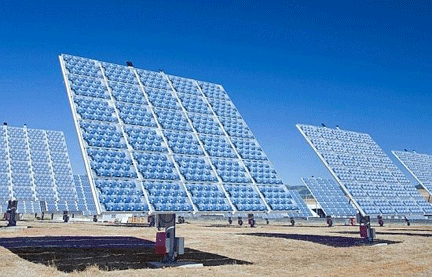 Australian Concentrating Solar Thermal Trial To Proceed http://www.energymatters.com.au/index.php?main_page=news_article&article_id=3954 24 Sept 13 The first Australian trial of concentrating solar thermal (CST) technology has been given the green light by Forbes Shire Council. ABC News states Vast Solar aim to have the demonstration 1.2MWth solar array with high temperature receivers and integrated thermal storage operating by March next year.
“This project will provide Vast Solar with data on system performance that will support the continued development and commercialisation of CST technology that can break the $100/MWh barrier,” says James Fisher, Principal Investigator and Chief Technology Officer of Vast Solar. Continue reading
1 This month
17 October, Free Public Talk on Nuclear Issues in South Australia
David Noonan will speak on public interest concerns over the new Roxby Downs Indenture Act 2026 on BHP copper-uranium mining and ore processing in SA, and on how AUKUS may face SA with a High-Level nuclear waste agenda.
Dr Jim Green will discuss international developments in the field of nuclear power including ‘small modular reactors’ and Generation 4 ‘advanced’ nuclear reactor concepts.


Help Aunty Sue Protect Her Land and Sacred Sites From Destructive Rocket Testing.
.

Australians deserve the truth
about
AUKUS – https://aukuspublicinquiry.com/

PETITION – To: Prime Minister Anthony Albanese and the Australian Labor Government

of the week – Australians for War Powers Reform (AWPR)
To see nuclear-related stories in greater depth and intensity

